Search This Blog

Thursday, September 20, 2012

The Chemicals that Made American Signaling Great

Two months before ALTO Tower closed I went out for a final round of photos on a sunny spring day and while I was there I spent some time at the satellite interlocking CP-SLOPE, which was under direct wire control from ALTO tower.  The old SLOPE tower was closed in the 1950's with a relay plant being constructed on the foundation.  However the power supply for the interlocking remained much as it was when the tower was open.  Pole line power is nothing new in my experience, however the PRR was not about to be satisfied with some dinky 440 volt wires on a telegraph pole and SLOPE was fed from ALTO through a thick bundle of signal wires to a number of vintage 1930's or 1940's "Pole Pig" at the westbound signal gantry.


 Hmmm, what's that sticker on the side of the transformer.  Let's take a closer look.


Yup, good old PCB's.  Except no substitutes when cooling a transformer.  In what could be the ultimate example of "if it ain't broke" this power supply lasted past the closing of the tower, past the formation of the Penn Central and Conrail and right up to the point that ALTO itself was closed and eliminated with those persistent organic pollutants staying stable, year in, year out.  This wasn't the only example either.  There were two more at the SLOPE relay plant.


I have asked around, but have not been able to definitively date these transformers except that they probably date from the 30's or 40's.  Help would be appreciated.

Monday, September 17, 2012

Rumors of Train Orders' Demise are Greatly Exaggerated

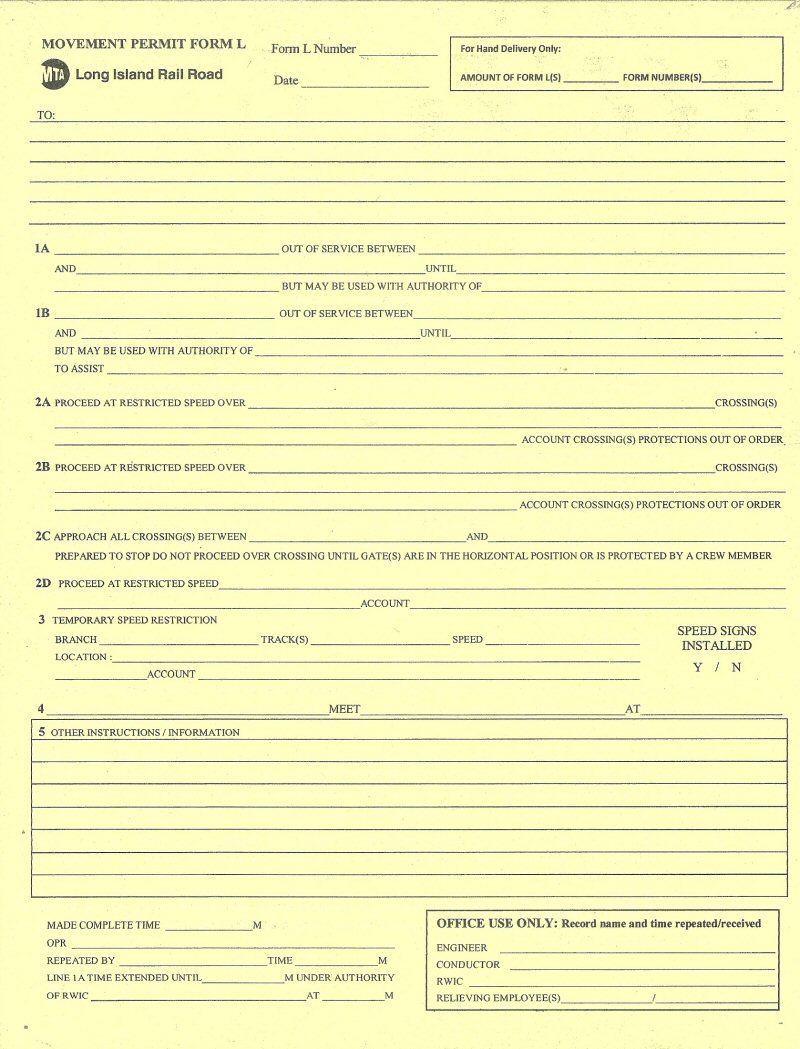
Last week it was reported that the Long Island Rail Road had "retired" its Train Order system inherited from the old PRR Standard Code rulebook.  The last Form 19 Train Order was issued on September 3rd at 11:59, removing the Form 19 from use as a train order device.  Prior to this the venerable Form 19 had only been used to deliver speed restrictions and other miscellaneous instructions with movement authorities being transferred to the new LIRR Form L.  While some had assumed this to mean that the LIRR was now using a modern Track Warrant system with paperwork similar to a NORAC Form D or MNRR Form M, the truth is that this only represented a change in paperwork.

The Form 19, seen below, was a long form train order where all the instructions were written out in long hand, on multiple copies and given to whomever it may concern.  The large block of text could confer a movement authority or seed restriction or just about anything safety related that a train needed to do.


The Form L on the other hand is broken up with those fill in the blank lines so common on track warrants and other movement permits in use across North America.  However while most of those other forms have 10 or more fill in the blank lines, the Form L only has 4, and none of them have anything to do with standard movement authority.  However there is a 5th block that contains a paragraph worth of blank lines for....hmmm...a long form, hand written block of instructions.


Upon inquiring I learned that there have been no alterations to LIRR operating practice except for the elimination of a Clearance Card C for passing a stop signal in favor of the Rule 241 verbal permission past a stop signal.  The LIRR still uses its traditional PRR manual block system with K cards, A cards and superior/inferior trains governed by timetable and, you guessed it, train orders.  So despite what you might hear, train order operation still lives on at America's oldest railroad.

Saturday, September 8, 2012

PHOTOS: METRA TOWER A-2 (Western Ave) Part 1

METRA Tower A-2, also known as Western Ave, is one of the most epic interlockings in North America.  Unlike many of the well known east coast interlockings like ZOO or UNION or JAY/HALL, Western Ave doesn't have networks of tunnels and flyovers artfully sending trains to their required destinations.  Western Ave does things the Chicago way with brute force using diamonds, diamonds and more diamonds.  Furthermore, the interlocking plans survives with an active tower and many original appliances from its heyday in contrast to many other large Chicago area interlockings which have fallen prey to resignaling and simplification in recent years.

Tower A-2 and the interlocking complex known as Western Ave is located a few miles to the west of downtown Chicago where the present day METRA Milwaukee District crosses the  METRA UP West Line. However back in the day the interlocking actually involves three railroads.  The heart of the interlocking was where the Milwaukee Road's trunk line to the North and West crossed the former Chicago Northwestern Railroad's main line to the west through Iowa.  There is where one four track main line met another four track main line at grade and the only solution was a set of diamonds.  Actually, diamonds would have been simple blessing, sort of an Englewood of the north side, as the lines cross at about 30 degree angle which required a set of 16 double slip switches and movable point diamonds to be constructed.  This is perhaps the largest such application of double slips and movable point diamonds to ever be installed in North America outside of a terminal location. 

Just when you thought it couldn't get any better the Pennsylvania Railroad got involved.  You see, the PRR didn't just have one route into Chicago.  Aside from the familiar route via Fort Wayne, passing through the Quad Draws and 21st St Tower (aka Alton Junction), the PRR operated what was known as the Panhandle Route, named after the West Virginian panhandle through which its main line passed after splitting off the usual main line at Pittsburgh.  The line continued on via Columbus, Richmond and Logansport, entering Chicago through the back door, running parallel to the B&OCT up through 75th St Junction and the Brighton Park crossing until it hit the CNW main line where it made a sharp right hand turn to curve back in toward the loop and the Chicago Union Station complex, rather ironically traveling the final miles to Chicago heading due east.  This right turn is located at Chicago's Western Avenue and is also the point where the PRR Panhandle Route would merge with the Milwaukee Road's Chicago main line.   Due to the PRR's 50% stake in the Chicago Union Station enterprise, this part of the line was equipped with position light signaling, making the junction at Western Ave a real Chimera with PRR, CNW and Milwaukee Road signals.


So let's take a quick look at Western and as you can see in this thankfully clear interlocking diagram, its layout borders on the insane.  It is similar to the interlockings at either ZOO or Janacia in function, a major sorting and junction point where two trunk lines meet on their way downtown, but like I said this one takes the brute force approach instead of something more elegant with ramps and flyovers.  The 83 lever US&S Model 14 interlocking is large, but still modest in size falling well short of at century mark at 83 total levers with 69 active.  Like I mentioned before the real hallmark of this interlocking are the doubleslip switches and movable point diamond (MPD) crossings.  Aside from the 4x4 crossing with its 7 doubleslips and 8 MPD's, as built there were two additional doupleslips for a trailing point ladder track on the CNW trunk and three additional MPD's where the Milwaukee Road track join with the PRR tracks.  All told there are 11 MPD's and 9 doubleslip switches, amounts not normally encountered of outside of terminal interlockings. 

It is also interesting to note how this interlocking was zoned.  As you can see there is the Milwaukee /CNW crossing zone and the Milwaukee/PRR junction zone.  In the PRR Zone the PRR was of course calling the shots and all of the signals were position light.  The CNW tracks of course has CNW type ssearchlight ignals and the last entrance for the Milwaukee Road was equipped with Milwaukee searchlights.  As the interlocking plant was built in 1938, all of the signals were of the most modern type (ie no semaphores) and those original signals remain in service to this day, for the most part.

At this point I wanted to mention that the photos used for the essay come from a series of my own trips to Western Ave (exterriors) and from a source at METRA (interriors).  My own trips were taken in 2007  on an inbound UP West Line train, 2009 on an inbound Milwaukee District train and 2010 on a trip to the Western Ave METRA station.  This first photo of the tower was from the 2007 set.


Monday, September 3, 2012

Signal News Updates

Two quick updates.  First the twin three track M&W CPL bridges at HULL have been replaced.  Unlike CSX I guess NS doesn't screw around with re-signaling projects.


I also identified another 5-orbital B&O CPL in the Cincinnati Area.  They are at KC Junction across the Ohio River in Kentucky where the B&O meets the old L&N main line.


Tuesday, August 21, 2012

Extinction Looms Again for the Complete CPL

Once again it appears that the Complete B&O CPL is one again headed for extinction.  These most rare of signals is the B&O style CPL with all 6 orbitals and a complete central target with all 4 lamp pairs (G,Y,R,LW).  As far as I could ever determine there only used to be 2 of these, one in Curtis, IN and the other in Laughlin Jct, PA.  The first bit the dust ~2000 when the B&O Main Line to Chicago was re-signaled in the wake of the Conrail merger.  The second then fell in 2004/5 when Glenwood interlocking was removed from service on the P&W. 

Then in 2007 a miracle occurred.  A capacity improvement project at West Baltimore triggered an upgrade of the 1992 installed westbound CPLs at CARROLL interlocking with one main track getting a plus up to 5 orbitals and another to 6 and like the coelacanth, the B&O complete CPL was back from the dead.  Unfortunately, a short 5 years later CSX abandoned all efforts to reuse any old signaling hardware, even if it was not life expired and in the case of the Capitol and Metropolitan subs had no incentive to do so as it was awash in stimulus money to upgrade the MARC commuter rail service.  The result is a brand new, modern and recently upgraded CPL signal now facing retirement and forcing the complete CPL back into extinction.  What a fucking waste of tax dollars.


As far as I can tell the next best CPL is a 5-orbital model in Hamilton, OH, although the head lacks a Lunar indication.  If anyone reading this knows of anything better let me know.


Sunday, August 5, 2012

Canadian Pacific Mystery Searchlights

A year ago I posted about the new searchlight signals being installed by the Canadian Pacific at their rebuilt Mechanicsville Yard.While the CP ultimately became rather inconsistent about its new searchlight policy it seems that there is a bit of a wrinkle to the plot.  I recent came across some photos about a new, new searchlight installation in Canada, this time with some closeups of the searchlights themselves and it confirmed something I had suspected for some time.  CP is not installing either recycled "classic' style searchlights or their modern replacement Unilens or tri-LED type searchlights.  Instead what is going in is something that looks like a classic searchlight, but has a much larger housing and the light output of an LED signal.  You can see here in this photo of the most recent instalation being put into service.


Compare them to the classic US&S H-2 units they are replacing.


I will look into this.  It would be great if modern solid state searchlight signals could finally take off and provide some much needed competition for those god damn Darth Vader signals.

Wednesday, August 1, 2012

VIDEOS: Pennsylvania Railroad Cab Signaling Demonstration

I've talked about the 4-aspect PRR Cab Signaling System before, but this time I have a really good video demonstration of how it works in practice. As you know the system uses coded track circuits with pulses of 100Hz current sent through the running rails at rates of 180, 120, 75 and 0 pulses per minute which provide the cab signals of Clear, Approach Medium, Approach and Restricting. These roughly correspond with the 4 main speeds of railroad operations, Normal, Limited, Medium and Slow. As there are about 20 signal indications displayed on wayside signals and only 4 cab signals, the cabs provide only a rough indication of what the engineer can expect, but the system is set up in such a way so that it can forestall most grossly unsafe conditions, especially when outfitted with speed control.

So what better way to demonstrate the PRR Cab Signaling System than to bring you a video taken in the cab of one of the last passenger cars purchased for use by the PRR. On June 29th, 2012 the 1967 vintage Silverliner III class EMU, along with the 1963 vintage Silverliner II class EMU made their final runs on the SEPTA Cynwyd Line service. I was take to stand in the cab and get some video of the engineer operating the train from the Cynwyd Station in towards 30th St Station in Philadelphia. The cars are equipped with a Modernized Cab Display Unit, installed during an early 1990's rehabilitation. This still display the PRR miniature position light signal indication, but also include an integrated speedometer for the speed control function as well as other lights for overspeed and brake suppression. The train starts in non-cab signal territory, but as it passed the signal at CP-JEFF (4:27) it passes a cut-in loop (4:55) and the display activates (5:00). The cab signals then begin an automatic test sequence running through each aspect before returning to the one respecting the code in the rails (6:00).

There is a slow speed switch onto the main line with a wayside signal displaying Slow Approach (6:38). This translates to a Restricting cab signal, but the cab signal only drops when the train passes the Slow Approach signal (7:03). Had the signal been displaying Stop it would drop about 1500 feet before the signal. At 7:12 the train's leading wheels pass the interlocking limits and then pick up the cab signal being fed into the block ahead of it and the cab signal upgrades to Clear. The engineer then waits for his entire train to clear the 15mph turnout. The signal remains at clear as the train enters the western limits of ZOO interlocking. As you recall ZOO is quite an expansive interlocking (less so than in years past) and is still controlled from a big US&S Model 14 machine in ZOO tower. There are several automatic signals located within ZOO's interlocking limits and as we approach the 28 automatic at Clear it drops to Approach (9:03) and then bounces up to Approach Medium (9:11). This was the result of a signal dropping to Stop at K interlocking and the old relay logic took a bit of time to figure out what to do with it as the 28 auto is the second signal in advance of the one at Stop. You can hear the delay between the signal drop and when the cab signal responds to it.

The next signal the train passes is at Approach (9:57), which causes a cab signal drop from Approach Medium to Approach (10:26), and then you hear the cab signal drop from Approach to Restricting (10:42) as we come upon the Stop signal. K interlocking used to be part of ZOO interlocking and was owned and maintained and operated by Amtrak. However Amtrak ran no trains through that part of ZOO so a few years ago Amtrak transferred that part of ZOO to SEPTA, re-signaling it and ting it into their own dispatch center. Well SEPTA has been having issues with their dispatching ever since they closed their panel type interlocking towers and set their trains to run on a system designed for rapid transit services. The dispatchers are told to use the automatic route setting almost exclusively and as a result their train routing skills are a bit rusty. In this case a heat kink was discovered on the track we were routed on and we needed to cross over to track 2 at K interlocking. The situation is discussed starting at11:19, but at 11:39 the dispatcher lines up a route down the kinked track 1 again!!! The crew calls it in and this time the signal needs to be knocked down (12:07) with a 4 minute timer run. We finally get a Medium Clear signal indication which results in an Approach Medium cab signal indication which turns to Clear when we pass the limits of K interlocking at 13:19.

Anyway, here is the video. Enjoy both the signaling and the vintage equipment on its last day of service.


As a bonus I have a second video taken in the opposite direction that still shows the cab signals, but doesn't capture the engineer very well. This is because the Silverliner III's were delivered with left hand driving positions to allow passengers to enter and exit through the front of the car when being operated as a single unit. In this video the train climbs up on a long slow ramp to a truss bridge flyover. This used to be the route of main track #4 flying over some freight tracks, but as the bridge deteriorated and freight was eliminated, main track #4 was relocated leaving only Cynwyd Line trains using it. As the train passes the reverse direction dwarf signal at 11:08 on an Approach cab signal, it leaves cab signal territory. I think automatic cab signal cutout loops do exist, but even if they do this location is not equipped with one and the conductor must place his key into a cab signal cutout box (11:15) and turn off the cab signals (which would otherwise be left at Restricting in absence of a CSS code). The cut-out box out is out of arm's reach of the engineer so it requires two people to cut out the cab signal system without stopping the train. Sort of like how missiles are launched from submarines.