Search This Blog

Showing posts with label signaling. Show all posts

Wednesday, September 30, 2026

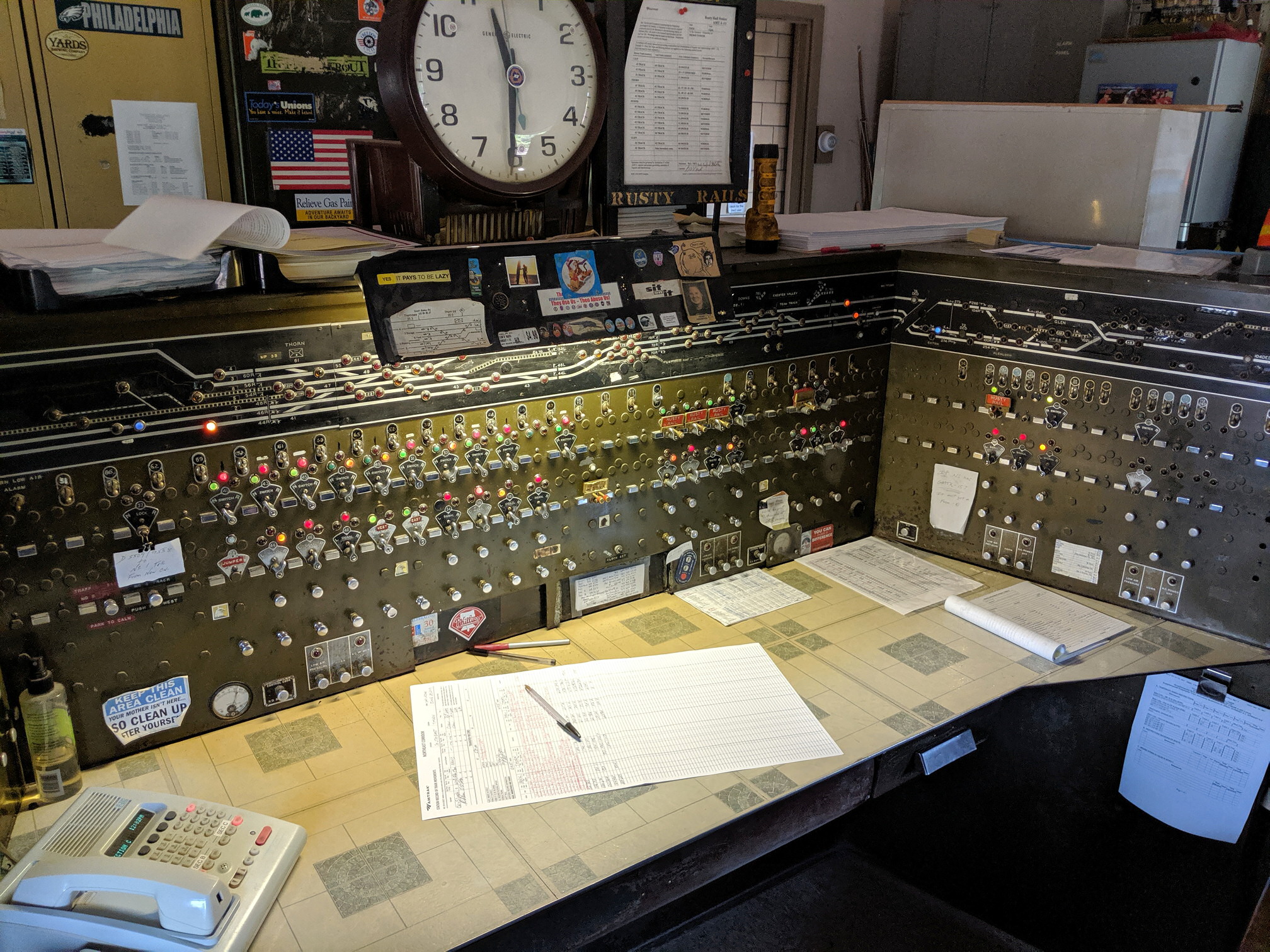
THORN Tower Just Won't Die

Over the past few years I have been reporting on what turned into a rather protracted closure of Amtrak's THORN interlocking tower. What made THORN a bit harder to close was that it was opened in 1938 as part of a wide area CTC project to support the PRR's electrification to Harrisburg. While the typical solution is to remote control the CTC interlockings to a central dispatch office, Amtrak's desire to perform an a general Rule 562 re-signaling made it a better option to keep legacy operations with the tower and modernized ones in the dispatch office. Well it seems that despite the tower's closure on August 8th, 2026, one piece of its territory remains partly un-resignaled. 


GLEN interlocking, located at the eastern end of THORN's territory where the Dale Secondary, nee PRR Trenton Cutoff, joins the Main Line via a flying junction, appears to have not been fully re-signaled. While new eastbound signals have appeared on tracks 4 (PL mast) and 2 (PL dwarf), the westbound signals are still date from the PRR era with the implication that the 1938 relay hut is still in service.  On the other hand the Milepost 25.1 automatic signal has been removed indicating that Rule 562 is now in effect on that track to FRAZER interlocking where new signals were in place earlier in 2026. 

Since an interlocking with 1938 signals in one direction and 2026 signals in the other was not on my bingo card, I am going to offer two plausible scenarios for what is going on. The first is that plans for a new interlocking in the area has prompted Amtrak to hack up a hybrid GLEN until funding is available for what comes next. The second is that THORN's closure was based on an employee bid cycle, not re-signaling project completeness and Rule 562 between PAOLI and GLEN on track #4 and PAOLI and FRAZER on Track #1 will proceed as PennDoT funding allows. It could also be a combination of both these theories working in tandem. 

If any of you happen to be on a SEPTA R5 or Amtrak Keystone out past Malvern you can catch this mess of an interlocking for yourselves. Feel free to add your experiences in the comments. 

Sunday, August 30, 2026

I 'C' You - Caltrain Adopts SP Commuter Plates?

In the bi-polar mess that are Union Pacific Signal rules, an often overlooked feature are the < C > plates that upgrade Advance Approach and Diverging Advance Approach to Advance Approach [Commuter] and Diverging Advance Approach [Commuter]. These modifiers came about in association with the Caltrans funded Capitol Corridor service between Sacramento and San Jose and upgrade the speed restriction associated with an Advance Approach signal indication to 60mph from 40mph.While this falls way short of the 90-110mph operation and 60-80mph high speed turnouts the line should have, its at least a step to improve performance. 

SP vintage mast signals displaying Advance Approach with a < C > Modifier


Anyway, at some point between 2023 and 2024, [ C ] markers appeared on virtually all signals on the Caltrain main line. At first glance it appears that Caltrain was trying to take full advantage out of the performance of its new electric trains  boost the speed of following movements from 50 to 60mph where an unrestricted speed if normally 80mph. 


However a helpful reader left a comment that the new [ C ] plates are simply to mark the signals as displaying Caltrain's speed signaling aspects. In the route signaled area an [ R ] plate is used. I'm not exactly sure which problem Caltrain thinks they are solving, maybe the new MU service involved the hiring of many new operators, but [ C ] and [ R ] are not the best choices for a letter plate. [ C ] for the aforementioned < C > "commuter" tag and [ R ] for the common "permissive" modifier. 

Milepost 25.4 signal before modification. 

Of course there wouldn't be much stopping Caltrain from re-purposing the [ C ] plates to refer to 60mph Advance Approach via a rulebook change if the "speed signal rules" reminder tunes out to be unnecessary.  Just sayin. 


Sunday, August 16, 2026

Protecting Sharp Curves Before PTC

Located at Milepost 90.3 on the former Rio Grande Moffat Tunnel route is a wonderfully analog system to help prevent inattentive train crews from derailing eastbound trains on an especially sharp 20mph curve. Despite the later deployment of ETMS PTC on the territory this holdover from the days of yore has remained in place and is observable by persons traveling on Amtrak California Zephyr Train 6. 

The Colorado Rockies have a geologic feature known as a mountain "park" which are wide flat valleys surrounded by generically mountainous terrain. The west slope of the DRGW Moffat Tunnel route alternates between impossibly tight canyons with a line speed of 25mph and these wide flat parks with long stretches of 60+ mph running. The mountain park near Kremmling, CO allows for 60+mph speeds between mileposts 82.2 and 86.2 on track that is close to tangent. At milepost 86.6 this abruptly ends in a wheel squealing 20mph curve as the line turns into Byres Canyon.  

To mitigate the risk of an inattentive crew hitting this curve at full speed a radio warning was installed at the milepost 90 automatic signal location. When an eastbound train is detected an audio message about the upcoming 20mph track is broadcast 4 times over the road channel. The distance between the warning and the curve is close to 3 miles and is more than sufficient for the engineer to control the train's speed.

The milepost 90 signal was replaced around 2015 when ETMS PTC was added to the line, however the radio message was left in place and today it serves as reminder of the sort of analog innovation that took place in the analog era like the timer based cab signal drops that were installed at similar high risk locations on the NEC in the 1980's. 


Friday, July 31, 2026

Reading and Northern's Flexible CTC

From loose car switching to running coal fired steam excursions at main line track speeds, the Reading and Northern has a thing those traditional operating methods that other railroads have shunned out of cost and liability concerns. Based on recent observations this also applies to signaling under degraded conditions, which is a real breath of fresh air compared to public transport agencies that are more comfortable canceling service than working around failure. 

RBMN Pittston train having passed Lehigh Line Signal 148S under normal operation

RBMN Pittston train passing Lehigh Line Signal 148N under normal operation

If you recall my post on Lehigh Line signaling locations, the milepost 148 intermediate signals are located on the former Central RR of NJ part of the line and date from that road's ownership in the 1960's. The signals use a route based approach lighting system where the signals are normally dark unless a route is set in the direction they govern. (Opposing signals remain dark unless the track circuit in front of them is occupied.) The CTC is based on pulse code transmission through the rails and the signal logic also dates from the CNJ era. According to locals the section of CNJ era signaling is not the most reliable.

Signal 148N remaining lit after the passage of the #2102 excursion.

Signal 148N at Approach for UP #4014 following the passage of #2102

The situation I am about to describe was a downstream outcome of a minor derailment of the train used for the Reading and Northern's regular weekend excursion service between Pittston and Mach Chunk through the Lehigh Gorge.  This damaged 3 of the 4 cars regularly used in the consist and because the RBMN was hosting both a Reading #2102 and a Union Pacific #4014 steam excursion the next day, it seemed likely that the "regular" Pittston to Mach Chunk train would be annulled. Sure enough, upon arrival at the Milepost 148 location a route had already been established in the northbound direction for #2102 instead of southbound for the Lehigh Gorge train. Upon passage of said #2102 excursion the 148N signal remained lit and then progressed to Clear for what would be the following UP #4014 movement.  

Single car Pittston to Mach Chunk excursion train passing 148N at Clear for UP #4014

However after about 15 minutes the 148N dropped first to Approach and then to Stop and Proceed. It turned out that even with just a single car available, the Reading and Northern was still going to run the "regular" Lehigh Gorge train. However RBMN management was not too keen on a signaling failure for the "celebrity" #4014 train and instead chose to run against an established CTC route. What I observed was the  gorge train roll past the 148N signal and towards the dark 148S signal at around 20mph. Upon entering the overlap circuit between 148N and 148S, the 148S illuminated to display Stop and Proceed. The Gorge train maintained its speed past the 148S and disappeared out of view around a curve.

#2023 and the single Pittston car approaching 148S at Stop and Proceed against the current of traffic.

Because I didn't have a scanner on me I didn't hear the exact details of what was going on, but there are several valid options. The first would be a permission past the stop signal at CP-CRESTWOOD followed by Restricted speed operation to CP-WHITE HAVEN, likely with additional Form D Line 2 authority. However the even speed of the train around curves and no attempt to stop at the Stop and Proceed intermediate signal implied that the Gorge train was moving under Line 6, "non-signaled DCS rules in effect", with an additional Line 2 movement authority. This method removes the need to stop within half vision and obey intermediate signal indications. 

While this method of degraded mode operation is available to all passenger railroads there is a reluctance to use it during signal failures because the crews have very little experience with moving against the current of traffic and track warrants in general. A few extra minutes delay or bustitution is considered preferable to some sort of accident, which of course makes the "lack of practice" issue even worse. 

Saturday, July 25, 2026

Automatic Signals To Be Axed From NY Penn Station Lines 1 and 2

Amtrak is currently halfway through a project to rehabilitate its East River Tunnels that were damaged during Hurricane Sandy way back in 2012. Lines 1 and 2, the southern pair of tunnels between Manhattan and Queens, were subjected to significant salt water intrusion and although this water was removed in short order, the salt created long term reliability problems. The solution has been a three year project to completely gut the tunnels to the 1910 iron rings and then rebuild them with a new concrete liner and a no ballast trackway. As of now the project is half way complete with Line 2 rebuilt and ready for service.  

Unfortunately Amtrak has also taken the opportunity to remove the automatic block wayside signaling within the tunnel. A total of 13 automatic block signals, some dating all the way back to 1910, were removed from the 2.75 mile long Line 2 tunnel. The 5 eastbound and 6 westbound and 2 westbound repeater signals were replaced by Rule 562 cab signaling without fixed wayside signals.  Rule 280a "C" lamps were added to the 708WA and 704W signals in F interlocking along with a new 580E signal at JO interlocking at the western Line 2 tunnel portal replacing the 1E02 automatic. Similar to CP-MID in the North River tunnels between Penn Station and New Jersey, a new controlled point, CP-LOW, was installed 1000 feet east of the 1st Ave shaft for westbound movements. This creates two Rule 280a "super blocks" within the tunnel in case of cab signal failure. 

Existing ABS configuration for Lines 1 and 2 west 

Existing ABS configuration for Lines 1, 2, 3 and 4 east

In a similar fashion to Grand Central and the defunct Cleveland Union Terminal, Penn Station used a unique style of color light signal as the technology of high intensity, long life electric bubs was still relativity new with semaphores being the then state of the art. ABS signals in the East River tubes were of the "frog eye" variety to create an "offset head" appearance that was customary for automatic signals. The upper "head" had the typical R/Y/G lamps with G/Y on the lower. This allowed for a 4 or 5 block progression for trains approaching the slow speed Penn Station complex, Clear -> Approach Medium -> Approach Slow -> Restricting. As signals at Penn Station can only display slow speed indications at best, the two western ABS locations would best display Approach Medium -> Approach Slow. It is unclear how many cab signal blocks have replaced the 5-6 wayside blocks, but CP-LOW's ability to display Cab Speed (60mph) implies that it matches the high density cab signaling installed on the Jersey approaches. 

"Frog Eye' type NY Penn automatic signal pressed into absolute service.

At this point the adjacent Line 1 will be shut down and reconstructed in a similar fashion over the next 18 months. Fortunately Lines 3 and 4, primarily used by the LIRR, were not damaged in the storm and will be left in their original condition for the foreseeable future. As I mentioned before the North River tunnels were already re-signaled in the late 1990's and will be fully rebuilt after the opening of the new Gateway tunnels in the 2030's.

Tuesday, July 7, 2026

Caught on Camera: Clear to Next Interlocking for UP #4014

For much of the Union Pacific Big Boy 2026 Coast to Coast excursion tour, #4014 was able to operate like any other Class 1 main line locomotive with an ETMS PTC box in the cab allowing the engine to operate in the leading position. However the former Pennsylvania Railroad Main Line between Harrisburg and Rochester, Pennsylvania not only remains cab signal equipped, but was converted to operation without wayside intermediate signals in 2018. Until recently Union Pacific was also a major user of continuous cab signals, however in 2022 they chose to scrap their system due to legacy design considerations that created a lack of synergy with ETMS. While it would have certainly been possible to reactivate the cab signals on #4014 and integrate them with ETMS, the increasingly popular solution to run the movement under Rule 280a, Clear to Next Interlocking, was chosen. I was able to catch this procedure at CP-ROCKVILLE on July 7th, 2026.

Here we can see the westbound track 2 signal at CP-ROCKVILLE displaying Slow Approach, R/R/*Y*, with the "C" lamp illuminated for a stop signal at CP-MARY about 5000 feet to the west on track #1. When the dispatcher lines a route between CP-MARY and CP-BANKS, the signal at CP-ROCKVILLE upgrades to R/Y/R Medium Approach with the "C" lamp lit. The plan for #4014 was to proceed past the far end of CP-MARY and then reverse into Enola Yard to spend the night. Note that the Slow Approach and "C" lamps are flashing with the  same cadence. This indicates that the interlocking has a single source for pulsed lamp current that is then directed to the lamps that require it.

Sunday, May 31, 2026

Caught on Camera: Track Circuits and Electrification Current

In a previous post covering the phenomena of a "bobbing" track signal that cycles intermittently between one or more states. I mostly covered the spectacle of a particularly egregious example on SEPTA's former Reading Main Line. Here I will cover two additional examples that are a bit more tame, but sheds some light into some operational side effects that come with railroad electrification. 

PATCO FERRY interlocking with an eastbound train on the troublesone WF2 track circuit.

The first example was caught on the PATCO Speedline and involves the cab signal bobbing between 30mph (Approach) to 65 mph (Clear) immediately after a westbound train crossed over to the eastbound track just past the Ferry Avenue interlocking. Was this cased by standing water or a lose wire? Apparently this bobbing signal is a known issue that occurs when the operator or ATO system selects the P4 power setting after exiting the turnout.  The current draw causes the WF2 track circuit relay at West Ferry interlocking to drop.  With the WF2 and NJ67 track circuits both occupied, the signaling system thinks that the train is still on the 30mph switch at West Ferry and drops the cab signal from Clear to Approach.  The train cuts power, the WF2 relay picks up, the signaling system "sees" the train off the 30mph switch and upgrades the cab signal to Clear again.  The process continues until the train passes the next code change point.

As I explained in my post regarding impedance bonds, the rails serve double duty as both a path for traction return current and the track circuit. Because of this a mis-calibrated signaling component can be affected by the acceleration state of nearby trains.    A "safe" failure of this type is less likely to be tested for upon installation or fixed quickly once identifies.  A good example of this is the southern segment of Amtrak's Northeast Corridor that still utilizes relay--based signaling hardware from the early 1980's.

Like with the PATCO example I have been told that the interaction between the signaling system and electrification can be to blame, especially from trains traveling on adjacent tracks. The first example was located at the northbound Milepost 69 intermediate signal near Aberdeen on the less frequently utilized center track #2. The signal can be seen slowly cycling between Clear and Approach, potentially due to an electric train movement on one of the outer "through "tracks". 

Here we see a slightly more extreme example as the southbound Milepost 103 intermediate signal on track #2 at Halethorpe rapidly flickers between Approach and Clear. It might look like Advance Approach is trying to display, but the signal blocks ahead are of usual length and the flicker interval is not uniform. This was noticed after the passage of a southbound Amtrak electric train on track #1. This instance of signal bobbing would also be likely to avoid rapid resolution as track #2 is less frequently used than tracks 1 and 3 and for at least half the day traffic is set in the opposite direction. 

Milepost 103 signal location with track #2 set northbound

Years ago when I had access to Amtrak NEC reports, there would be bobbing signal issues that would persist indefinitely. When the cause is an intermediate side effect of the electric traction system, these problems can become very difficult to troubleshoot as they might require a train running at some specific power load/speed to trigger the problem. A big reason central European countries are so enamoured with axle counters is that many electrified before installing automatic signaling. Counters solve both the problems associated with impedance bonds, but also problems like bobbing signals. 

Wednesday, April 29, 2026

Caught on Camera: New CSX Signal Rules in Action

A few months ago I posted about CSX's two new "Canadian" style signal rules, 281E Limited Approach Medium and 281F Limited Approach Limited, to augment its existing Rule 283A Medium Approach Medium and 283B Medium Approach Slow. Although established in 2024, I had not been expecting to catch one in the wild for some time as railroads tend to bend over backwards to avoid signal modifications if they can be avoided. Sightings of the new signal indications had mostly been in former Seaboard System territory in Georgia and Florida. Therefore you can imagine my surprise when, after stepping off Amtrak Empire Service Train 281, I saw a Rule 281D Limited Approach upgrade to Rule 281F, Limited Approach Limited at Chicago Line interlocking CP-292.

Now Rule 281D Limited Approach has been present on the Seaboard main lines for several decades, and although it is an odd duck, by seeming to authorize Limited speed up to a stop signal instead of Medium, this could have been present as part of the general Chicago Line re-signaling of the 2010's. The Rule 281F indication has to have been added since September 2024  so that is evidence of more system-wide changes on the part of CSX. 

As to why CSX is retrofitting existing interlockings as opposed to using 281E/F only in new projects my guess would be this is a downstream cost of PTC speed enforcement. Not so much in the sense that crews would "cheat" when 283A Medium Approach Medium was displayed for Limited Speed turnouts (although they probably did), but PTC's conservative braking curves could be raising the cost of signal indications that leave speed on the table. 


Friday, March 13, 2026

Amtrak Harrisburg Line Re-Signaling Hits FRAZER

I have previously discussed the drown out closure of Amtrak's THORN tower in Thorndale, PA. Recently the re-signaling efforts have hit FRAZER interlocking where new colorized position light masts have replaced the old amber style PLs. This is just another symptom of the eastern end of Thorn's territory being converted from its 1937 ABS 251 CTC to contemporary Rule 261 CTC. 


FRAZER is an interesting part of THORN's zone of responsibility. As covered in Part 2 of my old PRR Main Line signal survey, FRAZER was placed in service around 1994 when the old Paoli MU shoppe complex was closed due to massive PCB contamination stretching back to 1915. As a replacement a new yard and inspection shoppe was opened near Frazer, PA, extending basic SEPTA R5 service an additional stop to Malvern, PA. The only problem was that there was no interlocking infrastructure at the Frazer location to to support what is SEPTA's busiest commuter rail line. The solution was a new interlocking, FRAZER, that consisted of a yard lead, a turnback track and a center pocket track where eastbound R5 trains could wait for any conflicting movements to clear up.


There was some initial debate about whom would control the interlocking as in 1994 the entire Amtrak Harrisburg Line was still paper dispatched and FRAZER was located directly between the territories of THORN and PAOLI towers. A 1994 fire at BRYN MAWR tower forced the issue when PAOLI  took remote control of that interlocking leaving only THORN with the necessary spoons for more territory. However the increased workload did bump the operator's position at THORN to that of a higher paid Train Director. 


Because FRAZER was located in single direction Rule 251 territory about 4 miles from an existing interlocked crossover, it was not deemed necessary to give FRAZER universal crossovers of its own, so only a training point path was provided mainly for R5 trains heading east. Because this part of the Main Line was built with 4 tracks, there was ample room for a centrally placed pocket track. 


FRAZER is likely the last new Amtrak interlocking constructed with amber PRR position light signals. By 1994 the conversion of the NEC to colorized PRR position lights (a downstream outcome of the Chase, MD wreck) was well under way, but with no plans to convert the old PRR Main Line (Amtrak Harrisburg Line) FRAZER was designed with amber lamps for the sake of commonality. This view was incredibly short lived as PAXON and WOODBINE interlockings built to support the new Overbrook Maintenance Facility just a year or two later would have the position color lights.


It is unclear if FRAZER's conversion is part of a full re-signaling or just a modification to support both the colorized signals, bi-directional operation and Rule 562 cab signals without fixed wayside signals. Dwarf and pedestal signals unaffected by\the changes do not appear to be facing replacement along with the primary relay hut. New Rule 562 signal indication points between FRAZER and THORN are in place along with new signal equipment at GLEN and the planned decommissioning of DOWNS. If I am not mistaken, this will also be the first time SEPTA crews have to deal with Rule 280a "Clear to Next Interlocking" signals on their regular territory as their own Rule 562 territory lacks this feature, instead handling cab signal failures with dispatcher issued Form D's.

Friday, March 6, 2026

Former Dallas Terminal Railroad Re-signaling

 The Dallas Terminal Railroad can be considered to be in the midst of a slow-motion re-signaling, partly set off by Amtrak move from Union Pacific to TRE routing between Dallas and Fort Worth. This matters because the stretch of of 5 back-to-back interlockings, while "modern" in appearance, actually represents a vestige of late stage relay interlocking installed in the 80's or 90's with quirky signals of a non-Safetran nature.

The stretch in question used to be covered by the Dallas Terminal Railroad's Towers 106 and 107 that managed the west and east ends of Dallas Union Station. This has since become part of the Union Pacific Dallas Sub and from east to west consists of REUNION, DALLAS, JFK JCT, TRE JCT and INDUSTRIAL X-OVER interlockings. An additional interlocking, BN CONNECTION, makes up the third corner of the wye with TRE JCT and JFK JCT.

Around 2015 Amtrak shifted from the UP Dallas Sub to the ex-Rock Island Trinity Rail Express commuter route west of Union Station. Around 2023 the switch that connected the Amtrak platform at Union Station to the Dallas Sub was removed along with the west leg of the wye, turning both TRE JCT, BN CONNECTION and the TRE portion of JFK JCT into vestigial interlockings with signals guarding empty track. REUNION also saw the removal of the crossover to the east end of the Dallas MoW/passenger car storage track. 


In 2026 the other shoe dropped with the vestigial JFK JCT signals being removed and new signals going up at DALLAS. I don't know the exact plans, but there are two clear options. The first is that DALLAS loses its crossover and becomes an interlocked connection to the MoW stub with other interlockings staying unchanged. The second, and what I consider to be the more likely scenario, is that JFK JCT will be merged into DALLAS with INDUSTRIAL XOVER and the vestigial TRE JCT being eliminated along with BN CONNECTION. Currently trains on track #1 encounter 4 signals within 3000 feet, not a situation that is likely to play nice with PTC. Moreover, INDUSTRIAL XOVER duplicates the facing point crossover available at DALLAS. While its possible INDUSTRIAL XOVER might be kept something tells me that it is surplus to requirements.


So why does this all matter? Like I said the current setup uses late stage all or partial relay logic and non-Safetran signals consisting of L&W modular and GRS monobloc equipment. Second the close signal spacing introduced some very interesting signal progressions. In fact because of the sharp turn of the Dallas Sub at JFK JCT, the default progression for track #1 westbound is an Approach Restricting at DALLAS to a Diverging Clear (straight clear is onto the TRE) at JFK JCT. I suspect the new interlocking will display a Clear to UP train movements despite the curve. All together, what is an accessible place to observe interesting signal indications on interesting signals is about to get much less interesting, even if the exact amount of uninterestingness remains to be seen. 


Friday, February 20, 2026

Caught on Camera: PORTAL's new "Gantrylever" Under Test

Following up on the previous post regarding the new PORTAL bridge cutover, Amtrak I happened to catch a cab speed indication on the (New) PORTAL interlocking's westbound cantilever mast's 3W signal. With the new track #3 still very much under construction, crews were getting a jump on commissioning* the new interlockings associated with the project. Although this is a static image, the 3W was displaying a flashing green cab speed indication, which would be in line with the high density cab signaling in place between HUDSON and A interlocking at Penn Station. 

That alone is interesting, but if you review the track and signal diagram from Bulletin Order establishing OLD PORTAL and OLD SWIFT interlockings you might notice that future PORTAL is intended to be laid out similarly to OLD PORTAL with center Track A merging into tracks 2 and 3. Instead in the photo we see a two track cantilever mast, or do we?


Amtrak is splitting the commissioning of the new Portal fixed bridge into two month-long work sessions spaced 6 months apart. The primary reason for this is that activating the new eastbound track #2 will require the prior removal of overhead catenary supports required for both existing tracks. A secondary reason is that the new track 2 will require partly burying the old track 3 and removing the westbound cantilever as you can see below. 


If you look closely the end of the cantilever arm has some extra bits and the diagonal supports at the corner seem a bit flimsy. This is because that new signal structure is not a cantilever, but half of a three track signal gantry that will be completed once its southern foundation has something to sit on. I'd call this a "gantrylever", but that term is somewhat taken by gantry+cantilever combinations as seen at UNION and DUNTON. 


 In other news related to PORTAL's signaling  the lower heads on the westbound signals are conforming to the new pattern established at LEGGETT interlocking on the Hellgate Line, replacing the central lunar white Stop and Proceed dot with a a lunar white Restricting \. However the eastbound signal masts retain the Stop and Proceed dot. This might be a quirk needing the shorter signal blocks around Secaucas transfer than the SWIFT connection. 

Anyway. just though it was cool to catch the new temporary cantilever signal 3E under test, several weeks before the first revenue train would actually use the new bridge.

*Note: Amtrak would ultimately open track 3 for service two days ahead of schedule due to a problem that fouled track #2 during the morning rush. 


Saturday, February 14, 2026

Amtrak PORTAL Bridge Re-Labeling

The requirements of safety and signaling made railroads some of the first organizations to manage systems of unique identifiers and all their associated corner cases. Today we will explore how Amtrak is handling some of these corner cases as they replace the historic PORTAL swing bridge on the Pennsylvania Tunnel extension in the New Jersey Meadowlands.   

1910 vintage PORTAL swing bridge.

Let's first discuss names. Originally "W" cabin, PORTAL's current name emerged around the 1930's when increased use of voice-based telecommunications prompted the PRR to switch many of its interlocking identifiers from telegraph letter codes to names evocative of their local surroundings. At the time the swing bridge and its crossovers were the last interlocking station before the western portal of the North River Tunnels, thus PORTAL. In the mid-1990's Amtrak and New Jersey Transit implemented a connection between the DL&W main line and the Penn Station tunnel route immediately west of the PORTAL bridge. Branded Mid-Town Direct, this service would drastically decrease trip times compared to the 2-sear ride via Hoboken and someone came up with the name SWIFT for the new junction. 

"New" Eastbound PORTAL signal gantry over PRR era gantry.


Westbound gantry at SWIFT with route indicators.

The other important labeling system is for the universe of railroad tracks. It might seem straightforward to just start at 1 (or A) and advance upward, but on which side of the right of way does one start counting? What if you need to add a track on the "below" 1? I'll make a post about track numbering at some point, but in this case the PRR was forward looking and went with track #2 (eastbound) and #3 (westbound) since in 1910 it was foreseeable that traffic growth would require tracks #1 and #4 at some point in the future. When the Secaucus Transfer opened, the layout placed slower station tracks between main tracks #2 and #3. These were given letter designations with tracks A and B. PORTAL interlocking was even expanded to include switches into the western end of track A.  

1990's PORTAL extension to support new Track A with 80mph turnouts.

Fast forward to now and Amtrak is building a brand new PORTAL replacement bridge that will also replace most or all of the current PORTAL and SWIFT interlockings. However for the better part of a year both old and new bridges and tracks will be in service and keeping the names the same might result in safety critical confusion. As a result Amtrak proactively renamed the old tracks and interlockings in December, 2025 with PORTAL becoming OLD PORTAL, SWIFT becoming and OLD SWIFT, track #2 becoming track #22 and track #3 becoming #33.

It gets better because Amtrak employs a track number based labeling system for signals and interlocking appliances. This made signals like 2E and 3E into 22E and 33E. Likewise switches like #23 and #32 became #2233 and #3322. Note that lettered tracks are just assigned a number for the purposes of switch and signal labeling with 7 standing in for A, but because track A doesn't cross the bridge there was no need for it to participate in the renaming. 

The now renamed 2233 crossover and 227 turnout at SWIFT.

Like automatic signal number plates and interlocking station signs, track numbering is a fascinating topic that I will dive into at some point, but for now I'll leave things in the context of a topical news item. 

Sunday, December 21, 2025

PHOTOS: LEAMAN - The Place To Be

The Pennsylvania Railroad Main Line, today operated by Amtrak as their Harrisburg Line, is known for its many interlocking towers that survived well into the 21st Century and I have covered several of them on this blog. However there is one "place" that isn't quite a tower, although it has many of the trappings of one. While the PRR seemed to have an aversion to CTC, it still had a lot more signaling infrastructure than peer railroads with a particular focus on Manual Block System and its related component, the block station. What's a block station? Well its a location on the line that can host a block operator who in turn can perform those duties necessary for some (manual) block operation like transmitting train orders, displaying signals and throwing hand operated switches. Even on signaled PRR main lines one could find non-interlocked block stations open either 24/7 or part time.

Located at milepost 56.7 between PARK and CORK interlockings on the Main Line is the town of of Leaman Place. You might recognize the name for being the interchange point for the Strasburg Railroad. This segment of the Main Line was electrified in 1939 and at the time  featured 4 main tracks. Despite the 24 mile gap between the two interlocking stations, no intermediate crossovers were provided as most disruptions could be dealt with by relying on the "spare" main track (with the parallel Columbia Branch directly providing an additional two tracks of relief capacity for freight). However in 1948 tracks 2 and 3 were removed due to declining traffic and evidently this length of single track operation during maintenance or equipment failure had become an issue because in 1961 the PRR constructed the new LEAMAN block station at milepost 57.0 with a pair of main track crossovers protected by semi-automatic signals. Unlike similar hand throw block stations LEAMAN had no normal hours of operation and was only open as needed for single track operation.


LEAMAN consisted of a pair of center locked hand operated crossovers and a pair of position light signals oriented in the normal direction of travel. As this was not an interlocking, no reverse direction signals were not installed. A rather robust operator's shelter was provided and outfitted with  station signs, climate control and telecommunications. 


This sort of hand operated crossover layout was not uncommon on other double track ABS main lines with the requisite "shelter" typically taking the form of a wayside telephone booth that would allow crews to call the dispatcher to pick up their movement authority to run through the single track area or to report clear of it. However LEAMAN was unique in that its signals and electric switch locks were tied to a small control panel inside the operator's shelter and not accessible to road crews.