Search This Blog

Showing posts with label BART. Show all posts

Wednesday, September 30, 2020

BART Going with CTBC

 You might have missed it due to COVID news coverage, but back in January 2020, whomever it is that runs BART decided to use some new taxpayer funding to replace the "50 year old" audio frequency cab signal system with CBTC.  While BART does indeed have some extreme capacity constraints funneling 4 lines down a two track trunk between Oakland and Southern San Francisco, as that very city has seen with its MUNI Metro Subway, CBTC is not all its tracked up to be.

This is being brought to you by the same team that sold a $400 million combination railcar and re-signaling package to the Baltimore Metro. Hitachi purchased the Italian railcar manufacturer Breda and the Italian signal provider Ansaldo, which itself was the parent of Union Switch and Signal.  I guess because Hitachi figured that Japanese engineering was better than that of Italy it has gone in with a full re-branding even though I doubt any of the actual work is being carried out in Japan. Like the DC Metro, BART has a core system that is approaching 50 years in age and likely was looking at a full signal equipment replacement similar to that which WMATA carried out after the 2009 signaling related collision.  Although BART has seen many expansions over the years, its core system was and likely still is based on GRS relays and Wee-Zee bond technology. 

 While BART may be hoping for those 30 trains per hour, the reality will likely be less as at a certain point trains become dwell time limited.  It's not that passengers can't all shuffle on and off in 30 seconds, its that they will likely not do it reliably and even a small disruption at peak capacity will result a standing wave traffic jam.  Hopefully, because Bay Area, there will be some sort of backup system as you know every wanna be hacker looking to make a name for themselves will be looking for ways to disrupt the system and anything that uses wireless is ripe for disruption.  If cab signal circuits will remain in service as a backup or on outer portions of the system where such equipment is not life expired, remains to be seen.  The BART system was already pretty useless to railfan with dull signals and rolling stock hostile to look ahead or behind views.  The new D type cars were posed to reverse this trend so get your photos and videos of the current signaling and train control before it vanishes.


Monday, April 8, 2019

Caught on Camera: Original BART CTC Dispatch Center

Control centers with non-video displays are a true work of art and are vanishing just as quickly as the interlocking tower.  Wiring up a custom, semi-immutable display with all sorts of tiny lamps and pieces that could become obsolete within a year just cam't compete with a giant display wall that costs a couple thousand dollars and can be driven from an off the shelf TV.  However there was a time between the advent of centralized control center and the cheap video display wall that all sorts of these one off boards were constructed.

One such modern, but not too modern control center was that of the Bay Area Rapid Transit, which opened for business in 1972.  I've actually seen photos of it's control center in a number of 80's vintage rail transit books that would always feature BART and WMATA as examples of the future of rapid transit.  Here is the best example of those photos.

Click me, I'm high res.

I'm not sure if Westinghouse means it is a US&S product as US&S was a part of WABCO at the time, but WABCO was not the same as the "Big W" Westinghouse so they might have gotten the contract as more of an industrial control thing as opposed to a railroad signaling thing.  Anyway, note the spartan NASA style consoles with integrated phones and displays (and probably ash trays).  All of that and the wall sized model board is pretty distinctive so there was little chance I'd miss it when it appeared in the 1971 George Lucas Science Fiction film, TXH 1138.


Yeah, there's no mistaking that is the BART system!  Filmed in 1970 or 1971 the BART control center would have still been in the shrink wrap, with much of the system still under construction or still on the drawing boards.  Still, BART knew enough about what they were going to do to have the whole model board cut and dry 4 years ahead of time.


If you are wondering why there are two copies of the BART layout on either side of the room, it's not because the dispatcher have poor eyesight.  The display on the right is for rail operations, trains, signals, etc.  The other one on the left is the power dispatcher's diagram that shows the sections of third rail, substations and feeder lines. If you loo closely you can just about see the power distribution lines apart from the track sections on the power board.


Well chosen camera angle to disguise anything actually written on the special purpose interface. 
 

They've even got those snazzy phones!


 Probably hitting a key on the telephone concentrator.


Great view of the train movement board, but I'm interested in how in 1970 the entire operation could be staffed by just three people (although maybe each desk would support multiple persons at peak times).  Also, if you go back to the first picture note the size of the room vs the small number of dispatch desks.  I suspect one desk was for the power director, another for the train director and the one in the middle was some sort of chief or a service coordinator who could make announcements and such. 


THX 1138 used a lot of the to-be-opened BART system as locations for it's dystopian underground society.  In fact, the climax was filmed in a BART tunnel where the tracks had yet to be laid.  The rebar formed sort of a ladder effect so to simulate climbing up a shaft the camera was rotate 90o and the actors made to "climb" horizontally.  Amazing what good old George Lucas could think up when he didn't have CGI as a crutch 😏


Saturday, June 24, 2017

2017 California Zephyr Trip Report

Time for another trip report. This will be my third time covering the California Zephyr Route after previous trips in 2012 and 2014. Unlike before I only rode the train between San Francisco and Denver, but there was quite a bit going on. However, let me begin with some Bay Area news.

On Caltrain the supplementary signal automatic signal locations have been placed in service since my last visit to the peninsula. This has resulted in some remarkably short (for North America at least) main line signal block distances. For example from Redwood City, one can count up to 6 Clear signals in a row in the southbound direction.


Over on BART, the replacement of transit type gooseneck Unilens signals has been gaining speed with the Millbrae complex having its supply replaced by generic traffic light types. However Unilens signals were still in service at a number of other locations.


In the Capitol Corridor a new station is under construction at Fairfield, CA, which will result in the replacement of a number of SP style target signals, however the remainder, including the searchlights at DAVIS, appear to be safe.


The CTC is now active on the Roseville Sub between Colfax and Switch 9, however no new interlockings have been added and a number of the old ABS signals have been left alongside the RoW with the heads turned.


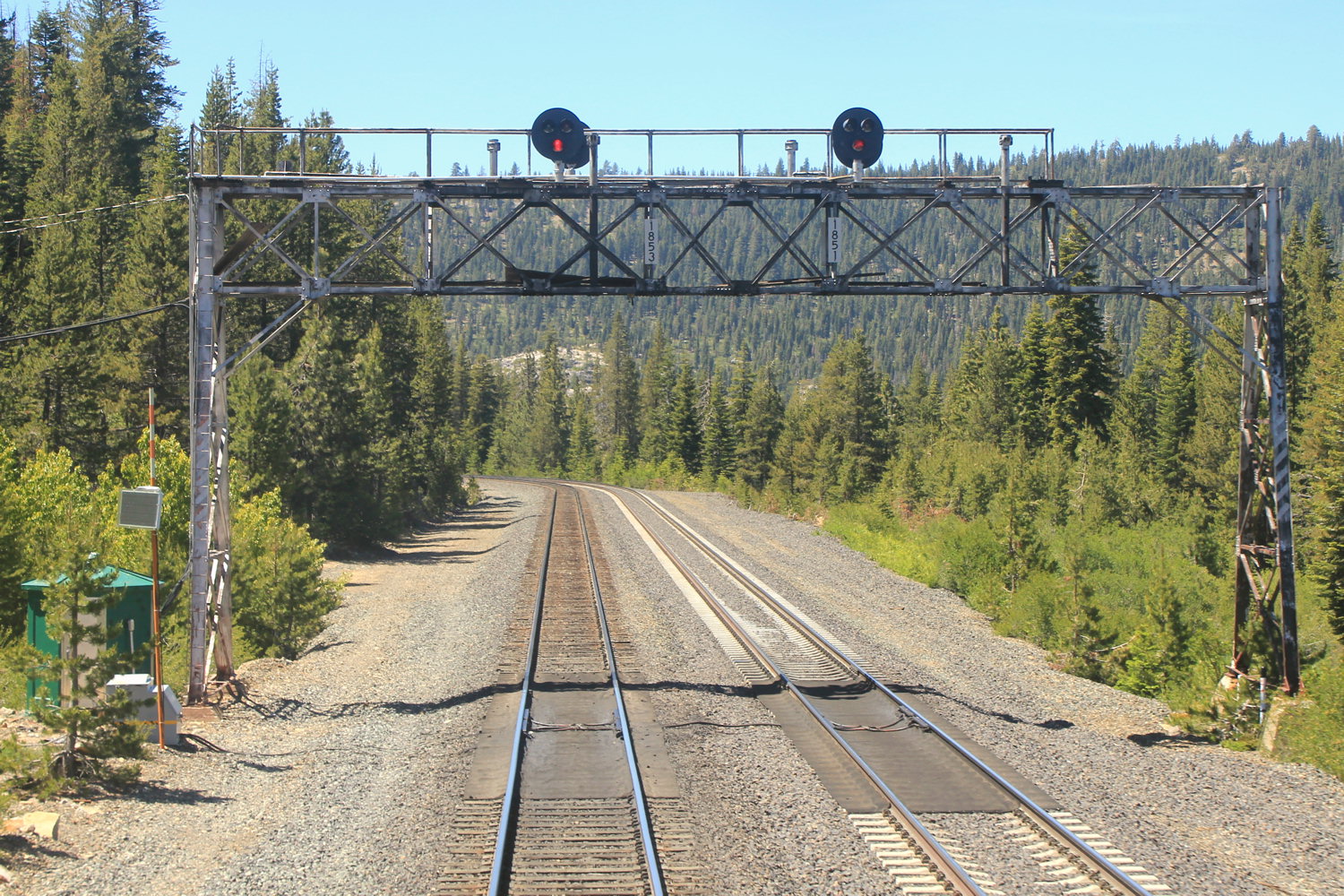
Over the Donner Summit, classic signaling remains in service between Shed 10 and Norden. Elsewhere old SP signal bridges have been generally left in place. This is also true along the old reverse running section between Truckee and Reno with almost all the old center mount signal bridges having been left in place.


All searchlights on the Nevada Sub have been replaced, however the SP tri-lights are safe. WESO interlocking and the Elko sub have been re-signaled, however it appears that the old single direction ABS tracks have been converted to bi-directional ABS. Old SP and WP ABS masts have been removed.


On the former DRG&W route, everything has been resignaled except the stretch between Green River and Grand Jct. This retains the 1960's era DRG&W CTC and pole line. This is all the more remarkable as replacement signals have been up since 2012! However the seemingly safe stretches of searchlight signals on the Moffatt Tunnel Sub have been replaced. On approach to Denver both Utah Jct and Fox have retained classic Rio Grand signaling.


Finally, the new Denver RTD commuter rail uses a Metro North style Rule 562 system with *G* Cab Speed signals placed only at interlockings. Cab signal speeds are Restricting, 15, 30, 45, 60 and MAS with 15 being given departing terminals and Restricting heading into them. This indicates use of a 50ppm slow speed code instead of just relying on a 0 ppm code in all slow speed situations. Also, Amtrak LD trains using tracks 4 and 5 in Denver Union Station only get *R* Restricted Proceed entering the terminal interlocking from non-RTD tracks.

Wednesday, May 27, 2015

No Respect - The Safetran Unilens

While riding up the Caltrain Corridor I noticed a little something that once again reminded me that the Safetran Unilens signal, for all its seeming usefulness, is the ugly duckling of the signal world.  The Unilens series (now in its second generation) was created as a solid state replacement for the old fashioned electro-mecnahical searchlight signal.  Inside, instead of a moving colored filter, one will find four lamps each connected to a single (hence the name) lens via fiber optic cables. This seems like the perfect solution to the old problem of getting multiple colors out of a compact signal head, and in fact should have been a marked improvement seeing as each Unilens head could support 4 colors instead of three.

From the Greek, Uni meaning one and lens meaning lens.
 Not only could the Unilens play the role of a dwarf signal, it could also be used in mast mounts behind a circular target just like the older searchlight and in the case of close quarters transit applications the Unilens had an additional trick up its sleeve with a goose-neck attachment that allowed the lens  to be placed a foot or two away from the actual lamp housing.


Initially adoption was good with a number of traditional searchlit railroads, such as the Delaware and Hudson and Canadian Pacific, buying them as a simple replacement for the US&S H series and GRS SA's they had been buying for decades. The BART rapid transit system enthusiastically bought into the whole goose-neck configuration for its limited number of wayside signals


But then things took a turn for the worse.  Crews complained that the small internal lamps didn't provide a bright enough light and the lamps themselves were proprietary, expensive and prone to burning out.

You be the judge!
The Canadian roads that briefly used the Unilens in high signal applications switched over to Darth Vader style LED lamps, and the transportation authority that owns the Coaster route to San Diego actually took the step of replacing its high mounted Unilens signals with target configuration Safetran colorlights.


I am posting this because while passing by the BART Millbrae station I observed that the goose-neck Unilens signals, perhaps some of the only examples ever purchased for rapid transit, had been swapped out for bland and boring LED traffic light type signals.  No the Unilens isn't going the way of the position or searchlight signal.  CSX, SEPTA and BNSF still prefer them in close clearance signaling locations across their systems, but as a replacement for what was once the most common signal type in North America if not the world, the Safetran Unilens has fallen dismally short.