A blog devoted to explaining the ins and outs of North American railroad signaling, past, present and future. This blog seeks to preserve through photo documentation the great diversity and technical ingenuity of 20th century signaling and interlocking hardware and technology. Related topics cover interlocking towers and railroad communications infrastructure.
Note, due to a web hosting failure some of the photos and links may be unavailable.
In southern Arizona one encounters the phenomena known as sky islands, where isolated mountain ranges, separated by harsh desert, become in effect islands for various plant and animal species due to the cooler temperatures and relative abundance of water. The Dragoon Mountains were one of these ecological islands that also happened to host an island of late model Southern Pacific signaling with short stature modular target signals. They had even survived the PTC asteroid with the familiar antennas installed to their original relay cabinets. This island was located on the double track section between VAIL XOVERS at Milepost 1000 and Dragoon Road at Milepost 1053. You can therefore imagine my dismay when I was passing the Sybil Road crossing at Milepost 1041.8 and saw a set of new Union Pacific LED signal masts.
Sybil Road 2016
Sybil Road 2024
The re-signaling took place between 2020 and the end of 2021. I suspect that Phoenix became so hot that the signal crews migrated to the cooler 4000 foot elevation of the Dragoon pass. In fact the riding temperatures of the southwest may have played a factor in shifting the signal locations nearer to road crossings. The Southern Pacific Milepost 1041 intermediates were actually a half mile to the west.
Sorry again for a late report, I just hadn't realized what had been lost until I was physically on site. The signal relocations and approach lighting so make the new signals more useful for railfanning train movements, however quite has been lost regarding the actual photo composition.
With Caltrain's new electrification set to kick off soon, I have been checking if there have been any additional signaling changes beyond the removal of the King St Terminal cantilever. While most of the action is happening north of San Jose Diridon, the wires do extend down to the Tamien Station, which has a direct VTA connection and has always seen a bit of through service. Here is what I found when I checked in on the Southern Pacific era signaling on that part of the line.
First up was CP-CAHILL and the southern end of the Diridon terminal. As expected these were replaced some time ago, getting the traffic light treatment in early 2017.
Next were the SP signals at CP-DELMAS about a mile to the south These lasted quite a bit longer, being replaced by US&S modular traffic lights around 2021-2022.
The most interesting changes occurred at CP-MACK at the Tamien Station. CP-MACK had southbound Sp masts, a northbound Sp cantilever and a northbound two "head", 6-module dwarf stack. Around 2021 the track two cantilever signal was changed from SP to Darth Vader type. Then later in 2022, both cantilever signals were replaced by two "head" LED searchlights.
In an even more baffling turn of events the dwarf stack was replaced by a two "head" mini transit style signals.
Your guess is as good as mine as to why, but its definitely something to see. As for the rest of the line to Gilroy and beyond, it appears to be unchanged.
Movable bridge cabins are the invisible step children of the interlocking tower scene, but its easy to forget that they have all the same stuff that regular towers have including the full compliment of electro+mechanical interlocking machines. While poking around YouTube I found this video of someone's 1994 tour of the Souther Pacific's SUISUN BRIDGE movable bridge cabin. This vertical lift drawbridge is a crossing of the Carquinez Strait, which connects Suisun Bay with San Fransisco Bay and hosts Amtrak's Capitol Corridor, Coast Starlight and California Zephyr services.
As far as I am aware it is still a staffed interlocking station, although I am not sure if it retains the US&S Model 14 machine and panel seen throughout the video (specifically 10:30). In the video you can also hear the sound of a signature US&S pneumatic switch machine at 4:00 as it locks down the lift span under the control of a Model 14 lever.
Based on intro and outro clips of ABS searchlight signals on the south bank, I suspect this pre-dated the era of SP style tri-light signals that remain at the bridge today and therefore implies that the Mode 14 was replaced by a panel or VDU.
Westbound home signals SUISUN BRIDGE
The panel shown at various points in the video also lacks the VISTA crossover immediately west of the eastbound signals.
Westbound home signals VISTA interlocking with eastbound home signals SUISUN BAY
So it looks like the "Southern Pacific" style re-signaling was going on quite a bit later than I had figured what with the mid-90's Union Pacific merger.
In a completely predicable turn of events, the iconic Southern Pacific cantilever mast that has guarded the southern approach to the 4th and Kin St terminal in San Francisco has met its demise sometime between March and October of 2023, likely in conjunction with the erection of overhead electrification wires. It has been replaced by three LED searchlight dwarfs.
I've noticed that starting with Amtrak's New Haven to Boston electrification. recent North American electrification projects have included far more overhead clutter than those seen in Europe. Specifically the use of solid overhead beams to mount the wire brackets as opposed to cable spans. Cable spans don't tend to block signal sight lines as much, allowing existing signal placements to remain.
Anyway, I'm not sure if the 4TH ST cantilever was scrapped or donated to a museum, but as one of the last of its type in daily service, its loss is significant.
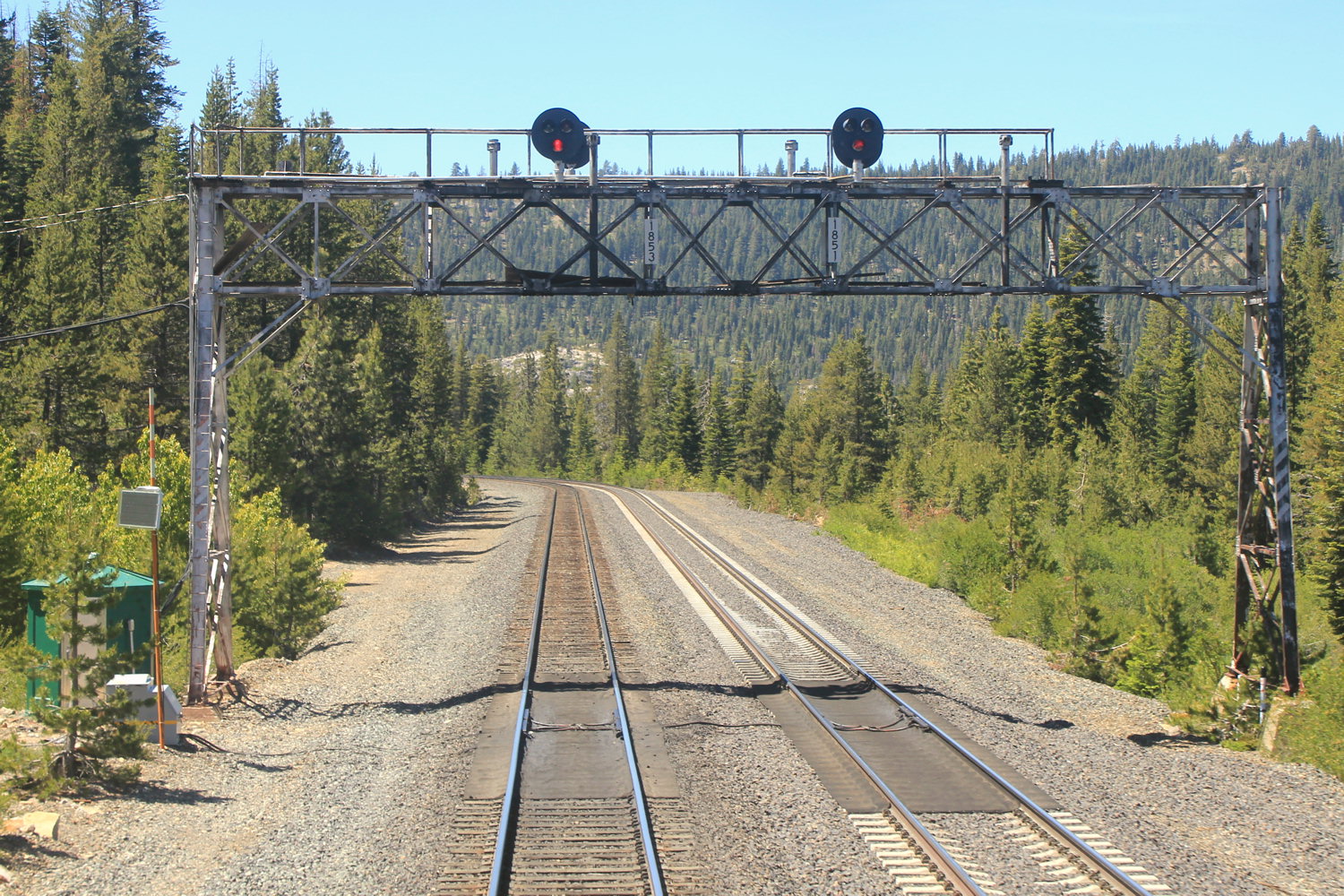
This definitely falls into the category of a news story that fell through the cracks, but after a bit of uncertainty I can confirm that all of the remaining Southern Pacific vintage signals on the Union Pacific Donner Pass route (Roseville Sub) between SHED 10 and and WEST NORDEN have been retired and replaced by extra height aluminum signal bridges of the same type already seen between SWITCH 9 and SHED 10 and east of EAST NORDEN. This change took place sometime in the 2020-2022 time frame with the searchlights at WEST NORDEN being the last converted.
Donner Pass Phase 1 replacement gantry at MP 173 in 2017
Although this development was not entirely surprising, the surviving SP signal locations, with the exception of WEST NORDEN, used Safetran CL-20 modules in a target configuration and had PTC antennas mounted on the steel lattice signal bridges. Although not part of a PTC project, it is likely that UP desired to replace the relay based signal logic and simplify maintainer access. In total 5 automatic locations and WEST NORDEN interlocking were affected.
WEST NORDEN was the former location where the old 1860's main track #1 split from the later main track #2 with the interlocking being completely covered in a snow shed. After the completion of the first phase of Donner Pass re-signaling in 2017 it was the only remaining set of searchlights on the entire Donner Pass route (US&S H-2's)
If there can be any consolation it is that the steel lattice signal bridges themselves have remained in place due to the inaccessibility by road cranes. In face, some of the phase 1 locations left the searchlight heads turned in place.
Unlike phase 1, phase 2 replaced the old SP locations on a 1 for 1 basis with most locations remaining the same except for the Milepost 181 automatics which have been removed in their entirety, creating a single 3.2 mile block where a 2.0 mike and a 1.2 mile block had existed before. In addition the the Vader type signals were moved off the westbound SHED 10 lattice gantry and replaced with masts at the mouth of the snow shed 450 feet to the west.
I finally got confirmation of this sad development due to media posted of the 2023 Donner Pass rotary plough training run so if you search out media of that event you can likely catch sight of some of the converted signal locations..
Way back in 2004 when the San Francisco peninsular commuter rail service known as Caltrain was being modernized with new trains, new passing tracks and new signaling, only a few pieces of Southern Pacific era hardware was retained. Perhaps the most spectacular of these was the 8 track signal bridge just north of the South San Francisco Station sources claim dates from 1907.
Needed to span a number of freight sidings, the signal bridge was evidently found to be in reasonable condition and subsequently fitted with two pairs of modern signals. Unfortunately, 15 years later freight service on the peninsula has continued to shrink and a new electrification project has provided capitol money to re-build the South San Francisco holdout platfom and replace the century old lattice steel signal bridge with a modern cantilever.
While the Bay Area's preservation mindset makes its likely that the signal bridge will avoid being sent to a scrap yard, the electrification project also makes it likely that the signal bridge will need to be moved elsewhere, perhaps to an existing museum, a Caltrain parking lot as an art installation or maybe just the purgatory of the former SP Bayshore shop and yard complex while the powers that be figure out what to do.
Time for another trip report. This will be my third time covering the California Zephyr Route after previous trips in 2012 and 2014. Unlike before I only rode the train between San Francisco and Denver, but there was quite a bit going on. However, let me begin with some Bay Area news.
On Caltrain the supplementary signal automatic signal locations have been placed in service since my last visit to the peninsula. This has resulted in some remarkably short (for North America at least) main line signal block distances. For example from Redwood City, one can count up to 6 Clear signals in a row in the southbound direction.
Over on BART, the replacement of transit type gooseneck Unilens signals has been gaining speed with the Millbrae complex having its supply replaced by generic traffic light types. However Unilens signals were still in service at a number of other locations.
In the Capitol Corridor a new station is under construction at Fairfield, CA, which will result in the replacement of a number of SP style target signals, however the remainder, including the searchlights at DAVIS, appear to be safe.
The CTC is now active on the Roseville Sub between Colfax and Switch 9, however no new interlockings have been added and a number of the old ABS signals have been left alongside the RoW with the heads turned.
Over the Donner Summit, classic signaling remains in service between Shed 10 and Norden. Elsewhere old SP signal bridges have been generally left in place. This is also true along the old reverse running section between Truckee and Reno with almost all the old center mount signal bridges having been left in place.
All searchlights on the Nevada Sub have been replaced, however the SP tri-lights are safe. WESO interlocking and the Elko sub have been re-signaled, however it appears that the old single direction ABS tracks have been converted to bi-directional ABS. Old SP and WP ABS masts have been removed.
On the former DRG&W route, everything has been resignaled except the stretch between Green River and Grand Jct. This retains the 1960's era DRG&W CTC and pole line. This is all the more remarkable as replacement signals have been up since 2012! However the seemingly safe stretches of searchlight signals on the Moffatt Tunnel Sub have been replaced. On approach to Denver both Utah Jct and Fox have retained classic Rio Grand signaling.
Finally, the new Denver RTD commuter rail uses a Metro North style Rule 562 system with *G* Cab Speed signals placed only at interlockings. Cab signal speeds are Restricting, 15, 30, 45, 60 and MAS with 15 being given departing terminals and Restricting heading into them. This indicates use of a 50ppm slow speed code instead of just relying on a 0 ppm code in all slow speed situations. Also, Amtrak LD trains using tracks 4 and 5 in Denver Union Station only get *R* Restricted Proceed entering the terminal interlocking from non-RTD tracks.
Sorry for th repetition, but as I explained in my 2015 Amtrak Cross-Country trip report, Dan Akroyd's private car was attached to the back of Amtrak's Sunset Limited ruining my efforts at surveying the route. This year I found significantly better luck and was even treated to a rare mileage detour outside of Houston. Also included in this report are various things I found in San Diego and the Pacific Surfliner route.
So I covered the San Diego Trolley's Green and Orange lines and to my delight I confirmed that the original Orange Line trunk was populated by US&S N3 Elephant Ear ABS signals
On the Surfliner route the ATS is still in service, but more and more of the target signals are being replaced with traffic lights as improvements are made to the line (new sidings, crossovers, etc).
At LAUPT, the Safetrain UniLens signals have been phased out. The two-head variety have been replaced with LED searchlights of the type seen at Chicago and Albany and most single head ones being retrofitted with a single red LED light that can display Stop and *R* Restricting.
On the Sunset route SP target color lights are still in place on areas that have not been upgraded, so that means the new double track main line in New Mexico is largely devoid of them. Also, there is a surviving SP cantilever mast with modern signals located just east of Tuscon.
I was looking forward to taking some better photos of TOWER 169 in El Paso, but to my dismay I discovered that it had been demolished :-(
The detour involved traveling down the BNSF Galveston Sub to Alvin and unfortunately the 80's vintage searchlights were undergoing replacement. Heading back into Houston on the Houston West Belt Sub there were a number of NYC style G-heads north of the yard complexes.
The searchlights and oddball signals were still in service in the Beaumont area.
And the searchlights were still in place at the Drawbridge and diamond in Lake St. Charles.
Finally East and West Bridge Jct towers are still hard at work talking trains over the Huey C. Long Bridge,
Well I just returned from my annual cross-country Amtrak trip and this year's target was the Sunset Limited running eastbound between Los Angeles and New Orleans. Unfortunately, I was unable to take most of my usual photos because Dan Akroyd parked his private car on the rear of my train and blocked most of the usable view. Nevertheless I was able to still observe the state of signaling along this route and if there was a silver lining I really didn't miss much photo wise because almost all the classic signaling has already been removed.
Because the scheduled departure for Train 2 is 10pm (and sometimes brought forward to 8pm as was the case with my train) there really wasn't anything to photograph on that leg of the journey anyway. The train used to depart at 3pm so if you want to see the state of the line this YouTube rear-end video before the schedule switch in 2011 will have to suffice.
Between LA and Pomona I did happen to spot a couple of surviving searchlight signals, but there were only about 2 or 3 locations. Everything else, including the entirety of the Colton terminal has been re-signaled. Moving east of Tuscon onto the Lordsburg Sub there are pockets of surviving Southern Pacific style target color light signals, but only in mountainous areas with low track speeds. On the flat desert the route has been completely resignaled for higher speed 50mph turnouts. You can see much of this re-signaled territory documented at redoveryellow.com. The new train timing allows for photographs in the SP zone so that is a plus.
These searchlights are no more.
While the large El Paso terminal featured two surviving interlocking towers and a number of SP style target signals, all of the searchlight signals have been removed. Continuing onto the Sanderson Sub, UP has completed its work in scrubbing the hooded SP signals and searchlights over the entire route to San Antonio.
This...
Has become this. No exceptions.
Moving onto the Glidden Sub, SP style targets still prevail, but many have been removed at any location that has been modified. Preserved interlocking towers still stand at Flatonia (Tower 3) and Rosenburg (Tower 17) so keep an eye peeled for them. In the Houston Terminal area a few searchlights can still be found, but those on the Glidden Sub will soon fall due to a double track project. On the Terminal Sub, none appeared to be currently threatened, but re-signaling projects are ongoing at a number of junctions previously re-signaled with Darth Vaders so look forward to cheaper LED Darth Vaders in those instances along with multi-interlocking diamond crossing complexes replacing single interlocking complexes.
In the Lubbock area the major junctions in town sport a number of searchlight signals along with US&S transit style signals at some of the more complex junctions. Many of those are controlled by the KCS so they might hold on a bit longer. Moving into Louisiana the entire route through and past Lafayette has been re-signaled, however the BNSF trackage is still using TWC-ABS operation with the brand new Darth Vaders. A smattering of searchlights are in service at some diamond crossings and movable bridges.
Entering New Orleans both East Bridge Junction and West Bridge Junction interlocking towers are doing strong with no signs of re-signaling or closure being apparent. The Amtrak terminal has of course been resignaled for years, however the old Clara St tower is still standing.
Well that's pretty much it. Not much to report, but I would have still liked to get a good photo set of things. I might try again next year since my subsequent day in NOLA was so fun ;-) Remember to check out Redoveryellow for 2008 photos taken before the route was completely sterilized.
This month's news post is going to be another of the all bad variety. It seems that the worst effect of the Midwestern oil boom is that railroads are flush with re-signaling money. We start out at the western end of the CBQ Chicago raceway in Eola, IL where the boom is falling on the massive searchlight interlocking complex there. Although I would hardly call this a surprising development with the concrete relay huts and above ground cable runs, Luckily this interlocking is able to be photographed from both METRA and Amtrak trains,
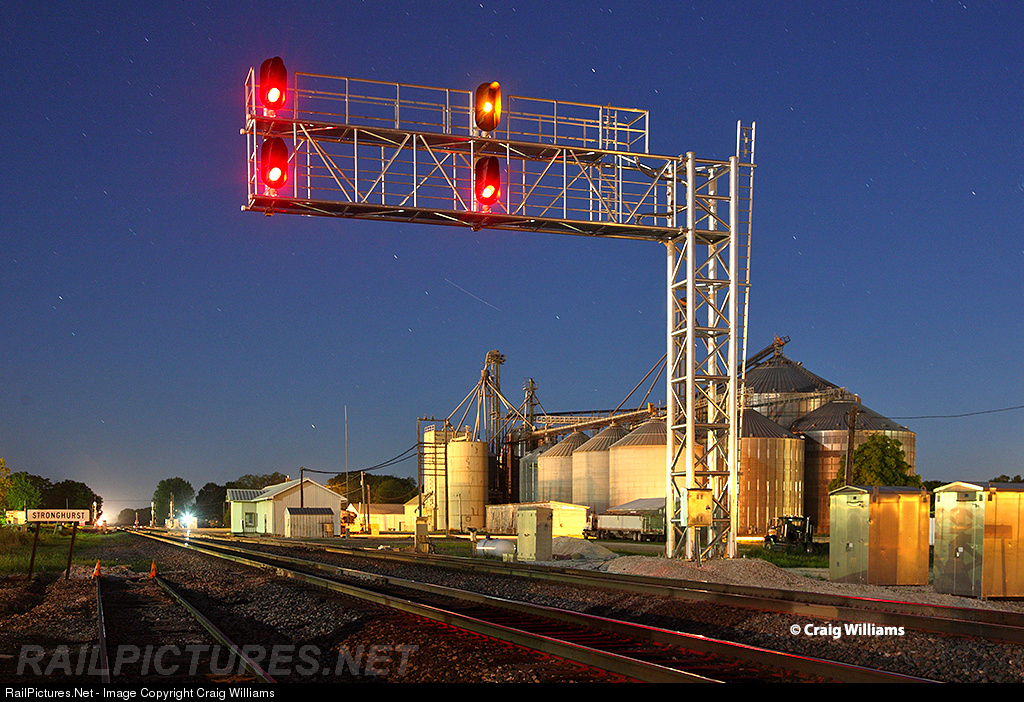
Further west I had previously had hope for the BNSF Chillicothe sub due to what were clearly 2000's re-signaled searchlit interlocking plants. However it appears that STRONGHURST was not among these (again note the above ground cable runs) and it was recently saw the Darths turned on.
Going about as far west as is possible, the new signals on the Donner Pass route between SWITCH 9 and SHED 10 were cut in. Good thing I took an encore trip on the Zephyr back in June. See my trip report for information on other parts of the line.
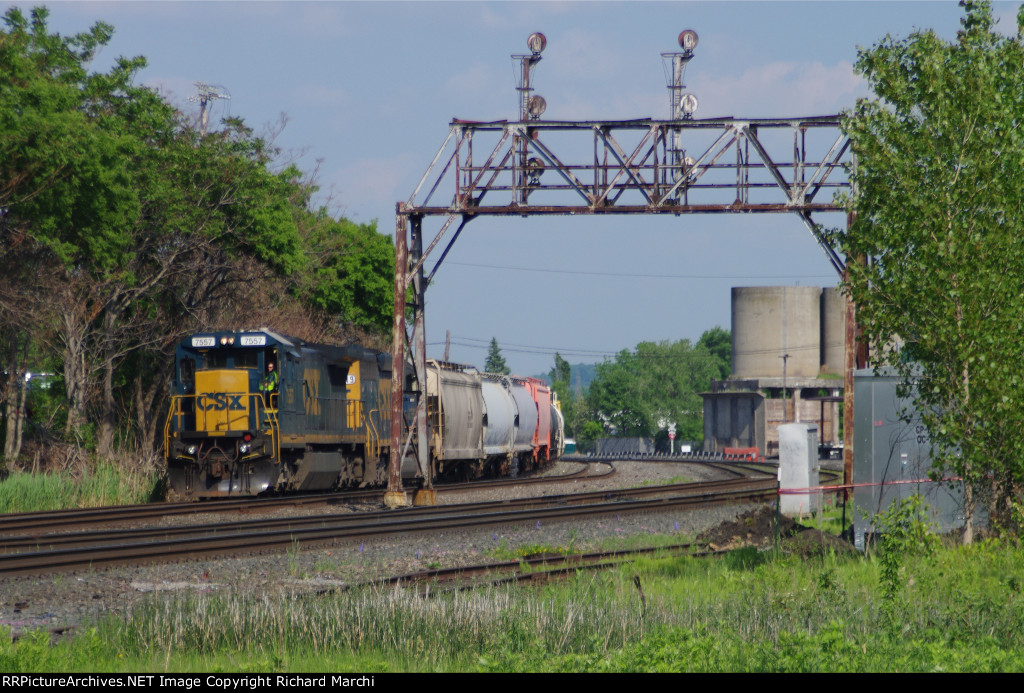
The small target searchlights are coming down at CP-287 near Syracuse on the Chicago Line. I assume this is part of a larger re-signaling project. The larger question will be what happens to the "new" Conrail signaled CP-290.
The new signals on the CSX Philly sub have been cut in through the Ankin siding.
Moving over to Ohio the C&O signals on the Northern Sub in the Richmondale, OH area have also finally been removed.
Saving the worst for last it appears that for some reason the Kansas City Terminal is replacing some of its searchlights in the Union Station area. I was hoping that KCT's independence would insulate it from the resignaling mania sweeping the nation. The real danger is replacement of SANTA FE JCT and its pneumatic point machines.
In an update to a previous news item I noticed a photo of the famous 4-track "modern" PRR PL signal bridge at CP-ROCKVILLE. The bridge is now down to 3 PLs as one of the yard tracks was lengthened by installing a new Vader mast a few hundred feet to the west.








%20woyh%20clear%20sig%20west%20aikin%209-5-2014.jpg)