Search This Blog

Showing posts with label PRR main line. Show all posts

Sunday, June 21, 2026

Amtrak THORN Tower to Close Aug 8, 2026

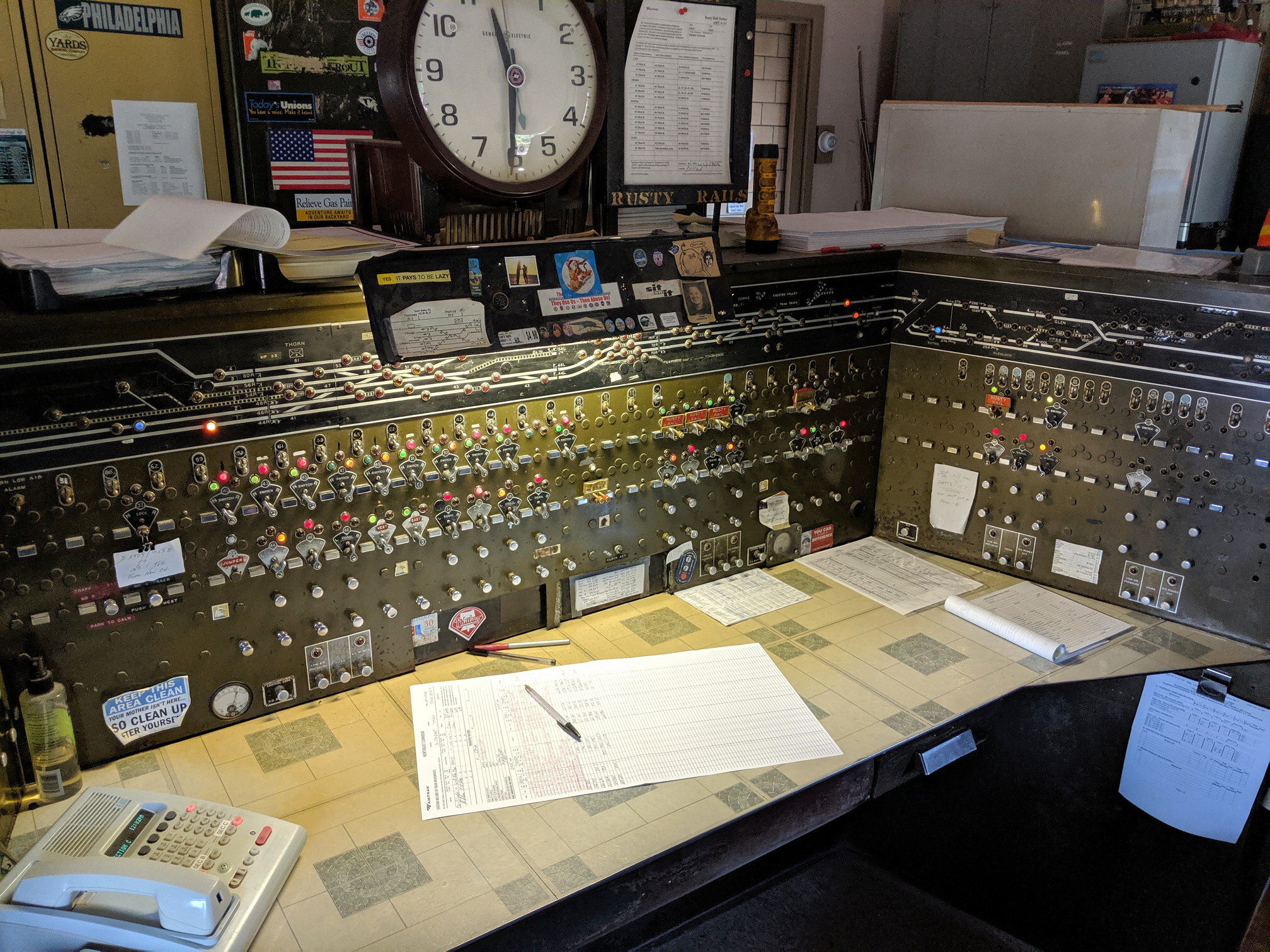
For over a year I have been tracking the slow motion closure of Amtrak's THORN interlocking tower. located on the old PRR Main Line in Thorndale, PA Opened in 1938 as part of the PRR's electrification project to Harrisburg, THORN was equipped with a state of the art CTC unit lever console controlling  4 remote interlockings in addition to the local 6(!) track full crossover. THORN's extended territory, including FRAZER interlocking which was commissioned in 1994, is what has allowed for the prolonged multi-year closure, which will take place just shy of the tower's 90th year in continuous operation.


Since the first part of THORN's territory, CALN interlocking, was chipped away back in 2020, the local 6-track crossover was rationalized and then turned over to CTEC control while the THORN operator continued to handle SEPTA movements in and out of Frazer yard as well as the daily NS freight entering the line at GLEN. More recently DOWNS interlocking was prepared for complete removal, its signals left standing as the change point between CTEC and THORN's control.  In the final act, kicking off in early 2026, GLEN and FRAZER interlockings were reconstructed with the goal of a Rule 562 cutover once all of the work had been completed. 

THORN interlocking as rationalized in 2023

The closure will bring full bi-directional operation between THORN and PAOLI, with the segment between FRAZER and PAOLI remaining outside the Rule 562 zone for now. The much diminished PAOLI tower is likely next on the list for closure before the heavy lift of installing Rule 562 on the core of the old 4-track "Main Line" begins. One loss that's easy to overlook is the now vestigial limited speed triangle at DOWNS interlocking with those at BRYN MAWR likely the only set remaining outside of Canada.

Another loss will be the intermediate signals at Exton, which were easily accessible from the SEPTA parking lot and well positioned for photography. 

For persons desiring photos of these, the Milepost 29 signals or what's left of DOWNS, you probably have until August 7th assuming transition operations will take place overnight. At 1:30pm on August 8th, THORN's final staffed shift will end. The tower is directly adjacent to the Happy Day's Diner for anyone looking to mark the event. 


Friday, March 13, 2026

Amtrak Harrisburg Line Re-Signaling Hits FRAZER

I have previously discussed the drown out closure of Amtrak's THORN tower in Thorndale, PA. Recently the re-signaling efforts have hit FRAZER interlocking where new colorized position light masts have replaced the old amber style PLs. This is just another symptom of the eastern end of Thorn's territory being converted from its 1937 ABS 251 CTC to contemporary Rule 261 CTC. 


FRAZER is an interesting part of THORN's zone of responsibility. As covered in Part 2 of my old PRR Main Line signal survey, FRAZER was placed in service around 1994 when the old Paoli MU shoppe complex was closed due to massive PCB contamination stretching back to 1915. As a replacement a new yard and inspection shoppe was opened near Frazer, PA, extending basic SEPTA R5 service an additional stop to Malvern, PA. The only problem was that there was no interlocking infrastructure at the Frazer location to to support what is SEPTA's busiest commuter rail line. The solution was a new interlocking, FRAZER, that consisted of a yard lead, a turnback track and a center pocket track where eastbound R5 trains could wait for any conflicting movements to clear up.


There was some initial debate about whom would control the interlocking as in 1994 the entire Amtrak Harrisburg Line was still paper dispatched and FRAZER was located directly between the territories of THORN and PAOLI towers. A 1994 fire at BRYN MAWR tower forced the issue when PAOLI  took remote control of that interlocking leaving only THORN with the necessary spoons for more territory. However the increased workload did bump the operator's position at THORN to that of a higher paid Train Director. 


Because FRAZER was located in single direction Rule 251 territory about 4 miles from an existing interlocked crossover, it was not deemed necessary to give FRAZER universal crossovers of its own, so only a training point path was provided mainly for R5 trains heading east. Because this part of the Main Line was built with 4 tracks, there was ample room for a centrally placed pocket track. 


FRAZER is likely the last new Amtrak interlocking constructed with amber PRR position light signals. By 1994 the conversion of the NEC to colorized PRR position lights (a downstream outcome of the Chase, MD wreck) was well under way, but with no plans to convert the old PRR Main Line (Amtrak Harrisburg Line) FRAZER was designed with amber lamps for the sake of commonality. This view was incredibly short lived as PAXON and WOODBINE interlockings built to support the new Overbrook Maintenance Facility just a year or two later would have the position color lights.


It is unclear if FRAZER's conversion is part of a full re-signaling or just a modification to support both the colorized signals, bi-directional operation and Rule 562 cab signals without fixed wayside signals. Dwarf and pedestal signals unaffected by\the changes do not appear to be facing replacement along with the primary relay hut. New Rule 562 signal indication points between FRAZER and THORN are in place along with new signal equipment at GLEN and the planned decommissioning of DOWNS. If I am not mistaken, this will also be the first time SEPTA crews have to deal with Rule 280a "Clear to Next Interlocking" signals on their regular territory as their own Rule 562 territory lacks this feature, instead handling cab signal failures with dispatcher issued Form D's.

Friday, February 27, 2026

PHOTOS: LANDIS - The PRR Main Line's Forgotten "Tower"

One might wonder how the electrified PRR Main Line could have an interlocking tower somehow more "forgotten" than the small booth that occasionally managed the emergency crossovers at LEAMAN, but it did and that forgotten tower also began with the letter L. LANDIS tower, in Landisville, PA, was always a stepchild of an interlocking forced on the PRR by the rival Reading Company by means of the Reading and Columbia Branch.  This was a forked "milk run" line connecting Reading (via Sinking Spring) to Ephreta, Columbia and Lancaster. The Lancaster fork was ultimately integrated into the west end of CORK interlocking, crossing the main line via crossover switches and the Columbia Branch via diamonds. The Columbia fork met the PRR Main Line about 8 miles to the west at Landisville and, due to the lack of any existing infrastructure, the diamond managed to justify its own interlocking tower, built and operated by the PRR.

Given the telegraph code NV, a square wooden tower was built in 1902 in the contemporary PRR style exemplified by the preserved LEMO tower at Strausburg. 

This tower lasted into the post war period, its Victorian aesthetic somewhat in conflict with the electrification infrastructure. In this photo one can see the Reading alignment complete with Reading style US&S color light signals in a target configuration. Also note the Reading freight station which in this photo is partly obscuring the PRR Landisville freight station behind it. 

Based on the 1962 interlocking chart it can be surmised that the old NV tower was taken out of service around 1953 with the block and interlocking station moved into the old PRR freight house. Here the part-time operator would work the crossing as needed using a 5 lever US&S table type interlocking machine. Each main track had a pair of signals controlled by a single lever in the US&S fashion. The Reading was controlled by lever 1, the PRR levers 6 and 8. The Reading signals could display Stop, Clear and Restricting in both directions. The PRR signals had a full ABS head with a Stop and Proceed marker with the current of traffic and a dwarf with Restricting and Sop against. The Reading track had split point derails on either wide of the diamonds controlled by lever #4 and the PRR had a hand throw trailing point crossover unlocked by lever 5. The last detail of note was an 'E' marker on the eastbound PRR track which would illuminate if the dragging equipment detector near milepost 79 were activated.


As of 1954 LANDIS was listed in the timetable as an Interlocking Station open part time from 8:30 AM to 4:30 PM daily except Sundays and holidays. By 1971 this had changed to 10:00 AM to 6:00 PM Daily except Saturdays, Sundays and Holidays. Ultimately the Conrail merger of 1976 would prove fatal to the diamond crossing at LANDIS as the Reading branch line was no longer providing "competition" in the Lancaster market and Conrail trains based out of the PRR Lancaster yard could serve what on line customers remained. Therefore the diamonds were removed, the "tower" was closed, the milepost 74 ABS signals replaced the controlled signals on the PRR Main Line and a PRR freight delivery track was repurposed into a new connection to the ex-Reading branch towards Columbia, PA.


Like many legacy railroad structures along the Amtrak RoW, the freight station version of LANDIS was boarded up and left to become somebody else's problem. 50 years later the building still stands in decayed-yet-reasonable condition.


Similar to the Reading's old Chester Creek Drawbridge, the 5-lever US&S "table interlocking machine" is still present in the operator's area, albeit in a stripped down condition. Similar to the single story PARK tower, the windows were covered over with high security wire mesh.


The "table interlocking machine" was a modular platform for very small interlockings up to about 10 levers. Each module contained a standard US&S bell-crank type "lever" and was could interface with both mechanical and electro-magnetic interlocking components. At LANDIS the lever modules have been removed, but the robust metal base remains in place.


For comparison here is a similar table interlocking device set up in NORTH PHILADELPHIIA tower as an auxiliary to the main US&S EP machine. 
 

We can see that the LANDIS machine had a US&S/S&F style mechanical locking grid as well as make/break circuit spindles.


As an interlocking station the operator was provided with a full telecom suite mounted just outside of the bathroom nook.


An old relay hut sits across the tracks, although it is hard to tell what era it came from, Amtrak, PRR or PC.


LANDIS continued on as an ABS signal location until the mid-2000's Rule 562 re-signaling. Today only those with a knowledge of PRR Main Line history, or a sharp eye for abandoned rights of way, would notice that something had once gone on here.


Just goes to show that while many old towers have been demolished, a few are still hiding in plain sight.

Sunday, December 21, 2025

PHOTOS: LEAMAN - The Place To Be

The Pennsylvania Railroad Main Line, today operated by Amtrak as their Harrisburg Line, is known for its many interlocking towers that survived well into the 21st Century and I have covered several of them on this blog. However there is one "place" that isn't quite a tower, although it has many of the trappings of one. While the PRR seemed to have an aversion to CTC, it still had a lot more signaling infrastructure than peer railroads with a particular focus on Manual Block System and its related component, the block station. What's a block station? Well its a location on the line that can host a block operator who in turn can perform those duties necessary for some (manual) block operation like transmitting train orders, displaying signals and throwing hand operated switches. Even on signaled PRR main lines one could find non-interlocked block stations open either 24/7 or part time.

Located at milepost 56.7 between PARK and CORK interlockings on the Main Line is the town of of Leaman Place. You might recognize the name for being the interchange point for the Strasburg Railroad. This segment of the Main Line was electrified in 1939 and at the time  featured 4 main tracks. Despite the 24 mile gap between the two interlocking stations, no intermediate crossovers were provided as most disruptions could be dealt with by relying on the "spare" main track (with the parallel Columbia Branch directly providing an additional two tracks of relief capacity for freight). However in 1948 tracks 2 and 3 were removed due to declining traffic and evidently this length of single track operation during maintenance or equipment failure had become an issue because in 1961 the PRR constructed the new LEAMAN block station at milepost 57.0 with a pair of main track crossovers protected by semi-automatic signals. Unlike similar hand throw block stations LEAMAN had no normal hours of operation and was only open as needed for single track operation.


LEAMAN consisted of a pair of center locked hand operated crossovers and a pair of position light signals oriented in the normal direction of travel. As this was not an interlocking, no reverse direction signals were not installed. A rather robust operator's shelter was provided and outfitted with  station signs, climate control and telecommunications. 


This sort of hand operated crossover layout was not uncommon on other double track ABS main lines with the requisite "shelter" typically taking the form of a wayside telephone booth that would allow crews to call the dispatcher to pick up their movement authority to run through the single track area or to report clear of it. However LEAMAN was unique in that its signals and electric switch locks were tied to a small control panel inside the operator's shelter and not accessible to road crews. 

Sunday, November 30, 2025

The Other Rule G

The evolution from "Stop and Proceed" to "Restricted Proceed" in North America is long and something I hope to tackle at a later date. A holdover from the timetable and train order era where waiting for a train running ahead increase its lead made some sense to reduce collisions, the fuel and time savings of allowing following movements to keep moving is hard to deny.  However even where Stop and Proceed are the norm, exceptions are necessary where something like a stiff grade might make restarting a heavy freight train difficult. To implement these exceptions, the (G) or Grade marker was used on automatic signals to relieve some or all trains of the need to stop when paired with a Stop and Proceed indication.


Stop and Proceed was especially popular in the Northeast United States, but after Conrail was picked apart by NS and CSX, most of the major northeastern freight territory fell under the spell of Restricted Proceed.  At this point the G marker appeared to be on its way out as the remaining NORAC roads were either passenger focused or too small to have signals or heavy freight trains. However, as the limited speed triangle, Amtrak's Harrisburg line turned into an unwitting refuge. The PRR's Main Line between Philadelphia and Harrisburg was surprisingly hilly and saw more than its fair share of automatic signals with (G) markers applied.

One might assume that the spread of Rule 562 cab signals without intermediate wayside signals and complete lack of through freight would put the Main Line's (G) markers into a terminal decline, however at the Milepost 21 intermediate signal, a minor capacity project may have what could be the last new main line (G) marker to be installed in the United States. 

When Amtrak wanted to upgrade the single direction tracks tracks between the SEPTA Yard at Frazer and the start of 4-track operation at Paoli, they modified Milepost 21 intermediate signal location for bi-directional operation on both tracks with new Safetran colorized position lights and (G) markers in the eastbound direction.  Moreover, the (G) even uses the same old school blocky font as opposed to the smoother letter used on things like (D)istant and (A)pproach markers.

It's anyone's guess how much longer these (G) markers will be around for as the track segment they govern will soon be subjected to the Rule 562 treatment. Another part of Amtrak territory south of Wilmington also features both long freight trains and (G) markers, but it too going the 562 route so its a good chance that these will be the last new (G)'s installed in the United States. 


Saturday, June 21, 2025

New Pittsburgh Line Interlockings

Norfolk Southern's ability to extort the state of Pennsylvania to add additional passenger frequencies on the old Pennsylvania Railroad Main Line is resulting in a slew capacity expansion projects in the form of "new" interlockings and additional tracks. I use the quotes as some of the interlockings are actually restorations of those that existed within living memory, but were removed for the sake of efficiency. 

Restoration of the old SG and NY interlockings.

The first phase of this work is underway at the set of the old SG interlocking west of Johnstown. The new crossovers will allow Amtrak trains to use both sides of the single island platform that serves tracks 2 and 3. Currently if track #2 is unavailable, trains must use main track #3 which follows the slower route of the old Sang Hollow Extension for 15 miles between CP-CONPIT and CP-C since SG interlocking was removed by Conrail around 1980. 

Returning 3 tracks to the Rockville Bridge

Additional changes include the restoration of CP-WEST PITT, removed by NS around 2007, a new crossover on the West Slope near the old NY interlocking between CP-SO and CP-MO, a new third main track between CP-ALTOON and CP-ANTIS, a new interlocking on the Altoona raceway between CP-ANTIS and CP-GRAY and another third main track between CP-BANKS and CP-HARRIS, which would restore a third track to the Rockville Bridge which was lost around 2000. Summary details of the project can be found here with a 2021 report providing more details of the track and interlocking changes. Note the report is not gospel as photos of the new CP-SG show parallel crossovers instead of a universal crossover.

Although no longer equipped with Conrail/PRR era signals, the NS Pittsburgh Line is still Rule 562 cab signaled with "C" lamps, so more interlockings means adding signals where automatics were previously removed.