Search This Blog

Showing posts with label ABS. Show all posts

Friday, August 15, 2025

Signals of the Reading and Northern Lehigh Line

Pennsylvania's Wyoming Valley, today home to the Scranton–Wilkes-Barre metropolitan area, was the West Texas or Saudi Arabia of the 19th century due to its massive reserves of Anthracite coal. A premium product demanding premium prices, anthracite coal was the way that industrializing America kept warm in the water months after the landscape had been stripped bare of trees for firewood. This is how the Wyoming Valley could fund the operations of three major railroads (the Lehigh Valley, Central RR of NJ and Delaware Lackawanna and Western) and similarly explain why those railroads seemed to evaporate without a trace when the world moved on to oil and natural gas.


Perhaps nothing optimized the uniquely American phenomena of direct railroad competition like the LVRR and CNJ, whose main lines were both functionally and in some places literally parallel. In the 1960's the anthracite collapse was well under way and a decade before Conrail, the CNJ teamed up with the LVRR to consolidate its operations to Scranton. North of its large yard in Lehighton, PA, the LVRR and CNJ used mutual trackage rights to stitch together a hybrid route, using better aligned portions of the CNJ over the Pocono mountain summit between White Haven and Laurel Run. In 1972 CNJ threw in the towel on operations to Scranton and later Conrail would choose to use the CNJ main line between Lehighton and Allentown creating a Frankenstein's monster "Lehigh Line" between NYC, Scranton and NY's Southern Tier. As the region's industry continued to shift, Conrail shoveled off the Lehigh Line north of Lehighton to the upstart Reading and Northern in the 1990's.


All this history is necessary to understand why the signaling on the Lehigh Line portion of the Reading and Northern's main line between Reading and Pittston, looks the way it does. Recently made visible by the series of R&N Iron Horse Rambles and its regular weekend Lehigh Gorge excursion service, the current signaling on the upper Lehigh Line reflect its unique history. In the 2024/2025 time frame I was able to gather enough content to put together a signaling guide covering the old Lehigh Line between Mauch Chunk and Pittston.


We begin at R&N's COAL interlocking, which was built new by them to support the R&N's "Main Line" concept between Reading and Pittston, but also its Lehigh Gorge tourist operations. Using a salvaged lattice cantilever mast, COAL connects what was the old CNJ route to the former LVRR route at the south end of the Lehigh Gorge.


Into the 2000's, Conrail (later NS) owned and operated this portion of the Lehigh Line as a double track Rule 251 main line. Traffic was so light that the southbound track was used bi-directionally with northbound trains needing to get a Form D, while the southbound track had its signal system taken out of service and used for R&M excursions and freights. NS moved first to convert the southbound track to Rule 261 (CTC) operation, with the R&N converting the former northbound track to Rule 261 in the late 2010's. Each track has a single ABS signal location in this line segment, NS at LVRR milepost 126 and the R&N's at its own milepost 124.


A quick note on Mileposts. In the Conrail era the Lehigh Line would alternately use legacy mileposts from the CNJ, LVRR and LVRR Mountain Cutoff. The Reading and Northern switched this to its own mileposts that continues the Reading Company chaining from the old Reading Terminal.  Somehow this has managed to match up with the legacy CNJ mileposts within a few tenths, but LVRR mileposts are off by several miles. I will be using the R&N mileposts for most of this article.
 

CP-M&H JCT marked the transition between double track ABS and single track CTC through the Lehigh Gorge and, starting in the 1990's, the start of the Reading and Northern lease. CP-M&H JCT was re-signaled by Conrail around the time of the lease and has the typical Conrail hallmarks of a CorTen steel relay hut and color tri-light signals. What sets CP-M&H JCT apart is the use of "budget" L&W brand modular signals in the tri-lights. It's entirely possible that the lease arrangement had Conrail responsible for some portion of the signaling system (the interlockings still appear in CR's 1997 signal charts) resulting in signaling that looked Conrail, but with different hardware.


When the R&N lease came into force the arrangement still created a gap in the R&N's conceptual Main Line between Mauch Chunk and CP-M&H JCT where they had to run under Conrail rules and dispatching. When NS finally transferred the northbound track to the R&N in the mid-2000's, they were so thrilled to be in total control that they built a new interlocking back-to-back with CP-M&H JCT named INDEPENDENCE.

The mast is for CP-M&H JCT and the dwarf for INDEPENDENCE.

CP-M&H JCT wasn't an isolated re-signaling as it appears that all of the signaling in the Lehigh Gorge proper was replaced around the time of the lease. This was possibly due to the desire to replace any pole line based system due to the inaccessible nature of the right of way in the Lehigh  Gorge. The new Conrail style signaling again reflected the economic decline of the region with a shift to extra long 3-4 mile signal blocks versus the standard 1-2 mile length. ABS signal locations in the gorge are at R&N milepost 130, 133/134 and 138. The 133/134 location split the Jeddo tunnel for visibility reasons.


134S from behind

It appears that the pole line was retained to supply 440v power to the signal locations, however it is unclear if this supply is still in service.


The end of the 90's re-signaling is at the controlled holdout signal CP-WHITE-HAVEN, which is just a few miles shy of the alignment change from LVRR to CNJ. In 1965, the CNJ main line north of Mach Chunk consisted of a CTC single track with passing sidings with the operating console located in PQ tower. A connection to the LVRR was eventually installed at a location known as FRASER that would serve as the west end of Lehigh Line double track into the 1980's.When the gorge was single tracked by Conrail, FRASER was replaced by a block signal and ultimately RBMN controlled point at the present location as a stopgap solution to increase capacity on the long stretch of single track. 

Saturday, November 9, 2024

PHOTOS: Amtrak CORK Tower

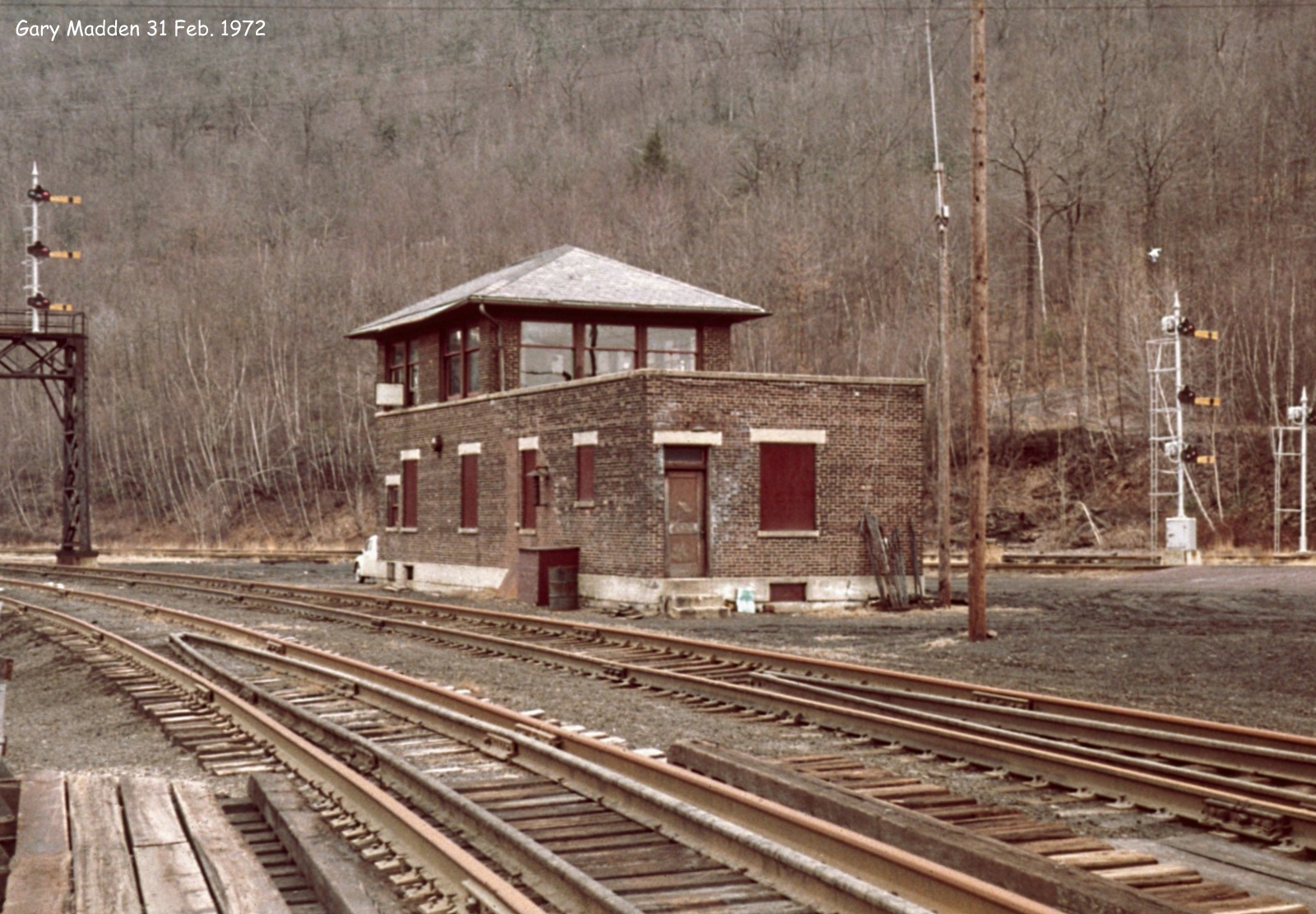
 A while ago I posted the first part of my coverage of the Pennsylvania Railroad's 1929 CORK interlocking tower in Lancaster, PA which covered the tower's history and the layout of the interlocking on the PRR's Main Line. Today we cover the tower itself, heading inside to see how it functioned in both its pre and post re-signaling phases. The exterior photos date from 2005 when the interlocking complex was in the process of being resignaled. 

To recap, CORK interlocking and tower were constructed as part of the 1929 Lancaster station project which moved Lancaster's busy passenger depot away from a downtown alignment with slow speeds, lots of grade crossings and partial street running. The resulting interlocking plant spanned approximately 3.3 miles of main line track, which was an outlier for early 20th century direct wire controlled interlockings in North America. Like the contemporary Lancaster station. CORK was built of a dark brick and featured a prominent bay window sheathed in copper cladding. 


The tower had one auxiliary building that housed the primary compressed air plant and was situated on the south side of the tracks in line with the extreme west ends of the high level station platforms. The tower had an internal staircase with the shelf type relay room on the first floor. With its brick construction and slate roof, the tower was in excellent physical shape as it entered the 21st century. 


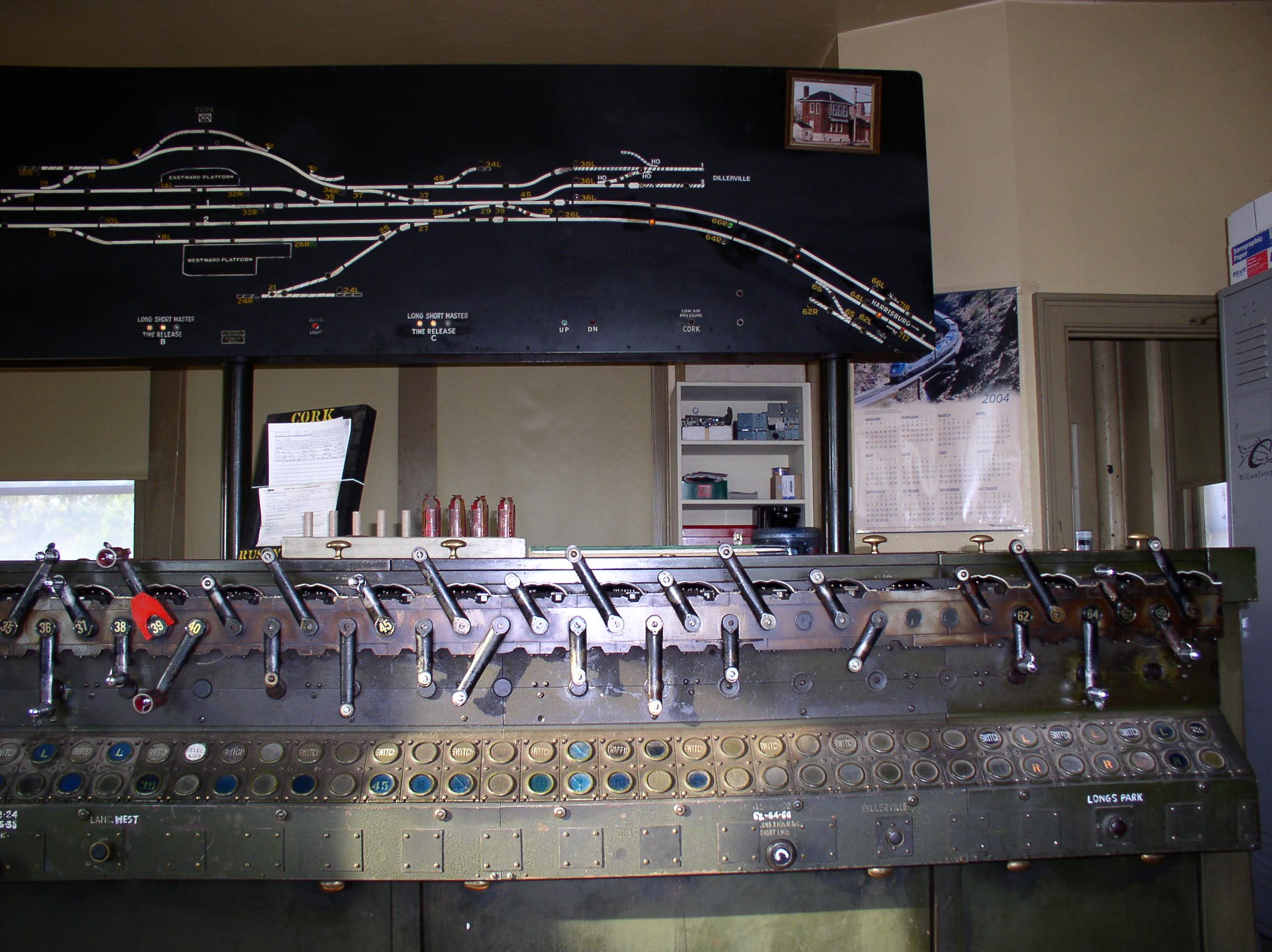
Heading inside the tower we find a typical layout with the operator's desk sitting in front of the US&S Model 14 interlocking machine. A defect detector readout and overhead catenary section breaker control panel are to the operator's right with the lockers, clock and old telecom plugboard sitting to the left. One interesting feature is that the room has retained its original 1929 vintage overhead lamp fixtures. 


The operator's space is feels like a more cramped version of HARRIS tower with less space around the interlocking machine on all four sides. The gap between the scoreboard style model board and the rear aligned internal staircase is particularly small. As with other PRR Main Line towers, lever blocking devices are stored on top of the interlocking machine and the bathroom is in the left rear corner. Also note the location of the refrigerator, notice board and train order hoops. 


The sprawling CORK interlocking plant was controlled by a relatively modest 67 lever interlocking machine with 49 active levers in its 1960's configuration consisting of 23 levers for switches, 23 levers for signals, 2 levers for electric switch locks and 1 crossing lever for the Reading's Lancaster Branch diamond crossing. The plant was divided into three timer zones, A, B and C with the A timer handling the Conestoga section, the B timer the central Cork plant and the C timer the Reading crossing. The short run was 1 minute with the long run being about 5 minutes and 30 seconds. The tower also had 4 horns for Conestoga, the tower itself, Lancaster West, Dillersville yard and the Reading crossing (Longs Park).


One interesting feature was the presence of Rusty Rail tabs instead of the more usual placard. Besides that the levers were of the standard US&S crank type.


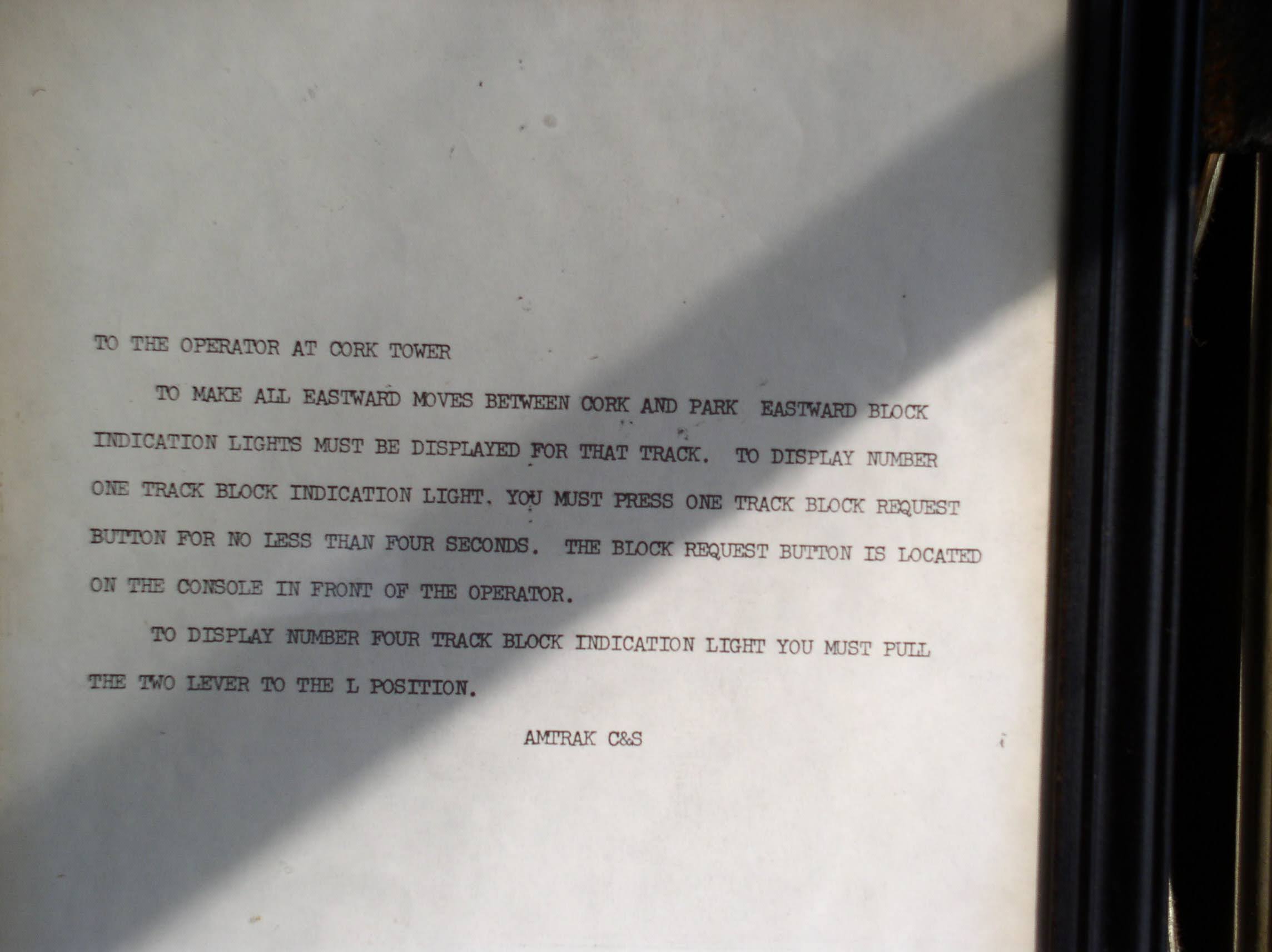
Although CORK's model board was a standard PRR illuminated type, it had several interesting features features. Grade crossing status lights were located at either end of the board to indicate the activation status of the Irishtown Road (east) or Eby Chiques (west) crossings. There were three low air alarms for East and West Conestoga in addition to the Cork main plant. In the post-1960 era two block indication lamps were added for tracks 1 and 4 eastbound. These had some interaction with PARK tower to the east as well as the intervening temporary block station at LEAMAN with track #1 being lit by the regular 2 lever and track #4 by a button on the operator's desk console. Best I can tell this was some technical method to prevent conflicting movements beyond what would be afforded by train orders and the dispatcher. Finally the most endearing model board feature was a framed photo of CORK tower itself that is also present in photos from c. 1992.
 

Saturday, August 31, 2024

Portland MAX Signaling Primer

In the 1980's and 90's North America's light rail renaissance didn't just save money over traditional urban metro systems by embracing street running and low level boarding. At the time, the signaling standard for "heavy" metros involved full CTC and cab signaled ATC, which came with both high infrastructural and operational costs. However light rail systems got a pass to re-write the rule book and adopt signaling practices that hankered back to the low cost interurbans of old with single direction operation and limited use of interlockings. While I have previously covered two examples of these low cost signaling practices in Denver and Dallas, I recently had the chance to explore a third in Portland Oregon.


Beginning operations in 1988 and seeing significant expansion in the 90's and 2000's, Portland's MAX light rail has the typical mix of downtown street running and dedicated suburban rights of way with operating speeds up to 55mph. The signaling of choice is single direction 3-aspect Automatic Block signaling using US&S transit type signal heads. There is little formal distinction between interlocking and intermediate signals each signal is the same in having a line-prefixed number plate.


One quirk of the system is the setup of having an ABS exit signal at each station and another ABS signal between stations. When a station platform s within a block, the signal will at best display yellow Approach so there is a distinct rhythm of exiting a platform on a Clear then entering the next on Approach. Intermediate signals on the main line away from stations are often of the high mast variety with earlier installations using US&S N type mono-block heads.


A key feature of the MAX train control system is the use of fixed inductive Automatic Train Stop (ATS). Unlike some other systems, MAX actually includes a bit of overlap to get trains stopped before they hit something. This is made possible by an LRV's enhanced braking performance necessary to handle the challenges of street running. Apparently MAX also has a few ATS based speed control timers that function independently of fixed signals, but are indicated by wayside signs.


Interlockings are limited to major junctions, yards and a few select crossovers. These are supplemented by hand operated temporary block stations. As I said before, both ABS and Interlocking signals are largely the same except for the possibility for route indications on the interlocking signals. This can range from the use of a single lamp in the "call-on" position, or separate heads, each governing a specific route. The wayside signals are supplemented by switch position indicators of the US&S ES-20 variety.

Sunday, April 21, 2024

NJT's Speed Enforcement System: A Thing That Existed

You might have heard me reference the Northeast's preferred transponder based PTC system ACSES, or the Advanced Civil Speed Enforcement System. In most cases when something called itself "Advanced" its usually a bit of marketing speak, but in this case the basic Speed Enforcement System was a thing that actually existed for a brief period of time on New Jersey Transit's Pascack Valley Line. However because of the rapid pivot to more "Advanced" systems and the 2008 PTC mandate, information on the SES pilot is remarkably hard to come by, however I have been able to piece together a few bits of information that can hopefully shed some light on the technology.

In 1996 NJT suffered its worst accident as of the time of this writing when two trains collated at WEST END interlocking where the diesel Bergen County and Main Lines diverge from the electrified Morris and Essex lines. The cause was a veteran engineer who had been hiding a medical condition that had severely impacted his visual acuity mistaking a Stop signal for a R/R/Y Restricting. In the aftermath NJT began an effort to implement what they called "Positive Train Stop" functionality across its system, which came on the heels of a near system-wide adoption of cab signals and automatic train control (ATC). At the same time Amtrak was completing implementation of its ACSES speed control and PTC system on parts of the NEC in conjunction with the new 150mph Acela rollout. This is where things get a bit murky, but going into the 2000's, both Amtrak and NJT had two different yet compatible transponder systems for "civil" (aka track) speed control, however Amtrak "Advanced" system was integrated with cab signals where as NJT left SES as an intermittent system.

The location for NJT's SES pilot was the Pascack Valley Line, a stepchild service that ran some 30 miles north from the old Erie Main Line to dip its toe into New York State. The single track line offered only weekday single direction peak service and, like the similar old Boonton Line, the PVL was essentially unre-signaled since the Erie days. This signaling came in the form of an Automatic Permissive Block-like bi-directional ABS with occasional non-number plated (ie absolute) automatic signals that would have once appeared at the ends of hand operated passing sidings. Without any actual interlockings and only a single block of cab signaling on approach to Pascack Jct, the limited service PVL was an ideal test bed. 


Reading through the SES special instructions in a 2004 NJT Employee Timetable (posted below) we can gain some insight into how the system worked. The evidence points towards SES was an intermittent transponder based system that would convey track speed information in a manner compatible with Amtrak's ACSES, but also fixed signal indications. A positive stop was enforced for Stop, Stop and Proceed and Restricting indications, with the positive stop zone extending 500 feet in advance of the signal. Stop and Proceed, and Restricting could then be passed after an acknowledgement, while Stop needed the dispatcher to provide a numerical override code in addition to the verbal Rule 241 instructions. This would have come into play at the non-plated automatics and the home signal at Pascack Jct. Special instructions about cab signal upgrades and other rules not applying in SES territory further strengthen the intermittent use case. 


This of course begs the question about how the system would account for signal upgrades after passing an Approach signal if the associated transponder flags a positive stop point like it does in ACSES. As easy solution would be to place additional active transponder at the start of the stop zone 500 feet from each signal, but I have nothing to confirm this theory. An additional feature of the PVL that made it attractive for the SES pilot and that was the presence of signal overlaps. From what I can tell from 2007 era photos, each set of ABS signals had several car lengths between them which would provide sufficient distance for a train running at reduced speed to get stopped before it might encounter an obstruction. This would explain why the SES stop zone is 500 feet vs 1500 for the ACES zone.

PVL automatic signal location with overlap in 2007 with what might be SES transponders (or grade crossing impedance bonds).

SES was always intended to be a temporary pilot and by 2002 NJT had let a contract for its own Advanced SES that integrated cab signals similar to Amtrak, but without the finicky data radio capability for temporary speed restrictions and stop release. Interestingly the $2 million contract with Union Switch and Signal would have outfitted the entire NJT system with PTS and track speed control by 2008! The wireless data free ASES vs off the shelf ACSES debate would extend into the post-2008 PTC era with the ASES plans eventually morphing into ACSES, but perhaps the original SES hints at what NJT's solution would have looked like. Version 1 ACSES also lacked data radios and needed temporary physical transponders for TSR's and use of the stop release procedure to pass certain signals with a proceed indication. Active SES-style transponder could have solved some of those issues without wireless data.

Unfortunately I have been unable to determine the exact timeline of the ABS SES system on the PVL. I know it was in service in 2004 with the CNJ vintage GP40PH locomotives operating in a dedicated pool. I know that SES was still in service as of Jan 1, 2006, however by the fall of 2007, the line had been re-signaled with Rule 562 cab signaling and upgraded with passing sidings to allow for all-day bi-directional service. Unfortunately, starting in August 2006, all PVL physical characteristics and rule changes were put into a separate supplementary bulletin order that I do not have any examples of. Interestingly, the 300 section of NJT special instructions covering SES were left in place with slight modifications likely to cover the upcoming ASES or ACSES installations due to the 2008 PTC mandate probably resulting in some savings in crew re-training. 

If anyone has any additional information on NJT's SES please let me know so I can update this post or make a new one. I've heard a bunch of other stories regarding issues with hair trigger penalty brake applications, but not much more than anecdotes and speculation.

Sunday, December 17, 2023

BNSF CTC Replacing Union Pacific Julesburg Sub ABS/TWC

Just a heads up that about 24 miles of ABS/TWS (aka Rule 271) on the Union Pacific Julesburg Sub in northern Colorado is being converted to CTC as BNSF takes over maintenance of the entire Bush Sub/Julesburg Sub corridor between Union and Sterling, CO. This line represents one of those dual operating arrangements where as traffic levels dropped, two competing railroads turned their parallel lines into a single joint. In the case of the Bush and Julesburg Subs, the division point was the small railroad location of UNION.

Over the last decade or so BNSF upgraded their side of the line and, as their traffic levels increase, they gained more control and have decided to apply CTC to the Union Pacific portion of bi-directional ABS. Although Union Pacific ABS signaling had eliminated use of the pole line and installed PTC, it also made use of short mile long signal blocks with US&S N type color lights at mileposts 77, 70, 69, 67, 66 and 65 in addition to fairly uncommon late model US&S modular color lights at mileposts 71, 72, For example the CTC interlocking replacing the ABS hand throw siding end at MP 58.8 in Sterling will have its distant at the MP 61 signal location. Union Pacific appears to have already been reducing the block length with 2 mile jump to a new Safetran signal at MP 63. The project will also include new interlockings and the currently hand throw searchlit ABS siding between WE and EE MESSEX and two new intermediate signals at mileposts 79 and 78 between MESSEX and UNION. 


It remains to be seen if BNSF will remove/replace all of the old UP intermediates or just those directly adjacent to one of the new interlockings, but for anyone in the area all of the existing signals are easily accessible from public highways including US 6 and County Rd 178.

Saturday, December 17, 2022

SEPTA Suburban Trolley Signaling: Past and Future

Light rail is currently the locus of signaling innovation in North America due to its mix of limited regulation, low budgets and legacy systems.  For example I have previously written about DART's three different signaling methods in use on its light rail network. In Philadelphia, one such legacy system is the suburban trolley lines running out of  69th Street terminal on the western Philadelphia border. Similar to Pittsburgh's south hills light rail lines in concept, the method of operation is currently being converted from a basic trolley era ABS system, to a hybrid CBTC system.  As I just managed to pick up a bunch of new photos, I figured it was a good time to cover both systems while they are still in the transition period. 

Route 101/102 block signals at 69th St

The ABS system inherited by and later updated by SEPTA as necessary, was a 2-block affair with signals displaying proceed (green) or stop (red). Although there was one location, Drexel Hill Jct, that could be described as an interlocking with full signal protection and a power operated facing point switch, the entirety of the Routes 101 (Media) and 102 (Sharon Hill) were run under traditional ABS rules with hand throw crossovers and spring switches entering sections of single track. 

Two aspect ABS signals at a Route 101 hand throw crossover including operator hut.
 
The single track segments were handled with an automatic tumbledown scheme and the one junction was fitted with a three lamp signal and a route selection punch box. Where a diverging move was encountered a yellow signal indication would be displayed. There was also no ATS or ATC enforcement of signals or speeds. 

Legacy yellow diverging aspect at east end of Route 101 single track segment.

Due to the sections of street running and close spacing of stops, the Suburban trolley LRV's are considered to have sufficient braking performance to dispense with an Approach type indication. Signals are approached prepared to stop and when the next block is cleared, the following movement will get a clear signal to proceed. Not all of the route miles are protected by signal indication with the street running and other slow areas working on sight. These sections are partly defined by "end of block" signs. 

Route 102 switch protection signal paired with a single track block entrance signal.

In addition to the two lamp ABS signals, there are/were switch position indicators and reverse direction protection for the single track sections and Drexel Hill Jct. When entering single track and exit signal would follow the spring switch to protect against a race condition if two opposing trolleys were to attempt to "seize" the single block at the same time. 

Route 101 single track switch signal with block entrance signal in distance.

Starting in 2019 work started on a new CBTC based signal system that would also make use of sizable number of interlockings to replace hand throw crossovers and single track spring switches. As of early 2022 the CBTC system had not yet entered service so the interlockings were used to supplement the existing ABS signal system. 

New SEPTA Suburban Trolley cab display unit with CBTC disengaged.

In fact on the combined section between 69th St and Drexel Hill Jct there were sufficient interlocked crossovers to supplant all of the ABS signal locations! As many of the ABS block signals have so far remained on the routes past Drexel Hill Jct during the transition period, it is anticipated that the CBTC will provide full block separation, not just a safety overlay.

New Route 101/102 combined trunk interlocked crossover and block section signal.

All in all the project involved the addition of 10(!) new interlockings, three crossovers on the combined Rt 101/102 trunk, Drexel Hill Jct, one crossover on each Rt 101/102 branch, three Route 101 single track endpoints and one Route 102 single track endpoint. In addition to these interlockings, three additional holdout signal locations were installed in proximity to an interlocking.
New interlocked holdout signal at entrance to Rt 101 single track territory to accommodate short turns


Another interesting new feature is the provision of a yellow fixed ATS transponder adjacent to each fixed absolute signal.

Yellow ATS transponder located between mast base and rail.

Although I was unable to observe every detail of the current operation it appeared that the new wayside interlocking signals were backwards compatible with the old ABS system displaying R - Stop, G - Clear, Y -Diverge. The presence of a 4th lamp hints at at the presence of a lunar white indication that will either be used for a "cab speed" (most likely) or an absolute block / restricting signal.

Same location as above prior to rebuild with spring switch and yellow "end of block" sign indicating start of line of sight operations.

Although the new CBTC/CTC system is modern and high tech, it never the less exhibits the limits of technology to deliver substantive performance gains. Ten new interlockings along with 20 or so miles of CBTC will cost more to maintain than the legacy ABS system. Furthermore, the speed control function will almost certainly decrease performance from current standards. On the other hand contingency operations will be greatly improved with track work becoming possible during operating hours and vehicle/overhead line failures now able to be worked around without the need for temporary block operators hand throwing switches. In theory the capacity of the system will improve, especially on the route 101/102 combined trunk, however the decision to run more frequent service has always been limited by the budgets and political will of both SEPTA and various levels of government. My assessment is that operations will say the same, liability will decrease along with speed and the impact/cost of contingency operations will decrease enough to offset the high cost of the new signaling system, at least until the point that the technology becomes unreliable.