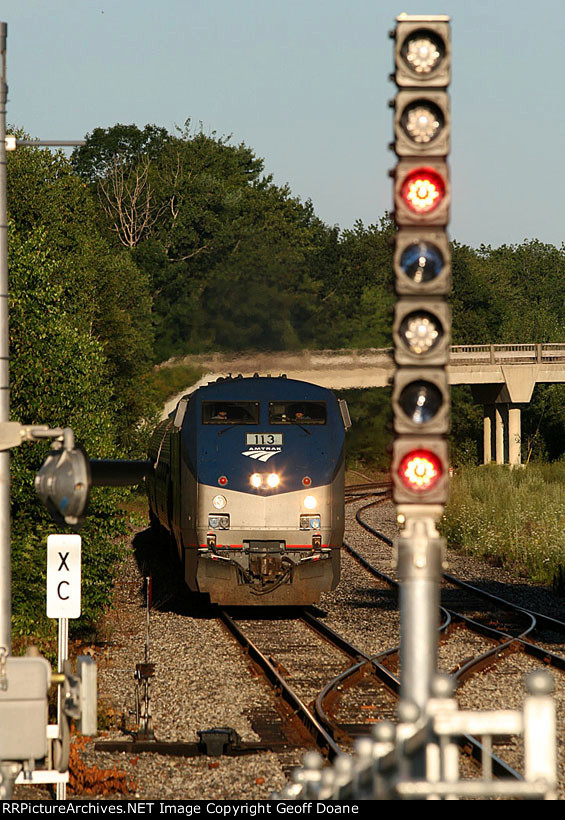
Search This Blog

Thursday, August 29, 2013

WALTHAM Tower: 1928-2013

Well this one snuck past me.  WALTHAM tower, which was creeping toward closure with a general resignaling project on the MTBA Fitchburg Line, went up and closed on June 1, 2013.  I wasn't keeping track of the project too closely, but I figured there would be ample warning from new signal locations and relay boxes and neither were in evidence as of March 2013 so either the signaling crews got that stuff in in record time or they did a less destructive splice job.


Anyway, WALTHAM was one of a dwindling number of US&S Model 14 interlocking machines still in service.  While all types of classical electro-mechanical towers have been suffering from attrition, US&S plants have taken it on the chin over the last few years with UNION, JAY, HALL, DUNTON, ALTO, NS BRIDGE, WB, CORK, BUZZARDS BAY and HN all getting tossed into the bin.  WALTHAM only survived this long due to the freak happenstance of it being made part of a B&M CTC project back in the 1950's or 60's.  This made it a shining example of modernization when the rest of the New Englande rail scene was terribly antiquated.  For example most of the NEC was still being run under ABS rules with block stations up into the 1990's.  Inside WALTHAM was a rather modest US&S Model 14 for the local plant and a 3-panel GRS unit level CTC machine controlling the line from the terminal area through to South Acton.


The local WALTHAM interlocking consisted of "Conrail Crossover" (two tracks going to single then back to two), with a couple of industrial spurs branching off.  Both "ends" of the crossover were fully protected by searchlight signals.  Despite the CTC machine most of the line was still run under rule 251 with the CTC being of the remote control only kind.


The brick B&M towers are solidly built and the MTBA has been kind enough to honor it with a historic plaque and several human interest pieces in local media so it is unlikely that WALTHAM faces demolition, but there will now no longer be any place in the Boston area where a lucky kid can get invited up to see a piece of history.  I am unsure if this is the MTBA's last active interlocking station as the movable bridges on the Newburyport/Rockport Line used to control local switches and signals although that may have changed.


If you are interested in my 2010 visit to WALTHAM tower you can find the full set of photos here.

If you are interested in a full Railfan Guide to the WALTHAM area you can find one written by a Position Light Blog collaborator here.

Sunday, August 25, 2013

Feathering a Signal

I was down by Maryland's Bush river recently trying to snag some photos of the rather rare drawbridge opening there when I noticed something odd on top of the 3N position light protecting the draw span on track 3.  The signal had been installed only a few years ago when BUSH interlocking was upgraded with a new 80mph High Speed Turnout.  Given LED lamps it also had its fully backed lower head replaced with a minimal / as clear diverging routes would not merit a Cab Speed Indication on the upper head.


Using my 35x zoom that so often comes in handy for close signal photos I noticed a mess of sticks on top of the US&S position light head as well as a lot of white splotches in and around the maintainers gantry. If that wasn't enough of a giveaway an Osprey was perched on this rather impressive nest scanning around for food or other threats.


Also known as the Sea Hawk, ospreys live near water and build large stick nests in elevated positions where they can survey said water for prey.


While these particular signals are not in any risk of being replaced, had they been a nest of this type may have thrown a significant wrench into the project timeline as I am fairly certain it is against Federal law to interfere with the occupied nest of a Bird of Prey, although I'm sure there are probably ways around it. It also shows how signaling structures can provide valuable habitat for raptors and other flying creature...like wasps. 


I am some come winter some maintainer is going to have a fun task knocking down the abandoned nest.  Fun part is when the birds, which mate for life, return to build the nest again in the same place.

Saturday, August 17, 2013

Once Again its Time for the News

This week we begin with the CSX Philly Sub resignaling project, which completed phase 1 over the last several weeks for both interlockings and intermediate signals.  B&O CPL signals were replaced from Bayview Yard in Baltimore up through the Van Bibber siding south of Aberdeen.  This is yet another occasion of recent re-signaling not saving classic signals as the Philly sub was almost completely re-signaled 10 years ago with pole line replacement and some of the interlockings getting new vital equipment.  While the Van Bibber siding interlockings were still relay, Rosedale interlocking was one of those that had been modernized and was replaced like the others.  I believe that Rosedale did in fact get a new Relay hut and not just a signal splice.


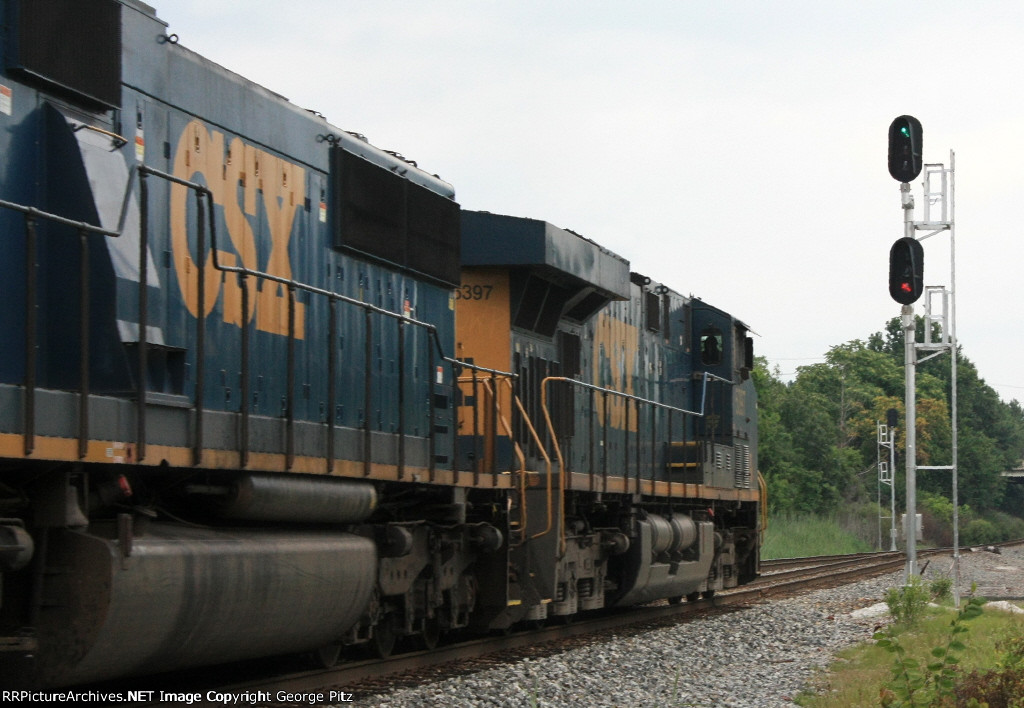
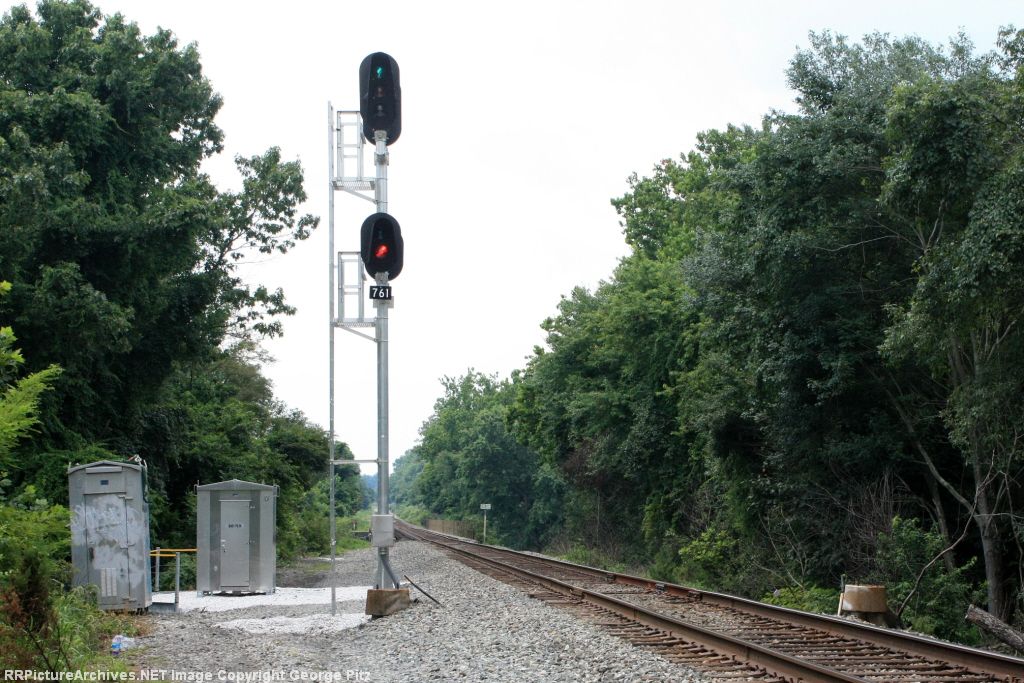
Strangely enough the new signaling scheme has converted almost the entire line to 4-block signaling despite 2 mile blocks and 50mph speeds.  Here you can see the new northbound Rosedale signal displaying Clear over the equilateral turnout with the capacity for Approach Medium as well and yes it is Approach Medium and not the Seaboard's antiquated Y/Y/ Advance Approach.


Also lost were a pair of 1990 vintage intermediate signals south of Rosedale on the double track segment.  Luckily over the years I have had the opportunity to fully document the Philly sub CPL's so stay tuned for a possible post devoted to them.  One signal location I was not able to profile was this one at Bradshaw.  You can see the new but not new enough relay box still standing next to the new new box.  makes one wonder what was so different about 2000 vs 2013 in terms of cost calculations.


 Moving on I noticed that the fairly modern CPLs at the famous Youngstown diamonds have been replaced, but I don't think that anyone is really surprised by this turn of events.  Interestingly enough there is an elephant ear target on the former PRR line which must have been a Conrail recycle job. Also note the bi-directional 4-block ABS support.


Moving on to Fort Wayne, IN on the old Nickle Plate line it seems that despite being more immune to this practice than CSX, NS is dumping a modern traffic light bracket mast in favor of a cantilever at the Runnion St interlocking.  The way railroads want to spend money on shiny new signals structures you'd think it was going out of style. This is also the reason I place bracket masts of any type above searchlights on the priority list.


One might think Amtrak was operating a rapid transit line if you happened to see this signal at the new Brunswick, ME Downeaster station. The previously un-signaled line to Brunswick, ME was given the Darth Vader treatment as opposed to the circular target signals previously preferred by the Guilford Rail System, but this 7-stack of modular Safetran dwarf heads appears to be a close quarters exception. More puzzling is the mix of LED units and traditional bulb and lens units.  Can't quite determine what all this signal can display or if the lens units are Lunar or Green.  I plan to head up there at some point and will investigate.


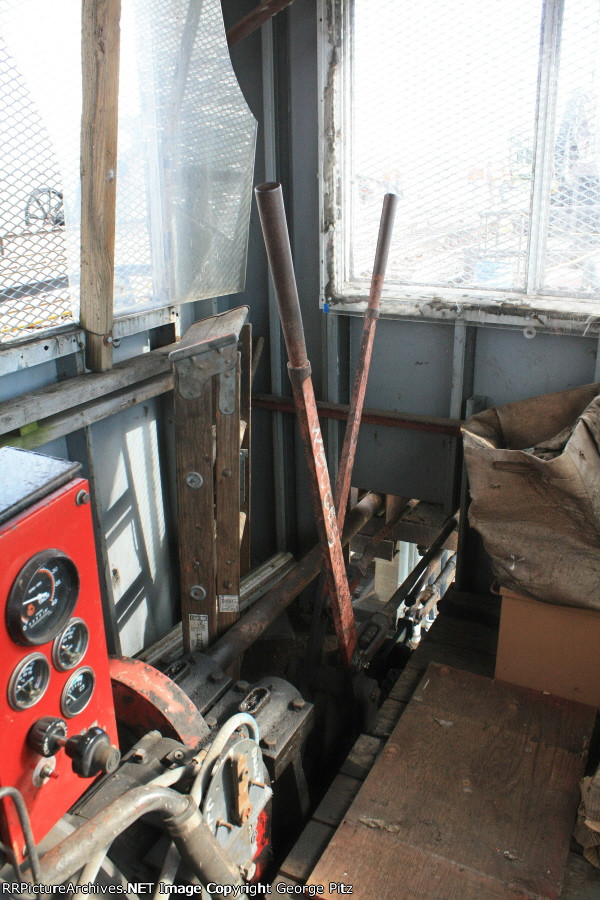
Showing once again that drawbridges are one of the major saviors of classic signaling here is a picture from inside the control cabin of Amtrak's Bush River drawbridge on the southern NEC.  This movable bridge is not part of an interlocking and in fact to open it the rails must be unbolted manually.  It is only opened during summer months on weekends, one in the morning and once in the evening.  Here we see a couple of old school switch levers that move the wedges that keep the bridge locked for train movements.  Next to them is the drive assembly for the short bascule span.


Wednesday, August 7, 2013

PHOTOS: SS44 BERK (and the SoNoToMo)

The South Norwalk Tower Museum comprises the old New Haven Railroad's SS44 (aka BERK) tower in South Norwalk (SoNo) , CT (map) preserved the way it was when it was closed around 1986.

The former New Haven RR main line is operated by Metro North Commuter Railroad, which, unlike is sister Long Island Railroad (this is also operated under the umbrella Metropolitan Transportation Authority), chose to ruin two of the most interesting stretches of classic signaling in the country by replacing forests of searchlights on overhead gantries with a waysideless CSS with 3-aspect dwarf signals at interlockings.

Ironically Metro North did a fairly good job of preserving all of the closed interlocking towers. One of these, SS44 in South Norwalk, was of the brick walled mechanical variety and after being boarded up was eventually sold to a preservation group in the mid-90's who painstakingly restored the tower as a museum. It is probably the only preserved tower with a substantial mechanical lever frame in North America, and a must visit for signal enthusiast visiting the New York City area. Here is a front view of SS44 taken from a passing train.


The museum makes most of its money be selling a truly excellent book about itself, so if you want any further information put and order in and help support the museum.

Signaling Station #44 was built around in 1896 before the "classic style" New Haven tower design came into effect with the pioneering overhead AC electrification project of 1906 and second phase of 1918. These later towers are square, cast concrete with or without brick and a hipped tile roof. Here are some examples.

SS22 SHELL

SS26 PIKE

SS28 GREEN
In 1919 the decision was made to upgrade the original interlocking plant at SS44 to support modern interlocking technologies such as electrically operated signals, track circuits, etc instead of attempting to build a new tower.  Despite the attrition of the early 20th century upgrade program  SS44 does still have a surviving sister by ways of SS214 HART in Hartford, CT.  Unfortunately HART was not as well preserved having suffered a fire and is now threatened by demolition.


While the square footprint NH "standard" towers were designed to take all power frames or electro-mechanical frames with lever operated points and miniature lever operated signals, the narrow rectangular SS44 had a 68 lever all mechanical frame made by the Johnson signal corporation. A more accurate term for this frame might be electro-enhanced mechanical as like later E-M frames, like the US&S style S, all the signals are power operated and governed by both track relay logic and mechanical interlocking logic. The frame was well organized with the red signal levers placed at either end sandwiching the blue and black point and FPL levers. All signal for eastward moves were on the west side of the frame and westward moves were on the east side of the frame.


The lever frame has been fully restored and disconnected from the electric-locking so that one can fully exercise the mechanical locking setting up routes and displaying signals. Unlike British practice all of the points are equipped with facing point locks because trains could operate against the current of traffic under train orders on a fairly regular basis. There almost seem to be more locks than point levers!


Tuesday, July 30, 2013

PHOTOS: ZOO Interlocking Part 1 - The New K

For those of you who didn't know, the famous ZOO Tower (with its formerly 230 lever Model-14 power frame) is is in the news again with the final pair of doubleslip switched in the "K" ladder getting replaced by a standard type turnout ladder.  I still need some time to gather some photos to cover this change, but this also happens to be the 4th anniversary of the "K" section of ZOO interlocking getting transferred to SEPTA so I figured I might as well begin with some additional context.  This will be the first of what will probably be many parts covering both ZOO tower and ZOO interlocking.

While originally part of the Pennsylvania Railroad K funneled trains to the upper level of 30th Street Station. In fact Milepost 0 of the famed PRR Main Line is at the end of the platform at the downtown Suburban Station Since the 70's these trains have all been commuter lines run by SEPTA. SEPTA owned trackage starts at the eastern limits of ZOO interlocking and the old K section of ZOO handles only SEPTA movements. While most movements are straight rail through K movements out of the west end of  Powlerton Yard and any special circumstances for trains coming out of SEPTA territory involve special handling. Since SEPTA closed the old PRR BROAD tower and centralized dispatch functions communications with ZOO have become more complicated and for a while after BROAD closed in 2003 misroutes were somewhat common and once I had to be "sent round the Berry" when my Trenton train came out track 4 instead of track 3 w/o ZOO being notified. 


Both Amtrak and SEPTA found this arrangement irritating as Amtrak disliked being responsible for tracks that doesn't handle any of its trains and SEPTA for having to hear Amtrak complain about this and refusing to put in any capitol investment (the tracks through there have grown extremely bumpy). SEPTA finally found 5 million dollars to re-signal and re-build this section of ZOO as the new K interlocking, controlled by dispatchers at SEPTA HQ and all through 2008 and early 2009 they went about implementing the project.
  
The old "K Tower" section, named for one of the 4 towers closed in the 1934 ZOO consolidation, is being transfered to the local commuter rail authority SEPTA. Shown in the upper corners here and here the K section consisted of the 25, 27, 39, 45, 47 and 53 turnouts and 28, 30, 32, 40, 42 and 168 signals. One very surprising development is that the 64 signals and 65 switch (seen here) were included in the re-working. This means that Amtrak will have to get permission from the SEPTA dispatcher for trains entering or leaving the Rundown track to Amtrak's own M of W yard. The Cuttover is scheduled for midnight on Saturday morning so if anyone has time they should go ride SEPTA today to take some final pics of the remaining old hardware. 

Anyway, back in2007 I was expecting the worst when it came to the re-signaling of K with its PRR amber position lights and pneumatic point machines. I was hoping they would leave the signals in situ and just re-wire them, but I was in for a pleasant surprise as SEPTA decided to install brand new LED Amber PRR Position Lights. Here are some early pictures I found on Railroad.net:


Since US&S PL-3's aren't made any more the signals were Safetran units and the new point machines were  electric. SEPTA also installed new Amber PL's at ARSENAL interlocking so unlike the turncoat LIRR there seems to be someone cool working in the C&S department at SEPTA

Anyway, for your reference I have posted a PDF of the Bulletin order describing the change.

The cutover was a rather slow motion affair with new signals and switches put in place, but wired to the big Model 14 machine in ZOO. This has provided the opportunity for ZOO to have one last hurrah controlling some brand new signals.On a 2009 trip on Amtrak's Pennsylvanian I managed to take a number of the ZOO-attached new signals.

Here's a new Cantilever with the old 30R and 32R signals for 3 and 4 track westbound.


The big signal gantry with the old 40R and 42R signals on track 1 and 2 westbound.


Big gantry with the 181 and 182 exit signals as well as the to-be-removed 32L signal. It's interesting to note that many of the new signals show more aspects than their former counterparts. 181 and 182, for example, both have new lower heads.


The same thing applies to the 183 and 184 exit autos show here in 2012.


Another view from K showing the classic wide signal gantry with the 181 and 182 exit autos and a much improved trackbed.

Saturday, July 27, 2013

PHOTOS: LIRR VALLEY Interlocking and Tower

VALLEY interlocking in Valley Stream, NY on the Long Island Rail Road (of iced tea fame) is one of the more important and visible towers on the LIRR. It was re-signaled in 2009 or 2010, but due to the LIRR's commitment to service quality the tower repained open converted from its original 1930's US&S Model 14 interlocking machine to new panel and video game setup. The tower is located at the quintuple junction(!) of the Montauk Branch, Long Beach Branch, Far Rockaway Branch, West Hempstead Branch and Atlantic Branch.


Now I don't have as many details as I usually do due to the retaliative opacity into LIRR operations as the labour organization is skilled at protecting the jobs of its workers, however some of the photos I have were made available by a knowledgeable individual on one of the forum's I frequent. Despite the LIRR prefix VALLEY and almost all the rest of the classic LIRR physical plant this was essentially a PRR operation as the LIRR was a wholly owned PRR subsidiary up until the mid 1960's when it was given over to the Metropolitan Transportation Authority. The tower is typical for late 1920's PRR interlocking plant with all brick construction, pneumatic switches and of course position light signals, one of which is seen here displaying a Clear indication for a move eastbound to Long Beach on the 24L signal.


Here is a side view of the tower from the Far Rockaway branch showing the air drying unit and a signal from the LIRR thanking you for riding.  Unlike many other PRR towers VALLEY lacks a bay window, but being situated in the middle of the interlocking plant VALLEY tower doesn't exactly need one.


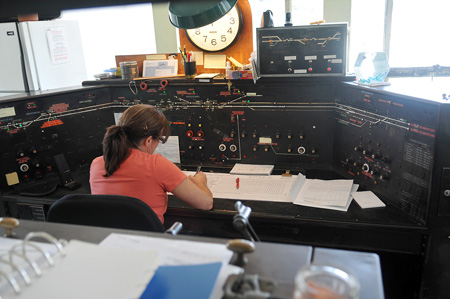
In this view of the model board you can see VALLEY is arranged into West and East sections on what appears to be a 4-track main line.  However the 4-tracks are actually two parallel two track lines with the northern set being the Montauk Branch and the southern set the Long Beach Branch. The single island platform for the Valley Stream station serves the Long Beach tracks and also features a two track flat junction complete with diamond to the Far Rockaway Branch.  This reflects the LIRR's concept of segmented service allowing Montauk/Babylon trains to run express on their own tracks while Long Beach / Far Rockaway trains make local stops.

Despite the 2x2 setup VALLEY is not inflexible with a trailing ladder in the west end to allow any eastbound trains to access the Valley Stream station and Far Rockaway / Long Beach branches.  In the east end of the plant there is a facing point ladder to allow trains to access the West Hempstead branch.  Today this is a minor branch line reduced from a double to a single track junction and non-peak service consists of shuttle trains originating from Valley Stream, laying over in the siding track east of the tower.   This requires shuttles to tie up the entire plant crossing over the 4 main line tracks. As one might expect peak period trains do not attempt to stop at Valley Stream and use the express track to Jamaica.

There is a third section to the interlocking plant which consists of an independent crossover on the Far Rock branch to allow trains leaving or arriving at the island platform to use either Far Rockaway track in combination with any platform track.  Both the Far Rock and Long Branch are run under single direction cab signals without fixed wayside signals, although manual block signals are provided for wrong direction running.


The heart of VALLEY is a US&S Model 14 electro-pneumatic interlocking machine dating from the 1930 when this part of the LIRR was grade seperated. The machine appears to be a 34 lever frame with only about 3-4 spare spaces.   Running against typical standards the signal levers are painted black and the switch levers are painted red.  The interlocking mahcine itself has been painted a pleasant green color which is common practice on the MTA owned NYC Transit Authority.

Unlike later Model 14 setups this one relies on a large number of glass globe signal rundown timers.  This shows the wealth of the PRR since in most interlocking plants poorer railroads would only provide about 1 to 3 timers for the full compliment of signals.  Here the PRR provides a timer for what is presumably every signal pair.  Similar arrangements could be found at OVERBROOK and NORTH PHILADELPHIA towers.  In the 1930's US&S began to offer timers integrated into the Model 14 itself that would cover multiple signals. The new arrangement was not as flexible this one, but offered savings that not even the PRR could turn down.


Here is the original westbound PRR position light signal guarding the west end crossovers and trailing ladder.


Here is the westernmost signal gantry showing the eastbound signals.  While the two primary eastbound tracks are provided with high PRR Pl signals, the reverse direction track on the Atlantic Branch is provided with a dwarf PL reflecting the original single direction operation.  The Montauk was upgraded for full bi-directional operations with the inclusion of a PRR pedestal signal.

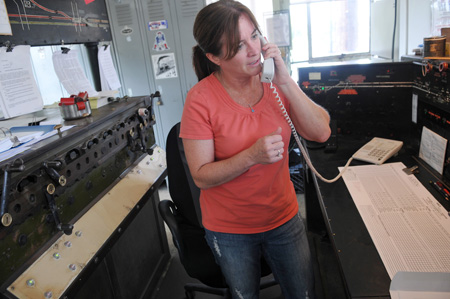
Thursday, July 18, 2013

CP Searchlight Mystery Continued

I got some interesting feedback on my post regarding the strange new type of searchlight signal that is now being installed on select new interlockings on the Canadian Pacific rail system on both sides of the border.  To summarize it appeared that CP was installing some new type of searchlight that had a custom housing and mystery interior which could include either a classic searchlight mechanism or something more modern like a Unilens.  The housing was quite a bit larger than the standard old GRS SA style which lead me to believe that the interior was also non-standard.  However I got an e-mail from John Ryan with his own theory on the matter.
"After looking at the the photos showing the new signals illuminated, the uneven nature of the lighting screams incandescent optics. This leads me to believe that CP hasn't invested thousands of R&D hours in some sort of new technology. After all, if they had, the result sucks. Why spend money for no improvement and why spend money on a technology with a limited lifespan?

This is GRS territory. Why not stick with what they have and what the maintainers already support? If you compare photos of the side of one of the new housings to those of any other GRS SA, you will see an identical triangular ratio between the door hinge pin, the mount hinge pin, and the mech mounting stud. Their wire-coupling assembly on the bottom of the housing, retained by three bolts, also looks like it would be a drop-in replacement for the GRS part. Almost certainly there is an SA mechanism in that box. Therefore the guts aren't news, the housing is the Main Event here.


What's so special about the housing? It is NEW. I have a little passel of captive dwarf signals and over time I've taken each of them apart for restoration. There is very little that can go wrong with an H or H-2 housing and the H-5 is the Cadillac of searchlight housings. However, the mid-to-late era SAs have a primary design weakness in the mech rail. The door latch pulls on a loop on the end of the mech rail. Over-tightening, common on heads with failing gaskets, results in the latch pull snapping off the end of the mech rail. Replacing the mech rail forces a confrontation with the bolts that retain the mech rail and the sighting device. I've never successfully removed those bolts without shearing or deforming the stamped bolt end inside the mech rail. Ironically it is easier to remove these bolts from cast housings, as every single aluminum housing has exhibited an aggressive galvanic reaction between those parts. I've scrapped a signal head where the aluminum was so pitted that water was seeping into the housing.

In the course of restoring one of my SAs it was necessary to re-tap the housing and make new bolts on the lathe. That's too much work. If I were running a signal shop and someone brought me a pile of SA heads and asked me to refurbish them to new, I would be very thankful for the near-term job security. I would be busy for a while.

Analysis: CP has shelves of serviceable SA mechanisms sitting around that represent a significant investment. Why not put them to work? The SA housing is flawed, so it is easier to send the critical dimensions to a fabrication house, where the contractor can CAD, stamp, mill, and weld a product far cheaper than an in-house recycling project, and for the equivalent cost of new housings from Alstom. Alstom doesn't want the business anyway; why else would they price the SA into extinction?

What won't break? The door latch. What isn't rotting? The door seal. What isn't leaking? Bolts on the top of the housing, certainly replaced by welds inside and out. What is back in productive use? SA mechs.

Time will tell if this is a successful experiment. The serial number would lead one to believe that they have made at least 623 of them. CP walked away from over 100 searchlights and searchlight mechanisms when they abandoned the Chalk River and portions of the North Bay Subdivisions in 2011. Perhaps that is also a sign that they have more than enough spares stockpiled to last until they are done with searchlights.

As an aside, if someone wanted to design a drop-in SA replacement with no moving parts, they could simply replace the mechanism with a disc carrying a multi-aspect LED diode array. The outer doublet lens would have to be discarded and replaced with plexiglass. If a replacement required focused optics, a solution could be engineered by a team of three in under a week. It would feature three compact LED clusters feeding into a prism. The optics would be mounted in a dummy frame that slid into the mech rail, aligned on the mounting pins, and lever-locked in a secure position. Nothing complicated there, but it is far cheaper to buy a stock colorlight head and bulldoze all the rusty old fossils. The real problem is the neglect suffered by the old equipment, which sometimes exacerbated the design flaws. Time will tell if these new searchlight housings fare any better, but I commend CP for trying. For now it seems to be an improvement on the SA housing. Too bad it is so ugly."
 Well there you have it.  There is a good chance that inside these new housings are classic old GRS electro-mechanical searchlights.  John said he'd ask around and try to get some confirmation on his theories and when/if I hear more I will update this post.  Unfortunately CP is increasingly abandoning the whole searchlight motif on its former D&H and CP main lines, even the Unilens and LED type.  Here's to them learning to change their errant ways.