Alright, I have an fairly major update of my METRA BLUE ISLAND Tower page to announce. I had an opportunity to visit Blue Island in December, 2015 and was able to add a good number of exterior tower photos as well as interlocking layout photos. Please go and check it out.
I also recently lost my long time web hosting mirror. You might remember the problems I was having a few years back with photo hosting. I actually went and swapped some of my posts over to use the backup host. I believe I was able to change them back, but the occasional photo might still link to the old, palter,org site so if you see any broken links pointing there, please let me know and I'll fix them post haste.
A blog devoted to explaining the ins and outs of North American railroad signaling, past, present and future. This blog seeks to preserve through photo documentation the great diversity and technical ingenuity of 20th century signaling and interlocking hardware and technology. Related topics cover interlocking towers and railroad communications infrastructure.
Note, due to a web hosting failure some of the photos and links may be unavailable.
Search This Blog
Tuesday, March 29, 2016
Tuesday, March 22, 2016
Caught on Camera - Episode 8: Chinese Cab
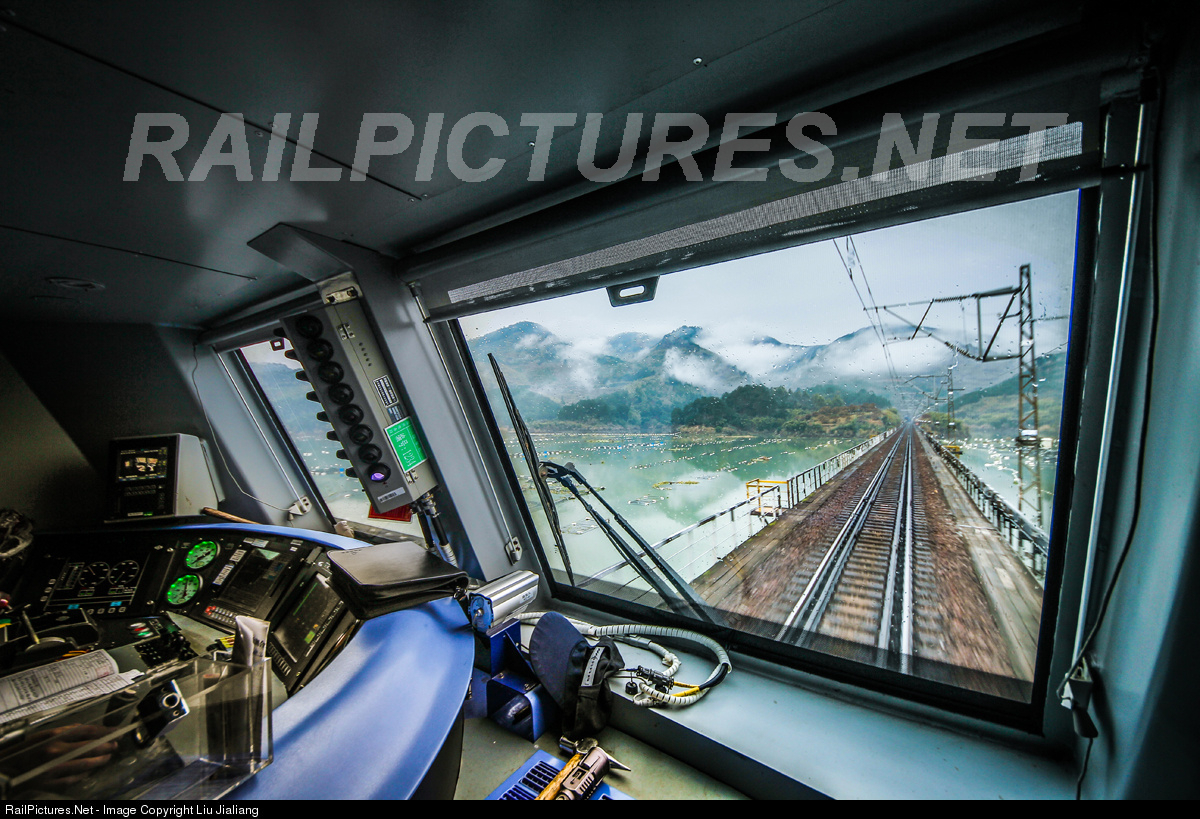
I noticed this photo taken inside the cab of a Chinese HXD1C electric locomotive and immediately a number of interesting tidbits caught my eye. Let's take a moment to step through them.
First my eye is drawn to the center of the cab and if I know my cab signal displays, that's a cab signal display with 8 bulbs. Now each cab signal aspect may use multiple bulbs, so I can't tell how many cab signal indications this unit can display, but I believe it would be more than four. There is one purple lamp lit and I know that, like France and the NY Central, China does does purple as a Stop indication at least on dwarf (shunt) signals. By looking out the window we can see that the train is moving along the track at a good clip, however by looking at the centenary structure and condition of the concrete we can infer that the line has seen some years.
So what does this all tell us? Well, we have a new model locomotive running at speed down a moderately old rail line with the most Restrictive cab signal indication displayed. While China isn't big on safety, I don't this we're seeing a stop signal violation, instead the line is not equipped with cab signals.
In summary, China is a lot like the United States. It has deployed an aspect based cab signal system with many new locomotives being equipped with the hardware, but for whatever reason the system has not seen universal adoption, or even adoption on all major rail lines.
First my eye is drawn to the center of the cab and if I know my cab signal displays, that's a cab signal display with 8 bulbs. Now each cab signal aspect may use multiple bulbs, so I can't tell how many cab signal indications this unit can display, but I believe it would be more than four. There is one purple lamp lit and I know that, like France and the NY Central, China does does purple as a Stop indication at least on dwarf (shunt) signals. By looking out the window we can see that the train is moving along the track at a good clip, however by looking at the centenary structure and condition of the concrete we can infer that the line has seen some years.
So what does this all tell us? Well, we have a new model locomotive running at speed down a moderately old rail line with the most Restrictive cab signal indication displayed. While China isn't big on safety, I don't this we're seeing a stop signal violation, instead the line is not equipped with cab signals.
In summary, China is a lot like the United States. It has deployed an aspect based cab signal system with many new locomotives being equipped with the hardware, but for whatever reason the system has not seen universal adoption, or even adoption on all major rail lines.
Sunday, March 13, 2016
Spring Newsbreak
I collected a number of additional news items over the last few weeks. First and foremost, it appears that we might have a new contender for the "What Took You So Long" award. Many many Newses ago (in 2014) I reported that NS was re-signaling the VRE portion of the Southern Main Line. I even rushed out to photo document the line. Well the new signals were cut over about two years later!
Elsewhere on the former Southern, searchlight style signals continue to be replaced in Kentucky.
Re-signaling on the former NKP lines continues in Ohio.
It might not be NS anymore, but new interlockings are going in place around Port Jervis as part of the Port Jervis Line re-signaling project. This interlocking will replace the old 'PA' manual crossovers west of the station in what is now a surviving portion of double track ABS.
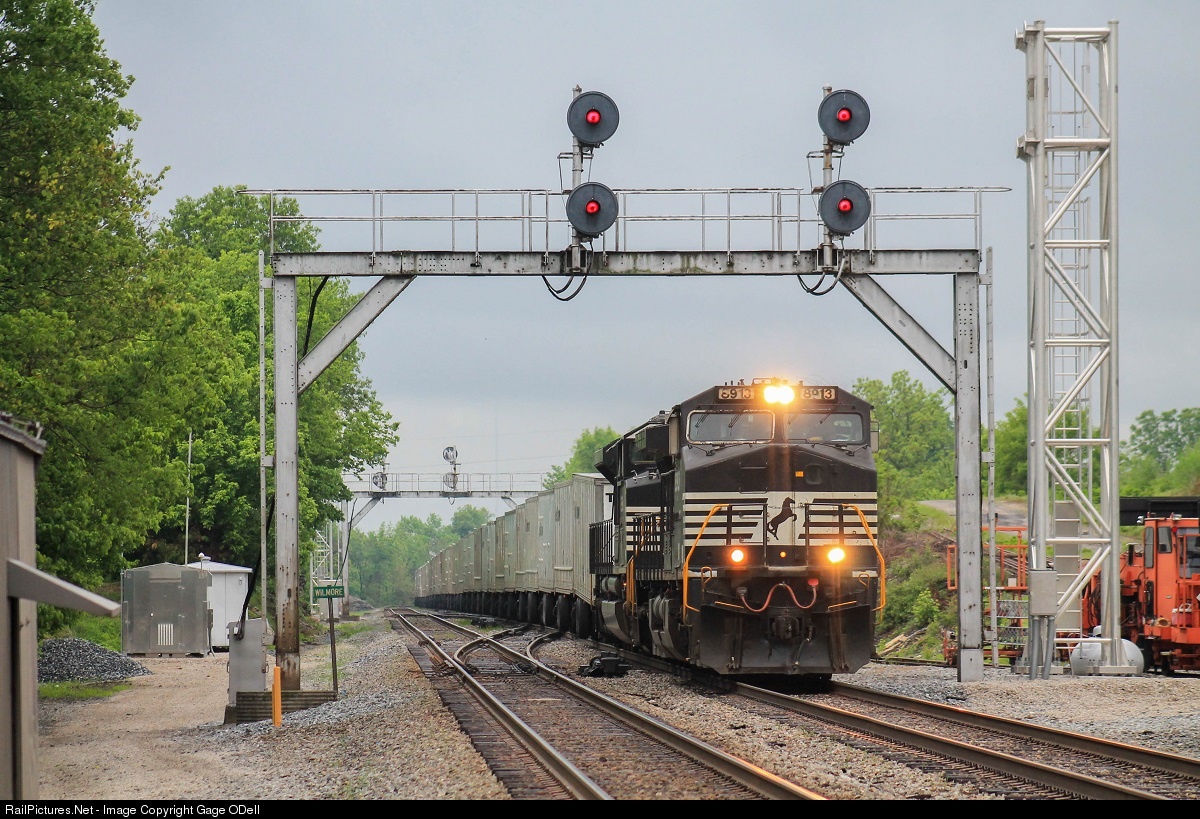
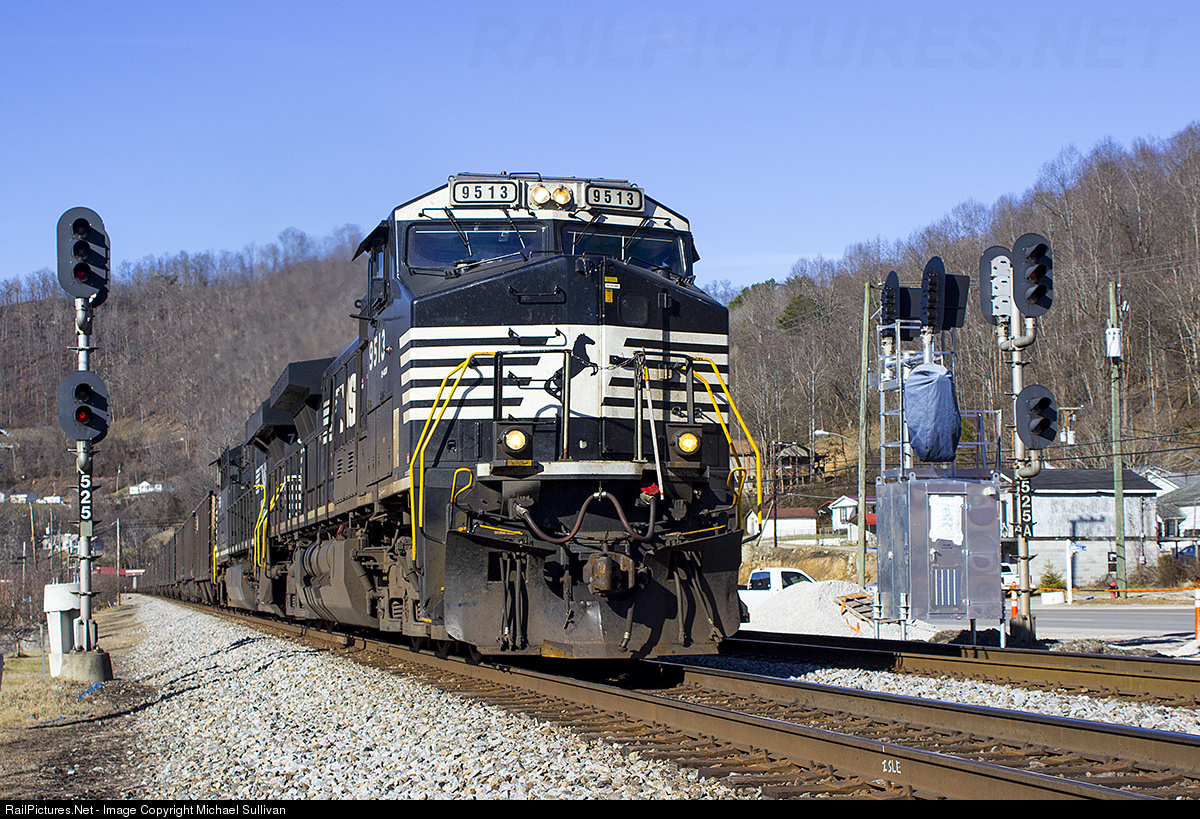
PTC antennas are up at the former PRR Main Line Fostoria signals, but not to fear because there won't be any replacement signals. This is partly because of long term NS plans to convert the line to 562 operation, something I consider preferable to Darth Vader heads.
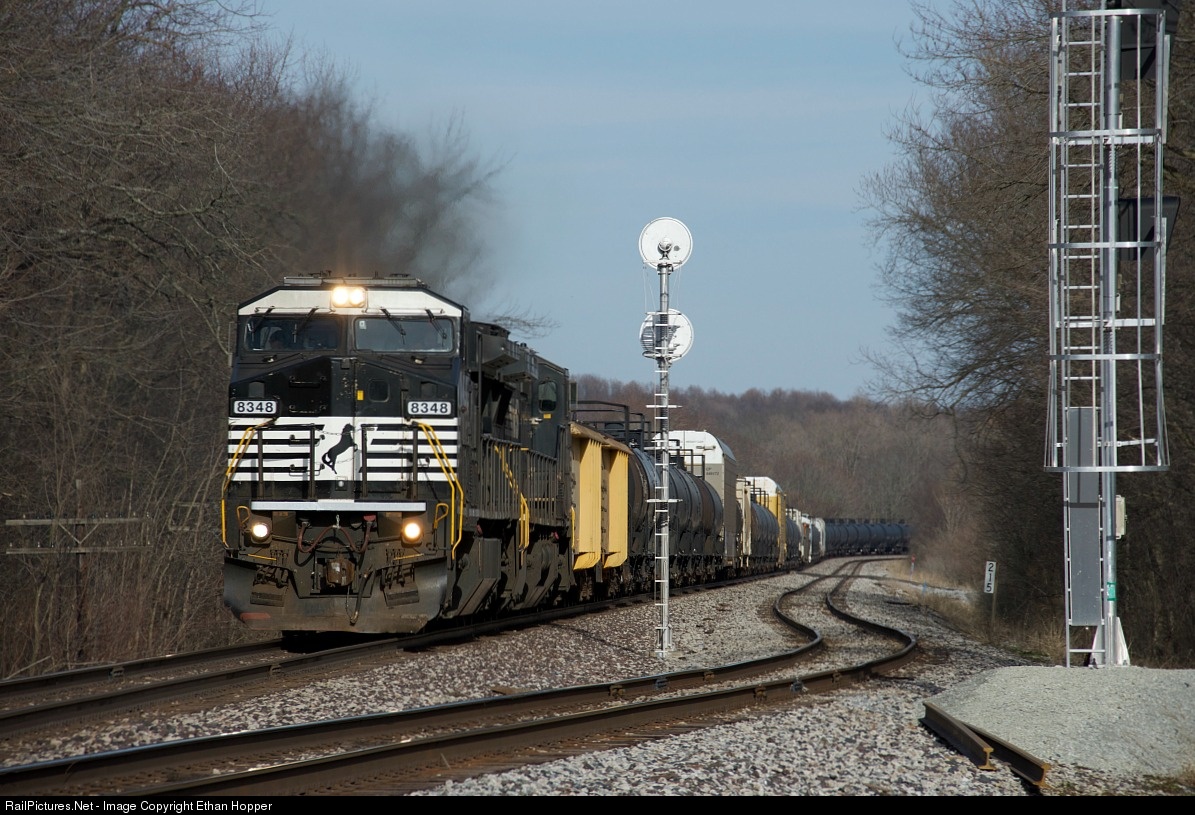
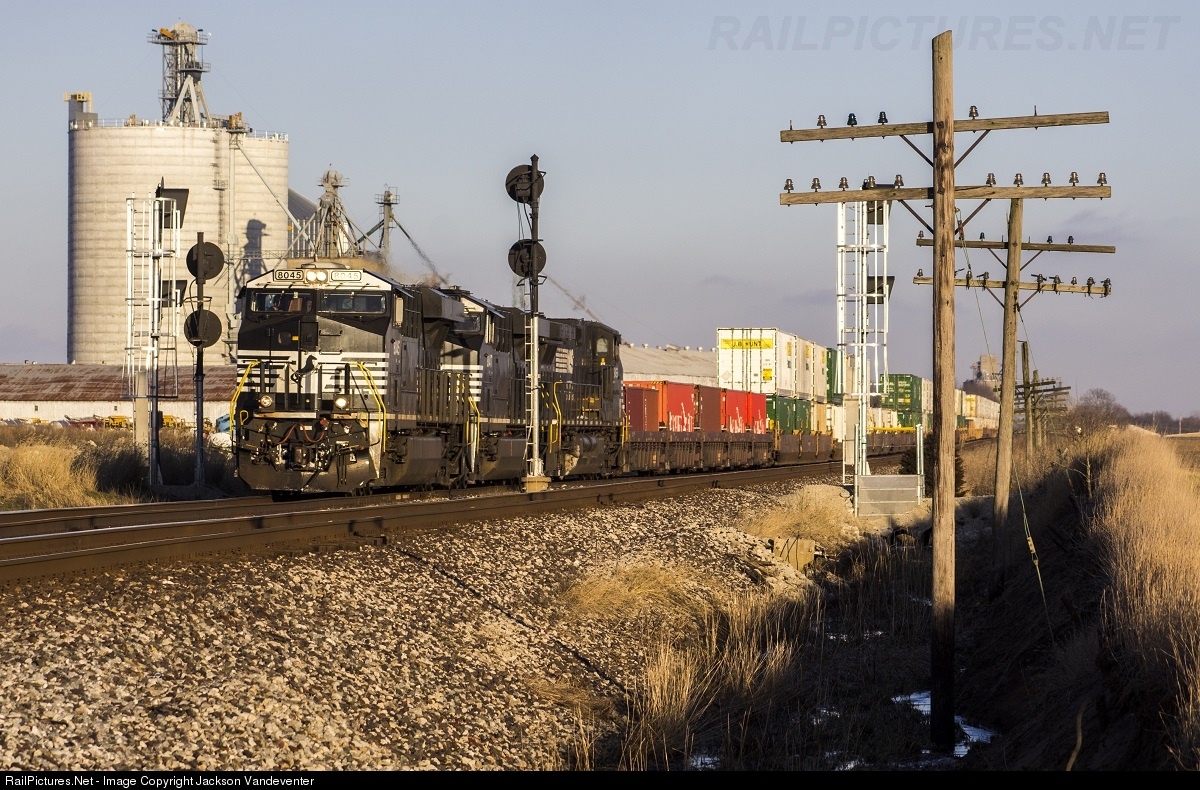
Unfortunately, the same cannot be said for the NS Marion Branch out in Indiana. This former NYC line was actually re-signaled with Rule 261 and PRR Position Lights by Conrail in the 1980's. In a crushing loss low cost Vader masts are already in place :-(
Amtrak continues its slow project to re-signal STATE interlocking in Harrisburg. The slow speed terminal is being upgraded for normal speed movements. One casualty is the sole remaining double slip switch, here seen partly removed from service. In an odd twist, a new double slip was installed at the Albany-Rensselaer station terminal complex where one had not existed previously.
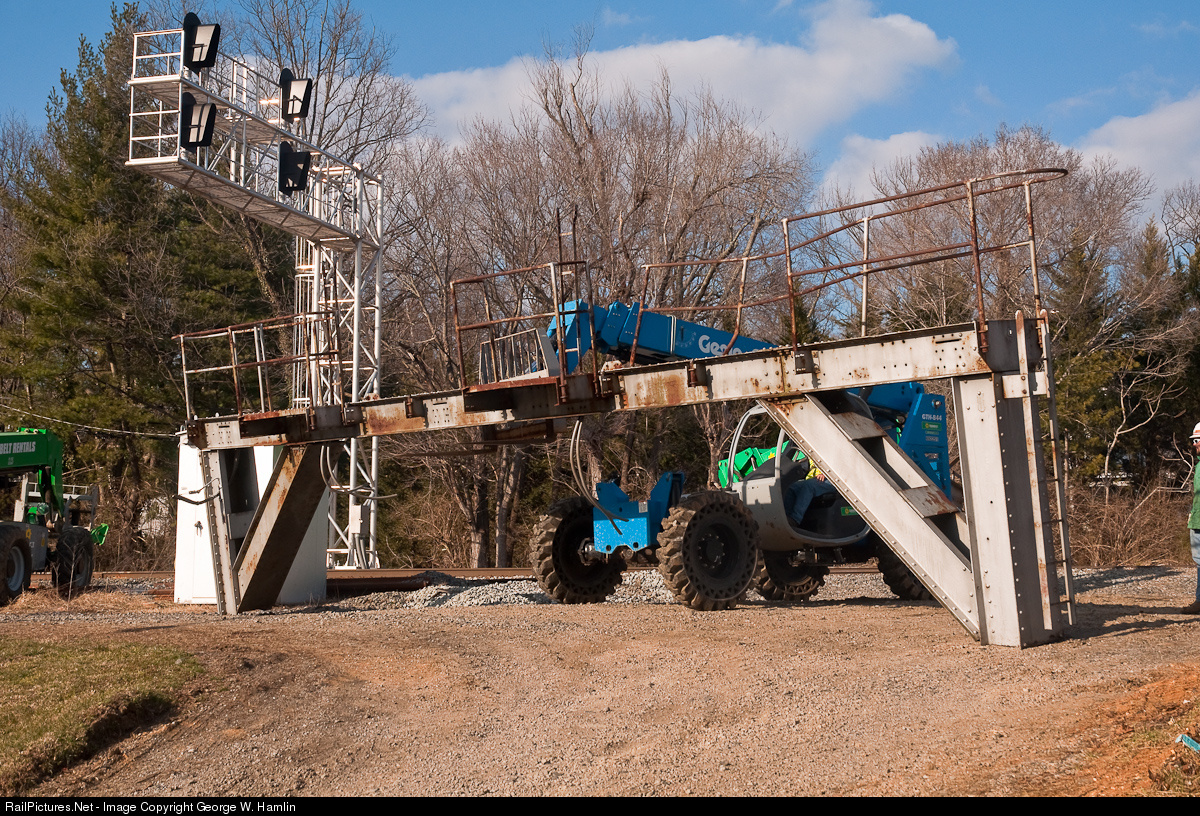
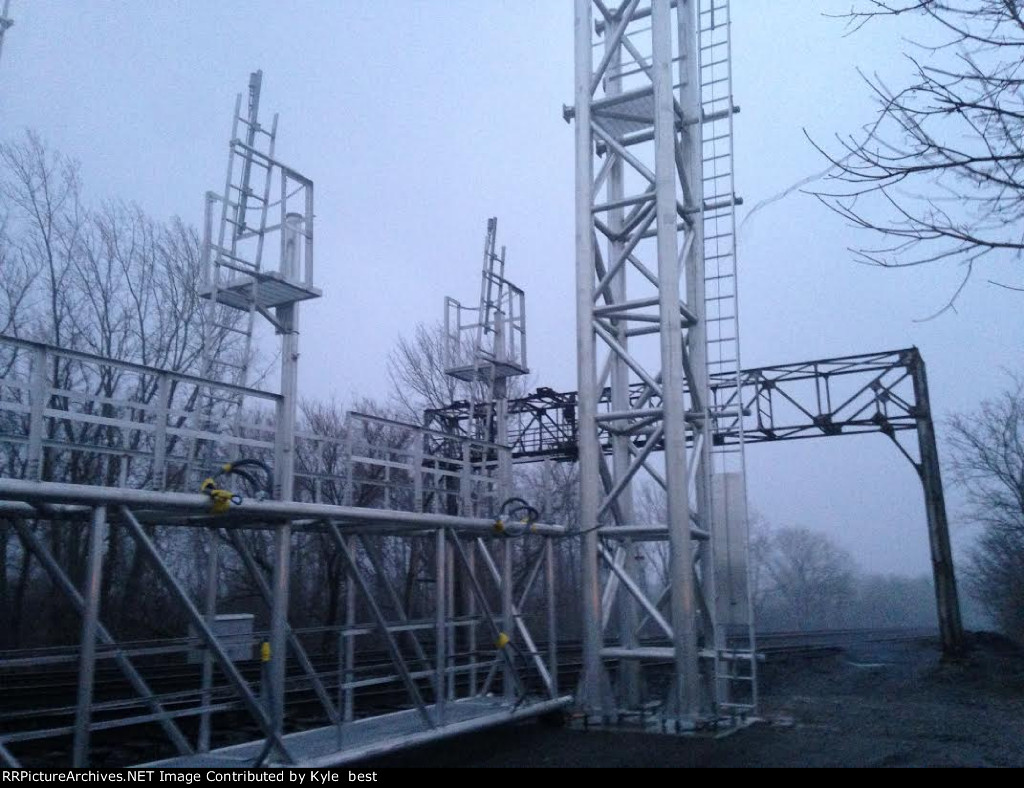
Also, Amtrak has just installed new Colorized Position Lights both east and west of the interlocking. To the east is a two track cantilever mast. To the west is this many track DIY gantry with more high PL signals. This gives new evidence that PRR pedestal type signals are unavailable for new purchase and also that these passenger upgrade projects aren't trying to save $ buying used.
Elsewhere on the former Southern, searchlight style signals continue to be replaced in Kentucky.
Re-signaling on the former NKP lines continues in Ohio.
It might not be NS anymore, but new interlockings are going in place around Port Jervis as part of the Port Jervis Line re-signaling project. This interlocking will replace the old 'PA' manual crossovers west of the station in what is now a surviving portion of double track ABS.
PTC antennas are up at the former PRR Main Line Fostoria signals, but not to fear because there won't be any replacement signals. This is partly because of long term NS plans to convert the line to 562 operation, something I consider preferable to Darth Vader heads.
Unfortunately, the same cannot be said for the NS Marion Branch out in Indiana. This former NYC line was actually re-signaled with Rule 261 and PRR Position Lights by Conrail in the 1980's. In a crushing loss low cost Vader masts are already in place :-(
Amtrak continues its slow project to re-signal STATE interlocking in Harrisburg. The slow speed terminal is being upgraded for normal speed movements. One casualty is the sole remaining double slip switch, here seen partly removed from service. In an odd twist, a new double slip was installed at the Albany-Rensselaer station terminal complex where one had not existed previously.
Also, Amtrak has just installed new Colorized Position Lights both east and west of the interlocking. To the east is a two track cantilever mast. To the west is this many track DIY gantry with more high PL signals. This gives new evidence that PRR pedestal type signals are unavailable for new purchase and also that these passenger upgrade projects aren't trying to save $ buying used.
Monday, March 7, 2016
Russell's Teapot
If I were to tell you that on the hundreds of miles of former C&O trackage between Cincinnati, OH and Norfolk, VA there is still an island of C&O signaling with 3-4 track signal bridges displaying all the quirky old C&O signals, would you believe me?
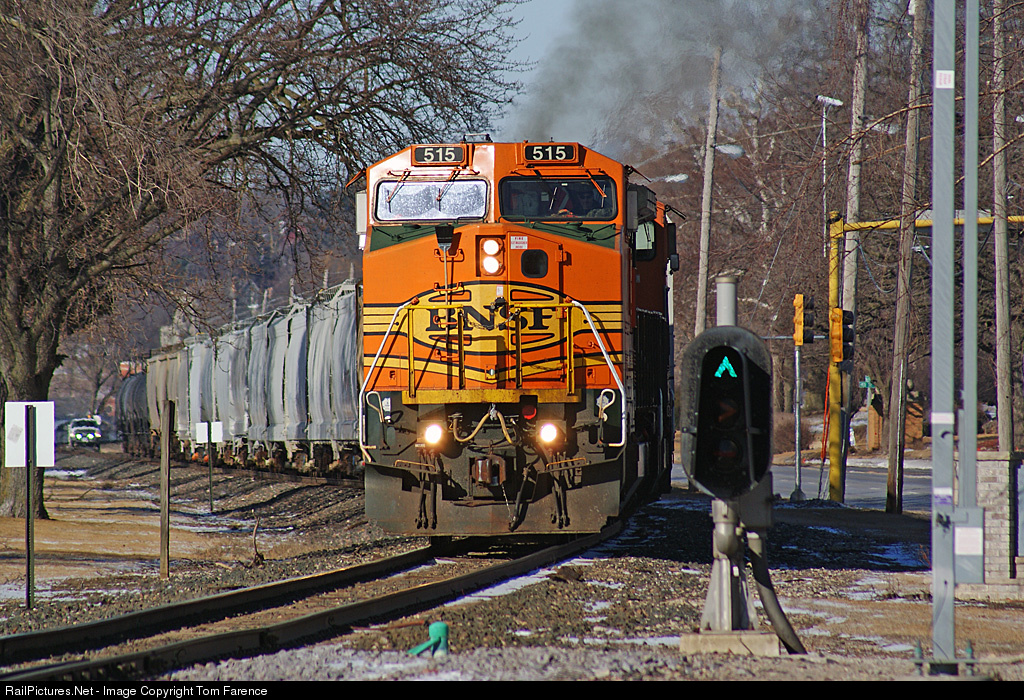
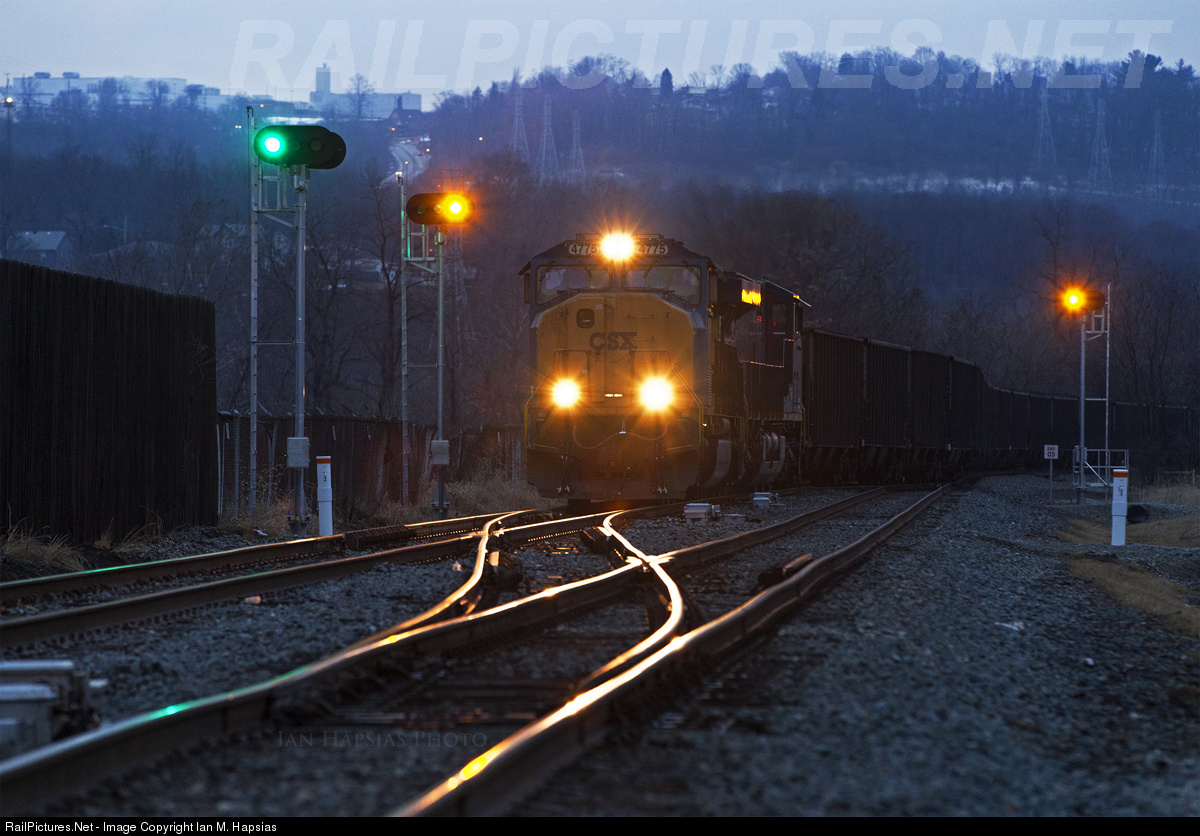
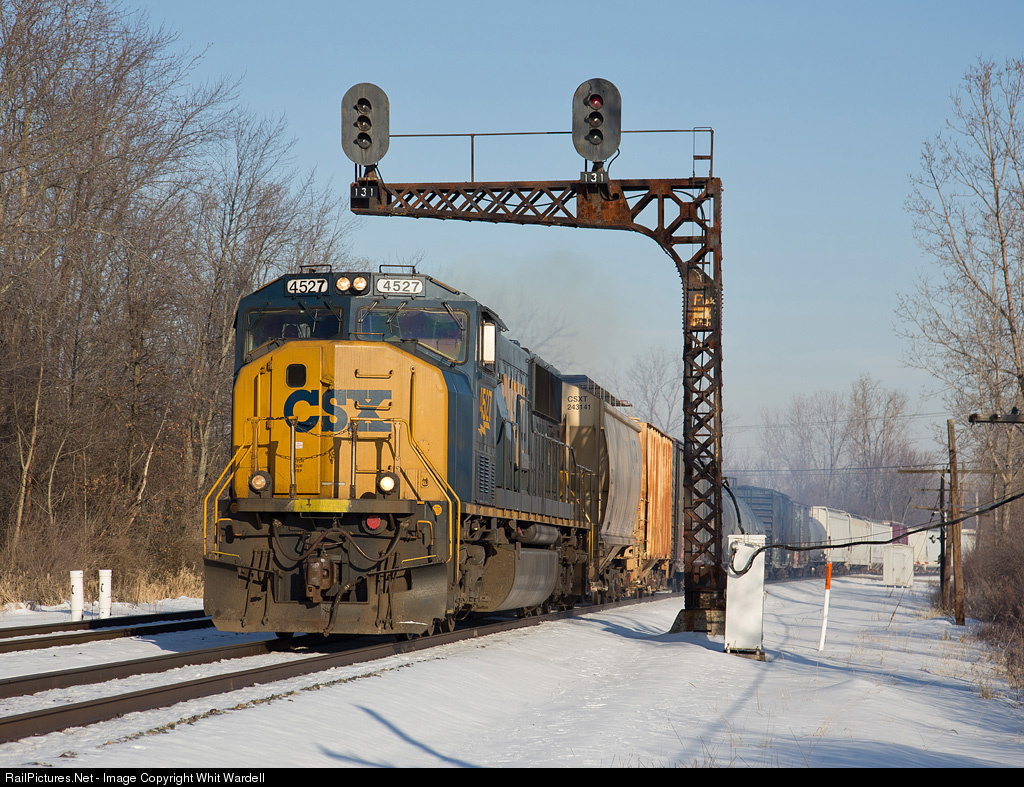
Well you should, but not for much longer because it appears that despite plunging coal revenue and threats to downgrade the Cardinal route to 25/30mph operation, CSX has nevertheless found some money to make sure not a single signal without a Darth Vader helmet survives.
As seen at FOSTORIA, I believe the placement of a red lamp in the middle of the lower head was to allow for R/Y/R Slow Approach or R/R/G Slow Clear without using a third head, but I've seen no direct evidence of this.
Well you should, but not for much longer because it appears that despite plunging coal revenue and threats to downgrade the Cardinal route to 25/30mph operation, CSX has nevertheless found some money to make sure not a single signal without a Darth Vader helmet survives.
The existence of this strange island of misfit signaling is due to CSX's efforts to close RU CABIN, which controlled the eastern end of the giant Russell Yard complex, around the year 2000. At that point the decision had still not yet been made to completely phase out the C&O signal rules so the new Darth Vader signals installed at RU and RACELAND interlockings were both of the C&O style.
![]() |
| RU Cabin westbound gantry |
![]() |
| Raceland westbound Passenger Track Mast |
Moreover, NC CABIN, one interlocking east of RU, was re-interlocked with the existing signals left in place, sort of like as was done on the B&O Philly Sub and on many other rail lines before the cost of labour to splice and test overtook the cost of new signals.
![]() |
| NC Cabin westbound C&O masts. |
Anyway, I guess someone had to spend a capitol improvement budget or risk losing it and with nothing left to re-signal, this island of the C&O was the only available target. No word on if RU CABIN and its C&O Darth Vaders are also being modified, but I wouldn't be surprised. If you happen to live in the area both RU and NC are a must see.
Monday, February 29, 2016
Switch Position Indicators
Switch Position Indicators are to railroad signals as Uber is to a taxi. It serves basically the same purpose, but without the high cost and pesky regulation. Switch Position Indicators (SPI) are exactly what they say on the tin, indicators (I'm focusing on the illuminated ones here) that indicate the position of an attached switch, either normal or reverse. As they are not part of an interlocking, the SPI is typically mounted on or near the switch and broadcasts its indication in both directions simultaneously. The typical colors are green for normal and yellow for reverse. Red is not typically employed since switches SPIs are attached to are usually trailable so there is indeed no wrong way to go through them.
Here we see an old US&S ES series SPI modified with LED lamps. Previously centrally mounted electric bulbs would have shown through in each direction. Out on the main lines, hand throw or spring switches would be fitted with kerosene lanterns that would be mechanically rotated 90 degrees to indicate the switch position. These were eventually replaced by reflective "flags", also mechanically rotated in accordance with switch position, but I am focusing on the electric variety.
Electric SPI's like these were typically found in yards attached to trainable point machines with the SPI's indication being determined by a separate circuit controller. If the switch points were on center, not valid for either route, the SPI would remain dark.
Here is a clearly lower quality GRS supplied SPI with plastic lollipop lamps indicating a reverse switch position. This one is in light rail use and is attached to a standard GRS Model 5F point machine. This switch is in use on the VTA light rail line and is actuated by the LRV's themselves via a transponder system.
Here we see a typical yard ladder setup with remote controlled switches and SPIs. The apparent cheesiness of the indicators steps from the fact that they are not considered safety critical devices like normal railroad signals and don't have to be weather resistant, fail safe, etc.
Now just because trains are moving at restricted speed doesn't mean that one can just shrug off derailments. These units at Amtrak's Lumber St Yard in Chicago have a special third, lunar white, lamps that illuminates when something is over the switch and the points are locked. I am not exactly sure of the mechanism that detects when a train is over the points (track circuit, treadle, inductive sensor) , but it appeared to work.
Outside of yards, spring switches were one of the earliest applications of SPIs on main line track. Popular on pre-CTC single track lines, spring switches eliminated the need for trains to have to re-line siding switches for the main and in certain applications eliminated any need to stop and throw at passing points all together. However where such lines lacked ABS signals to protect against misaligned points, SPIs were the answer, giving oncoming trains moving at above Restricted speed assurance they weren't about to careen into a siding.
Lately, railroads are getting increasingly bold with their use of indicators on unsignaled secondary tracks. Non-interlocked junctions might require sizable freight trains to have to stop and line a switch, possibly multiple times as cars are set out or backup moves made. Not to mention the hassle of having to wait for a member of the crew to walk to train after restoring a hand throw switch. Equipped with radio or transponder controlled switch machines just as we saw on the line rail line, these non-interlocked power switches are being fitted with a slightly higher class of SPI. This example makes use of a standard Darth Vader type signal head with modified lamps showing normal, reverse and on-center positions. As you can clearly see, SPIs do not convey block information.
Here we have perhaps the pinnacle of SPI craziness, a full crossover with M23 point machines protected by a full past SPI . As with BNSF above, CSX has sought to differentiate their signal-like SPIs from regular signals. Their method is to use CNW style horizontally mounted signal heads. This practice has been picked up by a few other roads while another popular method is to use ovoid signal heads with the cheap style signals seen in the Amtrak photos.
That's it for today. This wasn't meant to be anything really in depth, just a little heads up for when non-interlocked interlockings appear on a rail line near you.
Here we see an old US&S ES series SPI modified with LED lamps. Previously centrally mounted electric bulbs would have shown through in each direction. Out on the main lines, hand throw or spring switches would be fitted with kerosene lanterns that would be mechanically rotated 90 degrees to indicate the switch position. These were eventually replaced by reflective "flags", also mechanically rotated in accordance with switch position, but I am focusing on the electric variety.
Electric SPI's like these were typically found in yards attached to trainable point machines with the SPI's indication being determined by a separate circuit controller. If the switch points were on center, not valid for either route, the SPI would remain dark.
Here is a clearly lower quality GRS supplied SPI with plastic lollipop lamps indicating a reverse switch position. This one is in light rail use and is attached to a standard GRS Model 5F point machine. This switch is in use on the VTA light rail line and is actuated by the LRV's themselves via a transponder system.
Here we see a typical yard ladder setup with remote controlled switches and SPIs. The apparent cheesiness of the indicators steps from the fact that they are not considered safety critical devices like normal railroad signals and don't have to be weather resistant, fail safe, etc.
Now just because trains are moving at restricted speed doesn't mean that one can just shrug off derailments. These units at Amtrak's Lumber St Yard in Chicago have a special third, lunar white, lamps that illuminates when something is over the switch and the points are locked. I am not exactly sure of the mechanism that detects when a train is over the points (track circuit, treadle, inductive sensor) , but it appeared to work.
Outside of yards, spring switches were one of the earliest applications of SPIs on main line track. Popular on pre-CTC single track lines, spring switches eliminated the need for trains to have to re-line siding switches for the main and in certain applications eliminated any need to stop and throw at passing points all together. However where such lines lacked ABS signals to protect against misaligned points, SPIs were the answer, giving oncoming trains moving at above Restricted speed assurance they weren't about to careen into a siding.
Lately, railroads are getting increasingly bold with their use of indicators on unsignaled secondary tracks. Non-interlocked junctions might require sizable freight trains to have to stop and line a switch, possibly multiple times as cars are set out or backup moves made. Not to mention the hassle of having to wait for a member of the crew to walk to train after restoring a hand throw switch. Equipped with radio or transponder controlled switch machines just as we saw on the line rail line, these non-interlocked power switches are being fitted with a slightly higher class of SPI. This example makes use of a standard Darth Vader type signal head with modified lamps showing normal, reverse and on-center positions. As you can clearly see, SPIs do not convey block information.
Here we have perhaps the pinnacle of SPI craziness, a full crossover with M23 point machines protected by a full past SPI . As with BNSF above, CSX has sought to differentiate their signal-like SPIs from regular signals. Their method is to use CNW style horizontally mounted signal heads. This practice has been picked up by a few other roads while another popular method is to use ovoid signal heads with the cheap style signals seen in the Amtrak photos.
That's it for today. This wasn't meant to be anything really in depth, just a little heads up for when non-interlocked interlockings appear on a rail line near you.
Tuesday, February 23, 2016
Newsruary
Alright, let's see what's going on in 2016. On the former NY Central main line the CSX re-signaling effort is reaching towards Buffalo as seen here at Corfu and MP 402.
Hey, surely aluminum tubular signal bridges have a place in the 21st century. Hmm, guess not.
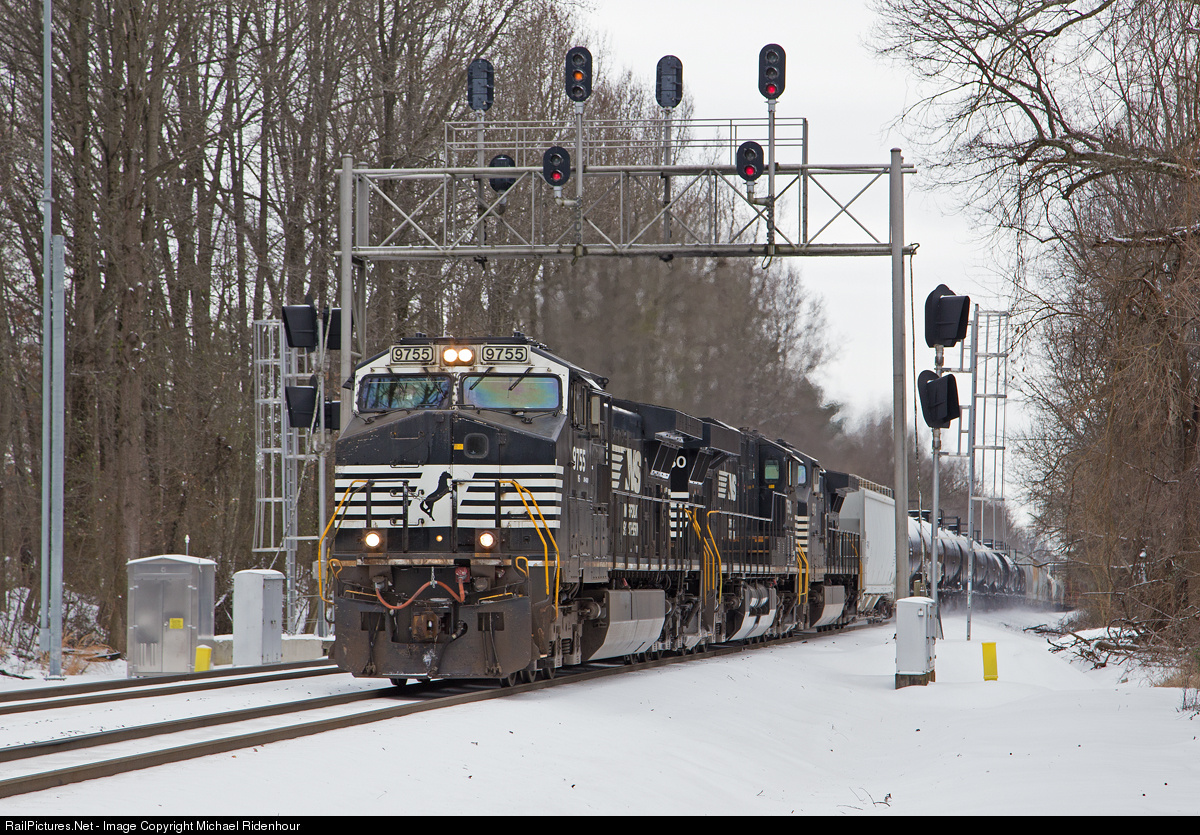
Southern style masts with Safetran clamshells aren't even safe in mast form like these examples on the old N&W main line. I'm thinking that 2008 PTC law should be called the signal uniformity act.
Of course NKP re-signaling is nothing new. This time an intermediate example with H-5 searchlights.
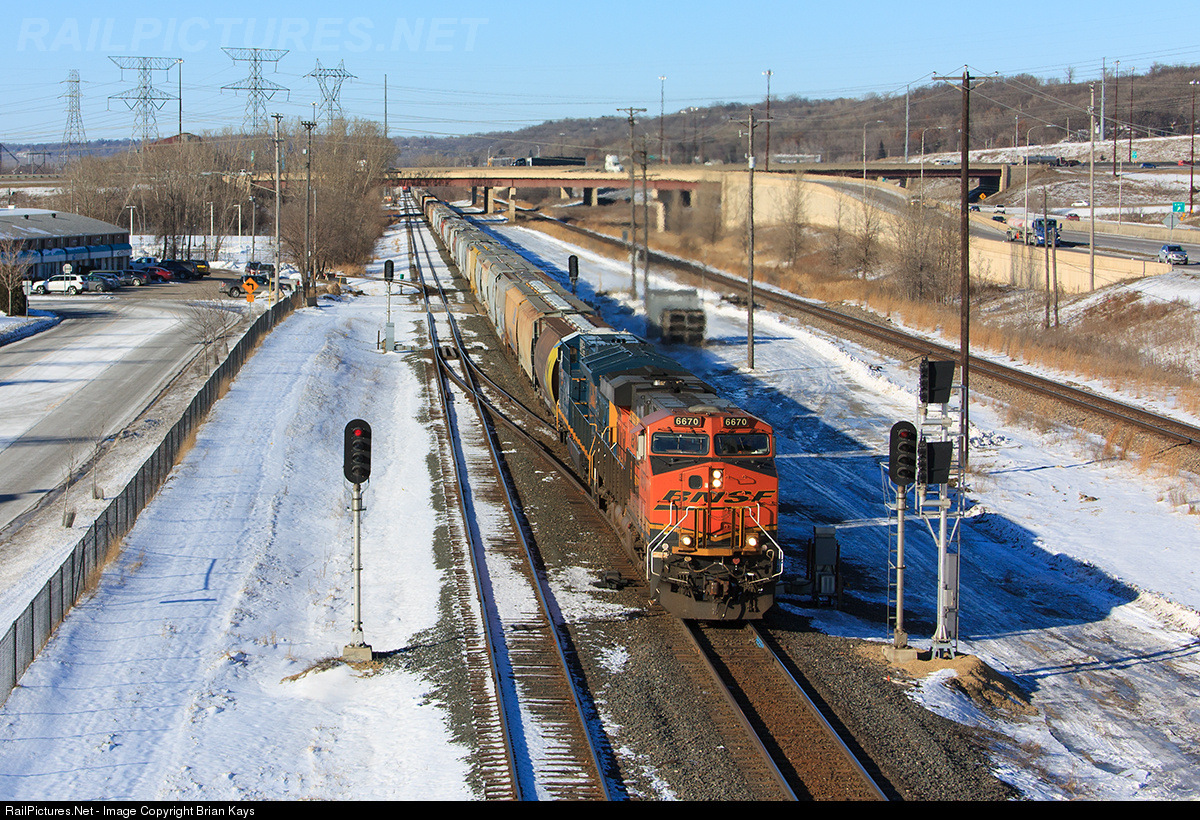
At least one can't say it all about saving $. These Soo Line economy heads are also playing second fiddle to Darth Vader masts.
New signals are still creeping up the old C&O Northern Division with this cute cantilever a recent victim, however they are hanging on in a few places.
This Darth Vader cosplayer didn't stand up to scrutiny by CSX's signal team. Replacement bases are already in place near Jacksonville.
In what I think qualifies as good news, the re-signaling at CP-BETHLEHEM is taking way longer than I had expected so...yay?
Yeah, no real good news this month. :-(
Hey, surely aluminum tubular signal bridges have a place in the 21st century. Hmm, guess not.
Southern style masts with Safetran clamshells aren't even safe in mast form like these examples on the old N&W main line. I'm thinking that 2008 PTC law should be called the signal uniformity act.
Of course NKP re-signaling is nothing new. This time an intermediate example with H-5 searchlights.
At least one can't say it all about saving $. These Soo Line economy heads are also playing second fiddle to Darth Vader masts.
New signals are still creeping up the old C&O Northern Division with this cute cantilever a recent victim, however they are hanging on in a few places.
This Darth Vader cosplayer didn't stand up to scrutiny by CSX's signal team. Replacement bases are already in place near Jacksonville.
In what I think qualifies as good news, the re-signaling at CP-BETHLEHEM is taking way longer than I had expected so...yay?
Yeah, no real good news this month. :-(
Monday, February 15, 2016
PHOTOS: OVERBROOK Interlocking
So it's been a while since we last visited the PRR Main Line and this time I have something special. OVERBROOK interlocking, straddling the border between the city of Philadelphia and Montgomery county, is not only an important part of past and present Main Line services, it is also an active interlocking tower dating from 1926 with all of the PRR trademarks on display for all to see. OVERBROOK and its interlocking is highly accessible, being located in the middle of a commuter station. However what makes this tower truly special is that in the 2003-2004 time period I was able to visit it on several occasions and spent hours inside watching the operations and even working the U&SS Model 14 machine. This will be the first of a three part look at OVERBROOK, the first covering OVERBROOK interlocking, the second OVERBROOK tower (inside and out) and the third OVERBROOK's CTC territory.
OVERBROOK is the first typical crossover interlocking on the Main Line after ZOO. It was later expanded to include the west end of the old Belmont Freight yard and CTC control over the junction with the old Schuylkill River branch at VALLEY interlocking, but the core of its operations were the 4-track crossover tracks that ran the length of the station. Here is a 1972 interlocking diagram showing OVERBROOK's territory at the peak of its responsibilities.
The original 4-track crossover part of the interlocking controlled by the US&S Model 14 interlocking machine dates from 1926. In 1941 OVERBROOK assumed control of the west end of PRR's 52nd Street Yard, situated between the main line passenger tracks stretching between OVERBROOK and ZOO by means of a direct wire relay interlocking. Not a separate interlocking in its own right, this new territory was made part of OVERBROOK interlocking itself, but referred to as the "Woodbine" section of OVERBROOK on signaling documents. OBERBROOK was also given CTC control over the aforementioned VALLEY interlocking on the Main Line and JEFF interlocking on the Schuylkill branch. Woodbine, VALLEY and JEFF were all controlled from a new US&S unit lever CTC machine installed on the operator's desk in the bay window and is the reason OVERBROOK is shown with two interlocking machines on the diagrams. Finally, in 1964, OVERBROOK was given one last CTC interlocking, MANAYUNK, when the Schuylkill branch was cut back to a single track at that passenger station. Here is how OVERBROOK appeared after 20 years with Amtrak in 1992.
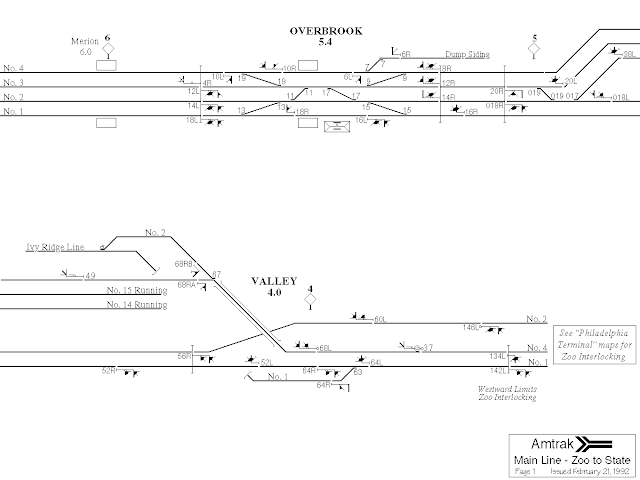
You can see that Woodbine and the old 52nd St yard complex has been greatly diminished as freight traffic left Amtrak territory in the 1980's. VALLEY has also been simplified, JEFF has been transferred to SEPTA control and MANAYUNK no longer exists after passenger service was cut back to Cynwyd. Finally here is how OVERBROOK's territory looks at the time of this writing in 2016.
The biggest change is the route that Main Line passenger track 4 takes between ZOO and OVERBROOK. Previously it had flown over the freight yard complex on a long truss bridge at VALLEY interlocking. (That is how freight traffic was able to access the yard from the middle tracks at OVERBROOK). However in the early 1990's twin crises emerged with a common solution. PCB from the former PRR electric MU shoppes at Paoli had contaminated large parts of three counties and the VALLEY flyover bridge was rapidly deteriorating and could no longer support passenger train speeds.
The solution was to shift track 4 over to run adjacent to tracks 1 and 2 on the site of the former freight yard and then build a new SEPTA MU maintenance facility on the newly available space. This had the side effect of requiring three new interlockings, STILES, PAXON and WOODBINE (not to be confused with OVERBROOK's Woodbine section mind you), which would then be controlled by ZOO, as it had a leverman job to support the extra workload. The effect on OVERBROOK proper was the further truncation of the Woodbine section, removing the #14 and #15 running tracks the 017 switch. This left only a triplet of signals, the 20R and 018R, and a single switch, the 019. The reason for the leading zero was to differentiate levers on the CTC machine from levers on the Model 14 machine.
As I mentioned before, OVERBROOK's Woodbine section was located directly adjacent to the new Amtrak WOODBINE interlocking, but confusion was minimized through the use of colorized position lights on the newly hardware.
Originally intended for terminal freight moves, the 019 is a slow speed switch with Slow Approach displayed for diverging routes on high PRR signals. The best indication the 018R can give is Approach Medium for a diverging route over the 17 switch at OVERBROOK.
Eastbound movements at OVERBROOK's Woodbine section were provided with a 4-track signal bridge hosting signals for the center tracks 2 and 3. In 1994 the bridge was re-purposed to also support WOODBINE's eastbound home signal as well. Tower, between OVERBROOK and ZOO, all 3 tracks are technically bi-directional, although reverse movements on #1 track will encounter a string of PL dwarf signals displaying slow speed indications. Prior to 1994 track 4 was only signaled for westbound movements, but this was upgraded when the three new interlockings were added. As you can see, due to its slow speed and somewhat redundant nature, the track 3 route over 019 switch isn't used much, but the famous 4-track main line does start here.
I should also mention that OVERBROOK was the site of a 1954 experiment to equip the upper head Stop position with red lenses, a measure that was later adopted by the Penn Central and Conrail. However Amtrak did not embrace this modification (at first) and OVERBROOK was converted back some time after 1976.
WOODBINE interlocking, that provides a seldom used westbound exit from SEPTA's Overbrook maintenance facility, is notable for the frequently displayed Slow Approach indication on its westbound mast signal. This is due to OVERBROOK's rather unique layout involving pocket tracks.
Only a few hundred feet separate the eastbound Woodbine signal bridge from OVERBROOK's westbound signal bridge. Despite all 4 tracks being technically bi-directional, only tracks 2, 3 and 4 (from left to right) are given high signals on the bridge as reverse movements on 1 are exceedingly rare and made at slow speed (no cab signal code). However they are still made under signal indication without a track warrant. Track 2 is Rune 251 in the eastbound direction west of OVERBROOK so its 14R signal does not provide straight route indications. The 12R and 8R signals on tracks 3 and 4 do have Clear indications (as seen on the 8R) however you might notice the absence of an Approach / on the upper head. This is due to the short distance between the westbound gantry and the pocket exit signal on track 4 or the interlocking exit signal on track 3. While most railroads would use speed control followed by a straight approach for short signal blocks, the PRR was on of the few that would follow it up with a Slow Approach. This was due to the availability of a slow speed indication on standard high signals.
OVERBROOK is the first typical crossover interlocking on the Main Line after ZOO. It was later expanded to include the west end of the old Belmont Freight yard and CTC control over the junction with the old Schuylkill River branch at VALLEY interlocking, but the core of its operations were the 4-track crossover tracks that ran the length of the station. Here is a 1972 interlocking diagram showing OVERBROOK's territory at the peak of its responsibilities.
The original 4-track crossover part of the interlocking controlled by the US&S Model 14 interlocking machine dates from 1926. In 1941 OVERBROOK assumed control of the west end of PRR's 52nd Street Yard, situated between the main line passenger tracks stretching between OVERBROOK and ZOO by means of a direct wire relay interlocking. Not a separate interlocking in its own right, this new territory was made part of OVERBROOK interlocking itself, but referred to as the "Woodbine" section of OVERBROOK on signaling documents. OBERBROOK was also given CTC control over the aforementioned VALLEY interlocking on the Main Line and JEFF interlocking on the Schuylkill branch. Woodbine, VALLEY and JEFF were all controlled from a new US&S unit lever CTC machine installed on the operator's desk in the bay window and is the reason OVERBROOK is shown with two interlocking machines on the diagrams. Finally, in 1964, OVERBROOK was given one last CTC interlocking, MANAYUNK, when the Schuylkill branch was cut back to a single track at that passenger station. Here is how OVERBROOK appeared after 20 years with Amtrak in 1992.
You can see that Woodbine and the old 52nd St yard complex has been greatly diminished as freight traffic left Amtrak territory in the 1980's. VALLEY has also been simplified, JEFF has been transferred to SEPTA control and MANAYUNK no longer exists after passenger service was cut back to Cynwyd. Finally here is how OVERBROOK's territory looks at the time of this writing in 2016.
The biggest change is the route that Main Line passenger track 4 takes between ZOO and OVERBROOK. Previously it had flown over the freight yard complex on a long truss bridge at VALLEY interlocking. (That is how freight traffic was able to access the yard from the middle tracks at OVERBROOK). However in the early 1990's twin crises emerged with a common solution. PCB from the former PRR electric MU shoppes at Paoli had contaminated large parts of three counties and the VALLEY flyover bridge was rapidly deteriorating and could no longer support passenger train speeds.
![]() |
| Realigned track 4 (far left) and the old VALLEY flyover. |
![]() |
| The westbound 018R signal at OVERBROOK's Woodbine section. |
![]() |
| 1941 PRR PL vs 1994 Amtrak PL. Taste the difference! |
![]() |
| OVERBROOK 018R displaying Slow Approach over the 019 switch reverse. |
I should also mention that OVERBROOK was the site of a 1954 experiment to equip the upper head Stop position with red lenses, a measure that was later adopted by the Penn Central and Conrail. However Amtrak did not embrace this modification (at first) and OVERBROOK was converted back some time after 1976.
![]() |
| OVERBROOK 20R displaying Slow Approach over the 019 switch reverse. |
Only a few hundred feet separate the eastbound Woodbine signal bridge from OVERBROOK's westbound signal bridge. Despite all 4 tracks being technically bi-directional, only tracks 2, 3 and 4 (from left to right) are given high signals on the bridge as reverse movements on 1 are exceedingly rare and made at slow speed (no cab signal code). However they are still made under signal indication without a track warrant. Track 2 is Rune 251 in the eastbound direction west of OVERBROOK so its 14R signal does not provide straight route indications. The 12R and 8R signals on tracks 3 and 4 do have Clear indications (as seen on the 8R) however you might notice the absence of an Approach / on the upper head. This is due to the short distance between the westbound gantry and the pocket exit signal on track 4 or the interlocking exit signal on track 3. While most railroads would use speed control followed by a straight approach for short signal blocks, the PRR was on of the few that would follow it up with a Slow Approach. This was due to the availability of a slow speed indication on standard high signals.
Subscribe to:
Posts (Atom)