A blog devoted to explaining the ins and outs of North American railroad signaling, past, present and future. This blog seeks to preserve through photo documentation the great diversity and technical ingenuity of 20th century signaling and interlocking hardware and technology. Related topics cover interlocking towers and railroad communications infrastructure.
Note, due to a web hosting failure some of the photos and links may be unavailable.
I wanted to discuss a topic I have mentioned multiple times in other posts, but never really addressed head on. This is the distinction between the two flavors of traffic control operation in North America typically known as Centralized Traffic Control (CTC) or Traffic Control System (TCS). In one flavor, each segment of track has a permanent traffic state that is in one direction or the other with signals against the flow of traffic all dropped to their most restrictive indication (usually Stop and Proceed / Restricted Proceed).
Traffic set opposed on tks A and 3
In the other flavor, if no route is set from an adjacent interlocking, the traffic direction "floats" to an undefined state where block signals in both direction display a signal based solely on block occupancy. This leads to signals displaying favorable indications in both direction at the same time, similar to non-traffic controlled bi-directional ABS lines.
No following train causes opposing signal to float to Clear
The first method is most commonly associated with the Union Switch and Signal company, which implemented "traffic levers" on its Left-Right interlocking frame and unit lever interfaces. The second is most often associated with General Railway Signal, who tended to use its N-X style interface where displaying a signal would automatically set traffic between there and the next interlocking. However, in modern times these corporate distinctions are not always clear and I have seen exceptions to the "floating" style within a single track segment!
Hudson Line Intermediate 79 like to float.
While adjacent signal 81 does not!
The "traffic lever" system is perhaps the easiest logically to implement. Some sort of constant state is transmitted between interlockings and each intermediate (perhaps a + or - voltage on a wire) and a relay at each signal location senses the direction of traffic. The floating system requires a reliable way to hold the signal state until the train passed and the route is released and then allow opposing signals to clear. The payoff for this complexity is that while under a traffic lever system the track segment must be completely clear before the direction can be reversed, the float system can handle reverse movements line a train in a non-interlocked siding as soon as the first train passes. This also reduces problems from track circuit failures that can can cause a "traffic lever" to become locked until the failure is repaired.
In the above video you can see the floating system in action where the far signal immediately upgrades from Stop and Proceed to Advance Approach. In the absence of any signal at the next interlocking, both signals would flash Advance Approach. Determining which system is in use on a particular line can be tricky. If you see any of the above behavior with reverse signals automatically clearing or opposing signals in CTC territory both showing favorable indications, then the float system is in effect. However the absence of said behavior does not indicate the use of traffic lever as the preceding controlled signal could be fleeted for following movements. However, given sufficient observations, if one never sees signals automatically upgrading behind a train, it is likely that traffic lever logic applies.
If your opposing signal never clears, you might be in traffic lever country.
I will update this space if/when I learn how these systems are technically implemented and if I can confirm if traffic lever is still associated with US&S and float with GRS. If anyone has this information, please leave a comment.
I recently came upon some information regarding the possible fates of Washington DC's two remaining interlocking towers. These are the still active K Tower, at Amtrak's Union Station, and the former PRR VIRGINIA tower at the junction of the passenger route through Union Station and the Landover freight bypass. Both locations have been the subject of recent development efforts and preservation of both towers have actually been addressed in the planning.
When CSX started its Virginia Ave Tunnel clearance project in 2015, part of the agreement with the city was that VIRGINIA tower was to not only be left in place, but also cleaned up and stabilized. That means roof and window repair along with some sort of move towards adaptive reuse. It was reported that some of the ideas include a bar, museum or even a boutique micro hotel. So called "security concerns" might derail some or all of these plans, but given the size of the building I would say that a museum might be the most likely option.
The same article also links to Amtrak's Union Station Master Plan that portends a similar far for the iconic K Tower, which would be covered over by some sort of terminal roof desk that would support an urban redevelopment project. The active tower itself would be moved into some sort of office, while the physical building would be moved around and turned into a cafe or bar. While the Union Station plan seems a bit more certain about the bar idea, cities reaching "peak millennial" or a Trump induced economic collapse could put the development on hold (at least for a time, like with the West Side Rail yard redevelopment).
Needless to say I am unenthusiastic about any project that would turn an active tower into a stuffed animal head on the wall. As tempting as selling air rights are, having trains scamper into underground rabbit dens are never a good way to enter a great city. Development comes in waves and both DC and NYC have been cresting for some time now. Hopefully the cycle will turn around and travelers on the NEC will be treated to K Towers cheery copper facade for decades to some.
Things have been pretty quiet as of late, but I did manage to tease out a few news items of note over the holiday season.
Starting off with Amtrak, it appears that the new CP-143 at Albany-Rensselaer had been cut over with LED searchlights replacing the classic ones and new double slip switches reducing the bottlenecks that would frequently occur when Empire trains mixed it up with late running long distance trains requiring a power change. With the new second track nearing completion between Albany and Schenectady, my trip to the area in February will hopefully not be too late.
Is a shocking turn of events, NS has stepped up its assault on the former N&W H-Line in Virginia with new signals appearing at the famous Shepherdstown, WV location as well as others. This is truly disappointing because the line was last re-signaled ~2000 with new logic cut into the old signal hardware, as was the style at the time. This is definitely a must visit for anyone in the area.
New signaling continues to appear in the Akron area as the last CPLs on the old B&O Main Line brave the assault.
In political news, it will be interesting to see if the PTC horseshit is rolled back under the Trump administration. That is the exact type of costly, useless regulation that should be targeted for elimination, but it is so far off anyone's radar that it is unlikely that anything will be done, especially due to the bizzare support it has in congress. My theory is that the mandate is simply a ploy by the truck lobby to hobble rail transportation.
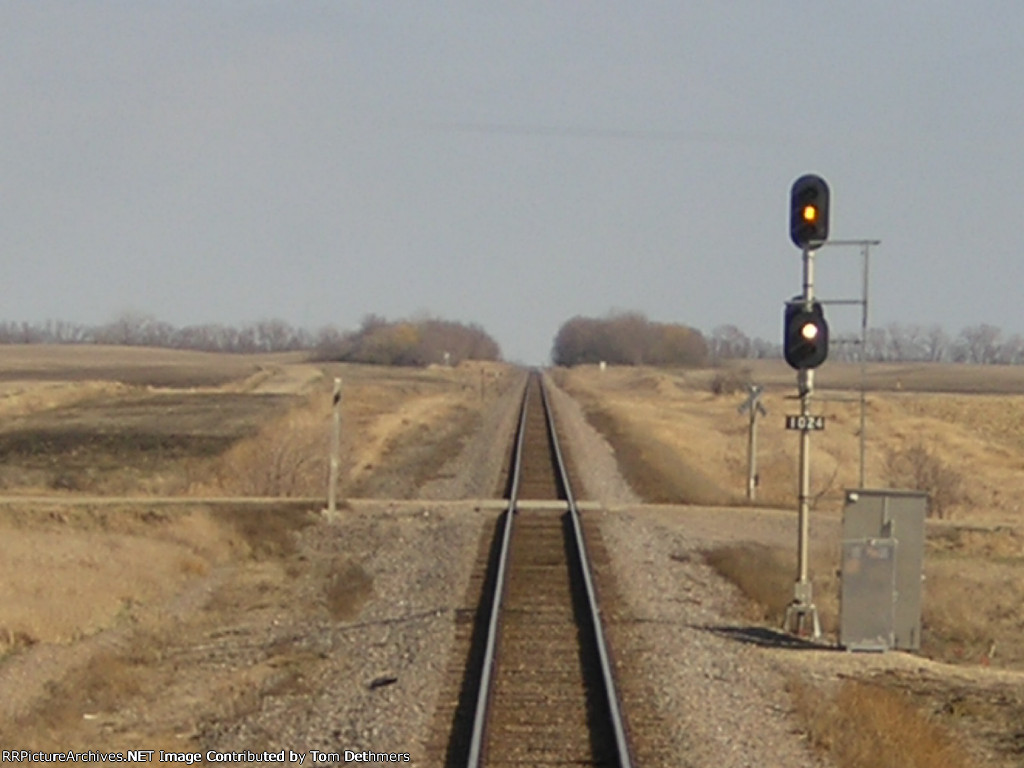
Ah the humble distant signal. A fixed light or blade that warns the inattentive that they are approaching the civilizing influence of an interlocking. In most places the fixed distant is an unimportant footnote that occasionally serves as the last refuge of the semaphore. Now one of these days I'll probably do a whole post about the many types and rules relating to fixed distants, but today I am going to feature the fixed distant's much less common cousin...the dynamic distant.
This one picture pretty much captures the full gamut of fixed distants
Sometimes a railroad is in the mood to inform trains approaching a absolute signal on otherwise unsignaled tracks about the condition of said signal Now I know some people might assume that if you want a train to approach an interlocking under signal control, just bang in an automatic block signal and Bob's your uncle. Well, they'd be right and this method remains a popular way for protecting interlocked junctions. Just stat your signaled a couple miles sooner with no need for any additional rules.
Of course the PRR had to be different and because they were one of the largest users of the Manual Block System, they incorporated that into their design of dynamic distant signals. Here we see a surviving example on the LIRR that supports a Clear, Approach Medium, Approach and "Caution" (upper head \ ). PRR's Caution signal is basically Manual Block Approach with the distinction being that trains also have to approach any switch protected by the signal prepared to stop. Because the Manual Block protection would negate the risk of another train on the line, there is no need for a Stop and Proceed aspect. However if a switch has been opened to break the track circuit then Caution provides the necessary warning.
Kinda looks like a flower on a stick
Of course in the NORAC era position lights were out and color lights were in. However vestiges of the old manual block system live on in the form of two aspect dynamic distants displaying Approach Clear and Approach Restricting (different than the one we discussed last week if you recall). Southern New Jersey, home of the Pennsylvania-Reading Seashore Lines, is one place where Manual Block hung around into the 1980's and as a result it retained a few dynamic distants.
Distant to CP-WOODBURY on the Vineland Secondary
They are of course the color light variety, having replaced former PRR position lights similar to the LIRR ones sometime in the 2000's. Unlike the PL's, they do not convey block information and signal state is transmitted via a microwave link instead of through track circuits. The older PRR era signals, seen in this signal diagram, did convey block information in the same manner as the LIRR signal.
The one on the Penns Grove Secondary, seen above, is actually being replaced by a CTC project of all things so I guess what's old (the track circuit block) is new again.
Anyway,this sequence of photos have been designed to lead you on a visual journey from the fixed and ABS distants of "other" railroads, to the PRR style of fully featured Manual Block distants and finally to their Conrail color light replacement. The point of the journey is to show how the PRR's Manual Block heritage has lived on into the modern era and if these photos don't convince you, compare the Conrail distants to this little example.
As you can see, they are quite clearly a vestige of Manual Block in a CTC world.
The Approach Restricting signal indication has a bit of a bad reputation in the land of speed signaling east of the Mississippi. Typically, the signal progression in both the NORAC and CSX codes are Approach -> Restricting with the idea being that since Restricting could be displayed with an obstruction 5 feet inside the signal, there is no benefit to preparing the engineer to do anything other than stop. Yes, NORAC does have an "Approach Restricting" rule, but it's basically a re-branded distant Approach or PRR Caution signal that doesn't really capture the spirit of approaching a signal in block signaled territory and finding the next signal displaying a Restricting indication.
Calling this "Approach Restricting" is an insult to "Approach Restricting"
So the real Approach Restricting is found in route signaled territory both in the west and on the Southern. Now I know that you are thinking that "Restricting" implies a speed, but the rationale behind Approach Restricting is much more apparent in a route signaled context. Below is the true meaning of Approach Restricting, caught on camera.
Y/L Approach Restricting leads yo...
R/Y Restricting for a route into a siding.
The traditional use of Approach Restricting was as a route indication to alert trains that they had been routed into a non-circuited (Restricted speed) siding. This was popular out west because there Single Track with Passing Siding was the predominant form of rail line. Once CTC started being installed it was logical to distinguish a movement into a signaled siding (Approach Diverging) from a non-signaled track (Approach Restricting) from some sort of regular Stop or Stop and Proceed signal (Approach). However, as speed signaling has started to gain traction on western roads, signal engineers and consultants have started employing it a wider variety of situations.
Ok, tk1 has a route lined at the next interlocking and tk 2 does not. Is this distinction really going to make a different here?
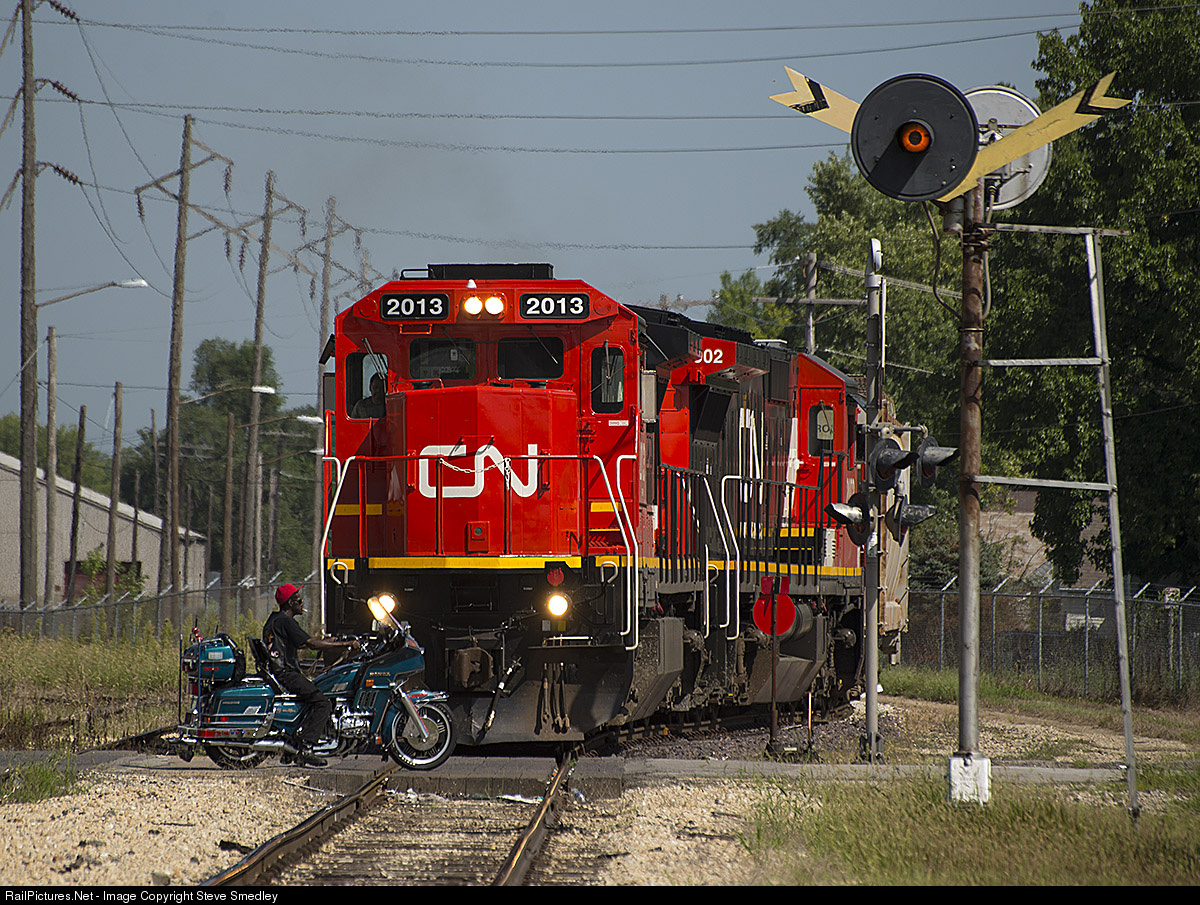
For example on the CN Waukesha Sub (METRA North Central line), Approach Restricting was widely applied as a capacity improvement, although as eastern railroaders pointed out, it's unclear how much one actually gains from this unless one is bending the rules of being able to stop within 1/2 vision. Approach Restricting (and Medium Approach Restricting) has also showed up on the hyper speed signaled Caltrain line, right along side Approach Slow.
Y/*R* Approach Restricting
This of course brings up the alternate Approach Restricting aspect, Y/*R*, which of course has become popular as *R* took over for Lunar for Restricting (since using 4-lamp monster heads is just wacky *cough*CSX*couch*). Since many two headed distant signals use placeholder Reds, this has made all of them a potential location to employ Approach Restricting. In fact, when the aforementioned CN Waukesha Sub was re-re-signaled, Y/*R* Approach Restricting came in to replace the lunars. You can see an example of "speed" style Approach Restricting on the following video montage of flashing signals on the Waukesha Sub (cut to time code 00:23).
Well I hope this sheds some light into the past, present and future of the Approach Restricting indication.
Today I hit the jackpot as part of a Philly area rail transit trip I help organize. While riding a short turn on SEPTA's Fox Chase line, I happened to catch a student engineer being instructed on how to operate a set of new Silverliner V cars and also deal with the new ACSES PTC system. Because of the glorious half cabs, the instructor was sitting in the second seat row and the student had the cab door open. From there I had a mostly unobstructed view into the cab where I could video the cab signal/ACSES display unit and how it behaved.
Until now, how ACSES would function in service was mostly speculation. Although Amtrak has had it in service for 15 years now, there have been few reports (and no video) of the system from an Engineers point of view. This made me optimistic that any impact would be minor and mostly involve positive stop points at stations. Of course there is wide variation and little regulation regarding how ACSES (and all other PTC systems) are implemented from a human factors perspective. There is also a fair bit of wiggle room in how the speed and stop enforcement take place with a good deal of it being policy decisions by railroad management, not necessarily the FRA or other third party safety scolds.
What I discovered today hit on both of these points, and neither fr the better. Note that the observations below apply only to SEPTA andwhat they saw fit to require of their vendors and signaling department. I know for a fact that similar railroads are examining other options. Hopefully if anyone involved in other projects they will take away some things to avoid.
Captured below are two runs on the Fox Chase Line from NEWTOWN JCT to the end of the line in Fox Chase and back. ACSES is in service on the entire Fox Chase Line NEWTOWN JCT excluded. The second video has a better angle on the cab display unit. Station stops were omitted and a few ACES / CSS changes were lost.
As you can see, the SEPTA ACSES system communicates the braking curve to the engineer by means of an Authorized Speed countdown system. As a speed restriction approaches the ACSES speed will begin to drop. If the train's speed is suddenly above the ACSES speed, at some point an overspeed warning will light and it sounds like 5 seconds after that there will be some sort of penalty application if either the brake is in the suppression position or the overspeed no longer no longer exists. Two problems with this system are plainly evident.
First, the braking curve is ridiculously conservative. Every time the ACSES speed began to drop, the engineer was able to get well ahead of the dropping curve without anything close to "aggressive" braking. The capabilities of the equipment have been completely ignored and some leisurely braking rate has been chosen. If PTC "ideal" is to stay out of the engineers way except in case of a dangerous condition, the penalty braking curve should follow the full service braking rate. SEPTA paid both $ and weight for full dynamic, disc and tread brakes on the Silverliner V, which should allow for later braking into curves and stations. Are we now to believe that was just a waste?
Second, the human factors of the speed countdown entourage the engineer to just proceed at slower speeds to avoid potential overspeed warnings. You can watch the student here get dinged by ACSES a couple times, and later, at the instructor's urging, keeps the train at a slower than authorized rate of speed in anticipation of another speed countdown. This is exactly the sort of behavior I warned of and is not exactly what is happening. In addition to a realistic braking curve, the system should try to be invisible and not trigger compensating behaviors. A warning light at 3mph above curve followed by a penalty application at 6mph is all that is needed. This is the standard used on the British Rail ATP system back in the 80's.
An additional item I wanted to quickly point out is the positive stop distance encountered southbound at NEWTOWN JCT (see video, its multiple car-lengths).
UPDATE: The effects of the ACSES roll out were evident in SEPTA's January 2017 schedule. Travel times were uniformly increased on the Media and West Trenton lines between 4 and 6 minutes. Again this runs completely counter to the PTC propaganda that operations would not be affected.
I first want to let everyone know that I now have confirmation that the NS PRR Main Line re-signaling program is not pausing at Lewistown, but has now reached as far west as Huntington. I hope to be able to get out there, but I am as of yet unaware of their timeline. Let's prey for a harsh winter as it would go far in slowing things down.
I can also report massive on Chicago Line re-signaling efforts are pretty much sweeping up everything between South Bend and Chicago including the former BEND interlocking itself, which itself was re-signaled back in the mid 90's to replace the old BEND tower. Multiple new interlockings are in service along with a lot of layout changes (including segments of third track). The former PC-style I-beam gantries at CP-501 and CP-502 have been replaced and older NYC era gantries will soon follow.
However the late model NYC cantilever just east of South Bend did not yet appear to be marked to replacement.
File photo
There is also evidence that some of the PRR PL's on the NS Marion Branch are also going to survive a bit longer.
On CSX some ominous signs are appearing around Akron, the last bastion of CPLs on the old B&O Main Line.
CSX resignaling is now invading the Atlanta area on both their searchlight and elephant ear territory.
While on the former SCL route to Alabama, the re-signaling has reached the GA/AL state line.
For another piece of good news, here is a fine example of the robustness (wind resistance?) of newer style Darth Vader signals that replaced the lower profile MC style searchlights on the former NYC Main Line.
.
In hindsight, 2016 was a pretty rotten year with a number of tower closures and major re-signaling projects, but compared to other events and past years, it was kind of tame (and I was able to get out and document more stuff compared to 2015).