A blog devoted to explaining the ins and outs of North American railroad signaling, past, present and future. This blog seeks to preserve through photo documentation the great diversity and technical ingenuity of 20th century signaling and interlocking hardware and technology. Related topics cover interlocking towers and railroad communications infrastructure.
Note, due to a web hosting failure some of the photos and links may be unavailable.
Some of you may have heard that the Baltimore Metro was installing a new CBTC signaling system in conjunction with its new order of 78 Breda (now owned by Hitachi) railcars. This might be surprising as such systems tend to only be economically viable when extremely high throughput over 20tph is required. Baltimore's 6tph service is more than adequately serviced by a traditional block system, but I figured that once again some non-technical administrator was fooled by a signal vendor. However this weekend I learned that the situation is far worse. Not only has the Maryland MTA guppied up for CBTC, but they have also opted to adopt a German style axle counter system for backup train detection without any track circuits, even within interlockings.
The Baltimore metro was constructed back in 1983 with a fairly typical audio frequency cab signal system with 6 speed codes. Apparently they have not very little investment in renewing the system and 30 years later most of the impedance bonds are end of life and getting unreliable so they see an axle counter system as a way to cut costs. Breda is under the same umbrella as Ansaldo STS, the Italian signaling company that bought US&S and now both operate under Hitachi. This enabled Hitachi to offer both the cars and signal system as a $400 million package deal, and Baltimore found it hard to say no.
Unfortunately use of a German style signal system without positive train detection may result in problems when the German railway culture is not important. The Baltimore Metro will be blind to broken rails, floods and random vehicles rolling onto the main line. Track workers will no longer be able to clip in a track circuit shunt to protect themselves. In Germany the government spends freely on rail maintenance and employees tend to obey orders without question. In the lower cost United States, it is only a matter of time before this budget system proves deadly.
So is CP-ROCHESTER back from the dead or is it just a zombie that NS will eventually shoot in the head. For a little context, CP-ROCHESTER in Rochester, PA was a junction of three former Conrail "Lines", the Fort Wayne Line, the Cleveland Line and the Youngstown Line. A 4-track partial crossover, CP-ROCHESTER took the 4 track Fort Wayne line in from the east and spit a 2 track Fort Wayne line sandwitching a 2 track Youngstown Line, all while the Cleveland Line branched out to the side. CP-ROCHESTER had always been a bit of a pain because it was not a 4-track complete crossover with only a complete facing ladder and two disjoint facing crossovers.
CP-ROCHESTER is as much a mix of signals as it is a mix of lines. When the old tower was closed in the 1990's, Conrail worked to re-use as much hardware as it could. The westbound PRR signal bridge with two high PL signals was retained, however 261 operation on all 4 track necessitated the old reverse direction pot signals be upgraded to Conrail special 4-lamp dwarfs (GGYR). Eastbound trains a new tubular Conrail cantilever and dwarfs and Cleveland line trains got a couple ratty looking color light masts.
Years ago NS single tracked the Youngstown Line and constructed a new CP-BRIGHT about two miles west of CP-ROCHESTER where the two main tracks could go to one. The interlocking was just a single turnout and located solely on the Youngstown Line, however this gave some people ideas and about 9 months ago CP-BRIGHT was expanded into a 4-track full crossover and the new split point between the Fort Wayne and Youngstown lines. The intention was to then remove CP-ROCHESTER except for the Cleveland Line turnouts, however this plan was postponed as dispatchers have found it exceedingly useful to store Conway Yard bound trains in the new pocket tracks created by the back-to-back interlockings. It also allows for all sorts of paralel movements.
Needless to say, CP-ROCHESTER and its Conrail/PRR heritage is still extremely endangered. I'd advise anyone in the area to get out and document it ASAP.
Fun Fact: I had always wondered why Conrail had installed GRS point machines at CP-ROCHESTER and CP-WEST CONWAY instead of their usual US&S M3 fare. However then I saw that each of the towers there had used GRS Model 2 interlocking machines, a real rarity for the Pensy.
Well the inevitable finally happened. The last all-big-lever interlocking tower in North America was not only taken out of service, but razed to the ground. DOLTON JCT and its 172-lever S&F machine was built by the PRR in 1897 (and possibly rebuilt in 1944). The squat wooden structure was built to accommodate an Improved Saxby and Farmer pattern frame with a giant horizontal locking bed.
A typical Chicagoland flat junction with more diamonds than turnouts, DOLTON JCT controlled the east end of the large B&OCT / IHB yard complexes. In 1942 the tower had 136 active levers, decreasing to 100 in 1944 and the number has only gotten smaller and smaller since then. when I Was able to visit in 2014, new owner IHB had started the process of chipping away the territory into new, independent sub-interlockings.
Apparently, the interlocking was cut over to the IHB dispatcher on February 27th, 2017 and then the tower itself was finally knocked down on Friday, August 4th in order to make way for a track realignment project. Hopefully, like the IHB CALUMET tower that was closed in early 2016, local preservation groups were given the opportunity to save artifacts and what was in all likelihood, the largest mechanical lever frame still in existence in the western hemisphere.
For full coverage of the last years of Dolton Junction tower and its ultimate demise, including a bevy of interior photos, check out the Industrial Scenery blog.
Just a brief news post. I can report that the last remaining 1950's vintage signaling on the former Conrail Reading line, including CP-WEST LAUREL and CP-LAUREL, has been deactivated as of a couple weeks ago. The section of ABS 251 between CP-BLANDON and CP-ALLEN remains intact for the time being. Fortunately I paid a visit to these vintage interlockings around Thanksgiving of last year. They had been part of the GRS provided Reading area CTC project that had been installed along with the Blandon Low Grade line. You can read about my documentary visit here.
Meanwhile, out on the New York Branch, CP-WOODBOURNE has also has its signals replaced (although possibly not resignaled outright given the old Conrail relay hut is still in use.) This was probably part of the same project that hit the Conrail signals at CP-BERRY, CP-NESH, CP-FAIRLESS JCT and even the 1990's Conrail signaled CP-RIVER and CP-BELMONT. At this point the Trenton Line can pretty much be considered an extension of the A-Line.
Interestingly, it appears that CSX is one of the last railroads clinging to Safetran Unilens signals As I previously reported, a number of design flaws has parked their neo-Searchlights for replacement on most railroad....except CSX. For example, Caltrain is the latest road to retrofit their Unilens signals with LEDs. Not sure if these specific examples at the San Jose Diridon Station are 3-color or just flash *R* Restricting, but its a major rebuke of the type.
I actually have one other major bit of positive news to report, but I'm going to save it for its own post. ;-)
In the beginning, before local power utilities were a thing, signals were powered by storage batteries placed in concrete wells at the base of the signal (or perhaps the basement of the interlocking tower). Every so often some workers would have to come around to replace the batteries, taking the old ones to be recharged. This is why searchlights and semaphores were so popular. Low wattage bulbs and track circuits could last for months on a charge, but it was still a labor intensive operation. Railroads and their newfangled electric signals needed a reliable source of power and rural electric light plants that only ran from 6-9pm simple weren't going to cut it.
The solution was for railroads to become their own utilities and to string AC power lines on the pole line that was already carrying the telegraph and signal wires. The simplest (and most popular) form of this was a 440-480v twin wire setup running on the outer position of the lowest group of wires (where it was least likely to drop into low voltage DC C&S lines).
Of course one can't just plug medium voltage AC into low voltage DC relays and expect it to work. For this one needs a transformer and at every signal location along the line one was usually supplied on the pole to avoid bringing the 440 into the sensitive relay cabinets. The transformers aren't very big, and its easy to not even notice they are there. This example, on the B&O main line, likely dates from the 1950's or earlier. The 440v supply passes through two ceramic fuses so that the specific signal location can be isolated.
On the opposite end of the spectrum, here is a modern style signal power transformer supplied by the Olsun corporation in 2003. The AC-DC rectifiers are located in the relay cabinet or hut.
The next level of signal power supply involved a single or three AC feed in the kilovolt range. These were typically employed by wealthier eastern railroads with multi-track main lines and interlockings that could draw a lot of power. Of course higher voltages required larger transformers. Basically something on the order of what would be seen on residential utility poles. This retired three phase example was found on the N&W H-line running north out of Roanoke.
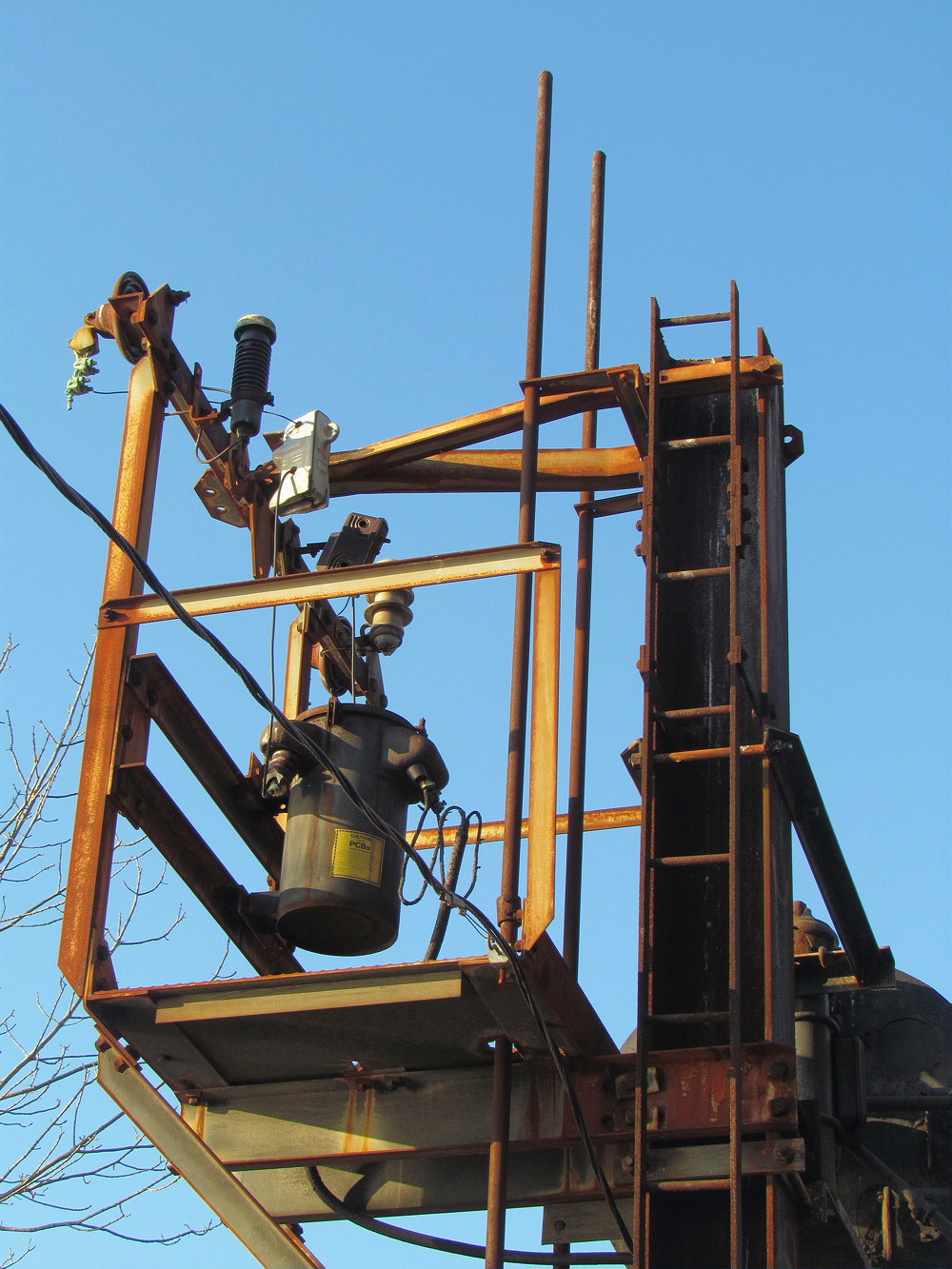
This active example was encountered at CP-SLOPE on the former PRR main line back in 2012. It had been installed before PCB's were banned in the 70's and has a big yellow sticker to that effect.
With transformers, frequency matters. The higher the frequency, the lower the inductive losses and the higher the equipment one can use. (This is why aircraft use 400hz power buses because they can use lighter transformers.) Mains power in North America is 60hz, however the Pennsylvania Railroad employed a 100hz cab signal carrier frequency to eliminate the risk of cross talk from 60Hz mains. This lead the PRR to actually adopt a 100Hz power supply in its electrified zone to eliminate the need for motor-generator frequency converters at every signal location. Here we can see a retired 6.9 kv transformer on the former PRR Port Road branch. You can see how the size compares with the 60hz transformers pictured above.
Here is a more contemporary example on Amtrak's NEC.
Today railroads are rapidly exiting from the utility business. It's a classic case of outsourcing. Now that public power utilities can be contracted to supply the power (even in rural locations), there is little reason for railroads to employ linemen and power engineers. Let the power company power and the railroad rail.
In the 1940's someone at the always cost conscious Pennsylvania Railroad wondered why if signals could be displayed in the cab, why was there any need to display them on physical wayside signals? Although not the first railroad to have such an idea, the PRR was the first to at least make such a concept ready for prime time. Implemented on the important-yet-not-that-important Conemaugh Line between Kitski and Conpit Junction, the PRR's main innovation was the 'C' Board or "Clear to Next Interlocking" signal, which allowed trains with failed or inoperative cab signals to proceed to the next fixed (and presumably absolute) signal, while still technically operating under signal indication and thus not needing to receive some sort of written movement authority. The assigned rule number, 280a, actually betrays the concept's roots in the old Manual Block System Rule 280, Clear Block, as opposed to Rule 281 Clear used in automatic signaled territory. Still numbered 280a under current NORAC signal rules, this can now be considered an Artifact Title since Rule 280 was long since removed. Both 280 and 280a can be lumped into the class of "super clear" indications, that can give trains 10 or even 20 miles of railroad at a shot.
Now I'd love to talk about how the technology behind Rule 280a works and how displaying 280a was implemented in towers, but both of those topics are the subject of ongoing research. Instead, today's post will focus on the 'C' signals themselves and how they evolved from the PRR's first deployment on the Conemaugh Line, through to the current flood of "Rule 562" territory on both Amtrak and Norfolk Southern.
The PRR's inaugural style of 'C' lamp was very much an ad hoc affair, making use of whatever materials were at hand. The the flashing lunar white marker lamps were provided by US&S PL-3 units, common to PRR position light signals, and they were surrounded by a rectangular piece of sheet metal with a white 'C' painted on it. The unit was attached to a standard PL mast by means of steel tubes that looked a lot like the type used to mount PL units to the central hub on PRR PL high signals. Here we see a surviving example of this type of 'C' lamp installed at CP-CONPIT.
Almost 50 years would pass until this method of operation once again gained traction. Metro North was looking to replace the New Haven vintage suspended semaphore signals, but the layout of the electrification system would either require completely new signal bridges or new suspended signals that would come with many of the same maintenance headaches. The solution was 562 operation that would allow most wayside signaling locations to be just removed from service. As 1980's Metro-North was still somewhat rooted in Conrail operating rules, it adopted the 'C' signal making use of PL-3 units surrounded by a pill shaped backing with a white 'C' painted above the lamp.
Conrail was next to pick up on the cab-signal-only crazy as a number of its cab signaled former PRR routes came up for re-signaling. The Morrisville Line, formerly the PRR Trenton Cutoff, made use of GRS SA searchlight heads modified to display a single lunar white light with a small reflective white 'C' on a flap of sheet metal mounted above. I am not sure if Conrail was recycling surplus SA heads made available in its transition to tri-light signals or if they were purchased new.
The next generation of Conrail "562" followed shortly thereafter with installations on the Fort Wayne Line and the east end of the Boston Line between Framingham and Worcester. These made use of more traditional railroad marker signal lamps, each mounted with a circular backing and the same metal 'C' flap as seen on the searchlights.
Of course one must account for dwarf signals. In both the Safetran stack and searchlight configuration, Conrail would place an extra lunar white Safetrain cube signal to the right of the signal with the same reflectorized metal 'C' fmap. On the Morrisville Line, there was at least one instance of PRR PL dwarfs getting an attached 'C' lamp, but these were replaced a number of years ago.
Meanwhile, the MBTA was the next railroad to employ 'C' signals when it rebuilt its Old Colony Lines. Here the distinctive feature was the reduced size of the 'C' lamp target, looking a bit like one of those small round lollipops. Like with Metro-North, the 'C' was incorporated into the target, placed above the lamp, which itself was of the Safetran square modular variety.
Fast forward to the 2000's and, like everything else signaling related, it appears that the venerable 'C' lamp has been standardized. Starting with Amtrak's 1999 Secaucas Junction and high density signaling project, Rule 280a has been displayed by a pair of Safetran modules, the lower one holding the flashing lunar white lamp, and the other one a reflective (or possible backlit) 'C'. This in turn is surrounded by a pill shaped backing, similar to the original Metro-North style. This layout has gone on from Amtrak to be employed by New Jersey Transit and Norfolk Southern.
The one exception is in the realm of dwarf signals where Amtrak's standard modular LED searchlight was modified to mount a lunar LED lamp next to the lower "head" of the dwarf stack and a blanked module with a white 'C' next to the upper "head" of the dwarf stack. BTW, anyone wondering what a 'C' light looks like when displayed, here you go.
Will there be more varieties of the 'C' signal? Possibly. There are a lot of railroads with a lot of signaling systems that haven't yet done all in with the waysideless future. What happens they are certainly more interesting than plan old Darth Vaders.
With electro-mechanical interlocking machines in terminal decline on North American main line railroads, the NYC Subway stood out as a bastion of classic signaling with more GRS Model 5's and US&S Model 14's than could be found throughout the entirety of the "real" railroad network stretching from coast to coast. Unfortunately, this appears to be coming to an end. Last I addressed this subject the system had just closed two towers at 4th Ave and Church Ave on the Prospect Park Line. This week I learned that three additional towers have closed on the Queens Boulevard line with one to follow shortly.
First I need to catch up on some old news. Way back in 2013 the NYCTA
closed the fishbown 5th Ave tower that worked the junction between the
Queens Boulevard the 6th Ave trunks. This tower was notable for being
able to watch the operator line up alternating straight and diverging
movements between E and M/V trains on a 40 lever GRS Model 5.
The Queens Plaza complex had already been re-signaled in support of the 63rd St connection, but just past it was the Roosevelt Ave crossover complex with another GRS Model 5 equipped tower at the east end of the eastbound platform. Only open as needed, I got some photos of the 60 lever machine back in December of 2015 after someone had left the lights on. I had known that the Queens Boulevard was on track for a CBTC capable re-signaling project, but I had expected that to take years if not decades to complete. Unfortunately I just found out that the tower closed less than a year after :-(
After Roosevelt the normally GRS equipped IND line enters US&S country. Although hard to get photos of due to the presence of a manned dispatch booth, the Continental Ave tower held an 83 lever US&S Model 14 that was also visible from the platform. This interlocking contains not only crossovers, but access to Jamaica Yard from the west. I just learned that its duties were recently transferred to a new N-X style area interlocking panel located in somewhere in the station.
Union Turnpike tower contains a 43 lever US&S machine and mirrors Continental Ave's function for trains accessing the yard from the east. Apparently this tower is still open, but will close soon. For sch a complex signaling project that involved at least a wiff of CTBC I really expected it to take many more years than it did :-(
I'd say I should have tried to get more photos, but the paranoid staff I really did the best I could. As I learned from Church Ave, it's really tough to provide a good "feel" for old NYC Subway towers since there is just so much that is behind the scenes.
In related news, I also got word that the PATH smashboards protecting
the DOCK drawbridge at Harrison have been removed. This was not
unexpected as both the DOCK complex and PATH in general are being
re-signaled. It's a shame that the smashboards did not make the cut as
PATH is keeping its pneumatic trips and switches, but in the age of CBTC
there probably isn't as much of a need to get in the operator's face.
Anyway, sorry for the bad news. Visit NYC while the towers last!




.JPG)