
Friday, July 31, 2020
Somethings up at Deshler
The CSX Toledo Branch is one of the last bastions of CPL signaling and the crossing complex at Deshler, OH is the crown jewel on the line. I don't have firm confirmation of a full re-signaling project, but something might be up so plan accordingly.

Sunday, July 26, 2020
Chicagoland CNW ATS Retired
The Intermittent inductive automatic train stop system in service on two former Chicago Northwestern commuter lines was taken out of service on October 19th, 2019. UP/Metra received FRA permission to abandon the system due it being generally rendered unnecessary through the deployment of PTC. Known for its distinctive "upside-down canoe" track mounted inductors, the IIATS system was developed by General Railway Signal in the 1920's and at its peak covered thousands of miles of main line track with the New York Central, Southern and Santa Fe being the most prominent users with the system supporting high speed operation after the ICC 80mph regulation came into effect in 1948.
Although the Central and Southern dropped the system in the 1970's, the Chicago Northwestern installed ATS on the North line to Kenosha in 1952 and the Northwest line to Harvard in 1967. The system provides a in cab alert if the train passes a signal displaying an indication other than Clear, which the engineer must acknowledge. Although the system is no longer is service, removing the inductors has not been a priority and there was likely no alterations made to any signal logic as the greatest operational impact of ATS is the pickup shoe mounted to the leading truck of the locomotive or cab car. The ATS shoe must be properly gauged to prevent false activation or damage as well as tested like any other technical safety system. The immediate result of the October 2019 retirement was the removal of equipment mounted ATS shoes with the track mounted inductors slated for removal over time.

This means that there is still a window of time for fans to get out there and document the trackside component of the ATS system as installed by the CNW, especially on the Northwest line with its three track arrangement on the UP Harvard Sub. At this point ATS is still in service on portions the former Santa Fe "Chief" transcontinental route between Chicago and LA, the Surfliner route between Fullerton and San Diego and the New Jersey Transit RiverLINE where it functions as a positive stop enforcement device at interlockings. Currently UP is undergoing a dispute with METRA over operation of the former CNW commuter routes with UP looking to offload responsibility. As the North and Northwest lines see minimal freight traffic, an outright sale to METRA could keep the inductors in place for many years to come. The Southwest Chief route in New Mexico, Colorado and Kansas has the ATS system "out of service" for over a decade, but the equipment left in place due to general disinvestment in the line.
Left unresolved is the fate of the CNW Automatic Train Control two aspect cab signal system. Although targeted for retirement by PTC, continuous cab signal systems have proven to be a more reliable form of wayside to train communication and the FRA is still generally in favor of ATC as a PTC supplement. Union Pacific with its extensive network of traditionally cab signaled track, may look to convert the CNW system or keep it in place as the differences can be ultimately handled in software.
 |
| ATS inductors partly hidden in the snow below Metra UP-Northwest Line Signal 48. |

This means that there is still a window of time for fans to get out there and document the trackside component of the ATS system as installed by the CNW, especially on the Northwest line with its three track arrangement on the UP Harvard Sub. At this point ATS is still in service on portions the former Santa Fe "Chief" transcontinental route between Chicago and LA, the Surfliner route between Fullerton and San Diego and the New Jersey Transit RiverLINE where it functions as a positive stop enforcement device at interlockings. Currently UP is undergoing a dispute with METRA over operation of the former CNW commuter routes with UP looking to offload responsibility. As the North and Northwest lines see minimal freight traffic, an outright sale to METRA could keep the inductors in place for many years to come. The Southwest Chief route in New Mexico, Colorado and Kansas has the ATS system "out of service" for over a decade, but the equipment left in place due to general disinvestment in the line.
 |
| ATS inductors at CY tower in Chicago. |
Saturday, July 18, 2020
Pan Am/Guilford Sale Threatens Heritage Signaling
In case you haven't heard, the Guilford Rail System, sometimes known as Pan Am Railways is putting itself up for sale. Owned by an eccentric businessman with an unhealthy obsession with Pan Am World Airlines, the Guilford is also known for its aggressive reluctance to spend money, turning it into a preserve of vintage searchlight signals and relay based CTC systems. Although the Boston to New York main line was partly sold to NS a few years ago and Darth Vader signals have been appearing here and there, the Guilford still uses such heritage practices such as double green clear, offset intermediate heads and bracket masts.

It is so far unclear who will be looking to purchase the Guilford Rail System, NS is unlikely to give up its route into the Bostom market, but the rest of the system relies on the lower costs and flexibility of a regional railroad. G&W is one obvious choice and they generally take a hands off approach to signaling, but there could be anti-trust concerns given its recent purchases of the P&W and New England Central. Either way, just another reason to get out and get your signal photos while you can.


Friday, July 10, 2020
MG and AR Towers Face Demolition
The NS PRR Main Line re-signaling project that culminated in the fall of 2019 is claiming two additional victims in the form of AR and MG towers on the famous East Slope of the Allegheny mountains.
Closed in 1994 with Conrail's previous effort to eliminate the island of paper dispatching and block operation between Altoona and Johnstown, AR tower, along with MG and SO were left standing due to the retention of pneumatic pair plants and some elements of the 100hz signal power supplies, which were in the way of a demolition operation. MO tower in Cresson was slated for preservation, but fell apart during the move while SO tower caught fire and burned down in 2009. C(onemaugh) tower in Johnstown was also demolished about that time leaving AR and MG as the only two PRR Main Line tower still under railroad control.
Both AR and MG were built in the 1940's as WW2 capacity improvement projects, with MG interlocking itself being built from scratch. Their strong brick construction helped them outlast their wooden counterparts and there was no reason they could not have stood for many more years.

Both towers were boarded up with their interlocking machines and other artifacts still inside. Photos taken on July 5th show the two towers being stripped of internal and external items with scrap value or asbestos contamination. While the demolition of AR seems inevitable, MG's highly remote location, over a mile from the nearest road, has NS apparently looking at demolition bids before a decision is made. AR's proximity to Gallitzin, PA allowed me to fully document it in 2018, however in the months before MG's re-signaling, reports of a heavy railroad police presence (as well as the long off-road component) prevented a similar effort there. Hopefully the fan community can preserve any of the more worthwhile items. Stay tuned for further updates and eventually full detail post on AR tower using my 2018 photos.
 |
| AR Tower in 2018 |
 |
| MG Tower in 2018 |

Both towers were boarded up with their interlocking machines and other artifacts still inside. Photos taken on July 5th show the two towers being stripped of internal and external items with scrap value or asbestos contamination. While the demolition of AR seems inevitable, MG's highly remote location, over a mile from the nearest road, has NS apparently looking at demolition bids before a decision is made. AR's proximity to Gallitzin, PA allowed me to fully document it in 2018, however in the months before MG's re-signaling, reports of a heavy railroad police presence (as well as the long off-road component) prevented a similar effort there. Hopefully the fan community can preserve any of the more worthwhile items. Stay tuned for further updates and eventually full detail post on AR tower using my 2018 photos.
Sunday, June 28, 2020
MUNI Metro Subway - Unrealized Capacity
You may have read about MUNI's radical attempts to deal with congestion issues in its Metro Subway that runs under Market Street and also included the Twin Peaks Tunnel. Long story short, MUNI is eliminating one seat rides downtown for riders on the J, K and L streetcar lines. The given reason is since the J and K lines are limited to single unit LRV operation, those "slots" in the Metro Subway are being underutilized and the new operating plan will replace the one LRV trains with two LRV trains.
The Metro Subway is signaled by a loop antenna based CBTC system in the style of LZB and if you are noticing a pattern between articles addressing CBTC and capacity problems then I thank you for being a long time reader. Basically MUNI is noticing the capacity problems that stopped both SEPTA and MBTA from realizing a full CBTC fantasy in their respective trolley subways and MUNI's response is to make many commutes much worse. To be honest this isn't just a CBTC problem as coded track circuits would have been no better and possibly worse. The issue is a fear of less automated operation.

Here is an LRV on the eastbound track at the Embarcadaro terminal station, which seems to be the major capacity constraint as M, L, K and J line trains all turn back here. You might notice a line of cones and a lot of unused platform space. That is because at every Metro Subway station, only one train can platform at a time, even though the platforms are long enough to support two trains.

Here is the westbound track with a fresh train sitting behind the cones just hanging out with a second train close behind while they wait for the single loading/unloading berth to become available. On all of the Metro subway stations it is common for following trains to stop short on the platform and wait for the single loading zone to become available. It is also common for passengers to run their buts off along the platforms to reach said single loading zone from the far end.
Both SEPTA and the MBTA use multiple berths at underground trolley stops to varying degrees. For example at Juniper St there is an unloading spot and a loading spot. At other stations different routes can stop at different points along the platform. On both systems the signaling system is equipped with R/Y station signals that allow operators to creep forward and occupy the station behind another LRV. It's not a cure all, but it helps.
MUNI plans to update its CBTC system to one that uses wireless instead of loop antennas. It might work better, it might not, but with new LRV's already arriving, maybe someone should have thought outside the box and ordered a radar based collision avoidance system to allow closer spacing in stations and thus pipeline the passenger boarding operation. Once headways drop below two minutes, dwell time and terminal capacity dominate block separation. It's why expensive CBTC systems don't move the capacity needle much and often do worse than traditional systems with on-sight operation, spring switches and loops.
The Metro Subway is signaled by a loop antenna based CBTC system in the style of LZB and if you are noticing a pattern between articles addressing CBTC and capacity problems then I thank you for being a long time reader. Basically MUNI is noticing the capacity problems that stopped both SEPTA and MBTA from realizing a full CBTC fantasy in their respective trolley subways and MUNI's response is to make many commutes much worse. To be honest this isn't just a CBTC problem as coded track circuits would have been no better and possibly worse. The issue is a fear of less automated operation.

Here is an LRV on the eastbound track at the Embarcadaro terminal station, which seems to be the major capacity constraint as M, L, K and J line trains all turn back here. You might notice a line of cones and a lot of unused platform space. That is because at every Metro Subway station, only one train can platform at a time, even though the platforms are long enough to support two trains.

Here is the westbound track with a fresh train sitting behind the cones just hanging out with a second train close behind while they wait for the single loading/unloading berth to become available. On all of the Metro subway stations it is common for following trains to stop short on the platform and wait for the single loading zone to become available. It is also common for passengers to run their buts off along the platforms to reach said single loading zone from the far end.
Both SEPTA and the MBTA use multiple berths at underground trolley stops to varying degrees. For example at Juniper St there is an unloading spot and a loading spot. At other stations different routes can stop at different points along the platform. On both systems the signaling system is equipped with R/Y station signals that allow operators to creep forward and occupy the station behind another LRV. It's not a cure all, but it helps.
MUNI plans to update its CBTC system to one that uses wireless instead of loop antennas. It might work better, it might not, but with new LRV's already arriving, maybe someone should have thought outside the box and ordered a radar based collision avoidance system to allow closer spacing in stations and thus pipeline the passenger boarding operation. Once headways drop below two minutes, dwell time and terminal capacity dominate block separation. It's why expensive CBTC systems don't move the capacity needle much and often do worse than traditional systems with on-sight operation, spring switches and loops.
Sunday, June 21, 2020
PHOTOS: GWYNN Tower
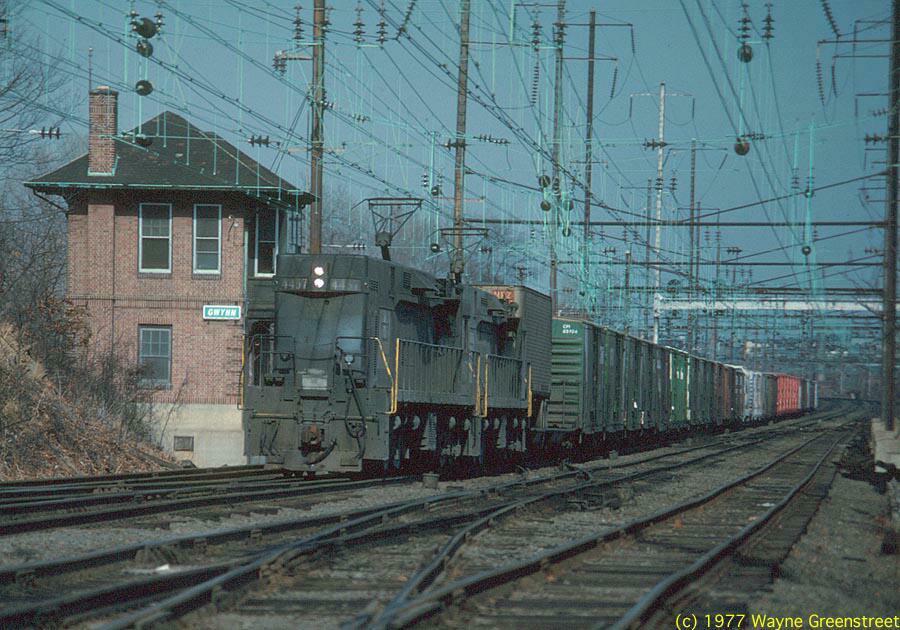
The PRR's GWYNN tower, originally named GWYNNS RUN, was built in 1931-32 and replaced the small, wood frame VN (CalVertoN Yard) tower on the same location adjacent to the viaduct over Gwynn's Falls. GWYNN served the function of a main line crossover, but being located only 1.5 miles from the end of 4-track territory at FULTON interlocking, its primary reason for existence was to support various industrial tracks south of the City of Baltimore in a similar fashion to MILLHAM interlocking north of Trenton. With the collapse of urban industry in the Northeast along with a specific reduction of freight services along the Northeast Corridor in the Amtrak era, GWYNN and its entire interlocking plant were ultimately found to be redundant and subsequently removed and abandoned.

GWYNNs layout consisted of a 4-track complete crossover with connections to industrial leads at three of the four corners. The original main track layout was 2+2 single direction Rule 251 in both directions, although by the Penn Central era track 3 had been converted to Rule 261. By the 1940's both logical pairs of crossovers were equipped with Limited Speed #20 turnouts with signals having the appropriate yellow triangles. The intent was to allow both passenger and through freight to bypass local industrial movements tying up the outer tracks directly south of the city The tower also had remote control of two nearby interlockings to the south, LOUDON PARK and WINANS.

The demise of GWYNN came with the Northeast Corridor Improvement Program (NECIP) of the early 1980's. With the aim to increase speeds to 125mph and remove costs associated with legacy freight infrastructure, Amtrak rationalized GWYNN by replacing the old interlocking with the MP 99.3/4 automatic signal location and, in 1985, transferring some of the functionality to a new interlocking named BRIDGE, 1.1 miles to the north (although it can be argued that BRIDGE is more a devolved FULTON than a relocated GWYNN). Note in the 1992 Amtrak diagram below that the #5 track, #0 track and Gwynn industrial track have all been removed as of 2020.
 The former northbound signal bridge now serves as automatic signal location 993 for southbound trains and 994 for northbound trains. The NECIP completely eliminated Rule 251 operation south of Philadelphia and at this point all 4 tracks were bidirectional. Note that the track to the far right is track #3 and the track to the far left is track #A, which is different from the PRR which numbered them 1 to 4.

Here we see GWYNN tower and the straight railed interlocking plant looking first northbound then southbound, which compares rather poorly to this 1977 view.


The southbound signal gantry today sits empty north of the Gwynn's Falls viaduct, but is past function is still obvious.

Similar in design to towers like CORK, GWYNN was a throwback to the more ornate towers of the teens and twenties, just before the general adoption of the cleaner designs of the 1930's. Compare the wooden bay window to that of WINSLOW tower, built just a few years later. In the photo below, taken around 2005, we can see that whole the structure is clearly decaying, it is relatively graffiti free and appears to have had a spot of paint applied to its concrete foundation.

15 years later the tower has seen some significant deterioration with the wooden bay window structure having completely rotted off and the walls not covered in spray paint. Unlike the DL&W style towers which had poured concrete roofs, the PRR tended to use wooden roofs and once the roof is compromised it tends to undermine the rest of the structure. Fortunately the cantilevered bay window floor did not appear to be going anywhere.

GWYNNs layout consisted of a 4-track complete crossover with connections to industrial leads at three of the four corners. The original main track layout was 2+2 single direction Rule 251 in both directions, although by the Penn Central era track 3 had been converted to Rule 261. By the 1940's both logical pairs of crossovers were equipped with Limited Speed #20 turnouts with signals having the appropriate yellow triangles. The intent was to allow both passenger and through freight to bypass local industrial movements tying up the outer tracks directly south of the city The tower also had remote control of two nearby interlockings to the south, LOUDON PARK and WINANS.

The demise of GWYNN came with the Northeast Corridor Improvement Program (NECIP) of the early 1980's. With the aim to increase speeds to 125mph and remove costs associated with legacy freight infrastructure, Amtrak rationalized GWYNN by replacing the old interlocking with the MP 99.3/4 automatic signal location and, in 1985, transferring some of the functionality to a new interlocking named BRIDGE, 1.1 miles to the north (although it can be argued that BRIDGE is more a devolved FULTON than a relocated GWYNN). Note in the 1992 Amtrak diagram below that the #5 track, #0 track and Gwynn industrial track have all been removed as of 2020.



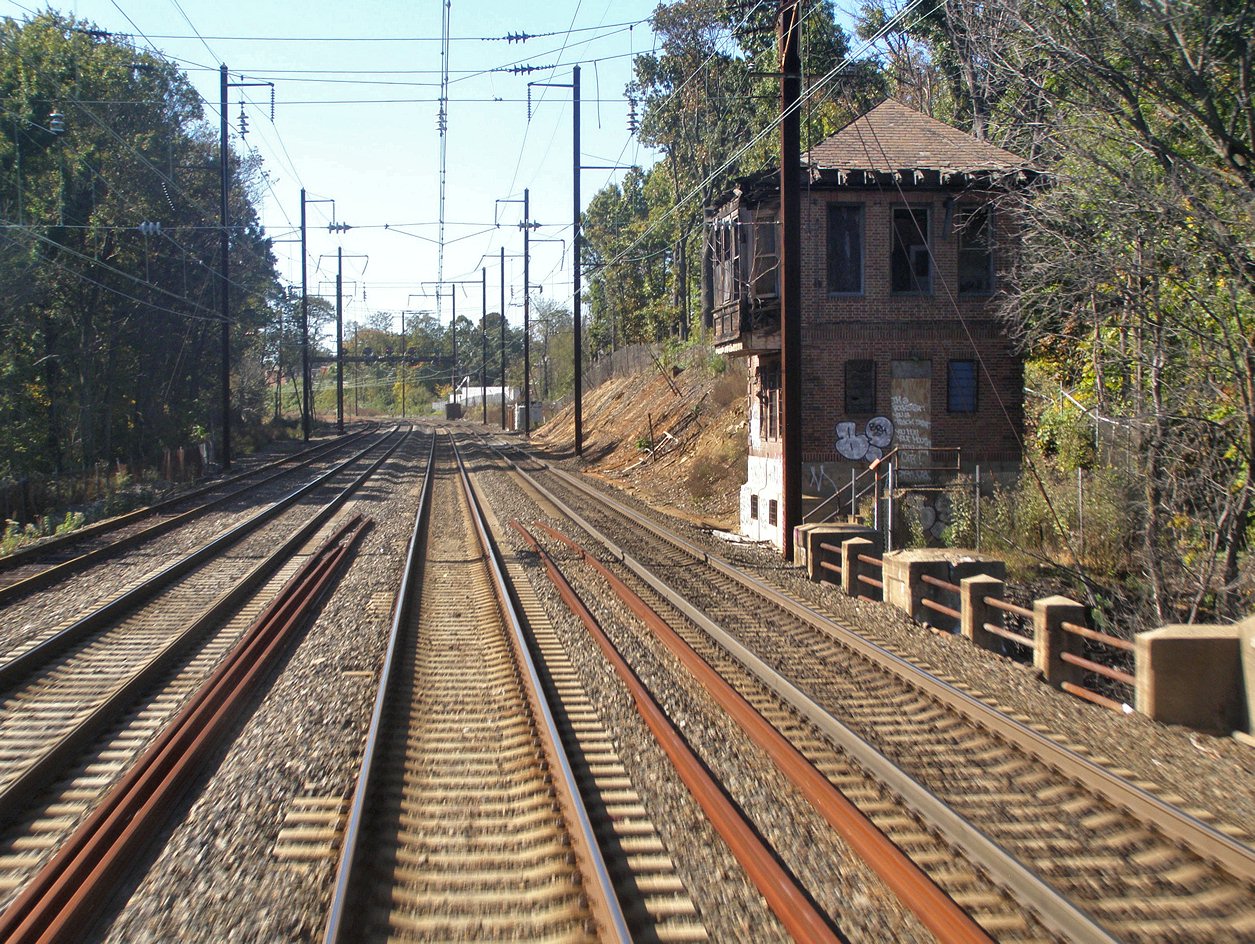

Similar in design to towers like CORK, GWYNN was a throwback to the more ornate towers of the teens and twenties, just before the general adoption of the cleaner designs of the 1930's. Compare the wooden bay window to that of WINSLOW tower, built just a few years later. In the photo below, taken around 2005, we can see that whole the structure is clearly decaying, it is relatively graffiti free and appears to have had a spot of paint applied to its concrete foundation.


15 years later the tower has seen some significant deterioration with the wooden bay window structure having completely rotted off and the walls not covered in spray paint. Unlike the DL&W style towers which had poured concrete roofs, the PRR tended to use wooden roofs and once the roof is compromised it tends to undermine the rest of the structure. Fortunately the cantilevered bay window floor did not appear to be going anywhere.

Saturday, June 13, 2020
Exit Stage Right - Leaving Signaled Territory
Typically I write about railroad signaling, occasionally touching on non-signaled block systems such as TWC or DTC. Each are more or less straightforward on their own, but things can get interesting when transitioning from one to another, specifically from signaled territory to non-signaled territory. the three primary methods are:
Under mostly defunct manual block systems, trains would be admitted to the block by a manual block signal, typically under a modified Clear indication like Rule 280 Clear Block in the PRR Rule book. These signals would be located at the start of manual block territory directly after the interlocking or on the last signal on a route that could lead to manual block territory. A signal less favorable than Clear Block would be preceded by an Approach-type indication.
With the coming of Track Warrant systems like Conrain's Form D Control system (DCS), trains moving from signaled territory to DCS territory would be given a Restricting indication, regardless of the trains DCS movement authority. In fact this method of operation was written into the text of NORAC Rule 290.


Where signaled approach blocks are not present, the exit sign can be used at the end of interlocking limits. As with the Restricting exit signal, this allows a more favorable indication, such as Approach or Slow Approach, to be displayed at the start of the interlocking. This in turn allows higher speeds for pretty much the cost of a sign and also better supports non-restricted speed track as, unlike the Restricting signal, Restricted speed is not necessarily required if the train possesses non-signaled movement authority.
Recently a more radical take on the exit sign has started cropping up. Instead of treating the signal as a virtual restricting signal demanding an Approach-class signal in advance, some railroads, including Norfolk Southern, have been configuring their interlockings to display Clear-class signals into an end of signaling sign, even if that sign is located at the interlocking limits.

For example, at CP-PORTER, shown above, the main track signal displays Approach for a straight route towards Restricted speed track marked by a sign at CP-PLANT. However it also can display Slow Clear for the diverging route directly into a Track Warrant territory (Rule 171) sign at CP-PORTER's southern limit. The only other option is Restricting if the route is occupied within the interlocking itself.

Trains being signaled into Yard Limits directly north of CP-PORTER get an Approach-class signal on the straight route, but a Slow Clear on the northeast wye track. While all this inconsistency can technically be considered safe as the signs technically overrule the preceding Clear-class signal. Still, I am not a fan of this practice as it is important to never violate the contract that a Clear-class signal provides two clear blocks ahead and an Approach-class one clear block. Unless approach blocks are being used, a signaling system has no idea about the state of the track in unsignaled territory and a Clear-class signal would be writing a check the signaling system cannot guarantee.
- Exiting at a Manual Block signal
- Exiting over Restricting
- Exiting at a sign
 |
| WINSLOW Jct on the PRSL had two exits into Manual Block territory. |
Under mostly defunct manual block systems, trains would be admitted to the block by a manual block signal, typically under a modified Clear indication like Rule 280 Clear Block in the PRR Rule book. These signals would be located at the start of manual block territory directly after the interlocking or on the last signal on a route that could lead to manual block territory. A signal less favorable than Clear Block would be preceded by an Approach-type indication.
 |
| NORAC Rule 290 Restricting into DCS territory. |
With the coming of Track Warrant systems like Conrain's Form D Control system (DCS), trains moving from signaled territory to DCS territory would be given a Restricting indication, regardless of the trains DCS movement authority. In fact this method of operation was written into the text of NORAC Rule 290.
Proceed at Restricted Speed until the entire train has cleared all interlocking and spring switches (if signal is an interlocking or CP Signal) and the leading wheels have:This is also the standard when trains are moving into a yard or non-signaled sidings, although in those situations the train is entering Restricted speed track as opposed to a non-signaled block system.
- Passed a more favorable fixed signal, or
- Entered non-signalled DCS territory
 |
| Seaboard Rule 290 Restricting into Collier Yard. |
In addition to placing the Restricting signal at the entrance of the interlocking, it can be placed on an exit signal allowing higher speeds throughout interlocking limits.

Exiting at a sign means that signaled territory ends at a sign instead of a signal. This can be used with signaled approach blocks to allow reverse direction trains to occupy the approach block without needing to get a track warrant, as seen below on the old D&H near Saratoga Springs, NY.

Where signaled approach blocks are not present, the exit sign can be used at the end of interlocking limits. As with the Restricting exit signal, this allows a more favorable indication, such as Approach or Slow Approach, to be displayed at the start of the interlocking. This in turn allows higher speeds for pretty much the cost of a sign and also better supports non-restricted speed track as, unlike the Restricting signal, Restricted speed is not necessarily required if the train possesses non-signaled movement authority.
 |
| NJT ARCH interlocking eastbound home signal. |

For example, at CP-PORTER, shown above, the main track signal displays Approach for a straight route towards Restricted speed track marked by a sign at CP-PLANT. However it also can display Slow Clear for the diverging route directly into a Track Warrant territory (Rule 171) sign at CP-PORTER's southern limit. The only other option is Restricting if the route is occupied within the interlocking itself.

Trains being signaled into Yard Limits directly north of CP-PORTER get an Approach-class signal on the straight route, but a Slow Clear on the northeast wye track. While all this inconsistency can technically be considered safe as the signs technically overrule the preceding Clear-class signal. Still, I am not a fan of this practice as it is important to never violate the contract that a Clear-class signal provides two clear blocks ahead and an Approach-class one clear block. Unless approach blocks are being used, a signaling system has no idea about the state of the track in unsignaled territory and a Clear-class signal would be writing a check the signaling system cannot guarantee.
Subscribe to:
Posts (Atom)