Search This Blog

Monday, January 31, 2022

The Several Faces of GRS Products

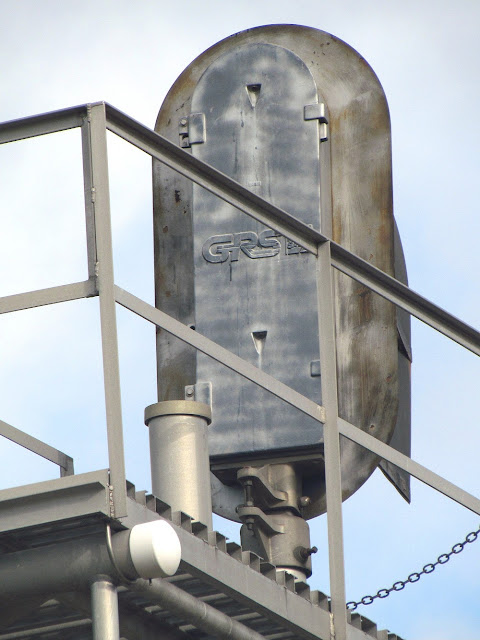
Like the other major North American railroad signaling supplier, General Railway Signaling of Rochester, NY went through a number of corporate ownership changes over the years, eventually becoming part of Alstom in 1998.  Unlike the other brand, GRS actually made an effort to update is corporate branding over the years and in many cases the logo was cast into the metal housings of its products. 

 The classic GRS logo was  born in the early 20th century and was consisted of a script monogram type inside a circle, similar in concept to General Electric's logo. Along with the plain text "General Railway Signal" that was used on signal housings, this served GRS well up until the 1970's.

At this point the script logo was decidedly old fashioned and was replaced by a sans serif boxy stylized monogram type.  This would be used on documentation up to the Alstom buyout and switch machine castings up through about 2010. 

After being purchased by the Sasib Railways Group of Italy in 1989, an updated logo appeared on its new mono-block color light signal that gave the "GRS" monogram some 90's style and included the Sasib logo as well.


After purchase by Alston, the Sasib bit was removed from the molds, but a ghost impression remained.

Ultimately, Alstom felt there was very little value left in the GRS brand and finally has the casting holds changed to read Alstom.  However because switch parts are durable and able to be reconditioned, the older logos still show up on motors or reconditioned housings on "new" point machines.

While US&S's many parents have still found no reason to update their castings, there have been all sorts of off brand knockoffs of the venerable M3 point machine, but that is a story for another day.

Friday, January 21, 2022

Video: Soviet Signaling on the Russia - Ukraine Border

 Today's video post is ripped from the headlines!  I'm sure many of you are familiar with the past and current conflict between Russia and The Ukraine. Well, the 2014 disagreement had some implications for the Moscow - Rostov-on-Don railway line as some of it actually runs through Ukrainian territory in the vicinity of Chertkovo. To avoid being in any way beholden to the Ukrainian government, Russia built an entirely new bypass between the towns of  Zhuravka and Millerovo.  While trying to figure out how this trans-national rail segment functioned, I found some reverse railfan window video footage that not only showed the area, but also provided a taste of Soviet style railway signaling, a versions of which are also used in former Eastern Bloc states and China.

While I'll try to do a more in depth review of Soviet railway signaling later, a brief primer can be found here. It's an interesting system based on the station and main line system where stations have crossovers and siding tracks and can sort of be considered within interlocking limits.  Here one sees more complex sation signals where the upper head provides information about the next signal, while the lower head provides information of any immediate diverging route, plus stop.  Between stations an ABS 251 system predominates with Approach type signal indications being given by flashing Green and Yellow aspects.  There's a lot of incomplete information so I'll try to get a more complete picture in the future, but for now, enjoy the video.


Friday, January 14, 2022

German Stellwerke Blog and Its English Mirror

Although they have been prominent in my sidebar for many years, I wanted to give another shoutout to the German equivalent of this blog, Von Stellwerken und anderen Maschinen, because the author has been trying their best to provide English translations of some of the key articles in a paralell blog, Of Interlockings and Other Machines


While the former has hundreds of posts from over the last 10 years and the latter only about a hundred, the effort to provide some translations is particularly important in this niche subject because niche subjects have a habit of confounding automated translation tools like Google Translate.  While the Germany version of the site is still pretty readable if you stare at it enough, the large sample of English translation pages now on the mirror site allows one to really get a handle on how Central European interlocking machines and signaling systems work.  If you are looking for something to do on a cold winter weekend I highly recommend both of these websites as the author has a seeming endless supply of behind the scenes photos, both of in service equipment and preserved.

Saturday, January 8, 2022

SEPTA West Chester Line Goes 562 and Other News

 This post had been planned as an update on SEPTA Signaling encountered during my SEPTA Mid-Winter fan trip, but after a couple of additional rail adventures in the December/January time period I figured I should address them in a single post.

The headline news item is that the SEPTA West Chester Line has been converted to Rule 562 operation with cab signals and no intermediate wayside signals.  This is surprising as the line had already been converted to Rule 261 with cab signaling and it appears that SEPTA had to go to the trouble of removing the wayside masts, exposing themselves to all of the attendant issues with cab signal failures.  The most significant loss are the distant signals that had been fitted with Reading style two lamp lozenge heads, that have not really been fitted anywhere since.

One the other hand, no changes were made to the interlockings CANE, MEDIA and NORTH/SOUTH ELWYN.  They still display full indication and not just Cab Speed and Restricting.  Also ARSENAL interlocking is still hanging in there with the LED position lights on the north end and full range color lights on the south end.

On the Routes 101 and 102 Suburban trolley, the long metastasizing CBTC project may or may not be in operation.  What has changed is that SEPTA has added a large number of interlocked crossovers and also interlocked the ends of single track operation.   This actually seems to have increased the number of wayside signals.  In addition to this, the old two aspect ABS signal locations appear to be in place, making me wonder if the CBTC is not yet active or if it will be a safety overlay like in the tunnels with no increase in capacity.

On the Route 100, the passenger stop request signals at stations are still in place, but the short stretch of 3rd rail used to cancel them are now being removed.

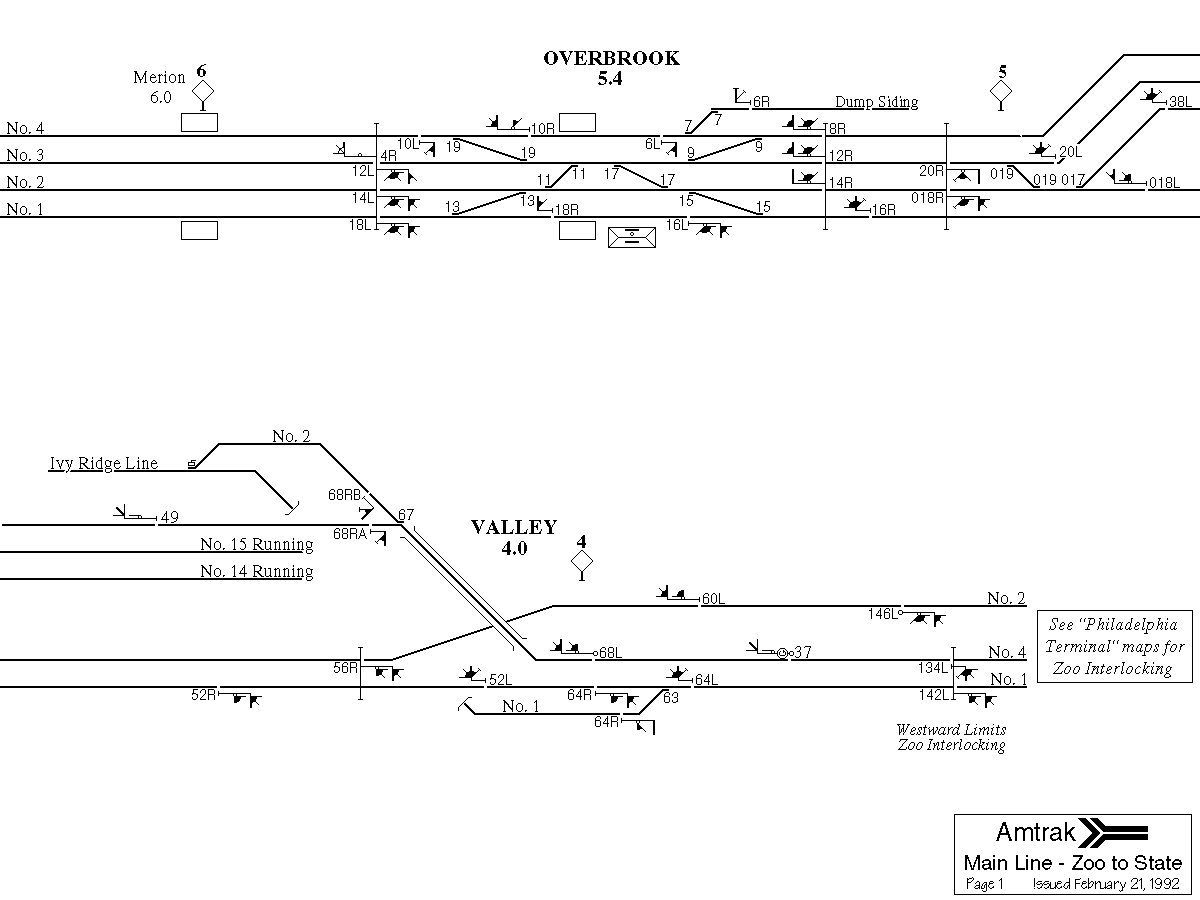
On the Amtrak Harrisburg Line / PRR Main Line, the crossovers between #1 and #2 track at OVERBROOK interlocking (levers 13 and 15) have been converted from pneumatic to electric operation.  Not sure what the plans or timeline are, but I figured that OVERBROOK would be replaced and removed, not closed, so this actually might represent a live extension.


Moving out along the PRR Main Line, the legacy signal bridges at Cove and CP-BANKS have been removed having been out of service since 2018.


Finally, no work appears to have been started on the off again, on again, NS D&H Main Line re-signaling project between Sunbury and Binghampton.  I visited a number of locations including CP-DUPONT and there is absolutely no evidence of prep work.  Hopefully that continues to limbo along for many years.


Friday, December 31, 2021

CSX Files to Discontinue Cab Signaling on RF&P

Virginia has become somewhat of a purple state both in its politics and its approach to higher speed passenger rail. Recently the state spent billions to purchase a number of key rail lines from CSX to grow service on the DC to Richmond to Raleigh corridor that already sees a significant amount of Amtrak service. From the outset it appeared that Virginia would begin to resemble New York or Pennsylvania with their own NEC adjacent 110mph intercity services and allied commuter rail. Unfortunately CSX's filing on December 23rd to abandon the RF&P cab signaling system (CSS) is threatening to upend these higher speed plans and, unfortunately, the State of Virginia appears to be on board.


As the wireless ETMS PTC system has come online across the country, the Class 1 carriers first moved to abandon their legacy safety systems such as the ex-Santa Fe IIATS and the CNW's legacy 2-aspect cab signaling. This was neither surprising nor controversial due to each system's rather limited capabilities and general lack of industry support. However Union Pacific then filed to discontinue its substantial coded track circuit based Automatic Cab Signaling system claiming that ETMS was a preferable substitute. Saving the accuracy of that assertion for later, UP-ASC did have a number of limitations that made it more difficult to integrate with ETMS the way NS had during its 2016-2018 PRR territory re-signaling project.


Union Pacific Cab with ATC / ASC Display

Left out of these moves was CSX, which was generally free of legacy systems except for former Conrail cab signals on the rather isolated Boston and Hudson Lines and the RF&P cab signals (changed to the Conrail/PRR standard) between Washington and Richmond. Although CSX filed to discontinue the in-cab ATC function in 2020, this was superfluous due to ETMS PTC. Then in late 2021 the other shoe dropped with CSX filing a petition with the FRA to completely discontinue and remove CSS using PTC as an excuse and the real shocker is that Amtrak, VRE Commuter Rail and the State of Virginia have signed onto the application as well.

Cab signal antenna behind the pilot of VRE MP36PH-3C #V50

The RF&P CSS forces CSX to cab signal equip a large portion of its locomotive speed so CSX wanting to rid itself of this headache is no surprise. Fear of cab signals is why CSX chose to force a SEPTA-ration of the Trenton Line with the SEPTA Fox Chase and West Trenton services. However getting VRE and Amtrak to sign on is a bit more of a puzzle because of the long term implications, however in the short term VRE would get out of the cab signal business and Amtrak would get to avoid a possible failure and inspection point on every diesel powered train heading out of DC except the Capitol Limited. The filing also mentions that having both CSS/ATC and ETMS active causes some issues for the crews as they have to pay attention to both systems as the CSS/ATC tends to be a bit more restrictive and, at as late as 2011, that would include dropping the cab to Restricting for Medium speed movements within interlocking limits.


Another point in the filing was CSX having to maintain mid-block CSS repeaters and code change points. Although when used for the purposes of CTC, pulse coded track circuits appear to be fine for block lengths of 2 or 3 miles, on CSS equipped lines, the cab signals appear to need repeaters spaced about every mile. I suspect the reason is due to the need for lower power pulse codes that prevent code energy burning through the circuit shunting action of the train axles . In addition to the repeaters it was common practice to put code change points in advance of absolute signals to drop an Approach cab to Restricting about 1500 to 3000 feet in advance of a stop signal. In the 1980's Conrail started using the repeaters to drop cabs in front automatic signals as well and SEPTA picked up that practice for use on the short blocks on the reading viaduct.   The diagrams provided in the appendix of the the regulatory filing show cut points between intermediate signals that are only 1 mile apart and also refer to them exclusively as cab signal cuts, so it is safe to assume that when the RF&P re-signaled in the 1980's they adopted the practice of dropping cabs in advance of Stop and Proceed intermediate signals as well.

RF&P CSS code change point at Milepost 24.1

So what's the problem? Why should one care beyond some sort of cab signal nostalgia?

  1. ETMS is not a cab signaling system and it is unclear if it ever will be or if that is even desirable.

  2. CSS increases capacity and provides concrete safety benefits that ETMS does not.

  3. CSS powered ACSES PTC provides a clearer path to 110 and 125mph operation.

  4. CSS is more resilient. 
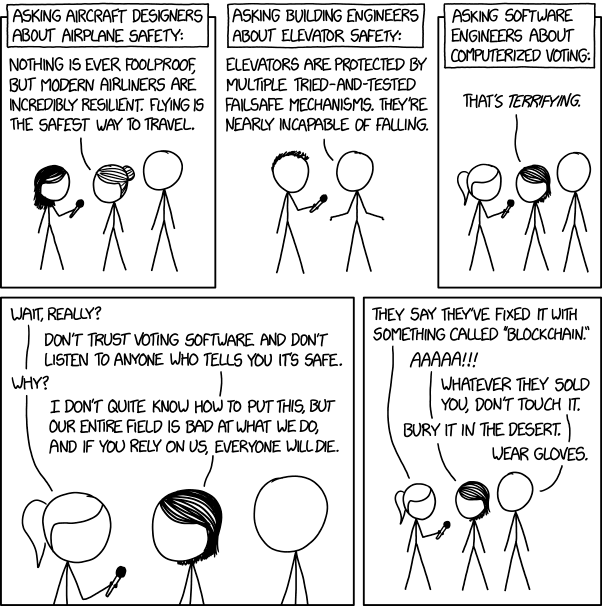
Let's go over these point by point. First, ETMS with all of its wireless communications, track profile databases and complicated computing power avoided a lot of hard technological and security issues by acting as a safety overlay instead of a signal system. This means it slows trains down, but doesn't speed them up. By rule ETMS fails safe because crews continue to follow the legacy rulebook and signals. Doesn't matter if the out of state PTC server gets hacked because by rule cannot rely on it to provide speed or signal information. It's the difference between adaptive emergency braking and Tesla autopilot. Of course people are making waves about using ETMS as a cab signal system or as a full on CBTC system and it might even get approved (like the 737 MAX got approved), but just remember it is going to have the same problems as voting software.

Second, CSS provides partial moving block functionality that allows for mid-block upgrades as block state is continuously fed to the train via the secure communications channel of the rails. Moreover, those extra cab signal repeaters CSX wants to get rid of can be instead used to provide DOUBLE the number of signal blocks! This is effectively what NS did on its former Conrail territory eliminating automatic wayside signals and creating code change points every mile. The RF&P on he other hand will be left with half the number of fixed signal locations that will need to be physically re-positioned to respond to capacity constraints or higher speeds. In terms of safety, CSS codes are transmitted through the rails. If a rail brakes or anything else suddenly disrupts the track circuit, an approaching train will see a signal drop immediately. ETMS only sees what the signal system sees, a block occupied by...something.


Third, ACSES is Amtrak's transponder and CSS based PTC system that is available off the shelf for speeds up to 150mph. Right now Amtrak is trying to get ETMS certified for 110 in a "couple of years". ACSES is far simpler to set up with no need to download track databases and both CSS and ACSES operate and expanding Rule 562-ACSES south to Richmond and Manassas would unify Virginia passenger rail with those of the entire northeast. 

Rule 562-A Signal Bridge at BERLIN at 100mph.


Fourth, CSS just works. The technology was developed in the 1920's and can be run with a couple of relays. There is no wireless data link that can be disrupted or hacked. Although NS uses ETMS on its former PRR territory, it does not need to maintain a constant wireless link with trains between blocks because cab signal codes are proof of movement authority (as evidences by the presence of PTC antennas only at interlockings). When deployed with ACSES, CSS and ACSES are independent systems that can each function if the other fails. Currently FRA regulations require a 60mph speed restriction for trains operating with failed PTC, however the limit is 80mph if ATC is present. These 60mph PTC failure restrictions are not a rare occurrence and on the 110mph Michigan Line this will impart 30 to 60 minutes of delay. The freight railroads don't care about a 60mph limit because that's as fast as their trains go. 

Cab Signal equipment box on a Geep

In summary, discontinuing the RF&P CSS is a massive failure of imagination that will lock the Virginia services into a second tier, freight centric method of operation for decades. It will reduce capacity, and increase service disruptions just to save a little money and hassle in the short term. I've linked the regulatory motion. If there's a way to leave a public comment try to do so and if you know of any advocacy groups that might be in a position to do something, please bring this to their attention. The ultimate shame is that the proper response to accidents such as Chatworth would have been a nation-wide cab signaling requirement.  Cheap, simple, effective.  Instead the only winners are signal vendors and those that stand to gain from a hobbled rail sector.


Tuesday, December 28, 2021

Caught on Camera: Amtrak's Two Indication Block Signals?

 Twice in the last year I have had the fortune to catch and video the strange situation of Amtrak intermediate signals transitioning directly from Stop and Proceed to Clear.  The first was at the 592 automatic on track #1 eastbound at Irishtown Road, part of the ~2006 Rule 562 CTC project, after the passage of the eastbound Train 42 Pennsylvanian.  The second instance was at the 133 automatic on track #4 westbound in Radnor, PA, an origional PRR signal dating from at least 1948, after the passage of a westbound SEPTA local. 


This effect is not universal so I don't think Amtrak has gone around systematically eliminating the Approach indication for "safety" reasons (although I wouldn't put it past them) so my best guess is that the 75ppm code generator at the next signal location down the line has failed resulting in the featured locations seeing a 0 code for an occupied block. Because train traffic hasn't been busy enough for one train to be running behind another, I suspect that in both cases the defects had simply not been noticed/reported.

Wednesday, December 22, 2021

133 Year Old BO Tower in Kalamazoo (Finally) Demolished

The demolition of some towers, like Fostoria's JACKSON ST, come as a surprise.  On the other hand other tower are clearly on the pah to the wrecking ball and it is not a matter of "if" but "when" and the former Michigan Central's BO tower in Kalamazoo was most definitely in the later category.  In operation for a mind boggling 128, a history of the tower was discussed in my post covering its closure back in 2016. Although BO was owned by Amtrak and/or the State of Michigan as part of the Wolverine Corridor, at the time when the door was locked and boards went up on the windows, it was mentioned that the interior equipment like the model board and interlocking frame were destined for the Henry Ford museum in Detroit.  This is when it became clear that there were no serious efforts underway to preserve BO tower.  

Honestly I would have been surprised if there were.  The tower was built in 1888 and constructed of wood.  It would have needed a pretty serious preservation effort to keep it intact (although the roof was replaced in 2006).  Second, the tower could not be preserved in situ as it was just feet from TWO active tracks, one an Amtrak route with multiple daily train movements.  Third, unattended wooden structures in an urban area catch fire, full stop.  See what happened to SHORE tower just a few months ago.  Fourth, there was no obvious rail museum to relocate the tower to in the immediate area.  Finally, the removal of the interlocking frame (if it was actually removed) would have fatally compromised the structure.  Remember, preservationists tried to move MO tower in Cresson, PA but it was just too weak and immediately fell apart. All of these factors working together sealed BO tower's fate.

Preserving BO tower would not have been beyond the pale.  Tower B-12 in Franklin Park is pretty much the same type of structure and was moved to a nearby park, but it does not seem that Kalamazoo has the enthusiast community on hand to take on such a project. Kalamazoo, where my maternal grandmother is actually from, is still part of the rust belt and there just isn't a lot of downtown civic energy available for these types of projects. Because of my family connection I will be certain to visit Kalamazoo in the upcoming years.  It's a shame BO tower will not be there waiting for me.

UPDATE: According to this video, the lever frame in BO tower was NOT preserved and was generally ripped up in the demolition process.  Not sure if it went to a scrap yard or if a collector was able to snag it. It also appears that there was a limited preservation effort that ultimately failed.