A blog devoted to explaining the ins and outs of North American railroad signaling, past, present and future. This blog seeks to preserve through photo documentation the great diversity and technical ingenuity of 20th century signaling and interlocking hardware and technology. Related topics cover interlocking towers and railroad communications infrastructure.
Note, due to a web hosting failure some of the photos and links may be unavailable.
One might wonder how the electrified PRR Main Line could have an interlocking tower somehow more "forgotten" than the small booth that occasionally managed the emergency crossovers at LEAMAN, but it did and that forgotten tower also began with the letter L. LANDIS tower, in Landisville, PA, was always a stepchild of an interlocking forced on the PRR by the rival Reading Company by means of the Reading and Columbia Branch. This was a forked "milk run" line connecting Reading (via Sinking Spring) to Ephreta, Columbia and Lancaster. The Lancaster fork was ultimately integrated into the west end of CORK interlocking, crossing the main line via crossover switches and the Columbia Branch via diamonds. The Columbia fork met the PRR Main Line about 8 miles to the west at Landisville and, due to the lack of any existing infrastructure, the diamond managed to justify its own interlocking tower, built and operated by the PRR.
Given the telegraph code NV, a square wooden tower was built in 1902 in the contemporary PRR style exemplified by the preserved LEMO tower at Strausburg.
This tower lasted into the post war period, its Victorian aesthetic somewhat in conflict with the electrification infrastructure. In this photo one can see the Reading alignment complete with Reading style US&S color light signals in a target configuration. Also note the Reading freight station which in this photo is partly obscuring the PRR Landisville freight station behind it.
Based on the 1962 interlocking chart it can be surmised that the old NV tower was taken out of service around 1953 with the block and interlocking station moved into the old PRR freight house. Here the part-time operator would work the crossing as needed using a 5 lever US&S table type interlocking machine. Each main track had a pair of signals controlled by a single lever in the US&S fashion. The Reading was controlled by lever 1, the PRR levers 6 and 8. The Reading signals could display Stop, Clear and Restricting in both directions. The PRR signals had a full ABS head with a Stop and Proceed marker with the current of traffic and a dwarf with Restricting and Sop against. The Reading track had split point derails on either wide of the diamonds controlled by lever #4 and the PRR had a hand throw trailing point crossover unlocked by lever 5. The last detail of note was an 'E' marker on the eastbound PRR track which would illuminate if the dragging equipment detector near milepost 79 were activated.
As of 1954 LANDIS was listed in the timetable as an Interlocking Station open part time from 8:30 AM to 4:30 PM daily except Sundays and holidays. By 1971 this had changed to 10:00 AM to 6:00 PM Daily except Saturdays, Sundays and Holidays. Ultimately the Conrail merger of 1976 would prove fatal to the diamond crossing at LANDIS as the Reading branch line was no longer providing "competition" in the Lancaster market and Conrail trains based out of the PRR Lancaster yard could serve what on line customers remained. Therefore the diamonds were removed, the "tower" was closed, the milepost 74 ABS signals replaced the controlled signals on the PRR Main Line and a PRR freight delivery track was repurposed into a new connection to the ex-Reading branch towards Columbia, PA.
Like many legacy railroad structures along the Amtrak RoW, the freight station version of LANDIS was boarded up and left to become somebody else's problem. 50 years later the building still stands in decayed-yet-reasonable condition.
Similar to the Reading's old Chester Creek Drawbridge, the 5-lever US&S "table interlocking machine" is still present in the operator's area, albeit in a stripped down condition. Similar to the single story PARK tower, the windows were covered over with high security wire mesh.
The "table interlocking machine" was a modular platform for very small interlockings up to about 10 levers. Each module contained a standard US&S bell-crank type "lever" and was could interface with both mechanical and electro-magnetic interlocking components. At LANDIS the lever modules have been removed, but the robust metal base remains in place.
For comparison here is a similar table interlocking device set up in NORTH PHILADELPHIIA tower as an auxiliary to the main US&S EP machine.
We can see that the LANDIS machine had a US&S/S&F style mechanical locking grid as well as make/break circuit spindles.
As an interlocking station the operator was provided with a full telecom suite mounted just outside of the bathroom nook.
An old relay hut sits across the tracks, although it is hard to tell what era it came from, Amtrak, PRR or PC.
LANDIS continued on as an ABS signal location until the mid-2000's Rule 562 re-signaling. Today only those with a knowledge of PRR Main Line history, or a sharp eye for abandoned rights of way, would notice that something had once gone on here.
Just goes to show that while many old towers have been demolished, a few are still hiding in plain sight.
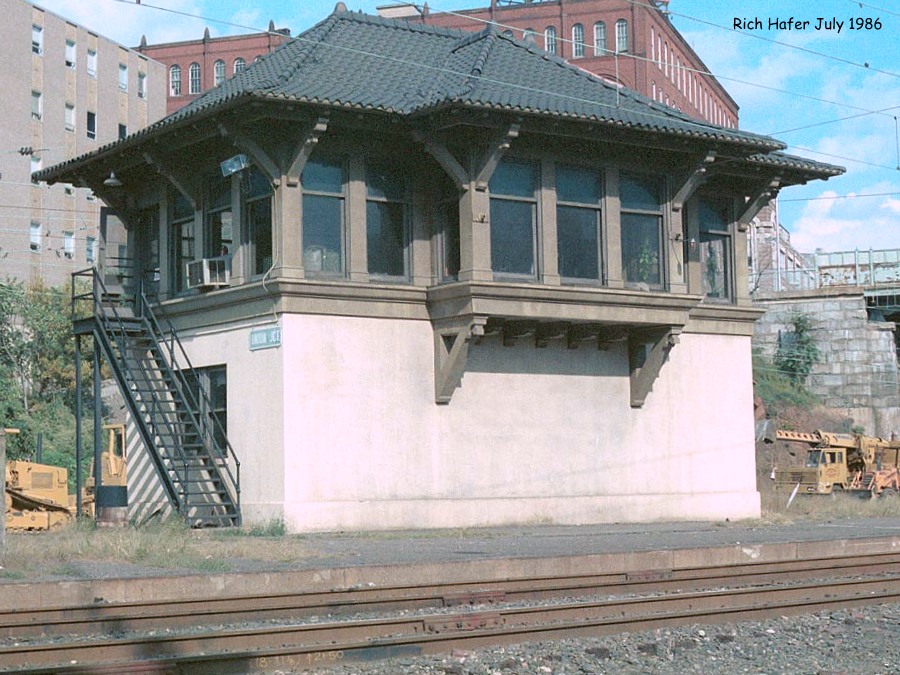
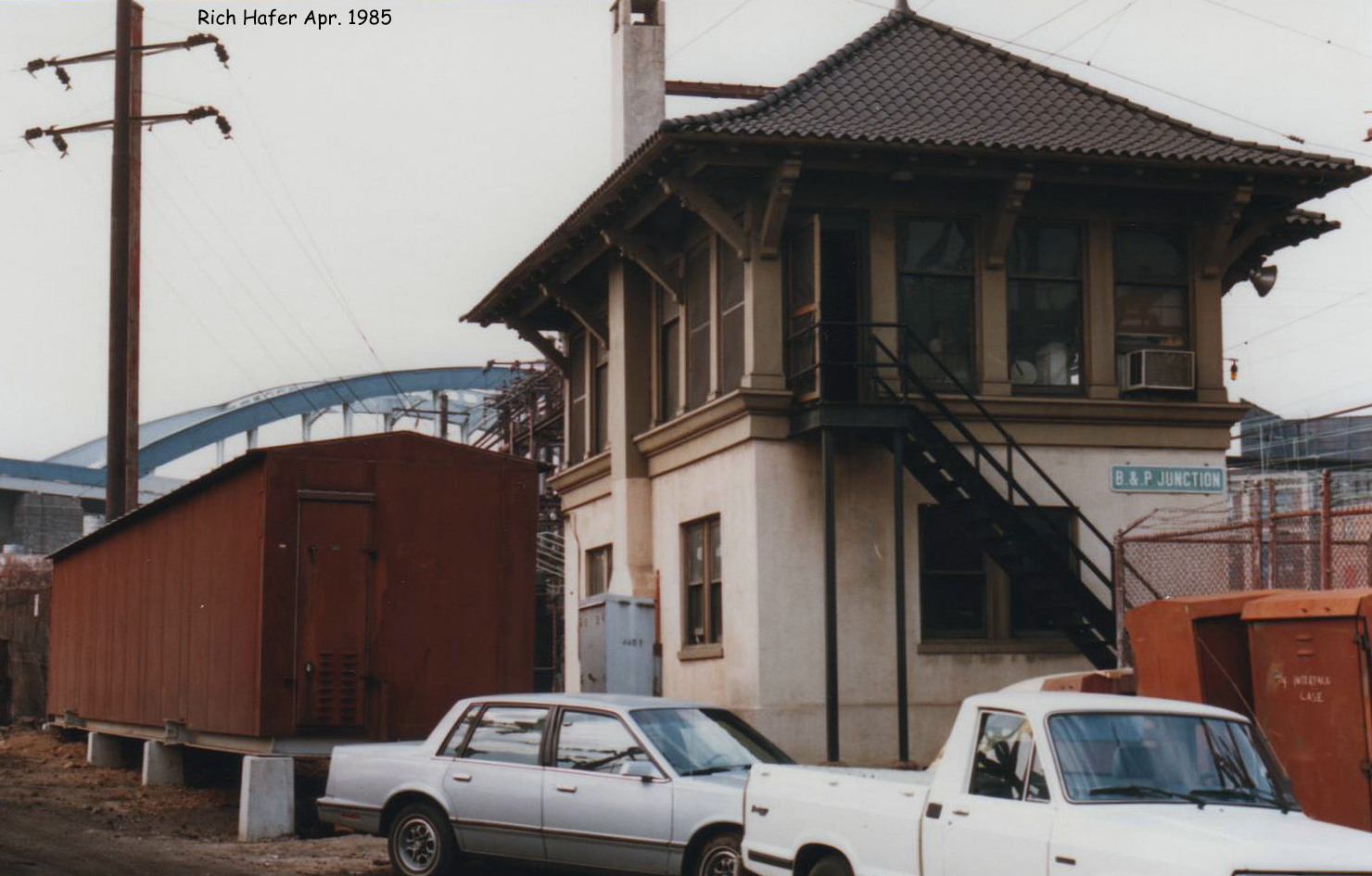
NORTH PHILADELPHIA is an interlocking emblematic of Philadelphia's industrial strength and the Pennsylvania Railroad's wealth and technical leadership. NORTH PHILADELPHIA is an interlocking emblematic of Philadelphia's industrial decline and Amtrak's chronic lack of funds. NORTH PHILADELPHIA is not an interlocking, and is barely a station. All of these statements were at one point true and thus track the up and down fortunes of the PRR's third great tower in the Philadelphia terminal area. Constructed in 1914 on the Connecting Railway that linked the PRR's East-West Main Line at Zoo Junction to the Philadelphia and Trenton railroad at Frankford Jct, NORTH PHILADELPHIA was a direct sibling to FAIR tower in Trenton and similar in style to UNION JCT and B&P JCT towers in Baltimore and was built to control the important North Philadelphia station complex along with the junction with the lucrative Chestnut Hill suburban branch. In this the first part of a two part series we will look at the layout and history of NORTH PHILADELPHIA interlocking before moving inside the tower in part 2.
As built in 1914, the North Philadelphia interlocking complex comprised a laundry list of "thoroughly modern" and "high tech" transportation concepts. The station featured 12-car 48" high level platforms designed to seamless transfer for passengers on long distance through trains to access downtown Philadelphia without those premier trains needing to make a costly stop at the stub end Broad Street Station. All of this was controlled by a 47-lever Union Switch and Signal Model F all-electric interlocking machine with a lighted diagram and multiple clockwork rundown timers to prevent delays. The entire 1915 rebuild project also coincided with the suburban electrification project that would bring 11kv 25hz overhead wires to Chestnut Hill.
The interlocking consisted of a trailing point ladder on the east end and a facing point ladder on the west end that doubled as a two-track into six-track flat junction for Chestnut Hill suburban trains. Between these two ladders were crossovers that allowed access to the additional station platform tracks. The tracks were arranged such that through freight trains would use center main tracks 2 and 3 unencumbered by the high level platforms, the outer passenger tracks 1 and 4 would split in to at each high level island allowing express trains to pass platformed locals and a pair of yard tracks, 0 and 5, running on each edge of the right of way to service local industry. Lever numbers ran from east to west and the facing point ladder on the west also featured a pair of double slip switches across tracks 2 and 3 as well as a diamond where the #5 freight track crossed the outbound Chestnut Hill track. Due to a tight curve on the Chestnut Hill suburban tracks, slow speed (15mph) routes for those movements was seen as acceptable.
Main Line electrification to Trenton arrived in 1930 and with it North Philadelphia saw a number of significant upgrades. Chief among these was the application of Pennsylvania Railroad position light signaling and with it the iconic 10-track signal bridge at the western end of the island platforms (although due to the use of single direction signaling only four signals were actually mounted on said gantry) along with older style dwarfs.
Switches were changed from electric to pneumatic operation and two additional crossovers were added (using spare levers #1 and #2) at the eastern end of the platforms to allow trains their choice of center or edge tracks as express passenger trains made increasing use of the center "freight" tracks. On the interlocking machine electric switch amp-meters were removed and additional rundown timers were added since this era of interlocking did not support zoned timers. On the Chestnut Hill branch a trailing point crossover was added just north of the platforms protected by a pair of signals on each track. Without room on the large Type F frame, the new crossover was accommodated on an adjacent 4-lever US&S table interlocker. Finally, some #20 (45mph) turnouts were added, but no Limited speed routes were provided for.
The post war period could likely be considered peak North Philadelphia as in the following decades industrial retreat combined with white flight turned a vibrant middle and working class community into a marquee example of urban decay on par with the Bronx and South Central. Not only did the East-West long distance trains that made North Philadelphia a vital transfer point evaporate, but the local ridership also plummeted due to the aforementioned neighborhood collapse. The freight services were also in disarray with the Penn Central imploding into Conrail and Amtrak taking charge of the Northeast Corridor route that was still configured in the manner of the combined passenger-freight operations of the PRR era. With funding from Regan's Washington in short supply the 1992 edition of NORTH PHILADELPHIA looked surprisingly like the 1972 version with only the #1, #2 and #29 station track access switches removed and the two double slips re-aligned into coventional turnouts.
Regardless it was hard to deny that NORTH PHILADELPHIA was over-built and many of the freight tracks and sidings were falling into weedy decay.
The early 1990's would see a huge push by Conrail and Amtrak to disentangle their operations on the former PRR. Via a new connection at the Reading's old Park Jct, the Conrail Trenton Line would take the place of the old #5 track through NORTH PHILADELPHIA interlocking with the deletion of the #45 and #5 switches and associated signals. Around 2000 Amtrak finally scrapped together enough funding to begin their NORTH PHILADELPHIA modernization effort.
The over the course of a couple years the entire east end of the interlocking save for the #11 and #17
crossovers was removed and reestablished as a new interlocking named
CLEARFIELD, remote to the CTEC dispatching office effective 2003.
Moreover the antiquated station track system was remedied via a wholesale track re-alignment with "Eastward Station" being through routed as Track #1, Track #2 being cut between the #47 and #17 switches, and a new Track #2 being routed along the eastbound platform. This left a rusting portion of concrete tied NEC track on the old track #2 alignment for a number of years after.
Former track #2, removed and relocated.
Finally both the Westbound Station and 0 tracks north of the westbound platform were removed at the 32R and 34R signals.
At this point NORTH PHILADELPHIA entered its most awkward phase of existence as a black hole on the dispatch board generally only able to participate in moving R8 SEPTA trains on and off the Chestnut Hill West line and trying not to delay through trains on the NEC. Perhaps the most inconvenient part from an operations point of view was NORTH PHILADELPHIA's continued configuration for single direction Rule 251 ABS operation when the NEC on either side of it had long since been upgraded to bi-directional CTC. Trains arriving on wrong-direction tracks would need to take a slow speed indication from a dwarf signal and stay at 15mph through most of the long interlocking.
Eastbound 40L and 42L home signals.
As 2005 approached Amtrak began to make the final push towards eliminating NORTH PHILADELPHIA. The pneumatic point machines were replaced by electrics, new high position light signals appeared on the westbound super-gantry and a brand new eastbound signal gantry was erected.
The track layout was predictably simplified with the 31 and 33 switches being removed along with the associated diamond and north side stub tracks. The #25 crossover was also removed limiting westbound parallel Chestnut movements to track #4. On the main ladder all the crossovers were aligned for Medium Speed (30mph) operation and the new signals were able to reflect this.
Finally the trailing crossover on the Chestnut Hill branch itself was removed shifting the division point with SEPTA to the 10-track signal bridge. However the former 50L and 52R signals remained for another decade as automatics.
Former NORTH PHILADELPHIA 50L turned automatic signal 50CH
In the summer of 2005 NORTH PHILADELPHIA tower was closed after 91 years in service with the new Chestnut Hill Branch junction being named LEHIGH after the nearby street. It's single facing point ladder complimenting the trailing point ladder at SHORE interlocking 2.6 miles to the east.
The PRR's GWYNN tower, originally named GWYNNS RUN, was built in 1931-32 and replaced the small, wood frame VN (CalVertoN Yard) tower on the same location adjacent to the viaduct over Gwynn's Falls. GWYNN served the function of a main line crossover, but being located only 1.5 miles from the end of 4-track territory at FULTON interlocking, its primary reason for existence was to support various industrial tracks south of the City of Baltimore in a similar fashion to MILLHAM interlocking north of Trenton. With the collapse of urban industry in the Northeast along with a specific reduction of freight services along the Northeast Corridor in the Amtrak era, GWYNN and its entire interlocking plant were ultimately found to be redundant and subsequently removed and abandoned.
GWYNNs layout consisted of a 4-track complete crossover with connections to industrial leads at three of the four corners. The original main track layout was 2+2 single direction Rule 251 in both directions, although by the Penn Central era track 3 had been converted to Rule 261. By the 1940's both logical pairs of crossovers were equipped with Limited Speed #20 turnouts with signals having the appropriate yellow triangles. The intent was to allow both passenger and through freight to bypass local industrial movements tying up the outer tracks directly south of the city The tower also had remote control of two nearby interlockings to the south, LOUDON PARK and WINANS.
The demise of GWYNN came with the Northeast Corridor Improvement Program (NECIP) of the early 1980's. With the aim to increase speeds to 125mph and remove costs associated with legacy freight infrastructure, Amtrak rationalized GWYNN by replacing the old interlocking with the MP 99.3/4 automatic signal location and, in 1985, transferring some of the functionality to a new interlocking named BRIDGE, 1.1 miles to the north (although it can be argued that BRIDGE is more a devolved FULTON than a relocated GWYNN). Note in the 1992 Amtrak diagram below that the #5 track, #0 track and Gwynn industrial track have all been removed as of 2020.
The former northbound signal bridge now serves as automatic signal location 993 for southbound trains and 994 for northbound trains. The NECIP completely eliminated Rule 251 operation south of Philadelphia and at this point all 4 tracks were bidirectional. Note that the track to the far right is track #3 and the track to the far left is track #A, which is different from the PRR which numbered them 1 to 4.
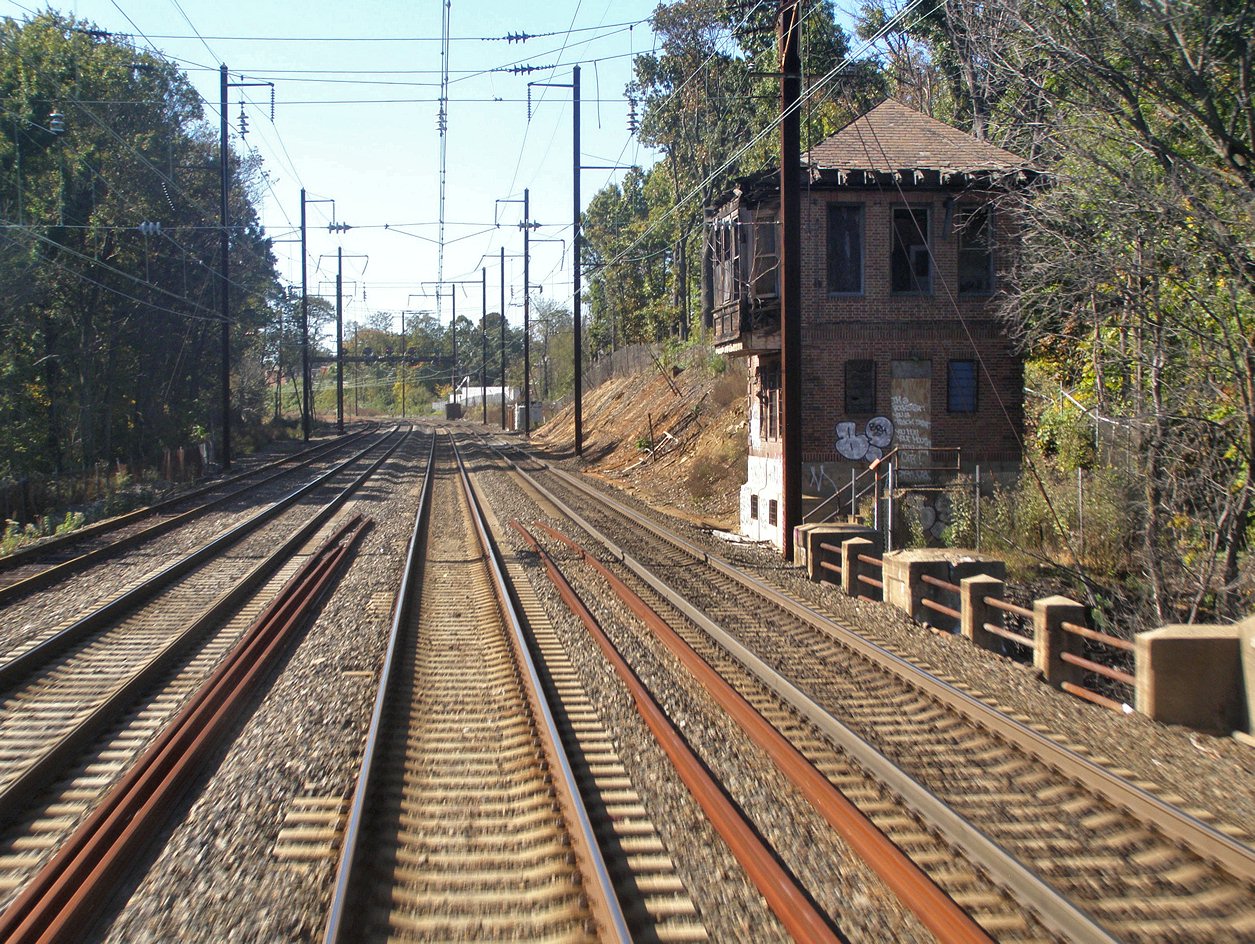
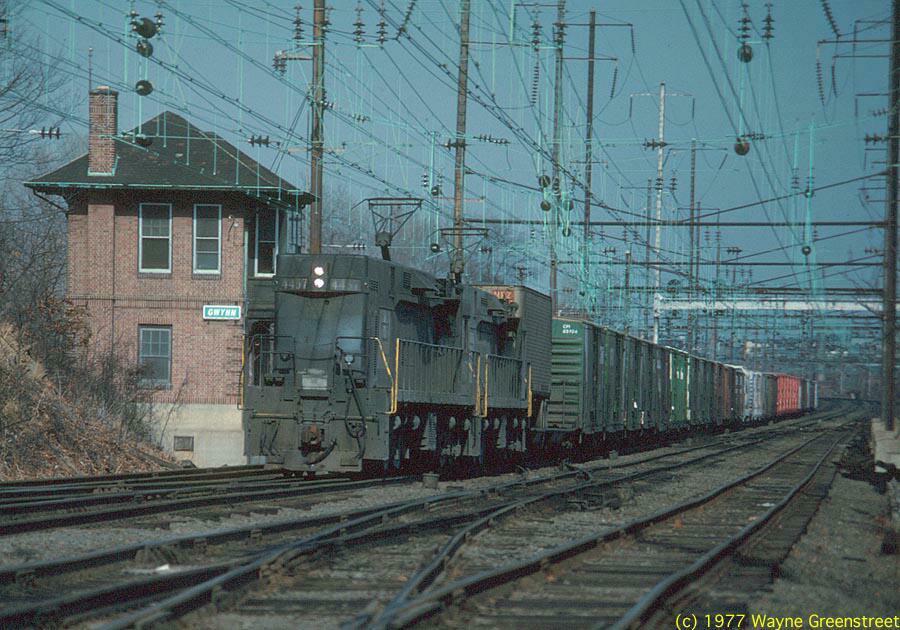
Here we see GWYNN tower and the straight railed interlocking plant looking first northbound then southbound, which compares rather poorly to this 1977 view.
The southbound signal gantry today sits empty north of the Gwynn's Falls viaduct, but is past function is still obvious.
Similar in design to towers like CORK, GWYNN was a throwback to the more ornate towers of the teens and twenties, just before the general adoption of the cleaner designs of the 1930's. Compare the wooden bay window to that of WINSLOW tower, built just a few years later. In the photo below, taken around 2005, we can see that whole the structure is clearly decaying, it is relatively graffiti free and appears to have had a spot of paint applied to its concrete foundation.
15 years later the tower has seen some significant deterioration with the wooden bay window structure having completely rotted off and the walls not covered in spray paint. Unlike the DL&W style towers which had poured concrete roofs, the PRR tended to use wooden roofs and once the roof is compromised it tends to undermine the rest of the structure. Fortunately the cantilevered bay window floor did not appear to be going anywhere.