Search This Blog

Sunday, April 5, 2026

GRS and the Age of Aluminum Signals

People talk a lot about disruption and an often overlooked disruption was the North American railroad signal industry's transition from cast iron to aluminum in the 1980's. Here I am talking about the railroad signals themselves, not the entire signaling product line, but the ability for new companies to enter the market selling  new types of bulbs in a housing put a lot of pressure on the US&S / GRS duopoly. Both companies tried to respond to the new competition, but only one was successful over the long term. 

Iron melts at around 2300o F while aluminum melts at around 1200o. The former requires a foundry and expensive sand molds, the latter can be done with an electric furnace and can get away with using permanent molds made of steel. By 1980 cast iron had been the material of choice for railway signals going back almost a century with GRS and US&S operating the necessary "smokestack" industrial infrastructure to make the components at scale. However, since World War 2 aluminum had become much more common in everyday products like cars and bicycles, and investors looked at the high margin railroad signaling duopoly and wondered if their might be a better way. 

Safetran CLS-10

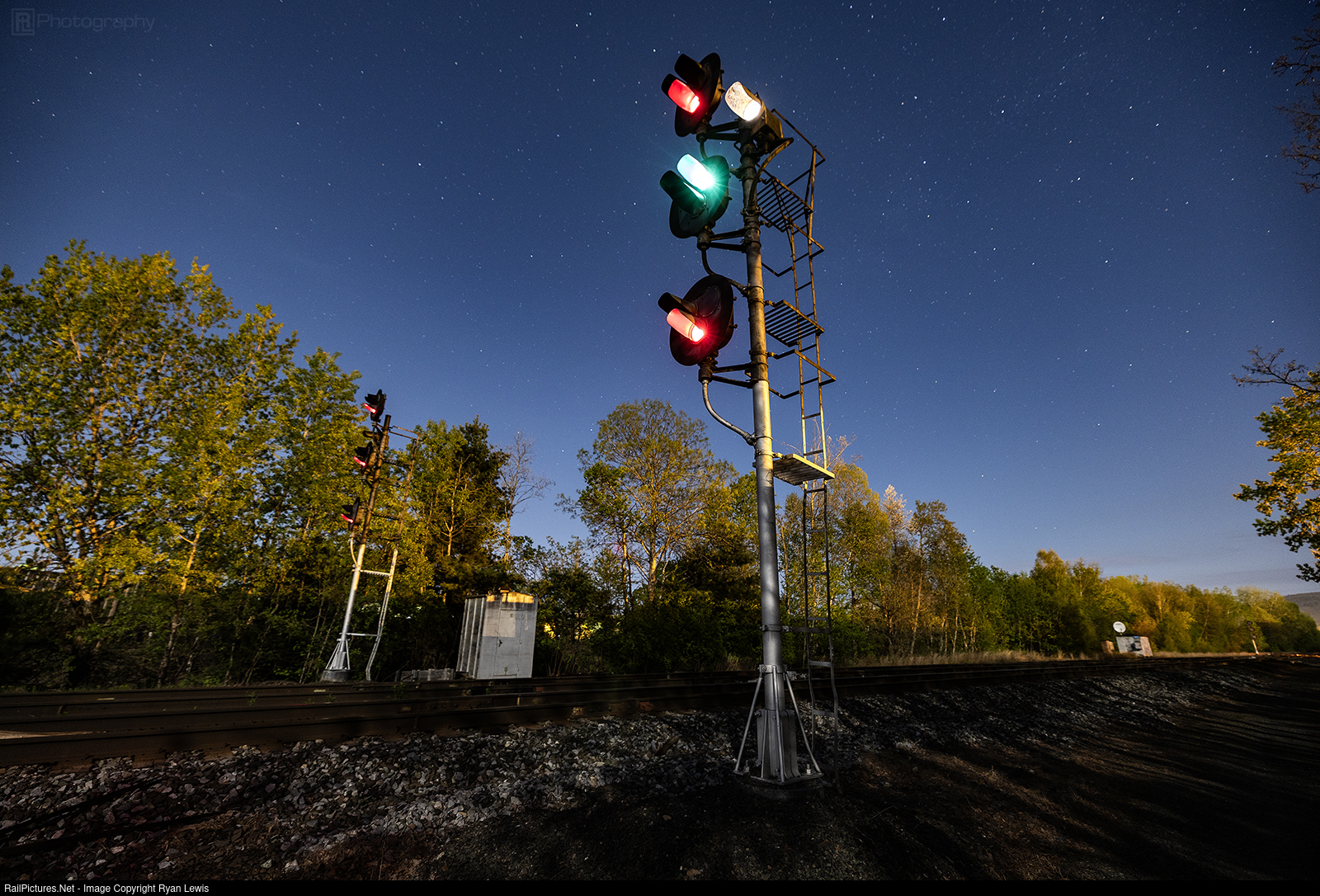
Safetran was the best known starting with the aluminum CLS-10 that directly competed with the cast iron GRS D Type modular color light signal. The aluminum (and solid state) Unilens was developed to go after the searchlight market and the NR went after GRS's famed G Type. About the same time both L&W and Harmon also entered the market with their own cast aluminum signal modules. The moat had been bridged and aluminum would eventually force cast iron signals out of the market entirely.


Of course both GRS and US&S were going to complete in the new aluminum signal market with US&S seeing some modest success with its clean cut modular box and CR-2 twilight. GRS on the other hand did not do so well.  In 1989 GRS was purchased by the Sasib Railway Group of Italy and they came out with a product family of aluminum signals. The better known family member was a 3-lamp monolithic signal similar to a US&S style P or R. This had some high profile sales such as the LA Union Station and Dallas Terminal re-signaling projects.

After Sasib was acquired by Alstom in 1998 this type of signal was still being sold, just with the Sasib logo scratched off.

The second offering in this family is the much rarer tri-light type intended as a G-Head replacement.  The only place I have noticed them was on the MBTA Dorchester Branch at Readville. Again, note the Sasib logo.


What I have yet to find is an aluminum D Type replacement to compete in the most popular part of the signal market, modular single lamp color lights. Of course maybe that's the point. GRS saw the market was saturated with lower cost competitors and decided not to bother. US&S did try to compete and was rewarded with lackluster sales. So why did the other two signal types fail? 1990 was a bit of an odd time in the railroad signals market. Traditional searchlights were still selling and it still made economic sense for railroads to refurbish old signals and reuse them in new signal projects. Used signals were in abundance as main line track was trimmed down from what they had been in the 1960's. It would be the better part of a decade before Safetran CLS-20 sales exploded as part of the Darth Vader boom of the 2000's.

Generic Canadian Pacific 3-stack.

In hindsight the bare bones GRS 3-lamp monolith may have simply been ahead of its time as Canadian Pacific has more recently adopted a similar no frills box as its standard new signal.

Tuesday, March 31, 2026

'A' Box Demolished and Other Changes at Wellington, NZ Terminal

About a year ago I reported on the closure of Wellington A Box, the last operating main line signalbox in all of New Zealand. This week one of my correspondents is on vacation there and I was a bit surprised when he said that he had been unable to spot old A Box for a photo.  Well it turns out the signalbox was demolished just a few months after it was closed. KiwiRail even posted a video of its demolition as if this wasn't a major failure of historic preservation.


Anyway, my correspondent also sent me this video of his train coming off the Johnsonville Line and through A interlocking. In a bit of good news one can see that the "standard" New Zealand LED color light signals have been recently replaced by LED searchlights, bringing back a major design detail of the pre-2006 "rail modernization" drive. 


You can see the difference compared to this head end video taken in 2024. The US&S M23 point machines with the external controller relays are a nice touch. 


Saturday, March 21, 2026

Little Boxes, Little Boxes

If the age of the Safetran scallop shell is actually ending, what appears to be replacing it are little boxes and they all look just the same. Of course modular square box housing signals are nothing new with the GRS D Type seeing widespread use up through the 1980's along with offerings from Harmon and L&W (which I have touched on before). What's interesting is that the new era of "little boxes" appear a bit more homogenous than the last so if we are seeing an end to the scallop shell era, what comes next could be equally bland. 

Above are new signals from Lindsay recently installed on the DART Silver Line. Lindsay had previously gotten the adjacent Texrail account and at the time I noted that its single color modular offerings still featured the GE logo, which put them in the lineage of Harmon.  Well the new batch used on the Silver Line have swapped out the GE circle for the Lindsay swoosh (which itself is vaguely reminiscent of the original Harmon logo). 

Now look at the new signal from Progress Rail that is being deployed on new projects by CSX. Looks awfully familiar to what Lindsay is selling. Keep in mind that little of these box designs would be protected by intellectual property apart from the logo so new market entrants are effectively free to copy what is in essence a cast aluminum box with a hinged door.

Of course this warrants comparison with Union Switch and Signal's attempt to enter this market segment 30 some odd years ago. While also a box, the lines are crisper and the design far less cluttered, which probably indicates an elevated price point. DART famously used blank US&S modules to increase the height of its mast style signals, but away from the public transport sector, the US&S boxes saw limited adoption.

Anyway with the scallop shell monopoly now broken, it will be interesting to see if we get additional "little box" suppliers or perhaps something more paradigm changing like LED searchlights.

Friday, March 13, 2026

Amtrak Harrisburg Line Re-Signaling Hits FRAZER

I have previously discussed the drown out closure of Amtrak's THORN tower in Thorndale, PA. Recently the re-signaling efforts have hit FRAZER interlocking where new colorized position light masts have replaced the old amber style PLs. This is just another symptom of the eastern end of Thorn's territory being converted from its 1937 ABS 251 CTC to contemporary Rule 261 CTC. 


FRAZER is an interesting part of THORN's zone of responsibility. As covered in Part 2 of my old PRR Main Line signal survey, FRAZER was placed in service around 1994 when the old Paoli MU shoppe complex was closed due to massive PCB contamination stretching back to 1915. As a replacement a new yard and inspection shoppe was opened near Frazer, PA, extending basic SEPTA R5 service an additional stop to Malvern, PA. The only problem was that there was no interlocking infrastructure at the Frazer location to to support what is SEPTA's busiest commuter rail line. The solution was a new interlocking, FRAZER, that consisted of a yard lead, a turnback track and a center pocket track where eastbound R5 trains could wait for any conflicting movements to clear up.


There was some initial debate about whom would control the interlocking as in 1994 the entire Amtrak Harrisburg Line was still paper dispatched and FRAZER was located directly between the territories of THORN and PAOLI towers. A 1994 fire at BRYN MAWR tower forced the issue when PAOLI  took remote control of that interlocking leaving only THORN with the necessary spoons for more territory. However the increased workload did bump the operator's position at THORN to that of a higher paid Train Director. 


Because FRAZER was located in single direction Rule 251 territory about 4 miles from an existing interlocked crossover, it was not deemed necessary to give FRAZER universal crossovers of its own, so only a training point path was provided mainly for R5 trains heading east. Because this part of the Main Line was built with 4 tracks, there was ample room for a centrally placed pocket track. 


FRAZER is likely the last new Amtrak interlocking constructed with amber PRR position light signals. By 1994 the conversion of the NEC to colorized PRR position lights (a downstream outcome of the Chase, MD wreck) was well under way, but with no plans to convert the old PRR Main Line (Amtrak Harrisburg Line) FRAZER was designed with amber lamps for the sake of commonality. This view was incredibly short lived as PAXON and WOODBINE interlockings built to support the new Overbrook Maintenance Facility just a year or two later would have the position color lights.


It is unclear if FRAZER's conversion is part of a full re-signaling or just a modification to support both the colorized signals, bi-directional operation and Rule 562 cab signals without fixed wayside signals. Dwarf and pedestal signals unaffected by\the changes do not appear to be facing replacement along with the primary relay hut. New Rule 562 signal indication points between FRAZER and THORN are in place along with new signal equipment at GLEN and the planned decommissioning of DOWNS. If I am not mistaken, this will also be the first time SEPTA crews have to deal with Rule 280a "Clear to Next Interlocking" signals on their regular territory as their own Rule 562 territory lacks this feature, instead handling cab signal failures with dispatcher issued Form D's.

Friday, March 6, 2026

Former Dallas Terminal Railroad Re-signaling

 The Dallas Terminal Railroad can be considered to be in the midst of a slow-motion re-signaling, partly set off by Amtrak move from Union Pacific to TRE routing between Dallas and Fort Worth. This matters because the stretch of of 5 back-to-back interlockings, while "modern" in appearance, actually represents a vestige of late stage relay interlocking installed in the 80's or 90's with quirky signals of a non-Safetran nature.

The stretch in question used to be covered by the Dallas Terminal Railroad's Towers 106 and 107 that managed the west and east ends of Dallas Union Station. This has since become part of the Union Pacific Dallas Sub and from east to west consists of REUNION, DALLAS, JFK JCT, TRE JCT and INDUSTRIAL X-OVER interlockings. An additional interlocking, BN CONNECTION, makes up the third corner of the wye with TRE JCT and JFK JCT.

Around 2015 Amtrak shifted from the UP Dallas Sub to the ex-Rock Island Trinity Rail Express commuter route west of Union Station. Around 2023 the switch that connected the Amtrak platform at Union Station to the Dallas Sub was removed along with the west leg of the wye, turning both TRE JCT, BN CONNECTION and the TRE portion of JFK JCT into vestigial interlockings with signals guarding empty track. REUNION also saw the removal of the crossover to the east end of the Dallas MoW/passenger car storage track. 


In 2026 the other shoe dropped with the vestigial JFK JCT signals being removed and new signals going up at DALLAS. I don't know the exact plans, but there are two clear options. The first is that DALLAS loses its crossover and becomes an interlocked connection to the MoW stub with other interlockings staying unchanged. The second, and what I consider to be the more likely scenario, is that JFK JCT will be merged into DALLAS with INDUSTRIAL XOVER and the vestigial TRE JCT being eliminated along with BN CONNECTION. Currently trains on track #1 encounter 4 signals within 3000 feet, not a situation that is likely to play nice with PTC. Moreover, INDUSTRIAL XOVER duplicates the facing point crossover available at DALLAS. While its possible INDUSTRIAL XOVER might be kept something tells me that it is surplus to requirements.


So why does this all matter? Like I said the current setup uses late stage all or partial relay logic and non-Safetran signals consisting of L&W modular and GRS monobloc equipment. Second the close signal spacing introduced some very interesting signal progressions. In fact because of the sharp turn of the Dallas Sub at JFK JCT, the default progression for track #1 westbound is an Approach Restricting at DALLAS to a Diverging Clear (straight clear is onto the TRE) at JFK JCT. I suspect the new interlocking will display a Clear to UP train movements despite the curve. All together, what is an accessible place to observe interesting signal indications on interesting signals is about to get much less interesting, even if the exact amount of uninterestingness remains to be seen. 


Friday, February 27, 2026

PHOTOS: LANDIS - The PRR Main Line's Forgotten "Tower"

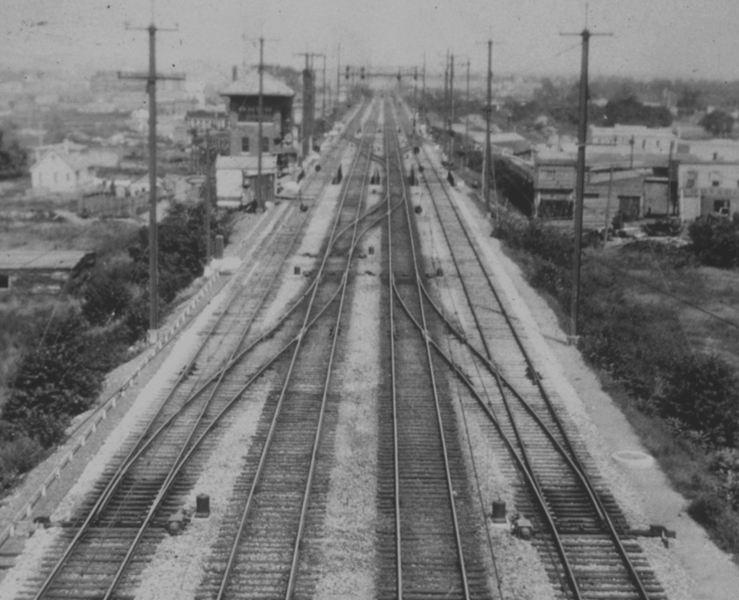
One might wonder how the electrified PRR Main Line could have an interlocking tower somehow more "forgotten" than the small booth that occasionally managed the emergency crossovers at LEAMAN, but it did and that forgotten tower also began with the letter L. LANDIS tower, in Landisville, PA, was always a stepchild of an interlocking forced on the PRR by the rival Reading Company by means of the Reading and Columbia Branch.  This was a forked "milk run" line connecting Reading (via Sinking Spring) to Ephreta, Columbia and Lancaster. The Lancaster fork was ultimately integrated into the west end of CORK interlocking, crossing the main line via crossover switches and the Columbia Branch via diamonds. The Columbia fork met the PRR Main Line about 8 miles to the west at Landisville and, due to the lack of any existing infrastructure, the diamond managed to justify its own interlocking tower, built and operated by the PRR.

Given the telegraph code NV, a square wooden tower was built in 1902 in the contemporary PRR style exemplified by the preserved LEMO tower at Strausburg. 

This tower lasted into the post war period, its Victorian aesthetic somewhat in conflict with the electrification infrastructure. In this photo one can see the Reading alignment complete with Reading style US&S color light signals in a target configuration. Also note the Reading freight station which in this photo is partly obscuring the PRR Landisville freight station behind it. 

Based on the 1962 interlocking chart it can be surmised that the old NV tower was taken out of service around 1953 with the block and interlocking station moved into the old PRR freight house. Here the part-time operator would work the crossing as needed using a 5 lever US&S table type interlocking machine. Each main track had a pair of signals controlled by a single lever in the US&S fashion. The Reading was controlled by lever 1, the PRR levers 6 and 8. The Reading signals could display Stop, Clear and Restricting in both directions. The PRR signals had a full ABS head with a Stop and Proceed marker with the current of traffic and a dwarf with Restricting and Sop against. The Reading track had split point derails on either wide of the diamonds controlled by lever #4 and the PRR had a hand throw trailing point crossover unlocked by lever 5. The last detail of note was an 'E' marker on the eastbound PRR track which would illuminate if the dragging equipment detector near milepost 79 were activated.


As of 1954 LANDIS was listed in the timetable as an Interlocking Station open part time from 8:30 AM to 4:30 PM daily except Sundays and holidays. By 1971 this had changed to 10:00 AM to 6:00 PM Daily except Saturdays, Sundays and Holidays. Ultimately the Conrail merger of 1976 would prove fatal to the diamond crossing at LANDIS as the Reading branch line was no longer providing "competition" in the Lancaster market and Conrail trains based out of the PRR Lancaster yard could serve what on line customers remained. Therefore the diamonds were removed, the "tower" was closed, the milepost 74 ABS signals replaced the controlled signals on the PRR Main Line and a PRR freight delivery track was repurposed into a new connection to the ex-Reading branch towards Columbia, PA.


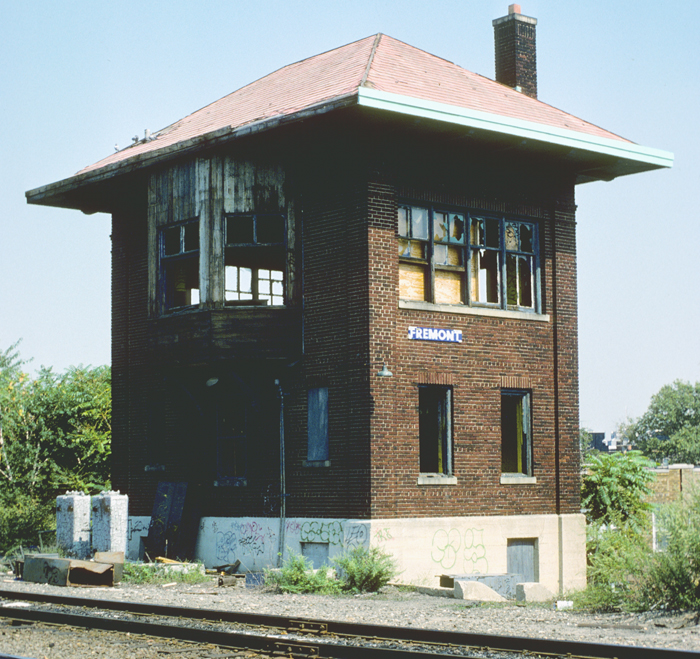
Like many legacy railroad structures along the Amtrak RoW, the freight station version of LANDIS was boarded up and left to become somebody else's problem. 50 years later the building still stands in decayed-yet-reasonable condition.


Similar to the Reading's old Chester Creek Drawbridge, the 5-lever US&S "table interlocking machine" is still present in the operator's area, albeit in a stripped down condition. Similar to the single story PARK tower, the windows were covered over with high security wire mesh.


The "table interlocking machine" was a modular platform for very small interlockings up to about 10 levers. Each module contained a standard US&S bell-crank type "lever" and was could interface with both mechanical and electro-magnetic interlocking components. At LANDIS the lever modules have been removed, but the robust metal base remains in place.


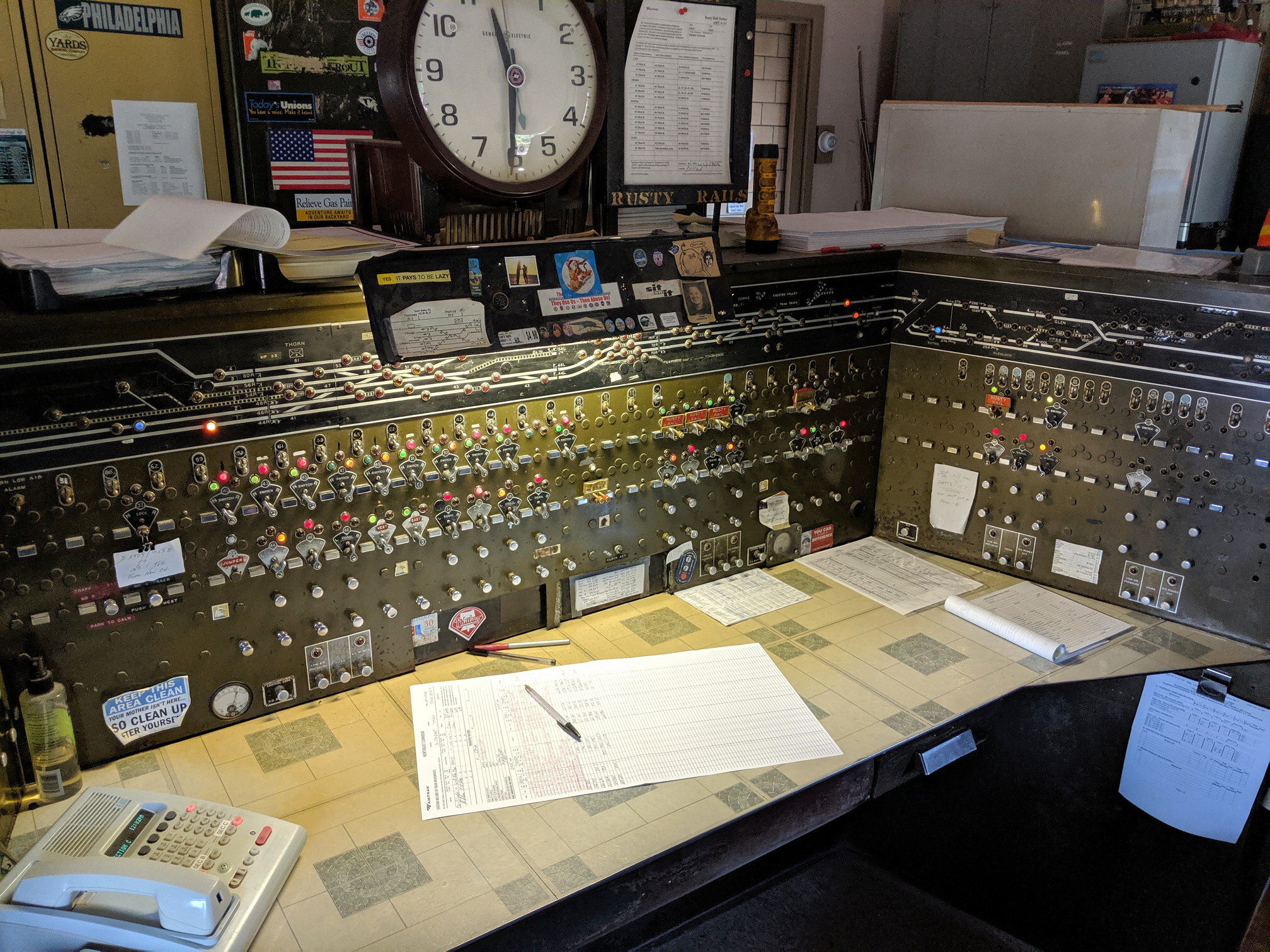
For comparison here is a similar table interlocking device set up in NORTH PHILADELPHIIA tower as an auxiliary to the main US&S EP machine. 
 

We can see that the LANDIS machine had a US&S/S&F style mechanical locking grid as well as make/break circuit spindles.


As an interlocking station the operator was provided with a full telecom suite mounted just outside of the bathroom nook.


An old relay hut sits across the tracks, although it is hard to tell what era it came from, Amtrak, PRR or PC.


LANDIS continued on as an ABS signal location until the mid-2000's Rule 562 re-signaling. Today only those with a knowledge of PRR Main Line history, or a sharp eye for abandoned rights of way, would notice that something had once gone on here.


Just goes to show that while many old towers have been demolished, a few are still hiding in plain sight.

Friday, February 20, 2026

Caught on Camera: PORTAL's new "Gantrylever" Under Test

Following up on the previous post regarding the new PORTAL bridge cutover, Amtrak I happened to catch a cab speed indication on the (New) PORTAL interlocking's westbound cantilever mast's 3W signal. With the new track #3 still very much under construction, crews were getting a jump on commissioning* the new interlockings associated with the project. Although this is a static image, the 3W was displaying a flashing green cab speed indication, which would be in line with the high density cab signaling in place between HUDSON and A interlocking at Penn Station. 

That alone is interesting, but if you review the track and signal diagram from Bulletin Order establishing OLD PORTAL and OLD SWIFT interlockings you might notice that future PORTAL is intended to be laid out similarly to OLD PORTAL with center Track A merging into tracks 2 and 3. Instead in the photo we see a two track cantilever mast, or do we?


Amtrak is splitting the commissioning of the new Portal fixed bridge into two month-long work sessions spaced 6 months apart. The primary reason for this is that activating the new eastbound track #2 will require the prior removal of overhead catenary supports required for both existing tracks. A secondary reason is that the new track 2 will require partly burying the old track 3 and removing the westbound cantilever as you can see below. 


If you look closely the end of the cantilever arm has some extra bits and the diagonal supports at the corner seem a bit flimsy. This is because that new signal structure is not a cantilever, but half of a three track signal gantry that will be completed once its southern foundation has something to sit on. I'd call this a "gantrylever", but that term is somewhat taken by gantry+cantilever combinations as seen at UNION and DUNTON. 


 In other news related to PORTAL's signaling  the lower heads on the westbound signals are conforming to the new pattern established at LEGGETT interlocking on the Hellgate Line, replacing the central lunar white Stop and Proceed dot with a a lunar white Restricting \. However the eastbound signal masts retain the Stop and Proceed dot. This might be a quirk needing the shorter signal blocks around Secaucas transfer than the SWIFT connection. 

Anyway. just though it was cool to catch the new temporary cantilever signal 3E under test, several weeks before the first revenue train would actually use the new bridge.

*Note: Amtrak would ultimately open track 3 for service two days ahead of schedule due to a problem that fouled track #2 during the morning rush.