Search This Blog

Showing posts with label IC. Show all posts

Sunday, February 2, 2025

METRA's 16TH ST Tower to Close, Following CY

I just got word that METRA's famed 16TH ST Interlocking tower at the triple crossing of the Alton (CNIC), Saint Charles Air Line and the Rock Island, is slated in close in early April. Built in 1901, the tower and its original Taylor Model 2 pistol grip type interlocking machine have been in continuous service since 1901 or 124 years! Unlike some other towers where the closure comes out of left field, this one has been telegraphed for some time. 16TH ST (and presumably its interlocking hardware) has been falling into increasing disrepair and I am honestly shocked it did not manage to catch fire or fall down on its own.

16TH ST in 2017, it looks worse now.

Cost cutting on the part of Canadian National, starting in 2019, have reduced the 12 diamond plant to just 4, as what had been a Y split of two double track main lines crossing another double track main line, was reduced to two single track lines crossing a double track line. It was clear for some time that once all the work was finished to rebuild the complex crossing to some sort of new standard, the tower would be closed.


Given the wooden tower's condition, its also pretty clear that the tower is beyond saving, even in situ, but I'd expect parts of the interlocking machine and model board to make their way into preservation similar to what we saw with CALUMET about a decade ago. Anyone looking to grab some photos during the final days in service can snag a view from the corner of 16th St and Clark.

In other bad news, the late model Chicago Northwestern CY tower has also been closed by Union Pacific as a downstream outcome of UP looking to transfer METRA commuter operations to METRA itself. The operator at CY had control of the local interlocking and much of the METRA UP-Northwest line, where Metra was the primary source of traffic. This was likely a way to better allocate the costs of dispatching the line. Run from a video display interface for years, control might end up in the METRA operation's center with staffing of the still open LAKE ST tower, also taken over by METRA.

Unlike 16TH ST, CY is of far more sturdy construction and will likely serve as an maintenance base for decades to come like its sibling KEDZIE tower on the UP-WEST line. With these two closures the Chicago area will be reduced to four traditional interlocking towers on main line railroads, LAKE ST (CNW), TOWER A-2 (Western Ave), TOWER B-17 and JB.  Three of these towers are on the METRA UP/CNW-West Line between the CNW Terminal and West Chicago with the fourth being on the Milwaukee West Line.


Sunday, December 16, 2018

IC / CNW Two Aspect Cab Signaling


In the past I have made reference to various "two aspect" cab signaling systems, specifically those used on the Illinois Central (since retired) and the former Chicago & North Western east-west main line, now operated by Union Pacific.  Aside from the cab signal display of current Union Pacific locomotives this two aspect system can be seen in the cabs of old METRA locomotives and Illinois Central signal rule charts.


If a two aspect signaling system sounds bizarre you would be correct.  It's a pretty fundamental principle that trains cannot stop on a dime and need some warning before encountering an occupied block.  Well the two aspect cab signaling system (Clear and Restricting) adopted by both the IC and CNW worked a lot better than you might think.  A somewhat recent article on Carsten S. Lundsten's US signaling website goes into detail about how the system functioned on an IC single track Automatic Permissive Block segment in Iowa, but it is probably best summed up in this single .gif image.


The cab signal "code" (pretty much the presence of an AC current frequency or even a DC voltage), is transmitted from any signal point displaying an approach indication or better.  Passing a yellow signals will cause the cab signal to drop to Restricting and the train will continue on at Restricted speed until the cab signal returns to Clear.  Both the CNW and IC also used this system in installations without fixed wayside signals except at distants and interlockings.

Alright, now I'll bet you are just thinking this system is horribly inefficient as trains will be crawling at Restricted speed instead of a less odious 30mph Approach.  The key consideration here is to remember the braking time and for most freight trains, getting slowed down from MAS to Restricting will take a good chunk of the Approach block. Let's see what the GCOR Rulebook has to say on this issue.
17.5.1: Over 40 MPH
The high speed whistle will sound when the speed is more than 40 MPH when the cab signal changes to a Restricting aspect.
  1. Move the brake valve handle to SUPPRESSION within 6 seconds to prevent a penalty brake application.
  2.  When speed is reduced to less than 40 MPH, the high speed whistle will stop and the acknowledging horn will sound.
  3.  Acknowledge this horn. If the cab signal continues to display Restricting, speed must immediately be reduced to restricted speed,
If restricted speed is not reached within 70 seconds after the acknowledging horn was acknowledged, a penalty brake application will occur unless the brake valve handle is in SUPPRESSION

17.5.2: Under 40 MPH
The acknowledging horn will sound if the cab signal changes from Clear to Restricting when the speed is under 40 MPH.
  1. Acknowledge the horn within 6 seconds to prevent a penalty brake application.,
  2.  If the cab signal continues to display Restricting, train speed must immediately be reduced to restricted speed.
If restricted speed is not reached within 70 seconds after the acknowledging horn was acknowledged, a penalty brake application will occur unless the brake valve handle is in SUPPRESSION.
Basically if you are traveling over 40mph, reduce to 40mph and then you have 70 seconds to reduce speed to Restricting (20mph) or at least be making a sufficient brake pipe application to reach that speed after 70 seconds. It's not as efficient as a traditional 3 aspect system, but it likely won't penalize a typical train more than a couple of minutes.  The situation is a bit dicier approaching diverging routes and, especially where no waysides are present, the engineer has to pretty much be prepared to advance on the slowest route unless the home signal can be otherwise made out.

Ultimately the system works, and although it is not as advanced as the PRR version, it did save a lot of expense equipping locomotives with code following relays.  The IC eventually removed it's installation on the Champlain District sometime in the late 80's or early 90's as Canadian National came on the scene. It also goes to show that the engineer doesn't need to know he's approaching an occupied block, just sufficient time to show down before entering the occupied block.

Sunday, June 16, 2013

PHOTOS: Brighton Park Crossing

Brighton Park Crossing appears on collections of interlocking charts, but it isn't an interlocking. It appears on lists of Chicago Rail Junctions, but it's not really a Junction either. What it was was a mess, a throwback to a time when railroading was a confusing and messy affair, a piece of living history that became a somewhat sanitized museum before vanishing into our rapidly homogenizing rail environment. Now largely remembered as unique, Brighton Park during its heyday wasn't anything special, especially in the Chicago area, but it still represents an important case study not on the history of railroad signaling and how it developed in North America.


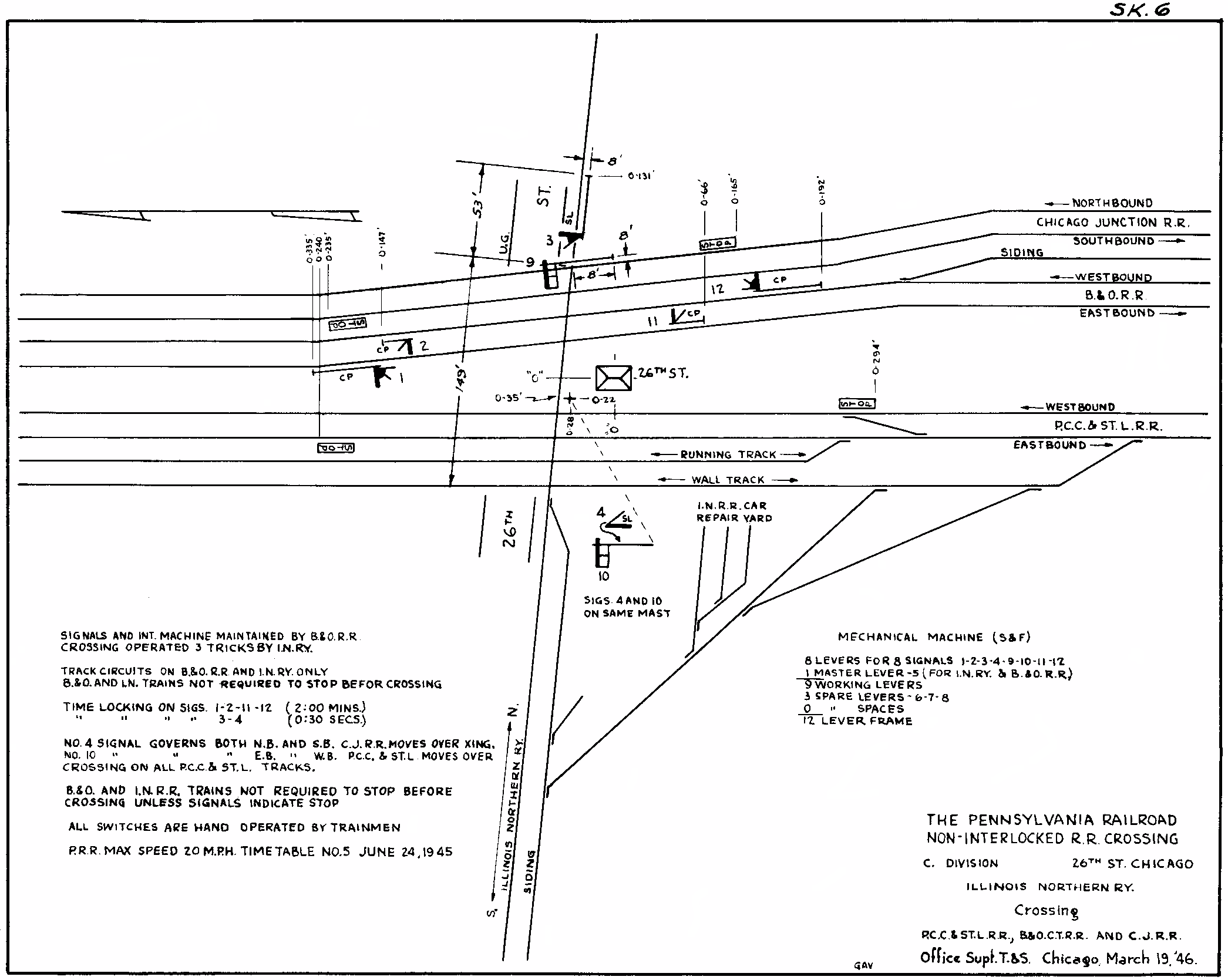
 For those of you who don't know, Brighton Park Crossing was a non-interlocking railroad crossing at grade between the compass east-west Chicago and Alton main line, and the three parallel compass north-south main lines of the New York Central – Chicago Junction, Baltimore and Ohio Chicago Terminal and Pennsylvania Railroad Panhandle Route. There were 8 tracks crossing 2 tracks that gave the plant a total of 16 diamonds with three wye legs and a number of crossovers thrown in to boot. The obvious question is of course, how did this complex crossing between three of the richest railroads in the country stay a non-interlocked manual operation during an era when the same railroads could and did afford to make something better at other similar locations in the region. Now of course I haven't been able to turn up the exact decision making process that lead to Brighton Park's ultimate configuration, but we are in a position to make a few good guesses.

The first, and perhaps foremost reason, was that this was simply not a priority route into Chicago. For the New York Central and PRR, this was not used by the streamliners making their grand entrance into Chicago from New York, but instead something more like the service entrance used by delivery vehicles. For the NYC all this route did was act a way to interchange freight with "western" roads. For the PRR the situation was essentially the same except for a smattering of passenger trains using the "back door" at Union Station to reach such thrilling destination as Indianapolis and Cincinnati. Only for the B&O was this their primary route into a downtown passenger terminal, but the B&O had long since given up trying to compete on time with its larger rivals, instead focusing on luxury. While the crossing did affect the Alton main line, the Alton was the priority user with the Pennsylvania Railroad being responsible for maintaining the crossing protection as the Panhandle railroad was built after the Alton. However being first is not always an advantage as whatever agreement was struck with the PRR would remain in effect even if conditions later changed. If the Alton had signed off on a non-interlocked crossing and did not wish to renegotiate then a non-interlocked crossing it would stay.

As you can see Brighton Park was not the B&OCT's biggest problem in reaching downtown Chicago in a timely fashion.
The second reason is the simple fact that interlocking technology was still very expensive back in the day and a similar interlocking plant at the 4x4 75th St interlocking (aka Belt Crossing) required a 132 lever mechanical frame that was not retired until the late 1990's. Making matters worse is that diamond crossings are notoriously tricky to signal properly because you cannot use traditional track circuits over a long string of diamonds. Because diamonds are already impractical to incorporate into track circuited rail single diamonds are simply excluded from the circuit. However multiple diamonds can potentially allow cars to "hide" in the dead section so in that case a construct called a "trap circuit" must be used. This works sort of like an axle counter before such things existed and basically makes sure that a diamond is marked as "occupied" as long as the train that tripped the circuit on one side of the diamond, also trips the circuit on the other side, in sequence. Multiply the logic over 16 diamonds and 10 tracks in both directions and you have quite the headache. Furthermore Brighton Park did not stand in isolation. Similar crossings existed at Ash St (8x4), 26th St (8x1) and 12th St (7x2 + 2x5) and all would have needed to have been interlocked to realize any of the benefits. Finally, speeds on the north-south trunks were only about 20-30 mph, so having to stop and proceed at crossings did not add significantly to the schedule.

The third reason is a bit softer, but one that I believe is still a strong unconscious motivator to preserve a status quo. If Brighton Park were to be interlocked, it would become more susceptible to policy capture and with the PRR pulling the levers the other railroads preferred leaving routing decisions in the hands of low level employees instead of higher level managers. Because it was not an interlocking Brighton Park was worked by switchtenders, which is even lower on the totem pole than a tower operator. They would be out and about, in full view of the crews and even switchtenders from other railroads. In the absence of some high priority passenger train there would be strong social pressure to be as fair as possible with regard to which train was allowed through the diamonds.


So lets take a look at Brighton Park as it was in its heyday before looking at what it eventually became.  Before it was retired Brighton Park was known for its switchtender's shanty, 10 diamonds and that semaphore bracket.  Back in the day however there was not one but two primary tender shanties, four semaphore locations and and three additional tender shanties.  Of all the manual crossings on the Panhandle trunk Brighton Park was easily the most complex in terms of the train control apparatus and this was mostly because this wasn't just a simple crossing like Ash Street, but actually had some switches that needed tending.  These consisted of two western wye connections between the B&OCT and the Alton, a southeastern wye connection from the NYC to the Alton and a twin pair of facing crossovers between the Panhandle and the B&OCT.  Operation of each of these crossovers was assigned to a specific switchtender with the Alton, PRR, B&O and NYC all employing tenders at Brighton Park to throw their assigned switches.  The diagram above actually marks which switches were assigned to which tender.


Of course the mechanically operated semaphores at Brighton Park became its most iconic feature.  At the time of its closure there were 8 signals still in operation, 5 on the central bracket mast and 3 on a secondary mast in the northwest corner of the crossing.  These were directly operated from an 8 lever S&F mechanical frame via pipelines.  The system was simple.  When it was time for a train to proceed across the crossing the switchtender would raise the semaphore corresponding to the line and direction.  The B&O, PRR, NYC and Alton each had 1 semaphore for each timetable direction for a total of 8.  The B&O, Panhandle and Northbound Alton signals were mounted on the bracket, NYC and southbound Alton on the single mast.  After Conrail abandoned the PRR Panhandle main line, a single ex-PRR running track was left in place for industrial work and it inherited the Panhandle semaphores. The lever frame provided basic mechanical locking to prevent conflicting movements from being routes (ie Alton xor anything else). Check out Jon Roma's Flickr page for additional photos of the semaphores and pipeline system.


I mentioned before that the B&OCT had wye connections with the Alton.  As you can see, with the Panhandle route standing in between the B&OCT and the Alton something had to be done.  This came in the form of two additional semaphore signals which would protect the diamond crossings of each wye track with the Panhandle main line.  The south wye was protected by an additional 4 semaphores worked from a 4 lever mechanical frame at the opposite end of the "A" tender Shanty.  The north wye was protected by a similar set of 4 semaphores, this time worked by a miniature lever frame next to the mast outside of the "B" tender shanty.


Since the 1940's and the resulting contraction of rail traffic, Brighton Park has been rationalized into the form we know it today.  You can find a complete rundown of the current state of Brighton Park on its own Chicago Rail Junctions page, but in summary, the former PRR Panhandle main line was completely ripped out leaving just the single industrial track behind with Conrail shifting traffic to the former New York Central line.  The B&OCT dropped its wye connections to the Alton as that route decreased in importance and other interchange points became available.  This reduced the number of diamonds to 10 in a 2x5 configuration.  Without the wye tracks all the many switchtender positions and tender shanties were eliminated including the PRR "B" shanty and the two semaphore masts protecting the wye tracks.  This left behind the "A" shanty and the 8 semaphore signals guarding the Alton crossing itself.


Like i said before Brighton Park isn't an interlocking and without the need to either house relays and electronics or keep them dry, the operating environment is rather minimalist.  There is a door, some windows, an air conditioning unit and an external portable toilet.  Even calling this a "cabin" would be generous and just about the only thing Brighton Park  has in common with an interlocking tower is "Tower Window Syndrome".  In this view you can see the pipelines emerging from the shanty's lever frame and passing through a set of cranks before running out to the two masts.

Thursday, November 17, 2011

PHOTOS: METRA 67TH ST TOWER

Last May Metra closed the last interlocking tower on its Electric Division running south out of Chicago. This was the former Illinois Central suburban routes electrified at 1500 vDC in the 1920's. Like many other high density suburban routes the Metra Electric continued to rely on on manned towers well into the CTC to deal with the traffic volume and complexity of operations. However over the last few years Metra has invested in closing the 3 towers on the line, Randolph Street (terminal office with some sort of relay machine), 67th St and Kensington.

Now I had always assumed that Kensington Tower would be the last to go because it was arguably more complex and also involved a crossing at grade of the CNIC freight main line by the South Shore Line, which diverged from the Metra Electric line there. Because of the three separate entities involved I figured a fight over funding and service quality would keep Kensington open. I was also under the impression that 67th St was some sort of more modern type relay based machine and Kensington was an ancient GRS pistol grip frame as that was how each was listed on the large Jon Roma list of towers. Turns out I had it completely backwards. Kensington had been converted to a relay plant controlled by a GRS TrafficMaster CTC console (and was originally a US&S plant), while 67th St had the GRS machine. Also I thought 67th St was some small office buried somewhere around the junction, while in reality it was a full on tower hiding in plain sight next to the tracks. I just never noticed it.

Anyway, I spotted this Blog piece on the closing of the last of the Metra Electric div towers and along with a good history of the tower (which you should read) there was a very tantalizing interior photo of the GRS Model 5 machine inside. I managed to track down the man who took the photos who was nice enough to send me his whole set on CD with permission to post them online and use them in my photo essays. The photos have been unmodified (apart from renaming) and left at their original resolutions to preserve the details inside the tower so you might want to click "View Image" to get the full amount of detail. The entire set may be viewed here.

Jumping right in, here is the best photo of 67th St that was provided showing a Metra Highliner EMU making a station stop in fairly typical Chicago weather. The tower is a large rectangular monolith with no typical "tower" accouterments, which is why I probably mistook it for a substation. What gives it away however is the massive arm bundles of signaling wires running out from the tower onto a local concrete pole line.  67th Street is located at the junction of the IC Main Line and the electrified South Chicago Branch which runs to a station only a short distance from the Quad Draws at CP-509.


 I should probably provide a little reference at this point. Here is a line guide to the Metra Electric division. There is an updated track chart at the bottom showing current CTC (red) and ABS (green) territories. both 67th St (MP 14) and Kensington (MP 19) interlockings used to be blue, indicating tower control. Express tracks are on the outside, local tracks on the inside serving island platforms. The tracks between 67th St and Kensington was upgraded to bi-directional operation some time ago, but between 67th St and Chicago it remains ABS. Moreover, between Roosevelt Rd and the Randolph St terminal, trains work on sight within unsignaled yard limits with hand operated points.

https://www.chicagorailfan.com/mmelec.html

Back to the tower we head to the top floor where we find a surprisingly large 176-lever GRA Model 5 pistol grip style interlocking machine. While only a small fraction of the levers were in use at the time of its closure, back in the day the tower would have also had control of the 4 parallel freight tracks. Here we have the left side of the machine starting at lever 1.


And continuing to lever 176 on the right. 


As per standard practice red levers are signals, black the switches. Here is some detail of the 8x levers. Pulled out from the machine displays a signal or reverses a switch. The small button on the pistol grip is not interlocked, but instead is covered by any blocking device. The red buttons are for displaying a call-on signal.


View along the levers showing the glass top of the machine and a scented candle. One wonders how often that glass top needed to be repaired in the 80 years the tower operated. 


Here is a view of the machine straight on. From top to bottom we have the illuminated track diagram, then the row of signal rundown timers (supplied by US&S) with an emergency switch release box. then a glass fronted case switch and signal fuses and finally the levers. Is it just me or are the stickers on the fuse case sending some mixed messages? 


Here is the right side of the track diagram showing off the north end of the interlocking. This consisted of a 4-track double slip scissors crossover employing levers 132 to 176. As the route north of here is ABS the tower only has full occupancy lights on the southbound tracks. Below the diagram is a display showing which levers are currently locked out, next to some truly ancient portable radios.


The left side of the track diagram shows off the south end of the interlocking which consists of a duckunder junction for trains proceeding down the South Chicago branch. Main line local train must make a diverging movement at the split. Past the South Chicago split we see a double slip trailing ladder allowing express to local crossover. Also note the traffic flow indications for the bi-directional territory south of 67th St. 


Sunday, October 16, 2011

PHOTOS: METRA 16TH ST CROSSING

Known as 16th St Junction or 16th St Crossing, the complex flat junction just south of Chicago's famous loop is the survivor of what used to be a dynamic duo of towers that shepherded some of the nation's flagship passenger trains in and out of downtown Chicago from points easth. Working opposite 16TH ST was the far better known 21ST ST (aka Alton Junction) and its 20 diamonds, but both towers were of such importance that both towers ended up with profile pages on signalbox.org.

16TH ST was located at the crossing of the Chicago and Alton route to Saint Louis and the southwest, the Saint Charles Air Line (jointly owned by the Illinois Central and Chicago, Burlington and Quincy) which provided cross-town freight service with the parallel north south Chicago, Rock Island and Pacific and New York Central (Lakeshore and Michigan Southern) main lines into the iconic LaSalle Street Station. Less than a mile to the west was 21ST ST owned and operated by NYC arch enemy Pennsylvania Railroad with smart brick structure with a Union Switch and Signal interlocked pneumatic plant. If back in the day one had asked which tower would still be up and functioning in 2011 one would have surely assumed the PRR plant, as it was nearly 40 years 16th St's junior and made of more durable materials. However not only was 21St ST closed in 2005, it was completely demolished(!) a few years later leaving 16TH ST to soldier on alone.

Today 16TH ST junction is much reduced from its heyday, but it is still complicated enough to protect the tower from any sort of hasty re-signaling scheme. The Chicago commuter rail authority, Metra, owns and operates the tower as part of its Rock Island division. The parallel NYC main was removed in the early 1970s when Amtrak shifted all passenger operations to Union Station. The former Alton route was merged into the GM&O before that merged with the Illinios Central and was eventually absorbed into Canadian National. The Saint Charles Air Line is now owned jointly by UP, BNSF and CNIC and used for various through-routings as well as Amtrak trains accessing the former IC Main Line to downstate Illinois and eventually New Orleans. A diagram of 16TH ST as it appeared in 1931 can be seen here.

16TH ST interlocking is not trivially accessible as it is in the middle of a large brownfield area next to the Chicago river, fenced off from the public. The best way to photograph it outside of riding the Railfan Window equipped METRA Gallery Cars is from the adjacent Orange Line that runs between Midway airport and The Loop. Even then you're going to need a good zoom.

Before we begin I would like to mention that the large format photos are not mine and were provided by one of my sources for this and other explanatory essays. Also the full set of non-captioned photos can be viewed here.

Here we see 16Th St from the southeast showing off the plain black on white lettered nameplate and the operator's parking lot. In the background we can see Roosevelt Ave which provides a popular photo location at the mouth of Chicago Union Station across the river.


As the Orange Line crosses the Rock Island division tracks we see the 68/69 trailing crossover and the 56 switch which forms a wye connection to the Air Line. That connection contains one of the interlocking's more unique features in the form of a diamond crossing over track 2 due to the originally constrained space creating too tight an angle for the track to connect in the usual fashion.


Here we see the tower end on with the CTA Red Line emerging from the downtown tunnel just past the former Alton tracks.


Finally we have a nice high res closeup of the east side of the tower and yeah...its a handyman's dream. Compared with the 1958 pics on Signalbox.org you can see that the siding dates from at least that time. The tower has developed a bit of a sag and half the windows are boarded up internally. Just about the only thing that isn't patched and falling apart is the roof, which was clearly replaced recently. The ladder is some sort of fire code thing, although I don't see how anyone could ever access it. I would not expect this tower to be preserved or to live on much past its eventual closure. It is too small to make a useful C&S/MoW base and its structural integrity probably leaves much to be desired. Also in urban environments towers like these tend to catch fire after being closed although this one standard a good chance of going up even before then.


Here is a diagram of how the interlocking appeared in 1931 with the combined New York Central/Rock Island 4-track trunk line crossing the St. Charles Air Line and Illinois Central lines with assorted connecting tracks.  The GRS model 2 machine was far less advanced than the US&S equivalents, which relied more on electric logic. As such points are not worked in pairs so a crossover requires two lever slots (although one lever is a phantom internally slaved to the first). Furthermore signal head gets its own lever and combined with traffic levers for the diamond crossings and lock levers for who knows what one can see why the machine has over 150 total levers.


Here is a photo of the well worn model board as it appears today. Put in the perspective of something made 110 years ago this fully electric display board must had the same impact large LCD screen does today as many GRS/Taylor plants still relied on static diagrams and individual tracks circuit indicators. A great many of the removed lines have been painted over and many of the original labels have been replaced by stick-on labels or new painted ones. Today there are surprisingly few turnouts, but the nexus of different ownerships have maintained the status quo.

The diagram is fairly self-explanatory, but in case you are having trouble to the left and right we have the Metra Rock Island tracks. To the north are the two tracks of the CNIC Chicago Sub. To the bottom right we have the CNIC Freeport Sub and to the bottom left we have the Air Line.


Part of the interlocking was re-signaled probably in the 1980s creating a logically separate "North End" where the two main tracks split into 3 for the final mile into LaSalle St Station. The North End represents where the majority of routing decisions have to be made for METRA trains, although the 68/69 switch is used to get trains between track 1 north and track 2 south. The panel is a fairly basic NX push button unit with a fairly minimal display. Like police radios the panel has attracted a number of Banana stickers and, hopefully, a Kitchen Aid logo. The panel makes use of US&S style signaling numbering with L and R suffixes. 


According to the Signalbox.org profile 16TH ST was built in 1901 with a 152 lever General Railway Signal Model 2 "pistol grip" interlocking machine. This was a very early example of this machine and used a beefed up version of the Taylor machine grip handle instead of the more iconic "pistol grip" that later became standard. This hybrid machine is the missing link that shows the direct lineage between the Taylor Model 2 (as seen in Willows Tower) and GRS Model 2. If this machine was actually built in 1901 that would indicate some overlap between the Taylor and GRS production runs and as you can see in the 1931 diagram even that is labeled Taylor so exactly how this machine was being branded and sold at the time is a bit uncertain.

Turning right from the model board to look along the GRS Model 2 power frame we can see that this tower is really a dump inside and the plastic sheeting over the windows is an indication of the heroic attempts by operators to keep Chicago's famous wind at bay.


Scooching down a bit to about lever 64 we can get a sense of the number of spare spaces that have developed on the main frame as the plant was rationalized over the tower's 11 decades of service. In the far right corner we can see the 48 lever GRS Model 5 machine that was installed sometime in the 20's or 30s to control a seperate logical section that contained some combination of crossovers with the New York Central, south of the main plant. While these have been completely removed, the old model board and interlocking machine have been remarkably preserved.

Also of interest in this photo are the 68 and 69 levers for the last remaining crossover in the interlocking plant. Because the high voltage current that ran the point machines were routed through contacts on the levers, the pistol grip style machine was limited to powering one set of points per lever due to the electric current limitations of these contacts. Crossovers thus had to use two lever spaces, but were worked in tandem from a single pistol grip with the second lever being omitted. These phantom levers for crossovers are marked with a (#) on the diagram.


Looking back in the opposite direction toward lever 1 from lever 145 we can see the placement of the model board, microwave over and other assorted debris. 


Wednesday, August 10, 2011

PHOTOS: METRA KENSINGTON Tower

During a trip to Chicago back in 2009 I posted a number of photos in the area of METRA's KENSINGTON interlocking in a non-signaling related essay. Today I will take a more in-depth look at the tower and signaling equipment and will make use of photos from that and a previous trip along with interior photos taken by another another tower enthusiast.

METRA KENSINGTON tower is located on the Electric Division on Chicago's South side at 115th St. It was built by the Illinois Central Railroad as part of their electric line improvements in the 1920's. Unlike some of the other towers I profile I don't have as much exact historical information on this tower except, so I'll muddle through with what I do know and if anyone has corrections they can let me know. Up through the early part of the 21st century the Metra Electric division was still primarily a tower controlled line with control locations at Randolph Street Station (some sort of panel), Weldon Yard (non-interlocked with switch-tenders on all main tracks), 67th St (GRS model 5 electro-mechanical) and Kensington (CTC and direct wire panel). Metra first moved control of Randolph St into its central control room, followed by Kensington and its territory and finally in March 2009, 67th Street was cut over. The non-interlocked portion between Van Buren and Roosevelt is still controlled by switchtenders and of those three closed towers, only 67th St was technically re-signaled as its interlocking was electro-mechanical, not relay like the others.

Between Roosevelt and 115th St the electric line has 4 tracks and sits adjacent to the CNIC freight main line where 67th St handled operations at the flying junction with the South Chicago Branch of the electric division and Kensington handled the junction with the Blue Island Branch and the begining/end of the 4-track local/express operation as well as the leads into the Kensington yard and maintenance facility.  When METRA took over the commuter operations on the electric line the integration with the IC freight line was removed, with the notable exception of Kensington. This was because the Chicago, South Shore and South Bend interurban line to South Bend joins the IC line into downtown Chicago. The CSS&SB crosses the 4 tracks of the former IC freight main line on 4 diamonds, but also has switch connections with the freight line. METRA was not at all interested in having to beg the freight railroads for lineups for the South Shore trains so it retained operation of the interlocking.

As a quick note since the original CSS&SB went bankrupt the passenger service has been operated by the Northern Indiana Commuter Transportation District or NICTD (pronounced Nicht-Dee) and I will be referring to it as such.

The photos I will be presenting come from two sources. The first are my own taken on a trip in Summer 2009 from the Metra station platform within the limits of KENSINGTON interlocking along with a smaller number of photos taken during a trip in 2002. The second are from a railroad insider and are being posted with permission. These photos are being left in their original resolution so please do not hesitate to right click and view those images in their unreduced state.

As you can see on the right there are 4 Electric Line tracks and 4 CNIC tracks coming in from the north. The 4 electric line tracks squash to 2 for the single island platform. Then south of the platform the NICTD line crosses the CNIC on 4 diamonds and we see the ladders to reach the Blue Island branch and the KDY yard lead. There remains a single switched connection from CNIC to Metra, probably for freight moves to reach either the yard or the Blue Island branch. NOTE there is a complete set of crossovers on the CNIC and there is a considerable distance between the Kensington interlocking proper and the Blue Island Branch / Yard junction. It will be worthwhile to keep this photo handy to refer to as I show various points and signals.

https://www.redoveryellow.com/position-light/Towers/KENSINGTON/KENSINGTON-old-panel.jpg

We begin with the tower itself which is mostly of brick construction with a tile roof, typical for a power-frame tower built in the first half of the 20th century. Here we see a view of the north side with a pair of C&S employees walking the track.


Here is a slightly wider view. While the tower may have been closed it was not re-signaled as the relay hut in front still houses some or all of the vital components and those thick bundles of wires on the pole line still work the field equipment. The tower was re-signaled sometime earlier in its life with the power frame being replaced by a direct-wire panel which I will show later. As METRA was interested with operations, not replacing life-expired equipment they saw no need to re-interlock the complex plant, but instead remote controlled it from a downtown office building.


While the tower retains its bay window, something must have happened at some point in its life to require the entire facade to be replaced with plywood and two small replacement windows. This counts as an example of "tower window syndrome" and was probably Metra's solution to fixing a problem with the original floor to ceiling windows. Fortunately the other windows don't see quite as affected.


Fortunately the other windows don't see quite as affected. Also note that there is no external difference between 2002 when the tower was open and 2009 when it was closed.