Search This Blog

Showing posts with label NS. Show all posts

Saturday, January 10, 2026

Conrail Signs on the D&H

One of the few interesting things NS still does from a signal perspective is show respect for its former Southern and Conrail territories through the use of those railroads' traditional "station" signs. For the Southern that is a sea green with white lettering and on Conrail that is blue with block white lettering in the Conrail font. In fact NS is so supportive of these heritage signs that they have been spreading beyond their traditional territories with the Southern green signs now seen on the old N&W and more recently Conrail signs on the former D&H


The specific instance I am making note of today is CP-597 in Afton, NY, an interlocking I previously discussed when it was under attack by a re-signaling project. If you really like your ancestry trivia we now have a former D&H interlocking location, that was amalgamated into Guilford's Main to Pennsylvania "Freight Main Line" with the new milepost 597, and today features NS color light signals with a Conrail station sign and CP designation (CP-597 vs Guilford's CPF-597). Wow, talk about a mixed bag, 

Saturday, January 3, 2026

Fire at VALLEY JCT Tower

The Reading Company's late LEBANON VALLEY JCT interlocking tower was built in 1951 with CTC and direct wire control over most of the Reading Belt Line and eventually closed as a staffed interlocking station around 1987. It was used as a glorified relay hut for the next 15 or so years until its complete retirement from railroad use.  When I was able to profile the tower in late 2020 it had become unsecured at the hands of local vagrants and while this was a boon for documentation, I mentioned at the time that the structure was at grave risk of a downward spiral.  A year later the spiral had begun with evidence of both fire and vandalism inside. My prediction was demolition as an attractive nuisance due to the tower's robust brick and concrete construction, but apparently the roof and interior fittings of the operator's floor were made of wood and on Christmas eve 2025 the structure was gutted by fire. 

Photo courtesy Exeter Township Volunteer Fire Company

Demolition is likely inevitable, although the timeline is unclear due to the challenging location. (Amtrak's wooden SHORE tower suffered a fire about 5 years ago and still stands as of this post.) Regardless, anything of historic value that was not already removed was likely destroyed in the blaze.


VALLEY JCT joins a growing list of "robust" towers that have been demolished in recent years, many in far better condition. Just another reminder to not wait when it comes to documentary efforts. 


Thursday, October 30, 2025

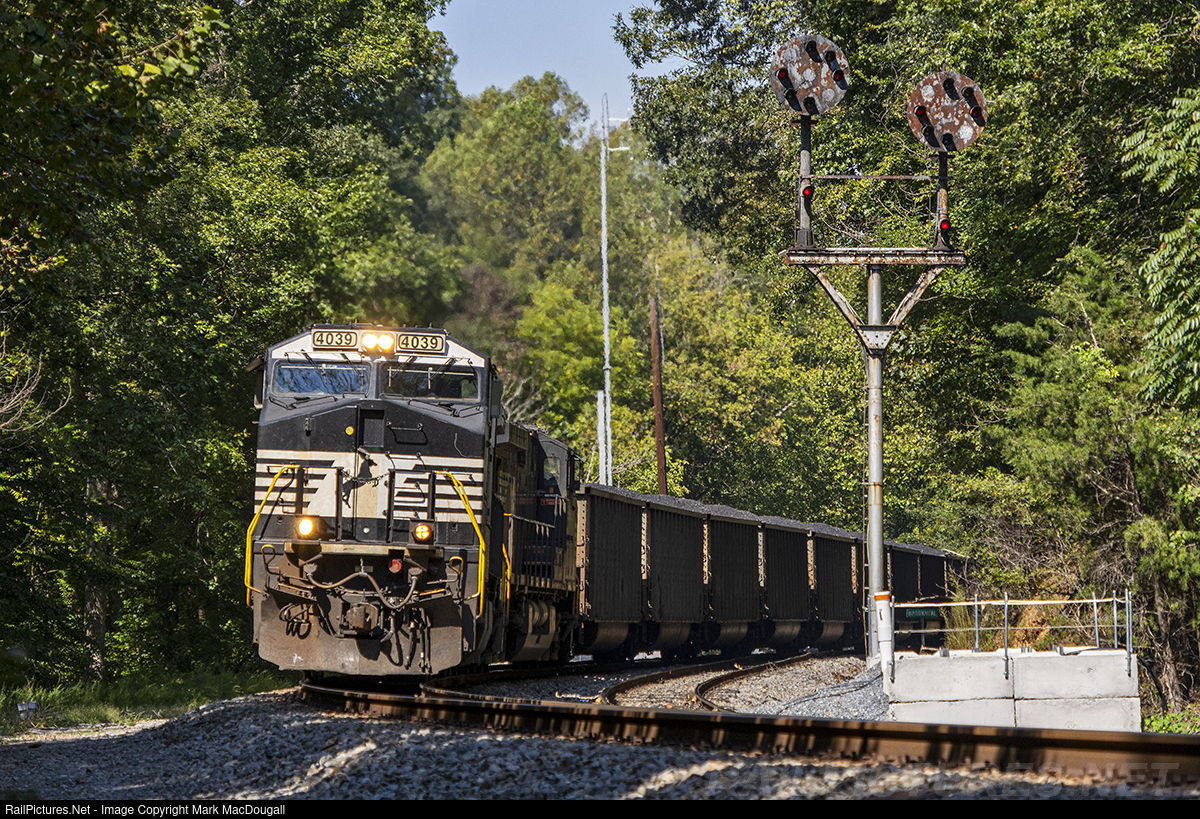
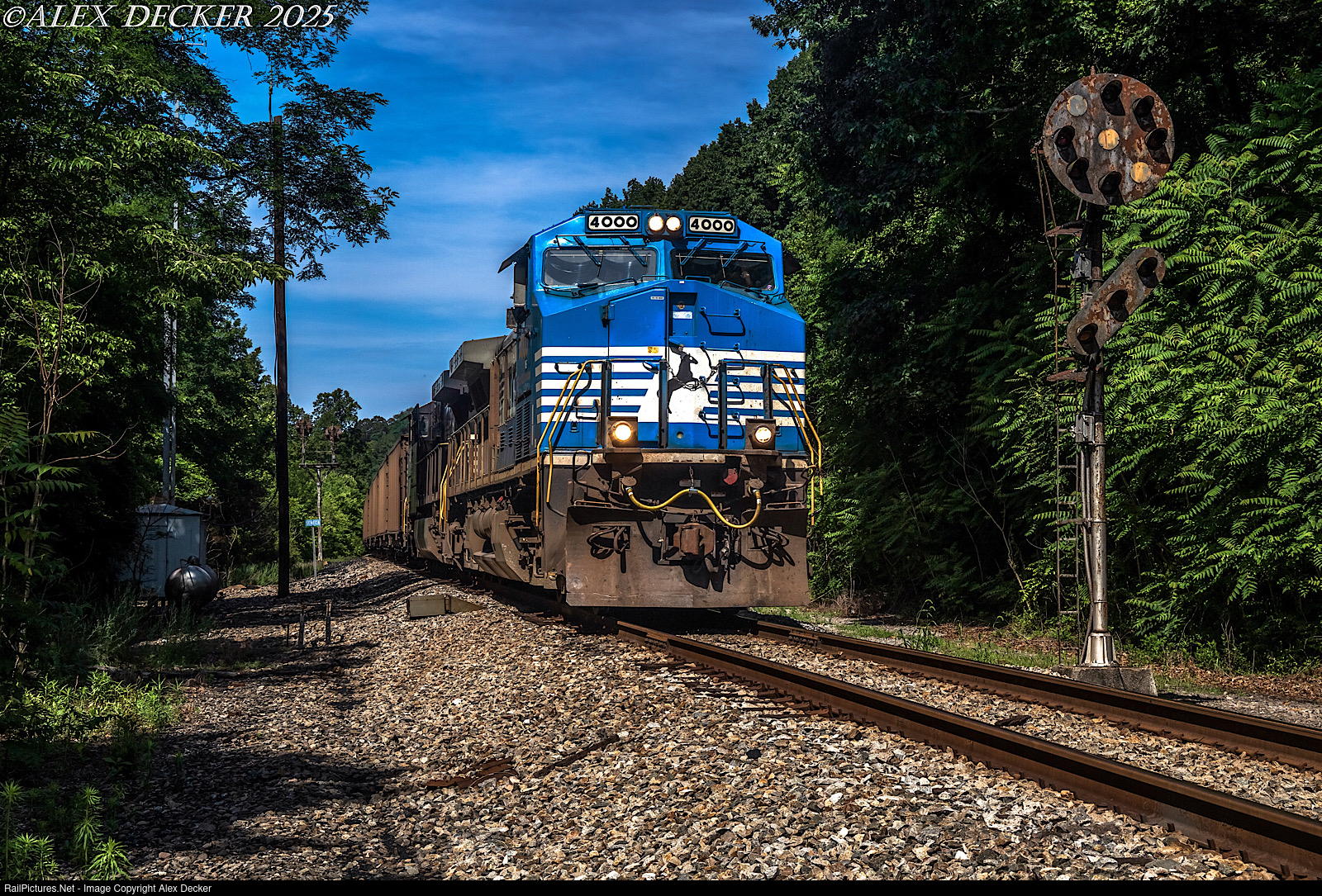
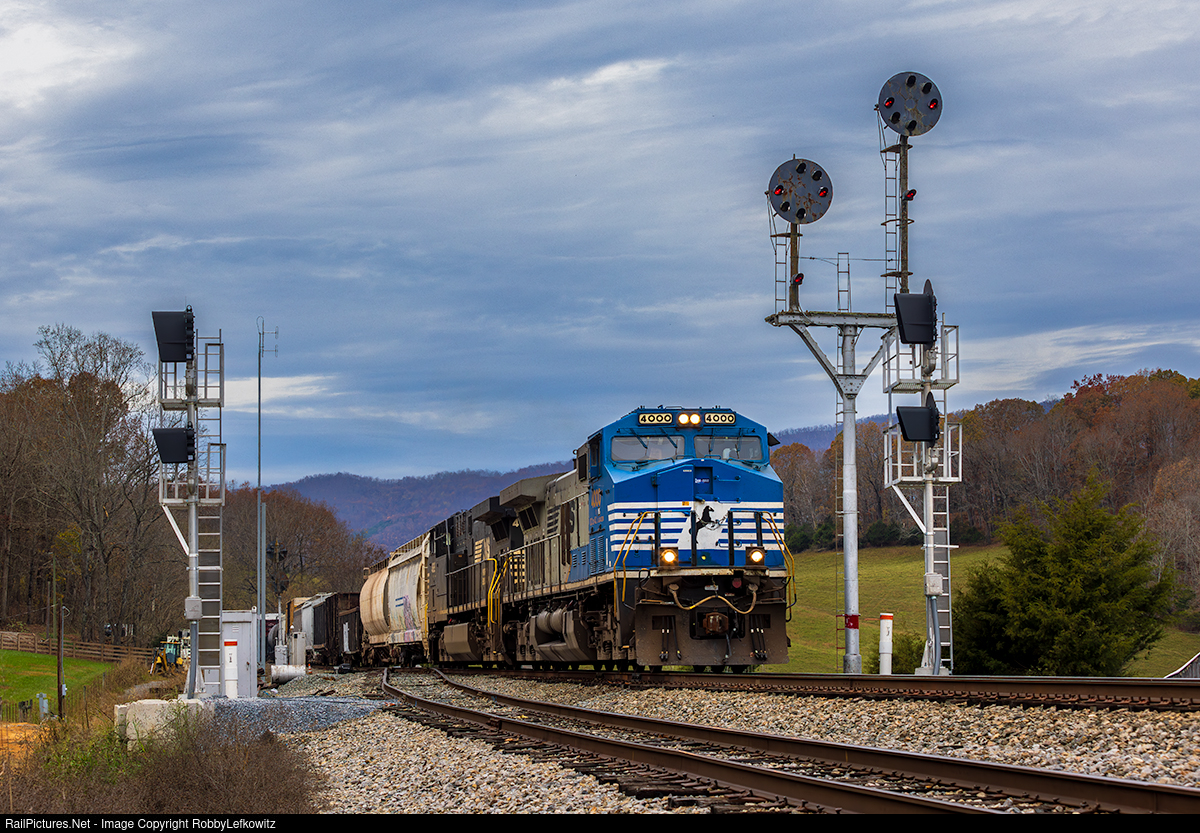
The Last N&W CPL Intermediates Fall

 For many years a lightly used NS line in southern Virginia has been been carrying the torch for N&W position light signaling. Well it appears that the torch has gone out not just for its own N&W colorized position lights, but, in all likelihood, the last example of N&W intermediate signals anywhere on the NS system. The NS Altavista district had become an island of classic signaling due to the typical reason of decline. Like the former Conrail Buffalo Line, C&O Virginia Central route and the B&O Mountain Sub, the Altavista district was involved with moving coal from the Appalachian interior to various ports. 

Comprised of the Virginian Railway's main line that was absorbed into the N&W in 1959, the gentler alignment makes it the preferred route for loaded eastbound coal trains in a form of directional running. Converted by the N&W to bi-directional CTC signaling with N&W style position lights between 1960 and 1963, the relatively young age of the signaling combined traffic that made the route PTC exempt put the Altavista District low down on the capital improvement totem pole.  Unfortunately with the great PTC push of the 2010's now in the rearview mirror, NS started to pick away at the Altavista district PLs in the early 2020's.

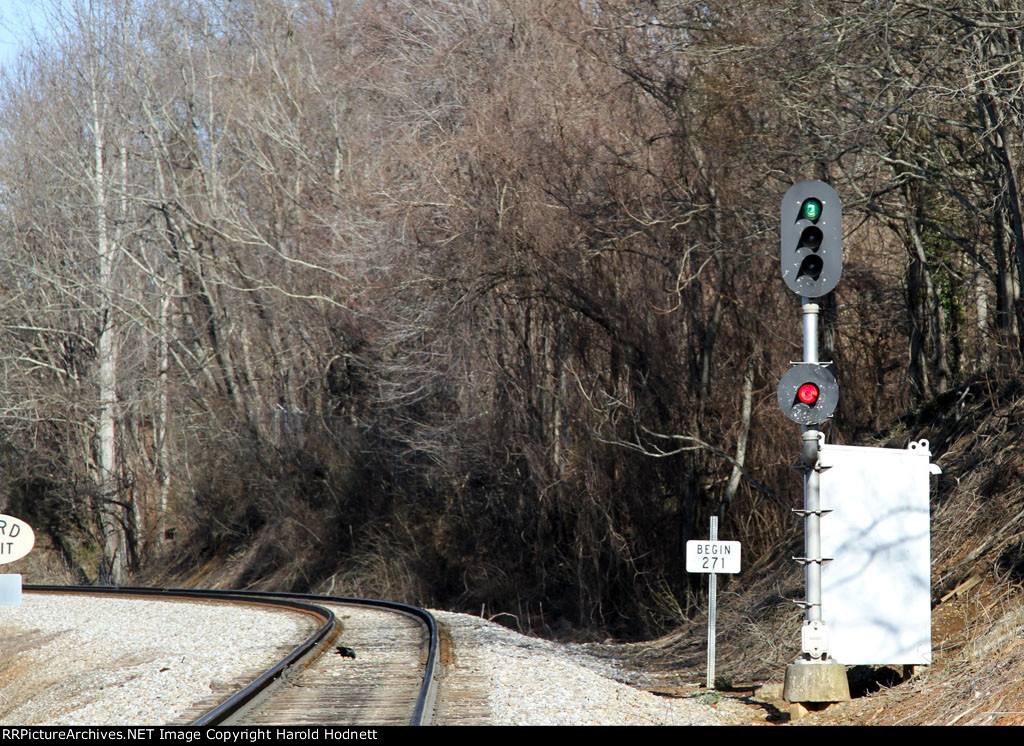
In the particular case of automatic N&W Pl locations, the N&W switched to installing new color lights before the end of the "right hand rule" in 1985. This made "split" automatics ripe for replacement during signal logic refreshes in the 90's and 2000's, even if PL signals at interlockings were left in place. If the assessment of the community is accurate, the Altavista district was the last place one could find active N&W PL signals with an automatic number plate, although like with the dwarf signals, its entirely possible that one or two might be hanging on deep in the forests of coal country. 

2025 Photos of Atlavista CPLs without replacements can be deceptive as the siding at SENECA was removed entirely.
 

Note the qualification of "active" as the former N&W route eastward out of Cincinnati had its N&W CTC signaling, including automatic locations, taken out of service, but not removed. Now leased to a shortline it is the most practical place to get photos of automatic N&W PLs.


Friday, August 15, 2025

Signals of the Reading and Northern Lehigh Line

Pennsylvania's Wyoming Valley, today home to the Scranton–Wilkes-Barre metropolitan area, was the West Texas or Saudi Arabia of the 19th century due to its massive reserves of Anthracite coal. A premium product demanding premium prices, anthracite coal was the way that industrializing America kept warm in the water months after the landscape had been stripped bare of trees for firewood. This is how the Wyoming Valley could fund the operations of three major railroads (the Lehigh Valley, Central RR of NJ and Delaware Lackawanna and Western) and similarly explain why those railroads seemed to evaporate without a trace when the world moved on to oil and natural gas.


Perhaps nothing optimized the uniquely American phenomena of direct railroad competition like the LVRR and CNJ, whose main lines were both functionally and in some places literally parallel. In the 1960's the anthracite collapse was well under way and a decade before Conrail, the CNJ teamed up with the LVRR to consolidate its operations to Scranton. North of its large yard in Lehighton, PA, the LVRR and CNJ used mutual trackage rights to stitch together a hybrid route, using better aligned portions of the CNJ over the Pocono mountain summit between White Haven and Laurel Run. In 1972 CNJ threw in the towel on operations to Scranton and later Conrail would choose to use the CNJ main line between Lehighton and Allentown creating a Frankenstein's monster "Lehigh Line" between NYC, Scranton and NY's Southern Tier. As the region's industry continued to shift, Conrail shoveled off the Lehigh Line north of Lehighton to the upstart Reading and Northern in the 1990's.


All this history is necessary to understand why the signaling on the Lehigh Line portion of the Reading and Northern's main line between Reading and Pittston, looks the way it does. Recently made visible by the series of R&N Iron Horse Rambles and its regular weekend Lehigh Gorge excursion service, the current signaling on the upper Lehigh Line reflect its unique history. In the 2024/2025 time frame I was able to gather enough content to put together a signaling guide covering the old Lehigh Line between Mauch Chunk and Pittston.


We begin at R&N's COAL interlocking, which was built new by them to support the R&N's "Main Line" concept between Reading and Pittston, but also its Lehigh Gorge tourist operations. Using a salvaged lattice cantilever mast, COAL connects what was the old CNJ route to the former LVRR route at the south end of the Lehigh Gorge.


Into the 2000's, Conrail (later NS) owned and operated this portion of the Lehigh Line as a double track Rule 251 main line. Traffic was so light that the southbound track was used bi-directionally with northbound trains needing to get a Form D, while the southbound track had its signal system taken out of service and used for R&M excursions and freights. NS moved first to convert the southbound track to Rule 261 (CTC) operation, with the R&N converting the former northbound track to Rule 261 in the late 2010's. Each track has a single ABS signal location in this line segment, NS at LVRR milepost 126 and the R&N's at its own milepost 124.


A quick note on Mileposts. In the Conrail era the Lehigh Line would alternately use legacy mileposts from the CNJ, LVRR and LVRR Mountain Cutoff. The Reading and Northern switched this to its own mileposts that continues the Reading Company chaining from the old Reading Terminal.  Somehow this has managed to match up with the legacy CNJ mileposts within a few tenths, but LVRR mileposts are off by several miles. I will be using the R&N mileposts for most of this article.
 

CP-M&H JCT marked the transition between double track ABS and single track CTC through the Lehigh Gorge and, starting in the 1990's, the start of the Reading and Northern lease. CP-M&H JCT was re-signaled by Conrail around the time of the lease and has the typical Conrail hallmarks of a CorTen steel relay hut and color tri-light signals. What sets CP-M&H JCT apart is the use of "budget" L&W brand modular signals in the tri-lights. It's entirely possible that the lease arrangement had Conrail responsible for some portion of the signaling system (the interlockings still appear in CR's 1997 signal charts) resulting in signaling that looked Conrail, but with different hardware.


When the R&N lease came into force the arrangement still created a gap in the R&N's conceptual Main Line between Mauch Chunk and CP-M&H JCT where they had to run under Conrail rules and dispatching. When NS finally transferred the northbound track to the R&N in the mid-2000's, they were so thrilled to be in total control that they built a new interlocking back-to-back with CP-M&H JCT named INDEPENDENCE.

The mast is for CP-M&H JCT and the dwarf for INDEPENDENCE.

CP-M&H JCT wasn't an isolated re-signaling as it appears that all of the signaling in the Lehigh Gorge proper was replaced around the time of the lease. This was possibly due to the desire to replace any pole line based system due to the inaccessible nature of the right of way in the Lehigh  Gorge. The new Conrail style signaling again reflected the economic decline of the region with a shift to extra long 3-4 mile signal blocks versus the standard 1-2 mile length. ABS signal locations in the gorge are at R&N milepost 130, 133/134 and 138. The 133/134 location split the Jeddo tunnel for visibility reasons.


134S from behind

It appears that the pole line was retained to supply 440v power to the signal locations, however it is unclear if this supply is still in service.


The end of the 90's re-signaling is at the controlled holdout signal CP-WHITE-HAVEN, which is just a few miles shy of the alignment change from LVRR to CNJ. In 1965, the CNJ main line north of Mach Chunk consisted of a CTC single track with passing sidings with the operating console located in PQ tower. A connection to the LVRR was eventually installed at a location known as FRASER that would serve as the west end of Lehigh Line double track into the 1980's.When the gorge was single tracked by Conrail, FRASER was replaced by a block signal and ultimately RBMN controlled point at the present location as a stopgap solution to increase capacity on the long stretch of single track. 

Saturday, June 21, 2025

New Pittsburgh Line Interlockings

Norfolk Southern's ability to extort the state of Pennsylvania to add additional passenger frequencies on the old Pennsylvania Railroad Main Line is resulting in a slew capacity expansion projects in the form of "new" interlockings and additional tracks. I use the quotes as some of the interlockings are actually restorations of those that existed within living memory, but were removed for the sake of efficiency. 

Restoration of the old SG and NY interlockings.

The first phase of this work is underway at the set of the old SG interlocking west of Johnstown. The new crossovers will allow Amtrak trains to use both sides of the single island platform that serves tracks 2 and 3. Currently if track #2 is unavailable, trains must use main track #3 which follows the slower route of the old Sang Hollow Extension for 15 miles between CP-CONPIT and CP-C since SG interlocking was removed by Conrail around 1980. 

Returning 3 tracks to the Rockville Bridge

Additional changes include the restoration of CP-WEST PITT, removed by NS around 2007, a new crossover on the West Slope near the old NY interlocking between CP-SO and CP-MO, a new third main track between CP-ALTOON and CP-ANTIS, a new interlocking on the Altoona raceway between CP-ANTIS and CP-GRAY and another third main track between CP-BANKS and CP-HARRIS, which would restore a third track to the Rockville Bridge which was lost around 2000. Summary details of the project can be found here with a 2021 report providing more details of the track and interlocking changes. Note the report is not gospel as photos of the new CP-SG show parallel crossovers instead of a universal crossover.

Although no longer equipped with Conrail/PRR era signals, the NS Pittsburgh Line is still Rule 562 cab signaled with "C" lamps, so more interlockings means adding signals where automatics were previously removed.

Saturday, June 14, 2025

Clear to Next Interlocking Rule 280a Displayed at CP-SOLOMON (EAST PITT)

In NORAC-aligned cab signal territory where wayside intermediate signals are not provided, Rule 280a, "Clear to Next Interlocking", allows trains without cab signals to proceed under signal indication instead of needing a track warrant or moving at Restricted speed. Related to the old concept of manual block clear, Rule 280a consists of a flashing lunar white light under the letter 'C' adjacent to a wayside controlled signal. These are normally pretty hard to catch in the wild because they are intended to be used to remedy en-route cab signal failures which are both rare and impossible to predict. For a time it was policy for Norfolk Southern dispatchers to run some Amtrak trains under absolute block protection and I was informed that some would display the  Rule 280a "C Lamp" where available, but I never managed to observe this practice for myself. 

That being said I did stumble upon a scheduled use of Rule 280a that one can catch if they are ever in the Pittsburgh area. After arriving at its Pittsburgh terminus, Amtrak Pennsylvanian Train 43 must reverse about 5 miles to CP-HOME where the closest turning wye is located. Because the rear coach lacks cab signal capability, the "C lamp" is displayed in along side the interlocking signal at CP-PITT, CP-EAST PITT (aka CP-SOLOMON), CP-BLOOM (if necessary) and depending on the order of the wye move, CP-HOME. 

Somewhat ironically the first three interlockings, CP-PITT, CP-EAST PITT and CP-BLOOM, are all back-to-back with no code change points between them. NS could have designated that track segment as normal Rule 261 without the "C" lamps, but their policy followed that of Conrail to provide the "C" even where it is not necessary. (Amtrak had chosen to do the opposite up until about 2010).


Anyway, here we see the 2E mast signal governing track #1 eastbound at CP-SOLOMON (EAST PITT) on the former Conrail Pittsburgh Line displaying Rule 280a in conjunction with a Medium Clear indication reverse move of Amtrak's westbound Pennsylvanian Train 43. CP-EAST PITT is only about half a mile from CP-BLOOM and directly adjacent to office parking making it and ideal spot to Rule 280a in the wild. 

I got this video from the east end of CP-PITT, which a shorter walk from downtown. About 30 minutes after its outbound passage, Train 43 will get more more "C" lamps displayed for a second long reverse move back into Pittsburgh Penn Station however the 2W signal at CP-PITT will display a Restricting into the station track without the "C" indication.


Friday, March 14, 2025

NS Ashville Cantilever is Kaput

I have seen photos of the great Southern RR cantilever signal in downtown Ashville, NC being cut down for scrap. With modern style ABS signals in the flood affected area now turned out of service it appears that Hurricane Helene has done what NS failed to do with a previous FRA petition failed to do and end the heritage signaling on at least part of the former Southern S-Line

Let's be clear, the only reason the S-Line still had much of its former Southern RR signaling was because declines in coal traffic had ended through trains on the line and NS was trying to actively discontinue the signaling system. Much of the line was still operating under Rule 271 (aka TWC/ABS) with a lot of the signaling dating from around 1980 in the late Southern era with generally more modern signal structures, but split ABS masts following the right-hand-rule.


Although NS appears to be scrapping the Southern-era signals on the hurricane damaged portions of the line around Ashville and into Tennessee, it is unclear if the FRA will re-visit the abandonment or if some sort of bog standard NS Rule 261 setup will replace it.  Also, the parts of the line not damaged by flooding will probably remain unchanged as the State of NC is making noise about passenger service on the route which will come with Federal $ for a resignaling project.

Sunday, December 1, 2024

Cleveland Line Autos Now on the Way Out

 In another example of either speaking too soon or rolling under the lowering door like Geordi, it has been reported that NS is planning on removing the remaining Cleveland Line ABS Position Lights I recently reported on

Scuttlebutt is that NS actually needs the parts to maintain the PL's on the western Fort Wayne Line, however I suspect that after the East Palestine explosion closed the Fort Wayne Line, the lack of PTC on the lower Cleveland may have become an issue. No word on the timeline, but I'll try to track the progress and if the project is a 1 for 1 signal replacement or something that will convert the line from ABS to CTC.

Friday, November 15, 2024

Some Apalachian Signal News

We first head to the N&W H-Line where ARCADIA interlocking is the next to get hit by the replacement ax. See my previous report for a more detailed status of H-Line signals. This location seems to be pretty accessible for anyone traveling the I-81 corridor this holiday season.

Next comes news from the CSX Big Sandy Sub in eastern Kentucky, known for its surviving C&O signaling. Due to declines in coal traffic, CSX has been removing or shortening passing sidings in a bid to save costs (and sometimes having to restore the sidings in a bid to set money on fire). Anyway while this didn't matter much on the re-signaled main line, its now affecting the classic signaled Big Sandy so expect interlocking removal/automatic downgrade to follow track removal at locations like SK Cabin in Thelma Kentucky

Most worrisome is the fate of the milepost 55.7 two track intermediate signal gantry on the other side of town. Although the situation has persisted for the better part of a year, this absolutely constitutes a railfan emergency.

 Finally in another "whoops I missed it" moment, the often photographed "modern" style C&O bracket masts adjacent to US 23 south of Catlettsburg, KY were replaced sometime in 2023. Likely installed in the CSX era, the replacements are typical color light masts displaying the same C&O signal aspects.


Wish I had some better news, but the wins are few and far between.

Sunday, October 6, 2024

Hidden Gems - Cleveland Line PRR ABS Signals

The whirlwind of PTC motivated re-signaling has wiped out vintage ABS and CTC systems all across the country including most of the main line PRR position lights. However in one tiny corner of Pennsylvania not only exists a remnant population of PRR position lights, but position lights in a single direction ABS configuration. The Cleveland Line between CP-ROCHESTER (Conway Yard) and Alliance, Ohio serves as a backup route for the far more popular Fort Wayne Line. Due to the low traffic volumes is it PTC exempt, which explains how the PRR era signals have hung on. All together there are 6 PL signal locations on the dual track ABS segment between Rochester, PA and Yellow Creek, OH and today I will cover them all in an eastbound direction using photos that were taken over three trips in 2021, 2022 and 2023


The first location is at milepost 22 at the east end of Wellsville, OH. It consists of one eastbound PL mast and a new westbound Darth Vader mast that was installed in the late 2010s when CP-YELLOW CREEK was re-signaled. It is located just outside the flood wall and is lit full time with PL signal 221 displaying clear by default and signal 222 Approach.


The next location is at milepost 19 right behind the football stadium of Westgate Middle School in the town of East Liverpool, OH. It consists of two single head PL masts, both continuously lit with a Clear signal indication.


The location is also notable for the presence of 1940's vintage Carnegie steel rail and a somewhat ad hoc run of signal wire between the cabinet and rails.


In the East End section of East Liverpool at the site of the closed Virginia Ave railroad crossing we find the milepost 16 location with another pair of PL masts. This time signal 164 displays Approach by default due to a pair of interlockings, VEZ and MIDLAND, at either end of a single track section a few miles to the east to the east. Because the track #1 does not encounter a diverging route at VEZ interlocking the corresponding PL mast needed no modification and was therefore not replaced. The short single track section seems to have been installed due to the risk of RoW erosion by the Ohio River, but also acts as a "Conrail Crossover". The eastbound 164 signal is also significantly taller than the opposite 165 mast.


The relay cabinets associated with the signals display both US&S and Wabco logos.


Seeing as VEZ and MIDLAND took out the following two ABS locations, the next automatic signal location is across the PA border, just east of te town of Midland and directly adjacent to state route 68 at milepost 8.6. It consists of an eastbound position light and westbound Darth Vader which are lit full time with Clear the default indication eastbound and Approach the default westbound. They are co-located with the Midland hotbox, dragging equipment and high car detector.


Saturday, July 6, 2024

Pittsburgh Line Points of Interest

While NS's move to embrace cab signaling without fixed wayside signals (which I will refer to as Rule 562) on the former Conrail Pittsburgh Line was a big loss for the casual observation of railroad signaling in action, there remain a few points of interest between Harrisburg and Pittsburgh that I was able to identify during a journey on Amtrak's Pennsylvanian in 2023. If you find yourself railfanning in that corridor, you might want to check them out.


The first thing worth pointing out are the few remaining number plated intermediate signals that still exist along the line. There is one on the Main Line adjacent to CP-HOMER due to the retention of Rule 261 operation between CP-ANTIS and CP-ALTOONA. There are also a pair of autos on the Altoona Yard leads west of CP-ANTIS.


Another distant type automatic exists on the South Fork Secondary adjacent to the Main Line near CP-SO for trains approaching CP-W.


We've all seen the signed "signal indication points", but did you see the two different SIP's located right next to each other between CP-MO and CP-AR/UN near Gallitzin due to slight differences in the mileage chaining between the two alignments.


Also present are half size SIP huts like this one near CP-MARY in Marysville, PA that serves only a single track.
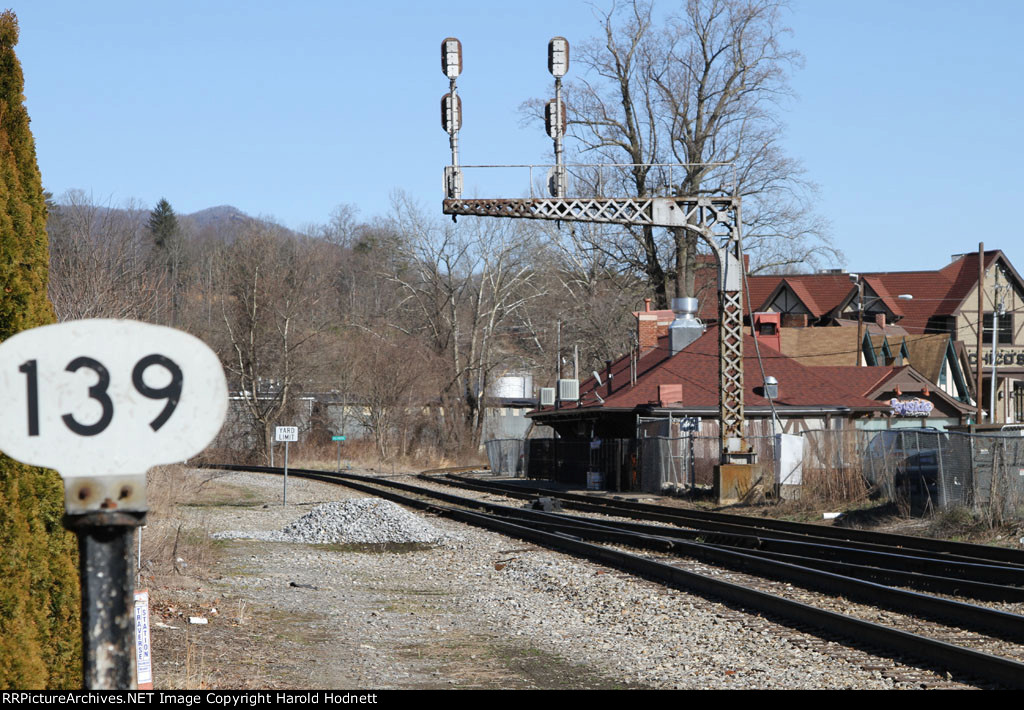

Of course when a SIP shares a relay hut with an interlocking why not sign them both like at CP-JW in Johnstown.


Finally we have the mystery of those places where full speed three headed interlocking signals are still present. When the Rule 562 operation went in, many back-to-back interlockings that supported signals like Medium Approach Medium (R/Y/G), saw their replacements only support Medium Clear (R/G) with the cab signal being held at Approach Medium. 
 

However a few locations on the Pittsburgh Line retain full speed three headed masts. The first are obviously where trains might immediately exit Rule 562 territory such as at CP-ATOONA, CP-ANTIS, CP-ROCKVILLE and CP-BLOOM, or are not in Rule 562 territory at all (CP-WORKS).


However around Pittsburgh we also see three headed signals at CP-PITT and the former CP-EAST PITT. These might exist for the benefit of certain area short lines that might be able to run unequipped locomotives, or to provide better advance routing information for shortline and Passenger movements that need to use specific tracks and/or get off the Pittsburgh Line.


Anyway, keep all these locations in mind if you are looking for something a little bit extra signaling wise to capture in your photos.