Search This Blog

Showing posts with label position light. Show all posts

Sunday, June 14, 2026

Art's LIRR Archives Online...For Now

 Word on the street is that the street is that the person behind Art's LIRR Archives, Art Huneke, has recently passed away. While not quite the #1 source on LIRR tower information, Art's wonderfully Web 1.0 Archive contains a huge amount of primary source material on the evolution of the LIRR in the 19th and early 20th centuries. While the tower and signaling information is scattered throughout the site, it does reward those who take the time to find it. Special attention is given to the older generation of LIRR towers and cabins that were closed in the mid-20th century modernization projects. The page has a wide collection of diagrams and bulletin order scans to track the life and death of these less well known LIRR towers as the rail road evolved into its present form. 

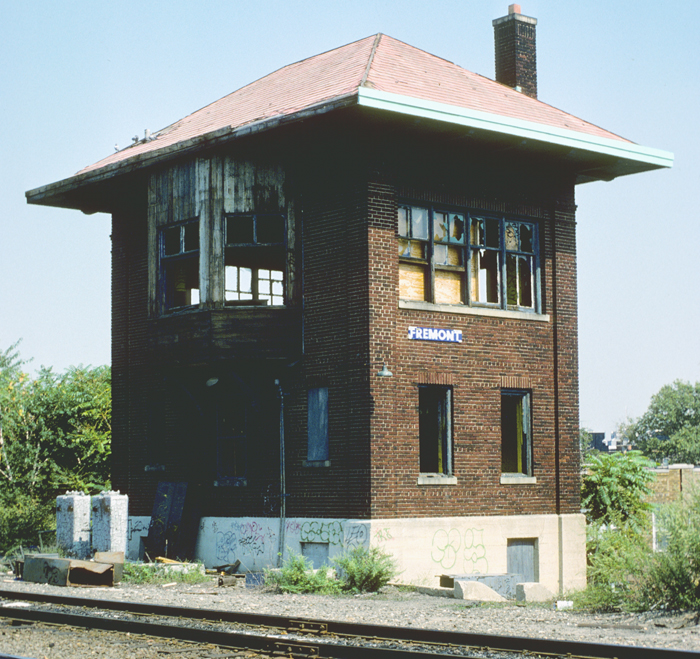
For example Art has extensive coverage of the LIRR's Bay Ridge Branch towers, like NO above, that were opened with the 1928 electrification only to be closed by 1932. In turn we see a photo of the tower that remained open, FN aka FREEMONT, with a Conrail era blue station sign. Other Bay Ridge towers include NU, KN, MJ and of course POND.

At this point there is no word on what will happen to the website so I urge all of you to check it out. Because its all Web 1.0, it is pretty easy to create local copies of the content via the "Save Webpage Complete" function in your browser. Other major signaling content includes:

Friday, March 13, 2026

Amtrak Harrisburg Line Re-Signaling Hits FRAZER

I have previously discussed the drown out closure of Amtrak's THORN tower in Thorndale, PA. Recently the re-signaling efforts have hit FRAZER interlocking where new colorized position light masts have replaced the old amber style PLs. This is just another symptom of the eastern end of Thorn's territory being converted from its 1937 ABS 251 CTC to contemporary Rule 261 CTC. 


FRAZER is an interesting part of THORN's zone of responsibility. As covered in Part 2 of my old PRR Main Line signal survey, FRAZER was placed in service around 1994 when the old Paoli MU shoppe complex was closed due to massive PCB contamination stretching back to 1915. As a replacement a new yard and inspection shoppe was opened near Frazer, PA, extending basic SEPTA R5 service an additional stop to Malvern, PA. The only problem was that there was no interlocking infrastructure at the Frazer location to to support what is SEPTA's busiest commuter rail line. The solution was a new interlocking, FRAZER, that consisted of a yard lead, a turnback track and a center pocket track where eastbound R5 trains could wait for any conflicting movements to clear up.


There was some initial debate about whom would control the interlocking as in 1994 the entire Amtrak Harrisburg Line was still paper dispatched and FRAZER was located directly between the territories of THORN and PAOLI towers. A 1994 fire at BRYN MAWR tower forced the issue when PAOLI  took remote control of that interlocking leaving only THORN with the necessary spoons for more territory. However the increased workload did bump the operator's position at THORN to that of a higher paid Train Director. 


Because FRAZER was located in single direction Rule 251 territory about 4 miles from an existing interlocked crossover, it was not deemed necessary to give FRAZER universal crossovers of its own, so only a training point path was provided mainly for R5 trains heading east. Because this part of the Main Line was built with 4 tracks, there was ample room for a centrally placed pocket track. 


FRAZER is likely the last new Amtrak interlocking constructed with amber PRR position light signals. By 1994 the conversion of the NEC to colorized PRR position lights (a downstream outcome of the Chase, MD wreck) was well under way, but with no plans to convert the old PRR Main Line (Amtrak Harrisburg Line) FRAZER was designed with amber lamps for the sake of commonality. This view was incredibly short lived as PAXON and WOODBINE interlockings built to support the new Overbrook Maintenance Facility just a year or two later would have the position color lights.


It is unclear if FRAZER's conversion is part of a full re-signaling or just a modification to support both the colorized signals, bi-directional operation and Rule 562 cab signals without fixed wayside signals. Dwarf and pedestal signals unaffected by\the changes do not appear to be facing replacement along with the primary relay hut. New Rule 562 signal indication points between FRAZER and THORN are in place along with new signal equipment at GLEN and the planned decommissioning of DOWNS. If I am not mistaken, this will also be the first time SEPTA crews have to deal with Rule 280a "Clear to Next Interlocking" signals on their regular territory as their own Rule 562 territory lacks this feature, instead handling cab signal failures with dispatcher issued Form D's.

Friday, February 20, 2026

Caught on Camera: PORTAL's new "Gantrylever" Under Test

Following up on the previous post regarding the new PORTAL bridge cutover, Amtrak I happened to catch a cab speed indication on the (New) PORTAL interlocking's westbound cantilever mast's 3W signal. With the new track #3 still very much under construction, crews were getting a jump on commissioning* the new interlockings associated with the project. Although this is a static image, the 3W was displaying a flashing green cab speed indication, which would be in line with the high density cab signaling in place between HUDSON and A interlocking at Penn Station. 

That alone is interesting, but if you review the track and signal diagram from Bulletin Order establishing OLD PORTAL and OLD SWIFT interlockings you might notice that future PORTAL is intended to be laid out similarly to OLD PORTAL with center Track A merging into tracks 2 and 3. Instead in the photo we see a two track cantilever mast, or do we?


Amtrak is splitting the commissioning of the new Portal fixed bridge into two month-long work sessions spaced 6 months apart. The primary reason for this is that activating the new eastbound track #2 will require the prior removal of overhead catenary supports required for both existing tracks. A secondary reason is that the new track 2 will require partly burying the old track 3 and removing the westbound cantilever as you can see below. 


If you look closely the end of the cantilever arm has some extra bits and the diagonal supports at the corner seem a bit flimsy. This is because that new signal structure is not a cantilever, but half of a three track signal gantry that will be completed once its southern foundation has something to sit on. I'd call this a "gantrylever", but that term is somewhat taken by gantry+cantilever combinations as seen at UNION and DUNTON. 


 In other news related to PORTAL's signaling  the lower heads on the westbound signals are conforming to the new pattern established at LEGGETT interlocking on the Hellgate Line, replacing the central lunar white Stop and Proceed dot with a a lunar white Restricting \. However the eastbound signal masts retain the Stop and Proceed dot. This might be a quirk needing the shorter signal blocks around Secaucas transfer than the SWIFT connection. 

Anyway. just though it was cool to catch the new temporary cantilever signal 3E under test, several weeks before the first revenue train would actually use the new bridge.

*Note: Amtrak would ultimately open track 3 for service two days ahead of schedule due to a problem that fouled track #2 during the morning rush. 


Saturday, January 17, 2026

L&W PRR Pedestal Signals Appear on the LIRR.

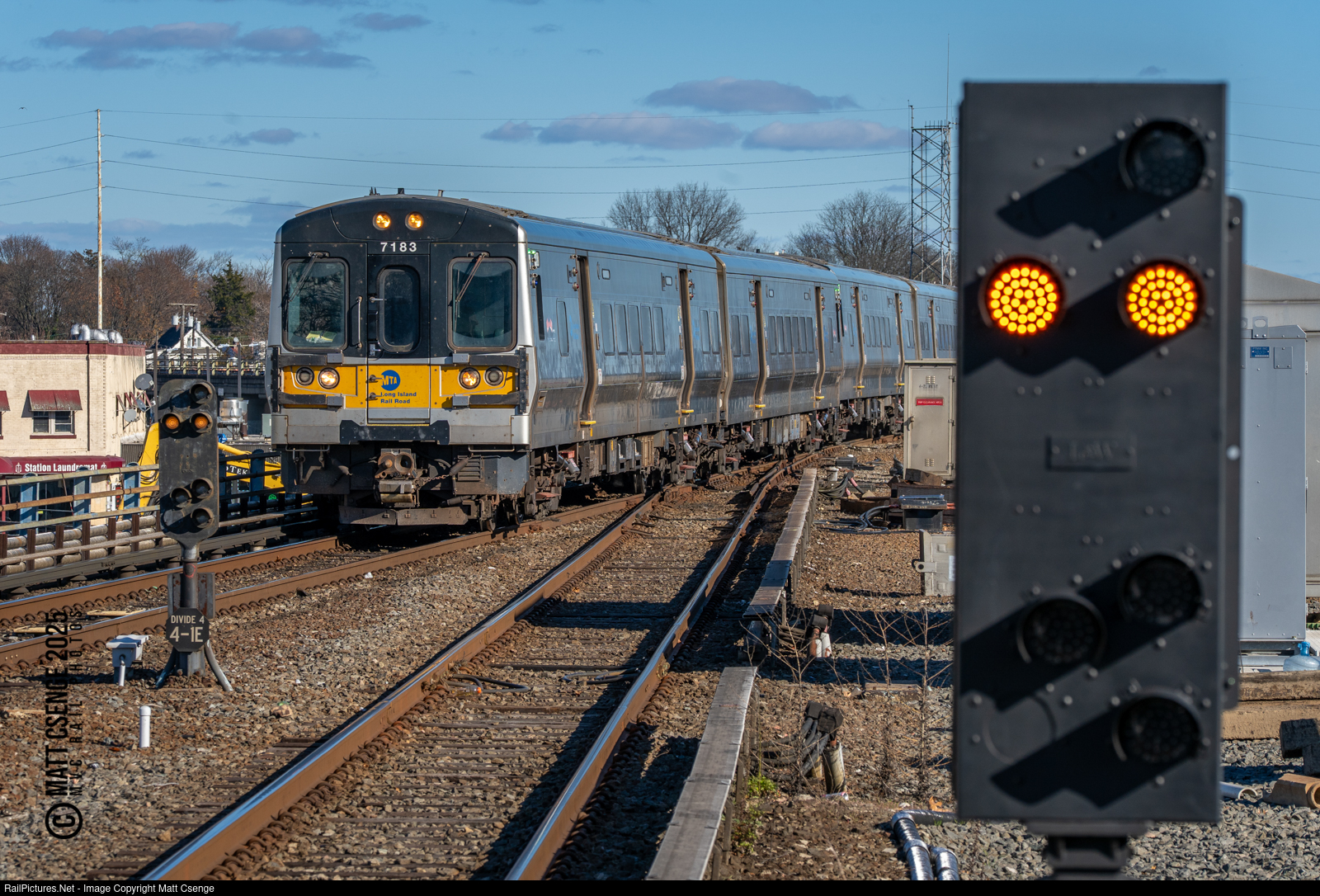
With cast iron PRR type "pedestal" position light signals from US&S long out of production, SEPTA appeared to be the first to purchase ersatz pedestal signals from independent signal manufacturer L&W back in 2019. These boxy LED equipped replacements have subsequently appeared on Amtrak around Philadelphia's PENN interlocking. Well it seems that despite their move towards reduced aspect signaling, the LIRR has purchased some as well with a prominent example now at DIVIDE interlocking.


 While not completely unexpected the LIRR is known to have a sizable stock of pedestal signals that it uses during re-signaling projects to take the place of gantry-mounted PLs until the cutover process. However the number of concurrent signal projects may have exhausted the supply necessitating the purchase of new L&W stock. 

Saturday, December 27, 2025

Amtrak Extends NEC Rule 562 From OAK to BUSH

Amtrak has recently activated Rule 562 cab signal operation between OAK and BUSH interlockings on the Aberdeen peninsula in Maryland retiring three intermediate wayside signal locations in the process. This follows a similar project between PRINCE and BACON interlockings that took place in 2018.  


The three wayside signal locations are the Milepost 65 signals just north of the Aberdeen station, the Milepost 67 signals near the defect detector in Short Lane and the Milepost 69 signals in Perryman.

This project has been anticipated for the better part of a decade, but according to my sources was waiting on a larger project to build a new interlocking or interlockings to improve routing around the Aberdeen station. It is possible that with both the Susquehanna River Bridge and Baltimore Tunnel replacement projects now underway, Amtrak lacked the spoons for a new Aberdeen interlocking.

Sunday, December 21, 2025

PHOTOS: LEAMAN - The Place To Be

The Pennsylvania Railroad Main Line, today operated by Amtrak as their Harrisburg Line, is known for its many interlocking towers that survived well into the 21st Century and I have covered several of them on this blog. However there is one "place" that isn't quite a tower, although it has many of the trappings of one. While the PRR seemed to have an aversion to CTC, it still had a lot more signaling infrastructure than peer railroads with a particular focus on Manual Block System and its related component, the block station. What's a block station? Well its a location on the line that can host a block operator who in turn can perform those duties necessary for some (manual) block operation like transmitting train orders, displaying signals and throwing hand operated switches. Even on signaled PRR main lines one could find non-interlocked block stations open either 24/7 or part time.

Located at milepost 56.7 between PARK and CORK interlockings on the Main Line is the town of of Leaman Place. You might recognize the name for being the interchange point for the Strasburg Railroad. This segment of the Main Line was electrified in 1939 and at the time  featured 4 main tracks. Despite the 24 mile gap between the two interlocking stations, no intermediate crossovers were provided as most disruptions could be dealt with by relying on the "spare" main track (with the parallel Columbia Branch directly providing an additional two tracks of relief capacity for freight). However in 1948 tracks 2 and 3 were removed due to declining traffic and evidently this length of single track operation during maintenance or equipment failure had become an issue because in 1961 the PRR constructed the new LEAMAN block station at milepost 57.0 with a pair of main track crossovers protected by semi-automatic signals. Unlike similar hand throw block stations LEAMAN had no normal hours of operation and was only open as needed for single track operation.


LEAMAN consisted of a pair of center locked hand operated crossovers and a pair of position light signals oriented in the normal direction of travel. As this was not an interlocking, no reverse direction signals were not installed. A rather robust operator's shelter was provided and outfitted with  station signs, climate control and telecommunications. 


This sort of hand operated crossover layout was not uncommon on other double track ABS main lines with the requisite "shelter" typically taking the form of a wayside telephone booth that would allow crews to call the dispatcher to pick up their movement authority to run through the single track area or to report clear of it. However LEAMAN was unique in that its signals and electric switch locks were tied to a small control panel inside the operator's shelter and not accessible to road crews. 

Sunday, November 30, 2025

The Other Rule G

The evolution from "Stop and Proceed" to "Restricted Proceed" in North America is long and something I hope to tackle at a later date. A holdover from the timetable and train order era where waiting for a train running ahead increase its lead made some sense to reduce collisions, the fuel and time savings of allowing following movements to keep moving is hard to deny.  However even where Stop and Proceed are the norm, exceptions are necessary where something like a stiff grade might make restarting a heavy freight train difficult. To implement these exceptions, the (G) or Grade marker was used on automatic signals to relieve some or all trains of the need to stop when paired with a Stop and Proceed indication.


Stop and Proceed was especially popular in the Northeast United States, but after Conrail was picked apart by NS and CSX, most of the major northeastern freight territory fell under the spell of Restricted Proceed.  At this point the G marker appeared to be on its way out as the remaining NORAC roads were either passenger focused or too small to have signals or heavy freight trains. However, as the limited speed triangle, Amtrak's Harrisburg line turned into an unwitting refuge. The PRR's Main Line between Philadelphia and Harrisburg was surprisingly hilly and saw more than its fair share of automatic signals with (G) markers applied.

One might assume that the spread of Rule 562 cab signals without intermediate wayside signals and complete lack of through freight would put the Main Line's (G) markers into a terminal decline, however at the Milepost 21 intermediate signal, a minor capacity project may have what could be the last new main line (G) marker to be installed in the United States. 

When Amtrak wanted to upgrade the single direction tracks tracks between the SEPTA Yard at Frazer and the start of 4-track operation at Paoli, they modified Milepost 21 intermediate signal location for bi-directional operation on both tracks with new Safetran colorized position lights and (G) markers in the eastbound direction.  Moreover, the (G) even uses the same old school blocky font as opposed to the smoother letter used on things like (D)istant and (A)pproach markers.

It's anyone's guess how much longer these (G) markers will be around for as the track segment they govern will soon be subjected to the Rule 562 treatment. Another part of Amtrak territory south of Wilmington also features both long freight trains and (G) markers, but it too going the 562 route so its a good chance that these will be the last new (G)'s installed in the United States. 


Saturday, November 15, 2025

Tight Jeans: Position Lights As The PRR Intended

We all know the PRR Position Light signal looks like this with the round upper head and the (usually) squared off lower head. Both backing targets are technically interchangeable with each other (Although I have never seen a lower head type target used on an upper head.). 

However what would you think if I told you that this concept of the PRR PL did not reflect the original vision of the author. A while ago I wrote up a post discussing the compact position light and how the lamp arms of a US&S pattern position light can support a PL lamp module at any point along their length.  At the time I thought that there were two standard PL setups, full size and compact. Well it turns out there is a third method of lamp arrangement which was actually the standard setup used by the PRR in its final few decades. 

While the PRR was an industrial behemoth that didn't hesitate to spend on quality, there were a few areas where its famed standardization turned more towards penny pinching. One of these was the configuration for the lower heads of its position light signals. To make the signals stand out in bright sun, a dark backing target would be necessary. However there would be little need for this contrast if an approaching train was moving at slow speed below 30mph. Therefore the PRR only applied a backing to the lower | position as the lower / and \ positions would be approached at something more like 15mph. 

If you look closely at one of these original pattern lower heads you'll also see that the modules for the / and \ positions are not positioned at the ends of the mounting arms. Instead they are scrunched in couple inches. Although not to the level seen in compact PL arrangements, this scrunch may have been to provide some contrast without the "expense" of a backing plate. 

See the difference between the placement of the lamps on the | vs the \ position.

I am sure the rivet counting modelers are yelling at their screens right now about my obliviousness, but somehow I had never noticed this before. I guess this is partly because unmodified PRR position lights have become so uncommon, but also because later lower backing plate thoroughly set the expectation that the spacing would be the same on both heads. Anyway now I know and now you know as well.


Thursday, October 30, 2025

The Last N&W CPL Intermediates Fall

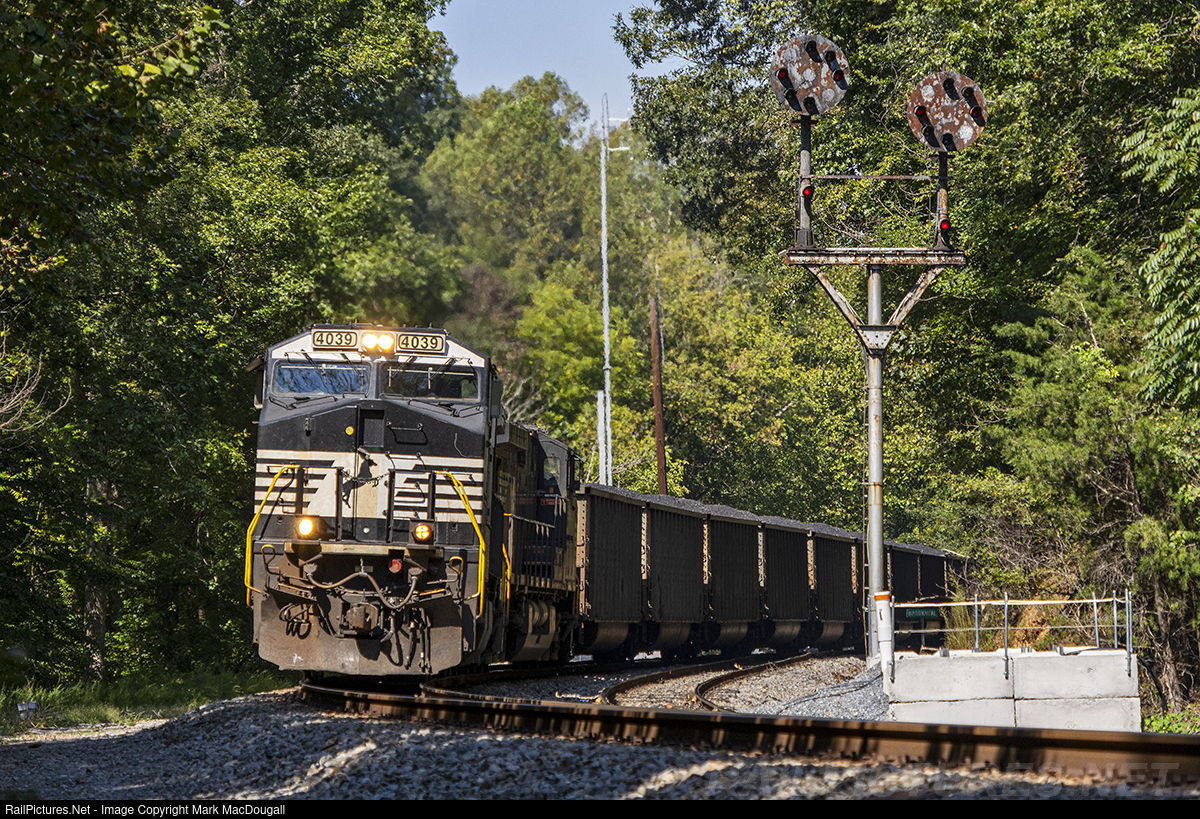
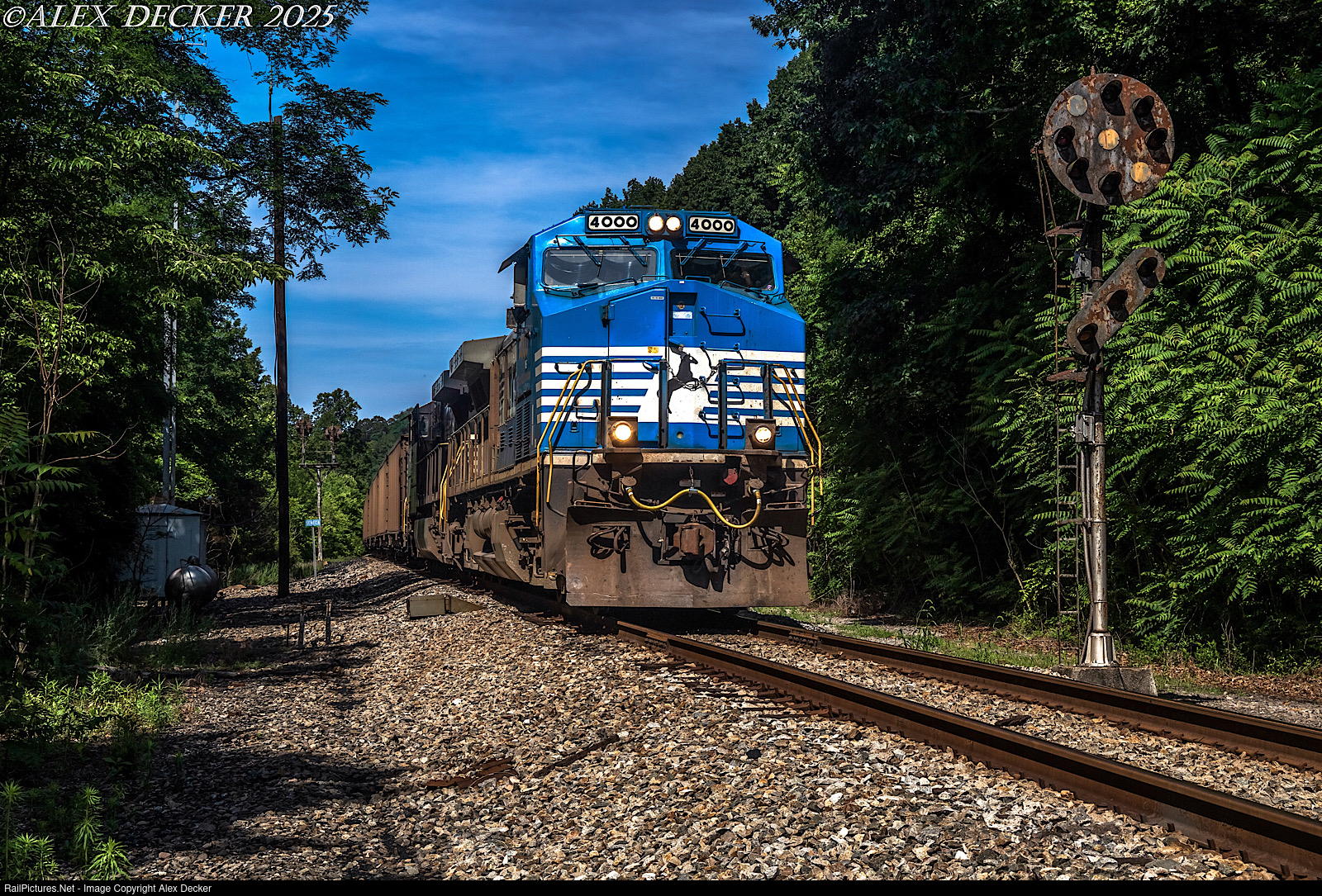
 For many years a lightly used NS line in southern Virginia has been been carrying the torch for N&W position light signaling. Well it appears that the torch has gone out not just for its own N&W colorized position lights, but, in all likelihood, the last example of N&W intermediate signals anywhere on the NS system. The NS Altavista district had become an island of classic signaling due to the typical reason of decline. Like the former Conrail Buffalo Line, C&O Virginia Central route and the B&O Mountain Sub, the Altavista district was involved with moving coal from the Appalachian interior to various ports. 

Comprised of the Virginian Railway's main line that was absorbed into the N&W in 1959, the gentler alignment makes it the preferred route for loaded eastbound coal trains in a form of directional running. Converted by the N&W to bi-directional CTC signaling with N&W style position lights between 1960 and 1963, the relatively young age of the signaling combined traffic that made the route PTC exempt put the Altavista District low down on the capital improvement totem pole.  Unfortunately with the great PTC push of the 2010's now in the rearview mirror, NS started to pick away at the Altavista district PLs in the early 2020's.

In the particular case of automatic N&W Pl locations, the N&W switched to installing new color lights before the end of the "right hand rule" in 1985. This made "split" automatics ripe for replacement during signal logic refreshes in the 90's and 2000's, even if PL signals at interlockings were left in place. If the assessment of the community is accurate, the Altavista district was the last place one could find active N&W PL signals with an automatic number plate, although like with the dwarf signals, its entirely possible that one or two might be hanging on deep in the forests of coal country. 

2025 Photos of Atlavista CPLs without replacements can be deceptive as the siding at SENECA was removed entirely.
 

Note the qualification of "active" as the former N&W route eastward out of Cincinnati had its N&W CTC signaling, including automatic locations, taken out of service, but not removed. Now leased to a shortline it is the most practical place to get photos of automatic N&W PLs.


Sunday, September 7, 2025

LINCOLN Lefty: Story of the PRR's Left Handed Dwarfs

 Anyone looking at the NORAC signal aspect charts may have noticed that the familiar PRR dwarf position lights have a curve to them (or yaw) that can go both ways. For all four dwarf indications, Slow Clear, Slow Approach, Restricting and Stop, one will see two entries on the diagram chart, one with a left hand curve and one with a right hand curve. To the uninitiated this can be dismissed as having to do with clearances or which side of the track a dwarf signal is placed, but it actually represents a fairly early change by the PRR to make a more practical signal vs a more conceptually accurate signal. 

The first PRR position light signals were designed as a replacement for semaphores. Version 1 or "tombstone" position lights (due to the shape of the backing) consisted of 4-lamp lines with an off-center pivot point that directly mirrored the shape and function of a semaphore blade. The position light dwarf signal was no different, but used two lamps to mimic the right to left sweep of a dwarf semaphore. Originally only three positions were provided, stop, low speed prepared to stop and low speed, again matching the function of the dwarf semaphore. 
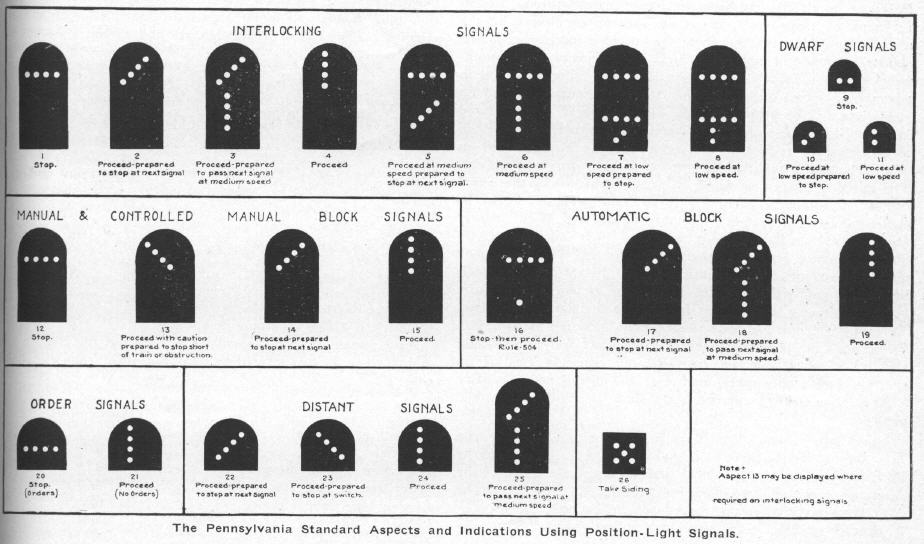

Between 1918 and 1925 the three lamp system with circular mounting became standard for high signals, but the dwarfs, unable to be simplified further, retained the design aesthetic of a semaphore blade sweeping out a curve. The one major change was that someone noticed that the 4-lamp PL dwarf could display the reverse \ for free and a distinction between "proceed expecting stop" and "proceed expecting obstruction" was able to be made. The result was the left-handed dwarf position light.


Made of cast iron by Union Switch and Signal, the left hand dwarf had bulb access hatches on both the straight and curved sides. The rest was a sealed unit with a small vent on the back. 
 

This model of PL dwarf would go on to be installed at all the great PRR signaling achievements of the 1930's such as ZOO and HARRIS, however the march of progress is never satisfied and the desire to simplify the design merged with the desire to reduce confusion. The new dwarf would be reversed such that the curve would proceed in a high hand direction with the Restricting \ position being reduced in size compared to the Slow Approach / Position. The design was also changed to one with a single large rear access door, possibly enabled through advances in large gasket technology. 

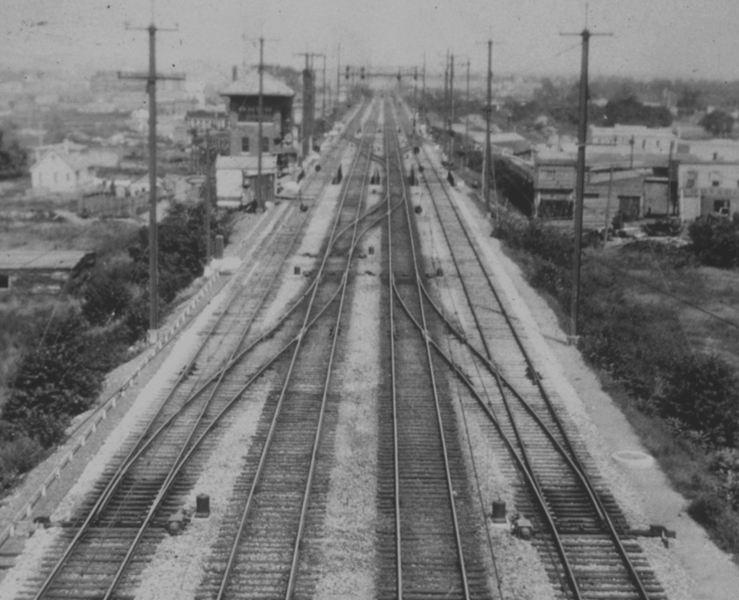
The new style position light proceeded to almost entirely replace the old, especially as the staffed interlocking towers and their electro-mechanical interlocking machines were replaced by CTC starting in the 1970's. By the 21st century left handed PL dwarfs were a rare sight with most appearing at those parts of Amtrak and Conrail territory that had escaped re-signaling since the 1930's. However while out at LINCOLN interlocking on Amtrak's Northeast Corridor in Metuchen, NJ, I spotted a left handed survivor  governing movements out of the MoW yard.


Somehow escaping replacement in the early 90's when LINCOLN tower was closed and re-signaled, LINCIOLN's 5W dwarf is now one of the more accessible left-handed PL dwarfs, mounted on the side girder of the Lake St bridge for all to see.


Hopefully it will escape scrutiny and continue to perform its job for years to come. 

Sunday, August 31, 2025

Amtrak's New Position Light Configuration

Following from Pennsylvania railroad practices, Amtrak used the following two configurations for all of its "complete" position color light mast signals at interlockings. They either have a lunar white Restricting \, or they don't. In both cases the single central lunar white Stop and Proceed marker has been retained.  


While most other North American railroads have shifted to using Restricted Proceed in place of Stop and Proceed, Amtrak, and the NORAC rulebook for whom Amtrak is the biggest member, have both retained the Stop and Proceed practice.  

So consider my surprise when saw the recently installed colorized position light signals at Amtrak's new LEGGETT interlocking on the Hellgate Line. The restricting \ is present, but, please correct me if I am wrong, I believe this is the first time I have seen Amtrak PL interlocking signals without a Stop and Proceed marker. 
 

Part of  the Penn Station Access Project, these colorized position lights are the first of many that will wipe out the last stretch of amber position lights on the NEC (PHIL is a point, not a stretch) and they appear to indicate a shift at Amtrak towards that all important stop before entering an occupied block.

In case your wondering the typical Amtrak signal progression is to display a Stop and Proceed if there is an obstruction within the interlocking limits and a Restricting (if available) if the interlocking is clear, but the block beyond is not. The stop certainly seems like a worthwhile safety precaution, but the distinction between it and Restricted proceed is minimal, mostly just the salience of entering a stretch of track with an obstruction or broken rail. 
 

As you can see the new signals on the replacement Portal Bridge have retained the Stop and Proceed marker, but that project was designed and specified some years before Penn Station Access. So it remains to be seen if this is the shape of things to come, or a one off trial.