Search This Blog

Showing posts with label photos. Show all posts

Friday, February 27, 2026

PHOTOS: LANDIS - The PRR Main Line's Forgotten "Tower"

One might wonder how the electrified PRR Main Line could have an interlocking tower somehow more "forgotten" than the small booth that occasionally managed the emergency crossovers at LEAMAN, but it did and that forgotten tower also began with the letter L. LANDIS tower, in Landisville, PA, was always a stepchild of an interlocking forced on the PRR by the rival Reading Company by means of the Reading and Columbia Branch.  This was a forked "milk run" line connecting Reading (via Sinking Spring) to Ephreta, Columbia and Lancaster. The Lancaster fork was ultimately integrated into the west end of CORK interlocking, crossing the main line via crossover switches and the Columbia Branch via diamonds. The Columbia fork met the PRR Main Line about 8 miles to the west at Landisville and, due to the lack of any existing infrastructure, the diamond managed to justify its own interlocking tower, built and operated by the PRR.

Given the telegraph code NV, a square wooden tower was built in 1902 in the contemporary PRR style exemplified by the preserved LEMO tower at Strausburg. 

This tower lasted into the post war period, its Victorian aesthetic somewhat in conflict with the electrification infrastructure. In this photo one can see the Reading alignment complete with Reading style US&S color light signals in a target configuration. Also note the Reading freight station which in this photo is partly obscuring the PRR Landisville freight station behind it. 

Based on the 1962 interlocking chart it can be surmised that the old NV tower was taken out of service around 1953 with the block and interlocking station moved into the old PRR freight house. Here the part-time operator would work the crossing as needed using a 5 lever US&S table type interlocking machine. Each main track had a pair of signals controlled by a single lever in the US&S fashion. The Reading was controlled by lever 1, the PRR levers 6 and 8. The Reading signals could display Stop, Clear and Restricting in both directions. The PRR signals had a full ABS head with a Stop and Proceed marker with the current of traffic and a dwarf with Restricting and Sop against. The Reading track had split point derails on either wide of the diamonds controlled by lever #4 and the PRR had a hand throw trailing point crossover unlocked by lever 5. The last detail of note was an 'E' marker on the eastbound PRR track which would illuminate if the dragging equipment detector near milepost 79 were activated.


As of 1954 LANDIS was listed in the timetable as an Interlocking Station open part time from 8:30 AM to 4:30 PM daily except Sundays and holidays. By 1971 this had changed to 10:00 AM to 6:00 PM Daily except Saturdays, Sundays and Holidays. Ultimately the Conrail merger of 1976 would prove fatal to the diamond crossing at LANDIS as the Reading branch line was no longer providing "competition" in the Lancaster market and Conrail trains based out of the PRR Lancaster yard could serve what on line customers remained. Therefore the diamonds were removed, the "tower" was closed, the milepost 74 ABS signals replaced the controlled signals on the PRR Main Line and a PRR freight delivery track was repurposed into a new connection to the ex-Reading branch towards Columbia, PA.


Like many legacy railroad structures along the Amtrak RoW, the freight station version of LANDIS was boarded up and left to become somebody else's problem. 50 years later the building still stands in decayed-yet-reasonable condition.


Similar to the Reading's old Chester Creek Drawbridge, the 5-lever US&S "table interlocking machine" is still present in the operator's area, albeit in a stripped down condition. Similar to the single story PARK tower, the windows were covered over with high security wire mesh.


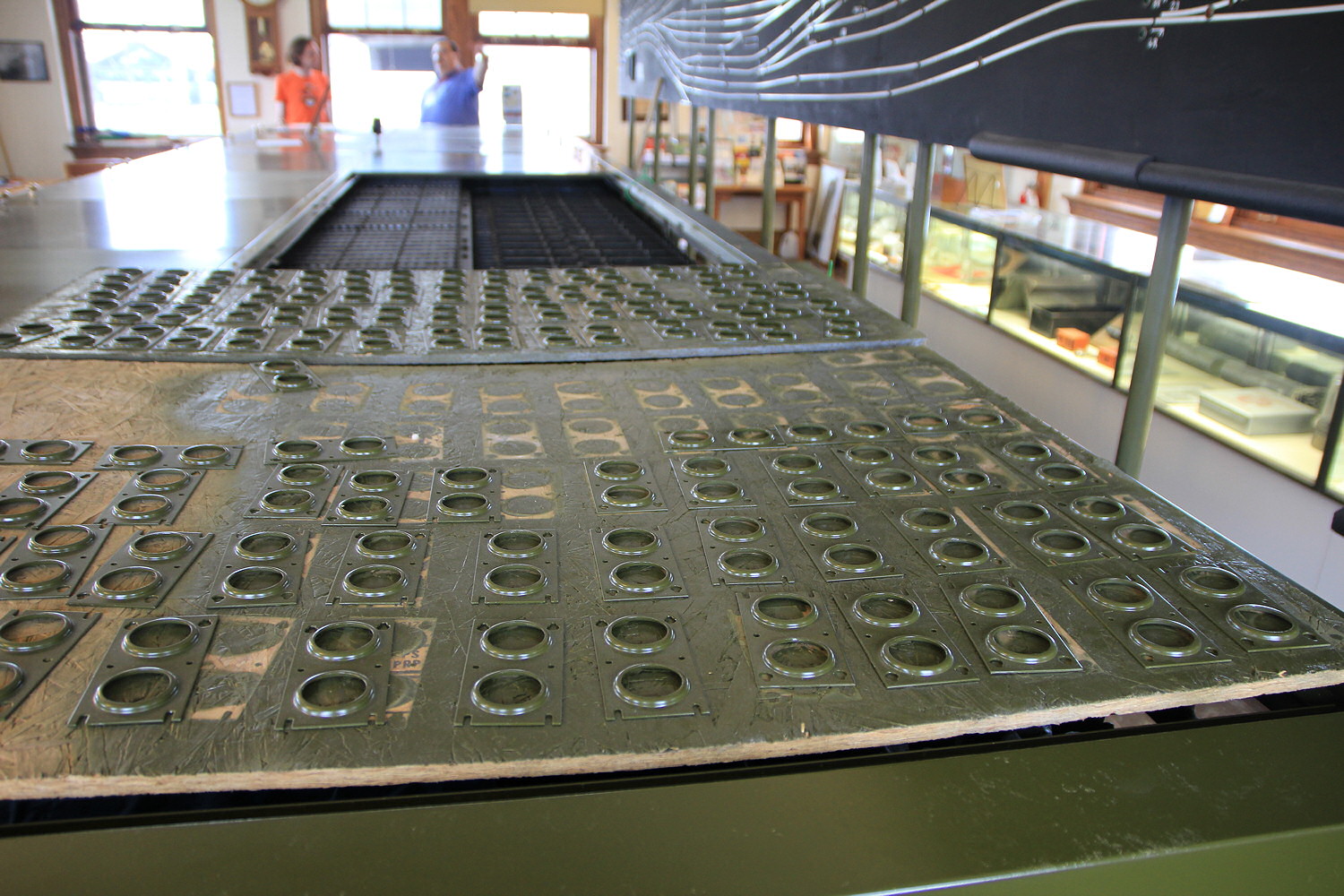
The "table interlocking machine" was a modular platform for very small interlockings up to about 10 levers. Each module contained a standard US&S bell-crank type "lever" and was could interface with both mechanical and electro-magnetic interlocking components. At LANDIS the lever modules have been removed, but the robust metal base remains in place.


For comparison here is a similar table interlocking device set up in NORTH PHILADELPHIIA tower as an auxiliary to the main US&S EP machine. 
 

We can see that the LANDIS machine had a US&S/S&F style mechanical locking grid as well as make/break circuit spindles.


As an interlocking station the operator was provided with a full telecom suite mounted just outside of the bathroom nook.


An old relay hut sits across the tracks, although it is hard to tell what era it came from, Amtrak, PRR or PC.


LANDIS continued on as an ABS signal location until the mid-2000's Rule 562 re-signaling. Today only those with a knowledge of PRR Main Line history, or a sharp eye for abandoned rights of way, would notice that something had once gone on here.


Just goes to show that while many old towers have been demolished, a few are still hiding in plain sight.

Sunday, December 21, 2025

PHOTOS: LEAMAN - The Place To Be

The Pennsylvania Railroad Main Line, today operated by Amtrak as their Harrisburg Line, is known for its many interlocking towers that survived well into the 21st Century and I have covered several of them on this blog. However there is one "place" that isn't quite a tower, although it has many of the trappings of one. While the PRR seemed to have an aversion to CTC, it still had a lot more signaling infrastructure than peer railroads with a particular focus on Manual Block System and its related component, the block station. What's a block station? Well its a location on the line that can host a block operator who in turn can perform those duties necessary for some (manual) block operation like transmitting train orders, displaying signals and throwing hand operated switches. Even on signaled PRR main lines one could find non-interlocked block stations open either 24/7 or part time.

Located at milepost 56.7 between PARK and CORK interlockings on the Main Line is the town of of Leaman Place. You might recognize the name for being the interchange point for the Strasburg Railroad. This segment of the Main Line was electrified in 1939 and at the time  featured 4 main tracks. Despite the 24 mile gap between the two interlocking stations, no intermediate crossovers were provided as most disruptions could be dealt with by relying on the "spare" main track (with the parallel Columbia Branch directly providing an additional two tracks of relief capacity for freight). However in 1948 tracks 2 and 3 were removed due to declining traffic and evidently this length of single track operation during maintenance or equipment failure had become an issue because in 1961 the PRR constructed the new LEAMAN block station at milepost 57.0 with a pair of main track crossovers protected by semi-automatic signals. Unlike similar hand throw block stations LEAMAN had no normal hours of operation and was only open as needed for single track operation.


LEAMAN consisted of a pair of center locked hand operated crossovers and a pair of position light signals oriented in the normal direction of travel. As this was not an interlocking, no reverse direction signals were not installed. A rather robust operator's shelter was provided and outfitted with  station signs, climate control and telecommunications. 


This sort of hand operated crossover layout was not uncommon on other double track ABS main lines with the requisite "shelter" typically taking the form of a wayside telephone booth that would allow crews to call the dispatcher to pick up their movement authority to run through the single track area or to report clear of it. However LEAMAN was unique in that its signals and electric switch locks were tied to a small control panel inside the operator's shelter and not accessible to road crews. 

Sunday, November 21, 2021

PHOTOS: NORTH PHILADELPHIA Tower

In my previous post, I covered the history of NORTH PHILADELPHIA Interlocking and Tower that were constructed as part of a 1915 improvement project to build a brand new main line passenger station at what had been known as Germantown Junction on the PRR's Connecting Railway. In this follow-up article I will cover the tower itself and its interior as they stood on the eve of closure in 2005 after 90 years of service.


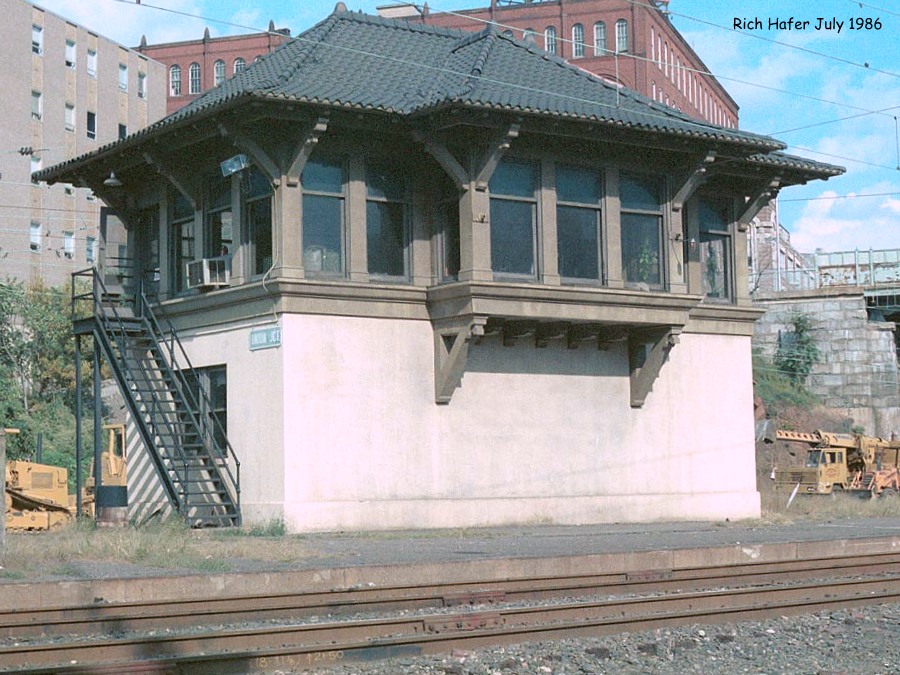
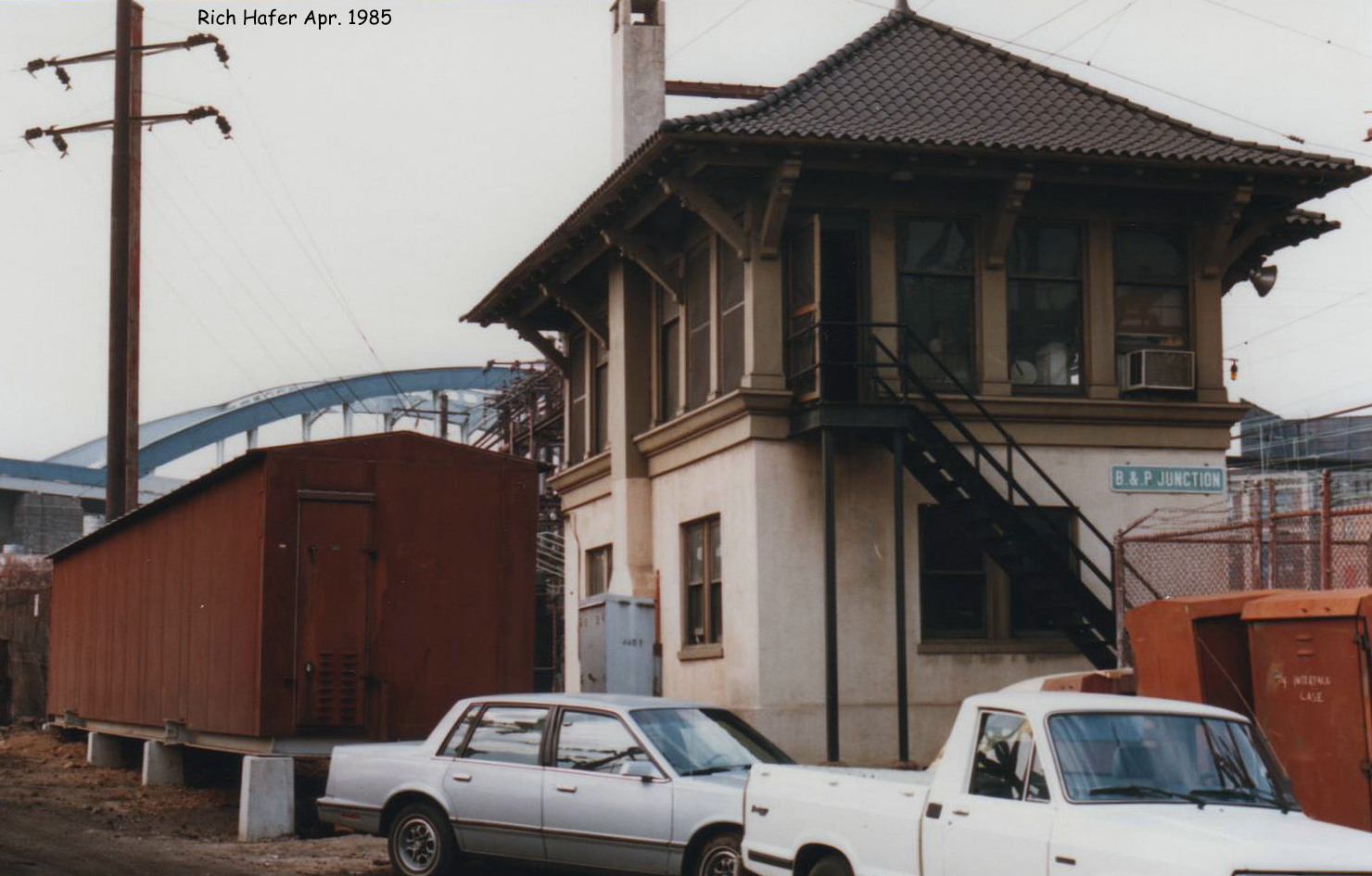
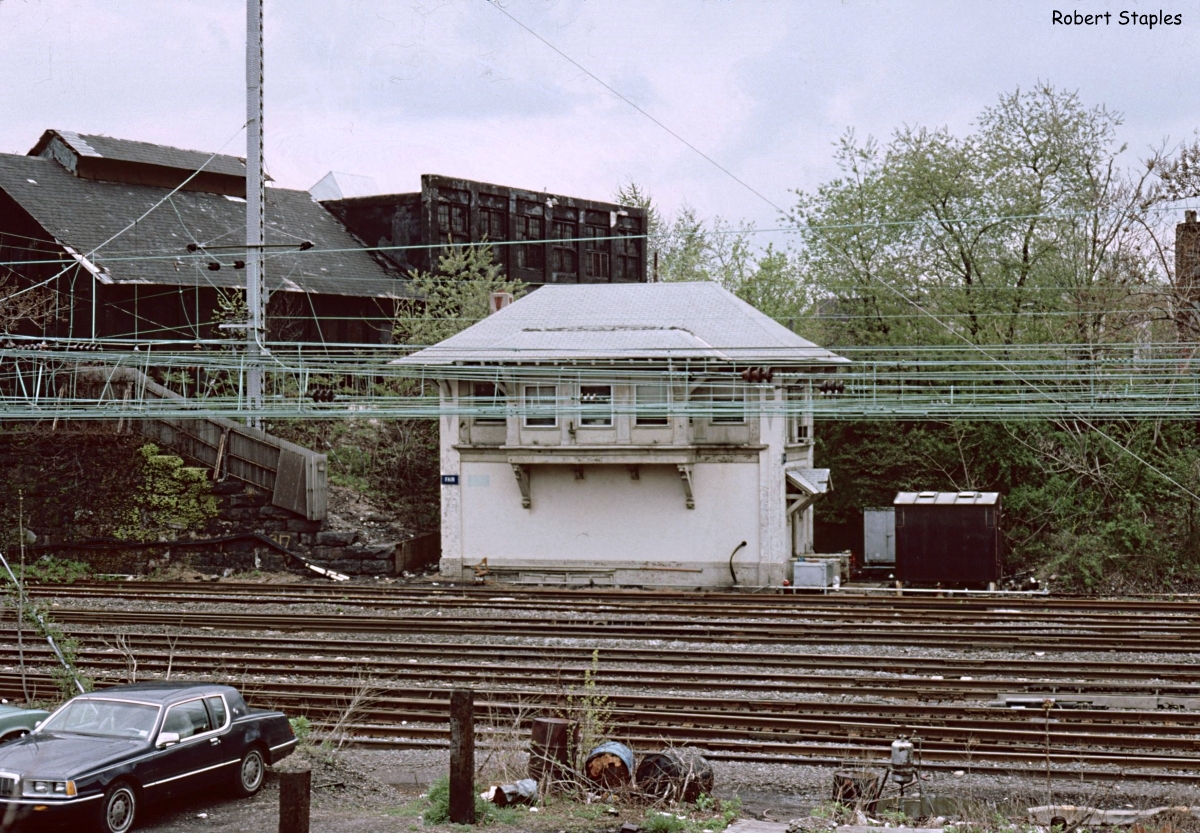
Although the adjacent North Philadelphia station itself is described as being designed in the Châteauesque style, NORTH PHILADELPHIA tower itself is more in line with UNION JCT and B&P JCT towers that were built as part of the Beaux-Arts Baltimore Penn Station project of 1911. From the outside NORTH PHILADELPHIA appeared to be an identical twin of FAIR tower located 30 miles to the north in in Trenton. However despite having been built at the same time, FAIR utilized an electro-mechanical US&S Style P interlocking machine, an example of railroads in this period hedging their bets in regards to purely power operated interlocking plants. Although both FAIR and NORTH PHILADELPHOIA interlockings served stations with high level platforms, station tracks and a double slip ladder, NORTH PHILADELPGIA would stay in service a decade longer, despite FAIR having its Style P machine replaced by a spiffy Model 14 in the 1930's. It would also avoid FAIR's severe case of "tower window syndrome".


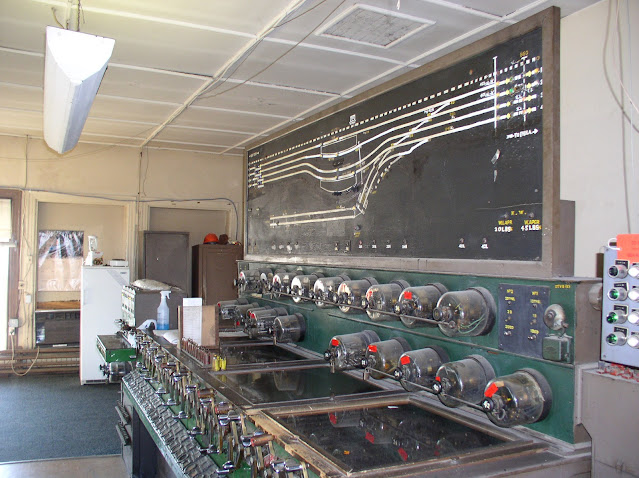
As documented in a period article in the journal Railway Signaling, NORTH PHILADELPHIA was state of the art with an all electric Union Switch and Signal Model F interlocking machine, illuminated model board and glass encased route locking cancellation timers.


As I detailed in the previous post, NORTH PHILADELPHIA's interlocking plant would see many changes over the years, including a change from electric to pneumatic switch operation, but despite all this the tower retained its original 47-lever Model F interlocking machine. The photo below has captured the NORTH PHILADELPHIA machine in its late 90's configuration with former 0 Track at the top separated as the Conrail Trenton Line, but the other freight and station tracks still present.  Also note the east end's trailing point ladder and the Chestnut Hill Branch crossover.  That crossover was a later addition and we can see how it necessitated re-drawing the Chestnut Hill Branch horizontally along the bottom of the model board when comparing with the 1915 photo above.  We can see the Rule 251 between here and SHORE via the 835 and 844 single direction automatic signals.  Makes you wonder if an operator was ever able to arrange a movement from #1 track to #1 track via #5 track through the station. 🤣


Skipping ahead to 2005 we can really see just how much was removed before the tower was closed. Compared with the 90's photo many of the upwards pointing switch levers on the left of the machine are out of service with their numbers missing. Although similar to the more refined Model 14 in operation, NORTH PHILADELPHIA's Model F featured a glass top, to ensure the full employment of signal maintainers, and a row of cast lever indication lamps instead of the later Model 14's use of stamped sheet metal. Other changes from the 1915 depiction include the removal of the electric switch amp meter and additional rundown timers to prevent delays at peak times if routes needed to be changed. In fact the provision of a clockwork rundown timer for practically each signal lever was almost unheard of luxury in the industry, which speaks to the financial resources of the PRR.  In the 2005 photo red tape with updated rundown times have been placed on the timer globes, perhaps indicating that the various signal changes on either side of the legacy plant required the times to be updated.


On the right side of the main machine we see the train announcement bell and higher numbered levers.


On the left side of the main machine we find the lower numbered levers along with the 4-lever table interlocking machine for the Chestnut Hill branch crossover supporting levers 50 through 53. Note the amount of space in this tower on either side of the lever frame which explains how FAIR tower was able to support a 75-lever Model 14 in the same physical space.


On the right side of the model board we can get a somewhat closer view of the changes that took place between 1999 and 2003. The gold stenciled labels on the board are original with the hand painted white and yellow indicating modifications. Removed portions have blacked out with paint, however most of the previous layout along with some labeling can still be seen. All four tracks to the west were bi-directional Rule 261 starting in the PRR era, but dedicated traffic levers were not provided at either NORTH PHILADELPHIA or ZOO. The red lamps at the bottom indicate which signals were currently displayed for train movements (in this case the 28R for one on track #3 west). There is also the west end low air warnings with lamps to 45psi and 20psi and a dragging equipment detector (DED) reset panel for DED's on eastbound tracks #1 and #2.


As of mid-2003 the entire east end of the plant was remoted to CTEC Section 6 as CLEARFIELD interlocking and was literally wiped off the model board despite physically occupying the same space. Because the east end no longer exists, displayed signal lamps have had the labels painted over and track indication lamps have been largely removed except approach lamps on tracks #3 and #4, which likely still give some reasonable degree of warning that a train is heading west from SHORE. Mirroring the west end we see an east end low air alarm as well as DED resets for westbound movements on tracks #3 and #4. Also missing is the 53 trailing crossover on the Chestnut Hill Branch.


The 10, 12, 14 and 16 signal levers previously controlled all main line signals through the east end and were repurposed as traffic levers as the simplest way to integrate the old 1915 mechanical interlocking logic on the west side with the modern interlocking on the east end. Observing the #14 lever lit for a westbound movement on track 3, appears that these levers must be operated for each movement, just like they had as signals, otherwise no direction of traffic is set.

Friday, April 16, 2021

PHOTOS: GREENBELT - The Last CPLs

In the fall of 2014 CSX completed multi-year re-signaling efforts in the heart of its former Baltimore and Ohio territory that included the Philly, Capitol, Metropolitan and Cumberland Subdivisions. B&O style Color Position Lights, some installed as late as the 1990's, were replaced by the typical hooded traffic lights. Beyond the odd siding exit, drawbridge, diamond crossing or distant on non-signaled track, the main line CPL era east of the Ohio River was over. There was however one notable exception on CSX in the form of GREENBELT interlocking in Greenbelt, Maryland. Located just inside the Beltway adjacent to the DC Metrorail-MARC transfer station of the same name, GREENBELT was distinctive in being an interlocking that only really served the MARC commuter train service. These CPL signals would stand for an additional 6 years until their replacement in late 2020. In May of 2020 I went out to GREENBELT for a documentation run so I could present to you photos of The Last CPLs.


GREENBELT interlocking was installed in 1992 as part of a general re-signaling of the Capitol Sub to better support the MARC Camden Line. This saw the elimination of any residual Rule 251 ABS territory, a new Camden terminal complex in Baltimore and the closure of any remaining manned towers such as JD TOWER in Hyattsville. Both the Capitol Sub project and a similar one on the Metropolitan Sub turned out to be some of the last where B&O CPLs were installed new. Like several of the new Capitol Sub interlockings, GREENBELT was commissioned solely for the benefit of MARC commuter trains and consisted of two side pocket tracks that would provide an ADA compliant high level platform connection to DC Metro's new Green Line terminus (The The Americans with Disabilities Act having recently come into force). Pocket tracks were necessary as high level platforms conflict with the clearance envelope of main line North American freight trains. The interlocking consists of two switch pairs, #1 and #2 and 4 signal pairs, 1E/1W. 2E/2W, 3E/3W and 4E/4W.


The signals were in turn broken down into 4 high mast CPLs for the main tracks and 4 dwarf CPLs for the pocket exits. The dwarf signals were placed following the old "right hand" style, while the high masts were not.


In addition to the 12 o'clock orbital for normal routes, eastbound main track signals sported 6 o'clock orbitals for Medium speed diverging movements into the pocket tracks as well as 10 o'clock orbitals for Approach Medium indications for crossover routes at AMMENDALE interlocking, one full signal block beyond GREENBELT.


Eastbound pocket track signals featured a 6 o'clock orbital for diverging routes back onto the main line as well as an 8 o'clock orbital for Medium Approach Medium indications when trains needed to immediately diverge again at AMMENDALE.


The westbound signals have a slightly more complicated history. As originally configured westbound main track signals featured both 10 o'clock and 2 o'clock orbitals for Approach Medium and Approach Slow indications respectively. This is because GREENBELT was also one signal block away from the former JD TOWER complex in Hyattsville. Trains approaching from the east would get an Approach Medium for track 1 to 2 crossovers or routes onto the Alexandria Extension at RIVERDALE PARK interlocking. However if a Stop signal was displayed at JD TOWER interlocking, a Slow Approach indication would be displayed (at least for diverging routes) at RIVERDALE PARK due to the short block distance between RIVERDALE PARK and JD TOWER. This then necessitated an Approach Slow capability at GREENBELT.


The westbound dwarf signals operated in a similar manner, just with a full row of lower orbitals including an 8 o'clock orbital for Medium Approach Medium and the somewhat rarer 4 o'clock orbital for Medium Approach Slow.

Monday, October 22, 2018

Buffalo Line: Gone But Not Forgotten

As of a year ago, the former PRR Buffalo Line, running between Harrisburg and Buffalo, was a real oasis of vintage PRR signaling with position lights and 1950's vintage CTC infrastructure.  Even the portions of the line where the signaling had been suspended, still retained a lot of the old hardware in situ.  Unfortunately, over the last year the line has been completely re-signaled or de-signaled as the case may be.  The good news is that over the years I went on several signaling expeditions to document what infrastructure I could.  Because these photos are split between a number of galleries shot between 2006 and 2018 it might be a bit of a challenge to find them so I decided to make a little guide in honor of the Buffalo Line.  Note, I plan to have my old web hosting restored later this year, but I will provide links to my Google hosted albums as those will hopefully be more reliable over the long run.

Beginning at CP-WYE, I first took some photos there on my 2006 PRR E8 excursion chase.


Then again in 2014 chasing an Amtrak Fall Foliage excursion. 


And finally in 2015 where I was looking to capture the signals I missed in my 2014 trip. 


I caught the intermediate at MP 304 as part of a 2007 trip to Harrisburg.


The MP 299 Automatic was also captured in the 2014 excursion chase.


I only got a few shots of CP-SOUTH FERRY in 2006 before the position lights were replaced rather early.


CP-NORTH FERRY was documented in the usual manner during my 2015 trip.


The next location I documented was CP-SOUTH MILLER, which was split between my 2014 trip and my 2017 trip.


While I got a few photos of CP-NORTH MILLER in 2006, I performed the full documentation in 2014.


From here northward the photos are from my big 2017 Southern Buffalo Line survey.  First up was the MP 278 automatic, which was replaced in the early 2000's.


The MP 273 automatic was a rare surviving split position light.  Possibly the only one on this part of the line.