Search This Blog

Saturday, March 30, 2013

PHOTOS: CPL Theatre - VINE and LOCUST

Well once again it is time to turn some hum drum interlocking photos into some sort of cohesive narrative on signaling. In today's installment I bring you VINE and LOCUST interlocking on CSX's Philadelphia Subdivision. These two interlockings are located back to back about 1/2 mile from eachother on the former Baltimore and Ohio line along the Schuylkill River in Philadelphia. Located just 600 feet from the far more impressive Pennsylvania Railroad Northeast Corridor and its 30th St Station, the B&O line was always a distant second in the City's transportation pie...taking you the same places the PRR could, just in a lot longer time.

Now technically the B&O line ended at VINE, but during the golden age of railroading the line made a connection with PRR antagonist Reading Company which had an alliance with the B&O to allow it access to the major New York area market. Now as I said the B&O's route between Washington DC and New York was hopelessly outclassed by the PRR's mega main line, even more so after the latter built tunnels directly into the heart of Manhattan and then electrified the whole kit and kaboodle. Their response was to try to compete on quality of service in the form of the daily Royal Blue service. This train would be handed off to the Reading at Philadelphia, then take Reading tracks to Bound Brook, NJ where there would be another hand off to Reading subsidiary Central RR of New Jersey, which would then take the train to its final destination in Jersey City where the passengers would leave their super luxurious train and board a deluxe...*sigh*...bus, to go the last few miles to Midtown Manhattan. Needless to say this train did not survive long into the era of the Eastern Shuttle between NY and DC.


Now this stretch of track along the east side of the River had two main uses. The first was passenger service with the B&O's 24th Street station located right there. The second was freight traffic to and from New York via the Reading, but the 1976 consolidation of the bankrupt Reading into Conrail ended these movements. Even in 1999 when CSX bought half of Conrail to regain access to New York, most traffic ended up bypassing this stretch via a connection to the West Philadelphia Elevated due to the clearance restrictions caused by the Art Museum tunnel. The upside of all this irreverence has been that since whatever signaling associated with the 24th St station was removed in the Chessie System era, what they put in for replacement has stayed intact to this day and that mean, you guessed it, the whole corridor is sprinkled with B&O style colour position light signals.

Now despite these two interlockings being located in a deep depression adjacent to the river on one side and a retaining wall for the city centre on the other, the City was awesome enough to install a Multi-Use Trail between the tracks and the river, allowing near perfect access for the purpose of documenting the signaling there. There's even a cute little level crossing for the pedestrians and cyclists, but more on that later.

Anyway we begin with LOCUST interlocking which is named for proximity to Locust St. LOCUST consists of a basic crossover and the western end of the old B&T Philadelphia terminal area between here and RG Tower where the freight yard is located. South of LOCUST in addition to the two main tracks there is also #3 and #4 Running track which are used to park freight trains for various reasons. In this photo we see the westbound CPL dwarf signals, which are dark due to approach lighting, and a freight train way in the distance parked on the running track. The principle freight traffic that uses this line are municipal waste trains to and from large transfer stations in New Jersey and Staten Island that cart away the endless stream of refuse from New York City en-route to points south. The running tracks are a popular place for CSX dispatchers to park returning empty trains until they are needed up north.


The track #1 CPL dwarf consists of a full central target with the 12 and 2 o'clock orbitals attacked. The 12 being for straight routes and the 2 for an Approach Slow for mores at GREYS FERRY interlocking. If you are wondering about diverging moves at LOCUST itself the switches only good for 10mph, which is 5mph less than the official "Slow" speed so they have a special note in the Timetable. Diverging moves are covered by either a flashing | for Slow Clear or a solid | for Slow Approach Slow.


The track #2 dwarf is the same as the #1 dwarf except it lacks the 2 o'clock orbital for Approach Slow. GREYS FERRY has another one of those 10mph turnouts for diverging moves only from track 1 to 2 westbound so at LOCUST all that is needed is Slow Approach Slow, which does not light an orbital. The lunar white Restricting \ is displayed for movements into the non-circuited #3 running track.


Now a couple months later a cut of 85 foot flatcars each with 4, 1 TEU garbage cubes parked on #2 track was lighting up the dwarf signals. In this zoom shot you can see the interlocking along with another cut of 85 foot garbage flats which was probably split to avoid fouling the interlocking and the crossing.


 Here we see each of the westbound CPL dwarfs lit up from a slightly off angle.


Thursday, March 21, 2013

An Interlocking By Any Other Name

If there is one thing that can be considered constant in the world of railroad signaling, apart from mileposts that is, it would be interlocking names.  Interlocking names tend to hang around even as towers are closed and signals replaced.  Now sometimes large plants are broken up into smaller ones and telegraph codes may be replaced by names and names replaced by CP numbers, but there are numerous cases of interlockings keeping the same name through 3 or 4 owners over a time period of a century or more. 

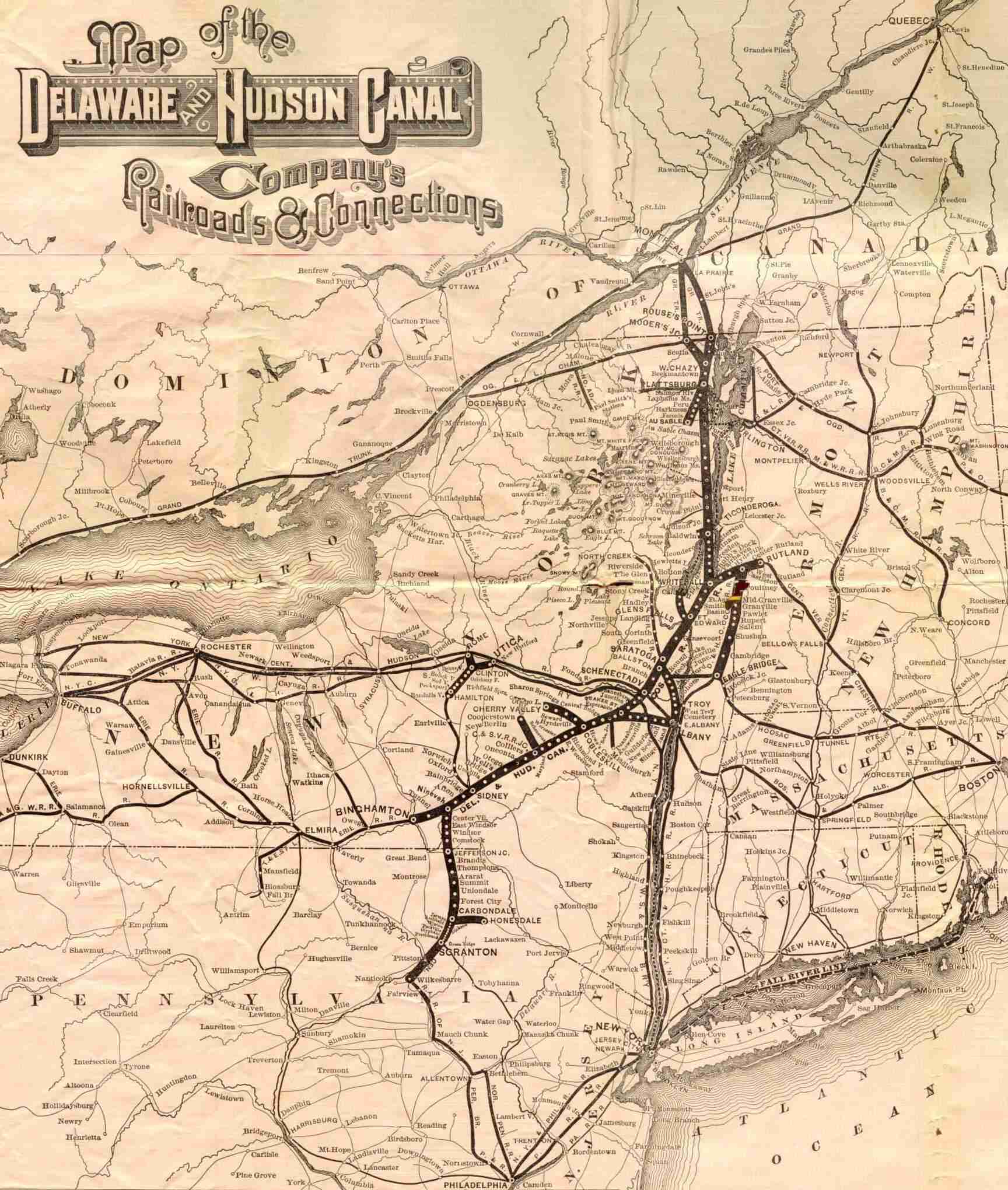
While out documenting some searchlight signals on the former Delaware and Hudson territory in Upstate New York I came upon a unique piece of living history several miles west of Mechanicville where the generically named Canadian Pacific "Freight Subdivision" joins with a connector track to Rotterdam Junction westbound and a 9000 foot siding eastbound.  As you can see the relay hut for the interlocking plant is suffering from a bit of an identity crisis.


As the intra-interlocking pole line cable may give allude to, this interlocking plant has clearly been in service for a number of decades and the relay hut has no fewer than four different nameplates identifying it three different ways.  Solving this puzzle will take one back in time through a tangle of corporate ownership, but fortunately its not too difficult to figure out what is going on here.


The oldest name is the QS telegraph code which is the original D&H name and was probably taken from the tower that used to be at this location.  At some point the D&H caught the CTC bug and when the number of interlockings exploded, instead of trying to make up new call-signs some clever person in the D&H front office just went with a popular variety of the CP system with a suffix indicating the particular subdivision.  In this case the Subdivision was F for the "Freight" Subdivision which ran from the Boston and Maine interchange and massive yard complex at Mechanicville to the interchange with the former Erie and DL&W lines in Binghamton with further connections to Scranton.   This new organization reflected the growing importance of freight flowing to and from the New England ports over freight to and from Canada and also opportunities granted the D&H during the Conrail merger where the smaller railroad was given expanded track access to help "compete" with the semi-nationalized northeast freight monopoly.  So the new designation of the old QS interlocking became CPF-10 as it was 10 miles from the start of the line in Mechanicville.


In 1984 the B&M successor Guilford Rail System and its eccentric owner bought the ailing D&H for essentially pocket change and because he now had a lot more railroad to play with the owner decided to fully integrate his existing 'Freight' Main Line, which ran from near Brunswick, Maine through to Mechanicville, with the D&H line to Binghamton.  Out went the millage reset and in came a new set of three digit numbers from 467 to 611 and CPF-10 became CPF-477.  GRS ran the D&H into the ground so badly that the D&H portion of GRS went bankrupt in 1988 and Canadian Pacific was eventually brought in to take it over.  Now CP Rail wasn't about to go all wacky and re-name things yet again, but it did eventually come by and attach new nameplates on the relay hut. 

One result of the CP takeover of the former GRS integrated line is that the CP trains which run primarily to and from Canada (just like the D&H trains did) start off at MP 611 in Binghamton, run to milepost 480 north of Schenectady and then continue straight ahead onto the Canadian Sub with its new mileage system starting at Milepost 21 (facepalm).  Oh, and CP trains making the turn to stay on the Freight Sub will continue to count down to 468 at which point they turn onto the Colonie Sub at Milepost 19 which will then count down to zero at Albany.


CPF-477 of course is not the only interlocking to show off at least some of its heritage.  One mile to the west CPF-487 still shows the signs of its original name, QG.  Unfortunately CPF-478 and other interlocking plants along the line are being re-signaled and the new relay huts aren't going to have their naming history transferred over.  One example that might survive is the old hut from CPF-130 (that's D&H CPF-130) now serving as the housing for the radio repeater at CPO-4 on the Colonie Sub in Watervillet. 

So the lesson for everyone is to think long and hard before you go and re-chain your rail line because if your expansion plans get undone its going to create major headaches for decades to come.

Saturday, March 16, 2013

CALUMET Tower Closes and Other News

Well this one certainly came in under my radar, but CALUMET tower located on the Indiana Harbour Belt where it crosses the CSX (BO&CT) main line in East Calumet City, IN just closed in early March 2013.  CALUMET was a very old mechanical tower with all the looks and structural integrity of METRA's 16th St crossing only containing a 96-lever National Switch and Signal (later bought by US&S) mechanical lever frame which would help to hold the tower up better.  Calumet Jct consists of the triple crossing between the IHB, B&OCT and EJE lines with the IHB and EJE each crossing the B&OCT on a set of 6 diamonds and then the EJE crossing the IHB via shallow angle movable point diamonds.


 Like all other surviving interlocking towers CALUMET lost a lot of complexity over the years and like DOLTON junction it had its mechanical points swapped for the power operated variety and most of its classic signals swapped for Darth Vader masts, but its ease of access and location at the crossing of two major main lines made it a very popular railfan hotspot, although only for those willing to brave the bad neighborhood it was in.  While no scheduled passenger service passed by CALUMET I personally had the honor of getting a rare mileage trip past during an Amtrak detour over the Porter Branch after a large freight train derailment on the Chicago Line and I am glad I was able to get my own photos of the old girl while where was still someone up top bending the iron.


CALUMET, which one source lists as being built between 1895 and 1897, clearly saw a long and full life and now will probably face the fate that befalls most wooden towers of that type of either being torn down or being burnt down.  There is a slim bit of hope in that the near by GRASSELI tower, which closed in 2007 as the third to last tower with mechanically worked points in North America, was actually preserved and moved to a nearby railroad museum so who knows, perhaps the same motivated individuals are still around to get the IHB to hold back the backhoes and give this tower a new lease on life.  One thing is for sure that is CALUMET is preserved its lever frame will be vastly more interesting to play around with. Unfortunately the once tower rich IHB is down to only about two active plants on its serpentine main line after HICK closed a year or two ago up where it joined the Chicago Line.  The EJE isn't far behind although it two movable bridges with local control towers are unlikely to be put under CTC.


There is of course a Has-Been post on the closing of CALUMET, although that site doesn't seem to like direct inbound links so you might have to re-load the page or cut and paste the link and of course John Roma has been inside to take pictures.

Tuesday, March 12, 2013

PHOTOS: METRA BLUE ISLAND TOWER

When one hears the name BLUE ISLAND in a Railroading context one is most likely to think about truss bridges, a 7 track grade crossing, 4 diamonds and the last Crossing Tower in the United States. Blue Island Junction is near the top of the list of hottest railfan hotspots. Located at the west end of both CSX's Barr Yard and the IHB's Blue Island Yard, many tend to pair it with the previously featured Dolton Junction which sits at the east end of the same yard complex. Like Dolton, Blue Island Junction is also controlled by a manned interlocking tower, although it is seldom seen as it sits on the far side of the river, partially hidden by the 5 truss bridges carrying the B&OCT, Grand Trunk, IHB and Iowa Interstate lines over the Calumet River.


However, there exists another Blue Island tower some 3000 feet from the first. Built about the same time and of roughly the same design, the second Blue Island hides in plain sight on a METRA passenger station platform at the southern end of the former Chicago, Rock Island and Pacific Blue Island Yard on what it today's the METRA Rock Island District. Visible on Google Street View, yet largely absent from the discussion today we will look inside the other Blue Island tower and also wrap up my METRA tower interior series as both the now demolished Lake Street and permanently hidden Jackson Street towers were part of Amtrak owned plants.


The METRA Rock Island district can be thought of as the Harrisburg Line of the Chicago area. While significant portions of the line have been running under CTC for decades now, up until 2010 there were still 4 active interlocking towers between LaSalle Street Station in Chicago and Joliet Union Station. These included the unique Gresham Junction, the increasingly elderly 16th St Crossing, the immaculate UD and of course the forgettable Blue Island.Blue Island is so under appreciated that a simple Google search reveals more photos and information about the abandoned Root Street tower than the active Blue Island tower. It probably doesn't help that Blue Island looks like a yard office is placed rather aloofly from the junction that it controls, but that should not diminish the significance of it and the classic relay signaling plant that it controls.


Saturday, February 23, 2013

PHOTOS: A Brief Ride Through DOLTON JUNCTION

For those of you who don't know, Dolton Junction is North America's largest operating mechanical lever frame interlocking tower located about 15 miles south of downtown Chicago. Over a couple of years while traveling on Amtrak Train 50, "The Cardinal" I have had opportunity to photograph the tower and parts of the interlocking and I seeing the ongoing series on Chicago area towers I feel its a good idea to share them here.

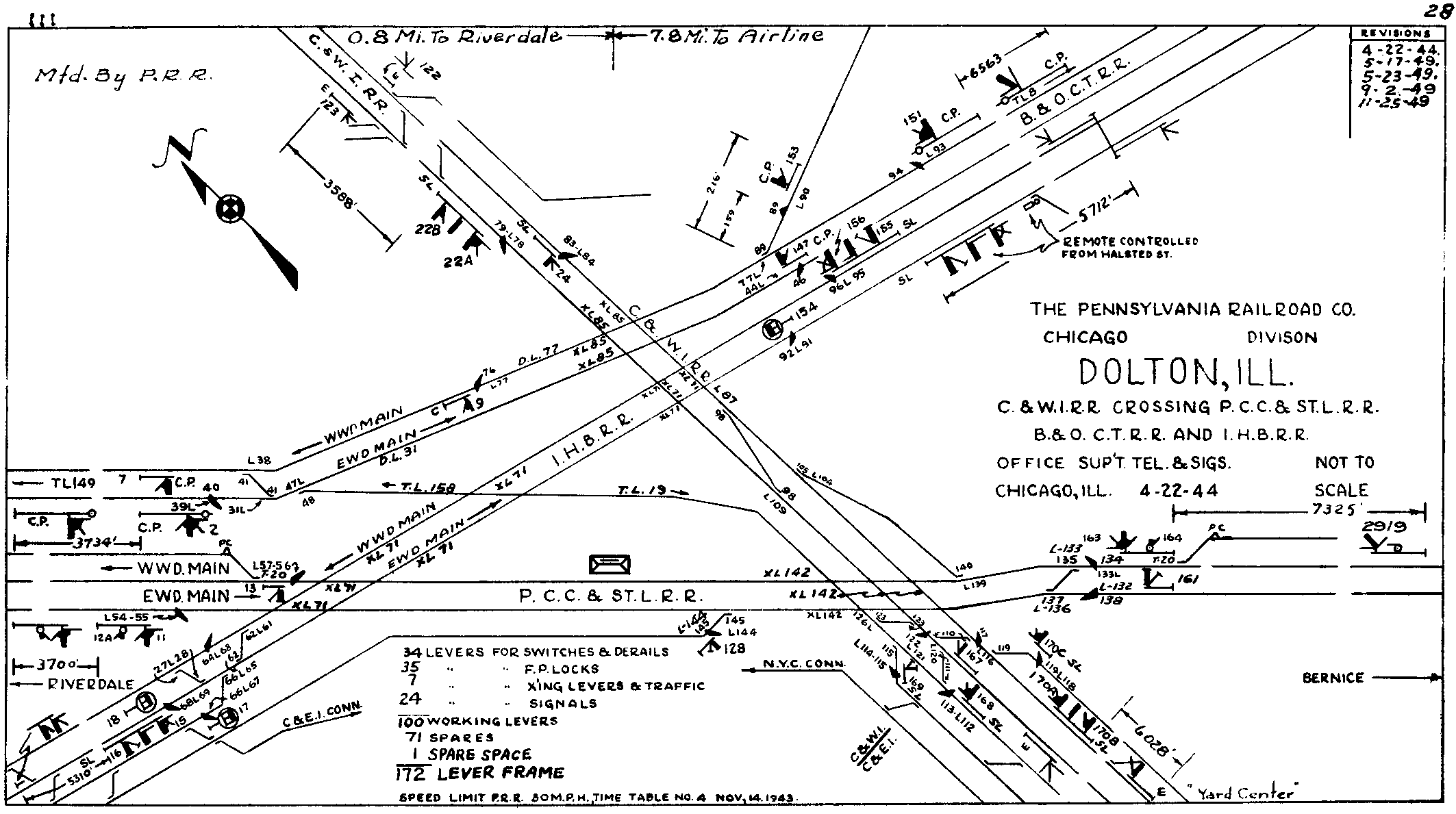
The massive complex that is Dolton Junction was created by the intersection of 4 railroad main lines. The Chicago and Western Indiana railroad ran north to Dearborn St Station as a terminal line that concentrated traffic from a number of other railroads, most notably the Chicago and Eastern Illinois, which eventually wound up owned by Union Pacific. Splitting the C&WI were the parallel east-west main lines of the Indiana Harbor Belt and the Baltimore and Ohio, Chicago Terminal railroads. Finally, playing the spoiler and crossing all the of the other main lines at an angle was the Pennsylvania Railroad's "Panhandle Route" main line from Columbus Ohio. Because the PRR was involved you can find an interlocking diagram here.


The tower at Dolton Junction was built in 1897 and contained a 178 lever frame with 100 active levers. As built the interlocking contained a total of 20 diamonds which included an extra 4 from various connection tracks between the main lines. At the time most of the routes through the plant were fitted with split point derails to prevent any catastrophic Stop signal violations.

Today the interlocking plant has seen some expensive reconfigurations carried out on the old mechanical frame. With the removal of the PRR route the number of diamonds has been reduced to 11 and a few new crossovers and connector tracks have been installed. Still the interlocking is operated as an island of manual control with CTC on all sides. Most of my photos were taken from the rear of a south/eastbound train as it passed through the interlocking in 2009.

Entering Dolton Junction from the North we pass the southbound home signal which is back to back with the signals for an independent interlocking that connects the C&WI line with the B&OCT line. The Doton signals stand out as they are older searchlights and not Darth Vaders.


Next we cross the B&OCT diamonds.


Then the IHB diamonds.


And now the tower itself. I believe you can just make out some of the levers inside the open window.


Another angle....


Monday, February 18, 2013

CORK Tower Closes: 1929-2013

At 10am on Tuesday February 19th, 2013 Amtrak's CORK Tower in Lancaster, PA will was planned to close for good and when it does finally close that will also drop the curtain on the last fully paper dispatched railroad main line in North America (although the LIRR probably still has some branch lines that can qualify as paper dispatched).   CORK tower was opened in 1929 as the PRR re-routed its Main Line around downtown Lancaster (resulting in the infamous 1000 foot mile) and along with a shiny new station building the entire area was signaled by a new brick interlocking and an 67 lever US&S Model 14 interlocking machine.  From end to end the whole interlocking was 3.2 miles long and controlled a junction of the Main Line with the Columbia Branch to COLA, the Reading Lititz Branch crossing both the Main Line and Columbia Branches, the Lancaster terminal area, the junction of the PRR New Holland Branch and, until 1948, the 4 track to 2 track squeeze on the main line at the Conestoga River Bridge.


CORK did not go quietly and was probably one of the most protracted interlocking resignalings of all time.  The process started way back in 2005 (!) when the interlocking was dramatically reconfigured from its PRR vintage layout with the old station tracks being removed and the disused main tracks (previously used by freight trains that did not like high level platforms) being physically moved over to serve the platforms.  The pneumatic point machines were replaced with electrics, new crossovers were added (but not activated) and many of the old freight sidings were reconfigured and a new freight bypass track installed.  In 2008, with Rule 562 operation on its way east from Harrisburg, the old junction with the Lititz Branch was spun off as its own LITITZ interlocking, and about a year later the old Model 14 machine was finally retired with the remainder of CORK's territory being split into a new CORK interlocking west of the Station, CONESTOGA interlocking east of it and HOLLAND interlocking at the New Holland branch junction.


CORK was not about to have a little thing like re-signaling stop it as it simply exchanged its Model 14 for a bunch of panel machines controlling not only LITITZ, CORK, CONESTOGA and HOLLAND, but also the new interlocking at LEAMAN (formerly a TBS) and PARK (replacing the old PARK tower).  CORK soldiered on with a 24/7 operator looking at the little portrait on the model board for three more years until Amtrak finally managed to move its NEC Mid-Atlantic dispatching facility from 30th St Station to Wilmington, DE in the fall of 2012.  While the Section B and C dispatchers made the move with their large paper block registers, their new digs were fully equipped for computers and other modern amenities unlike the "back room" on the 8th floor of 30th St. With CORK's territory already under remote control it was simply a matter of adjusting the Wide Area Network to send the work out of State.


While it was inevitable that the Harrisburg Line would wind up as traditional CTC, the sad part is that both is and the southern NEC are no longer dispatched from a purpose built railroad structure.  While Amtrak's new operations center in Wilmington is next to the NEC, it is not in a station or other PRR related building.  The real irony is that the state of Pennsylvania has spent hundreds of millions of dollars to allow Amtrak to offshore about 10 or so jobs to Delaware while former dispatching offices in the Harrisburg Station not sit empty.  Oh well, perhaps one day CORK and the other preserved towers will see new life as museums, or maybe not.

 UPDATE: Due to unspecified issues the cutover was not successful and CORK remains in operation as of 2/22/13.

Saturday, February 9, 2013

PHOTOS: CPL Recycling at Landenburg Junction

Once upon a time in North America railroads were either seriously strapped for cash or railroad signaling hardware was abnormally expensive, but unlike today where re-signaling means installing 100% new signaling equipment and throwing out the old as recently as the 1990's it was common practice to reuse as much of the exigent hardware as possible. In today's post I will examine Landenburg Jct interlocking on CSX's Philadelphia Sub.

Today Landenburg Jct is hardly remarkable consisting of the end of a signaled siding on the mostly single track Philadelphia Subdivision. The Junction in Landenburg Jct refers to a connection with the Wilmington and Western Railroad, now a steam heritage line. I am not sure if this was ever a fully interlocked junction, but today the connection is not interlocked and the signaled siding interfaces with a small local freight yard. The CSX Philly sub used to be the Baltimore and Ohio railroads main line between Baltimore and Philadelphia and like many North American main lines it was operated as a two track line running single direction ABS. Because railroad interlockings used to be very expensive unless one was either the PRR or NYC they would tend to be used sparingly with simple crossovers and minor junctions being worked by hand with safety provided by timers and electric locks.

At some point, probably in the 1970's, the line was converted to a single bi-directional track with controlled sidings and CTC operation. However to save on costs much of the original ABS signaling hardware was retained. In the case of Landenburg Jct that means much of the original B&O Color Position Light equipment. At block signals the common practice was to simply move one signal over into the now empty trackbed to act as the reverse direction signal for the remaining track. I suspect that much of the track circuit logic from the old ABS line would have also been retained with some CTC modifications. An example of this type of block signal can be found a little to the south at Havre De Grace, MD.


The interlockings were a slightly different story as while a hand operated set of points could make due with protection by single direction ABS signals, and interlocking required signal protection on all routes. Extra signals could be installed, but back before the 1980's it was still common practice to install signals only to the right of the track they applied to due to the use of long hood diesel locomotives. Short of installing a new signal gantry, bracket or cantilever mast a dwarf could be installed governing the exit from the siding, but this could pose visibility problems and was susceptible to damage located between the running tracks.

However the B&O/Chessie System implemented a more innovative strategies to solve this problem that took the form of the bracket dwarf. This consisted of the original ABS signal for the removed/siding track altered to govern the new single main track with a dwarf signal attached to govern trains exiting from the siding. Here is what the bracket dwarf looks like at Landenburg Jct.


To allow trains on the main track to sight the signal that governs it over another train on the siding the mast must be extended to raise the CPL target up about 5-7 feet. Furthermore, because the dwarf is not visible a doll arm must be installed to indicate that a track intervenes between the signal mast and the track it applies to.