Search This Blog

Saturday, December 9, 2023

Results of FRA PTC Braking Algorithm Study

I recently discovered the results of the FRA's Positive Train Control Passenger Braking Algorithm Enhancement project dated September 2023. As regular readers are aware I have been a frequent critic of the overly conservative braking algorithms used by various PTC systems and vastly under perform the performance capabilities of the rail vehicles. While this FRA study was confined to the entirely wireless ETMS system used outside the northeast, it might still offer meaningful improvements to these systems in general. Long story short don't get your hopes up. In fact the results of this study might make things even worse.

So I encourage everyone to try and work their way through the linked paper (mirror here), but in my quest to add value I will provide a summary of the key points. The study examined four potential algorithm enhancements, Target Approach Management (TAM), specified consist length trains, tuned train types, and adaptive braking. TAM is for low speed (5-10mph) approach to stop signals while the other three are general purpose braking algorithms that better take into consideration various quirks of passenger train and EMU/DMU operation. The study was almost entirely carried out via computer simulation where real world variables like train consist, rail adhesion and brake pipe latency were tested in tens of thousands of combinations to estimate real world performance. There also appeared to be real world tests carried out on a test track.

The first important takeaway is that the performance baseline for defining an "undershoot", as in PTC stops the train too quickly is 500 feet for speeds under 30mph and 1200 feet for speed over 30mph. Under the baseline scenario these limits were exceeded 20-25% of the time. The PTC braking algorithms calculate a stop point probability distribution and then add a safety factor. Higher speeds mean more uncertainty so the typical stop point for 25mph might be a couple hundred feet short of the signal, the stop point for 90mph could be multiple thousands of feet short. This is why PTC forces so much aggressive braking at line speed.

As for the results of the study the good news was that the new TAM algorithm improved low speed undershoots (defined as more than 100 feet) from nearly 50% under the current proprietary EMTS implementation to a fraction of a %. Unfortunately that's all the good news you are going to get as the other "improved" general purpose algorithms blew up undershoots in the simulated runs. Specified Consist undershoots increased between 9 and 17% with some passenger train consists undershooting up to 40% of the time. Tuned Train Type saw mixed results with some equipment having less undershoots and some more. Adaptive showed no change for the commuter type equipment while undershoots for passenger type equipment went up from 20 to 30%. The gain for this drop in performance was an improvement in meeting the stop target from 98 to 99%. The real life tests resulted in a mixed bag of performance gains and losses, however unlike the costless simulations far fewer real life tests could be carried out and under much more limited conditions.

The problem with the study is that it ultimately treats a safety overlay system like autonomous operation. PTC isn't what has to stop a train before it hits something. That's the job of a skilled locomotive engineer. PTC is what should step in when the Engineer is clearly going to be doing something unsafe. Even unsafe conditions rarely lead to physical impacts at which point the crash safety system prevent potential injury or death. PTC preventable accidents of all types were already rare and PTC should eliminate at least 98% of those. Meanwhile poor train performance is pushing riders onto the roads where they'll die in car accidents. Celebrating a 1% improvement in PTC effectiveness at the cost of yet more performance isn't the win the FRA thinks it is. The infuriating part is that over on those highways self-professed self driving cars are blowing throw stop signs left and right and Federal regulators do nothing.

Saturday, December 2, 2023

Caught on Camera: CSX's Gonzo Distant Signals

Distant signals, as defined as those that appear in otherwise unsignaled territory to warn train movements of an upcoming absolute signal (ie an interlocking), are seen in two flavors in the North American scene, fixed and dynamic. Many year's ago I discussed the use of dynamic distant signals on some Conrail Shared Assets lines in Southern New Jersey and although fixed distant signals are far more common, dynamic distants aren't remarkably rare. Today, most signaling systems make use of two possible distant signal rules. Approach the next signal prepared to stop and approach the next signal expecting a proceed indication of a type defined by route knowledge. As these appear in unsignaled territory neither of these conveys track occupancy information between itself and the absolute signal. CSX on the other hand defined its distant signals by a marker plate that, like the vomiting emoji, can be applied to any signal.

In practice the CSX App Marker would only be applied to Clear, Approach, Approach Limited, Approach Medium, Approach Slow and Restricted Proceed/Restricting. Basically anything that would normally appear on an automatic signal before an interlocking. Now of course this wouldn't be a "Caught on Camera" post if I didn't find an exceptional example of this system. In Cartersville, GA the unsignaled Cartersville Sub approaches the W&A sub at a wye interlocking designed BOWEN. At some point after 2012 CSX re-signaled the W&A sub and installed a new App marked distant signal right off Sugar Valley Road, seen below.


Unlike the typical dynamic distant with two lamps, yellow and green, this example has 5 lamps including a fixed yellow in the uppermost head. This was because the west apex of the wye was interlocked and could give a slow speed route and a medium speed route. Therefore the Sugar Valley Road distant can display Y/R/R Approach for a stop or restricting, Y/G/R Approach Medium for the medium speed route and Y/R/G Approach Slow for the slow speed route. Of course because it doesn't reflect track occupancy the most restrictive indication is Y/R/R Approach as seen here next to an approaching train movement. Ironically, the approach lit distant signal is indirectly reflecting the occupied nature of the block by being lit so at some level, the App Marker lies 😅.

Wednesday, November 29, 2023

Mazda Cab Signals are the PTC Solution We Needed

While driving in a brand new rental Mazda sport wagon in Colorado I noticed something interesting on the instrument cluster.

There was a dynamic speed limit indication accompanied by a red tick on the speedometer indicating the currently detected speed limit. Now this sort of information has been available in Waze for some time, accurately using smart phone grade GPS to pull a road segments speed limit from a crowd sourced database and displaying it on the interface. Using something like Android Auto this could be displayed to he driver in any number of ways.


The cybersecurity implications of this aside, I noticed an interesting Mazda party trick that Waze could not perform and that was the seeming ability to detect temporary speed restrictions, aka work zone speed limits. Waze explicitly rejects trying to track TSR's, even for long term work zones. Although achievable through traditional data collection methods, I was aware that the vehicle was equipped with forward facing cameras for its lane-assist feature (or MCAS) and if on-board systems could keep track of lanes, they could also recognize wayside speed limit signs and display them on cab signal, possibly augmented by a Waze style database.

The current national Class 1 PTC standard, ETMS, relies on wireless data and GPS to track a trains position and compare is, Waze style, to a database of authorized speed limits. The problem this creates are clunky data networks that result in slow setup time and en-route loss of connectivity as well as occasional mass outages that can halt traffic across a railroad's entire network. The preferable solution has been evident in the field of vehicle automation for over a decade now. Computer vision systems just look at wayside signs (and/or signals) the same way the human engineer does. To the extent that wayside signs are vulnerable to impairment computer vision doesn't have to replace the current "Waze" type system, but in case ETMS suffers a failure, the backup solution isn't halt all traffic (or god forbid just let the crews do their job), but fall back to wayside sinage detected by computer vision and enforced by the on board apparatus 

Sunday, November 19, 2023

NS D&H Re-Signaling Hits Afton, NY

In yet more fallout from the NS purchase of the former D&H Main Line, the re-signaling ax has hit the siding in Afton, NY after randomly bouncing around the line between Schenectady and Sunbury, PA. The real shame was that at least the north end of the siding, CPF-587, was on track to stay searchlit under CP ownership.

As of 2014 CPF-587 had two CP type GRA SA searchlight masts on the south end that replaced a D&H style searchlight bracket at some point between then and 2008.

CPF-587 also had a D&H vintage single track cantilever mast at the north end that remained untouched until the summer of 2022(!) when a Canadian Pacific in-house type searchlight mast went up.

It is unclear if this was part of a long term Canadian Pacific plan that NS management later nixed or just something NS scraped together as a temporary measure, but by fall 2023 both the out of service bracket and active cantilevers were gone with Darth Vaders and a new relay hut in place.

Although this was always to be expected and CP was in the midst of its own scattershot re-signaling of the D&H line. It is a major shame to lose one of the best preserved interlockings on the route in so short a space of time. Unfortunately the D&H route is well off the beaten path and I my best efforts have only allowed me to nibble at the ends. If you live in the I-88 corridor please do your best to get some photos at those interlockings that remain.


Saturday, November 11, 2023

The Ultimate Cutover - SEPTA 90TH ST JCT SOUTH

Typically when one discusses a signal cutover one is cutting new signal logic over to control new or existing signals or interlocking appliances. Sometimes one will cut new signals or interlocking appliances into existing signal logic. However in 2014 when SEPTA wanted to relocate 90TH ST JCT SOUTH interlocking 2000 feet to the north to expand a Conrail SAO industrial siding they took things a step further and relocated the entire signaling bungalow.

Above is a street view of the original location in 2014. Below is the new location in 2015. SEPTA didn't even bother to clean the graffiti off the relay hut.

Part of the penny pinching shown here is due to 90TH ST JCT SOUTH being solely the domain of Conrail freight movements before they hit the SEPTA Airport Line at 90TH ST JCT NORTH. Without a Federal or State grant to pay for the capital improvement, there was no incentive to pad things out and create more jobs and with traffic being pretty minimal there wasn't a cost incentive to minimize down time due to testing. This just goes to show when the costs align, railroads will save money on signaling.

Sunday, November 5, 2023

Southern Pacific Cantilever Zapped by Caltrain Electrification

In a completely predicable turn of events, the iconic Southern Pacific cantilever mast that has guarded the southern approach to the 4th and Kin St terminal in San Francisco has met its demise sometime between March and October of 2023, likely in conjunction with the erection of overhead electrification wires. It has been replaced by three LED searchlight dwarfs.

I've noticed that starting with Amtrak's New Haven to Boston electrification. recent North American electrification projects have included far more overhead clutter than those seen in Europe. Specifically the use of solid overhead beams to mount the wire brackets as opposed to cable spans. Cable spans don't tend to block signal sight lines as much, allowing existing signal placements to remain.

Anyway, I'm not sure if the 4TH ST cantilever was scrapped or donated to a museum, but as one of the last of its type in daily service, its loss is significant.

Tuesday, October 31, 2023

ALTO Tower Preservation Plans At Risk

It has been a decade since ALTO tower in Altoona, PA closed and after a conversation with persons directly involved in the process I have come to learn that the likelihood of its preservation seems increasingly remote. The good news is that there are currently no plans to demolish the tower by Norfolk Southern, however the previously touted move the tower in its entirety to the Railroaders Museum about a half mile to the east are unlikely to ever come to fruition due to the structural condition of ALTO tower itself. 
 

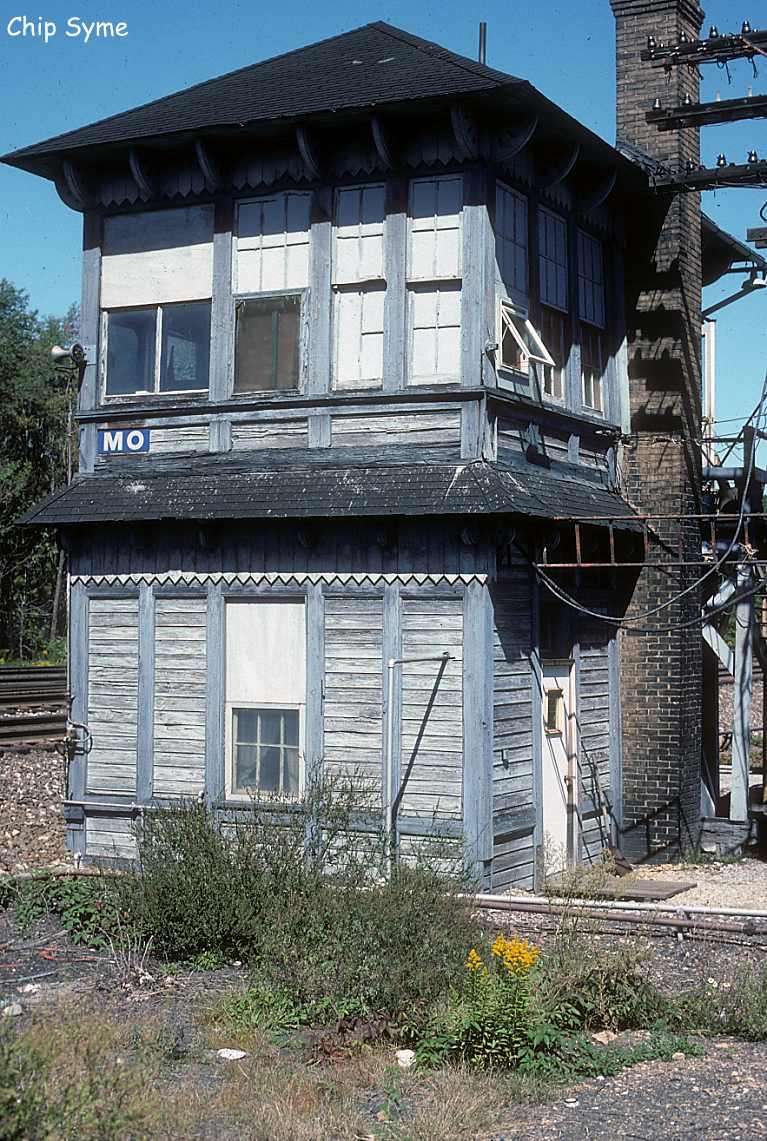
Immediately after the tower's closure there were two competing plans about how to preserve it. The first was to move the tower in its entirety in a similar process to the recent move of WB tower in Brunswick, MD. The second plan was to gut the tower of all internal components, strip off all of the architectural ornamentation and then reconstruct the tower from scratch. One of the advocates for the second plan expressed that his motivation to sacrifice the 1915 structure was due to it being fatally compromised by termites and requiring asbestos remediation. All up, full preservation and relocation of the 1915 structure would cost multiple times construction of a duplicate fitted out with the internal components and external ornamentation. It would also avoid the fate of MO tower about 10 miles down the Main Line in Cresson, PA that literally fell apart during a late 1990's effort to relocate the structure to a nearby railfan park due to compromise of the 100 year old wooden structure.


Nevertheless, higher-ups at the Altoona Railroadsers Museum decided on the full preservation plan and drew up a phone book sized document about the tower and the process (with more than a few of my photos included I might add). At this point the sizable cost of the preservation plan became a barrier to implementation along with whatever roadblocks NS would be inclined to throw up. In the following decade the tower has started to lose interior items to theft with the bank of glass timers being an early casualty. Although it is more secure than some of its peers, the wooden structure remains vulnerable to vandalism and fire. BTW I attempted to gain a PDF digital copy of the preservation document from the the individual I was speaking to, but he never followed up after I gave him my contact information. Hopefully he will become aware of my interest and reach out.


Let me be clear. I am not saying that ALTO tower is doomed to demolition or fire. It is immediately adjacent to a major roadway and could still be saved according to the 2012 plan. The point of this report is to provide the community with an update/explanation after the well known preservation plans seemed to go nowhere. I don't have independent verification of the claims expressed to me or independent analysis regarding the best course of action. The better option is absolutely relocation of the 1915 structure, but we should all be clear eyed about that not being possible. It's also unfortunate that the ideal option of preserving ALTO in situ appears to have never been on the table due to NS and liability paranoia.