Search This Blog

Friday, September 8, 2023

PHOTOS: CORK Interlocking

Over the first century of its existence the vaunted Pennsylvania Railroad Main Line between Philadelphia and Harrisburg suffered from a significant design flaw around the city of Lancaster. Despite all of the grade separation and curve elimination, trains still had to navigate through Lancaster's downtown grid because when the Philadelphia and Columbia railroad was being built in 1834, the Lancaster establishment lobbied for the route to pass through downtown to better support the local economy. As the decades passed this little detour became unwieldy. A cutoff was constructed north of the city in 1888, but the vast majority of passenger trains still had to take the old route through town because that was there the station was. Finally in the 1920's the PRR had the money and opportunity to construct a state of the art station on the bypass route along with a modern interlocking plant to control the terminal area and PRR Columbia Branch junction. This would be come known as CORK interlocking, after an adjacent Crown Cork and Seal plant and is the next in my deep dives into PRR Main Line interlocking towers.

Opening at the same time as the station in 1929, CORK was a rare, for North America, direct wire area interlocking with an end-to-end length of 3.3 miles. For comparison the sprawling ZOO interlocking in Philadelphia is only about 1.7 miles between its extreme points. Controlled from a relatively modest 67 lever US&S Model 14 interlocking machine, the CORK plant consisted of 4 distinct sections. From east to west there was the "Conestoga" section where 4 tracks converged into 2 and the old line downtown diverged, the east end of the station, the west end of the and Columbia Branch junction, the diamond crossing of the Reading Lancaster Branch over the PRR Columbia Branch and finally the crossing of the same over the PRR Main Line proper. Additionally, CORK had a plethora of interlocked hand throw switches serving local industry scattered along its length.

CORK went through four distinct phases in its layout. The initial 1929 configuration, pictured above, had 4 main track to the east, 4 main tracks in the station area and the full compliment of station support tracks. On or after 1948, track #3 to the east was removed and this marks the second configuration.

Sometime around 1960, as seen above, the PRR implemented a significant rationalization with track #2 to the east also being removed and significant cuts being made to the station terminal support tracks. The final Amtrak era configuration, seen below, saw the end of through/electrified freight operations along with the Reading Lancaster branch and resulted in the removal of Columbia Branch portion of the interlocking plant.


Starting at the extreme eastern end of the territory we find the Conestoga section, likely named for an earlier tower covering the New Holland Branch and the squeeze from quad to double track to pass over the Conestoga Creek viaduct that the PRR never bothered to widen. The Main Line was 4-track to this point until 1948 when either track 2 or 3 was removed as most through freight could be accommodated on the A&S Low Grade Line branching off at Parkesburg. In 1929 Main Line at this point was ABS Rule 251 so all reverse direction movements would be provided with dwarf signals. The old 4-track beam gantry carries the remaining 2R signal with the 4R dwarf on the ground. It is currently not clear if the post 1948 third track was bi-directional or a second ABS track in the direction best able to support slow freight trains on the Main Line's infamous grades.


The ~1960 reconfigured Conestoga section saw the addition of a trailing point crossover set adjacent to the lever 16 locked New Holland Branch connection. Possibly intended to allow eastbound trains to use the eastbound platform or something with local movements, the #1 crossover was not very useful in the Amtrak era with typically rusty rails and the overhead catenary removed. The "hacked" nature of the #1 crossover is evident from the dual level westbound dwarf signal that is cleared by the 4R with #1 normal and 2R with #1 reverse. When CORK was rebuilt, the New Holland Branch switch was upgraded to power operation, which would have required additional modifications to the CORK Model 14's logic in the 2007 time frame.

The west end of the Conestoga section is located west of the viaduct at the point where the old alignment would veer south towards the downtown. In the 1929 configuration this would be the east end of a second stretch of 4-track main line running from the Conestoga section through the Lancaster Station proper with tracks 1 and 4 having interlocked hand throw industrial leads. The intent appears to minimize the conflicts between freight and passenger trains east of the station. After 1960 the need for 4 main tracks in this area was eliminated so both tracks 1 and 4 west of Conestoga were relabeled as Ewd and Wwd Station Tracks with the eastern 5700 feet of the old track #4/Wwd Station converted into an industrial lead and the #5 switch removed.


Although labeled a "station track", the eastern part of the old #1 track to the 20L still had up to 8 hand throw industrial spurs locked by the 30 lever so trains stopping at Lancaster would likely return immediately to track #1 via the #11 crossover. Later, the #7 switch would be reduced to slow speed operation as evidenced by the lack of medium speed route on the 20L on the far right of the signal bridge shown below. Entrance into the Conestoga section was governed by the 6L high signal on the post-1948 track #1 and the 2L dwarf on post-1948 track #2.


A mile to the west we encounter the station terminal area. As a clean sheet modern design, the Lancaster station was equipped with high level platforms that avoided issues with freight clearance via the provision of two non-platformed through tracks like Trenton and North Philadelphia. In the 1929 configuration each island platform supported 2 tracks, a main track and an additional station track numbered A and B. On the southern side of the station and additional through freight track numbered 0 could carry eastbound Columbia Branch freights and a further Express Track served Lancaster Station's dedicated high level mail and express platform. A further mail/express/engine stub track was built into the west end of the westbound platform.


After the 1950's both tracks A and B were removed along with the westbound stub track. From then on the east station section of CORK featured the #15 switch from track #2 onto the westward station track and a facing point ladder from track #2, through track #1 to access the eastward station track and #0 express track. Westbound movements were governed by the 10R high signal and the 12R and 14R dwarfs.


Starting in 2005, the east end of the station would be reconfigured for the final time with a full crossover in conjunction with the removal of both station tracks. Here in this 2005 photo from the east end of the westbound platform you can still get the jist of the PRR layout.


Eastbound trains on the old station track would be governed by the 14L high signal that also allowed for straight routes to the extension. With the end of through freight, the center track #1 and #2 saw little use in the late Amtrak era and when the Harrisburg Line was reconstructed in the 2000's the station tracks were removed and the main tracks ultimately relocated to serve the high level platforms. 

Thursday, August 31, 2023

NJT (CNJ) ESSAY Tower Demolished

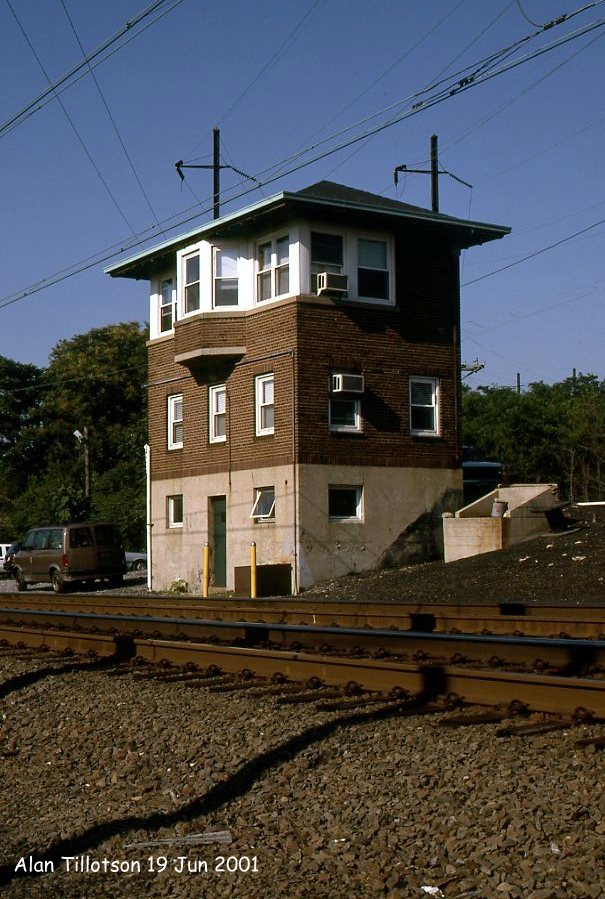
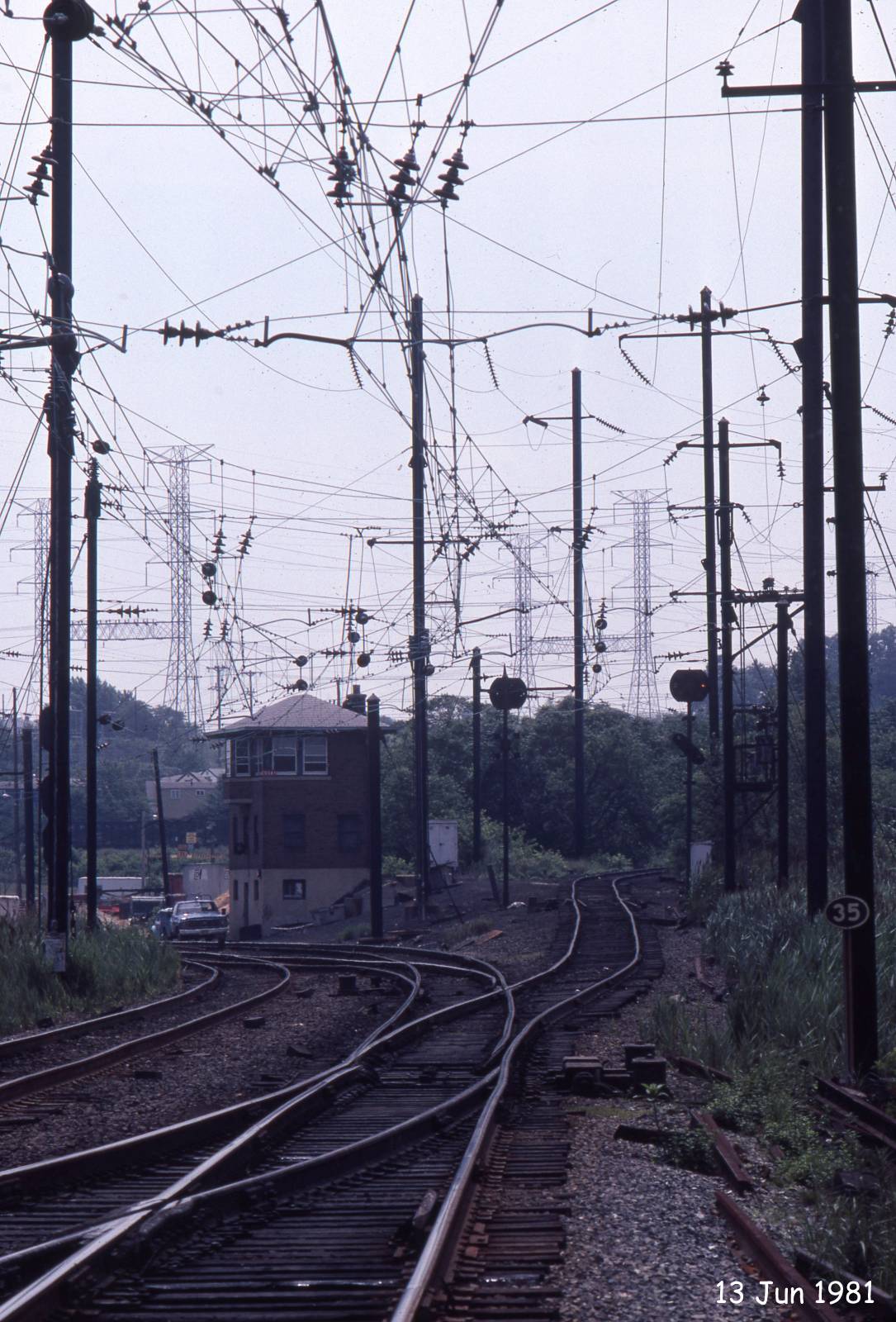
 I have the sad duty to report the demolition of ESSAY (aka SA) tower in South Amboy, NJ. Nominally a CNJ tower on the jointly PRR/CNJ operated New York and Long Branch commuter line, it entered in service on Jan, 7, 1942. Since its closure around 1990 the tower had a second life as a maintenance base and had been kept in good shape. Unfortunately it ran afoul of the Raritan Bay Drawbridge replacement project and was demolished on August 29, 2023.

A few years ago I had caught a report that ESSAY was on track to be demolished, but looking at the EIS plans, it did not appear that the new bridge alignment would impact the tower. Unfortunately it appears that the initial reports were correct and we have lost yet another good condition, late model, brick interlocking tower.

This was unfortunately a more recent example of me not acting on intel of an impending demolition with literally years of advance notice. Unfortunately the location was both off my usual path and was not immediately accessible for photos, especially with all of the bridge construction activity. 

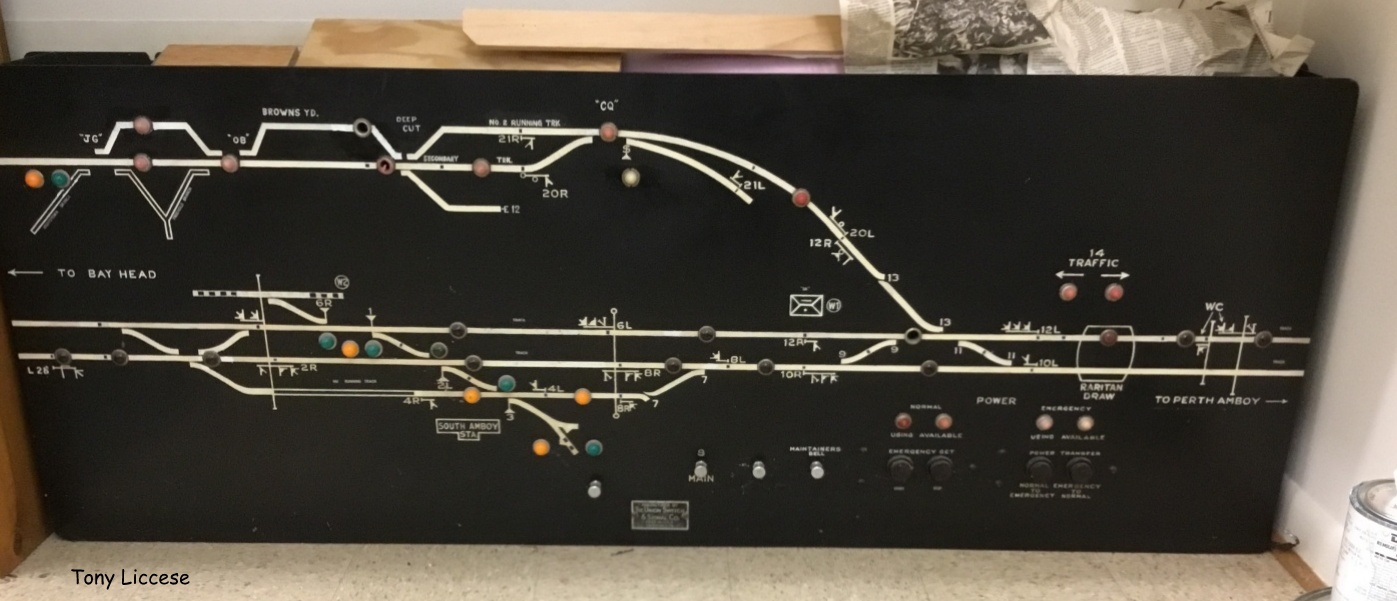
ESSAY controlled a modern interlocking plant with a Model 14 interlocking machine and pneumatic signals. It was located at the south end of the drawbridge and the junction with the electrified PRR Jamesburg Branch. It was also notable for overseeing the largely hand operated power change between electric and non-electric at the South Amboy station where the last operational GG-1s wound up their careers in 1983.

The good news is that NJT is generally supportive of its towers as I, in hindsight regrettably, took the time to visit those at SUMMIT and DENVILLE on the DL&W side back in June.

Sunday, August 20, 2023

You Want to Live in the Box?

As housing costs in some of North America's most desirable areas continue to skyrocket, enterprising vagrants have discovered a somewhat innovative solution in the form of taking over disused railroad relay bungalows. The problem of the homeless setting up camp in rail related buildings such as stations and interlocking towers has existed for some time with the resulting fires used for heat and cooking inevitably leading to destructive fires such as those at SO and SHORE. However over the last year I have encountered multiple instances of persons living in disused metal interlocking bungalows which, as primitive as they are, can keep out the wind and rain. 

The fist was on a disused rail line in Colorado where between spring 2021 and winter 2022, someone moved in, ripped out all the relays and set up a cot on the old CTC relay cabinets. The second was in New Hampshire where the residents were at least thoughtful enough to lay in a supply of Narcan for their overdosing needs.

Now, these locations had been out of service for years, but it shows the lengths that the unhoused will go to. For the signal enthusiast there is always the slight risk of running into a disagreeable resident while out on a documentation exercise, however the more pressing risk is that these actions create a persistent nuisance that will prompt railroads to remove out of service bungalows that may have otherwise been abandoned in place, potentially full of vintage relays and other goodies.

My only suggestions for the enthusiast to err on the side of salvaging historic materials before they are broken up and dumped outside.

Sunday, August 13, 2023

LIRR East Side Access Signaling Surprises

When the LIRR's new East Side Access opened to Grand Central Terminal earlier this summer and I was expecting the signaling to follow the pattern of the LIRR's other recent projects with the new reduced aspect signals like G/L that have become the new standard. However, now that cab view videos have become available the new signaling setup came with a few surprises.


Once trains enter the ESA tunnels at HAROLD interlocking they are exclusively presented with transit style 3-lamp signals displaying single light Green, Yellow and Red aspects. Although these two videos can't necessarily reveal all possible operating conditions, the lack of anything aside from Green, Yellow and Red over both straight and diverging routes implies that those are what one gets in the ESA tunnels even with track speeds up to 45mph. It also appears that intermediate signals are provided in the few parts of the route that have significant distance between interlockings.

I suspect that the decision was made to lean on both the track speeds and speed code based cab signals to simplify the ESA wayside signaling based on the LIRR's existing practices before the implementation of the Reduced Aspect Signals. Remember, ESA has been under construction for almost 20 years and the design work was likely completed a decade before the Main Line capacity expansion projects motivated the new signals. A review of the videos shows a combination of diverging routes at the prevailing line speed (15, 30 or 45mph) or sufficient distance between the signal and the turnout for a cab signal code drop to take effect. On the outbound video there appears to be an unprotected slow speed crossover so I am not sure if that would rate Green signals over cab drops or a Yellow approaching a flashing red or what. I made some inquiries and I will post an update if those pan out.

All in all, the signaling is more interesting than an endless string of Green over Lunar and the use of US&S transit style signals is nice, but its unfortunate we didn't get a full set of LIRR "tunnel" signals similar to the Atlantic Ave branch.

Sunday, August 6, 2023

The Final Months at AC Tower

Looks like the Railroad Media Archive has done it again with a video covering the last few months of operation at the former Erie AC tower in Marion, Ohio from November 1994 to just before its closing on January 18, 1995. AC tower was located at the crossing of the compass east-west Erie and Big Four (NYC) with the compass north-south N&W and C&O.The Erie and Big Four alignments would be merged into Conrail and eventually became the Indianapolis Line on a largely Big Four routing with the Erie RR main being largely abandoned. By the mid-90's it was finally time to retire the old Taylor Model 2 machine.

In the video the things of note are the various communications duties of a tower operator and the lever manipulation sequences, specifically the use of crossing lock levers to set the direction of travel through a diamond. 

AC Tower model board and manipulation charts as preserved.

Although the tower was closed in 1995, it was moved to the nearby station grounds and preserved as a semi-restored museum. Hopefully they will get the expertise to restore it in a similar fashion to HARRIS. Because of the "lateness" of the conversion, the N&W and C&O signals were retained on the two non-Conrail routes until about 2012.

Sunday, July 30, 2023

SEPTA Completes ARSENAL Re-Signaling

SEPTA is finally wrapping up its ARSENAL interlocking re-signaling and track reconfiguration project that has been underway since 2019(!).


The primary goal of the project was the allow select trains to turn back at the University City station, instead of 30th St, which required the addition of crossovers and a tail track between the old limits of ARSENAL and WALNUT interlockings. However SEPTA used the funding opportunity to renew the 12kv overhead lines and 1980's vintage ARSENAL interlocking, which unfortunately saw the demise of amber type PRR position lights, some of which were 2000's era LED upgrades.

An extension of ARSENAL southward to include a new trailing point crossover on the West Chester Line resulted in the old northbound signal bridge now serving only the NEC bound tracks. Note that the signal from the NEC can display full indications instead of SEPTA's go-no-go 562 indications.

In the other direction two new automatic exit signals have been furnished as distants to PHIL interlocking. With Approach Medium/Limited being the most favorable indication this could be seen as a downgrade for Airport Line routings that should take place over a Clear signal, however the ACSES speed enforcement doesn't make 45mph possible, let alone the actual line speed, so no big loss..

ARSENAL's southbound limits have been relocated about 900 feet to the south. This will substantially reduce transit time through the interlocking so that an NEC train can follow more closely behind a West Chester Line train .

The big surprise was the complete removal of the WALNUT crossovers in the trench leading up the tunnel approaching 30th St Station. Possibly due to maintenance issues involving water drainage or foul time associated with close clearances, the lack of WALNUT's crossover will risk snarling service if there is ever a need to single track/wrong rail through 30th St Station. Southbound wrong-railing trains at 30th St will have to travel 1.5 miles to ARSENAL whole northbound trains can benefit from the new turnback crossover for a 1.1 mile penalty. I'm not a daily rider, but hopefully I'll have a chance to pick up on how the new configuration help or hurts the user experience (as opposed to the bottom line).


Saturday, July 22, 2023

A Second B&O CPL For Baltimore Penn

A year ago I reported on Amtrak replacing the NECIP era cantilever mast covering tracks 7 and 8 at CHARLES interlocking with a pedestal and ground mounted B&O style CPL dwarf. Well at some point over the winter of 2023, CHARLES' ad-hoc cantilever governing track #3 was also replaced by a CPL dwarf. Baltimore Penn Station has always been a land of close clearances, so is this part of a trend that will result in even more new B&O CPL dwarfs? Probably not, but its fun to take a look at the new one on track #3 since there's a bit more history than meets the eye.

Pulling up the 1992 track chart we can see that after the NEC Improvement Project (NECIP) and before the late 1990's expansion of MARC service that restored Track #5 as a stub terminal, tracks 3 and 4 converged past southbound PRR pedestal signals over the 34 switch before passing a second PRR pedestal, 3SA, guarding the convergence with track #1 and ultimate connection into through track #6.

With the MARC expansion, track #4 was extended to its own switch with through track #6 with the 34 switch and 3SA signal being removed.

Photo courtesy B&O Photo Tours

The improvements also left track #3 as the only remaining low level track at Baltimore Penn Station as track #1 was being used as a freight bypass stood off from the platform and protected by a low fence. At this time it was also decided to replace the 3S pedestal with a cantilever mast to raise the pedestal up off the trackbed for some reason. The low level platform would eventually fall into ever more disrepair before being completely taken out of passenger service in the 2010's Track #3 would be used for storage of MARC trains, but the 3S signal was still positioned in relation to the long removed 34 switch resulting in the waste of several carlengths of storage space and extended train movement transit times through the interlocking.

Above we can see the placement of the new temporary(?) 3S CPL dwarf in relation to the 1S pedestal and the insulated joints for the 64 switch. (The 4S pedestal is located under the bridge to the upper left.)


The CPL dwarf has a R-Y-G face and orbitals in the 12 and 6 o'clock position. This is slightly confusing as the 3S lacks any straight routes for Clear or Approach that would utilize the 12 o'clock orbital, but it might be used for a Stop and Proceed marker light in a way that made the wiring easier.

The 3S now joins the 7S as the second B&O CPL in the Baltimore Penn Station terminal area. A fitting turn of events as Baltimore has very few of its namesake CPL signals in service on home rails.