Search This Blog

Saturday, February 23, 2013

PHOTOS: A Brief Ride Through DOLTON JUNCTION

For those of you who don't know, Dolton Junction is North America's largest operating mechanical lever frame interlocking tower located about 15 miles south of downtown Chicago. Over a couple of years while traveling on Amtrak Train 50, "The Cardinal" I have had opportunity to photograph the tower and parts of the interlocking and I seeing the ongoing series on Chicago area towers I feel its a good idea to share them here.

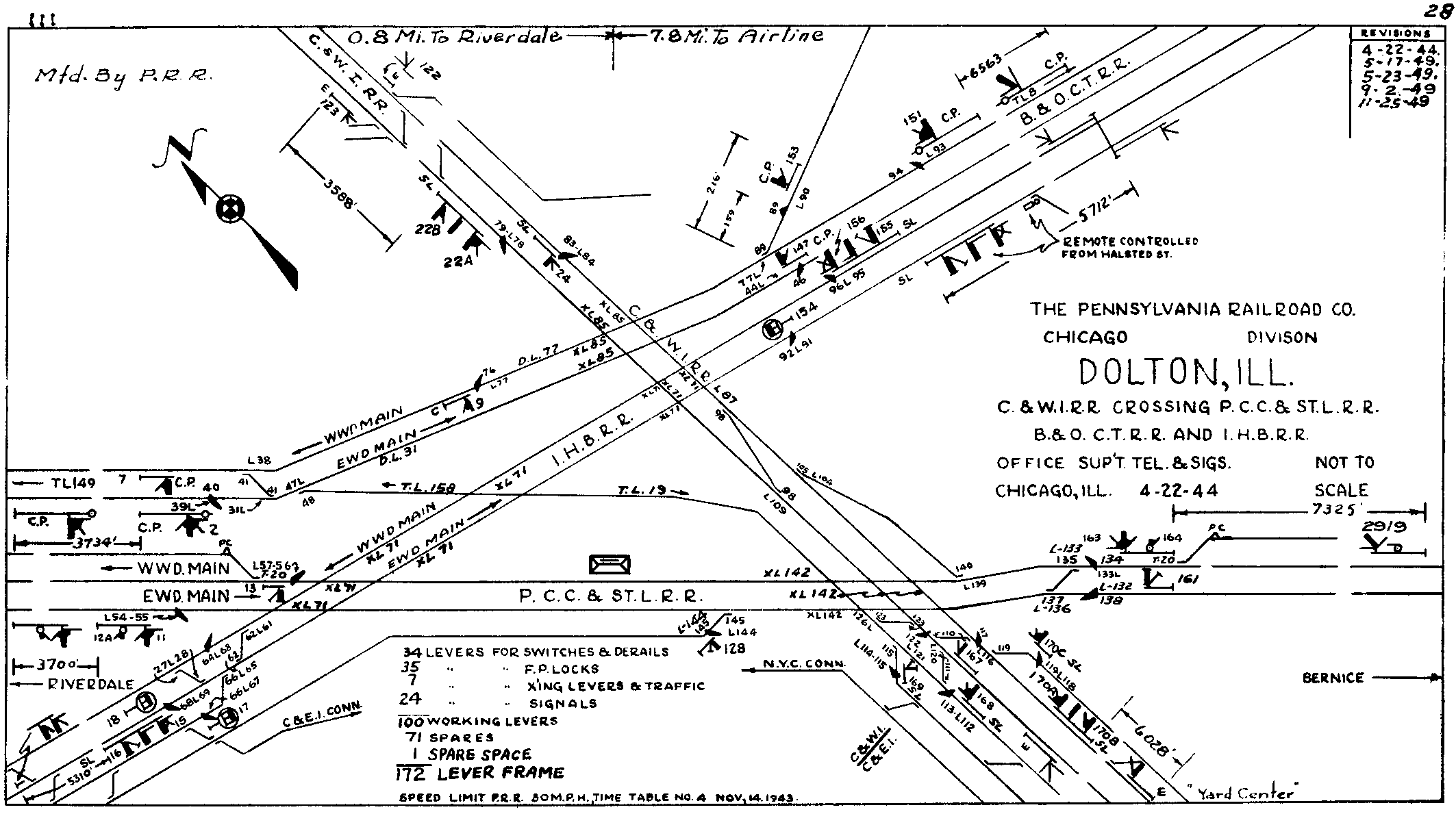
The massive complex that is Dolton Junction was created by the intersection of 4 railroad main lines. The Chicago and Western Indiana railroad ran north to Dearborn St Station as a terminal line that concentrated traffic from a number of other railroads, most notably the Chicago and Eastern Illinois, which eventually wound up owned by Union Pacific. Splitting the C&WI were the parallel east-west main lines of the Indiana Harbor Belt and the Baltimore and Ohio, Chicago Terminal railroads. Finally, playing the spoiler and crossing all the of the other main lines at an angle was the Pennsylvania Railroad's "Panhandle Route" main line from Columbus Ohio. Because the PRR was involved you can find an interlocking diagram here.


The tower at Dolton Junction was built in 1897 and contained a 178 lever frame with 100 active levers. As built the interlocking contained a total of 20 diamonds which included an extra 4 from various connection tracks between the main lines. At the time most of the routes through the plant were fitted with split point derails to prevent any catastrophic Stop signal violations.

Today the interlocking plant has seen some expensive reconfigurations carried out on the old mechanical frame. With the removal of the PRR route the number of diamonds has been reduced to 11 and a few new crossovers and connector tracks have been installed. Still the interlocking is operated as an island of manual control with CTC on all sides. Most of my photos were taken from the rear of a south/eastbound train as it passed through the interlocking in 2009.

Entering Dolton Junction from the North we pass the southbound home signal which is back to back with the signals for an independent interlocking that connects the C&WI line with the B&OCT line. The Doton signals stand out as they are older searchlights and not Darth Vaders.


Next we cross the B&OCT diamonds.


Then the IHB diamonds.


And now the tower itself. I believe you can just make out some of the levers inside the open window.


Another angle....


Monday, February 18, 2013

CORK Tower Closes: 1929-2013

At 10am on Tuesday February 19th, 2013 Amtrak's CORK Tower in Lancaster, PA will was planned to close for good and when it does finally close that will also drop the curtain on the last fully paper dispatched railroad main line in North America (although the LIRR probably still has some branch lines that can qualify as paper dispatched).   CORK tower was opened in 1929 as the PRR re-routed its Main Line around downtown Lancaster (resulting in the infamous 1000 foot mile) and along with a shiny new station building the entire area was signaled by a new brick interlocking and an 67 lever US&S Model 14 interlocking machine.  From end to end the whole interlocking was 3.2 miles long and controlled a junction of the Main Line with the Columbia Branch to COLA, the Reading Lititz Branch crossing both the Main Line and Columbia Branches, the Lancaster terminal area, the junction of the PRR New Holland Branch and, until 1948, the 4 track to 2 track squeeze on the main line at the Conestoga River Bridge.


CORK did not go quietly and was probably one of the most protracted interlocking resignalings of all time.  The process started way back in 2005 (!) when the interlocking was dramatically reconfigured from its PRR vintage layout with the old station tracks being removed and the disused main tracks (previously used by freight trains that did not like high level platforms) being physically moved over to serve the platforms.  The pneumatic point machines were replaced with electrics, new crossovers were added (but not activated) and many of the old freight sidings were reconfigured and a new freight bypass track installed.  In 2008, with Rule 562 operation on its way east from Harrisburg, the old junction with the Lititz Branch was spun off as its own LITITZ interlocking, and about a year later the old Model 14 machine was finally retired with the remainder of CORK's territory being split into a new CORK interlocking west of the Station, CONESTOGA interlocking east of it and HOLLAND interlocking at the New Holland branch junction.


CORK was not about to have a little thing like re-signaling stop it as it simply exchanged its Model 14 for a bunch of panel machines controlling not only LITITZ, CORK, CONESTOGA and HOLLAND, but also the new interlocking at LEAMAN (formerly a TBS) and PARK (replacing the old PARK tower).  CORK soldiered on with a 24/7 operator looking at the little portrait on the model board for three more years until Amtrak finally managed to move its NEC Mid-Atlantic dispatching facility from 30th St Station to Wilmington, DE in the fall of 2012.  While the Section B and C dispatchers made the move with their large paper block registers, their new digs were fully equipped for computers and other modern amenities unlike the "back room" on the 8th floor of 30th St. With CORK's territory already under remote control it was simply a matter of adjusting the Wide Area Network to send the work out of State.


While it was inevitable that the Harrisburg Line would wind up as traditional CTC, the sad part is that both is and the southern NEC are no longer dispatched from a purpose built railroad structure.  While Amtrak's new operations center in Wilmington is next to the NEC, it is not in a station or other PRR related building.  The real irony is that the state of Pennsylvania has spent hundreds of millions of dollars to allow Amtrak to offshore about 10 or so jobs to Delaware while former dispatching offices in the Harrisburg Station not sit empty.  Oh well, perhaps one day CORK and the other preserved towers will see new life as museums, or maybe not.

 UPDATE: Due to unspecified issues the cutover was not successful and CORK remains in operation as of 2/22/13.

Saturday, February 9, 2013

PHOTOS: CPL Recycling at Landenburg Junction

Once upon a time in North America railroads were either seriously strapped for cash or railroad signaling hardware was abnormally expensive, but unlike today where re-signaling means installing 100% new signaling equipment and throwing out the old as recently as the 1990's it was common practice to reuse as much of the exigent hardware as possible. In today's post I will examine Landenburg Jct interlocking on CSX's Philadelphia Sub.

Today Landenburg Jct is hardly remarkable consisting of the end of a signaled siding on the mostly single track Philadelphia Subdivision. The Junction in Landenburg Jct refers to a connection with the Wilmington and Western Railroad, now a steam heritage line. I am not sure if this was ever a fully interlocked junction, but today the connection is not interlocked and the signaled siding interfaces with a small local freight yard. The CSX Philly sub used to be the Baltimore and Ohio railroads main line between Baltimore and Philadelphia and like many North American main lines it was operated as a two track line running single direction ABS. Because railroad interlockings used to be very expensive unless one was either the PRR or NYC they would tend to be used sparingly with simple crossovers and minor junctions being worked by hand with safety provided by timers and electric locks.

At some point, probably in the 1970's, the line was converted to a single bi-directional track with controlled sidings and CTC operation. However to save on costs much of the original ABS signaling hardware was retained. In the case of Landenburg Jct that means much of the original B&O Color Position Light equipment. At block signals the common practice was to simply move one signal over into the now empty trackbed to act as the reverse direction signal for the remaining track. I suspect that much of the track circuit logic from the old ABS line would have also been retained with some CTC modifications. An example of this type of block signal can be found a little to the south at Havre De Grace, MD.


The interlockings were a slightly different story as while a hand operated set of points could make due with protection by single direction ABS signals, and interlocking required signal protection on all routes. Extra signals could be installed, but back before the 1980's it was still common practice to install signals only to the right of the track they applied to due to the use of long hood diesel locomotives. Short of installing a new signal gantry, bracket or cantilever mast a dwarf could be installed governing the exit from the siding, but this could pose visibility problems and was susceptible to damage located between the running tracks.

However the B&O/Chessie System implemented a more innovative strategies to solve this problem that took the form of the bracket dwarf. This consisted of the original ABS signal for the removed/siding track altered to govern the new single main track with a dwarf signal attached to govern trains exiting from the siding. Here is what the bracket dwarf looks like at Landenburg Jct.


To allow trains on the main track to sight the signal that governs it over another train on the siding the mast must be extended to raise the CPL target up about 5-7 feet. Furthermore, because the dwarf is not visible a doll arm must be installed to indicate that a track intervenes between the signal mast and the track it applies to.


Monday, January 28, 2013

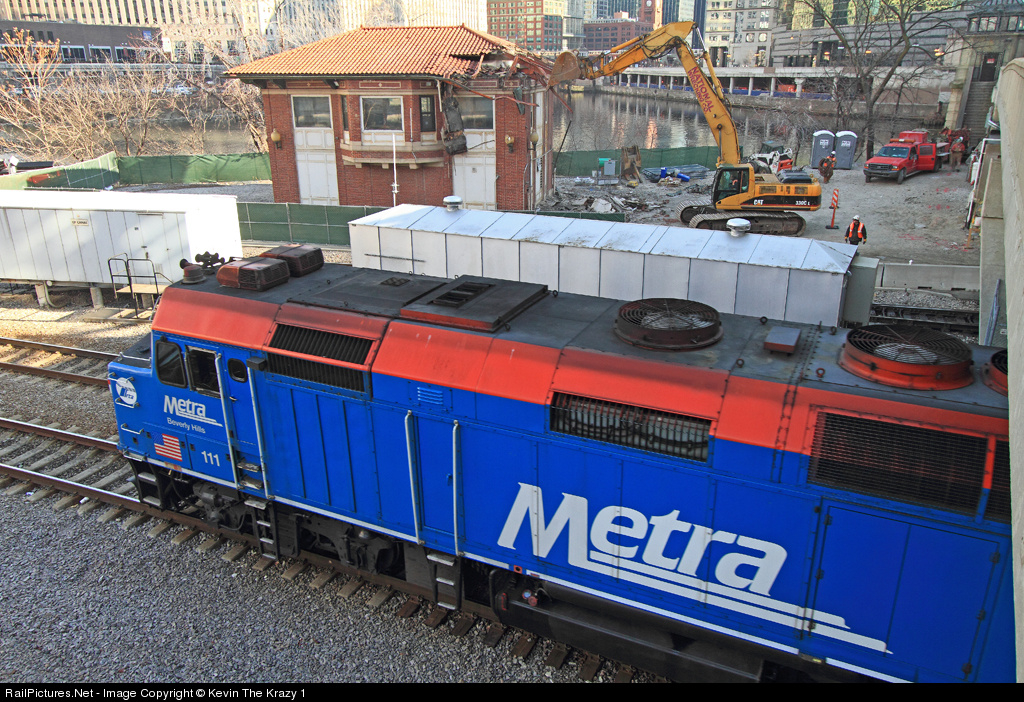
You Gotta Be Kidding me - Chicago Lake St Tower Demolished

Saw this heartwrenching photo last week of a backhoe ripping down the 80+ year old Lake Street tower at the north end of the Chicago Union Station complex. Lake St was in service until 2005 with both a big US&S Model 14 interlocking machine for the local interlocking and a large panel for the entire southern end of the Union Station complex.  While disused since then Lake Street was in amazing shape and in a very secure area.


Well so much for all that.  Perhaps it was attracting too many railfan photographers or perhaps Chicago is following through with some old pipe dream plans to cover the tracks in this area with either a park or parking lot.  Whatever the reason the City of Chicago has lost an important historic artifact that could have been preserved as a museum at the tri-point of the Chicago river.

Hopefully the interlocking machine and model boards were preserved before the tower was ripped down.  Fortunately the tower at the other end of the Union Station complex, Jackson Street, is immune from demolition as the new Post Office building was literally built around it in the 1990's.  Unfortunately its view of the city is now severely limited.

Monday, January 21, 2013

B&O CPLs: Gotta Catch 'Em All

This past year saw the destruction of my beloved Huntington Ave interlocking by CSX C&S forces as they needlessly re-signaled a 261/CTC line without pole lines just to spite the memory of the B&O in its home city.  However I was provided with over 6 months of lead time to get out and get all the photos and videos and since I needed to make a proper tribute to the signals that have given me so many years of enjoyment. I felt it fitting to show off the eastbound CPL dwarf's full range of emotion.

Rule 291: Stop


Rule 290: Restricted Proceed


Rule 286: Medium Approach


Rule 285: Approach


Rule 283-A: Medium Approach Medium


Rule 282: Approach Medium


Rule 281: Clear


The most difficult indication to capture was naturally Medium Approach Medium which I only managed to snag with a cell phone camera a week before the signal was retired.  Farewell old chum, your approach lit light show never failed to brighten my day.

Monday, January 14, 2013

PHOTOS: METRA TOWER A-5 (Pacific Junction)

While I have now covered most of the major METRA operated interlocking towers in the Chicago Area in my ongoing web series there are still a few left in the bag and one of these is the partner in crime to the recently covered METRA Tower A-2 at Western Ave. Pacific Junction is a 4-legged junction on the old Milwaukee Road passenger network as it approached Chicago's Union Station. Logically it is composed of the Milwaukee Road main line to Milwaukee running North-South and the main line across Illinois splitting off to the west with a small freight spur heading west to the Chicago River industrial district. In practice the junction looks like a 90 degree crossing with connector tracks cutting each of the corners. Today the Chicago commuter railroad provider METRA owns both the interlocking plant itself and the tracks south to Chicago Union Station. All other lines feeding the interlocking are owned by Canadian Pacific which was previously handled through its SOO Line subsidiary. Today the line to Milwaukee comprises the CP C&M Subdivision while the line to the west is the Elgin Sub and together they host the METRA Milwaukee North and Milwaukee West commuter services.

On the ground Tower A-5 has a very interesting layout with a three track main line running north to west via a sweeping 90 degree curve and another two track main line splitting from the 3 track line to run north. The eastern two-track freight spur used to split from the western route of the 3-track line, crossing the north-south line via a diamond crossing, but the diamond has since been removed leaving access to the freight spur and wye track via the curved connections to the north-south line. Here in a photo from the Railroad Signal Collections site we see the A-5 interlocking plant from the west with the tower visible far in the background. While technically two of the three Elgin line tracks diverge into the C&M line, the weak route signaling used on the line offers each of the two rightmost tracks (tracks 2 and 3) a "Straight" route through the plant. In the photo the track #2 signal is displaying a lunar white Restricting indication due to another train running ahead in the same block. Previously the former Milwaukee Road lines utilized "bottom yellow" Restricting, which is derived from the older practice of having a subsidiary signal for "call-on" indications. This is why the track #3 signal has the gap between the lower and upper heads to differentiate R/Y Diverging Approach and R/*/Y Restricting. Use of Lunar White in place of bottom yellow removes this potential conflict. A 4th siding track also used to join the junction from the right, but this has been removed although its signal on the gantry has only been partly so.


Here we see the rear of the northbound home signal gantry for Tower A-5. A three headed signal is provided for each track as all three are provided with diverging routes. The right of way clearly had provision for 4 tracks, but as the model board no longer shows any indication of a 4th track I cannot comment on the original layout of the tower as I do not have an original diagram. Both home signal on the three-track route are provided with absolute exit signals controlled from tower A-5. The use of exit signals is an easy way to implement bi-directional operation with simple relay based interlockings as it simplifies a lot of the logic by not having to check traffic flow status when setting up a route through the plant.  Also note the 72L signal for track #2 which lacks a middle "diverging" head despite protecting the 63 switch which can send trains either north or west.  This indicates either that both routes are signaled for the same speed and thus do not need to be differentiated or that a diverging move would need to be made under a Restricting indication.


Saturday, December 22, 2012

End of the Main Line

It appears that NS wasn't finished when it applied to the FRA to remove the wayside block signals on the Port Road between PERRY and STELL as in a slightly more recent filing they are looking to remove all the wayside automatic signals from the PRR Main Line proper as well all the way from CP-HARRIS to CP-BLOOM/EAST PITT.  While the Port Road had been largely ruined with re-signaling work with only a handful of position light automatics remaining I was cautiously looking forward to the 'C' boards to spruce up the monotonous Darth Vader signals, but 562 on the Main Line proper would be a devastating turn of events, dumping the last of the major east-west main lines into the bucket of crap signals (not counting the Erie).

Like with the Port Road we are presented with the same questions with a few different twists.  First, as with the Port Road why is NS going ahead with this after a decade of wayside signal replacement and the precedent of no freight railroad installing new 562 trackage since Conrail's work on the Cleveland Line in 1999?.  Second, is this going to simply comprise a bagging of the intermediates and installation of 'C' boards at the existing interlockings without any other work or will this be the end result of a complete end to end re-signaling effort that will put the position lights out of service at even the 1980's and 1990's re-signaled interlockings? 

I suspect the answer, at least to the second question, would be along the lines of a complete re-signaling rather than a quickie effort to save on light bulbs.  Despite all the new intermediate signals that NS and Conrail have put up to replace the failing PRR signal bridges starting about 1990, a closer looks reveals that almost all of them have been plugged into the existing hardware.  East of Altoona this would date from the mid-1980's re-signaling, but between Altoona and SO and CONPIT JCT and Pittsburgh the signaling there dates from around 1980 if not earlier.  So when you see shiny new signals, remember there is a lot of old school relays hiding under the surface.


The other problem is that even a lot of the "new" 1986 signaling east of Altoona doesn't use the what might be considered modern solid state equipment as is evidenced by this video taken at the famous Fostoria intermediate signal bridge which reveals the presence of electro-mechanical pulse code generators.  Even if the components were entirely "modern" that doesn't mean that would be any less likely to be replaced as the old relay systems so often derided as being unreliable, are actually able to last about twice as long in service as a solid state component.  It's the old tradeoff between maintenance and replacement.  Big old relays can be repaired and adjusted.  Integrated circuits and printed circuit boards with individual components can only be replaced.  Seeing old school position lights on shiny new aluminum signal bridges may have only given us a false sense of security as the rusty cantilevers and brackets with their supporting pole lines on the B&O and C&O mains were all ripped down.


The good news about a complete re-signaling is that it will give those who are interested in classic signaling several years to get out and catch things before they are changed.  If this is just someone's bright idea to save money then bagging the autos out of service could be accomplished within a few months.  Another reason to suspect re-signaling is the remaining section of Rule 251+261 mixed trackage between Altoona and CP-SO has been standing out like a sore thumb since NS installed three track 261 between SO and C.  This would parallel the section of 251 on the Port Road that also had to be dealt with at some point.  When you factor in any sort of PTC upgrades, even thought Amtrak is showing how well PTC systems can get along with both 1980's and 1930's signaling, it wouldn't surprise me if whatever consultants NS brought on for the project simply went with all new signaling and no waysides. Still, NS is not known, at least no recently, for end to end re-signaling projects.


Still, it is fairly clear that this decision, if one has even been made yet, has come about quite recently as there was absolutely no indication during the ALTO replacement that this sort of thing would be going on.  Furthermore, you never know exactly what the final product will look like.  NS can currently run non-CSS equipped trains off the Buffalo Line to the Harrisburg Line, so removing the 107 automatic would upset that arrangement.  Likewise would NS want to be vulnerable to CSS failure on a major mountain grade choke point where crews might rely in signals ahead on how they handle their trains. Remember the Fort Wayne and Cleveland lines are much flatter than the Pittsburgh Line.

While some recent 562 projects have come with surprised likefixed distant signals or, in the case of NJT, the retention of of single direction wayside signals on bi-directional 562 track, we can't assume that all the autos on the Pittsburgh Line wont be gone within the next 12 months.  While a qualified positive on the Port Road, this will doom the former PRR Main Line as a railfan friendly route to either ride or watch trackside.