Search This Blog

Sunday, January 26, 2020

2020 A-Line Trip Report

So I recently had the opportunity to ride Amtrak's Palmetto for almost its entire run to Savannah which would be my first trip since 2018 between DC and Selma and my first time ever south of Selma.  Unfortunately the placement of the baggage car on the rear of the train prevented me from taking a proper survey, but I was able to observe the few remaining bits of interesting signal kit that do survive and because that set is so limited, I can pretty much list them all here with both new and archive material.


Kicking things off the RF&P vintage US&S N-3 intermediate signals are still in place between Spotsylvania and Doswell.  They may have some Darth Vader head mods for 4-block signaling, however the old school 90's hardware is clinging to life.


Speaking of Doswell, the US&S large target bracket mast is still in service for southbound trains.


In case you were wondering, the RF&P FB, MD, HN and GN towers are also still standing.


The next classic signals, again, slightly modified, can be found at CHARLIE BAKER interlocking in Rocky Mount, NC.


On the South End Sub between Rockey Mount and Fayetteville, there are a number of 90's vintage transitional signals that use the large targets and painted mast structures with modular or Safetran hardware.  However in places the integrated hut-masts are being replaced with more traditional single purpose equipment so these might soon be disappearing.


At the Wilson diamond south of Wilson, NC, I spotted this ACL survivor facing the intersecting NS line.


At FLORANCE interlocking in Florance, SC there are some more 90's vintage, Seaboard style US&S large target signals.

File Photo
Finally in Drayton Hall, SC, the drawbridge over the Ashley River is protected by Stop and Check signals in the traditional manner, even if those signals were changed during the recent re-signaling process.

All in all, its not much, but its something.  If you are in the vicinity of any of these signal locations, make sure you pop by for some photos.

Sunday, January 19, 2020

God Bless the Guilford - Part 2

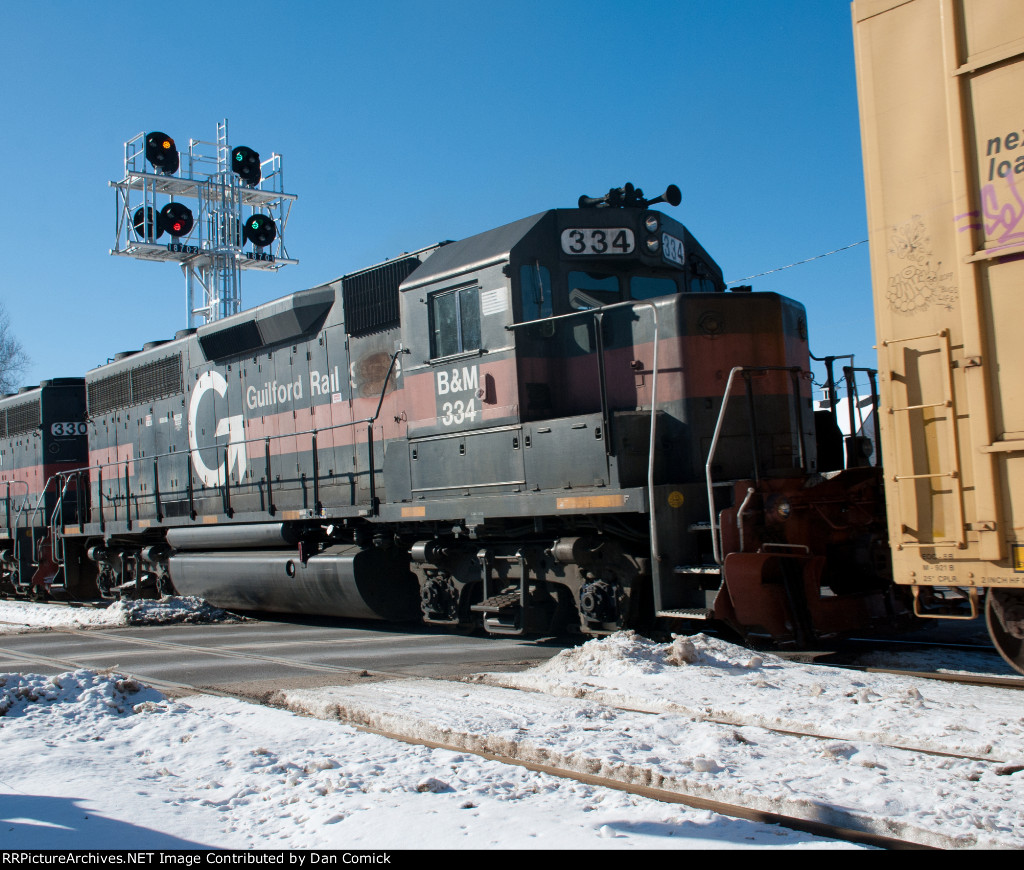
Back in Part 1 I used the example of the new Wachusett MBTA station to highlight how the Guilford Rail System was bucking the trend of sterile Darth Vader signals with not only a commitment to target style tri-lights, but also oddities like bracket masts and doll arms.  Well, a few additional examples from their Freight Main Line have tumbled my way.


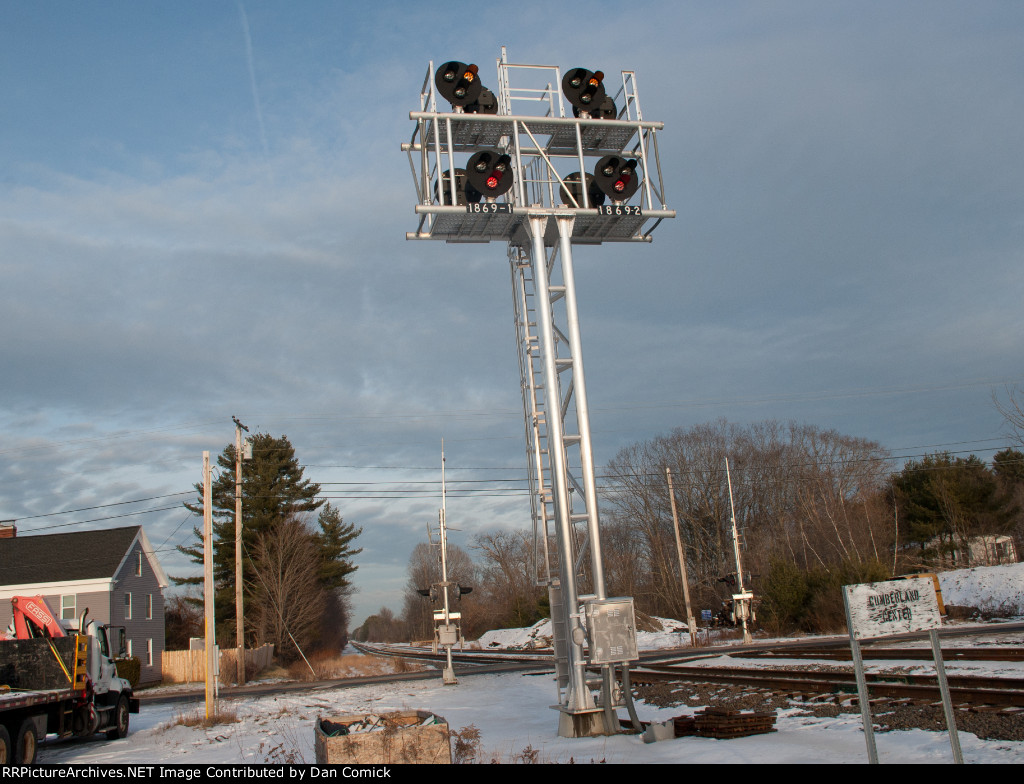
First we have this new bracket mast near Cumbermand Center, Maine and not only is it a bracket mast, but it also shows us that the Guilford is still employing the antiquated Double Green Clear signal aspect from the old Boston and Main days!


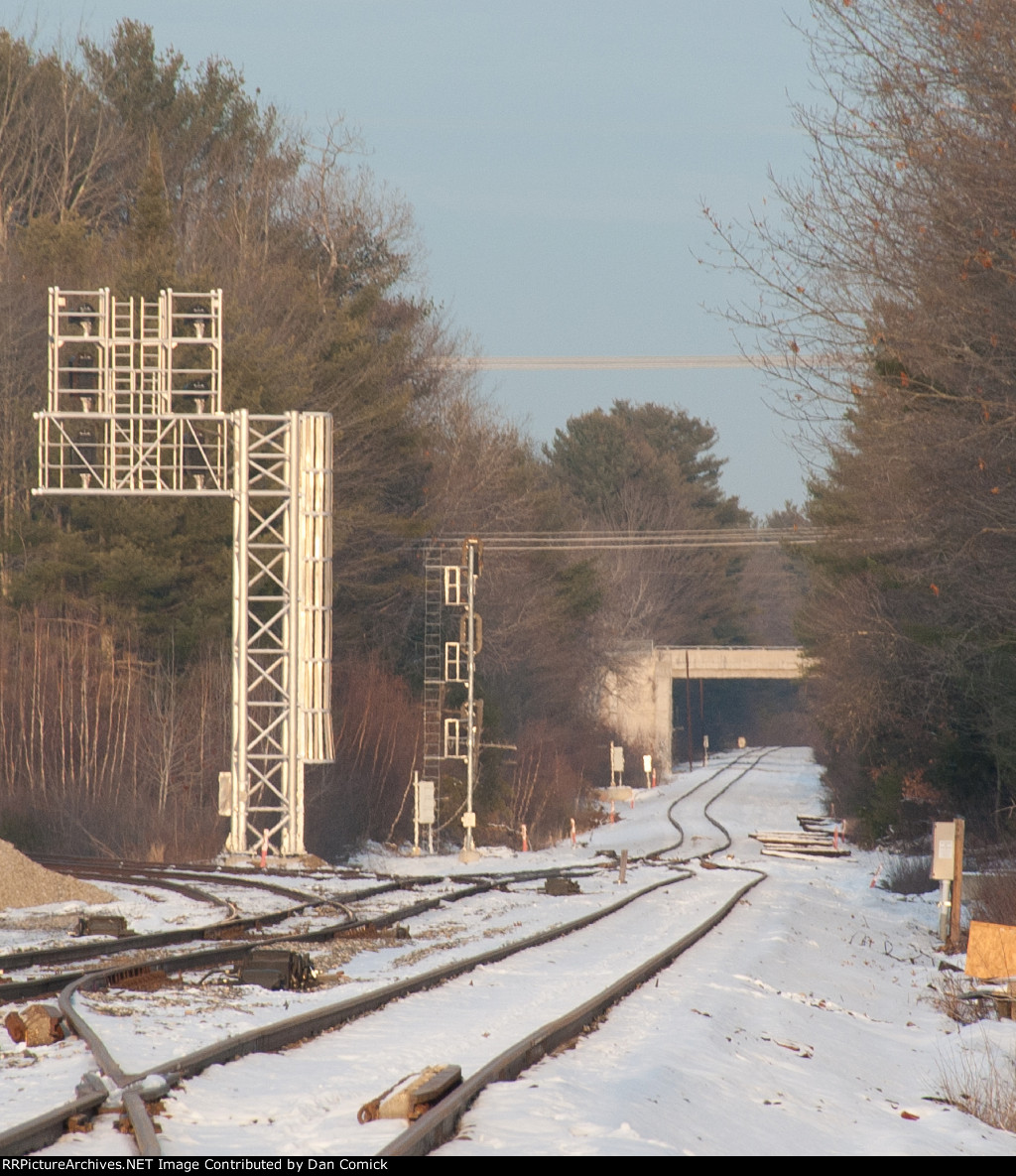
Although unfortunately not target signals, the nearby CPF-185 is also sporting a new cantilever/bracket hybrid for movements off the Brunswick Branch (now used by Downeaster trains).


Speaking of the Downeaster, check out this new doll arm equipped bracket mast protecting a crossover just east of the Lawrence Station on the MBTA Haverhill line.  Not exactly a Guilford  purchase, but don't think that they probably don't have at least a little input.


Well that's it for now.  Hopefully we will see more wacky stuff like this in the future, as opposed to NS style Darths and cantilevers.

Saturday, January 11, 2020

QUEENS Tower Closes

At 11:38pn on January 10th, 2020, the Long Island Railroad's QUEENS tower was closed with control passing to the dispatch office at Jamaica. This is the first expansion of the Jamaica dispatch office's control beyond the Port Washington Branch and the Jamaica Terminal.  QUEENS tower was built in 1924 in the style of other towers on the main line like DUNTON, JAY and HALL.


QUEENS interlocking had actually been re-signaling in the 2008 time period with the Model 14 and NX panel being replaced by a VDU system, however the LIRR had a commitment to the quality of service provided by local tower operators and the tower remained manned.

Old Model 14 machine for the local 4-track crossovers

Old N-X panel for the adjacent high speed equilateral turnouts.
While not much will change from the outside, this is likely the next step in the LIRR's change to a more Metro-North style of operation with reduced aspect dwarf signals and centralized dispatch from a single location.


Please look out for a more in depth article on the history and operation of QUEENS tower as I have a good collection of both interior and exterior photos.

Saturday, January 4, 2020

New New Searchlights at Chicago Union

Amtrak's Chicago Union Station has been a haven for oddball signaling.  It's new stuff, from about 2005, consists of tri-color LED searchlights (a rarity in North America).  It's "old" stuff dates from the late 80's and consists of  US&S style TR tri-lights,  B&O CPL dwarfs and a few scattered GRS SA searchlights.  While many of the CPLs have since been replaced, the other oddball signals have hung on, that is until recently when I noticed that Amtrak appears to be standardizing on the LED searchlights in a slow, but now more steady re-signaling operation.

To begin with the combination large target US&S NR's and LED searchlights on the bracket at 21ST ST have been replaced by small target LED searchlights.

Before

After 

Next, the 3N and 4N TR trilight signals on the northbound signal bridge for CP-ROOSEVELT have also been given the boot for small target LED's (previously many of these signals were modified with a small target LED lower head).


After

Lastly the two remaining large target searchlight signals mounted on the B&OCT viaduct as CP-LUMBER  4S and 5S have also been replaced by small target LEDs.

Before 

After

Anyway, just a heads up for anyone passing through Chicago Union Station.  Make sure you get your photos in because there are some a-dooings a-transpiring.

Tuesday, December 31, 2019

SEPTA Signaling Updates

I just compiled a few bits of signaling news after my recent SEPTA Winter fan trip and figured I should share them while they were still fresh. The the headline is that the work to rebuild or change ARSENAL interlocking is already having a negative impact on signaling as the 20 exit signal on #4 track at the north end of ARSENAL has already been replaced with what I assume is a temporary color light mast exit signal.


I say temporary because a few feet to the north some new turnouts had been installed either for an Amtrak connection (unlikely) or some sort of relocation of at least one of the Airport Line ladders off the curve where they currently exist.  Anyway, the 20 auto and southbound ARSENAL home signals are accessible for photography and a definitely work a hike in combination with the PLs at CP-WALNUT north of the University City station.


I finally got out to The SEPTA Norristown Line terminus at Elm St in Norristown and saw that SEPTA put a fair amount of money into the interlocking making all the switches power operated as well as adding power details.


Southbound signals were of the Unilens type, despite the signals well known problems. 


CTBC transponders have made an appearance on the Routes 101 and 102 suburban trolleys.  The existing ABS signaling system is a two aspect type with fairly long blocks, however after the trouble SEPTA had and continues to have in their downtown trolley tunnel I'm surprised they didn't consider just switching to some sort of light rail CTC.  I suspect they want to tie in light preemption and other goodies.


Anyway, those are the major changes I noticed.  Hope you had a reasonable 2019 and let's all look forward to a better 2020.

Sunday, December 22, 2019

Hot Stuff! Railroad Point Heaters and Snow Melters.

Railroads are normally pretty tolerant of ice and slow with even the snowiest lines through the Sierra Nevada or Rocky Mountains needing the use of specialized rotary snow ploughs only about once a decade.  However when rails need to move back and forth at the point of a switch, snow and ice can quickly gum things up and that is where the wonderful world of switch heating comes into play.  Despite there really being only two main heating methods and a handful of fuels, the solutions employed still show a fair bit of diversity, even within the railroads themselves.

SEPTA losing a bet on the necessity of point heaters at 16TH ST Jct.

 The two main methods of clearing the movable parts of switches are heating the rails directly or blowing hot air in and around them.  These two categories are then divided by the type of fuel beings used to do the job.  Currently the most common are electricity, gas (methane or propane) and kerosene. The decision of which point heating solution to use is typically based on the severity of the winter events any given interlocking is likely to encounter.  Erring on the side of caution may result in unnecessary maintenance and capitol expenditures.  On the other hand insufficient point heating capacity may not only fail in its intended role, but also succeed in making the problem worse.  Railroads may further adopt the use of snow plans where the use of top quality snow melting is restricted to certain locations with the remainder being straight railed and taken out of service for the duration of the snow event.


The most basic type of point heating solution is that of the smudge pot.  Named for an agricultural device designed to ward off the effects of frost, a railroad smudge pot is a long, flat metal tank holding 2-5 gallons of kerosene with a wick at one end.  Placed under the running rails and ignited, the open flame will heat the rail sufficiently to ward off snow and ice accumulation within a certain vicinity.


 Smudge pots can be left in place year round or deployed by maintainers in advance of a weather event.  Regardless of the placement, smudge pots must by lit and extinguished manually and are generally not used anywhere a switch needs to be in service during a significant snow/ice event. They also replaced the practice of igniting oil or other flammable liquids directly on the track structure, although that can still be used to free frozen points in an emergency.


 Moving up a notch in power, the electrically powered rail heater works in much the same fashion as a smudge pot, but without the need for on-site manual operation or fuel oil and with a significantly larger area of effect.  The hardware device could not be simpler, usually consisting of an electric-range style heating elements strapped along the length of the outer rail.


In the above example of an electric resistance point heater in operation, the water has evaporated along the entire length of the heating element.  When encountered in the nighttime the elements glow a cherry red, again similar to a household electric range.


Where heating elements on the outside rail prove insufficient, additional coils can be placed under the points themselves where the radiant heat would work to keep the mechanism clear.  One major drawback to electric contact point heaters is the somewhat limited amount of BTUs available.  A practically sized heating coil can only output so much heat and in extremes of temperature and precipitation and electric contact point heater will not only fail to melt the snow as it accumulates, but the snow that does melt may re-freeze between the ties and the points making mechanical clearance nearly impossible.


Electric heaters also require a fair amount of railroad and utility infrastructure.  Not only do the interlocking locations need a power supply with sufficient current available to power tens of feet of heating element, they also need additional cabling between the power supply and the switches themselves and in the long run high voltage electrical cabling in wet conditions can become a maintenance issue.


When the electricity supply either isn't available or isn't enough then it's time to break out the burner bars that apply a gas flame directly to the rail.  Generally impractical to use except on the outside rail, it was common to add an additional shroud to trap the heat around the rail, although these since fallen out of favor due to issues related to inspection or snagging equipment.  


The propane heaters shown above generally succeed in hiding the flame and and often create a whistling noise while in operation.  Some older installations that use municipal natural gas lines create more visible flames, sometimes to the alarm of passers by who think that something has gone wrong.

Sunday, December 15, 2019

Blockstation.Net Goes Down

Another indispensable web 1.0 resource for those interested in Amtrak's NEC operations appears to have gone down in the last few weeks.  Blockstation,net was a small site dating from 1998 that published a set of 1992 vintage Philadelphia Division track diagrams that the site owner had made for Amtrak using MS Paint.  Covering then-CTEC Sections A, C/B, F and G, the site had some additional interior photos and information on a number of individual towers including PENN, BRWN MAWR, THORN, PARK, CORK, STATE, HARRIS and oddly enough, BALDWIN.

The good news for everybody is that I had saved hard copies of most of the informational parts of the site (at the time I didn't feel that the index pages needed saving).  This includes all of the diagrams and all of the tower pages with textual descriptions and detail photos. You can find this content here or here.


Let's all hope that the site returns.  On the pages I do have the author was listed as Ken Reinert who was using an Erols.com e-mail address that no longer functions. Like I said the page seemed to have been populated once back in 1998 and then completely left alone for the next 21 years.  For all I know the server it was running on may have been lost in some data center sort of like Milton from Office Space and some sysadmin may have simply rectified the error. it could be that poor Ken has passed away and the web hosting and/or domain name registration may have finally lapsed.

This is why I tell people that over the long run, the "cloud", is not reliable and that people need to make hard copies of everything they find important! With Yahoo Groups having been unilaterally wiped out just this past weekend, this is especially true as Web 1.0 content may be literally reaching end of life.  Fortunately I had saved this content way back in 1999 because then what was online was seen as fleeting and unreliable on a more relatable time scale. That means today in 2019 I just have to deal with another round of dead link fixing and instead of having to restore the lost content.