The NS Altavista district is a low grad coal route between Roanoke and Abiline, VA and I just saw some current photos showing that it has somehow avoided the mass re-signaling efforts that hit the N&W main line via Lynchburg. I'm not sure how similar it is to the Shenandoah District, which had its classic signaling refreshed (but not replaced) around the year 2000, but from what I can see most of the interlockings are still equipped with N&W style color PL's.
Still, nothing lasts forever and ALTAVISTA interlocking in Altavista, VA has the Darth Vaders up and ready to take over. Other interlockings seem to be OK, but if you live anywhere nearby, put this whole route on your must see list. The Altavista district is somewhat isolated and low traffic so it doesn't attract a lot of photography. It definitely needs some attention from the railfan community seeing the general lack of good signaling options.
A blog devoted to explaining the ins and outs of North American railroad signaling, past, present and future. This blog seeks to preserve through photo documentation the great diversity and technical ingenuity of 20th century signaling and interlocking hardware and technology. Related topics cover interlocking towers and railroad communications infrastructure.
Note, due to a web hosting failure some of the photos and links may be unavailable.
Search This Blog
Sunday, February 23, 2020
Sunday, February 16, 2020
Stop vs Proceed - Telling the Difference
Where railroad signals are involved there are two schools of thought. Should I stay or should I go? Usually this is pretty clear cut, but where Red signals are involved sometimes one should kind of do both. Back in the day in North America, there were long stretches of railroad that were literally out of all communication. A minor failure of some kind could leave a train stranded with no means of proceeding for perhaps hours. Therefore signals not protecting against a conflicting movement or other crash inducing hazard were defined as being permissive in that trains could pass them at slow speed and proceed until a more favorable signal indication was passed. Of course with three standards colors (R,Y,G) and signal heads only capable of displaying 2 or 3 aspects, railroads needed to get creative in how they indicated which signals could be passed, and which could not.
The first solution was to use the color and shape of a semaphore blade to define the type of signal and the rules involved. Absolute signals were painted red with a squared off end while distant signals were given a fishtail end and painted yellow. When permissive automatics came on the scene the fishtail was inverted into a point with the yellow background and black band remaining.
Of course semaphore signals are only disable during conditions of daylight. For the nighttime a marker light was applied below the main head. Also popular on position light signals, marker lights were the common way to define an automatic in the position/semaphore systems. Although there were the occasional exception of using a marker to denote an absolute signal (I'm looking at you N&W), more often the markers were used to make absolute signals that could be switched to act like a permissive signal.
Alright, you have your marker, but what if you also have absolute signals with more than one head. It's possible to mistake the marker for a lower absolute head in the darkness, even if the marker was smaller. One solution would be to use a yellow or lunar marker, but back in the day railroads still wanted a distinction between Stop and Proceed and a rolling Restricting. The solution was to offset the signal heads, using the relative position to convey the permissive meaning.
At this point someone realized that maybe they should just tell the crews that a signal was permissive. In the United States a number of railroads, typically in the South, adopted the (P) board for "Permissive".
Canadian railroads, on the other hand, have gone with a [R] Board for Restricting.
Of course the easiest/cheapest solution was to simply use the milepost number plate, useful in defining the particular the signal location, to also indicate a permissive status. Now milepost number plates have been around since the dawn of the automatic signal era with Hall Banjo, so why the need for markers and offset heads? Well reflector technology was pretty primitive up until the 1960's, either consisting of white paint with a bit of glass or glass cats eye jewels. Film plastic reflectors was what gave the railroads assurance that the number plate would be distinguishable at sufficient distance at night (at least when they still cared about such things).
Of course one outlier from the whole number plate system is Canada where offset heads or [R] boards are used instead. In fact, virtually all signals, absolute and permissive, come with a number plate denoting either the milepost or signal (lever) designation.
I'm sure for many of you this was pretty basic information, but these pages tend to come up in Google searches so its nice to have a comprehensive guide to the North American way of distinguishing permissive signals from absolute signals. The same distinctions also apply overseas, but there most countries have more unified sets of signal rules.
The first solution was to use the color and shape of a semaphore blade to define the type of signal and the rules involved. Absolute signals were painted red with a squared off end while distant signals were given a fishtail end and painted yellow. When permissive automatics came on the scene the fishtail was inverted into a point with the yellow background and black band remaining.
Of course semaphore signals are only disable during conditions of daylight. For the nighttime a marker light was applied below the main head. Also popular on position light signals, marker lights were the common way to define an automatic in the position/semaphore systems. Although there were the occasional exception of using a marker to denote an absolute signal (I'm looking at you N&W), more often the markers were used to make absolute signals that could be switched to act like a permissive signal.
Alright, you have your marker, but what if you also have absolute signals with more than one head. It's possible to mistake the marker for a lower absolute head in the darkness, even if the marker was smaller. One solution would be to use a yellow or lunar marker, but back in the day railroads still wanted a distinction between Stop and Proceed and a rolling Restricting. The solution was to offset the signal heads, using the relative position to convey the permissive meaning.
At this point someone realized that maybe they should just tell the crews that a signal was permissive. In the United States a number of railroads, typically in the South, adopted the (P) board for "Permissive".
Canadian railroads, on the other hand, have gone with a [R] Board for Restricting.
Of course the easiest/cheapest solution was to simply use the milepost number plate, useful in defining the particular the signal location, to also indicate a permissive status. Now milepost number plates have been around since the dawn of the automatic signal era with Hall Banjo, so why the need for markers and offset heads? Well reflector technology was pretty primitive up until the 1960's, either consisting of white paint with a bit of glass or glass cats eye jewels. Film plastic reflectors was what gave the railroads assurance that the number plate would be distinguishable at sufficient distance at night (at least when they still cared about such things).
Of course one outlier from the whole number plate system is Canada where offset heads or [R] boards are used instead. In fact, virtually all signals, absolute and permissive, come with a number plate denoting either the milepost or signal (lever) designation.
Sunday, February 9, 2020
Off Brand Modular Signals
Usually when a railroad has gone all in for modular color light signals they place an order for a GRS D type, a Safetran CLS-20 or whatever the heck US&S is selling, but sometimes your railroad might be looking at a weak 3rd quarter or is funded by the public sector. In those cases you might want to go with one of the little guys because they are probably willing to sell that $10,000 aluminum box for $7,000. In this case your major minor players are L&W, Harmon, something I think might be related to Harris Technologies and whatever is ripping off the CLS-20.
First up, L&W Industries is based in rural Missouri and made some inroads with Union Pacific or its predecessors in the 1980's before being generally rejected for the Safetran. It's current claim to fame is the LED searchlight still being bought by Amtrak for various terminal projects. Noticeable by the L&W logo I have found these in the wild from Virginia to Texas.
If you are looking to save some money by purchasing your signaling equipment from Harmon Industries, located near Kansas City, you will have to look elsewhere because they were purchased by GE in 2000. However some of their signals can be encountered from time to time, specifically on the Amtrak Shore Line and Atlantic City Line.
If you see a logo that sort of looks like an H with a swoop, I think this may have been something related to Harris Technologies that also got swept up in a GE joint venture in 2001. These also appeared on Amtrak and other commuter systems in the northeast and Caltrain.
Finally we have this blatant CLS-20 knockoff that I encountered on the low budget Buckingham Branch that have the same clam-shell look, but no glass lens or even that many LED modules. I'm not sure, but UP might also be investing in these bargain bin clunkers.
Well those are all the ones I can dig up at this time. If any of you are aware of others please let me know in the comments!
First up, L&W Industries is based in rural Missouri and made some inroads with Union Pacific or its predecessors in the 1980's before being generally rejected for the Safetran. It's current claim to fame is the LED searchlight still being bought by Amtrak for various terminal projects. Noticeable by the L&W logo I have found these in the wild from Virginia to Texas.
If you are looking to save some money by purchasing your signaling equipment from Harmon Industries, located near Kansas City, you will have to look elsewhere because they were purchased by GE in 2000. However some of their signals can be encountered from time to time, specifically on the Amtrak Shore Line and Atlantic City Line.
Sunday, February 2, 2020
Trackside Photographer Profiles NY Central Towers
The Trackside Photographer is a great publication and I've have been tapped a few times to provide content there. Recently I noticed that another contributor appears to be running a feature on New York Central railroad interlocking towers in the Metropolital Region where he got to spend time as a kid with his dad, who was a tower operator. At this point NW tower in North White Plains and OW tower in Ossining have been profiled and I suspect that a few additional towers are in the pipeline.
The posts are comprehensive, discussing operations, history, mechanics, you name it, all bound together with a great personal touch. Central towers are woefully under-documented compared to PRR and Reading towers for reasons I have yet to figure out and at this point Trackside Photographer is the only publication trying to pick up the slack In fact the site has a whole interlocking tower category, and while some of the listed posts can be a bit lite on tower content, they are nevertheless worth checking out.
Sunday, January 26, 2020
2020 A-Line Trip Report
So I recently had the opportunity to ride Amtrak's Palmetto for almost its entire run to Savannah which would be my first trip since 2018 between DC and Selma and my first time ever south of Selma. Unfortunately the placement of the baggage car on the rear of the train prevented me from taking a proper survey, but I was able to observe the few remaining bits of interesting signal kit that do survive and because that set is so limited, I can pretty much list them all here with both new and archive material.
Kicking things off the RF&P vintage US&S N-3 intermediate signals are still in place between Spotsylvania and Doswell. They may have some Darth Vader head mods for 4-block signaling, however the old school 90's hardware is clinging to life.
Speaking of Doswell, the US&S large target bracket mast is still in service for southbound trains.
In case you were wondering, the RF&P FB, MD, HN and GN towers are also still standing.
The next classic signals, again, slightly modified, can be found at CHARLIE BAKER interlocking in Rocky Mount, NC.
On the South End Sub between Rockey Mount and Fayetteville, there are a number of 90's vintage transitional signals that use the large targets and painted mast structures with modular or Safetran hardware. However in places the integrated hut-masts are being replaced with more traditional single purpose equipment so these might soon be disappearing.
At the Wilson diamond south of Wilson, NC, I spotted this ACL survivor facing the intersecting NS line.
At FLORANCE interlocking in Florance, SC there are some more 90's vintage, Seaboard style US&S large target signals.
Finally in Drayton Hall, SC, the drawbridge over the Ashley River is protected by Stop and Check signals in the traditional manner, even if those signals were changed during the recent re-signaling process.
All in all, its not much, but its something. If you are in the vicinity of any of these signal locations, make sure you pop by for some photos.
Kicking things off the RF&P vintage US&S N-3 intermediate signals are still in place between Spotsylvania and Doswell. They may have some Darth Vader head mods for 4-block signaling, however the old school 90's hardware is clinging to life.
Speaking of Doswell, the US&S large target bracket mast is still in service for southbound trains.
In case you were wondering, the RF&P FB, MD, HN and GN towers are also still standing.
The next classic signals, again, slightly modified, can be found at CHARLIE BAKER interlocking in Rocky Mount, NC.
On the South End Sub between Rockey Mount and Fayetteville, there are a number of 90's vintage transitional signals that use the large targets and painted mast structures with modular or Safetran hardware. However in places the integrated hut-masts are being replaced with more traditional single purpose equipment so these might soon be disappearing.
At the Wilson diamond south of Wilson, NC, I spotted this ACL survivor facing the intersecting NS line.
At FLORANCE interlocking in Florance, SC there are some more 90's vintage, Seaboard style US&S large target signals.
![]() |
| File Photo |
All in all, its not much, but its something. If you are in the vicinity of any of these signal locations, make sure you pop by for some photos.
Sunday, January 19, 2020
God Bless the Guilford - Part 2
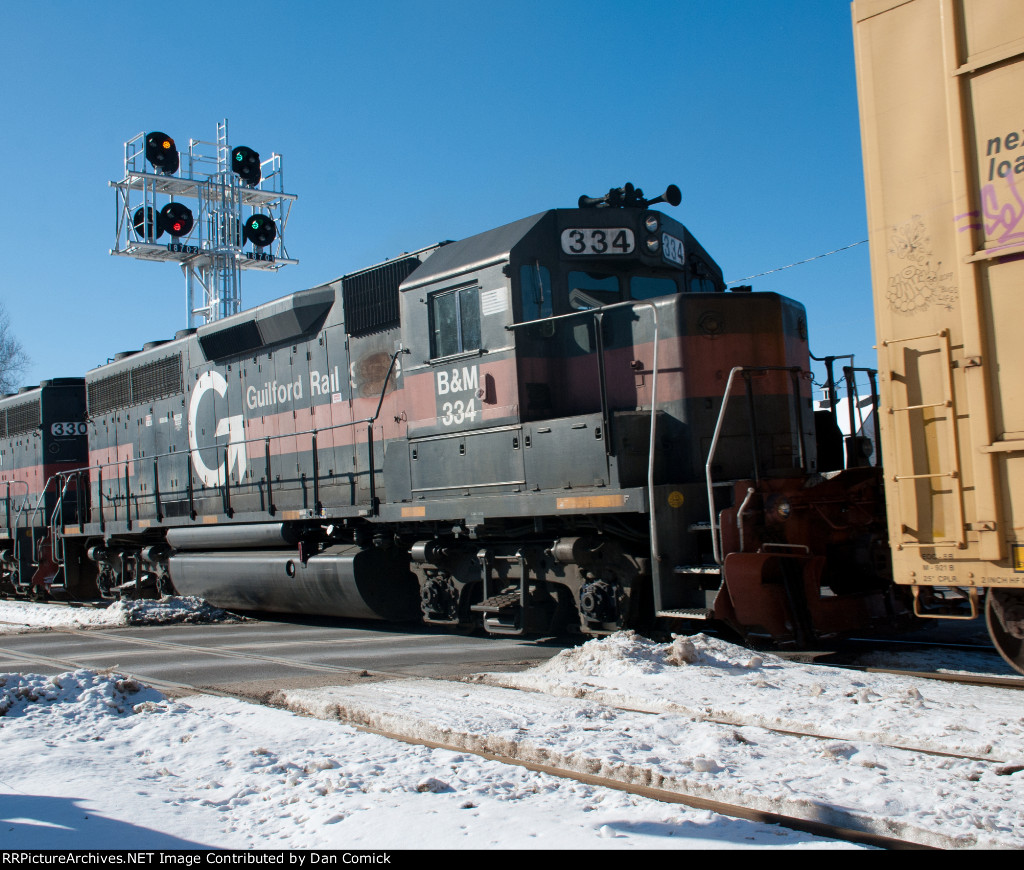
Back in Part 1 I used the example of the new Wachusett MBTA station to highlight how the Guilford Rail System was bucking the trend of sterile Darth Vader signals with not only a commitment to target style tri-lights, but also oddities like bracket masts and doll arms. Well, a few additional examples from their Freight Main Line have tumbled my way.
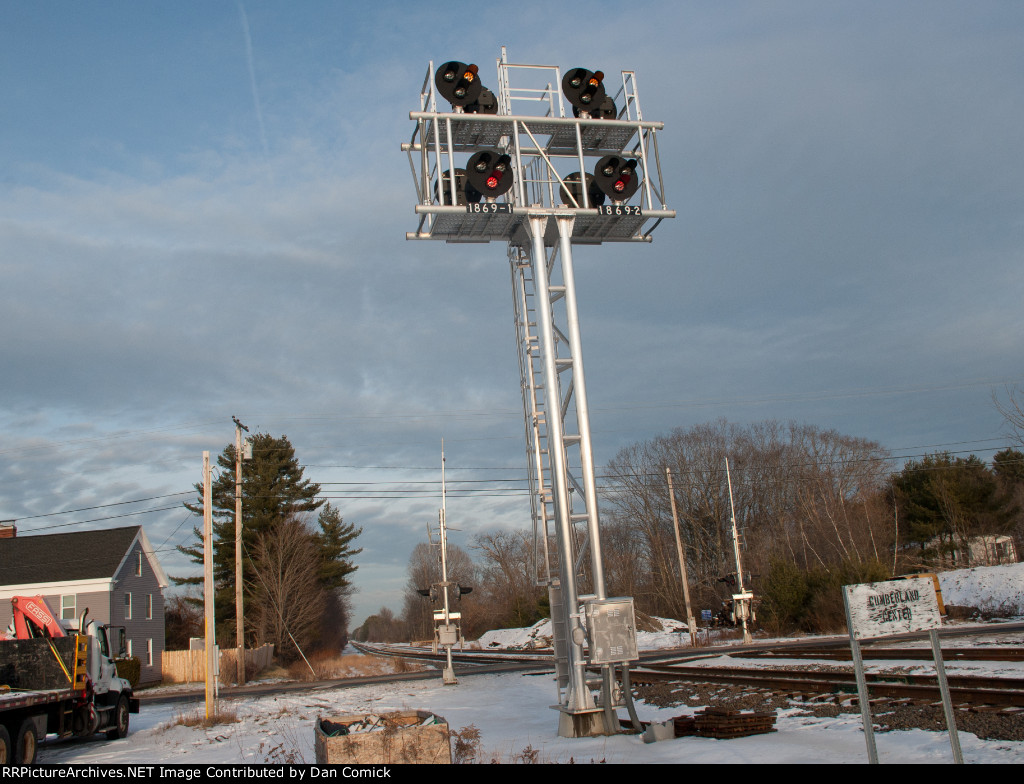
First we have this new bracket mast near Cumbermand Center, Maine and not only is it a bracket mast, but it also shows us that the Guilford is still employing the antiquated Double Green Clear signal aspect from the old Boston and Main days!
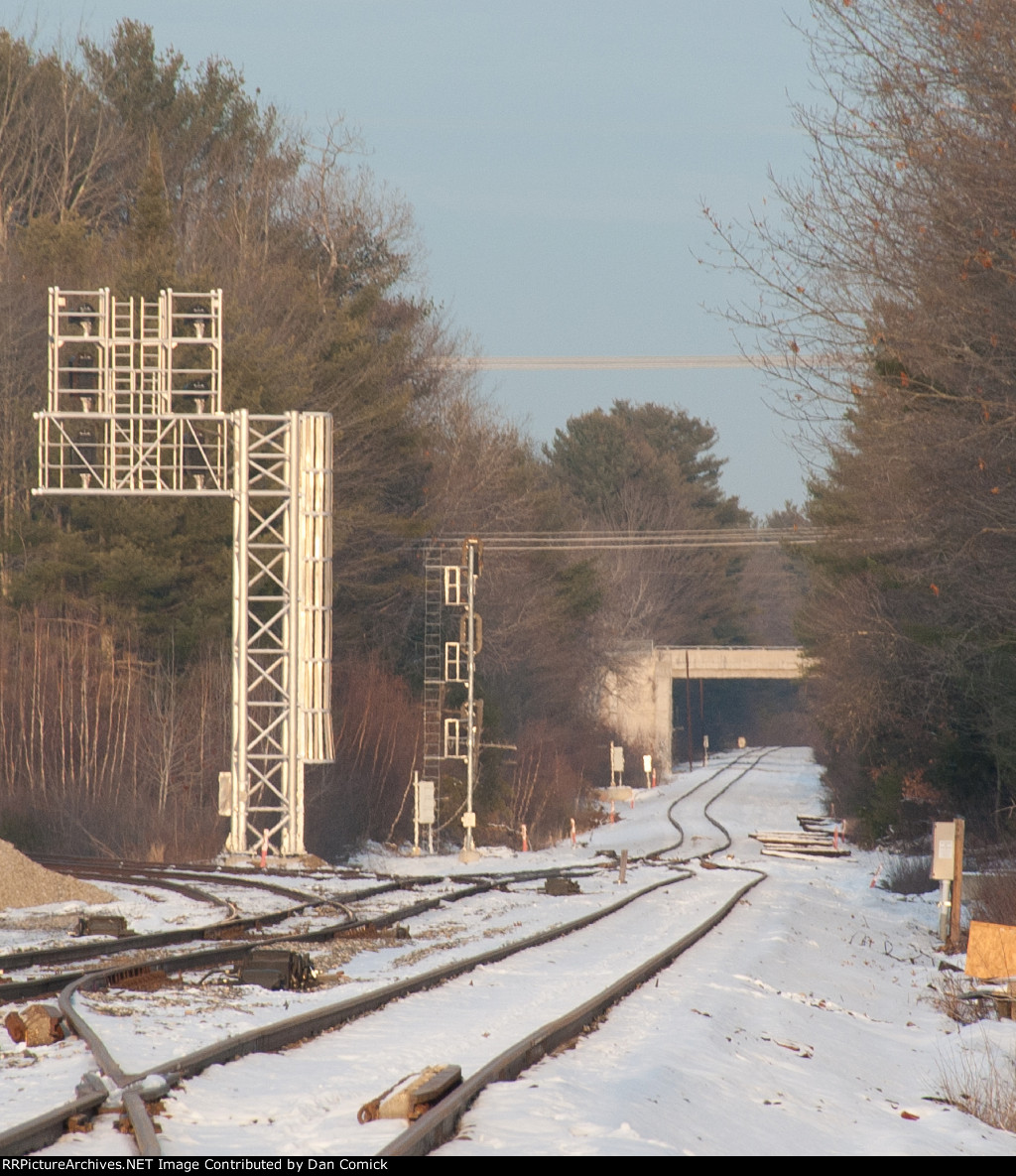
Although unfortunately not target signals, the nearby CPF-185 is also sporting a new cantilever/bracket hybrid for movements off the Brunswick Branch (now used by Downeaster trains).
Speaking of the Downeaster, check out this new doll arm equipped bracket mast protecting a crossover just east of the Lawrence Station on the MBTA Haverhill line. Not exactly a Guilford purchase, but don't think that they probably don't have at least a little input.
Well that's it for now. Hopefully we will see more wacky stuff like this in the future, as opposed to NS style Darths and cantilevers.
First we have this new bracket mast near Cumbermand Center, Maine and not only is it a bracket mast, but it also shows us that the Guilford is still employing the antiquated Double Green Clear signal aspect from the old Boston and Main days!
Although unfortunately not target signals, the nearby CPF-185 is also sporting a new cantilever/bracket hybrid for movements off the Brunswick Branch (now used by Downeaster trains).
Speaking of the Downeaster, check out this new doll arm equipped bracket mast protecting a crossover just east of the Lawrence Station on the MBTA Haverhill line. Not exactly a Guilford purchase, but don't think that they probably don't have at least a little input.
Well that's it for now. Hopefully we will see more wacky stuff like this in the future, as opposed to NS style Darths and cantilevers.
Saturday, January 11, 2020
QUEENS Tower Closes
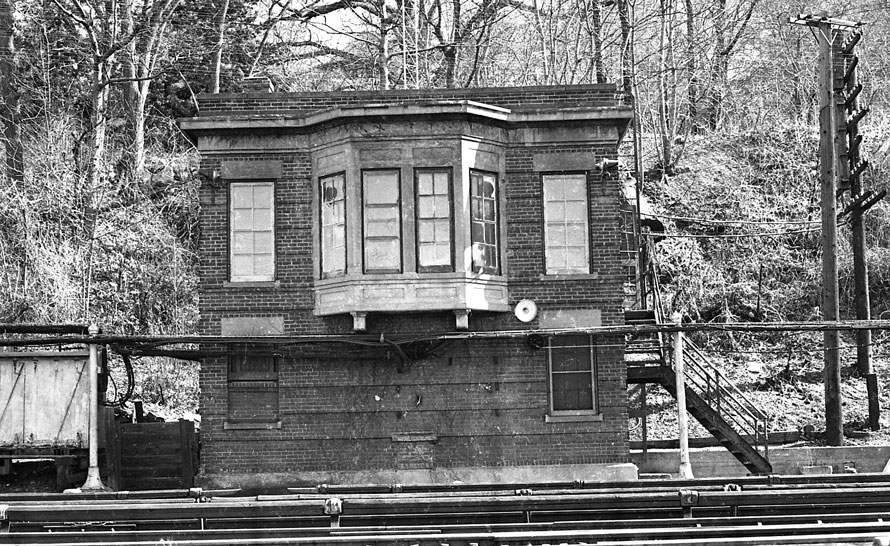
At 11:38pn on January 10th, 2020, the Long Island Railroad's QUEENS tower was closed with control passing to the dispatch office at Jamaica. This is the first expansion of the Jamaica dispatch office's control beyond the Port Washington Branch and the Jamaica Terminal. QUEENS tower was built in 1924 in the style of other towers on the main line like DUNTON, JAY and HALL.
QUEENS interlocking had actually been re-signaling in the 2008 time period with the Model 14 and NX panel being replaced by a VDU system, however the LIRR had a commitment to the quality of service provided by local tower operators and the tower remained manned.
While not much will change from the outside, this is likely the next step in the LIRR's change to a more Metro-North style of operation with reduced aspect dwarf signals and centralized dispatch from a single location.
Please look out for a more in depth article on the history and operation of QUEENS tower as I have a good collection of both interior and exterior photos.
QUEENS interlocking had actually been re-signaling in the 2008 time period with the Model 14 and NX panel being replaced by a VDU system, however the LIRR had a commitment to the quality of service provided by local tower operators and the tower remained manned.
![]() |
| Old Model 14 machine for the local 4-track crossovers |
![]() |
| Old N-X panel for the adjacent high speed equilateral turnouts. |
Please look out for a more in depth article on the history and operation of QUEENS tower as I have a good collection of both interior and exterior photos.
Subscribe to:
Posts (Atom)