Search This Blog

Thursday, October 31, 2024

More Connecticut River Corridor News

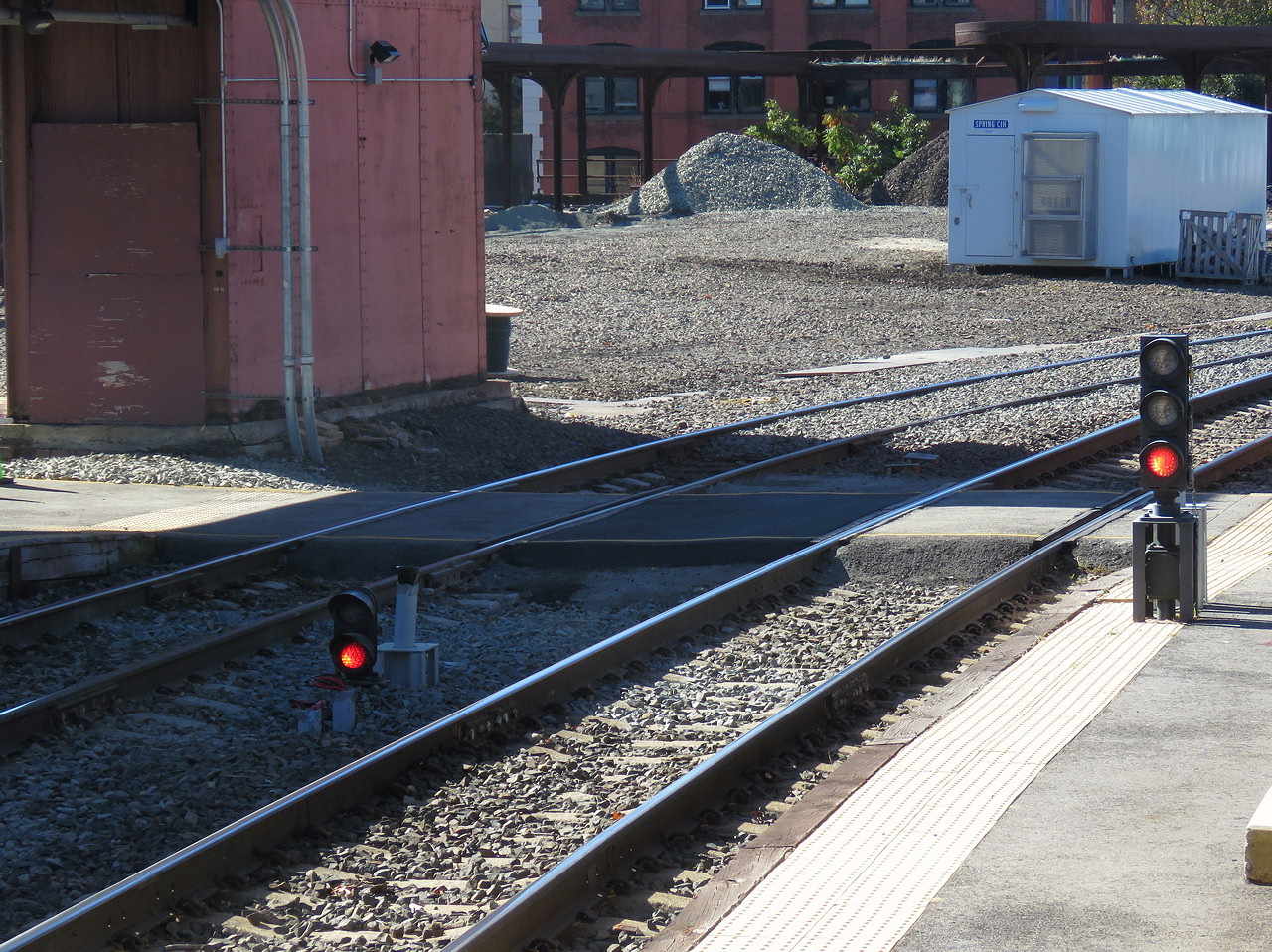
 Although my last update on the Connecticut Valley Corridor was only back in March, I have some additional updates from a follow up trip in October. The most significant are alterations to SPRING interlocking in Springfield, MA. The root cause for altering SPRING is to create an interlocked connection between Boston Line Track 2A and the Amtrak Springfield Line trackage. This route was previously used by the old Vermonter and Inland Route Regionals and required the use of hand throw switches to the east of the station. Without a connection at SPRING, Track 2A is only purpose is to serve as an emergency berth for the daily Lake Shore Limited round trip. The new switch allows Track 2A to be used for both CT Rail Hartford Line trains and Amtrak Springfield Shuttles and also creates additional storage space for increased CT Rail or Regional service. 


Of course there always has to be a downside and unfortunately the changes at SPRING will also cause the elimination of what is arguably the last vintage signal on the Amtrak Springfield Line.  Station track #8 is still governed by a US&S N-2 dwarf, possibly dating back to the New Haven era.  Moreover station track #6 is governed by an uncommon US&S modular dwarf stack that was installed in the early-2000's to replace an H-5 searchlight.  Both will be replaced by Safetran modular cube dwarfs that infected the Springfield line back in 2004.


The bad news doesn't stop there as the New Englande Central re-signaling project continues unabated. It currently appears that new standard sized ABS blocks are in service between Walpole and Claremont, replacing the old B&M large block CTC. This also implies that the new signaling at Claremont has been activated. New interlocking huts have been dropped at both the south end of the Walpole siding and the Bellows Falls diamond. At the north end of the Walpole siding the new interlocking retained the southbound searchlight mast, so it remains to be see if there are any searchlit survivors in the Bellows Falls area. I unfortunately neglected to inspect the controlled point south of Bellows Falls, but it is on my list for a visit in the Spring.

Sunday, October 20, 2024

A Video Guide to French "Poste d'Aiguillage"

Getting information on interlocking tower / signalboxes outside the anglosphere can be a bit difficult not only due to the language barrier, but also cultural difference about railfanning and content creation.  While I found a comprehensive site on German towers many years ago, similar resources for French signaling had yet to pop up on my radar. This is rather unfortunate as I believe that France has a strong tradition of staffed towers and electro-mechanical era power interlocking machines.It also doesn't hurt that the standard SNCF model board design gives off strong PRR vibes.

Anyway, when doing a quick Youtube search on "Poste d'Aiguillage" I found a somewhat recent public information film detailing the many styles of French interlocking machine, running the gammut from mechanical lever frames to VDU area interlockings. It even gives a shout out to a North American pattern Taylor (GRS) machine. You can watch the whole thing for yourself below.  Enjoy!


Sunday, October 13, 2024

There Unitl it Wasn't: Nova's VN Tower

In the early years of my "keep track of towers" hobby, one Class 1 tower stood out for the sheer improbability of its survival. For well over a decade, a wooden tower in absolutely deplorable condition, standing along side a main line in an accessible area with no discernable railroad use managed to not only avoid demolition, but also the all too common risk of fire. I am talking about VN tower in Nova, Ohio on the CSX New Castle Sub. When it was finally demolished in 2013, VN Tower had outlived Amtrak's Three Rivers passenger service that operated on the same line by 8 years.


The story of VN and its longevity is wrapped up in the story of CSX's somewhat neglected B&O Main Line between Washington and Chicago. VN tower was the first significant town east of the Big Four junction in Greenwich, OH and served as an ABS crossover point with control over some adjacent sidings. Similar in style to other wooden B&O towers and painted in B&O beige, VN tower itself closed in the 1980's with the crossovers also being retired leaving just the tower and a pair of B&P CPL ABS signals. (The lack of crossover capacity on the New Castle Sub would in part doom Amtrak's Three Rivers as it frequently wound up stuck behind slow moving freight trains).


Until 1999, the CSX east-west route to Chicago had played a distant second to Conrail's Chicago and Fort Wayne Lines. While the Conrail split turbocharged the western end of this service lane with new signals and a second track, the eastern end of the route had significant numbers of staffed interlocking towers and single direction Rule D-251 track. The line segment between New Castle, PA and Greenwich, OH was no different with a few CTC islands and a staffed tower in Newton Falls. With investment and eyeballs fixed elsewhere for most of this period VN tower just managed to avoid the wreckers ball.


Through 2000's, the decaying tower with its intact lever frame became a local railfan landmark with photos frequently appearing on the major photo archives. VN stayed in this state for so long that people began to speculate that it still had some use, the tower was privately owned or that some local manager was protecting it. In 2011 CSX finished re-signaling the New Castle Sub, banishing the CPL signals and pole line, still VN hung om, now exhibiting a pronounced lean. With other towers, such as HN, being demolished, VN's popularity increased as a photo location due to the well lit east-west orientation of the track.


VN was demolished on November 22, 2013 and the Nova, OH crossing where it had been located went from a must-see for area railfans to a complete afterthought. With all traces of the tower removed and without anything else of note nearby, there weren't many "here's the pile of rubble that used to be VN" photos. VN's demolition over Thanksgiving also made it less salient than other tower demolitions that year so it escaped my notice and coverage. Today I hope to rectify that situation, although the Akron Railroad Club has had a memorial page for VN tower up for the better part of a decade. That site reports that the lever frame and related components were sent to a museum in Utah for some sort of tower related exhibit.

Sunday, October 6, 2024

Hidden Gems - Cleveland Line PRR ABS Signals

The whirlwind of PTC motivated re-signaling has wiped out vintage ABS and CTC systems all across the country including most of the main line PRR position lights. However in one tiny corner of Pennsylvania not only exists a remnant population of PRR position lights, but position lights in a single direction ABS configuration. The Cleveland Line between CP-ROCHESTER (Conway Yard) and Alliance, Ohio serves as a backup route for the far more popular Fort Wayne Line. Due to the low traffic volumes is it PTC exempt, which explains how the PRR era signals have hung on. All together there are 6 PL signal locations on the dual track ABS segment between Rochester, PA and Yellow Creek, OH and today I will cover them all in an eastbound direction using photos that were taken over three trips in 2021, 2022 and 2023


The first location is at milepost 22 at the east end of Wellsville, OH. It consists of one eastbound PL mast and a new westbound Darth Vader mast that was installed in the late 2010s when CP-YELLOW CREEK was re-signaled. It is located just outside the flood wall and is lit full time with PL signal 221 displaying clear by default and signal 222 Approach.


The next location is at milepost 19 right behind the football stadium of Westgate Middle School in the town of East Liverpool, OH. It consists of two single head PL masts, both continuously lit with a Clear signal indication.


The location is also notable for the presence of 1940's vintage Carnegie steel rail and a somewhat ad hoc run of signal wire between the cabinet and rails.


In the East End section of East Liverpool at the site of the closed Virginia Ave railroad crossing we find the milepost 16 location with another pair of PL masts. This time signal 164 displays Approach by default due to a pair of interlockings, VEZ and MIDLAND, at either end of a single track section a few miles to the east to the east. Because the track #1 does not encounter a diverging route at VEZ interlocking the corresponding PL mast needed no modification and was therefore not replaced. The short single track section seems to have been installed due to the risk of RoW erosion by the Ohio River, but also acts as a "Conrail Crossover". The eastbound 164 signal is also significantly taller than the opposite 165 mast.


The relay cabinets associated with the signals display both US&S and Wabco logos.


Seeing as VEZ and MIDLAND took out the following two ABS locations, the next automatic signal location is across the PA border, just east of te town of Midland and directly adjacent to state route 68 at milepost 8.6. It consists of an eastbound position light and westbound Darth Vader which are lit full time with Clear the default indication eastbound and Approach the default westbound. They are co-located with the Midland hotbox, dragging equipment and high car detector.


Sunday, September 29, 2024

The Mystery of the Zombie Route

This came up as I was recently out along the New Englande Central near Bellows Falls, VT when I noticed something strange at the north end of the Walpole siding.

The southbound searchlight mast was displaying an Approach Medium and my first assumption was that the signal at the Bellows Falls diamond crossing was still at Stop and due to the short distance between the south end of the siding and said diamond crossing, the signal at the south end of the siding would be displaying Approach. This is a pretty common technique to deal with a short block without using a flashing Advance Approach indication.


Well, you can imagine my surprise when I traveled back to the south end of the siding to discover a Medium Clear indication for the normal route over the single trailing point switch. The signal for the Bellows Falls diamond, about 1500 feet to the south, was also displaying clear. So, what is going on here?  My first thought was that this was some kind of zombie route. The New Englande Central flipped the orientation of the turnout to create a zombie route, but didn't have the wherewithal to alter the signaling. These sorts of double track passing points where trains enter a short stretch of double track ABS on a normal route and exit on a diverging route, were that uncommon in the early CTC era. The north end of the siding even looked a little suspicious with a bracket-dwarf arrangement that could have once been a normal mast and center mounted dwarf.


The other hypothesis is that this is due to speed control over the Bellows Falls bridge. Using signaling to encourage speed control, typically involving slow speed signals, wasn't unheard of in the pre-PTC world. Although Approach Medium to a Medium Clear over a straight route is quite out of the ordinary, The train approaching the interlocking will be traveling at medium speed per rule with the Medium Clear further acting as a reminder. After the 2016 Amtrak Frankford Jct derailment the FRA leaned heavily on various passenger railroads to use signals less favorable than Clear to help prevent accidents at significant speed restrictions. Since the Bellows Falls Bridge is 10mph compared with 50-60mph approach speeds, this seems like  the sort of remedy the FRA would require on a PTC exempt rail line.

So which is the more likely scenario? Well, the answer would come from YouTube of all places. If you remember back to that interlocked diamond crossing at the Bellows Falls passenger station, the northbound signal is at the end of the platform and likely visible in rider's videos. A Clear signal on the northbound mast would imply the zombie route, while something other than clear would imply speed control. Well after some searching I found an answer.


So the northbound mast is displaying Approach Medium, which I said implies speed control, however the date of the video is the most important clue. 2013 was well before the FRA freakout over speed restrictions implying that the South End Walpole was displaying a Medium Clear over a normal route in the northbound direction as well. The situation is still not 100% clear cut and there could be alternate explanations that don't involve a passing point type layout, for example the siding being changed from the west to east side of the main line. Still, its a unique situation that lead me down a rabbit hole. It will be interesting to see what if any changes the re-signaling project brings.

Saturday, September 21, 2024

Spooky Signaling - Zombies and Phantoms

As the smell of pumpkin space fills the coffee shoppes and the foliage begins to change colors, I figured I'd do a little Halloween themed post about zombie and phantom signals. While I may have touched on this topic as part of other posts, apparently I never gave zombies and phantoms a dedicated post so here you go.  Zombie signals are signals that exist, but govern a track that does not and phantom signals exist within the interlocking logic, but not in real life. Both appear where interlockings are having bits and pieces removed with zombies being out in the field and phantoms on the interlocking machine or other user interface. However in both cases the signal must still wired into active signaling infrastructure so a signal standing aside a completely removed rail line is not a zombie and a signal lever painted white as a spare is not a phantom. 
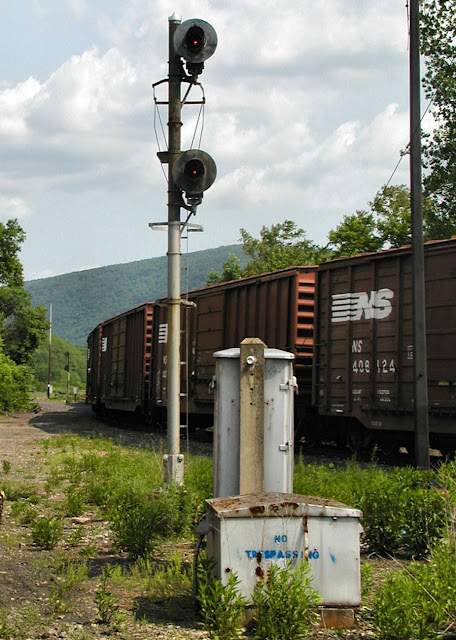
2W zombie mast at CP-LEHIGHTON

The best example of a zombie signal was the 2W small target searchlight mast at CP-LEHIGHTON on the former Conrail Lehigh Line. Located at the point where a connection to the old CNJ Main Line was plugged into the old Lehigh Valley Main Line, CP-LEHIGHTON came about when the staffed tower was closed and Conrail created a single main line from the best parts of each predecessor roads. Governing a stub industrial track on the route of the old LVRR main, industry closures eventually made the industrial track surplus to requirements between 1992 and 1997.  However Conrail faced non-trivial costs to alter the interlocking, especially since the signal had bulb out protection. Their solution was to leave the signal in place with the searchlight bulbs in a low power mode.

Remains of 76LA after the signal was finally removed.

Another good example is the 76LA dwarf signal at DOWNS interlocking on the PRR Main Line.  Again, this governed an industrial track that was eventually removed from service, but once again it was cheaper to leave the signal in place.

Zombie CPL at LAUGHLIN JCT in 2009

I recall reading that the eastbound signal for passenger traffic to Pittsburgh's B&O Station at LAUGHLIN JCT became a zombie after the rail service was discontinued. While the mast was still there in 2009, a partial re-signaling in 2003 may have finally extinguished the lamps. 


Does the 10RB signal from nowhere count?

Now one minor distinction are signals where the tracks have been cut just past the insulated joint and signals that are just floating out in the middle of nowhere.  PAOLI tower's Hill Track 10RB signal went on this journey first standing next to the end of track and later standing next to nothing. While standing next to cut track isn't quite as "zombie" as standing next to nothing, I'm not going to nitpick. 

Track 2 signal is still lit over an empty roadbed.

Another interesting zombie signal situation was on the removed #2 track on the same PRR Main Line between CALN interlocking and PARK tower. This track was removed around 2010 and featured 3 zombie intermediate signal locations for the better part of a decade. In this case in addition to having to modify the old 504 CTC system controlled by THORN tower, Amtrak also was able to put off having to do the regulatory process of discontinuing that track's signal system, even if the track did not physically exist. 

Sidings exit signals are another common source of zombie signaling as industrial closures can lead to siding removal by MoW forces while the related signaling is left in place until the signal department decides to deal with it.

MIDLAND interlocking in Gainesville featured a zombie derail.

The final type of zombie signal I should mention is removed diamond crossings. These are expensive to maintain and while often the diamond is removed with the tracks and signals on either side remaining, its not unheard of for the entire crossing line to be torn up except for the signals which may be the property/responsibility of the surviving route. I can't currently find my example of a zombie diamond signal, so I posted a zombie derail instead. 

Examples of phantom signals are a bit harder to document and were largely the product of mechanical interlocking where changes in the physical plant would require extensive physical modifications to the physically implemented interlocking logic.  In certain locations it made more sense to leave the unused levers in place where the operator would still have to line them as if they were still in the field. While I am aware of phantoms also existing in relay based interlocking plants, the only example I can currently come up with is the late great ALTO tower in Altoona, PA. When the layout was modified in the 1980's, several signals in the east end of the plant were converted into phantoms, specifically the 20L, 34R and 38R, as they crossovers they had protected had been removed. On the model board the signals existed (labeled phantom), but it would not be possible to hold a train at one. 


In summary, far from being scary, zombie and phantom signals are a neat little quirk that occurs at the intersection of abstract logic and the real world.

Saturday, September 14, 2024

CSX Demolishes New Hampshire's Penultimate Tower

The effects of CSX's takeover of the Guilford Rail System is already becoming apparent as I have discovered that New Hampshire's second to last surviving interlocking tower, MA in Manchester, has been demolished. Never a big state for main line railroading, New Hampshire did have some fairly robust Boston and Maine infrastructure in the Merrimack River Valley between Nashua and Concord. The B&M had a thing for placing towers at the end of yards and had such towers in the cities of Manchester and Concord.  Both towers were low level brick and concrete "cabin" types built around 1944 to the same plan and designed around a unit lever (CTC style) console and associated local relays.

B&M MA(nchester) Tower, just visible behind the tree line at center left.

CSX's chosen victim was MA tower in Manchester, which is especially vexing because as you can see in the photo above, I had been a stone's throw away taking photos of the deactivated remains of CPN-28 in October, 2022, only becoming aware of the tower's existence after I got home. I had plans to re-visit the area, but had not been able to put them into effect by the time the tower was demolished in May of 2024. Luckily a local urban explorer visited the tower in February, 2024. According to a history published by the Boston and Maine Historical Society, the tower first gained CTC control of the entire New Hampshire Route Main Line in the 1950's before closing entirely in 1974.


In a bit of good news, the tower in Concord had been identified some years ago by local preservationists who are currently involved in its restoration. The story behind the preservation effort is told in the video below. Unless something has been overlooked it is believed to be New Hampshire's last standing purpose built interlocking tower.

Once again the lesson is to be aware of your surroundings and do the research before you go on an expedition.  This was not even the first time I missed something in Manchester as in the fall of 2020 I had failed to get photos of CPN-28 before it was taken out of service despite performing a historic walking tour just a half mile away.