Ever since CSX turned against the cab signaling system on the RF&P, the "Rule 562" cab signaling without fixed wayside signals on the former Conrail Boston Line has looked increasingly out of place. The only part of Conrail's 1990's cab signal push that was taken over by CSX, the Boston Line east of CP-187 has technically required CSX to entire that the 4 or so daily road freights have CSS equipped leading locomotives that have also carried out the perfunctory cab signal test. Although Selkirk yard has to handle similar requirements for freight on Amtrak's Hudson Line, those can be handled by a dedicated pool of local power. Road freights, on the other hand, are likely to arrive with unequipped leaders requiring a potentually time consuming engine swap.

Although Boston Line cab signals were recently extended east of Framingham as part of the MBTA's ACSES PTC implementation, CSX has become increasingly vocal about removing the Conrail era system west of Worcester. This "demand" has made it into a state funded East-West rail corridor improvement program and if you think that using state funds to adjust a fully modern, privately owned signaling system is insulting, the state has the audacity to label the cab signal removal as a "capacity improvement".


For anyone not familiar with the technology, continuous cab signals provide real time block status updates when a train is within the typically 2-mile long fixed track circuit blocks. Through this mechanism cab signaling is what provides a capacity improvement over fixed wayside signaling. (Recall that as far as I am aware, ETMS PTC systems are not cab signaling as they currently do not meet the requirements for safety critical operation. IE they can be trusted to stop trains, but cannot make them go.)

So why is a state government website proclaiming this to be a capacity improvement? It's possible that they figure its best to frame every state funded change as an improvement and assume that only me and three other people will ever notice. However a recent photo I came across hints at what CSX might be doing to make this statement true.
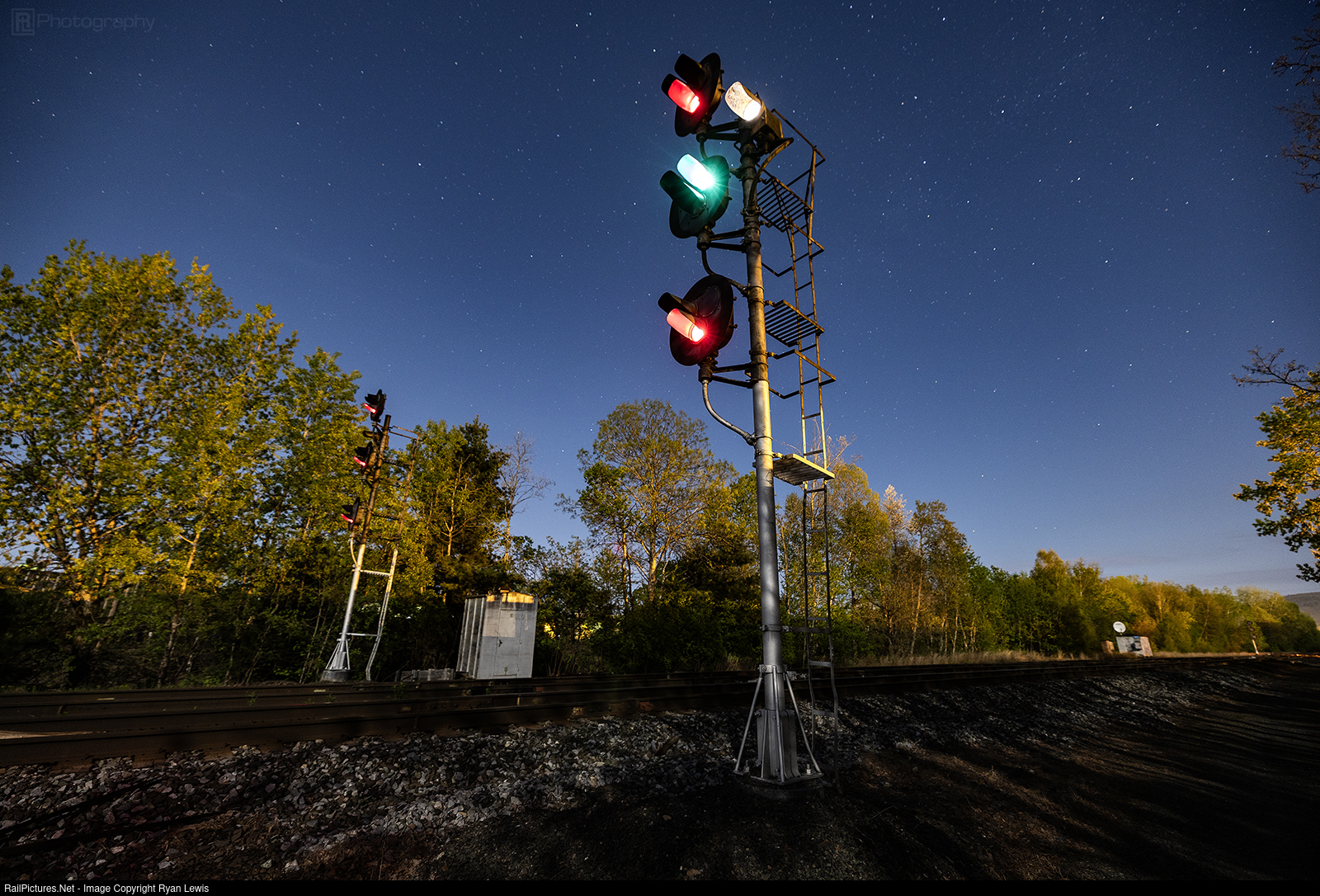
The photo shows a Conrail era signal in the Pittsfield area displaying a Rule 280a "Clear to Next Interlocking" 'C' lamp. This is supplied in Rule 562 territory to allow trains to proceed to the next interlocking at track speed in case of cab signal failure. Sometimes called "super clear" it is normally a hard signal to catch in the wild since cab signal failures aren't typically predictable. While it is certainly possible the photographer got lucky or caught wind of a special movement, I believe a more likely situation is that CSX is running non-cab signal equipped leading locomotives on its through freights and relying on Rule 280a as a standard operating procedure. This would create functional blocks over 10 miles long, thus seriously reducing capacity. So in theory, by jamming a broom handle in the spokes of the bike it is riding, CSX could have created the conditions where removing continuous cab signals would increase capacity. 🙄


Only road freights that terminate west of Worcester on the B&A would have the need for CSS-equipped locomotives removed by this - the ones that terminate in Portland, ME or Framingham, MA still need to run over Rule 562 territory. It may be that by removing the cab signals between Post Road and Worcester it becomes less expensive to make changes that would add capacity (additional tracks, additional interlockings), though.
ReplyDelete