Search This Blog

Monday, June 29, 2026

LIRR Greenport PTC - Much Ado About Nothing

We have another data point regarding the FRA's PTC paranoia, this time regarding the Long Island Rail Road's Greenport Branch waiver. Although I missed it at the time, in 2021 LIRR Today published a comprehensive article about the LIRR's efforts to get a PTC waiver for the lightly used Greenport Branch (aka North Fork Branch). Previously one of two regularly served lines to still be operating under a form of the PRR's Manual Block System, in late 2017 the LIRR activated CTC and cab signaling over the entire length of the Montauk Branch, leaving the 46-mile long Greenport Branch as the only US commuter rail service running on "dark" main track territory. What followed next was a lengthy pas de deux between the MTA, which really doesn't want to operate the Greenport service and the FRA, which really doesn't want commuter rail services operating under non-signaled (TWC/DCS/Manual Block, etc) rules.

Until fairly recently non-signaled main track operation could be found on Metro-North, the LIRR and METRA. Although the PTC mandate does not require block signaling and CTC, all three quickly caved in and carried out signaling projects (one might also include South Shore which eliminated its APB territory). The only holdout appears to be the Greenport Branch where, for reasons best explained by The LIRR Today, the MTA is highly reluctant to invest capital resources. No matter, although the ACSES PTC system is intended to work with continuous cab signaling, it does not require functional CSS except for following movements between controlled points.

Let's review how ACESS works.

  1. Cab signals codes provide movement authority.
  2. Fixed beacons between the rails inform trains of permanent speed restrictions.
  3. A data radio system informs trains of temporary speed restrictions and track posessions.
  4. The data radio can also provide movement authority when cab signal codes are not present.
With these ingredients you can build a dark territory PTC system. ACSES beacons provide the same civil speed enforcement and the data radio provides movement authority between block limits either using the "Clear To Next Interlocking" functionality or by manipulating track possessions (aka 0mph Temporary Speed Restrictions). Remember ACSES does not replace the LIRR Manual Block Rules, it just stops trains if they exceed their movement authority.
 

This is not the solution that was decided upon. The MTA wanted to install the ACSES track speed beacons and keep sing MBS, after all 4 daily round trips are on par with Amtrak's PTC exempt Valley flyer and Downeaster routes. The FRA wanted temporal separation with 1 passenger train on the entire 46 mile branch. Eventually a compromise was reached with 1 train per MBS block with empty buffer blocks between different passenger trains and passenger trans and freight. To be clear the normal mode of Greenport Branch operation is 1 passenger train on the 46 mile  line, but there are edge cases where this would cause problems.


So why did both parties seem to pass on the opportunity to innovate with the technical capabilities of ACSES? A generous answer could be the chance it would have required software changes on the dispatcher's end to give trains dark territory movement authorities as opposed to the dispatcher setting up and releasing possessions. A more cynical take is that the FRA  wants all regularly scheduled commuter/transit services to be operating under automatic block signaling. The deeper issue is that the FRA considers legacy operating methods as unsafe as opposed to PTC being a nice-to-have overlay on an already safe system. The LIRR has safely operated trains under Manual Block rules for decades, just like Metro North and Metra, but apparently they were all jut lucky that tens or hundreds of passengers weren't horribly killed. 🙄 This catastrophizing is what leads to an inflexibility that cancels service, raises costs and pushes more people onto the highways. 
 
BTW, please check out The LIRR Today blog. It has a major discoverability problem on Google so I want to raise some awareness.  

Sunday, June 21, 2026

Amtrak THORN Tower to Close Aug 8, 2026

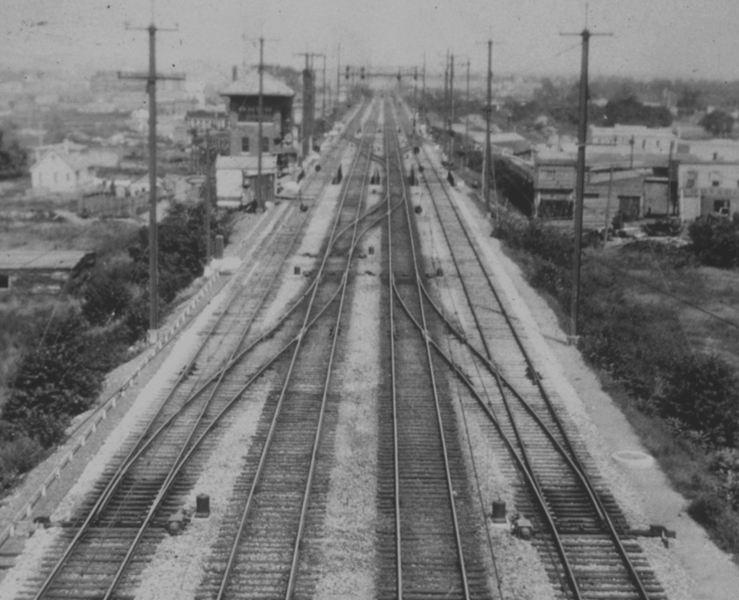
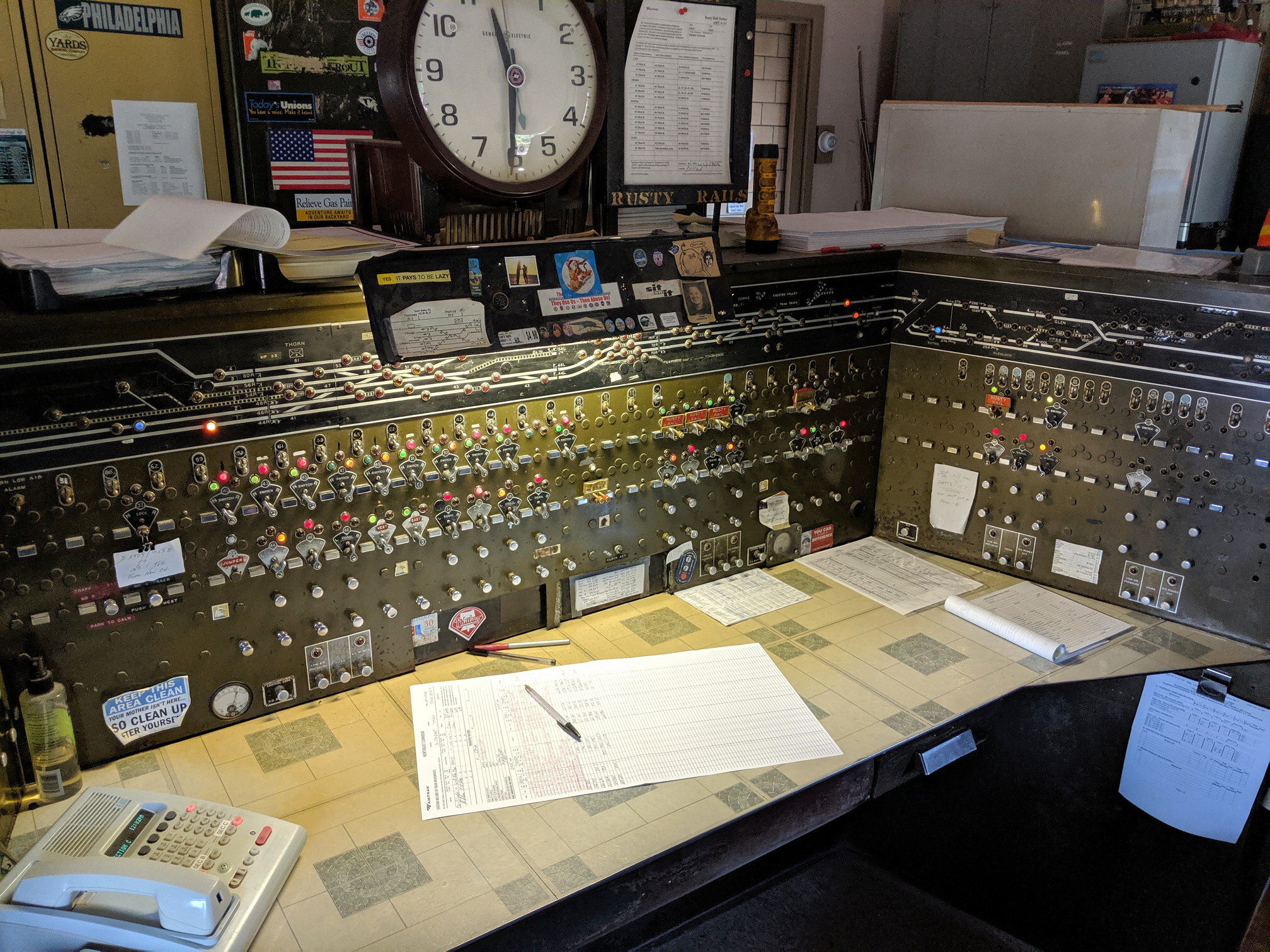
For over a year I have been tracking the slow motion closure of Amtrak's THORN interlocking tower. located on the old PRR Main Line in Thorndale, PA Opened in 1938 as part of the PRR's electrification project to Harrisburg, THORN was equipped with a state of the art CTC unit lever console controlling  4 remote interlockings in addition to the local 6(!) track full crossover. THORN's extended territory, including FRAZER interlocking which was commissioned in 1994, is what has allowed for the prolonged multi-year closure, which will take place just shy of the tower's 90th year in continuous operation.


Since the first part of THORN's territory, CALN interlocking, was chipped away back in 2020, the local 6-track crossover was rationalized and then turned over to CTEC control while the THORN operator continued to handle SEPTA movements in and out of Frazer yard as well as the daily NS freight entering the line at GLEN. More recently DOWNS interlocking was prepared for complete removal, its signals left standing as the change point between CTEC and THORN's control.  In the final act, kicking off in early 2026, GLEN and FRAZER interlockings were reconstructed with the goal of a Rule 562 cutover once all of the work had been completed. 

THORN interlocking as rationalized in 2023

The closure will bring full bi-directional operation between THORN and PAOLI, with the segment between FRAZER and PAOLI remaining outside the Rule 562 zone for now. The much diminished PAOLI tower is likely next on the list for closure before the heavy lift of installing Rule 562 on the core of the old 4-track "Main Line" begins. One loss that's easy to overlook is the now vestigial limited speed triangle at DOWNS interlocking with those at BRYN MAWR likely the only set remaining outside of Canada.

Another loss will be the intermediate signals at Exton, which were easily accessible from the SEPTA parking lot and well positioned for photography. 

For persons desiring photos of these, the Milepost 29 signals or what's left of DOWNS, you probably have until August 7th assuming transition operations will take place overnight. At 1:30pm on August 8th, THORN's final staffed shift will end. The tower is directly adjacent to the Happy Day's Diner for anyone looking to mark the event. 


Sunday, June 14, 2026

Art's LIRR Archives Online...For Now

 Word on the street is that the street is that the person behind Art's LIRR Archives, Art Huneke, has recently passed away. While not quite the #1 source on LIRR tower information, Art's wonderfully Web 1.0 Archive contains a huge amount of primary source material on the evolution of the LIRR in the 19th and early 20th centuries. While the tower and signaling information is scattered throughout the site, it does reward those who take the time to find it. Special attention is given to the older generation of LIRR towers and cabins that were closed in the mid-20th century modernization projects. The page has a wide collection of diagrams and bulletin order scans to track the life and death of these less well known LIRR towers as the rail road evolved into its present form. 

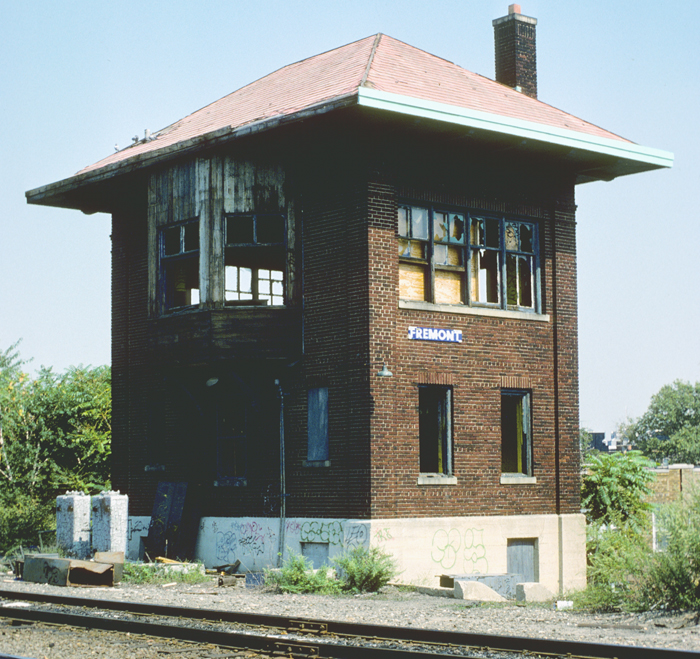
For example Art has extensive coverage of the LIRR's Bay Ridge Branch towers, like NO above, that were opened with the 1928 electrification only to be closed by 1932. In turn we see a photo of the tower that remained open, FN aka FREEMONT, with a Conrail era blue station sign. Other Bay Ridge towers include NU, KN, MJ and of course POND.

At this point there is no word on what will happen to the website so I urge all of you to check it out. Because its all Web 1.0, it is pretty easy to create local copies of the content via the "Save Webpage Complete" function in your browser. Other major signaling content includes:

Sunday, June 7, 2026

Yes, US&S Made Handguns

In the past I have spoken to the importance of looking for the Union Switch and Signal label when purchasing your next M3 switch machine. However, you might also consider looking for the US&S logo when in the market for a M1911A1 .45 caliber handgun. Not only was US&S one of several non-traditional manufacturing concerns drafted into weapons production during World War 2, they were one of the few to affix their corporate trademark to the finished product. Recently Ian at Forgotten Weapons finally got around to covering the US&S M1911 in what might be his only firearm/railfan crossover video

Although they ended up being the second smallest manufacturer of M1911A1 pistols during WW2, this still amounted to over 55,000 units. Anyone familiar with the parts and pieces in a Model 14 interlocking machine can see that making firearms components would be in their wheelhouse. It's unfortunate that Hitatchi has been sidelining the US&S brand after their takeover of the previous parent, Ansaldo.