Search This Blog

Showing posts with label CTC. Show all posts

Thursday, October 30, 2025

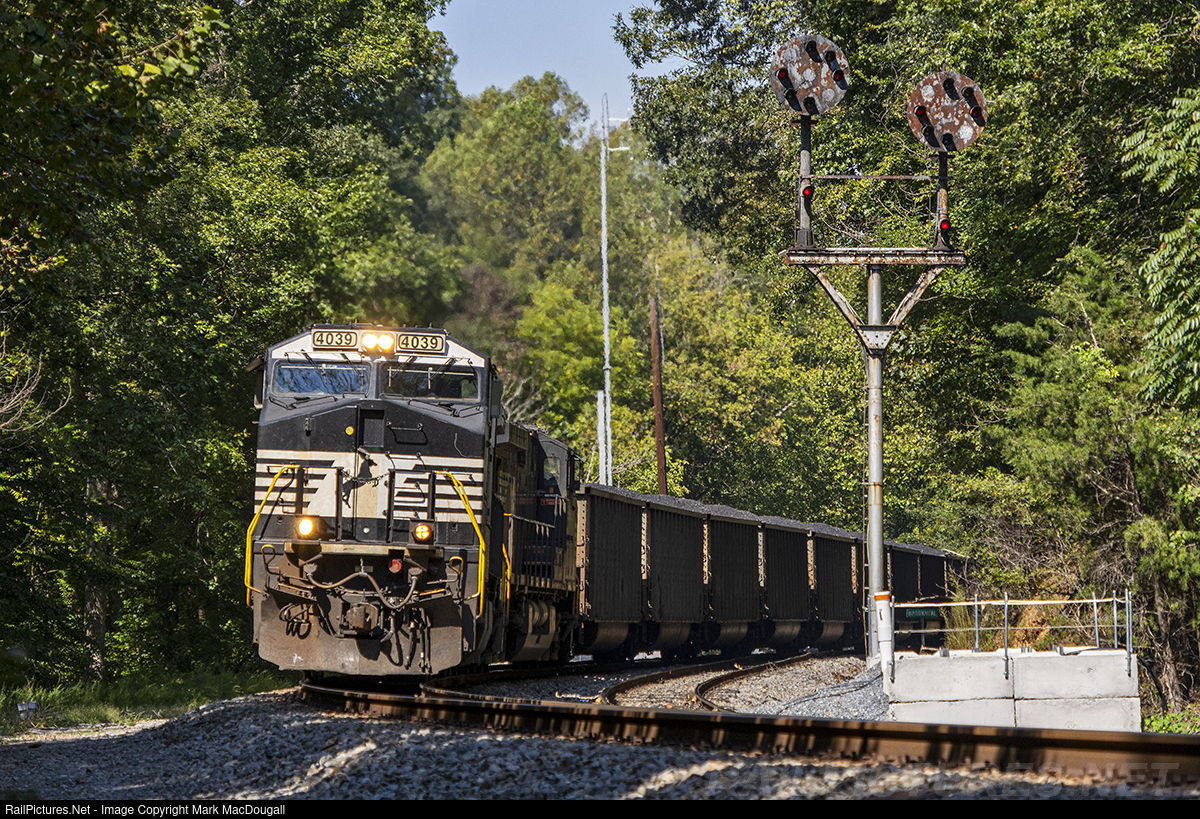
The Last N&W CPL Intermediates Fall

 For many years a lightly used NS line in southern Virginia has been been carrying the torch for N&W position light signaling. Well it appears that the torch has gone out not just for its own N&W colorized position lights, but, in all likelihood, the last example of N&W intermediate signals anywhere on the NS system. The NS Altavista district had become an island of classic signaling due to the typical reason of decline. Like the former Conrail Buffalo Line, C&O Virginia Central route and the B&O Mountain Sub, the Altavista district was involved with moving coal from the Appalachian interior to various ports. 

Comprised of the Virginian Railway's main line that was absorbed into the N&W in 1959, the gentler alignment makes it the preferred route for loaded eastbound coal trains in a form of directional running. Converted by the N&W to bi-directional CTC signaling with N&W style position lights between 1960 and 1963, the relatively young age of the signaling combined traffic that made the route PTC exempt put the Altavista District low down on the capital improvement totem pole.  Unfortunately with the great PTC push of the 2010's now in the rearview mirror, NS started to pick away at the Altavista district PLs in the early 2020's.

In the particular case of automatic N&W Pl locations, the N&W switched to installing new color lights before the end of the "right hand rule" in 1985. This made "split" automatics ripe for replacement during signal logic refreshes in the 90's and 2000's, even if PL signals at interlockings were left in place. If the assessment of the community is accurate, the Altavista district was the last place one could find active N&W PL signals with an automatic number plate, although like with the dwarf signals, its entirely possible that one or two might be hanging on deep in the forests of coal country. 

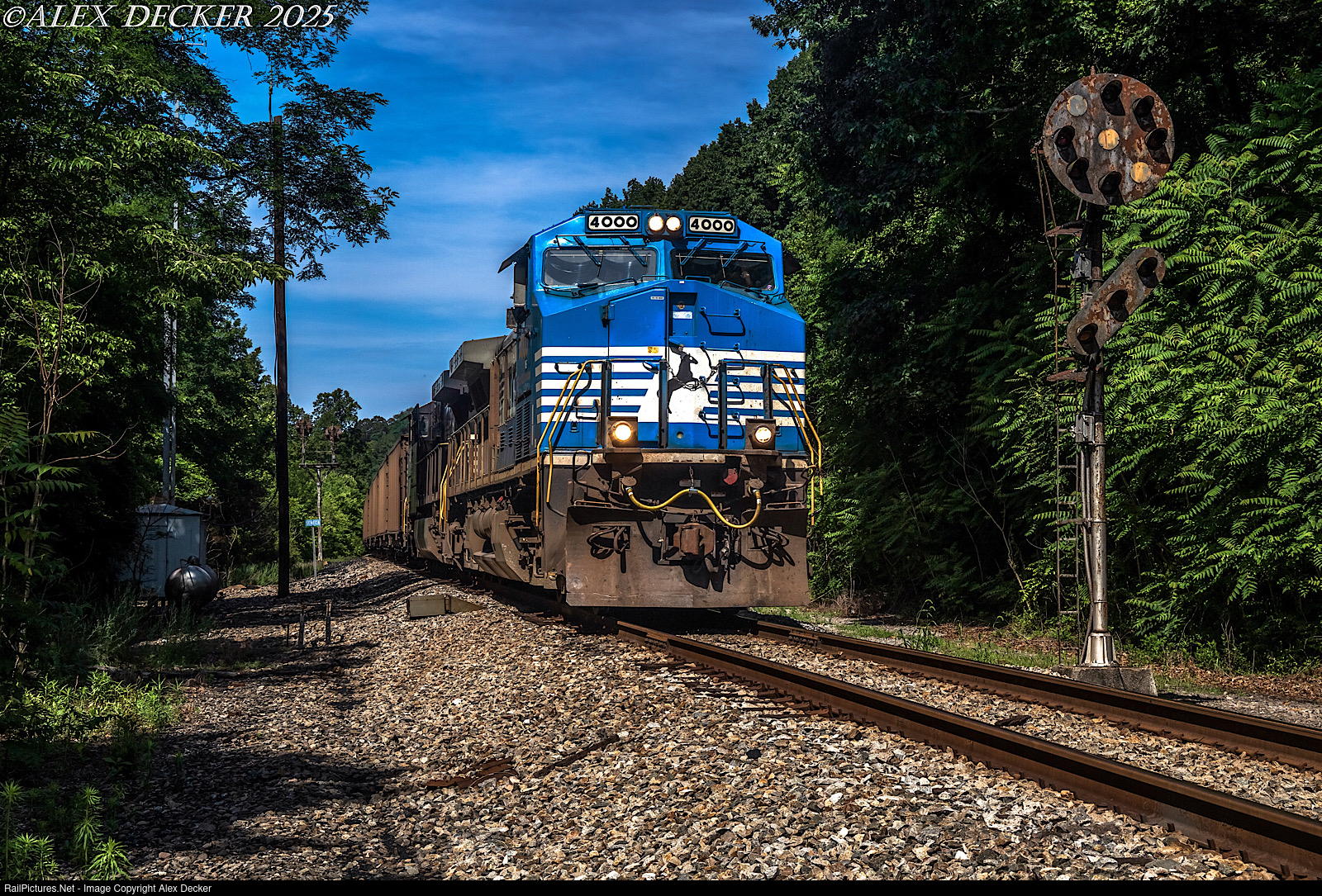
2025 Photos of Atlavista CPLs without replacements can be deceptive as the siding at SENECA was removed entirely.
 

Note the qualification of "active" as the former N&W route eastward out of Cincinnati had its N&W CTC signaling, including automatic locations, taken out of service, but not removed. Now leased to a shortline it is the most practical place to get photos of automatic N&W PLs.


Sunday, October 5, 2025

Dispatcher Signal Stacking

The story of railway signaling, like many others, has been one of technology increasing human productivity. Power operation allowed "levers" to be thrown faster, N-X machines allowed routes to be set with fewer button presses and remote operation combined with CTC allowed one person to control many miles of track. However remote control and ease of operation were not the only types of automation added to towers and dispatch offices. Fleeting allowed infrequently manipulated interlockings to do the same thing over and over and in cases where routing decisions needed to be made, automatic route setting combined with train labeling could keep track of train movements and automatically request routes as they approached junction points.

Recently another method of automation has crept into dispatch software, route stacking. While similar to automatic route setting, it is different in a significant way. Consider the following pair of photos showing an Amtrak Springfield shuttle train departing SPRING interlocking at Springfield Union Station.  


Within seconds of clearing the interlocking the 2N dwarf signal (upper right of the photo) changes from Stop to Restricting for an opposing movement. In the past this would signify a very attentive dispatcher, hovering over their CTC panel or video display, ready to line the new route as soon as possible. If this was an auto-routing system we would have had to wait for the opposing movement  to enter the track segment to trigger the route request.  With stacking the dispatcher simply uses their computerized dispatching interface to queue up a sequence of routes which will be executed as soon as the last established route is taken. Then they can do and pay attention to something else.  


This works well at places like Springfield where reverse movements are common. For a northbound train the dispatcher could set up a route from the 2S at SWEENEY, 12 switch reverse. Then immediately have a second route set for the 1N 13 switch reverse to the CT River Main Line.  It's not super complicated, but it is something that, due to the time penalties associated with bad routes, took a little while to catch on.

Friday, August 15, 2025

Signals of the Reading and Northern Lehigh Line

Pennsylvania's Wyoming Valley, today home to the Scranton–Wilkes-Barre metropolitan area, was the West Texas or Saudi Arabia of the 19th century due to its massive reserves of Anthracite coal. A premium product demanding premium prices, anthracite coal was the way that industrializing America kept warm in the water months after the landscape had been stripped bare of trees for firewood. This is how the Wyoming Valley could fund the operations of three major railroads (the Lehigh Valley, Central RR of NJ and Delaware Lackawanna and Western) and similarly explain why those railroads seemed to evaporate without a trace when the world moved on to oil and natural gas.


Perhaps nothing optimized the uniquely American phenomena of direct railroad competition like the LVRR and CNJ, whose main lines were both functionally and in some places literally parallel. In the 1960's the anthracite collapse was well under way and a decade before Conrail, the CNJ teamed up with the LVRR to consolidate its operations to Scranton. North of its large yard in Lehighton, PA, the LVRR and CNJ used mutual trackage rights to stitch together a hybrid route, using better aligned portions of the CNJ over the Pocono mountain summit between White Haven and Laurel Run. In 1972 CNJ threw in the towel on operations to Scranton and later Conrail would choose to use the CNJ main line between Lehighton and Allentown creating a Frankenstein's monster "Lehigh Line" between NYC, Scranton and NY's Southern Tier. As the region's industry continued to shift, Conrail shoveled off the Lehigh Line north of Lehighton to the upstart Reading and Northern in the 1990's.


All this history is necessary to understand why the signaling on the Lehigh Line portion of the Reading and Northern's main line between Reading and Pittston, looks the way it does. Recently made visible by the series of R&N Iron Horse Rambles and its regular weekend Lehigh Gorge excursion service, the current signaling on the upper Lehigh Line reflect its unique history. In the 2024/2025 time frame I was able to gather enough content to put together a signaling guide covering the old Lehigh Line between Mauch Chunk and Pittston.


We begin at R&N's COAL interlocking, which was built new by them to support the R&N's "Main Line" concept between Reading and Pittston, but also its Lehigh Gorge tourist operations. Using a salvaged lattice cantilever mast, COAL connects what was the old CNJ route to the former LVRR route at the south end of the Lehigh Gorge.


Into the 2000's, Conrail (later NS) owned and operated this portion of the Lehigh Line as a double track Rule 251 main line. Traffic was so light that the southbound track was used bi-directionally with northbound trains needing to get a Form D, while the southbound track had its signal system taken out of service and used for R&M excursions and freights. NS moved first to convert the southbound track to Rule 261 (CTC) operation, with the R&N converting the former northbound track to Rule 261 in the late 2010's. Each track has a single ABS signal location in this line segment, NS at LVRR milepost 126 and the R&N's at its own milepost 124.


A quick note on Mileposts. In the Conrail era the Lehigh Line would alternately use legacy mileposts from the CNJ, LVRR and LVRR Mountain Cutoff. The Reading and Northern switched this to its own mileposts that continues the Reading Company chaining from the old Reading Terminal.  Somehow this has managed to match up with the legacy CNJ mileposts within a few tenths, but LVRR mileposts are off by several miles. I will be using the R&N mileposts for most of this article.
 

CP-M&H JCT marked the transition between double track ABS and single track CTC through the Lehigh Gorge and, starting in the 1990's, the start of the Reading and Northern lease. CP-M&H JCT was re-signaled by Conrail around the time of the lease and has the typical Conrail hallmarks of a CorTen steel relay hut and color tri-light signals. What sets CP-M&H JCT apart is the use of "budget" L&W brand modular signals in the tri-lights. It's entirely possible that the lease arrangement had Conrail responsible for some portion of the signaling system (the interlockings still appear in CR's 1997 signal charts) resulting in signaling that looked Conrail, but with different hardware.


When the R&N lease came into force the arrangement still created a gap in the R&N's conceptual Main Line between Mauch Chunk and CP-M&H JCT where they had to run under Conrail rules and dispatching. When NS finally transferred the northbound track to the R&N in the mid-2000's, they were so thrilled to be in total control that they built a new interlocking back-to-back with CP-M&H JCT named INDEPENDENCE.

The mast is for CP-M&H JCT and the dwarf for INDEPENDENCE.

CP-M&H JCT wasn't an isolated re-signaling as it appears that all of the signaling in the Lehigh Gorge proper was replaced around the time of the lease. This was possibly due to the desire to replace any pole line based system due to the inaccessible nature of the right of way in the Lehigh  Gorge. The new Conrail style signaling again reflected the economic decline of the region with a shift to extra long 3-4 mile signal blocks versus the standard 1-2 mile length. ABS signal locations in the gorge are at R&N milepost 130, 133/134 and 138. The 133/134 location split the Jeddo tunnel for visibility reasons.


134S from behind

It appears that the pole line was retained to supply 440v power to the signal locations, however it is unclear if this supply is still in service.


The end of the 90's re-signaling is at the controlled holdout signal CP-WHITE-HAVEN, which is just a few miles shy of the alignment change from LVRR to CNJ. In 1965, the CNJ main line north of Mach Chunk consisted of a CTC single track with passing sidings with the operating console located in PQ tower. A connection to the LVRR was eventually installed at a location known as FRASER that would serve as the west end of Lehigh Line double track into the 1980's.When the gorge was single tracked by Conrail, FRASER was replaced by a block signal and ultimately RBMN controlled point at the present location as a stopgap solution to increase capacity on the long stretch of single track. 
Monday, June 30, 2025

MARION (AC) Tower's Missing CTC Machine

A couple years ago the folks at the Railroad Media Archive Youtube Channel posted a video covering the last months of Conrail's MARION (formerly AC) tower in Marion, OH.  Originally built by the Erie Railroad in 1902 and located at the parallel crossing of the CSX Toledo Sub and NS Sandusky Branch with the Conrail Indianapolis Line, the video shows off the tower's GRS/Taylor Model 2 interlocking machine with its proto-pistol grip type levers. At the time, MARION's operator only had control of the local interlocking, which seemed reasonable considering that they had to deal with train movements on separate railroads. However a new video from Railroad Media Archive shows a whole other side to operations at MARION. Sometime after the closure of the Eire main line around 1978, MARION gained CTC control of the Indianapolis Line between Belelfonte and Galleon (CP-BURT) with a 80's "Traffic Master"-style CTC panel and interface situated behind the operator's desk controlled by a compact interface of action keys and a numeric keypad.

In the posted video full attention is given to this CTC panel, with MARION's legendary lever frame barely making an appearance. We watch freight trains slowly cross MATION's territory while the operator discusses his duties and lines routes while text annotations appear in the video's side bars. It is mentioned that the tower would be losing its CTC territory by the end of the year (1989). 

The video captures that fleeting period between classic towers and train order offices, and modern point and click computer dispatch interfaces. By the time MARION was fully closed in 1995, all traces of its 1980's CTC territory had been removed. 

Sunday, April 20, 2025

NECR / Central Vermont Changes You May Have Missed

While I have been posting much about the loss of former Boston and Maine searchlight signaling on the New Englande Centrale, a couple of other changes on the Central Vermont end of the CT Valley corridor caught my eye. While B&M ownership and CTC ended at Windsor, at some point in the 1990's the Statge of Vermont and/or Amtrak got some money to install about 10 miles of new CTC between there and White River Jct. Unlike the low cost B&M system, the CTC extension had regular 2-3 mile long blocks with vertical color lights, but no new interlockings or passing points.


Upon closer inspection one might notice that the type of color light signal are the short lived mono-housing GRS variety that are also present around LA Union Station, Dallas Union Station and the extreme northern end of the Conrail Lehigh Line.


Anyway in an absolutely baffling decision that was probably the result of generous Federal funding, the NECR also replaced the completely modern CTC extension several years before the 1950's B&M signaling. The new signals consist of hooded LED modular units from Progress Rail The new mast-on-relay-hut signals replaced the older and slightly smaller mast-on-relay-hut signals and feature Canadian style "R" boards in both directions as well as new number places with direction suffixes. The change took place between 2022 and 2024 and mirrors the new signaling installed between EAST NORTHFIELD and Brattleboro, VT.


Another change came in the form of a further CTC extension all the way through the White River Junction area sometime in the 2010's. This change took place between 2012 and 2019 and includes interlockings north and south of White River Jct.


Stay tuned for at least one additional post covering the recent history of signaling in the Connecticut River Valley.

Saturday, November 9, 2024

PHOTOS: Amtrak CORK Tower

 A while ago I posted the first part of my coverage of the Pennsylvania Railroad's 1929 CORK interlocking tower in Lancaster, PA which covered the tower's history and the layout of the interlocking on the PRR's Main Line. Today we cover the tower itself, heading inside to see how it functioned in both its pre and post re-signaling phases. The exterior photos date from 2005 when the interlocking complex was in the process of being resignaled. 

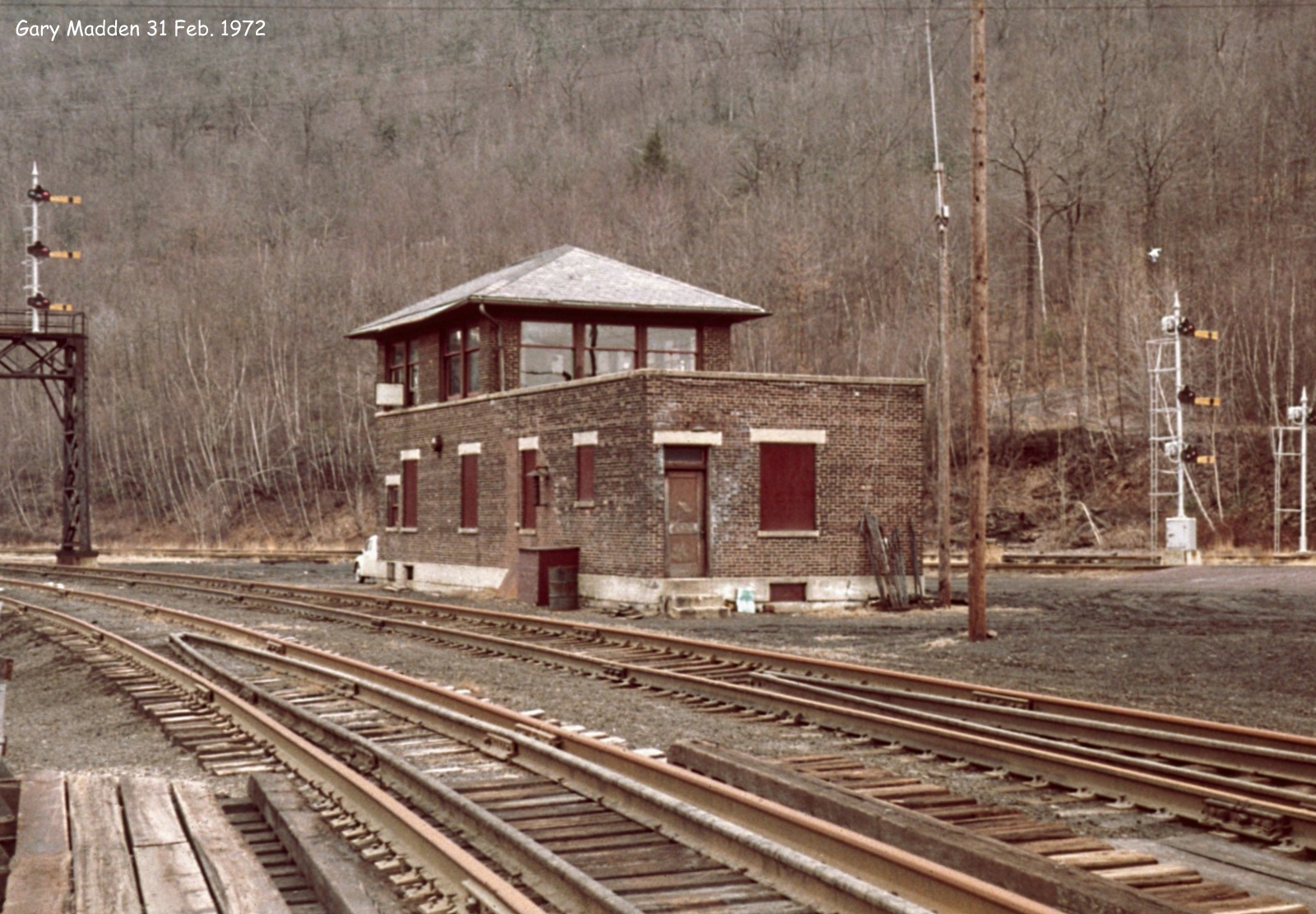
To recap, CORK interlocking and tower were constructed as part of the 1929 Lancaster station project which moved Lancaster's busy passenger depot away from a downtown alignment with slow speeds, lots of grade crossings and partial street running. The resulting interlocking plant spanned approximately 3.3 miles of main line track, which was an outlier for early 20th century direct wire controlled interlockings in North America. Like the contemporary Lancaster station. CORK was built of a dark brick and featured a prominent bay window sheathed in copper cladding. 


The tower had one auxiliary building that housed the primary compressed air plant and was situated on the south side of the tracks in line with the extreme west ends of the high level station platforms. The tower had an internal staircase with the shelf type relay room on the first floor. With its brick construction and slate roof, the tower was in excellent physical shape as it entered the 21st century. 


Heading inside the tower we find a typical layout with the operator's desk sitting in front of the US&S Model 14 interlocking machine. A defect detector readout and overhead catenary section breaker control panel are to the operator's right with the lockers, clock and old telecom plugboard sitting to the left. One interesting feature is that the room has retained its original 1929 vintage overhead lamp fixtures. 


The operator's space is feels like a more cramped version of HARRIS tower with less space around the interlocking machine on all four sides. The gap between the scoreboard style model board and the rear aligned internal staircase is particularly small. As with other PRR Main Line towers, lever blocking devices are stored on top of the interlocking machine and the bathroom is in the left rear corner. Also note the location of the refrigerator, notice board and train order hoops. 


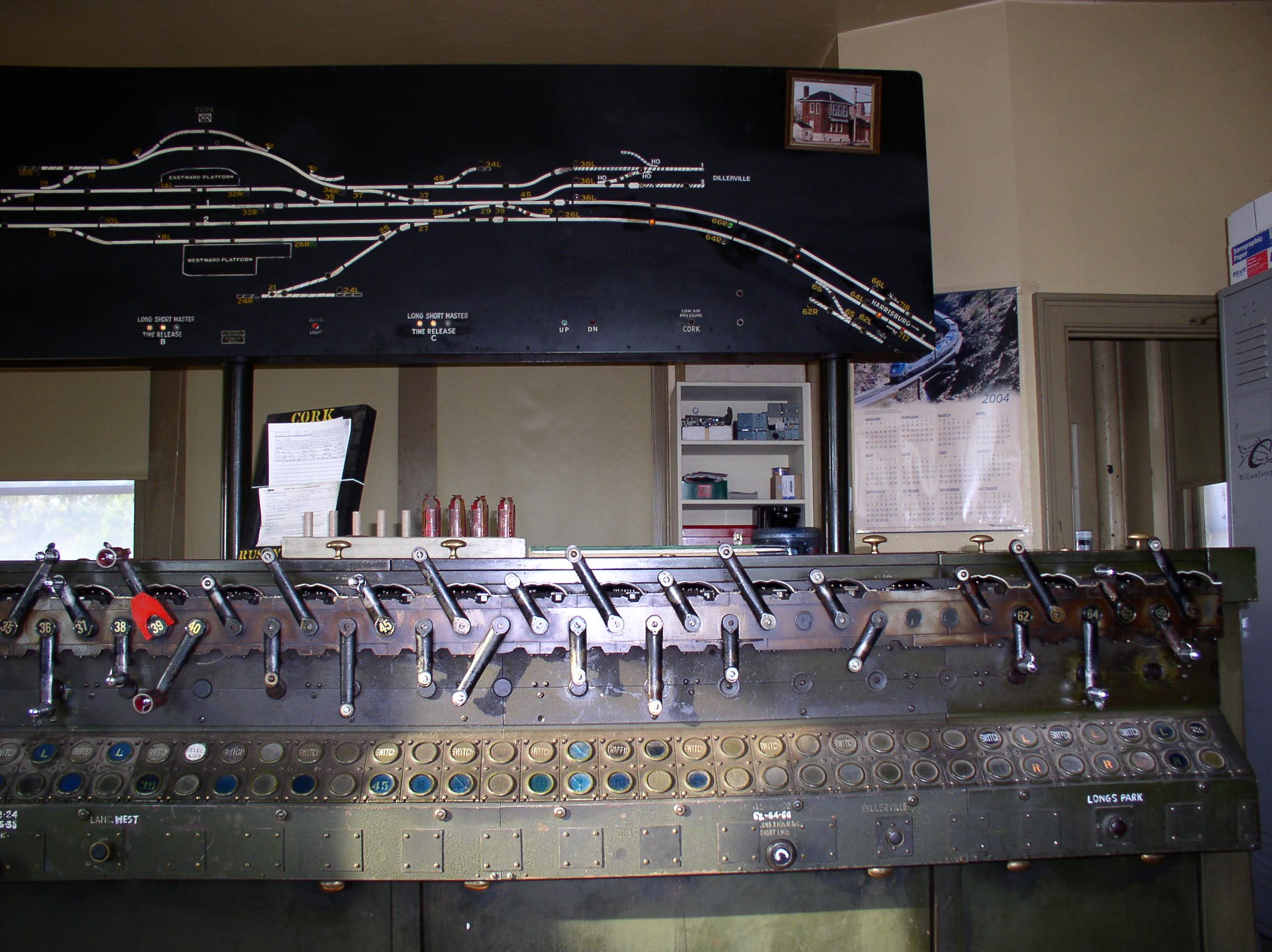
The sprawling CORK interlocking plant was controlled by a relatively modest 67 lever interlocking machine with 49 active levers in its 1960's configuration consisting of 23 levers for switches, 23 levers for signals, 2 levers for electric switch locks and 1 crossing lever for the Reading's Lancaster Branch diamond crossing. The plant was divided into three timer zones, A, B and C with the A timer handling the Conestoga section, the B timer the central Cork plant and the C timer the Reading crossing. The short run was 1 minute with the long run being about 5 minutes and 30 seconds. The tower also had 4 horns for Conestoga, the tower itself, Lancaster West, Dillersville yard and the Reading crossing (Longs Park).


One interesting feature was the presence of Rusty Rail tabs instead of the more usual placard. Besides that the levers were of the standard US&S crank type.


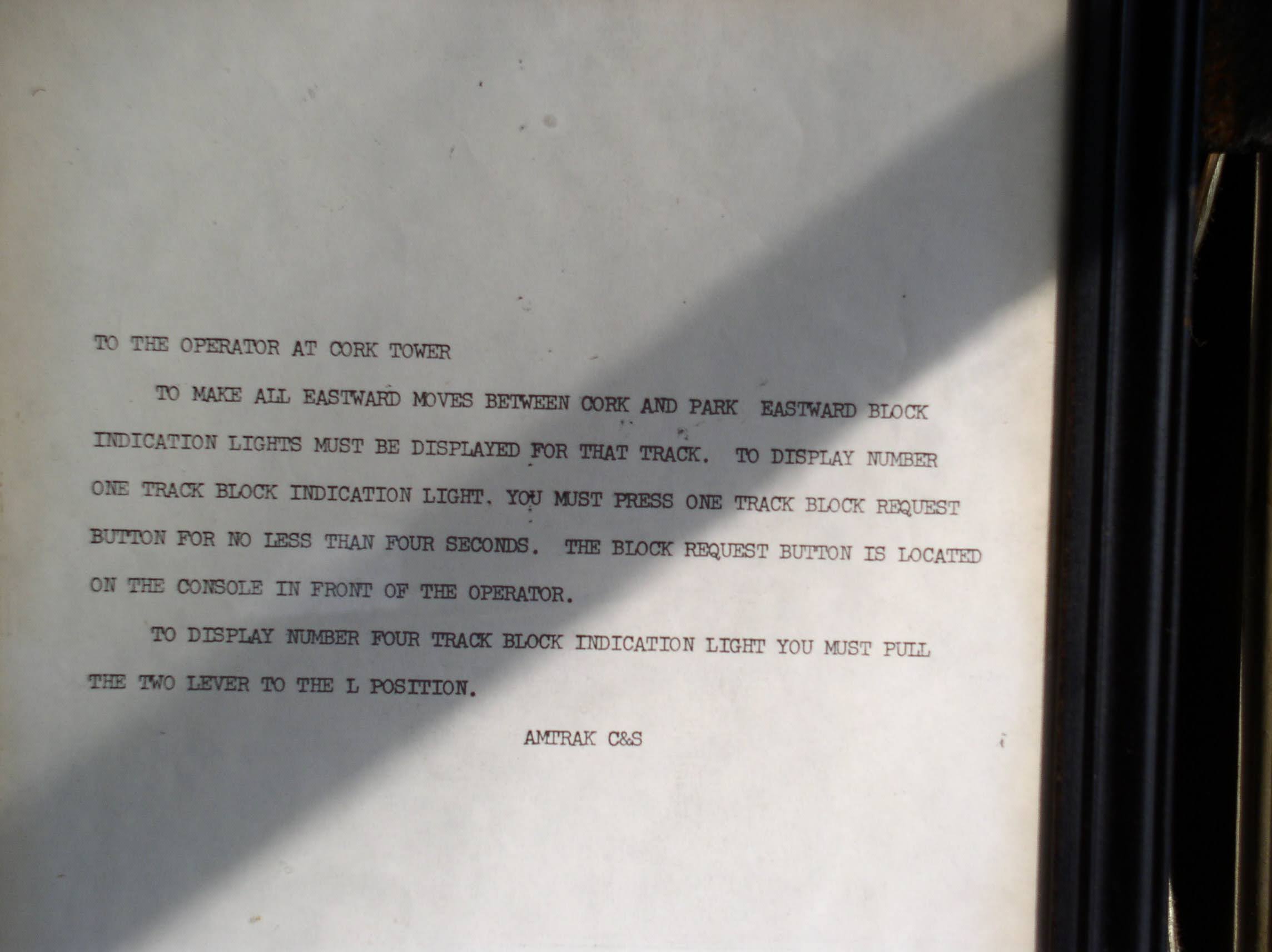
Although CORK's model board was a standard PRR illuminated type, it had several interesting features features. Grade crossing status lights were located at either end of the board to indicate the activation status of the Irishtown Road (east) or Eby Chiques (west) crossings. There were three low air alarms for East and West Conestoga in addition to the Cork main plant. In the post-1960 era two block indication lamps were added for tracks 1 and 4 eastbound. These had some interaction with PARK tower to the east as well as the intervening temporary block station at LEAMAN with track #1 being lit by the regular 2 lever and track #4 by a button on the operator's desk console. Best I can tell this was some technical method to prevent conflicting movements beyond what would be afforded by train orders and the dispatcher. Finally the most endearing model board feature was a framed photo of CORK tower itself that is also present in photos from c. 1992.
 

Saturday, June 29, 2024

RBMN CTC Gap Slowly Closes

 In my last RBMN signaling update from a speeder video in the winter of 2022, I noticed that turned signals had appeared in the last gap of dark territory on their Main Line between Hometown, PA and JIM THORPE JCT near Mach Chunk. Well as of the Iron Horse rambles of Summer 2024 the gap has closed ever so slightly with the ABS now ending at the turned Milepos 118S intermediate and the formerly turned 118N intermediate now being an active distant signal for JIM THORPE JCT. Although I didn't get a photo of the 118N, the 118S now bears the "END AUTO BLOCK" sign.

Apart from this I noticed no additional signaling changes on the former Conrail Lehigh Line, although I just now realized that the RBMN built a brand new interlocking on the Lehigh Line between CP-DUPONT and CP-LAUREL HILL in order to place out of service a portion of the second main track there.


The "new" SEIDEL interlocking uses the same 1980's GRS type three lamp housing color light signals that are also in place at CP-DUPONT and some nearby intermediates. Likely in place for well over a decade now, I had always assumed it was a Conrail era interlocking.

Sunday, March 24, 2024

Vermonter Route Signal Update

About 3 years ago I wrote a fairly positive report on the state of signaling on Amtrak's Vermonter route between New Haven and White River Junction. Unfortunately the recent spike in infrastructure spending has had major negative impacts on the New England Central portion of the route within just the past six months. The only good news is that some of the vintage searchlit signaling might hang on for a little while longer, but much of it is already on the way out.


First a quick overview of the old NECR signaling. Originally part of the Canadian National family under the Central Vermont brand, the rail line up the Connecticut River Valley would have likely passed into unsignaled TWC territory if not for the presence of Amtrak's Montrealer/Vermonter on the route that made abandoning the signaling system impossible from a regulatory point of view. The solution to make the signaling more cost effective was what I termed "Centralized Manual Block", with typical single track CTC sidings, but only a single ABS block between them (although technically the distant signal in advance of the next CTC interlocking did a second ABS block in that direction). This resulted in block lengths as long as 14 miles. South of Brattleboro, there was a additional 10 mile segment of non-signaled TWC before a (formerly) isolated interlocked junction between the old CV and Boston & Maine lines. In the 90's the NECR got some money to install a section of new CTC north of Windsor, VT, however this only included block signaling without interlockings with a more sensible 3 mile block spacing.


The first major change was the elimination of the TWC island south of Brattleboro. A new signaled siding was installed in Brattleboro itself, eliminating the old WEST RIVER CTC entrance interlocking and the related northbound searchlight distant signal just north of the Brattleboro station platform. It is not clear if the project included south of the NECR's Brattleboro yard, but if not evidence also pointed to sensibly spaced automatic block signals. Unfortunately the project also included the re-signaling of the EAST NORTHFIELD junction where the former Boston and Maine CT River Main Line splits off with the typical Safetrain Vaders. It is unclear if an additional new interlocking was installed at the south end of the NECR Brattleboro yard.

New block signaling between EAST NORTHFIELD and SOUTH BRATTLEBORO

New NORTH BRATTLEBORO interlocking south of the Brattleboro, VT station.

At the Putney CTC siding, the south end was re-signaled some years back with the notable poor man's bracket mast, however the north end is still searchlit with no evidence of impending changes. The same goes for the diamond crossing at Bellows Falls with cabling that implies a more recent logic update which might fend off searchlight replacement. I did not visit the Walpole siding just north of Bellows Falls, but as of June 2023 there were no signs of reconstruction. the news CTC siding at Claremont is a different story with new signals on the ground at the south end and in place, but no new relay hut yet installed at the north end. Both of these locations will use Vader masts from Progress rail (aka EMD, aka Caterpillar). This siding is also being upgraded from restricted speed to signaled which will allow Amtrak to better use the station-side platform at Claremont at the cost of siding exit dwarf signals.

New signals up at NORTH CLAREMONT.

Between Claremont and Windsor it also appears that new ABS signals have been installed at more regular intervals. The controlled point at Windsor has work going on, but the replacement signal masts are not yet present. A station sign also indicates that the "CTC" between Windsor and White River Jct was at one time operated under Canadian style Occupation Conrail System (OCS) rules. As I understand it this is somewhat analogous to APB system.

Northern extent of the Central VT era CTC.

From a documentation perspective, while I just missed getting photos of EAST NORTHFIELD and WEST RIVER at Brattleboro, I was able to fully document interlockings near Putney, Bellows Falls, Claremont and Windsor. I hope to return shortly and get the remaining signal locations around Wapole.

Tuesday, January 30, 2024

Amtrak's Post Road Puzzle

The Albany Port Road Branch, now under long term lease to Amtrak, has an interesting history. One of the few stretches of non-commuter North American main line track dedicated solely to passenger operation, the Post Road Branch represents the original route of the Boston and Albany before the construction of the Selkirk Cutoff that allowed New York Contrail freight trains to bypass the Albany terminal area in the 1920's. In the 1970's, Penn Central completely ripped up the track on the 12 mile branch as a cost cutting measure before being ordered to restore it by the ICC. Since then it has hosted exactly two regular trains per day, the Boston section of the east and westbound Lake Shore Limited and with an 80mph track speeds, it currently represents the fastest portion of the Boston to Albany route. 

Listed as operating under Rule 261 bi-directional signaling in the timetables of both Conrail and CSX one might assume that the line would have something on the order of 4 or 5 intermediate signal locations based on the typical North American main line block length of 2-3 miles. Riding the line I recall having trouble spotting these signal locations, but I assumed they were there. More recently I noticed that Boston Line CP-187 had been re-signaled by CSX and then used Google Earth to carefully scan the Post Road to see if Amtrak had used the opportunity to convert it to Rule 562 cab signals without wayside intermediates. I couldn't find the intermediates or their associated ACSES beacons, but there was also no evidence of cab signaling. It was only then I realized what Conrail had done.

In 2021 I reported on the Boston and Maine's budget CTC signaling on the Connecticut Valley route. Each CTC "block" of 6-8 miles in length might have only one intermediate signal, the distant two miles from the next CTC siding interlocking. Well when I saw the  Milepost 188.8 intermediate above that governs only eastbound movements as they approach CP-187, it became clear that Conrail had done the same thing, just with a 10 mile long block.

Reviewing my archives I discovered a similar westbound only signal about 1-2 miles east of CP-141 at Albany confirming the use of a "superblock" type configuration. While this certainly matches the traffic levels of 2 trains per day and cuts down on some relay logic, it still means that a single faulty track circuit component can trigger up to 10 miles of Restricted speed operation, or possibly 10 miles of Approach.  

With the limited traffic it will be interesting if Amtrak extends the cab signaling to CP-187 and close the last remaining cab signal gap between Boston and Albany. It's not like there are not intermediate signaling hardware on the line since a block that long needs occasional repeaters for track circuit integrity.

Sunday, May 14, 2023

ATCS Caught in Frequency Realignment

I know I'm a couple years late on this news, but ATCS (Advanced Train Control System) radio relay that replaced pole based code lines for Centralized Traffic Control schemes is in the process of changing frequencies (or just being completely phased out) due to an FCC directive that will reallocate its 900Mhz spectrum for wireless broadband in 2025. For the last 20+ years ATCS has been super useful for enthusiasts to monitor railroad dispatching in real time as data packets are relayed from station to station, just like with an old CTC code line, only now they can be sniffed and displayed.

Although some railroads like CSX shifted away from ATCS in favor of satellite links years ago and hard links like fiber optics were popular for a window in the 80's and 90's, ATCS has been a massively useful took for those looking to take photos of trains or just gather data that can be used for all manner of public policy. Word is that for those railroads wanting to keep the ATCS system, the data will piggyback on the frequencies allocated for PTC communications. However because the PTC communications specifications have to be purchased for a sizable amount of money (who'd have thunk it), the ATCS monitoring community is facing a reverse engineering challenge. 

The silver lining could be that after some amount of outage, the community will be able to monitor not only lineups, but also PTC signaling and authority information.

Friday, January 6, 2023

Last SP Donner Pass Signals Retired

This definitely falls into the category of a news story that fell through the cracks, but after a bit of uncertainty I can confirm that all of the remaining Southern Pacific vintage signals on the Union Pacific Donner Pass route (Roseville Sub) between SHED 10 and and WEST NORDEN have been retired and replaced by extra height aluminum signal bridges of the same type already seen between SWITCH 9 and SHED 10 and east of EAST NORDEN. This  change took place sometime in the 2020-2022 time frame with the searchlights at WEST NORDEN being the last converted.

Donner Pass Phase 1 replacement gantry at MP 173 in 2017

Although this development was not entirely surprising, the surviving SP signal locations, with the exception of WEST NORDEN, used Safetran CL-20 modules in a target configuration and had PTC antennas mounted on the steel lattice signal bridges. Although not part of a PTC project, it is likely that UP desired to replace the relay based signal logic and simplify maintainer access. In total 5 automatic locations and WEST NORDEN interlocking were affected.


WEST NORDEN was the former location where the old 1860's main track #1 split from the later main track #2 with the interlocking being completely covered in a snow shed. After the completion of the first phase of Donner Pass re-signaling in 2017 it was the only remaining set of searchlights on the entire Donner Pass route (US&S H-2's)


If there can be any consolation it is that the steel lattice signal bridges themselves have remained in place due to the inaccessibility by road cranes. In face, some of the phase 1 locations left the searchlight heads turned in place.  


Unlike phase 1, phase 2 replaced the old SP locations on a 1 for 1 basis with most locations remaining the same except for the Milepost 181 automatics which have been removed in their entirety, creating a single 3.2 mile block where a 2.0 mike and a 1.2 mile block had existed before. In addition the the Vader type signals were moved off the westbound SHED 10 lattice gantry and replaced with masts at the mouth of the snow shed 450 feet to the west.

I finally got confirmation of this sad development due to media posted of the 2023 Donner Pass rotary plough training run so if you search out media of that event you can likely catch sight of some of the converted signal locations..