Search This Blog

Showing posts with label signals. Show all posts

Sunday, August 9, 2026

Position Lights Replaced at QUEENS Interlocking

 In 2005 the future looked somewhat bright at QUEENS Interlocking. Although the US&S Model 14 interlocking machine has been taken out of service, the extra long interlocking plant had been rebuilt with brand new PRR style amber position light signals that were set to last 40 years or more. Well changes in LIRR operations that ultimately closed the tower in 2020 have now come for the position lights. LIRR's new "Reduced Aspect Signals" began to appear at the eastern end of QUEENS in 2023 and it was reported that the west end had had its position lights replaced. 

QUEENS East End RAS dwarfs in 2023

QUEENS eastbound PLs on the final day of service.

If there is a silver lining the classic eastbound PRR style signal bridge was retained for the new RAS dwarfs. It is also not entirely clear about what if anything replaced the intermediate PRR PL cantilevers. Or if their conversion is to occur at a later date. 

QUEENS intermediate PL cantilevers in the Winter of 2025/2026.

QUEENS was subjected to numerous re-configurations over the past 20 years as the Main Line 3rd Track project progressed and a new infill station was built at Elmont. When first rebuilt in 2005 QUEENS has 4 PL signal locations dividing the interlocking into 3 logical zones. From west to east this consisted of the original PRR PL gantry, Medium Speed crossovers, modern PL cantilevers, the 80mph high speed crossovers, a modern PL gantry, an unused portion and finally a PL "gantrylever".

Westbound PRR PL "gantrylever" protecting the future 80mph crossover location in 2015.

Original post-2005 configuration of QUEENS high speed turnouts. 

In 2023 the 3rd track project and Elmont station projects added crossovers into the east end, however instead of using the 2005 infrastructure that intended to support this very move, the LIRR depopulated the signal gantries in favor of RAS dwarfs and temporary PRR pedestal signals. 

It was unclear exactly what motivated this change, but the process now appears to be complete. This unfortunately represents a major loss of classic PRR amber position lights on modern 4-track structures.

Saturday, July 25, 2026

Automatic Signals To Be Axed From NY Penn Station Lines 1 and 2

Amtrak is currently halfway through a project to rehabilitate its East River Tunnels that were damaged during Hurricane Sandy way back in 2012. Lines 1 and 2, the southern pair of tunnels between Manhattan and Queens, were subjected to significant salt water intrusion and although this water was removed in short order, the salt created long term reliability problems. The solution has been a three year project to completely gut the tunnels to the 1910 iron rings and then rebuild them with a new concrete liner and a no ballast trackway. As of now the project is half way complete with Line 2 rebuilt and ready for service.  

Unfortunately Amtrak has also taken the opportunity to remove the automatic block wayside signaling within the tunnel. A total of 13 automatic block signals, some dating all the way back to 1910, were removed from the 2.75 mile long Line 2 tunnel. The 5 eastbound and 6 westbound and 2 westbound repeater signals were replaced by Rule 562 cab signaling without fixed wayside signals.  Rule 280a "C" lamps were added to the 708WA and 704W signals in F interlocking along with a new 580E signal at JO interlocking at the western Line 2 tunnel portal replacing the 1E02 automatic. Similar to CP-MID in the North River tunnels between Penn Station and New Jersey, a new controlled point, CP-LOW, was installed 1000 feet east of the 1st Ave shaft for westbound movements. This creates two Rule 280a "super blocks" within the tunnel in case of cab signal failure. 

Existing ABS configuration for Lines 1 and 2 west 

Existing ABS configuration for Lines 1, 2, 3 and 4 east

In a similar fashion to Grand Central and the defunct Cleveland Union Terminal, Penn Station used a unique style of color light signal as the technology of high intensity, long life electric bubs was still relativity new with semaphores being the then state of the art. ABS signals in the East River tubes were of the "frog eye" variety to create an "offset head" appearance that was customary for automatic signals. The upper "head" had the typical R/Y/G lamps with G/Y on the lower. This allowed for a 4 or 5 block progression for trains approaching the slow speed Penn Station complex, Clear -> Approach Medium -> Approach Slow -> Restricting. As signals at Penn Station can only display slow speed indications at best, the two western ABS locations would best display Approach Medium -> Approach Slow. It is unclear how many cab signal blocks have replaced the 5-6 wayside blocks, but CP-LOW's ability to display Cab Speed (60mph) implies that it matches the high density cab signaling installed on the Jersey approaches. 

"Frog Eye' type NY Penn automatic signal pressed into absolute service.

At this point the adjacent Line 1 will be shut down and reconstructed in a similar fashion over the next 18 months. Fortunately Lines 3 and 4, primarily used by the LIRR, were not damaged in the storm and will be left in their original condition for the foreseeable future. As I mentioned before the North River tunnels were already re-signaled in the late 1990's and will be fully rebuilt after the opening of the new Gateway tunnels in the 2030's.

Sunday, April 19, 2026

Asymmetric Tri-Lights

 When one thinks of the North American tri-light signal configuration (circular target with the lamps clustered in a triangle) one might assume that if the lamps are not set in a single large housing they would consist of single lamp modules kit bashed into a triangle instead of a vertical stack. For the most popular color light signal modules, the Safetran CLS-20, this is the case, however over the years the industry has produced some modular tri-light designs that don't use a common lamp module.

Of course I was prompted to write this post after being confronted by a tri-light product from our old friends at L&W. Purchased by Amtrak for its New Haven to Boston "Shore Line", this tri light has a single lamp module at the bottom with a double lamp cast aluminum housing above. From the front it looks like three singles due to the characteristic gap in the middle, but closer inspection reveals the true configuration.


The second example is from Transcontrol, a company typically associated with active grade crossing equipment. Somehow they were part of the contract to re-signal Hoboken Terminal around 1984 and their tri-light solution involves two standard lamp modules above an extra large one, which I assume serves as a junction box for the whole assembly. (Note, until this post I was unaware that Transcontrol made signal hardware and I might follow up with them in the future if more information presents itself.) 

One might consider the crop of asymmetric tri-lights to be offshoots of the original US&S style "TR", which features a single cast iron housing with three individual lamp sockets. Signals need terminal blocks to connect the interior wiring to the external wiring and terminal blocks take up space.

If you're wondering how the CLS-20 does it, there are openings on top at the 11 and 1 o'clock positions that match with other openings at the 7 and 4 o'clock positions. For a tri-light configuration the lamp modules are mounted 4 to 11 and 7 to 1. A supplier who can handle both vertical and tri-lights with a single SKU is naturally at an advantage so as a result the asymmetric tri-light has faded into history.

Sunday, April 5, 2026

GRS and the Age of Aluminum Signals

People talk a lot about disruption and an often overlooked disruption was the North American railroad signal industry's transition from cast iron to aluminum in the 1980's. Here I am talking about the railroad signals themselves, not the entire signaling product line, but the ability for new companies to enter the market selling  new types of bulbs in a housing put a lot of pressure on the US&S / GRS duopoly. Both companies tried to respond to the new competition, but only one was successful over the long term. 

Iron melts at around 2300o F while aluminum melts at around 1200o. The former requires a foundry and expensive sand molds, the latter can be done with an electric furnace and can get away with using permanent molds made of steel. By 1980 cast iron had been the material of choice for railway signals going back almost a century with GRS and US&S operating the necessary "smokestack" industrial infrastructure to make the components at scale. However, since World War 2 aluminum had become much more common in everyday products like cars and bicycles, and investors looked at the high margin railroad signaling duopoly and wondered if their might be a better way. 

Safetran CLS-10

Safetran was the best known starting with the aluminum CLS-10 that directly competed with the cast iron GRS D Type modular color light signal. The aluminum (and solid state) Unilens was developed to go after the searchlight market and the NR went after GRS's famed G Type. About the same time both L&W and Harmon also entered the market with their own cast aluminum signal modules. The moat had been bridged and aluminum would eventually force cast iron signals out of the market entirely.


Of course both GRS and US&S were going to complete in the new aluminum signal market with US&S seeing some modest success with its clean cut modular box and CR-2 twilight. GRS on the other hand did not do so well.  In 1989 GRS was purchased by the Sasib Railway Group of Italy and they came out with a product family of aluminum signals. The better known family member was a 3-lamp monolithic signal similar to a US&S style P or R. This had some high profile sales such as the LA Union Station and Dallas Terminal re-signaling projects.

After Sasib was acquired by Alstom in 1998 this type of signal was still being sold, just with the Sasib logo scratched off.

The second offering in this family is the much rarer tri-light type intended as a G-Head replacement.  The only place I have noticed them was on the MBTA Dorchester Branch at Readville. Again, note the Sasib logo.


What I have yet to find is an aluminum D Type replacement to compete in the most popular part of the signal market, modular single lamp color lights. Of course maybe that's the point. GRS saw the market was saturated with lower cost competitors and decided not to bother. US&S did try to compete and was rewarded with lackluster sales. So why did the other two signal types fail? 1990 was a bit of an odd time in the railroad signals market. Traditional searchlights were still selling and it still made economic sense for railroads to refurbish old signals and reuse them in new signal projects. Used signals were in abundance as main line track was trimmed down from what they had been in the 1960's. It would be the better part of a decade before Safetran CLS-20 sales exploded as part of the Darth Vader boom of the 2000's.

Generic Canadian Pacific 3-stack.

In hindsight the bare bones GRS 3-lamp monolith may have simply been ahead of its time as Canadian Pacific has more recently adopted a similar no frills box as its standard new signal.

Saturday, March 21, 2026

Little Boxes, Little Boxes

If the age of the Safetran scallop shell is actually ending, what appears to be replacing it are little boxes and they all look just the same. Of course modular square box housing signals are nothing new with the GRS D Type seeing widespread use up through the 1980's along with offerings from Harmon and L&W (which I have touched on before). What's interesting is that the new era of "little boxes" appear a bit more homogenous than the last so if we are seeing an end to the scallop shell era, what comes next could be equally bland. 

Above are new signals from Lindsay recently installed on the DART Silver Line. Lindsay had previously gotten the adjacent Texrail account and at the time I noted that its single color modular offerings still featured the GE logo, which put them in the lineage of Harmon.  Well the new batch used on the Silver Line have swapped out the GE circle for the Lindsay swoosh (which itself is vaguely reminiscent of the original Harmon logo). 

Now look at the new signal from Progress Rail that is being deployed on new projects by CSX. Looks awfully familiar to what Lindsay is selling. Keep in mind that little of these box designs would be protected by intellectual property apart from the logo so new market entrants are effectively free to copy what is in essence a cast aluminum box with a hinged door.

Of course this warrants comparison with Union Switch and Signal's attempt to enter this market segment 30 some odd years ago. While also a box, the lines are crisper and the design far less cluttered, which probably indicates an elevated price point. DART famously used blank US&S modules to increase the height of its mast style signals, but away from the public transport sector, the US&S boxes saw limited adoption.

Anyway with the scallop shell monopoly now broken, it will be interesting to see if we get additional "little box" suppliers or perhaps something more paradigm changing like LED searchlights.

Friday, March 13, 2026

Amtrak Harrisburg Line Re-Signaling Hits FRAZER

I have previously discussed the drown out closure of Amtrak's THORN tower in Thorndale, PA. Recently the re-signaling efforts have hit FRAZER interlocking where new colorized position light masts have replaced the old amber style PLs. This is just another symptom of the eastern end of Thorn's territory being converted from its 1937 ABS 251 CTC to contemporary Rule 261 CTC. 


FRAZER is an interesting part of THORN's zone of responsibility. As covered in Part 2 of my old PRR Main Line signal survey, FRAZER was placed in service around 1994 when the old Paoli MU shoppe complex was closed due to massive PCB contamination stretching back to 1915. As a replacement a new yard and inspection shoppe was opened near Frazer, PA, extending basic SEPTA R5 service an additional stop to Malvern, PA. The only problem was that there was no interlocking infrastructure at the Frazer location to to support what is SEPTA's busiest commuter rail line. The solution was a new interlocking, FRAZER, that consisted of a yard lead, a turnback track and a center pocket track where eastbound R5 trains could wait for any conflicting movements to clear up.


There was some initial debate about whom would control the interlocking as in 1994 the entire Amtrak Harrisburg Line was still paper dispatched and FRAZER was located directly between the territories of THORN and PAOLI towers. A 1994 fire at BRYN MAWR tower forced the issue when PAOLI  took remote control of that interlocking leaving only THORN with the necessary spoons for more territory. However the increased workload did bump the operator's position at THORN to that of a higher paid Train Director. 


Because FRAZER was located in single direction Rule 251 territory about 4 miles from an existing interlocked crossover, it was not deemed necessary to give FRAZER universal crossovers of its own, so only a training point path was provided mainly for R5 trains heading east. Because this part of the Main Line was built with 4 tracks, there was ample room for a centrally placed pocket track. 


FRAZER is likely the last new Amtrak interlocking constructed with amber PRR position light signals. By 1994 the conversion of the NEC to colorized PRR position lights (a downstream outcome of the Chase, MD wreck) was well under way, but with no plans to convert the old PRR Main Line (Amtrak Harrisburg Line) FRAZER was designed with amber lamps for the sake of commonality. This view was incredibly short lived as PAXON and WOODBINE interlockings built to support the new Overbrook Maintenance Facility just a year or two later would have the position color lights.


It is unclear if FRAZER's conversion is part of a full re-signaling or just a modification to support both the colorized signals, bi-directional operation and Rule 562 cab signals without fixed wayside signals. Dwarf and pedestal signals unaffected by\the changes do not appear to be facing replacement along with the primary relay hut. New Rule 562 signal indication points between FRAZER and THORN are in place along with new signal equipment at GLEN and the planned decommissioning of DOWNS. If I am not mistaken, this will also be the first time SEPTA crews have to deal with Rule 280a "Clear to Next Interlocking" signals on their regular territory as their own Rule 562 territory lacks this feature, instead handling cab signal failures with dispatcher issued Form D's.

Friday, March 6, 2026

Former Dallas Terminal Railroad Re-signaling

 The Dallas Terminal Railroad can be considered to be in the midst of a slow-motion re-signaling, partly set off by Amtrak move from Union Pacific to TRE routing between Dallas and Fort Worth. This matters because the stretch of of 5 back-to-back interlockings, while "modern" in appearance, actually represents a vestige of late stage relay interlocking installed in the 80's or 90's with quirky signals of a non-Safetran nature.

The stretch in question used to be covered by the Dallas Terminal Railroad's Towers 106 and 107 that managed the west and east ends of Dallas Union Station. This has since become part of the Union Pacific Dallas Sub and from east to west consists of REUNION, DALLAS, JFK JCT, TRE JCT and INDUSTRIAL X-OVER interlockings. An additional interlocking, BN CONNECTION, makes up the third corner of the wye with TRE JCT and JFK JCT.

Around 2015 Amtrak shifted from the UP Dallas Sub to the ex-Rock Island Trinity Rail Express commuter route west of Union Station. Around 2023 the switch that connected the Amtrak platform at Union Station to the Dallas Sub was removed along with the west leg of the wye, turning both TRE JCT, BN CONNECTION and the TRE portion of JFK JCT into vestigial interlockings with signals guarding empty track. REUNION also saw the removal of the crossover to the east end of the Dallas MoW/passenger car storage track. 


In 2026 the other shoe dropped with the vestigial JFK JCT signals being removed and new signals going up at DALLAS. I don't know the exact plans, but there are two clear options. The first is that DALLAS loses its crossover and becomes an interlocked connection to the MoW stub with other interlockings staying unchanged. The second, and what I consider to be the more likely scenario, is that JFK JCT will be merged into DALLAS with INDUSTRIAL XOVER and the vestigial TRE JCT being eliminated along with BN CONNECTION. Currently trains on track #1 encounter 4 signals within 3000 feet, not a situation that is likely to play nice with PTC. Moreover, INDUSTRIAL XOVER duplicates the facing point crossover available at DALLAS. While its possible INDUSTRIAL XOVER might be kept something tells me that it is surplus to requirements.


So why does this all matter? Like I said the current setup uses late stage all or partial relay logic and non-Safetran signals consisting of L&W modular and GRS monobloc equipment. Second the close signal spacing introduced some very interesting signal progressions. In fact because of the sharp turn of the Dallas Sub at JFK JCT, the default progression for track #1 westbound is an Approach Restricting at DALLAS to a Diverging Clear (straight clear is onto the TRE) at JFK JCT. I suspect the new interlocking will display a Clear to UP train movements despite the curve. All together, what is an accessible place to observe interesting signal indications on interesting signals is about to get much less interesting, even if the exact amount of uninterestingness remains to be seen. 


Saturday, February 14, 2026

Amtrak PORTAL Bridge Re-Labeling

The requirements of safety and signaling made railroads some of the first organizations to manage systems of unique identifiers and all their associated corner cases. Today we will explore how Amtrak is handling some of these corner cases as they replace the historic PORTAL swing bridge on the Pennsylvania Tunnel extension in the New Jersey Meadowlands.   

1910 vintage PORTAL swing bridge.

Let's first discuss names. Originally "W" cabin, PORTAL's current name emerged around the 1930's when increased use of voice-based telecommunications prompted the PRR to switch many of its interlocking identifiers from telegraph letter codes to names evocative of their local surroundings. At the time the swing bridge and its crossovers were the last interlocking station before the western portal of the North River Tunnels, thus PORTAL. In the mid-1990's Amtrak and New Jersey Transit implemented a connection between the DL&W main line and the Penn Station tunnel route immediately west of the PORTAL bridge. Branded Mid-Town Direct, this service would drastically decrease trip times compared to the 2-sear ride via Hoboken and someone came up with the name SWIFT for the new junction. 

"New" Eastbound PORTAL signal gantry over PRR era gantry.


Westbound gantry at SWIFT with route indicators.

The other important labeling system is for the universe of railroad tracks. It might seem straightforward to just start at 1 (or A) and advance upward, but on which side of the right of way does one start counting? What if you need to add a track on the "below" 1? I'll make a post about track numbering at some point, but in this case the PRR was forward looking and went with track #2 (eastbound) and #3 (westbound) since in 1910 it was foreseeable that traffic growth would require tracks #1 and #4 at some point in the future. When the Secaucus Transfer opened, the layout placed slower station tracks between main tracks #2 and #3. These were given letter designations with tracks A and B. PORTAL interlocking was even expanded to include switches into the western end of track A.  

1990's PORTAL extension to support new Track A with 80mph turnouts.

Fast forward to now and Amtrak is building a brand new PORTAL replacement bridge that will also replace most or all of the current PORTAL and SWIFT interlockings. However for the better part of a year both old and new bridges and tracks will be in service and keeping the names the same might result in safety critical confusion. As a result Amtrak proactively renamed the old tracks and interlockings in December, 2025 with PORTAL becoming OLD PORTAL, SWIFT becoming and OLD SWIFT, track #2 becoming track #22 and track #3 becoming #33.

It gets better because Amtrak employs a track number based labeling system for signals and interlocking appliances. This made signals like 2E and 3E into 22E and 33E. Likewise switches like #23 and #32 became #2233 and #3322. Note that lettered tracks are just assigned a number for the purposes of switch and signal labeling with 7 standing in for A, but because track A doesn't cross the bridge there was no need for it to participate in the renaming. 

The now renamed 2233 crossover and 227 turnout at SWIFT.

Like automatic signal number plates and interlocking station signs, track numbering is a fascinating topic that I will dive into at some point, but for now I'll leave things in the context of a topical news item. 

Saturday, January 17, 2026

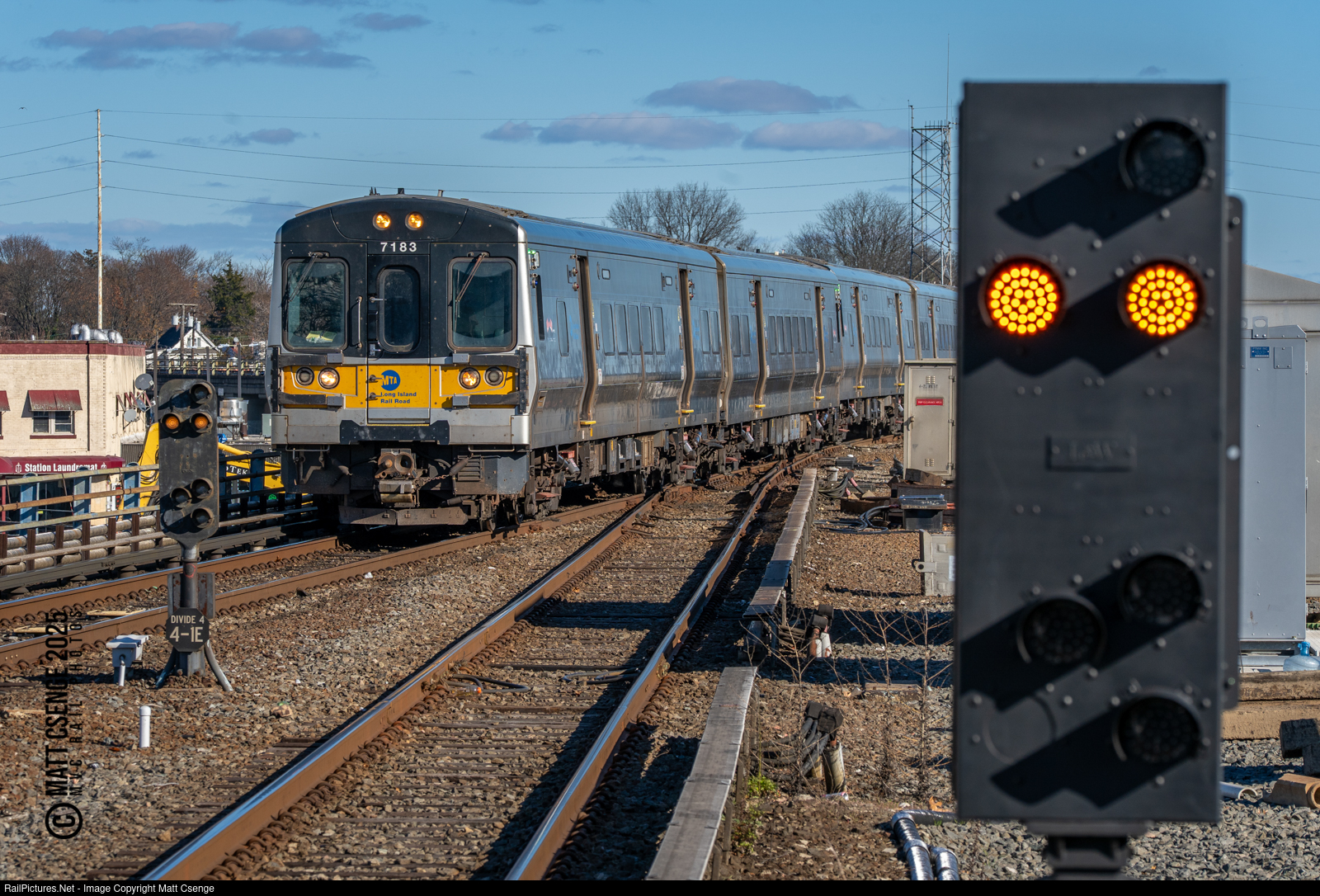
L&W PRR Pedestal Signals Appear on the LIRR.

With cast iron PRR type "pedestal" position light signals from US&S long out of production, SEPTA appeared to be the first to purchase ersatz pedestal signals from independent signal manufacturer L&W back in 2019. These boxy LED equipped replacements have subsequently appeared on Amtrak around Philadelphia's PENN interlocking. Well it seems that despite their move towards reduced aspect signaling, the LIRR has purchased some as well with a prominent example now at DIVIDE interlocking.


 While not completely unexpected the LIRR is known to have a sizable stock of pedestal signals that it uses during re-signaling projects to take the place of gantry-mounted PLs until the cutover process. However the number of concurrent signal projects may have exhausted the supply necessitating the purchase of new L&W stock. 

Sunday, December 21, 2025

PHOTOS: LEAMAN - The Place To Be

The Pennsylvania Railroad Main Line, today operated by Amtrak as their Harrisburg Line, is known for its many interlocking towers that survived well into the 21st Century and I have covered several of them on this blog. However there is one "place" that isn't quite a tower, although it has many of the trappings of one. While the PRR seemed to have an aversion to CTC, it still had a lot more signaling infrastructure than peer railroads with a particular focus on Manual Block System and its related component, the block station. What's a block station? Well its a location on the line that can host a block operator who in turn can perform those duties necessary for some (manual) block operation like transmitting train orders, displaying signals and throwing hand operated switches. Even on signaled PRR main lines one could find non-interlocked block stations open either 24/7 or part time.

Located at milepost 56.7 between PARK and CORK interlockings on the Main Line is the town of of Leaman Place. You might recognize the name for being the interchange point for the Strasburg Railroad. This segment of the Main Line was electrified in 1939 and at the time  featured 4 main tracks. Despite the 24 mile gap between the two interlocking stations, no intermediate crossovers were provided as most disruptions could be dealt with by relying on the "spare" main track (with the parallel Columbia Branch directly providing an additional two tracks of relief capacity for freight). However in 1948 tracks 2 and 3 were removed due to declining traffic and evidently this length of single track operation during maintenance or equipment failure had become an issue because in 1961 the PRR constructed the new LEAMAN block station at milepost 57.0 with a pair of main track crossovers protected by semi-automatic signals. Unlike similar hand throw block stations LEAMAN had no normal hours of operation and was only open as needed for single track operation.


LEAMAN consisted of a pair of center locked hand operated crossovers and a pair of position light signals oriented in the normal direction of travel. As this was not an interlocking, no reverse direction signals were not installed. A rather robust operator's shelter was provided and outfitted with  station signs, climate control and telecommunications. 


This sort of hand operated crossover layout was not uncommon on other double track ABS main lines with the requisite "shelter" typically taking the form of a wayside telephone booth that would allow crews to call the dispatcher to pick up their movement authority to run through the single track area or to report clear of it. However LEAMAN was unique in that its signals and electric switch locks were tied to a small control panel inside the operator's shelter and not accessible to road crews.