Search This Blog

Showing posts with label KCS. Show all posts

Monday, June 20, 2022

Beware the Three Headed Monster

 In North American railroad Signaling truly "universal" rules are pretty rare as in almost every situation one can usually find exceptions.  For having a high green reserved exclusively for Clear is pretty universal except the Bessemer and Lake Erie uses G/*Y* for Approach Limited and G/Y for Limited Clear.  Well another one of these rules is that intermediate signals either have one or two heads. By intermediate signals I am referring to signals with a number plate or signals with offset heads that cannot display an absolute Stop indication. Well there is one big exception to this and it is the Y/R/G Approach Slow indication used by a number of Conrail predecessors like the New York Central and Reading Systems and, more recently, CSX via the Seaboard System. 


This results in what I like to call a "three headed monster" in that you have an exceptionally tall intermediate signal that makes one question if they are at an interlocking or not.  Although potentially less of an issue due to PTC, salience is a huge human factors issue and when designing a signaling system from scratch like Caltrain did, making every absolute signal three heads, every automatic distant signals two heads and every basic block signal one head makes it harder for the engineer to become confused about what sort of signal is coming up. The Y/R/G three headed monster sort of blows this approach out of the water, but fortunately Approach Slow is one of the less commonly encountered indications. 


However if one is able to look past the signal policy issues and get into the fun world of rare signaling setups, CSX's three headed monster as a few additional tricks up its sleeve. If an interlocking has both slow and Medium/Limited Speed then you get a 7 lamp, 3 head intermediate signal (GYR-GR-GR) like the ones at Milepost 70 west of Point of Rocks.

 Alright, but I think we can do even better!  What if we had a situation with both Slow and Medium Speed routes AND short signal blocks between that next interlocking and one after.  Well, then we'd have an 8 lamp, 3 head intermediate signal (GYR-GYR-GR) and thanks to some recent capacity expansion and re-signaling work an example now exists in the Richmond area on the Belt Line just west of AY wye.

Don't forget, if CSX had simply adopted the NORAC style signal rules with Y/Y Approach Slow and *Y* Advance Approach they would have been able to do this with 6 lamps and 2 heads, but thanks to their Dixieland myopia we now have what is probably the ultimate intermediate signal. The fact that the masts are on both tracks is even better, 
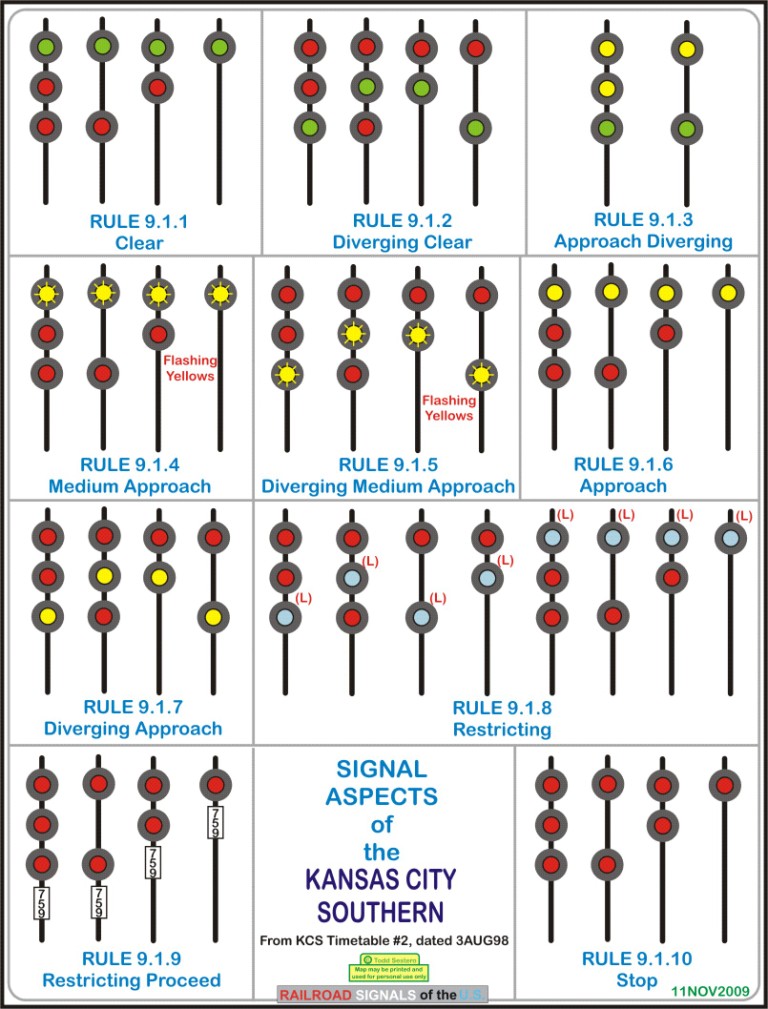
 
Before I go I would like to mention that there is another three headed intermediate signal still in use and that would be Y/Y/G Approach Diverging on Kansas City Southern. Some newer materials are showing the use of Y/Y and with all the recent re-signaling I am unsure if any Y/Y/G still survives, but it technically could exist. Also, in case anyone was wondering if Canada and its crazy quilt of signal indications has a three headed intermediate, they do not as the indication chart would show it with offset heads and all offset head indications have at most two heads. 

Anyway, if I missed anything or you know other examples of an ultimate intermediate signal location please let me know in the comments.

Tuesday, April 6, 2021

What the KCS - CN/CP Merger Means for Signaling

 A few months ago I discussed the absolute signaling disaster the potential purchase of Pam Am by CSX would be.  Since rail mergers are suddenly in vogue again, Canadian National and Canadian Pacific are nowboth bidding for Kansas City Southern and I am sure at least someone out there is interested in what this will mean for the signaling on the KCS.

To make a long story short, not much.  Not only is KCS pretty much entirely Darth Vader masts or slightly older traffic lights, both CN and CP are good about preserving the unique signal rules of their subsidiaries.  For example the CN owned Grand Trunk Western route uses a very NORAC style speed signaling system.  That feeds into the CN owned Illinois Central that still uses a bland weak route signaling system, which is also distinct from the CN owned EJ&E's signaling system. So yeah, don't sweat this one, just sit back and enjoy the C40-8s or SD70ACUs.

Sunday, October 6, 2019

Signs! Signs! Everywhere a Sign! - Western Freight Roads

Well it's time to cross the Mississippi and get this series finished up.  Today I will be exploring the signs of the Western freight roads.  Today this would be UP, BNSF, KCS, CP (former SOO) and CN (former IC).

We'll begin with the BNSF and you can't spell BNSF without ATSF.  Spoiler, western railroads had a big thing for white signs and black lettering so most of this post is going to be discussing all the ways one can do a white sign with black lettering and in my opinion the ATSF did the best job with white signs on black letters by adding a black border to the signs and a somewhat distinctive font. In this photo below we can see an example on the BNSF Raton Sub showing a single interlocking with a free standing ATSF style sign (probably from late in the ATSF era in the 1990s, and then more plain black on white BNSF signage mounted on the relay hut.


Elsewhere on the Raton sub we see a non-black border sign with the same ATSF font.


And finally we have a BNSF standard font.


On the BN side of the house we see a similar style of free standing black on white sign using a two post support.  On certain single track territories, interlocking signs would sometimes be replaced by a station sign similar to the one seen below. 


Note the variety of fonts.


Sunday, March 17, 2019

LENOX and WILLOWS Towers Close

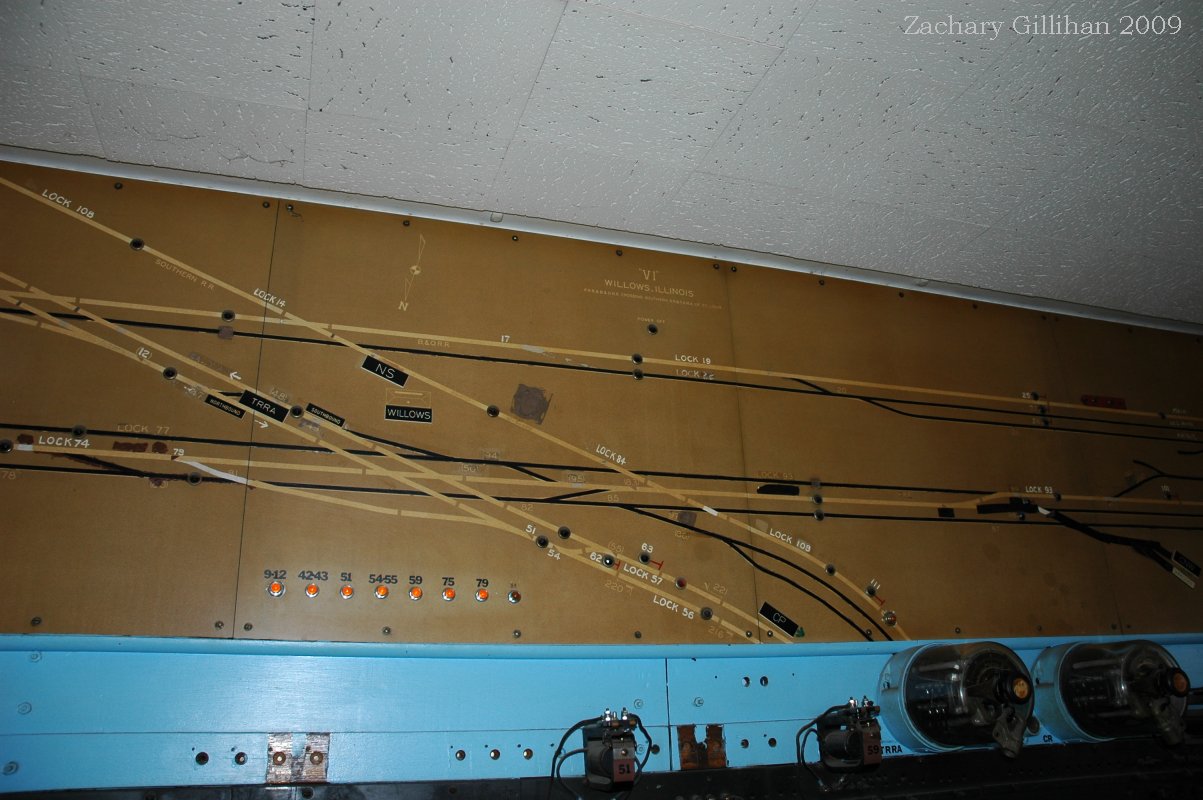
In a devastating blow to St Louis area rail history and living examples of General Railway Signal Co technology, I just learned that both LENOX and WILLOWS towers closed in the later part of 2018.  LENOX was a former Big Four tower operated by Union Pacific between Granite City and Alton and WILLOWS was operated by Kansas City Southern.


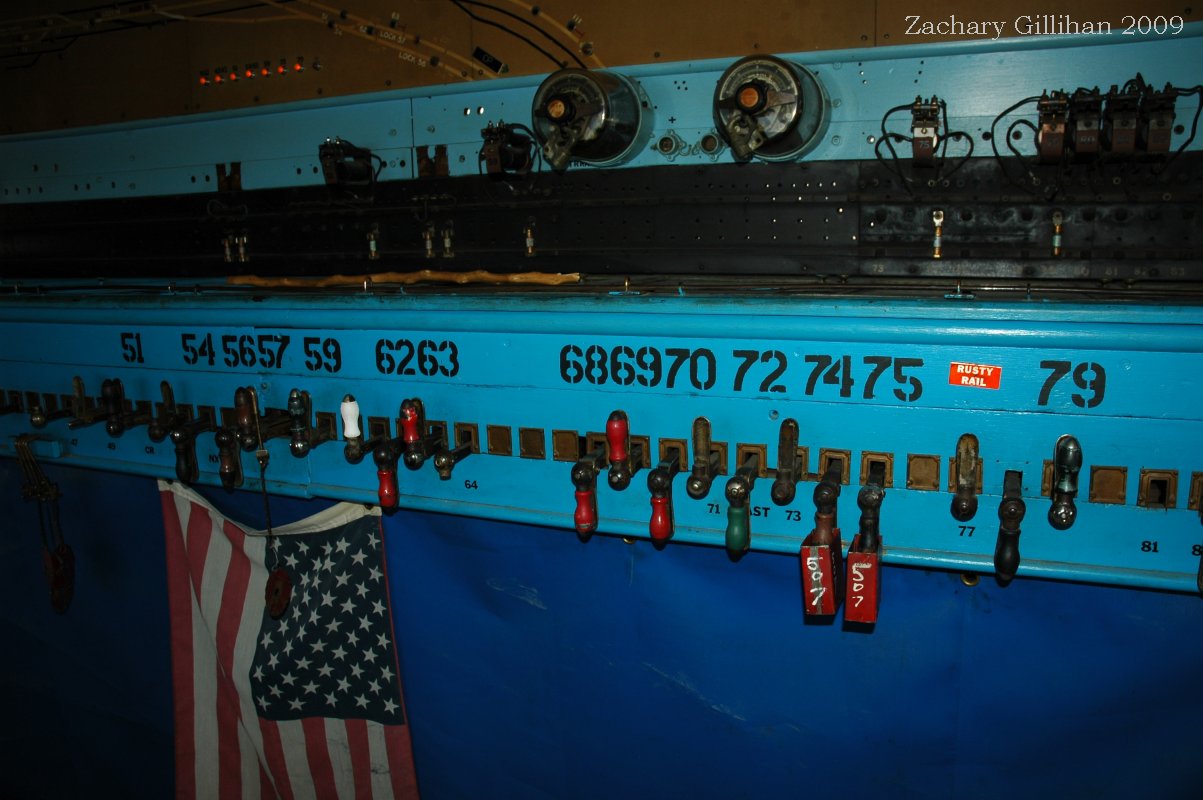
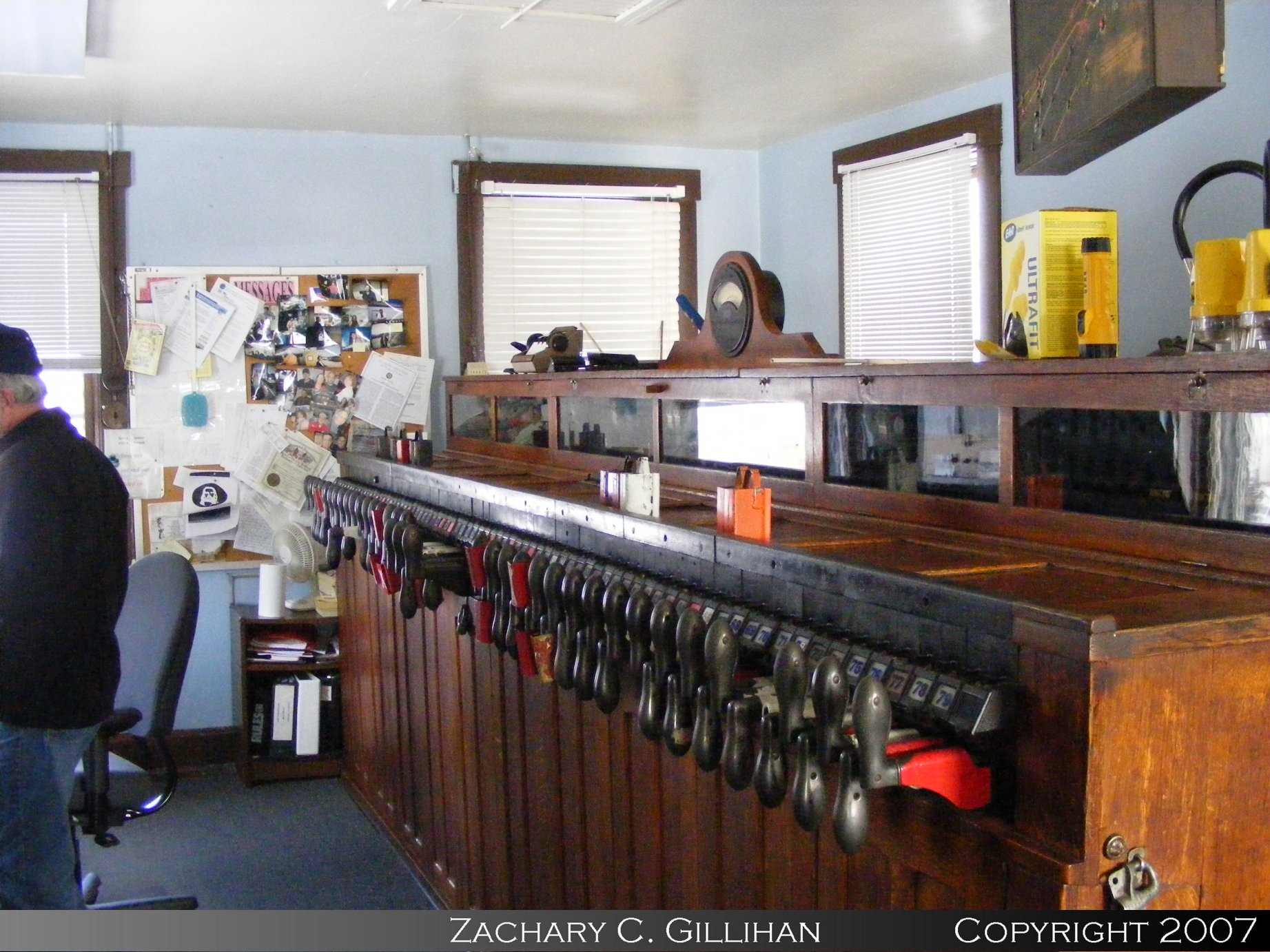
LENOX tower was built in 1924 with an 80 lever GRS Model 2 interlocking machine. It eventually passed from the former New York Central to the Chicago and Alton (owned by a succession of other railroads) to finally the Union Pacific in 1996.  As late as 2016 the future of the lower looked bright as no funding was available to rebuild the plant as part of the Illinois High Speed Rail Lincoln Corridor.  However it appeared that Union Pacific had grown tired of looking for a state financed rebuild and settled for a simple CTC automation.


 The real bummer is that I am scheduled to travel the Texas Eagle route for the first time in early 15 years at the end of this month and was really looking forward to get some reasonable photos of LENOX's other features such as the single slip switch and old B&O style CPL signals.  Latest report is that the tower is still standing and the lights are still on, but nobody is home :-(


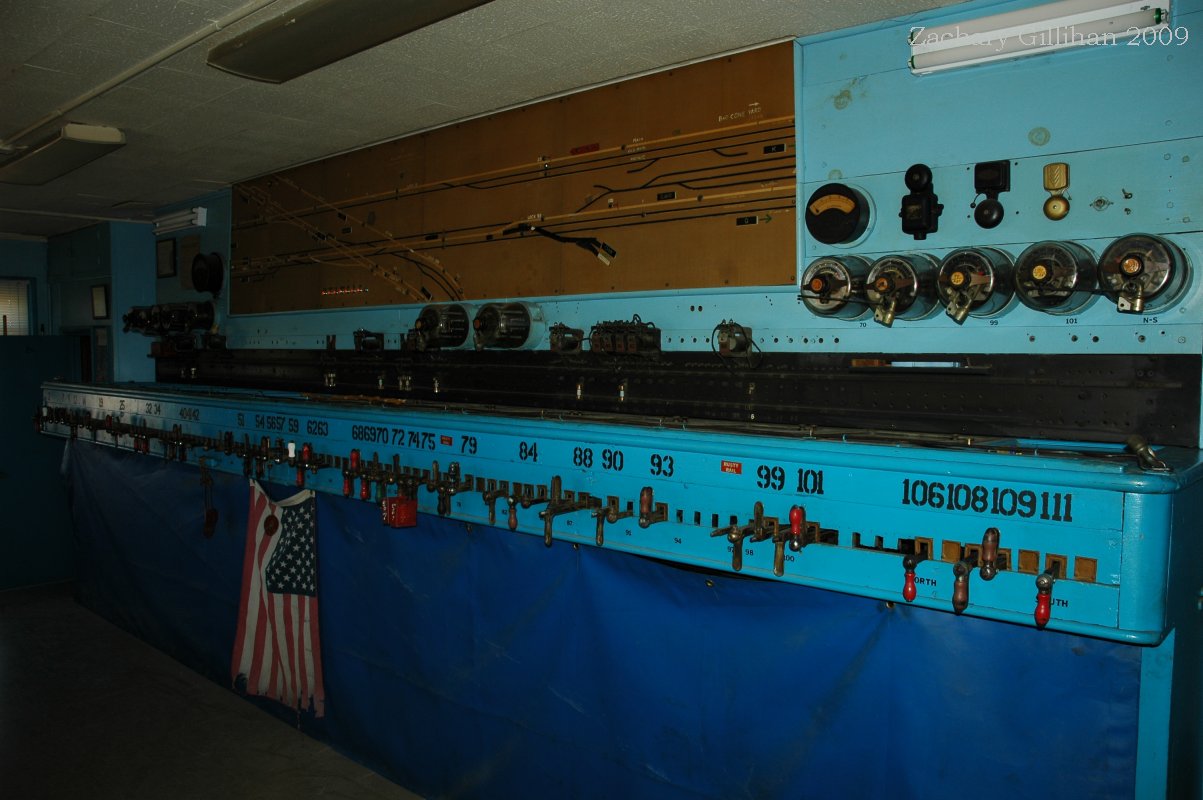
WILLOWS tower, built in 1903 and equipped with a 112-lever, pre-GRS Taylor Signal Co Model 2 interlocking machine, was one of those I thought would be around for some time to cone due to the intersection of 4 lines with 6 diamonds and 5 competing railroads (NS, TRRA, CP, KCS and CSX).  Well I guess I was wrong :-(  Word is that Kansas City Southern is looking to donate the vintage interlocking machine to the science museum co-located with the Kansas City Union Station.


These latest closures leave only one or two examples of either the GRS or Taylor Model 2 interlocking machines left in the North American rail network.  My cursory count gives me three in Chicago (JB, LAKE ST, 16TH ST) and two more in New Orleans (East and West BRIDGE JCT). 

Tuesday, February 3, 2015

Garden Variety Bad News

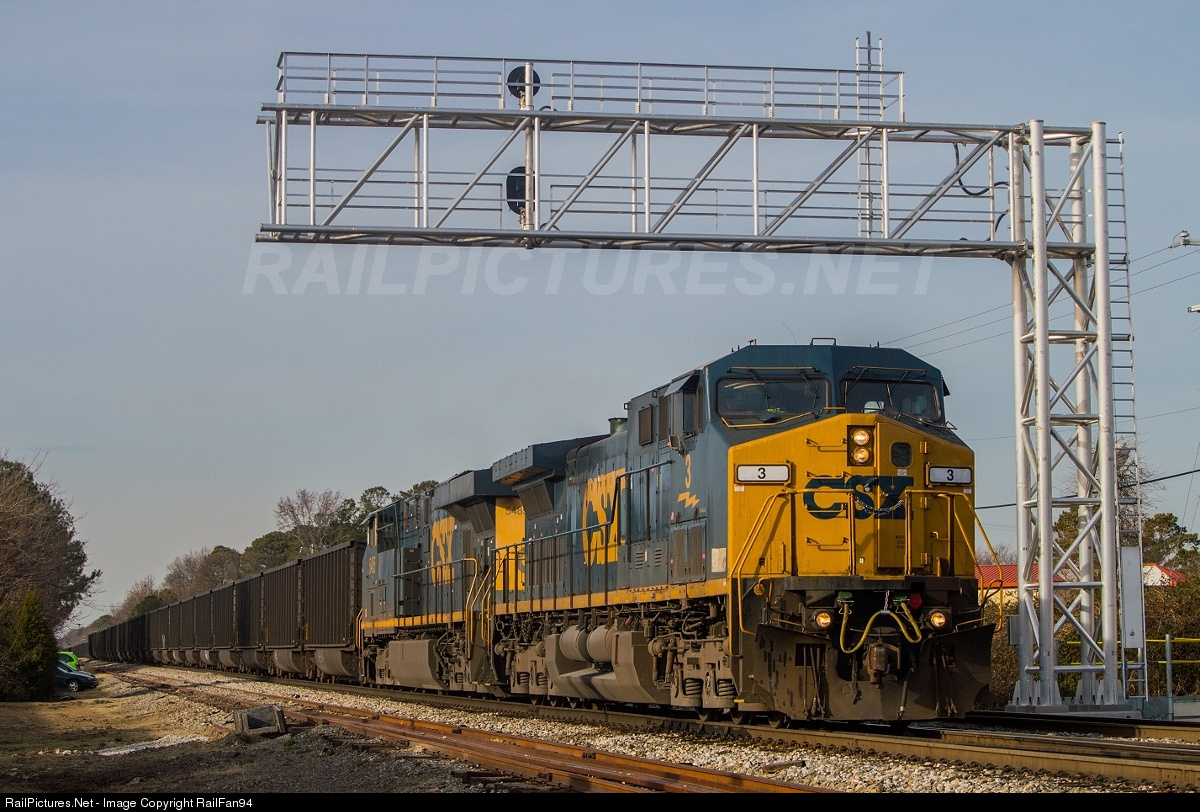
Very rare to see any good signaling news these days, but nothing really stands out as particularly bad.  We begin with a few bits left over from past news segments.  To begin with CSX has completed the re-signaling of the entire C&O Peninsula Sub as seen by this new Darth Vader cantilever mast at Hampton Roads.  Lovely how they spend the $ on a new cantilever for what could have been handled by a single two lamp dwarf signal.


NS has also completed the re-signaling at the famous WORTHINGTON interlocking on its Columbus District.  While the loss of both PRR and N&W position lights was tragic, the pneumatic movable point diamonds were the real gems. :-(


While partly ruined way back in 2012 when the Buckingham Branch installed its cheapo signals on the Washington Sub, the C&O signal gantry at ORANGE interlocking is finally facing the axe as NS's Southern Main Line re-signaling protect takes effect in Virginia. Looks like the signal will retain the C&O signal rules.


Way out in KSC territory, those Broken Rail Detector signals I profiled a few months ago have been decommissioned in favor of full on CTC.  Not often Darth Vader signals are an improvement over something.


Finally in another "push" UP is filling in the stretch of TWC on the Brownsville Sub north of Sinton, TX.  I guess even new signals are better than no signals.


Tuesday, August 12, 2014

When is an ABS Signal not an ABS Signal?

With railroad signaling I really do learn new things every day especially when I get off the beaten path and what's less beaten than the Kansas City Southern.  Track circuits and the principles of automatic block signaling are well over 100 years old.  With metal wheels on metal rails, running an electric current through the rails is an easy way to provide continuous train detection with side benefits such as detecting improperly lined switches and broken rails.  ABS is railroad signaling at its most basic with red, yellow and green lights how could this concept ever be ambiguous?


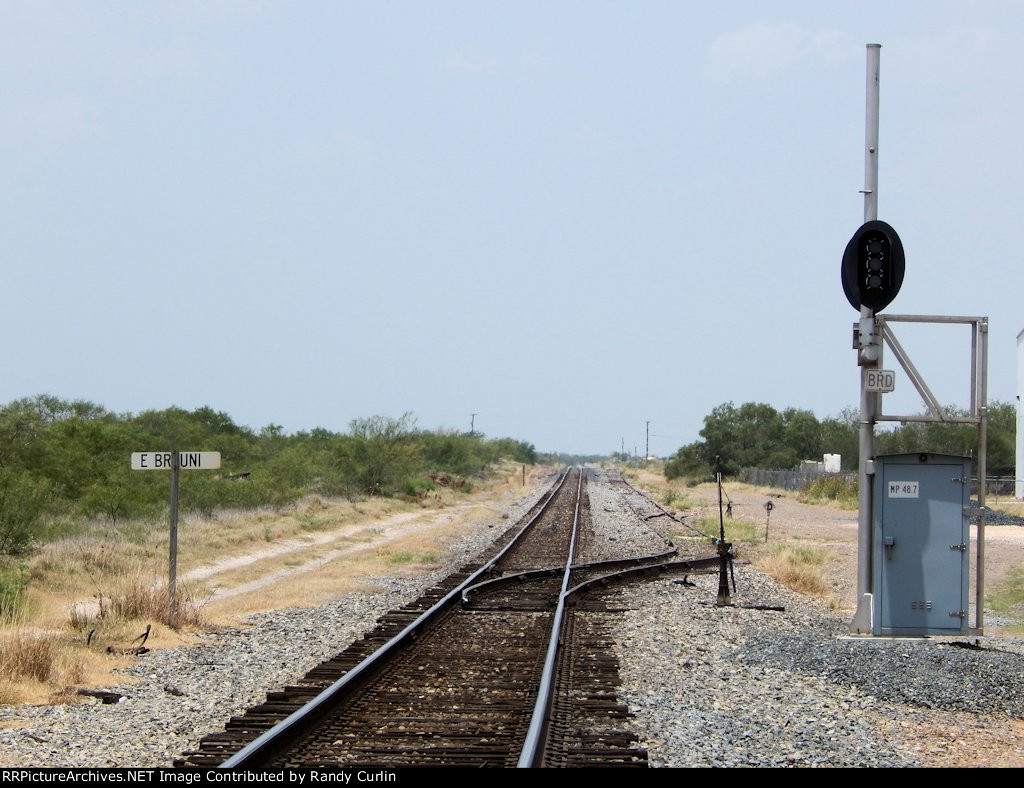
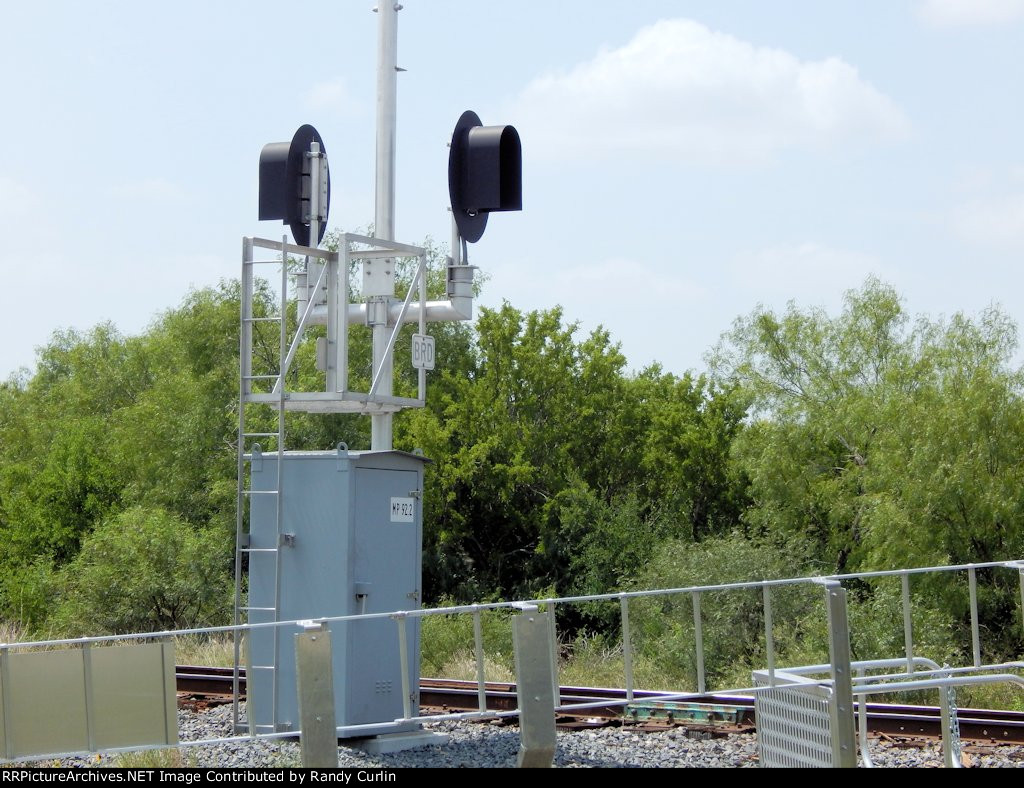
At first glance this rather ungainly signal looks like a fairly typical North American bi-directional automatic signal, however the football shaped targets and cheap, small LED lamp units combined with a hand throw switch and station sign should make more signal fans instantly think of some sort of point detection/switch position signal.  These non-interlocked and lightly regulated faux signals are used in non-signaled territory where remote controlled switches have been installed or a an extra measure of safety was desired for hand operated sidings or industrial tracks. 

While you would be correct in that these signals are of that type they do not however serve that function.


This is in actuality a broken rail detection signal, which was kinda given away by the big BRD plate under the head.  So instead of being connected to a set of points, as is seen in yards and other trackage without train detection, this signal is actually hooked into a track circuit and carries out all the functions typically ascribed to track circuits.  In addition to broken rails I assume it might also detect open switches or even rolling stock within the block.  The caption on the photo reads that flashing green is used for a "no defects" indication so avoid confusion with a genuine Clear signal, but the question remains why would anyone install such a monstrosity?


The answer is that Automatic Block Signals are a regulated railroad safety system and BRD signals are not, even if they basically do the same thing on a technical level.  Despite being track circuited this main line track is still considered non-signaled, with track warrants providing the vital safety protections.  BRD are frosting on the cake that provide assurance above and beyond what the FRA requires.  I suspect that they do not need the same types of inspections or maintenance or even have to meet the same hardware standards.  The equipment used for the BRD system probably cost a fraction of what a full on CTC signal would with non-vital relays and wiring and shit ass signal heads that don't need to meet visibility requirements etc.  The advantages is that the trains get increased assurance that the line ahead is clear and the company does not need to worry about running long, heavy trains up to the 60mph limit for non-signaled track.

The KCS is actually upgrading the line to full on CTC and as you can see in the foreground all the budget faux signals are going to need to be replaced with the fully kosher kind.  However do not think this is the end of BRD's.  With the PTC regulations the FRA maintained a 60mph speed limit on all track that lacks broken rail detection.  We might eventually see lines with fully wireless signaling and wayside BRD signals to allow speeds even in excess of 80mph.