Search This Blog

Showing posts with label SCL. Show all posts

Saturday, December 31, 2022

Limited Triangles!

 A little while ago I mentioned NORAC Rule 280b Approach Normal, a signal indication that has been effectively extinct in the wild for over two decades. However we will look at another marker type signal indication that used to be fairly widespread, but as far as I can tell, has now been reduced in the United States to just a pair of locations on the former PRR Main Line. Of course I am referring to the limited speed triangle.


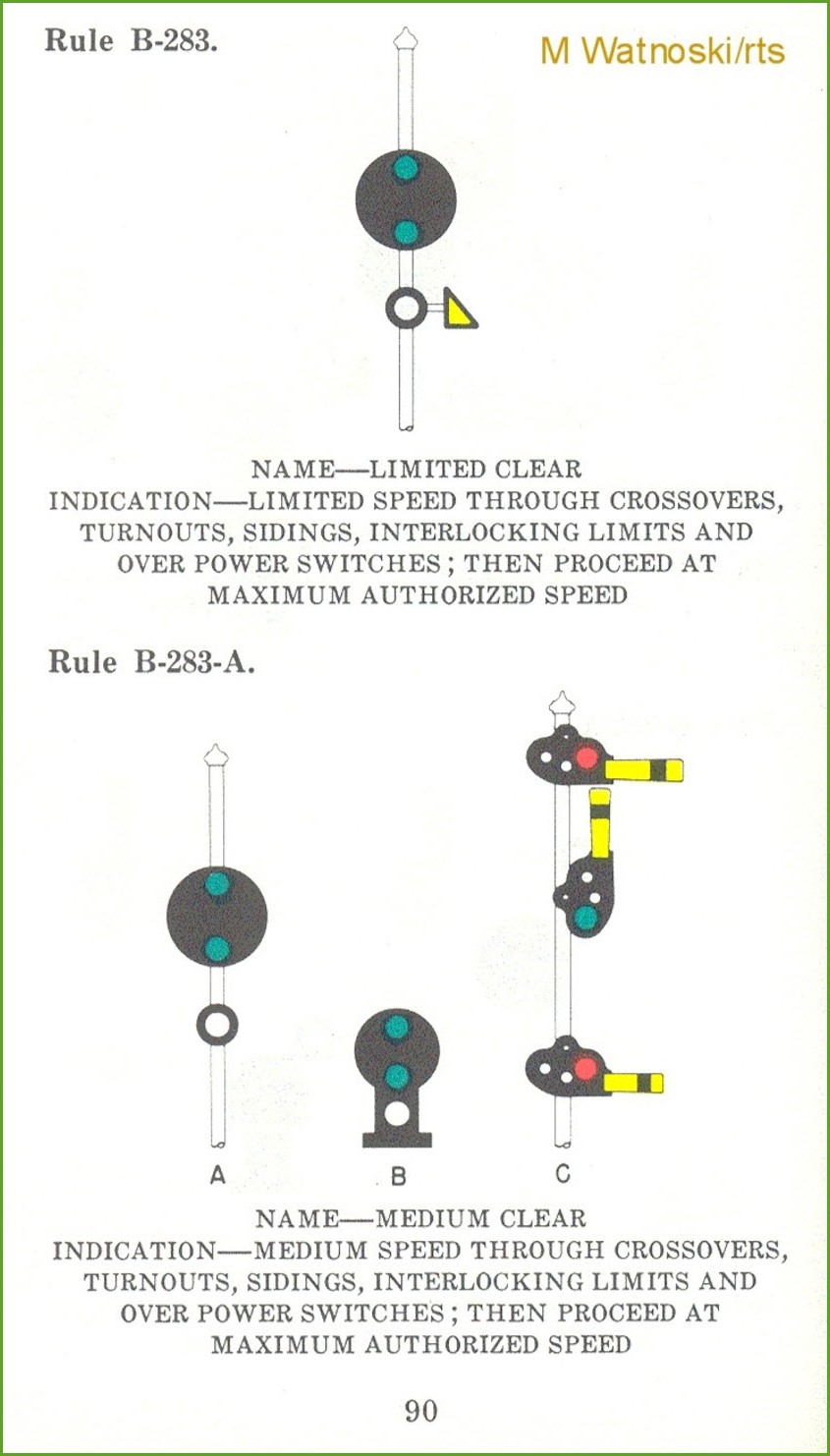
Introduced sometime around the 1940's, the bright yellow Limited Speed Triangle was deployed on speed signaled railroads in conjunction with the introduction of the #20, Limited Speed turnout. For the uninitiated this translates to speeds of about 40-45mph. Prior to this speed signaled railroads tended to have a main line Normal (Maximum Authorized) speed of  50-70mph, a Medium (aka Reduced) speed of 30mph and a Slow speed of 15mph. The system worked from both a track engineering standpoint given the speeds involved and logical standpoint in terms of full speed, half speed and quarter speed. As equipment improved throughout the 1920's and 30's, the gap between the maximum speed trains could regularly achieve and the 30mph Medium Speed began to grow. Because its easier to decrease running time by not going slow as opposed to just going fast, a number of Eastern railroads invented both faster turnouts and the concept of Limited speed. 

#20 Limited Speed turnout at BRYN MAWR interlocking.

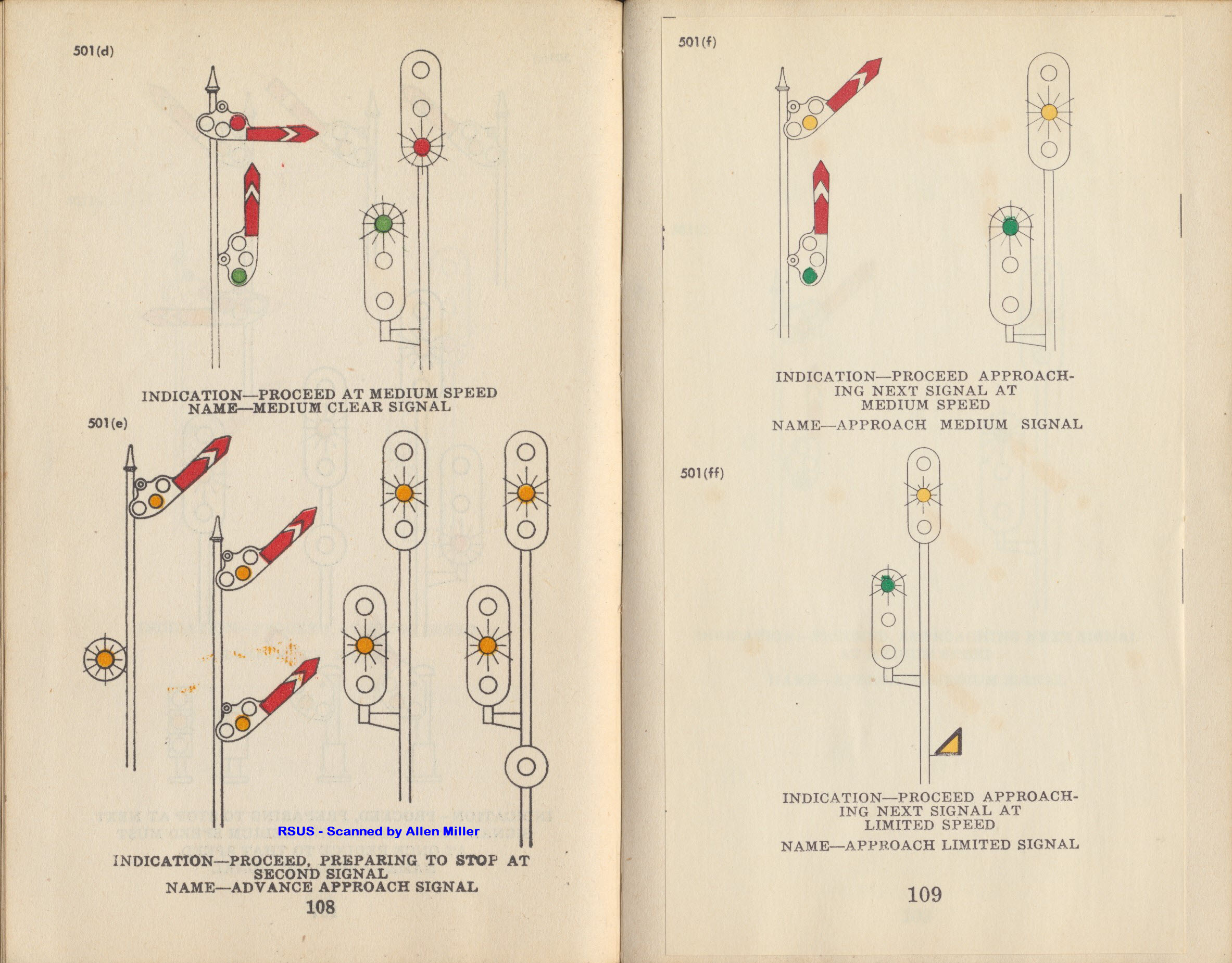
Just like in the 1980's when High Speed 60 and 80mph turnouts were invented, railroads suddenly had to fit the round peg of a new speed into the square hole of their existing signaling system. In a time when flashing signal relays were generally shunned as unreliable the solution was the Limited Speed Triangle. The black bordered yellow triangle would upgrade Approach Medium and Medium Clear indications to Approach Limited and Limited Clear. In cases where a #15 turnout was being replaced by a #20, the signaling change would involve change to interlocking wiring or logic. 


Although some railroads including the Reading, did invent new non-flashing limited speed color light signal like Y/G/G or R/G/G, limited speed triangles were embraced by the PRR, B&O, L&N, ACL/SAL and Southern. They also appeared in Canada with the addition of the letter L inside the triangle. Of course one of the biggest users of the triangles was the PRR, which would employ them at select junctions and along its 4 track main lines that features frequent non-reverse running crossover movements.  More specifically the PRR deployed limited speed upgrades (and triangles) to places where its 4-track lines would shift orientation from ⏬⏬⏫⏫ to ⏬⏫⏬⏫ and also as part of its general World War 2 era NEC re-signaling effort.

DV Interlocking with a mix of Limited and Slow speed diverging routes.

Starting in the 1950s flashing signals became more accepted and the Limited Speed Triangle began its slow decline. The main downsides was the inability to mix Limited and Medium speed routes, the issue of Approach Limited indications proceeding Medium Approach and the reduced visibility of the triangle vs a color light, especially at night. By the dawn of 21st century I was only aware of two remaining installations of limited speed triangles. The first was at COUNTY interlocking on Amtrak's NEC in New Brunswick, NJ with a full set of four triangles at the interlocking itself and the milepost 31 and 34 automatic locations adjacent to it. These were unfortunately replaced in the early 2010's as part of the larger 562 re-signaling effort between COUNTY and FAIR near Trenton.


The other use of limited speed triangles, and the only one still in service today, were the milepost 8 and 11 automatic signal locations adjacent to BRWN MAWR interlocking on the name brand "Main Line" portion of the Amtrak Harrisburg Line. These two signal locations are adjacent to the Ardmore and Villanova stations respectively and easily photographed. The reason BRWN MAWR itself lacks the triangles is because the tower caught fire in 1994 and the interlocking redone with modern hardware including flashing relays. The two distant locations will certainly keep their triangles until the Main Line between ZOO and PAOLI is slowly re-signaled over the next 10-20 years.


Note I have been invoking the United States instead of North America in terms of the endangered nature of these signals.  That is because Canada still retains quite a few of its Limited triangles generally on its western transcontinental routes at the ends of single track passing sidings. Highly ironic that the land that hasn't seen a flashing signal indication it doesn't love, has become the final refuge for a hack intended to avoid flashing signals.


Sunday, January 26, 2020

2020 A-Line Trip Report

So I recently had the opportunity to ride Amtrak's Palmetto for almost its entire run to Savannah which would be my first trip since 2018 between DC and Selma and my first time ever south of Selma.  Unfortunately the placement of the baggage car on the rear of the train prevented me from taking a proper survey, but I was able to observe the few remaining bits of interesting signal kit that do survive and because that set is so limited, I can pretty much list them all here with both new and archive material.


Kicking things off the RF&P vintage US&S N-3 intermediate signals are still in place between Spotsylvania and Doswell.  They may have some Darth Vader head mods for 4-block signaling, however the old school 90's hardware is clinging to life.


Speaking of Doswell, the US&S large target bracket mast is still in service for southbound trains.


In case you were wondering, the RF&P FB, MD, HN and GN towers are also still standing.


The next classic signals, again, slightly modified, can be found at CHARLIE BAKER interlocking in Rocky Mount, NC.


On the South End Sub between Rockey Mount and Fayetteville, there are a number of 90's vintage transitional signals that use the large targets and painted mast structures with modular or Safetran hardware.  However in places the integrated hut-masts are being replaced with more traditional single purpose equipment so these might soon be disappearing.


At the Wilson diamond south of Wilson, NC, I spotted this ACL survivor facing the intersecting NS line.


At FLORANCE interlocking in Florance, SC there are some more 90's vintage, Seaboard style US&S large target signals.

File Photo
Finally in Drayton Hall, SC, the drawbridge over the Ashley River is protected by Stop and Check signals in the traditional manner, even if those signals were changed during the recent re-signaling process.

All in all, its not much, but its something.  If you are in the vicinity of any of these signal locations, make sure you pop by for some photos.

Wednesday, July 25, 2018

2018 RF&P / A-Line / H-Line / Southern Main Line Trip Report

It has been three years since I last surveyed the RF&P, A-Line and Southern Main Line and quite a bit has changed. This report will try and cover more of the signaling related changes and less of the various capacity improvements that have occurred in tandem. On the RF&P third track projects are causing intermittent layout changes north of Fredericksburg, but a number of legacy 2 track bridges are isolating the new segments. Not much of a signaling change as the whole area was re-done between 2012 and 2014. South of Fredericksburg a few remaining RF&P large target US&S N-3 intermediates still stand along with the classic bracket mast at Doswell. Towers at Fredericksburg, Millford, Doswell and Greendale were also still standing.

Still hanging in there!

Acca Yard in Richmond has seen major changes. Previously both ends of the yard had been completely interlocked. Now the throats had been converted to hand operation with simplier terminal interlockings constructed farther out. On the south end the old AY interlocking has been relocated with a access cutting through the wye to allow northbound movements off the Belt Line to access all the yead tracks. South of Richmond AF interlocking was getting a complete set of limited speed crossovers to replace a single trailing 15mph crossover. The Petersburg Station has also been provided with a new interlocking to reduce the need for trains to cross passengers across an active main track.

This RF&P vintage modern style N-3 gantry is a goner :-(

South of Petersburg the only remaining classic signals are at CHARLIE BAKER interlocking in Rocky Mount. A few new limited speed crossovers have also been installed with a few extra miles of double track to reduce time spent waiting in sidings for meets which is what eliminated the last few N-3 holdouts after 2015. The NS H-line has also seen a number of improvements with new interlockings and new passing sidings, but the line had already been assimilated by NS so there wasn't anything to be lost. The new Raleigh Station is open, but not all the tracks are in service and there is still work to be done before the new terminal interlockings are fully in service.

The last A-Line N-3s were replaced by new crossovers.

On the Southern main line a smattering of interlockings remain unresignaled, typically 1990's builds with the traffic light style heads. One example is FAWELL interlocking south of Lynchburg. Also, CR TOWER interlocking in Alexandria, VA has seen new Darth heads placed on the Southern vintage ladder poles. Although there are some exceptions, NS did not use the opportunity to add new CTC features such as a Restricting indication into single track territory. This has been done on some NS lines like the former NKP route, I believe, but not Southern. Also, many of the old Southern signal gantries have been left in place along the RoW where it was somehow inconvenient to have them scrapped. So there might be something worth taking a picture of if anyone makes a signal trek.

Apt that FAWELL interlocking would be resistant to change.


All in all this was a pretty dull trip, signaling wise. Exactly what we have to look forward to across North America for probably the rest of time :-(

Sunday, December 18, 2016

The Grinch Steals More Signals

I first want to let everyone know that I now have confirmation that the NS PRR Main Line re-signaling program is not pausing at Lewistown, but has now reached as far west as Huntington.  I hope to be able to get out there, but I am as of yet unaware of their timeline.  Let's prey for a harsh winter as it would go far in slowing things down. 


 I can also report massive on Chicago Line re-signaling efforts are pretty much sweeping up everything between South Bend and Chicago including the former BEND interlocking itself, which itself was re-signaled back in the mid 90's to replace the old BEND tower. Multiple new interlockings are in service along with a lot of layout changes (including segments of third track).  The former PC-style I-beam gantries at CP-501 and CP-502 have been replaced and older NYC era gantries will soon follow.


 However the late model NYC cantilever just east of South Bend did not yet appear to be marked to replacement.

File photo
 There is also evidence that some of the PRR PL's on the NS Marion Branch are also going to survive a bit longer.


 On CSX some ominous signs are appearing around Akron, the last bastion of CPLs on the old B&O Main Line.

 CSX resignaling is now invading the Atlanta area on both their searchlight and elephant ear territory. 


While on the former SCL route to Alabama, the re-signaling has reached the GA/AL state line.


For another piece of good news, here is a fine example of the robustness (wind resistance?) of newer style Darth Vader signals that replaced the lower profile MC style searchlights on the former NYC Main Line.

.
In hindsight, 2016 was a pretty rotten year with a number of tower closures and major re-signaling projects, but compared to other events and past years, it was kind of tame (and I was able to get out and document more stuff compared to 2015).