Search This Blog

Showing posts with label interlocking tower. Show all posts

Sunday, June 21, 2026

Amtrak THORN Tower to Close Aug 8, 2026

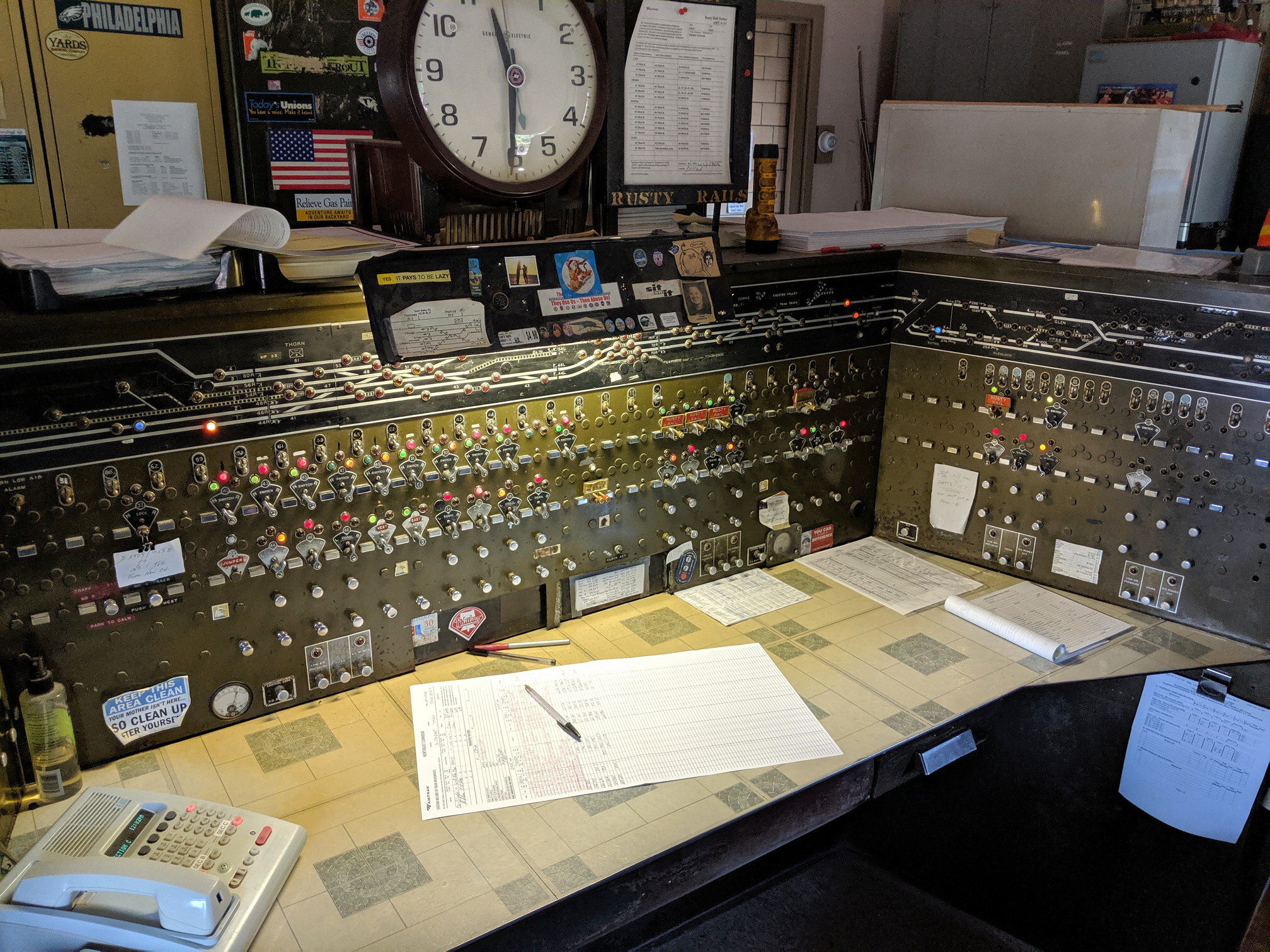
For over a year I have been tracking the slow motion closure of Amtrak's THORN interlocking tower. located on the old PRR Main Line in Thorndale, PA Opened in 1938 as part of the PRR's electrification project to Harrisburg, THORN was equipped with a state of the art CTC unit lever console controlling  4 remote interlockings in addition to the local 6(!) track full crossover. THORN's extended territory, including FRAZER interlocking which was commissioned in 1994, is what has allowed for the prolonged multi-year closure, which will take place just shy of the tower's 90th year in continuous operation.


Since the first part of THORN's territory, CALN interlocking, was chipped away back in 2020, the local 6-track crossover was rationalized and then turned over to CTEC control while the THORN operator continued to handle SEPTA movements in and out of Frazer yard as well as the daily NS freight entering the line at GLEN. More recently DOWNS interlocking was prepared for complete removal, its signals left standing as the change point between CTEC and THORN's control.  In the final act, kicking off in early 2026, GLEN and FRAZER interlockings were reconstructed with the goal of a Rule 562 cutover once all of the work had been completed. 

THORN interlocking as rationalized in 2023

The closure will bring full bi-directional operation between THORN and PAOLI, with the segment between FRAZER and PAOLI remaining outside the Rule 562 zone for now. The much diminished PAOLI tower is likely next on the list for closure before the heavy lift of installing Rule 562 on the core of the old 4-track "Main Line" begins. One loss that's easy to overlook is the now vestigial limited speed triangle at DOWNS interlocking with those at BRYN MAWR likely the only set remaining outside of Canada.

Another loss will be the intermediate signals at Exton, which were easily accessible from the SEPTA parking lot and well positioned for photography. 

For persons desiring photos of these, the Milepost 29 signals or what's left of DOWNS, you probably have until August 7th assuming transition operations will take place overnight. At 1:30pm on August 8th, THORN's final staffed shift will end. The tower is directly adjacent to the Happy Day's Diner for anyone looking to mark the event. 


Sunday, June 14, 2026

Art's LIRR Archives Online...For Now

 Word on the street is that the street is that the person behind Art's LIRR Archives, Art Huneke, has recently passed away. While not quite the #1 source on LIRR tower information, Art's wonderfully Web 1.0 Archive contains a huge amount of primary source material on the evolution of the LIRR in the 19th and early 20th centuries. While the tower and signaling information is scattered throughout the site, it does reward those who take the time to find it. Special attention is given to the older generation of LIRR towers and cabins that were closed in the mid-20th century modernization projects. The page has a wide collection of diagrams and bulletin order scans to track the life and death of these less well known LIRR towers as the rail road evolved into its present form. 

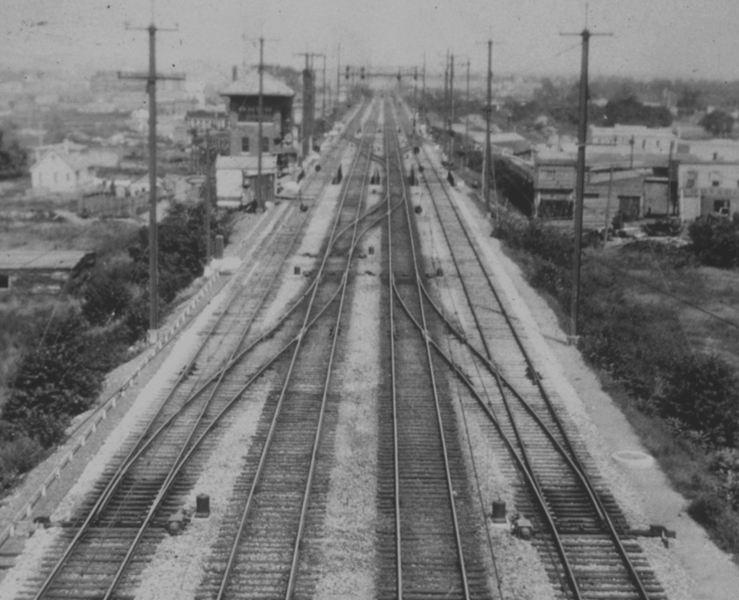
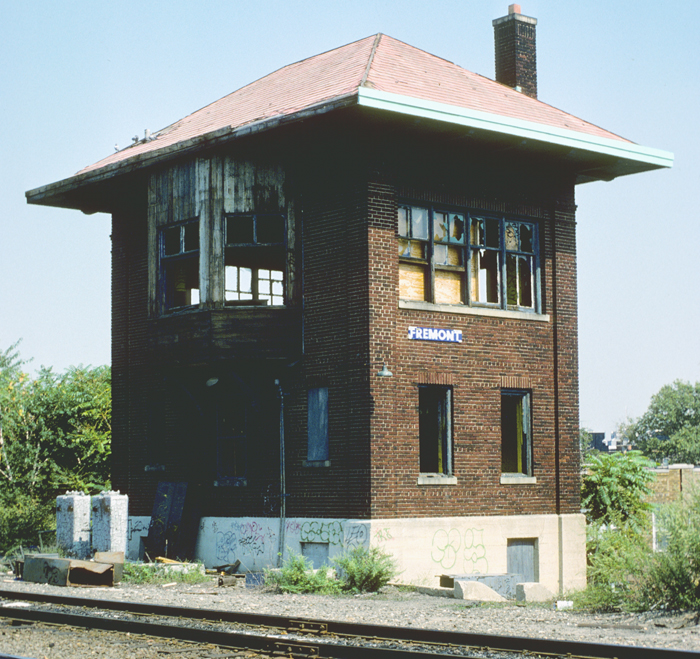
For example Art has extensive coverage of the LIRR's Bay Ridge Branch towers, like NO above, that were opened with the 1928 electrification only to be closed by 1932. In turn we see a photo of the tower that remained open, FN aka FREEMONT, with a Conrail era blue station sign. Other Bay Ridge towers include NU, KN, MJ and of course POND.

At this point there is no word on what will happen to the website so I urge all of you to check it out. Because its all Web 1.0, it is pretty easy to create local copies of the content via the "Save Webpage Complete" function in your browser. Other major signaling content includes:

Friday, February 27, 2026

PHOTOS: LANDIS - The PRR Main Line's Forgotten "Tower"

One might wonder how the electrified PRR Main Line could have an interlocking tower somehow more "forgotten" than the small booth that occasionally managed the emergency crossovers at LEAMAN, but it did and that forgotten tower also began with the letter L. LANDIS tower, in Landisville, PA, was always a stepchild of an interlocking forced on the PRR by the rival Reading Company by means of the Reading and Columbia Branch.  This was a forked "milk run" line connecting Reading (via Sinking Spring) to Ephreta, Columbia and Lancaster. The Lancaster fork was ultimately integrated into the west end of CORK interlocking, crossing the main line via crossover switches and the Columbia Branch via diamonds. The Columbia fork met the PRR Main Line about 8 miles to the west at Landisville and, due to the lack of any existing infrastructure, the diamond managed to justify its own interlocking tower, built and operated by the PRR.

Given the telegraph code NV, a square wooden tower was built in 1902 in the contemporary PRR style exemplified by the preserved LEMO tower at Strausburg. 

This tower lasted into the post war period, its Victorian aesthetic somewhat in conflict with the electrification infrastructure. In this photo one can see the Reading alignment complete with Reading style US&S color light signals in a target configuration. Also note the Reading freight station which in this photo is partly obscuring the PRR Landisville freight station behind it. 

Based on the 1962 interlocking chart it can be surmised that the old NV tower was taken out of service around 1953 with the block and interlocking station moved into the old PRR freight house. Here the part-time operator would work the crossing as needed using a 5 lever US&S table type interlocking machine. Each main track had a pair of signals controlled by a single lever in the US&S fashion. The Reading was controlled by lever 1, the PRR levers 6 and 8. The Reading signals could display Stop, Clear and Restricting in both directions. The PRR signals had a full ABS head with a Stop and Proceed marker with the current of traffic and a dwarf with Restricting and Sop against. The Reading track had split point derails on either wide of the diamonds controlled by lever #4 and the PRR had a hand throw trailing point crossover unlocked by lever 5. The last detail of note was an 'E' marker on the eastbound PRR track which would illuminate if the dragging equipment detector near milepost 79 were activated.


As of 1954 LANDIS was listed in the timetable as an Interlocking Station open part time from 8:30 AM to 4:30 PM daily except Sundays and holidays. By 1971 this had changed to 10:00 AM to 6:00 PM Daily except Saturdays, Sundays and Holidays. Ultimately the Conrail merger of 1976 would prove fatal to the diamond crossing at LANDIS as the Reading branch line was no longer providing "competition" in the Lancaster market and Conrail trains based out of the PRR Lancaster yard could serve what on line customers remained. Therefore the diamonds were removed, the "tower" was closed, the milepost 74 ABS signals replaced the controlled signals on the PRR Main Line and a PRR freight delivery track was repurposed into a new connection to the ex-Reading branch towards Columbia, PA.


Like many legacy railroad structures along the Amtrak RoW, the freight station version of LANDIS was boarded up and left to become somebody else's problem. 50 years later the building still stands in decayed-yet-reasonable condition.


Similar to the Reading's old Chester Creek Drawbridge, the 5-lever US&S "table interlocking machine" is still present in the operator's area, albeit in a stripped down condition. Similar to the single story PARK tower, the windows were covered over with high security wire mesh.


The "table interlocking machine" was a modular platform for very small interlockings up to about 10 levers. Each module contained a standard US&S bell-crank type "lever" and was could interface with both mechanical and electro-magnetic interlocking components. At LANDIS the lever modules have been removed, but the robust metal base remains in place.


For comparison here is a similar table interlocking device set up in NORTH PHILADELPHIIA tower as an auxiliary to the main US&S EP machine. 
 

We can see that the LANDIS machine had a US&S/S&F style mechanical locking grid as well as make/break circuit spindles.


As an interlocking station the operator was provided with a full telecom suite mounted just outside of the bathroom nook.


An old relay hut sits across the tracks, although it is hard to tell what era it came from, Amtrak, PRR or PC.


LANDIS continued on as an ABS signal location until the mid-2000's Rule 562 re-signaling. Today only those with a knowledge of PRR Main Line history, or a sharp eye for abandoned rights of way, would notice that something had once gone on here.


Just goes to show that while many old towers have been demolished, a few are still hiding in plain sight.

Friday, January 30, 2026

PATCO CENTER Tower Moves To The Pherphery

 As the prototype for the "modern" heavy rail rapid transit system, Philadelphia's PATCO (Port Authority Transit Corporation) Hi-Speed Line was naturally designed with state of the art signaling. However as a prototype it had a few features rooted firmly in the past. For example it had cab signals without wayside block signals, but it used PRR style 100hz pulse codes as opposed to the audio-frequency track circuits that would appear on the DC Metro and BART. One of PATCO's most visible links to traditional railroad operation was its signaling control where the full-line CTC was placed not in a command center or dispatch office, but a "tower" built and named for the PRR interlocking tower that had occupied the same location for the previous 40+ years. 

As built by the Pennsylvania Railroad, CENTER tower sat at the 3-way junction where trains from the Federal Street Terminal would fan out en-route to various points along the South Jersey shore from Long Beach Island to Cape May. Older than the wave of towers that accompanied with 1934 PRSL merger, CENTER featured a 66-lever EP machine and despite the drop in passenger traffic throughout the 1950's, still saw plenty of action from freight trains and lite engine moves to the PRSL's primary service facility at the old Federal Street complex.  


This would change in 1966 when construction on the PATCO Hi-Speed line commenced. The project would replace the PRSL's Broadway station and the associated trackwork controlled by the old CENTER. The resulting real estate was repurposed for Interstate 676 and all traces of the old CENTER tower was erased, however the spirit of CENTER would live on in the new PATCO Hi Speed Line. 


When completed, the PATCO Speedline consisted of the existing 1936 vintage Delaware River Joint Commission "Bridge Line" between Camden and downtown Philadelphia along with a brand new grade separated rapid transit line to the New Jersey suburb of Lindenwold.  The new and old parts of the line joined just east of the old PRSL Broadway station in a space that would have been physically within the territory of CENTER tower. As PATCO tried to re-use as much existing infrastructure as possible it was decided to build the CTC office at this junction point as it could directly interface with the existing signaling and telecom links from the Bridge Line and not have to somehow forward those signals all the way to Lindenwold. Because PATCO's design team were generally rail enthusiasts, they named their CTC office after the old PRR CENTER tower. 

Technically the structure did count as a traditional tower as the operating floor was located above a typical PATCO substation. In addition to the unit lever CTC machine, CENTER also supported traction power direction and remote customer service via "call for aid" telephones and CCTV. CENTER would serve PATCO well for over 50 years, however as the systems were upgraded over the decades, the rationale for its existence, supporting direct wire control cabling, would no longer apply. Instead CENTER would be physically isolated from the main PATCO offices and shoppes in Lindenwold and also located in what had become one of the most dangerous cities in America. With the building starting to age and the work-site unpopular with employees, PATCO eventually found the money to build a brand new state of the art control facility at Lindenwold.   


Although the original CENTER tower will be retained as a backup facility, much of the spirit of classic railroading that CENTER represented is likely to be lost.

Saturday, January 3, 2026

Fire at VALLEY JCT Tower

The Reading Company's late LEBANON VALLEY JCT interlocking tower was built in 1951 with CTC and direct wire control over most of the Reading Belt Line and eventually closed as a staffed interlocking station around 1987. It was used as a glorified relay hut for the next 15 or so years until its complete retirement from railroad use.  When I was able to profile the tower in late 2020 it had become unsecured at the hands of local vagrants and while this was a boon for documentation, I mentioned at the time that the structure was at grave risk of a downward spiral.  A year later the spiral had begun with evidence of both fire and vandalism inside. My prediction was demolition as an attractive nuisance due to the tower's robust brick and concrete construction, but apparently the roof and interior fittings of the operator's floor were made of wood and on Christmas eve 2025 the structure was gutted by fire. 

Photo courtesy Exeter Township Volunteer Fire Company

Demolition is likely inevitable, although the timeline is unclear due to the challenging location. (Amtrak's wooden SHORE tower suffered a fire about 5 years ago and still stands as of this post.) Regardless, anything of historic value that was not already removed was likely destroyed in the blaze.


VALLEY JCT joins a growing list of "robust" towers that have been demolished in recent years, many in far better condition. Just another reminder to not wait when it comes to documentary efforts. 


Sunday, December 21, 2025

PHOTOS: LEAMAN - The Place To Be

The Pennsylvania Railroad Main Line, today operated by Amtrak as their Harrisburg Line, is known for its many interlocking towers that survived well into the 21st Century and I have covered several of them on this blog. However there is one "place" that isn't quite a tower, although it has many of the trappings of one. While the PRR seemed to have an aversion to CTC, it still had a lot more signaling infrastructure than peer railroads with a particular focus on Manual Block System and its related component, the block station. What's a block station? Well its a location on the line that can host a block operator who in turn can perform those duties necessary for some (manual) block operation like transmitting train orders, displaying signals and throwing hand operated switches. Even on signaled PRR main lines one could find non-interlocked block stations open either 24/7 or part time.

Located at milepost 56.7 between PARK and CORK interlockings on the Main Line is the town of of Leaman Place. You might recognize the name for being the interchange point for the Strasburg Railroad. This segment of the Main Line was electrified in 1939 and at the time  featured 4 main tracks. Despite the 24 mile gap between the two interlocking stations, no intermediate crossovers were provided as most disruptions could be dealt with by relying on the "spare" main track (with the parallel Columbia Branch directly providing an additional two tracks of relief capacity for freight). However in 1948 tracks 2 and 3 were removed due to declining traffic and evidently this length of single track operation during maintenance or equipment failure had become an issue because in 1961 the PRR constructed the new LEAMAN block station at milepost 57.0 with a pair of main track crossovers protected by semi-automatic signals. Unlike similar hand throw block stations LEAMAN had no normal hours of operation and was only open as needed for single track operation.


LEAMAN consisted of a pair of center locked hand operated crossovers and a pair of position light signals oriented in the normal direction of travel. As this was not an interlocking, no reverse direction signals were not installed. A rather robust operator's shelter was provided and outfitted with  station signs, climate control and telecommunications. 


This sort of hand operated crossover layout was not uncommon on other double track ABS main lines with the requisite "shelter" typically taking the form of a wayside telephone booth that would allow crews to call the dispatcher to pick up their movement authority to run through the single track area or to report clear of it. However LEAMAN was unique in that its signals and electric switch locks were tied to a small control panel inside the operator's shelter and not accessible to road crews. 

Friday, November 7, 2025

Hoboken Terminal's Suspended Signals

Stations with large terminal fans often exhibit a problem at one or both of edge tracks. Because rail vehicles can't generally make hard right turns, one needs a longer series of switches to reach the highest and/or lowest track. Unfortunately terminals often abut a fixed location like a river or street or public square and to avoid having those extreme tracks things can get a little squished. In the early 1980s, New Jersey Transit engaged in a near total reconstruction of the former Delaware, Lackawanna and Western electrified suburban network. Not only was the 3kv DC traction power system under powered and on its last legs, but the signaling system was firmly rooted in the 1920's. In the re-signaling project that followed, NJT built the last great North American interlocking tower, TERMINAL TOWER and replaced most vestiges of the former DL&W plant.

New (frame left) and old HOBOKEN TERMINAL TOWERs shortly before cutover.

In the late DL&W era Hoboken Terminal signals consisted largely of two head, small target searchlight signals displaying the DL&W's unique mix of color light signal indications. Long platforms in the center of the terminal had these mounted on signal gantries in the normal way, while tracks towards the edge of the low 1908 train shed saw signals mounted below the gantries under the shed itself. Moreover, while center tracks could get a "straight" clear out of town, tracks towards the edges had to make do with a Restricting indication as the DL&W lacked Slow Clear and Slow Approach options, even on dwarfs. 

When NJT rebuilt the signaling there appears to be a time when the new signals were wired into the old HOBOKEN TERMINAL tower's old US&S 1908 Electro-Pneumatic interlocking machine. To make the cutover process easier, signal locations were largely kept the same, but NJT had no desire to keep the old handicap of trains of edge tracks departing under a Restricting signal indication. This meant that the replacement "high" signals had to display R/R/G Slow Clear as opposed to the G and G/G on a dwarf. In most locations this wasn't a big deal as the signal gantries could easily support three tri-light heads, however on tracks 2, 3, 12 and 13, the need to suspend signals under the trainshed due to the closeness of the first switches presented a bit of a problem.

TERMINAL TOWER 36W2 and 36W1 suspended signals governing tracks 3 and 2 respectively.

TERMINAL TOWER 88W and 92W suspended signals governing tracks 13 and 12 respectively.

The solution was somewhat akin to a Penn Station signal, just with three "heads" instead of two. To display R/R/G, R/R/*Y* and R/R/Y, two fixed Safetran modular dwarf cubes were mounted close above an additional three-unit cluster of modular dwarf cubes. These were then mounted close under the roof at the westernmost end of the trainshed.

36W2 signal governing track #3.


Although a bit inelegant compared to a dwarf or today's compact LED searchlights, they are a unique solution in today's largely homogeneous signaling environment and are likely to persist for many years to come.