Search This Blog

Showing posts with label NECR. Show all posts

Saturday, May 24, 2025

NECR Resignaling Project is Complete

I can report that the re-signaling of the New Englande Centrale's main line that hosts Amtrak's Vermonter north of the Massachusetts border has been completed. While I had previously reported on the state of this project, I can confirm that all legacy signaling has now been replaced. While the diamond at Bellows Falls was perhaps the most visible of the final round of changes, the north end of the Putney siding was also re-signaled. 

As always there are a few interesting details I should point out. The previously reported signaling anomaly at Bellows Falls resulting from a old double to single track conversion, has been eliminated. Trains at Bellows Falls now get a Clear signal indication for a straight route at Wapole siding as opposed to the previous Approach Medium to Medium Clear. 


The holdout signal at SOUTH BELLOWS FALLS has been retained, evidently to allow interchange with the Green Mountain Railroad without needing to seize the main line all the way to Putney.


The entire NECR portion of the line has done away with the Boston and Maine / Guilford practice of ultra-long ABS blocks. Now signal blocks will be a more uniform 2-4 miles which limits the impact of track circuit failures and increases capacity.


Having been re-signaled just prior to the start of the most recent project, the South Putney interlocking will be the only non-standard signal location on the line with a poor man's bracket mast for southbound trains and the use of Safetran scallop shell modules as opposed to Progress Rail square modules.

Although an honorable mention goes to the old northbound searchlight signal on the Bellows Falls platform that was so popular as a photo backdrop. That has been moved to the adjacent park around the Bellows Falls Chamber of Commerce.


It will be interesting to see if this affects on time performance or the schedule at all. In theory replacing the TWC with CTC for the 10 or so miles south of Brattleboro could allow a speed increase.

Sunday, April 20, 2025

NECR / Central Vermont Changes You May Have Missed

While I have been posting much about the loss of former Boston and Maine searchlight signaling on the New Englande Centrale, a couple of other changes on the Central Vermont end of the CT Valley corridor caught my eye. While B&M ownership and CTC ended at Windsor, at some point in the 1990's the Statge of Vermont and/or Amtrak got some money to install about 10 miles of new CTC between there and White River Jct. Unlike the low cost B&M system, the CTC extension had regular 2-3 mile long blocks with vertical color lights, but no new interlockings or passing points.


Upon closer inspection one might notice that the type of color light signal are the short lived mono-housing GRS variety that are also present around LA Union Station, Dallas Union Station and the extreme northern end of the Conrail Lehigh Line.


Anyway in an absolutely baffling decision that was probably the result of generous Federal funding, the NECR also replaced the completely modern CTC extension several years before the 1950's B&M signaling. The new signals consist of hooded LED modular units from Progress Rail The new mast-on-relay-hut signals replaced the older and slightly smaller mast-on-relay-hut signals and feature Canadian style "R" boards in both directions as well as new number places with direction suffixes. The change took place between 2022 and 2024 and mirrors the new signaling installed between EAST NORTHFIELD and Brattleboro, VT.


Another change came in the form of a further CTC extension all the way through the White River Junction area sometime in the 2010's. This change took place between 2012 and 2019 and includes interlockings north and south of White River Jct.


Stay tuned for at least one additional post covering the recent history of signaling in the Connecticut River Valley.

Thursday, October 31, 2024

More Connecticut River Corridor News

 Although my last update on the Connecticut Valley Corridor was only back in March, I have some additional updates from a follow up trip in October. The most significant are alterations to SPRING interlocking in Springfield, MA. The root cause for altering SPRING is to create an interlocked connection between Boston Line Track 2A and the Amtrak Springfield Line trackage. This route was previously used by the old Vermonter and Inland Route Regionals and required the use of hand throw switches to the east of the station. Without a connection at SPRING, Track 2A is only purpose is to serve as an emergency berth for the daily Lake Shore Limited round trip. The new switch allows Track 2A to be used for both CT Rail Hartford Line trains and Amtrak Springfield Shuttles and also creates additional storage space for increased CT Rail or Regional service. 


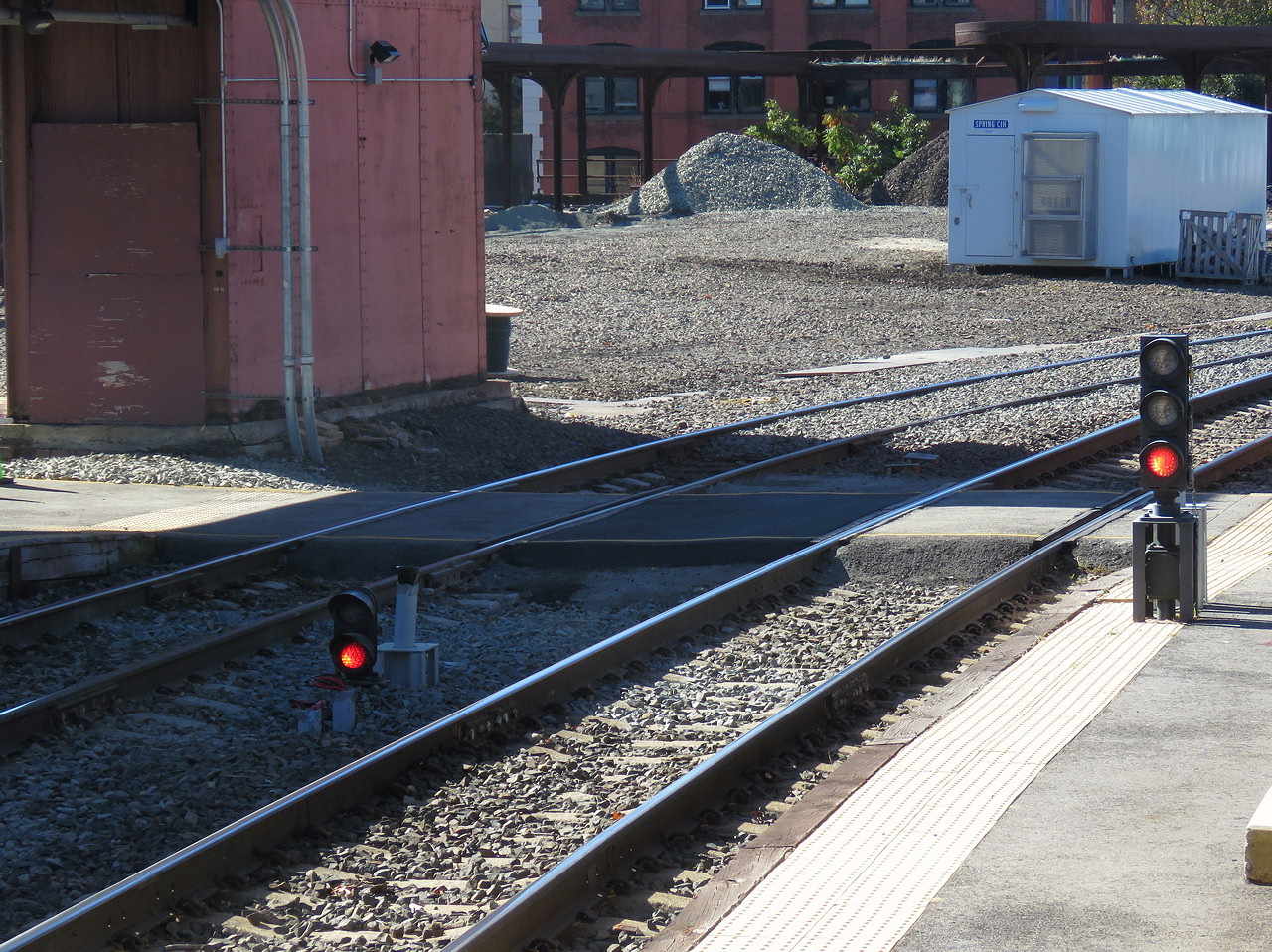
Of course there always has to be a downside and unfortunately the changes at SPRING will also cause the elimination of what is arguably the last vintage signal on the Amtrak Springfield Line.  Station track #8 is still governed by a US&S N-2 dwarf, possibly dating back to the New Haven era.  Moreover station track #6 is governed by an uncommon US&S modular dwarf stack that was installed in the early-2000's to replace an H-5 searchlight.  Both will be replaced by Safetran modular cube dwarfs that infected the Springfield line back in 2004.


The bad news doesn't stop there as the New Englande Central re-signaling project continues unabated. It currently appears that new standard sized ABS blocks are in service between Walpole and Claremont, replacing the old B&M large block CTC. This also implies that the new signaling at Claremont has been activated. New interlocking huts have been dropped at both the south end of the Walpole siding and the Bellows Falls diamond. At the north end of the Walpole siding the new interlocking retained the southbound searchlight mast, so it remains to be see if there are any searchlit survivors in the Bellows Falls area. I unfortunately neglected to inspect the controlled point south of Bellows Falls, but it is on my list for a visit in the Spring.

Sunday, September 29, 2024

The Mystery of the Zombie Route

This came up as I was recently out along the New Englande Central near Bellows Falls, VT when I noticed something strange at the north end of the Walpole siding.

The southbound searchlight mast was displaying an Approach Medium and my first assumption was that the signal at the Bellows Falls diamond crossing was still at Stop and due to the short distance between the south end of the siding and said diamond crossing, the signal at the south end of the siding would be displaying Approach. This is a pretty common technique to deal with a short block without using a flashing Advance Approach indication.


Well, you can imagine my surprise when I traveled back to the south end of the siding to discover a Medium Clear indication for the normal route over the single trailing point switch. The signal for the Bellows Falls diamond, about 1500 feet to the south, was also displaying clear. So, what is going on here?  My first thought was that this was some kind of zombie route. The New Englande Central flipped the orientation of the turnout to create a zombie route, but didn't have the wherewithal to alter the signaling. These sorts of double track passing points where trains enter a short stretch of double track ABS on a normal route and exit on a diverging route, were that uncommon in the early CTC era. The north end of the siding even looked a little suspicious with a bracket-dwarf arrangement that could have once been a normal mast and center mounted dwarf.


The other hypothesis is that this is due to speed control over the Bellows Falls bridge. Using signaling to encourage speed control, typically involving slow speed signals, wasn't unheard of in the pre-PTC world. Although Approach Medium to a Medium Clear over a straight route is quite out of the ordinary, The train approaching the interlocking will be traveling at medium speed per rule with the Medium Clear further acting as a reminder. After the 2016 Amtrak Frankford Jct derailment the FRA leaned heavily on various passenger railroads to use signals less favorable than Clear to help prevent accidents at significant speed restrictions. Since the Bellows Falls Bridge is 10mph compared with 50-60mph approach speeds, this seems like  the sort of remedy the FRA would require on a PTC exempt rail line.

So which is the more likely scenario? Well, the answer would come from YouTube of all places. If you remember back to that interlocked diamond crossing at the Bellows Falls passenger station, the northbound signal is at the end of the platform and likely visible in rider's videos. A Clear signal on the northbound mast would imply the zombie route, while something other than clear would imply speed control. Well after some searching I found an answer.


So the northbound mast is displaying Approach Medium, which I said implies speed control, however the date of the video is the most important clue. 2013 was well before the FRA freakout over speed restrictions implying that the South End Walpole was displaying a Medium Clear over a normal route in the northbound direction as well. The situation is still not 100% clear cut and there could be alternate explanations that don't involve a passing point type layout, for example the siding being changed from the west to east side of the main line. Still, its a unique situation that lead me down a rabbit hole. It will be interesting to see what if any changes the re-signaling project brings.

Sunday, March 24, 2024

Vermonter Route Signal Update

About 3 years ago I wrote a fairly positive report on the state of signaling on Amtrak's Vermonter route between New Haven and White River Junction. Unfortunately the recent spike in infrastructure spending has had major negative impacts on the New England Central portion of the route within just the past six months. The only good news is that some of the vintage searchlit signaling might hang on for a little while longer, but much of it is already on the way out.


First a quick overview of the old NECR signaling. Originally part of the Canadian National family under the Central Vermont brand, the rail line up the Connecticut River Valley would have likely passed into unsignaled TWC territory if not for the presence of Amtrak's Montrealer/Vermonter on the route that made abandoning the signaling system impossible from a regulatory point of view. The solution to make the signaling more cost effective was what I termed "Centralized Manual Block", with typical single track CTC sidings, but only a single ABS block between them (although technically the distant signal in advance of the next CTC interlocking did a second ABS block in that direction). This resulted in block lengths as long as 14 miles. South of Brattleboro, there was a additional 10 mile segment of non-signaled TWC before a (formerly) isolated interlocked junction between the old CV and Boston & Maine lines. In the 90's the NECR got some money to install a section of new CTC north of Windsor, VT, however this only included block signaling without interlockings with a more sensible 3 mile block spacing.


The first major change was the elimination of the TWC island south of Brattleboro. A new signaled siding was installed in Brattleboro itself, eliminating the old WEST RIVER CTC entrance interlocking and the related northbound searchlight distant signal just north of the Brattleboro station platform. It is not clear if the project included south of the NECR's Brattleboro yard, but if not evidence also pointed to sensibly spaced automatic block signals. Unfortunately the project also included the re-signaling of the EAST NORTHFIELD junction where the former Boston and Maine CT River Main Line splits off with the typical Safetrain Vaders. It is unclear if an additional new interlocking was installed at the south end of the NECR Brattleboro yard.

New block signaling between EAST NORTHFIELD and SOUTH BRATTLEBORO

New NORTH BRATTLEBORO interlocking south of the Brattleboro, VT station.

At the Putney CTC siding, the south end was re-signaled some years back with the notable poor man's bracket mast, however the north end is still searchlit with no evidence of impending changes. The same goes for the diamond crossing at Bellows Falls with cabling that implies a more recent logic update which might fend off searchlight replacement. I did not visit the Walpole siding just north of Bellows Falls, but as of June 2023 there were no signs of reconstruction. the news CTC siding at Claremont is a different story with new signals on the ground at the south end and in place, but no new relay hut yet installed at the north end. Both of these locations will use Vader masts from Progress rail (aka EMD, aka Caterpillar). This siding is also being upgraded from restricted speed to signaled which will allow Amtrak to better use the station-side platform at Claremont at the cost of siding exit dwarf signals.

New signals up at NORTH CLAREMONT.

Between Claremont and Windsor it also appears that new ABS signals have been installed at more regular intervals. The controlled point at Windsor has work going on, but the replacement signal masts are not yet present. A station sign also indicates that the "CTC" between Windsor and White River Jct was at one time operated under Canadian style Occupation Conrail System (OCS) rules. As I understand it this is somewhat analogous to APB system.

Northern extent of the Central VT era CTC.

From a documentation perspective, while I just missed getting photos of EAST NORTHFIELD and WEST RIVER at Brattleboro, I was able to fully document interlockings near Putney, Bellows Falls, Claremont and Windsor. I hope to return shortly and get the remaining signal locations around Wapole.

Monday, September 20, 2021

Vermonter Route Signaling Report

I recently completed a trip on Amtrak's Vermonter all the way to White River Junction, which covers all of the signaling on the route.  The Vermonter passes through three signaling regions each with their own unique features, the Amtrak Springfield Line, the Boston and Maine CT River Line and the New Englande Central main line.


HAYDEN interlocking northbound.  Start of Rule 261 territory.

The Amtrak Springfield Line has made headlines with a recent 110mph upgrade programme and support of the Hartford Commuter Rail line.  This involved restoration of the double track south of Hartford and Rule 562 signaling (cab signals w/o wayside signals).  However one might not know that the Rule 562 only extends to HAYDEN interlocking about 6 miles north of Hartford where beyond that trains still run under Rule 261/CSS.

New Unilens signals at CP-98

At the Springfield the signaling is much the same since I was last there, but I can confirm that the US&S 3 lamp modular and N-2 dwarfs are still in place at SPRING interlocking.  On the former Conrail Boston Line, CSX has indeed replaced all of the SA searchlight dwarfs at CP-98 with Unilens dwarfs.  CP-97 was previously re-signaled with 3 and 4 stack Safetran modular dwarfs.

New and classic signals at CPF-385

On the CT River Main Line, which was rebuilt and re-signaled around 2014, standard modern Guilford signaling applies with 3-head home signals and offset heads on two head intermediate signals.  Single Green clear is in use as opposed to double green.  The one exception is at the junction with the east-west freight main line at CPF-385 where the Freight Main Line signals remain B&M searchlights.

Budget bracket mast at Putney.

On the New Englande Central part of the line things get a bit odd. Leaving the CT River Main and its CTC at East Northfield, the line is run under TWC through Brattleboro to the siding at Putney where CTC begins. North of Putney all controlled siding and diamond crossing interlockings are equipped with searchlight signals except for the south end of the Putney siding that has Vader type color lights and a strange budget southbound bracket bast. Much of the block signaling south of Windsor is still searchlight, but the blocks seem very long with some stretching the entire distance between sidings with a single direction distant mast.  North of Windsor the CTC was a recent TWC upgrade with color light masts and what felt like 3 mile blocks.

TLDR the important thing is the searchlight interlockings on the NECR.  Safe from the Guilford sale to CSX, but still targets for potential infrastructure spending.  If you are in the area, check them out and take photos.