Search This Blog

Showing posts with label cab signals. Show all posts

Sunday, May 31, 2026

Caught on Camera: Track Circuits and Electrification Current

In a previous post covering the phenomena of a "bobbing" track signal that cycles intermittently between one or more states. I mostly covered the spectacle of a particularly egregious example on SEPTA's former Reading Main Line. Here I will cover two additional examples that are a bit more tame, but sheds some light into some operational side effects that come with railroad electrification. 

PATCO FERRY interlocking with an eastbound train on the troublesone WF2 track circuit.

The first example was caught on the PATCO Speedline and involves the cab signal bobbing between 30mph (Approach) to 65 mph (Clear) immediately after a westbound train crossed over to the eastbound track just past the Ferry Avenue interlocking. Was this cased by standing water or a lose wire? Apparently this bobbing signal is a known issue that occurs when the operator or ATO system selects the P4 power setting after exiting the turnout.  The current draw causes the WF2 track circuit relay at West Ferry interlocking to drop.  With the WF2 and NJ67 track circuits both occupied, the signaling system thinks that the train is still on the 30mph switch at West Ferry and drops the cab signal from Clear to Approach.  The train cuts power, the WF2 relay picks up, the signaling system "sees" the train off the 30mph switch and upgrades the cab signal to Clear again.  The process continues until the train passes the next code change point.

As I explained in my post regarding impedance bonds, the rails serve double duty as both a path for traction return current and the track circuit. Because of this a mis-calibrated signaling component can be affected by the acceleration state of nearby trains.    A "safe" failure of this type is less likely to be tested for upon installation or fixed quickly once identifies.  A good example of this is the southern segment of Amtrak's Northeast Corridor that still utilizes relay--based signaling hardware from the early 1980's.

Like with the PATCO example I have been told that the interaction between the signaling system and electrification can be to blame, especially from trains traveling on adjacent tracks. The first example was located at the northbound Milepost 69 intermediate signal near Aberdeen on the less frequently utilized center track #2. The signal can be seen slowly cycling between Clear and Approach, potentially due to an electric train movement on one of the outer "through "tracks". 

Here we see a slightly more extreme example as the southbound Milepost 103 intermediate signal on track #2 at Halethorpe rapidly flickers between Approach and Clear. It might look like Advance Approach is trying to display, but the signal blocks ahead are of usual length and the flicker interval is not uniform. This was noticed after the passage of a southbound Amtrak electric train on track #1. This instance of signal bobbing would also be likely to avoid rapid resolution as track #2 is less frequently used than tracks 1 and 3 and for at least half the day traffic is set in the opposite direction. 

Milepost 103 signal location with track #2 set northbound

Years ago when I had access to Amtrak NEC reports, there would be bobbing signal issues that would persist indefinitely. When the cause is an intermediate side effect of the electric traction system, these problems can become very difficult to troubleshoot as they might require a train running at some specific power load/speed to trigger the problem. A big reason central European countries are so enamoured with axle counters is that many electrified before installing automatic signaling. Counters solve both the problems associated with impedance bonds, but also problems like bobbing signals. 

Sunday, April 12, 2026

CSX Removing Cab Signals Is Not an "Upgrade"

Ever since CSX turned against the cab signaling system on the RF&P, the "Rule 562" cab signaling without fixed wayside signals on the former Conrail Boston Line has looked increasingly out of place. The only part of Conrail's 1990's cab signal push that was taken over by CSX, the Boston Line east of CP-187 has technically required CSX to entire that the 4 or so daily road freights have CSS equipped leading locomotives that have also carried out the perfunctory cab signal test. Although Selkirk yard has to handle similar requirements for freight on Amtrak's Hudson Line, those can be handled by a dedicated pool of local power. Road freights, on the other hand, are likely to arrive with unequipped leaders requiring a potentually time consuming engine swap.

Although Boston Line cab signals were recently extended east of Framingham as part of the MBTA's ACSES PTC implementation, CSX has become increasingly vocal about removing the Conrail era system west of Worcester. This "demand" has made it into a state funded East-West rail corridor improvement program and if you think that using state funds to adjust a fully modern, privately owned signaling system is insulting, the state has the audacity to label the cab signal removal as a "capacity improvement".


For anyone not familiar with the technology, continuous cab signals provide real time block status updates when a train is within the typically 2-mile long fixed track circuit blocks. Through this mechanism cab signaling is what provides a capacity improvement over fixed wayside signaling. (Recall that as far as I am aware, ETMS PTC systems are not cab signaling as they currently do not meet the requirements for safety critical operation. IE they can be trusted to stop trains, but cannot make them go.)

So why is a state government website proclaiming this to be a capacity improvement? It's possible that they figure its best to frame every state funded change as an improvement and assume that only me and three other people will ever notice. However a recent photo I came across hints at what CSX might be doing to make this statement true. 

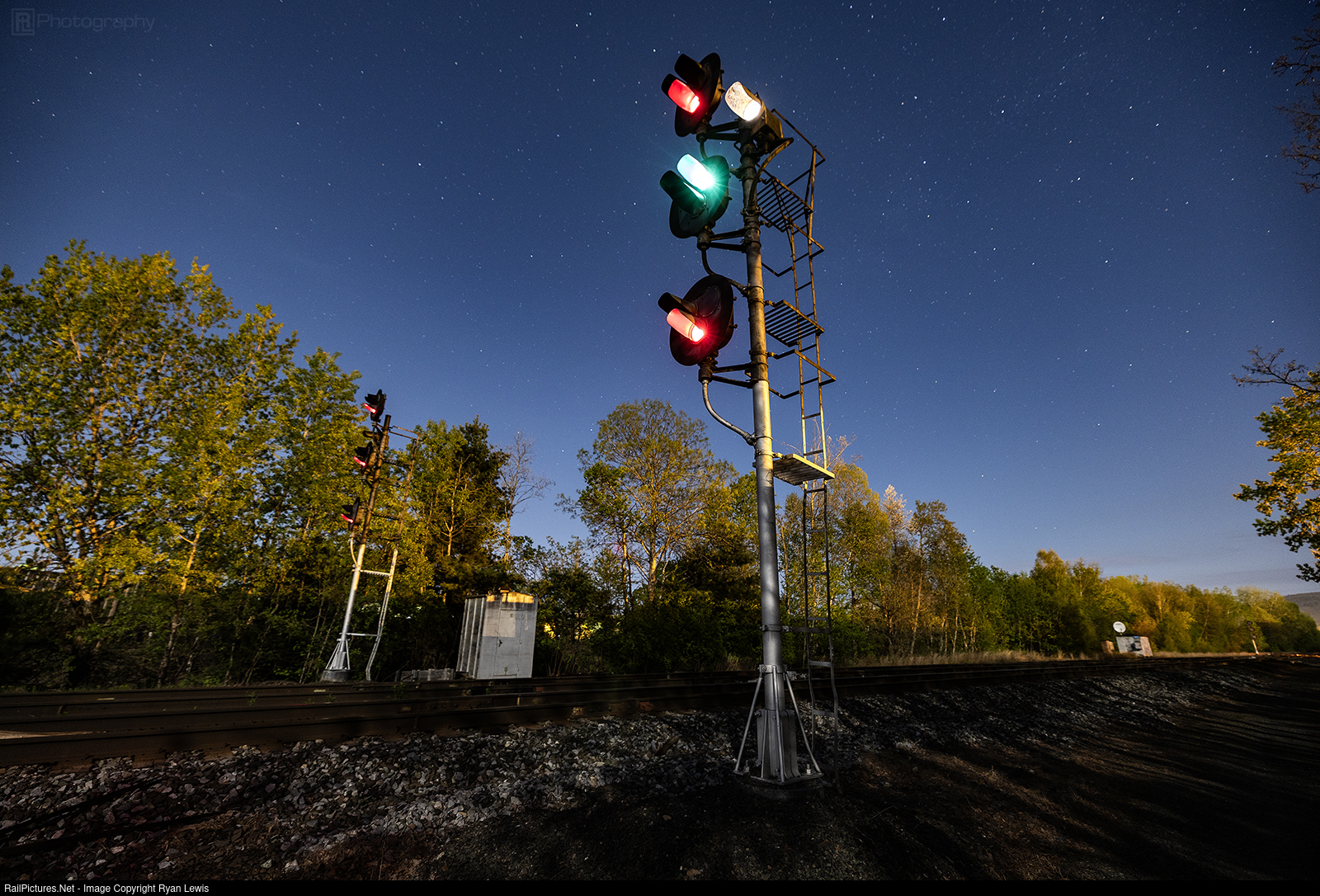
The photo shows a Conrail era signal in the Pittsfield area displaying a Rule 280a "Clear to Next Interlocking" 'C' lamp. This is supplied in Rule 562 territory to allow trains to proceed to the next interlocking at track speed in case of cab signal failure. Sometimes called "super clear" it is normally a hard signal to catch in the wild since cab signal failures aren't typically predictable. While it is certainly possible the photographer got lucky or caught wind of a special movement, I believe a more likely situation is that CSX is running non-cab signal equipped leading locomotives on its through freights and relying on Rule 280a as a standard operating procedure. This would create functional blocks over 10 miles long, thus seriously reducing capacity. So in theory, by jamming a broom handle in the spokes of the bike it is riding, CSX could have created the conditions where removing continuous cab signals would increase capacity. 🙄


Saturday, December 27, 2025

Amtrak Extends NEC Rule 562 From OAK to BUSH

Amtrak has recently activated Rule 562 cab signal operation between OAK and BUSH interlockings on the Aberdeen peninsula in Maryland retiring three intermediate wayside signal locations in the process. This follows a similar project between PRINCE and BACON interlockings that took place in 2018.  


The three wayside signal locations are the Milepost 65 signals just north of the Aberdeen station, the Milepost 67 signals near the defect detector in Short Lane and the Milepost 69 signals in Perryman.

This project has been anticipated for the better part of a decade, but according to my sources was waiting on a larger project to build a new interlocking or interlockings to improve routing around the Aberdeen station. It is possible that with both the Susquehanna River Bridge and Baltimore Tunnel replacement projects now underway, Amtrak lacked the spoons for a new Aberdeen interlocking.

Tuesday, September 30, 2025

Amtrak's Secaucus High Density Cab Signaling in Action

When the Secaucus transfer was being designed and built around the year 2000, Amtrak implemented a new "High Density Cab Signaling" concept with shorter blocks and additional cab signal codes in order to increase the capacity of the approach into Penn Station especially with all the NJT Corridor and Midtown Direct trains stopping at Secaucus. This would replace the PRR era Rule 261 signaling with mile long blocks. Below we see the 2E signal at ERIE interlocking cycle through its indications after an eastbound NJT push-pull takes a Clear signal upon departing the track 2 station platform. 2E was fleeted for a normal route and immediately went to Stop and Proceed, then Slow Approach, Approach, Approach Limited and  finally Cab Speed (which could represent both 60 and 80mph speed codes). The horn at the end was an approaching Amtrak Regional which ultimately took 2E at Clear (not captured on video).

Unfortunately this was just in time for NJT to lean into Push-Pull service which lacked the acceleration to and braking systems to take advantage of the rapidly changing speed codes. On push-pull sets with traditional air brakes, crews would often target one speed below the one being displayed to avoid jerky train handling and the risk of penalty brake applications in the face of frequent cab signal drops.This negated much of the intended speed benefits from the high density cab signals. For whatever reason, similar High Density Cab Signals could be found on the 2005 era western Harrisburg Line re-signaling, however due to the low traffic density, Amtrak has taken to disabling some of these extra code change points.

Saturday, June 14, 2025

Clear to Next Interlocking Rule 280a Displayed at CP-SOLOMON (EAST PITT)

In NORAC-aligned cab signal territory where wayside intermediate signals are not provided, Rule 280a, "Clear to Next Interlocking", allows trains without cab signals to proceed under signal indication instead of needing a track warrant or moving at Restricted speed. Related to the old concept of manual block clear, Rule 280a consists of a flashing lunar white light under the letter 'C' adjacent to a wayside controlled signal. These are normally pretty hard to catch in the wild because they are intended to be used to remedy en-route cab signal failures which are both rare and impossible to predict. For a time it was policy for Norfolk Southern dispatchers to run some Amtrak trains under absolute block protection and I was informed that some would display the  Rule 280a "C Lamp" where available, but I never managed to observe this practice for myself. 

That being said I did stumble upon a scheduled use of Rule 280a that one can catch if they are ever in the Pittsburgh area. After arriving at its Pittsburgh terminus, Amtrak Pennsylvanian Train 43 must reverse about 5 miles to CP-HOME where the closest turning wye is located. Because the rear coach lacks cab signal capability, the "C lamp" is displayed in along side the interlocking signal at CP-PITT, CP-EAST PITT (aka CP-SOLOMON), CP-BLOOM (if necessary) and depending on the order of the wye move, CP-HOME. 

Somewhat ironically the first three interlockings, CP-PITT, CP-EAST PITT and CP-BLOOM, are all back-to-back with no code change points between them. NS could have designated that track segment as normal Rule 261 without the "C" lamps, but their policy followed that of Conrail to provide the "C" even where it is not necessary. (Amtrak had chosen to do the opposite up until about 2010).


Anyway, here we see the 2E mast signal governing track #1 eastbound at CP-SOLOMON (EAST PITT) on the former Conrail Pittsburgh Line displaying Rule 280a in conjunction with a Medium Clear indication reverse move of Amtrak's westbound Pennsylvanian Train 43. CP-EAST PITT is only about half a mile from CP-BLOOM and directly adjacent to office parking making it and ideal spot to Rule 280a in the wild. 

I got this video from the east end of CP-PITT, which a shorter walk from downtown. About 30 minutes after its outbound passage, Train 43 will get more more "C" lamps displayed for a second long reverse move back into Pittsburgh Penn Station however the 2W signal at CP-PITT will display a Restricting into the station track without the "C" indication.


Saturday, July 6, 2024

Pittsburgh Line Points of Interest

While NS's move to embrace cab signaling without fixed wayside signals (which I will refer to as Rule 562) on the former Conrail Pittsburgh Line was a big loss for the casual observation of railroad signaling in action, there remain a few points of interest between Harrisburg and Pittsburgh that I was able to identify during a journey on Amtrak's Pennsylvanian in 2023. If you find yourself railfanning in that corridor, you might want to check them out.


The first thing worth pointing out are the few remaining number plated intermediate signals that still exist along the line. There is one on the Main Line adjacent to CP-HOMER due to the retention of Rule 261 operation between CP-ANTIS and CP-ALTOONA. There are also a pair of autos on the Altoona Yard leads west of CP-ANTIS.


Another distant type automatic exists on the South Fork Secondary adjacent to the Main Line near CP-SO for trains approaching CP-W.


We've all seen the signed "signal indication points", but did you see the two different SIP's located right next to each other between CP-MO and CP-AR/UN near Gallitzin due to slight differences in the mileage chaining between the two alignments.


Also present are half size SIP huts like this one near CP-MARY in Marysville, PA that serves only a single track.


Of course when a SIP shares a relay hut with an interlocking why not sign them both like at CP-JW in Johnstown.


Finally we have the mystery of those places where full speed three headed interlocking signals are still present. When the Rule 562 operation went in, many back-to-back interlockings that supported signals like Medium Approach Medium (R/Y/G), saw their replacements only support Medium Clear (R/G) with the cab signal being held at Approach Medium. 
 

However a few locations on the Pittsburgh Line retain full speed three headed masts. The first are obviously where trains might immediately exit Rule 562 territory such as at CP-ATOONA, CP-ANTIS, CP-ROCKVILLE and CP-BLOOM, or are not in Rule 562 territory at all (CP-WORKS).


However around Pittsburgh we also see three headed signals at CP-PITT and the former CP-EAST PITT. These might exist for the benefit of certain area short lines that might be able to run unequipped locomotives, or to provide better advance routing information for shortline and Passenger movements that need to use specific tracks and/or get off the Pittsburgh Line.


Anyway, keep all these locations in mind if you are looking for something a little bit extra signaling wise to capture in your photos.

Tuesday, April 30, 2024

RF&P Cab Signals Out of Serice Mid-June

When CSX first announced in plan to discontinue cab signal rules on the RF&P in 2021 I went into some detail about the possible motivations. A year later when the FRA petition was approved (despite a national spotlight on rail safety issues) I again explored some possible timelines for the process. Well it seems that we have our answer and the cab signal system will be taken out of service on June 15th, 2024. 

As a result of the process, I had to assume the worst and I embarked on a program to document the remaining RF&P intermediate signals that somehow survived the great 2010's re-signaling effort. Between 2023 and 2024 I didn't notice any changes on the physical plant so it appears that so far the discontinuation of the CSS has consisted of adding the PTC integration to all of the intermediate signal locations and hand throw switches. Because CSX does not use large visible antennas at every signal location, the process was largely invisible to outside observers. 


What this means on a technical level is that for the near term the cab signal codes will still be present in the rails to transmit block state. CSX in its filings indicated that moving to ETMS PTC for ABS speed enforcement will allow it to remove the mid-block code change points where Approach drops to Restricting. Since these are all less than 10 years old and theoretically reliable, it will be interesting to see if this is given any sort of priority. It will also be interesting to see if VRE has to retain the cab signals on its locomotives for the Washington Terminal area, which I heard is planning to actually install cab signaling in the 1st Street tunnels between CP-VIRGINIA and A interlocking. With VRE looking to purchase the Manassas Line, who knows, CSS might make a return. 


PS: Also keep an eye on the patches of former Conrail/PRR cab signaling around Philly. CSX does not have to run equipped locomotives on this territory so they might keep it active for the benefit of NS.

Sunday, April 21, 2024

NJT's Speed Enforcement System: A Thing That Existed

You might have heard me reference the Northeast's preferred transponder based PTC system ACSES, or the Advanced Civil Speed Enforcement System. In most cases when something called itself "Advanced" its usually a bit of marketing speak, but in this case the basic Speed Enforcement System was a thing that actually existed for a brief period of time on New Jersey Transit's Pascack Valley Line. However because of the rapid pivot to more "Advanced" systems and the 2008 PTC mandate, information on the SES pilot is remarkably hard to come by, however I have been able to piece together a few bits of information that can hopefully shed some light on the technology.

In 1996 NJT suffered its worst accident as of the time of this writing when two trains collated at WEST END interlocking where the diesel Bergen County and Main Lines diverge from the electrified Morris and Essex lines. The cause was a veteran engineer who had been hiding a medical condition that had severely impacted his visual acuity mistaking a Stop signal for a R/R/Y Restricting. In the aftermath NJT began an effort to implement what they called "Positive Train Stop" functionality across its system, which came on the heels of a near system-wide adoption of cab signals and automatic train control (ATC). At the same time Amtrak was completing implementation of its ACSES speed control and PTC system on parts of the NEC in conjunction with the new 150mph Acela rollout. This is where things get a bit murky, but going into the 2000's, both Amtrak and NJT had two different yet compatible transponder systems for "civil" (aka track) speed control, however Amtrak "Advanced" system was integrated with cab signals where as NJT left SES as an intermittent system.

The location for NJT's SES pilot was the Pascack Valley Line, a stepchild service that ran some 30 miles north from the old Erie Main Line to dip its toe into New York State. The single track line offered only weekday single direction peak service and, like the similar old Boonton Line, the PVL was essentially unre-signaled since the Erie days. This signaling came in the form of an Automatic Permissive Block-like bi-directional ABS with occasional non-number plated (ie absolute) automatic signals that would have once appeared at the ends of hand operated passing sidings. Without any actual interlockings and only a single block of cab signaling on approach to Pascack Jct, the limited service PVL was an ideal test bed. 


Reading through the SES special instructions in a 2004 NJT Employee Timetable (posted below) we can gain some insight into how the system worked. The evidence points towards SES was an intermittent transponder based system that would convey track speed information in a manner compatible with Amtrak's ACSES, but also fixed signal indications. A positive stop was enforced for Stop, Stop and Proceed and Restricting indications, with the positive stop zone extending 500 feet in advance of the signal. Stop and Proceed, and Restricting could then be passed after an acknowledgement, while Stop needed the dispatcher to provide a numerical override code in addition to the verbal Rule 241 instructions. This would have come into play at the non-plated automatics and the home signal at Pascack Jct. Special instructions about cab signal upgrades and other rules not applying in SES territory further strengthen the intermittent use case. 


This of course begs the question about how the system would account for signal upgrades after passing an Approach signal if the associated transponder flags a positive stop point like it does in ACSES. As easy solution would be to place additional active transponder at the start of the stop zone 500 feet from each signal, but I have nothing to confirm this theory. An additional feature of the PVL that made it attractive for the SES pilot and that was the presence of signal overlaps. From what I can tell from 2007 era photos, each set of ABS signals had several car lengths between them which would provide sufficient distance for a train running at reduced speed to get stopped before it might encounter an obstruction. This would explain why the SES stop zone is 500 feet vs 1500 for the ACES zone.

PVL automatic signal location with overlap in 2007 with what might be SES transponders (or grade crossing impedance bonds).

SES was always intended to be a temporary pilot and by 2002 NJT had let a contract for its own Advanced SES that integrated cab signals similar to Amtrak, but without the finicky data radio capability for temporary speed restrictions and stop release. Interestingly the $2 million contract with Union Switch and Signal would have outfitted the entire NJT system with PTS and track speed control by 2008! The wireless data free ASES vs off the shelf ACSES debate would extend into the post-2008 PTC era with the ASES plans eventually morphing into ACSES, but perhaps the original SES hints at what NJT's solution would have looked like. Version 1 ACSES also lacked data radios and needed temporary physical transponders for TSR's and use of the stop release procedure to pass certain signals with a proceed indication. Active SES-style transponder could have solved some of those issues without wireless data.

Unfortunately I have been unable to determine the exact timeline of the ABS SES system on the PVL. I know it was in service in 2004 with the CNJ vintage GP40PH locomotives operating in a dedicated pool. I know that SES was still in service as of Jan 1, 2006, however by the fall of 2007, the line had been re-signaled with Rule 562 cab signaling and upgraded with passing sidings to allow for all-day bi-directional service. Unfortunately, starting in August 2006, all PVL physical characteristics and rule changes were put into a separate supplementary bulletin order that I do not have any examples of. Interestingly, the 300 section of NJT special instructions covering SES were left in place with slight modifications likely to cover the upcoming ASES or ACSES installations due to the 2008 PTC mandate probably resulting in some savings in crew re-training. 

If anyone has any additional information on NJT's SES please let me know so I can update this post or make a new one. I've heard a bunch of other stories regarding issues with hair trigger penalty brake applications, but not much more than anecdotes and speculation.

Sunday, February 4, 2024

CTA Skokie Swift Smackup

In November 2023 an inbound "Skokie Swift" Chicago El train rear-ended an MoW vehicle stopped on the track waiting for signal clearance into the Horward terminal interlocking complex. The impact took place at a speed of 26mph and the NSBT was quick to blame "outdated" signal stopping distances that were last set whenever cab signaling was installed on the line, likely in the 1970's or 80's. The result was a multi-month service suspension and a reduction in maximum authorized speed from 55mph to 35mph, which was achieved by disabling the 55mph cab signal code at ever block location. To the lay person this might seem open and shut, the CTA did something wrong and they fixed the problem. In reality this is a classic example of go slow safety scolds and risk averse CYA officials pushing people away from public transport. This case is especially ironic since when the Skokie Swift opened in 1964, it was a demonstration project on how rapid transit could be high tech, modern and fast compared with the "square cut gear" era equipment.


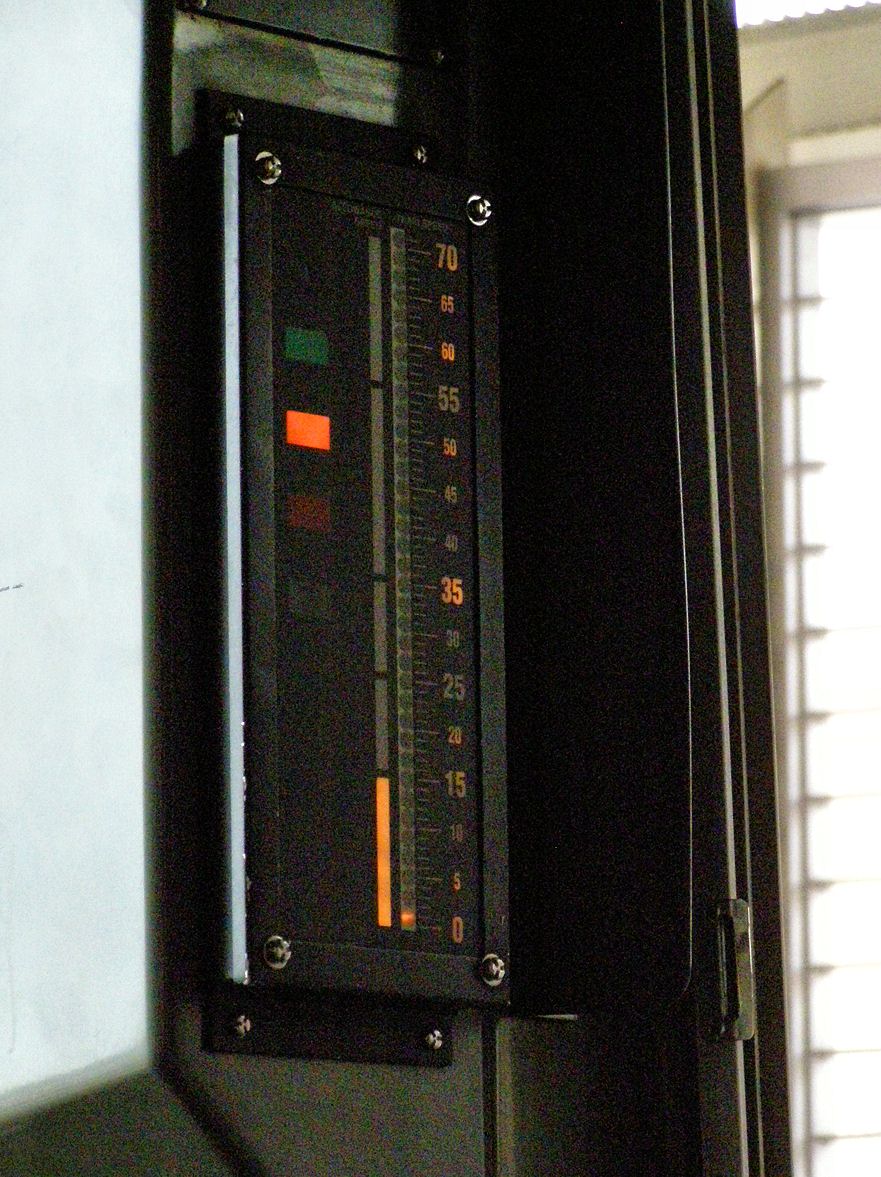
For background, the CTA uses a pretty standard audio frequency cab signaling system with automatic speed enforcement and speed codes for 15, 25, 35, 55 and 70mph. Lack of code is fail safe and registers 0 mph and it is standard practice on this type of system to have sufficient 0 code behind any train for fail safe stopping. While most of the Skokie Swift is straight and uncongested, allowing for 55mph operation, the the busy Howard terminal will frequently see Skokie trains encountering stop signals and thus need to reliably slow from 55mph to 0 starting at a point about 2500 feet from Howard Interlocking's home signal. This would be carried out by progressively slower cab signal codes, although it is not clear if the operator gets a 0mph code ahead of the wayside absolute signal or at it, where a physical trip stop is also provided. The following CTA produced head end video of an inbound Skokie Swift run shows how this progression from 55mph to stop is well within the vehicle's performance envelope. The 55 to 35mph code change point is encountered at 7:55. Code change points are identified by small black boxes, called impedance bonds, located between or adjacent to the rails.


Feel free to judge for yourselves, but it appears that the first code drop is just before the hand throw crossovers about 2500 feet before the Howard absolute signal as stated in news reports and the last code drop is located under the overpasses at the final curve. It is not entirely clear if the final drop is to 0mph and the train takes the time shown to react and stop (likely) or if the operator chooses their stop point on a more favorable 15mph code (possible) or even if a timer that drops out the code mid-block is involved (unlikely). (Note: It's pretty trivial to determine how CTA trains get stopped before absolute signals by observing the cab signal display in the cab from the first car, I just haven't done so in a while so let me know if the comments.) The difference between normal operations and the day of the collision was the presence of an MoW snow melting vehicle on the inbound main track about 370 feet short of the Howard interlocking home signal. Had everything been working as intended, the train following the MoW vehicle should have gotten stopped before the final code change point under the overpasses.


The NTSB's knee jerk assessment implied that the following train somehow couldn't get stopped in time. As in it got the proper speed codes, but the speeds and distances were calculated incorrectly and it ran into the snow melter. Given that the line has been operating without incident for 60 years this seems unlikely, however the train was a newer 5000 series car that has only been operating for 15 years so it is possible something like crushed leaves resulted in decreased braking that combined with a heavier vehicle could have resulted in the observed accident. Still, is there an alternative explanation?


What stands out to me is the impact speed of 26mph. That's pretty much full speed approaching the final code change point. Typically when stopping distances have gotten out of sync with the equipment you see the rail equivalent of foot faults where the train can't quite get stopped in time. Remember in this case, if the block before Howard interlocking is occupied the second to last code change point should be giving a 0mph. It's almost like the train was approaching the MoW vehicle like it wasn't there. Moreover the operator indicated that the signal system commanded a speed reduction from 55 to 25 or 35 ~2100 feet from the equipment (or ~2500 feet from the Howard signal). If you refer to the video you can see the train begin to slow from 55mph at that same point, but again, that is for an unobstructed block before the Howard signal. If that block was occupied the inbound train should have gotten a signal drop one block before.


By this point I've already given away the twist. Maintenance of Way vehicles and other things the FRA likes to classify as "track cars" are known to not reliably shunt the track circuit and therefore need to be run with absolute block protection, especially to the rear and double especially when cab signals are involved. In cab signal territory if a track car fails to properly shunt the track circuit, not only will it not be detected by the signaling system, but favorable cab signal codes can also be transmitted to trains approaching from behind. Rail contamination like leaf debris only makes this problem worse.
 

To be clear, I have heard stories of trains having braking issues and sliding past calculated stop points as a result. For example an Acela locking up its wheels approaching Trenton and sliding for over 2 miles allegedly resulted in an extra block of speed control being added. Still, every detail about the indecent matched up with a loss of track circuit shut involving a track car and an approaching Yellow Line train that received cab signals in the sequence expected for a stop at the Howard interlocking home signal. It's certainly possible that the signal design created some grossly unsafe condition as the NTSB is implying, but the decades of safe operation imply otherwise. Unfortunately signal distances are easy to calculate and in addition to using the worst possible braking performance and the worst possible rail condition, the NTSB might actually believe rail vehicles need to emergency brake short of any obstruction they encounter within the range of vision.

Wednesday, November 29, 2023

Mazda Cab Signals are the PTC Solution We Needed

While driving in a brand new rental Mazda sport wagon in Colorado I noticed something interesting on the instrument cluster.

There was a dynamic speed limit indication accompanied by a red tick on the speedometer indicating the currently detected speed limit. Now this sort of information has been available in Waze for some time, accurately using smart phone grade GPS to pull a road segments speed limit from a crowd sourced database and displaying it on the interface. Using something like Android Auto this could be displayed to he driver in any number of ways.


The cybersecurity implications of this aside, I noticed an interesting Mazda party trick that Waze could not perform and that was the seeming ability to detect temporary speed restrictions, aka work zone speed limits. Waze explicitly rejects trying to track TSR's, even for long term work zones. Although achievable through traditional data collection methods, I was aware that the vehicle was equipped with forward facing cameras for its lane-assist feature (or MCAS) and if on-board systems could keep track of lanes, they could also recognize wayside speed limit signs and display them on cab signal, possibly augmented by a Waze style database.

The current national Class 1 PTC standard, ETMS, relies on wireless data and GPS to track a trains position and compare is, Waze style, to a database of authorized speed limits. The problem this creates are clunky data networks that result in slow setup time and en-route loss of connectivity as well as occasional mass outages that can halt traffic across a railroad's entire network. The preferable solution has been evident in the field of vehicle automation for over a decade now. Computer vision systems just look at wayside signs (and/or signals) the same way the human engineer does. To the extent that wayside signs are vulnerable to impairment computer vision doesn't have to replace the current "Waze" type system, but in case ETMS suffers a failure, the backup solution isn't halt all traffic (or god forbid just let the crews do their job), but fall back to wayside sinage detected by computer vision and enforced by the on board apparatus 

Saturday, September 16, 2023

Go No Go: Cab Signaled Transit Wayside Dialects

In the late 1960's a new crop of "Space Aged" rapid transit systems began to take shape in North America making use of the new materials and electronics developed since the end of World War 2. In particular was a push to replace wayside signals and trip-stops with cab signals which would enable both automated operation and a reduction in wayside hardware. Of course this forced the question about contingency operations in case of cab signal or related failure. Railroad explorations of wayside elimination in the 1930's and 40's had retained wayside signals at interlockings and other controlled points and rapid transit followed suit with the further innovation of reduced aspect signals displaying Stop and Proceed aspects with the occasional Diverge and Absolute Block. Also like railroads, the rapid transit systems adopted a mix of "dialects" for their reduced aspect signals that I hope to categorize below.

Lunar White - The Granddaddy of them all, the Lunar White proceed indication can be considered the "default" rapid transit proceed signal aspect. First appearing on the PATCO Speedline in South Jersey (at least as far as I can tell), lunar proceed was later adopted by systems including DC Metro, SEPTA MFL and Route 100, HBLR, Cleveland Rapid Transit and Baltimore Metro (as built). The rationale was to be distinct from the existing ABS signal aspects using Green and Yellow and present as a railroad Restricting style aspect for non-cab signal equipped movements.

PATCO Lunar White Cab Speed

Steady Green - Considered the "obvious" solution since Green means Go, use of Green in place of Lunar White has been gaining in popularity with newer systems as any perceived need to be distinct from older ABS systems has faded. Notably appearing on DC Metro peer system BART in 1972 it was also adopted by Maimi MetroRail, St Louis Metrolink, Baltimore Light Rail and the Baltimore Subway as modified. Some systems will use flashing green to indicate a diverging route, others yellow. 

Baltimore Metro Steady Green Cab Speed

Flashing Green - Taking another page from the railroad playbook, flashing has made a few appearances to indicate a proceed indication on rapid transit systems. On the New York city subway flashing green straight up means Cab Speed for both straight and diverging movements under the control of the CBTC system. On Atlanta's MARTA, flashing green is the default proceed signal with steady green indicating a diverging route. 

Yellow - Similar to lunar white, this substitutes lunar for yellow similar to that dialect of railroad Restricting indications. This is most prominently used in Boston with Y/R for straight routes and R/Y for diverging.  

MBTA Y/R Cab Speed

Green Arrows - This most prominently appears on the cab signaled  portions of the Dallas DART system to differentiate from the ABS signals and avoid the use of flashing. 

DART arrow signals, not illuminated.


DART arrow signals, illuminated.

White Arrows - Like the green arrows above, but using either lunar or plain white. This is popular with airport people movers including the JFK AirTrain but also in use on the Sound Transit light rail with stylized direction indicators.

Sound Transit stylized arrow.

ABS - Currently used on Chicago, this method of go-no-go signaling takes a cue from the cab signal state to display a Green if the cab speed is "clear" (55/70mph) and a yellow if it is "restricted" (35/25/15mph). The cab signals can be from either block state or due to civil speed restrictions.

CTA Proceed Clear

 
CTA Proceed Restricted

This is my best shot at a taxonomy. I'm sure I've forgotten about a few systems or corner cases so if you, the reader, can think of any, please let me know in the comments. Please make sure that the line is actually cab signaled as there are quite a few ABS signaled light and heavy rail transit systems in North America.