A blog devoted to explaining the ins and outs of North American railroad signaling, past, present and future. This blog seeks to preserve through photo documentation the great diversity and technical ingenuity of 20th century signaling and interlocking hardware and technology. Related topics cover interlocking towers and railroad communications infrastructure.
Note, due to a web hosting failure some of the photos and links may be unavailable.
Two quick updates. First the twin three track M&W CPL bridges at HULL have been replaced. Unlike CSX I guess NS doesn't screw around with re-signaling projects.
I also identified another 5-orbital B&O CPL in the Cincinnati Area. They are at KC Junction across the Ohio River in Kentucky where the B&O meets the old L&N main line.
Once again it appears that the Complete B&O CPL is one again headed for extinction. These most rare of signals is the B&O style CPL with all 6 orbitals and a complete central target with all 4 lamp pairs (G,Y,R,LW). As far as I could ever determine there only used to be 2 of these, one in Curtis, IN and the other in Laughlin Jct, PA. The first bit the dust ~2000 when the B&O Main Line to Chicago was re-signaled in the wake of the Conrail merger. The second then fell in 2004/5 when Glenwood interlocking was removed from service on the P&W.
Then in 2007 a miracle occurred. A capacity improvement project at West Baltimore triggered an upgrade of the 1992 installed westbound CPLs at CARROLL interlocking with one main track getting a plus up to 5 orbitals and another to 6 and like the coelacanth, the B&O complete CPL was back from the dead. Unfortunately, a short 5 years later CSX abandoned all efforts to reuse any old signaling hardware, even if it was not life expired and in the case of the Capitol and Metropolitan subs had no incentive to do so as it was awash in stimulus money to upgrade the MARC commuter rail service. The result is a brand new, modern and recently upgraded CPL signal now facing retirement and forcing the complete CPL back into extinction. What a fucking waste of tax dollars.
As far as I can tell the next best CPL is a 5-orbital model in Hamilton, OH, although the head lacks a Lunar indication. If anyone reading this knows of anything better let me know.
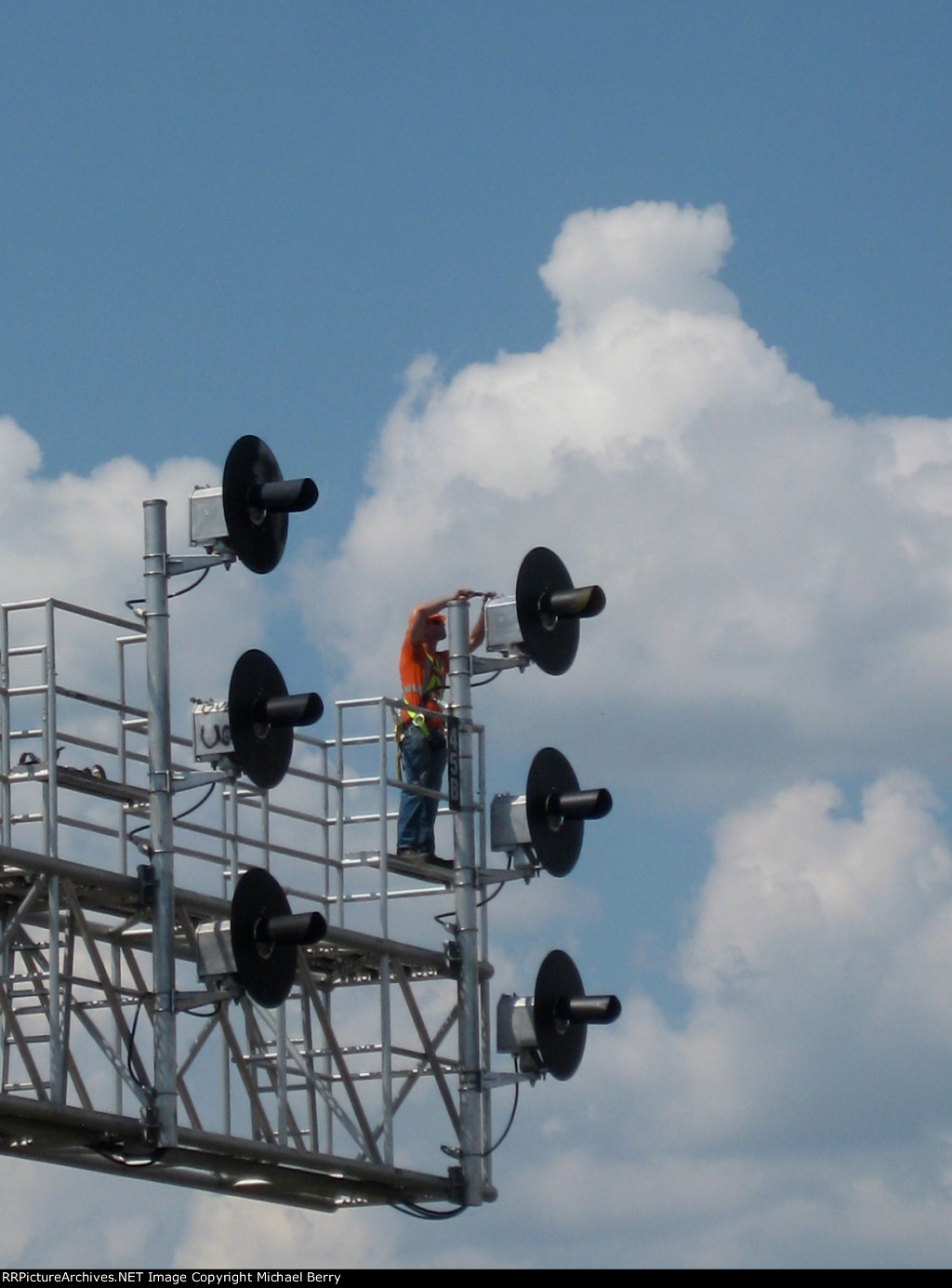
A year ago I posted about the new searchlight signals being installed by the Canadian Pacific at their rebuilt Mechanicsville Yard.While the CP ultimately became rather inconsistent about its new searchlight policy it seems that there is a bit of a wrinkle to the plot. I recent came across some photos about a new, new searchlight installation in Canada, this time with some closeups of the searchlights themselves and it confirmed something I had suspected for some time. CP is not installing either recycled "classic' style searchlights or their modern replacement Unilens or tri-LED type searchlights. Instead what is going in is something that looks like a classic searchlight, but has a much larger housing and the light output of an LED signal. You can see here in this photo of the most recent instalation being put into service.
Compare them to the classic US&S H-2 units they are replacing.
I will look into this. It would be great if modern solid state searchlight signals could finally take off and provide some much needed competition for those god damn Darth Vader signals.
I've talked about the 4-aspect PRR Cab Signaling System before, but this time I have a really good video demonstration of how it works in practice. As you know the system uses coded track circuits with pulses of 100Hz current sent through the running rails at rates of 180, 120, 75 and 0 pulses per minute which provide the cab signals of Clear, Approach Medium, Approach and Restricting. These roughly correspond with the 4 main speeds of railroad operations, Normal, Limited, Medium and Slow. As there are about 20 signal indications displayed on wayside signals and only 4 cab signals, the cabs provide only a rough indication of what the engineer can expect, but the system is set up in such a way so that it can forestall most grossly unsafe conditions, especially when outfitted with speed control.
So what better way to demonstrate the PRR Cab Signaling System than to bring you a video taken in the cab of one of the last passenger cars purchased for use by the PRR. On June 29th, 2012 the 1967 vintage Silverliner III class EMU, along with the 1963 vintage Silverliner II class EMU made their final runs on the SEPTA Cynwyd Line service. I was take to stand in the cab and get some video of the engineer operating the train from the Cynwyd Station in towards 30th St Station in Philadelphia. The cars are equipped with a Modernized Cab Display Unit, installed during an early 1990's rehabilitation. This still display the PRR miniature position light signal indication, but also include an integrated speedometer for the speed control function as well as other lights for overspeed and brake suppression. The train starts in non-cab signal territory, but as it passed the signal at CP-JEFF (4:27) it passes a cut-in loop (4:55) and the display activates (5:00). The cab signals then begin an automatic test sequence running through each aspect before returning to the one respecting the code in the rails (6:00).
There is a slow speed switch onto the main line with a wayside signal displaying Slow Approach (6:38). This translates to a Restricting cab signal, but the cab signal only drops when the train passes the Slow Approach signal (7:03). Had the signal been displaying Stop it would drop about 1500 feet before the signal. At 7:12 the train's leading wheels pass the interlocking limits and then pick up the cab signal being fed into the block ahead of it and the cab signal upgrades to Clear. The engineer then waits for his entire train to clear the 15mph turnout. The signal remains at clear as the train enters the western limits of ZOO interlocking. As you recall ZOO is quite an expansive interlocking (less so than in years past) and is still controlled from a big US&S Model 14 machine in ZOO tower. There are several automatic signals located within ZOO's interlocking limits and as we approach the 28 automatic at Clear it drops to Approach (9:03) and then bounces up to Approach Medium (9:11). This was the result of a signal dropping to Stop at K interlocking and the old relay logic took a bit of time to figure out what to do with it as the 28 auto is the second signal in advance of the one at Stop. You can hear the delay between the signal drop and when the cab signal responds to it.
The next signal the train passes is at Approach (9:57), which causes a cab signal drop from Approach Medium to Approach (10:26), and then you hear the cab signal drop from Approach to Restricting (10:42) as we come upon the Stop signal. K interlocking used to be part of ZOO interlocking and was owned and maintained and operated by Amtrak. However Amtrak ran no trains through that part of ZOO so a few years ago Amtrak transferred that part of ZOO to SEPTA, re-signaling it and ting it into their own dispatch center. Well SEPTA has been having issues with their dispatching ever since they closed their panel type interlocking towers and set their trains to run on a system designed for rapid transit services. The dispatchers are told to use the automatic route setting almost exclusively and as a result their train routing skills are a bit rusty. In this case a heat kink was discovered on the track we were routed on and we needed to cross over to track 2 at K interlocking. The situation is discussed starting at11:19, but at 11:39 the dispatcher lines up a route down the kinked track 1 again!!! The crew calls it in and this time the signal needs to be knocked down (12:07) with a 4 minute timer run. We finally get a Medium Clear signal indication which results in an Approach Medium cab signal indication which turns to Clear when we pass the limits of K interlocking at 13:19.
Anyway, here is the video. Enjoy both the signaling and the vintage equipment on its last day of service.
As a bonus I have a second video taken in the opposite direction that still shows the cab signals, but doesn't capture the engineer very well. This is because the Silverliner III's were delivered with left hand driving positions to allow passengers to enter and exit through the front of the car when being operated as a single unit. In this video the train climbs up on a long slow ramp to a truss bridge flyover. This used to be the route of main track #4 flying over some freight tracks, but as the bridge deteriorated and freight was eliminated, main track #4 was relocated leaving only Cynwyd Line trains using it. As the train passes the reverse direction dwarf signal at 11:08 on an Approach cab signal, it leaves cab signal territory. I think automatic cab signal cutout loops do exist, but even if they do this location is not equipped with one and the conductor must place his key into a cab signal cutout box (11:15) and turn off the cab signals (which would otherwise be left at Restricting in absence of a CSS code). The cut-out box out is out of arm's reach of the engineer so it requires two people to cut out the cab signal system without stopping the train. Sort of like how missiles are launched from submarines.
In 2005 the door closed on one of the last large panel driven interlocking tower in North America. Occupying the bridge between second generation power interlocking machines like the Model 14 and Pistol Grip and today's ubiquitous computer driven interlocking systems. Typically referred to as N-X interlocking machines, the simple technology of pushing buttons to set routes is just one part of a true panel interlocking. The best example of panel machines controlled either large territories or complex stretches of track. In addition to the simple N-X route buttons and unit levels for switches panels would be outfitted with communications equipment and large analogue model boards separated from the human interface that would light up the routes set. Sometimes this interface would be simplified like a GRS TrafficMaster, other times a highly compact model board that could be easily reached by the operator, but no matter their appearance their time in service was short lived.
Panel type interlocking control systems were never as popular in the United States as they were in Europe or other parts of the world. At the time that large panel type technology replaced power frames like the US&S Model 14 and GRS Pistol Grip (~1955-1985), railroads in North America were entering a period of sharply declining fortunes and austerity. Where lines retained their signaling or were not simply ripped out, classic interlocking towers dating from the 1900's through 1940's were either not replaced or replaced by Unit Lever CTC type panels, which while a form of panel, completely lacked the sorts of advanced technologies seen in European panel boxes. While there was adoption of first generation N-X technology for complex junctions and terminals starting in the late 1930's, this petered out austerity took over and railroad's physical plants were drastically simplified along with the near complete abandonment of passenger operations where the need for advanced panel technology would be greatest.
The other factor working against large panel type "boxes" in North America is the fact that vital interlocking hardware for large areas is not concentrated in one structure and the lower traffic density, even in remaining passenger terminals, was never high enough to necessitate things like automatic train describers. Therefore what panels were built served only as a human interface device, one that was easily replaced by software solutions and video display units. While most railroads jumped directly from towers to computers or from first generation CTC panels to computers, there was a small period of time where N-X panels with all the flashing lights were standard fare in dispatch offices and those towers that remained open. Here is a YouTube video of one such panel, situated in RU tower in Lorain Ohio that also happened to be a lift bridge control cabin, in operation.
The other problem was that when railroads did rebound after deregulation in the 1980's those that had previously made the largest investment in signaling were the roads serving the heavily industrialized northeast and Midwest. When manufacturing was decimated those railroads found their signaling and track infrastructure drastically overbuilt just at a time when new technology was appearing so those few panels that had been installed in the late 50's and 1960's were nearly all removed from service during this period. Here are videos of two examples on the former Reading System in Reading, PA. The first is VALLEY tower which contained a wrap around General Railway Signal N-X console dating from the 1950's which had the operator directly pressing buttons on the model board. The machine is on the verge of retirement here in this 1987 video and you can see how much of the physical plant has been altered by looking at what's been blanked out on the diagram.
Across the river from VALLEY is OLEY tower, which was built in the 1960's to consolidate several older towers in the Reading terminal and yard area. OLEY was provided with a much more advanced N-X setup that had a billboard style model board sitting in front of a wrap around operator's console. In this case the operator would work compact groupings of N-X controls on miniature diagrams, but not interact with the model board itself. In a similar 1987 video we can see the inside of OLEY shortly before its closure as part of the same re-control project.
So this brings us to Hoboken Terminal Tower which was built along with the terminal itself by the Delaware, Lackawanna and Western in 1907. As can be seen in the Signalbox site's page the original tower, which had the appearance of a gingerbread house, contained an ancient 155 lever US&S Electro-Pneumatic type interlocking machine. This machine was in service up until the early 1980's when the state took over commuter rail operations directly from DL&W successor Conrail, which had previously been running them under contract. The old DL&W commuter rail system was in a sorry state to say the least with the 1907 signaling running electric MU's dating from 1930 under a bizzare signal aspect system. The state planned to replace both the aging 3000 volt DC electrification and completely re-signal the lines with modern signals displaying standard signal aspects. Most of its new commuter lines were to be signaled from a new dispatch office inside the Hoboken Terminal headhouse utilizing large non-video type model board displays. However the complex Hoboken terminal would still be worthy of its own dedicated interlocking tower and for this purpose a new 4 story brick structure was constructed at the end of the longest platform with a mix of signal operators and clerks contained within.
However 21 years later the entire 1984 vintage signaling control system with its micro-bulb lit model boards and semi-computerized operation was already starting to show its age and compared poorly with new all software systems that could do things like train description. Even more of a concern was the fact that with the office in the terminal station, signalers might occasionally interact with train crews, contaminating them with non-management approved ideas. Therefore the decision was made to move the whole kit and caboodle to a new control center located in the isolated Meodowlands Maintenance Facility, affectionally named Club Med due to all of the creature comforts the new facility would have compared to the old one. In addition to the dispatch center it was determined that having signalers who could actually see the complex terminal they were responsible for was a bad idea that might complicate scheduling and management so instead of replacing the old Terminal Tower hardware with some computer screens those jobs were also moved to Club Med.
Anyway what inspired this entire post is that I finally discovered some photos of the inside of Terminal Tower, which also happened to be taken on its last day of service on June 10th, 2005. So let's begin by entering the operational area of the tower.
CSX ripping down CPL's is nothing really newsworthy, but this time it involves the subject of a previous blog post. If you happen to remember the piece on Laughlin Junction you will recall that it was an actual junction located on the CSX P&W Subdivision on the route of Amtrak's Capitol Limited. The P&W Sub was the original B&O route to Chicago, but was long ago relegated to secondary status by the use of P&LE trackage rights between Braddock and New Castle. Laughlin Junction was the junction of the short branch to the old B&O station in downtown Pittsburgh, last used for the PATrain service in the 1980's. Laughlin Junction was special because it contained one of two Full Complete CPL's with all 4 positions on the target and all 6 orbitals being used.
The Junction's fall began in the late 90's the station was demolished and the line to it converted into a bike path. In 2003 the active interlocking tower at Glenwood was closed due to a long trending decline in local industrial rail traffic which was done in conjunction with CSX single tracking the line between there and Braddock which in turn caused the full CPL to lose all of its orbitals. Shortly thereafter the entire P&W sub was leased to a shortline and all of the CPL signaling removed from service, making the three remaining interlockings orphans on the CSX system, retained only because of the Amtrak traffic but still requiring all the usual maintenance. Well next Laughlin lost first one of its crossovers and then the other leaving only one switch between the former second main turned running track and the west end of the Glennwood yard. Well this past week the final nail was put in the coffin when CSX removed the entire interlocking from service, replacing the CPLs on the E/B bracket and W/B tubular gantry with a simple bi-directional Darth automatic signal at the site of the gantry.
It remains to be seen what will become of the new gantry, the old bracket and the forest CPL. Anyway I can't really get too made at this one. The interlocking was barely functional and a dispatcher told me it would take several minutes for the all relay plant to display an indication.
Here is something I cannot say I am very surprised about, although I have been expecting it for some time. It seems that at least one of the N&W Position Light brackets on the NS Sandusky Branch are being replaced at the famous AC diamonds in Marion, OH. AC Tower itself closed in the mid-1990's but was preserved, interlocking machine included, nearly in place as a signaling museum. For over a decade the N&W brackets have stood in a sea of Vadar signals on the former Conrail branch since operated by CSX, but it appears now that at least one of those brackets (the northbound one with the / and | positions on the lower head) are being replaced by a bullshit cantilever.