Search This Blog

Wednesday, March 26, 2014

Falling Signals and a Possible New Tower

It's news time again and I have a mix of good and bad news this time, which I guess is better than just all bad news.  First up the CSX re-signaling project in the Bailey's Wye area was supposed to be completed over the President's Day weekend, but do to the crazy amount of snow that schedule has slipped back until May so everyone has another month to get their final photos in.


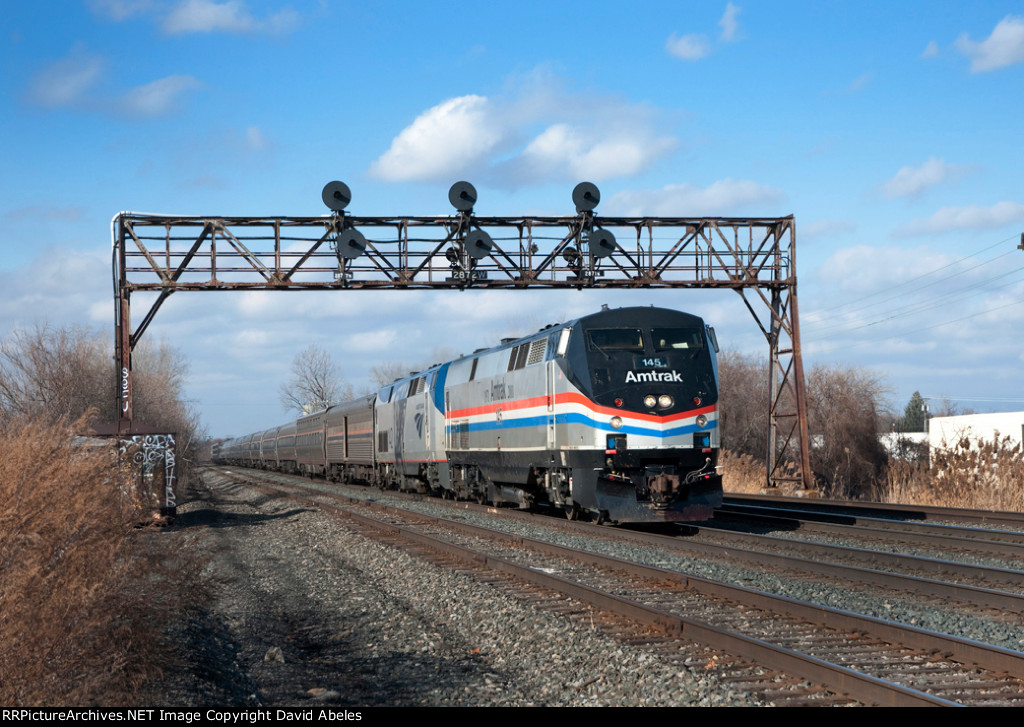
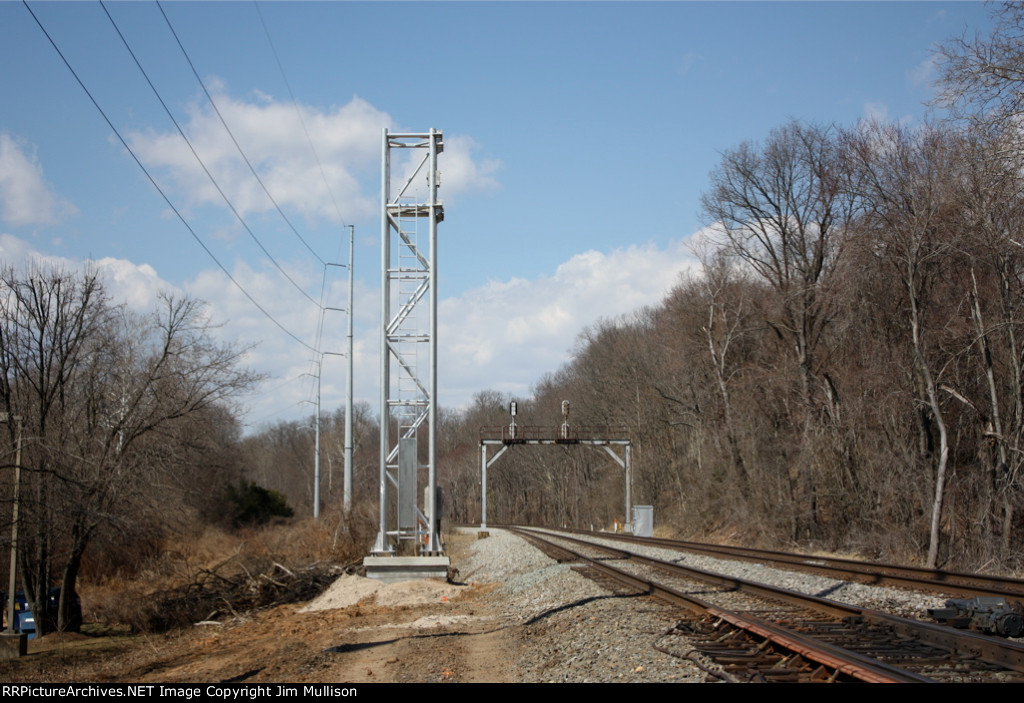
On the other side of the Potomac it looks like NS is doing some signal replacement on the Southern Main in the VRE Zone, although the extent of the work is not quite apparent.  What I do know is that NS is replacing the northbound Southern style signal gantry at BURKE interlocking in such a manner as to improve the sight lines.   As you can see the new cantilever is about 400 feet farther away from the curve than the old signal.


BNSF is continuing to replace its lightly used searchlights in Kansas.


Perhaps the biggest tragedy is that the mystery searchlights at Eagle Bridge Junction are on track to be replaced by the Guilford Rail System's ultra cheap brand of Darth Vaders.   I had this on my list of locations to document in February, but car trouble caused me to shelve it in favor of CPF-480 (which I figured was more endangered) and it was about a week later when I saw this photo.  Yay for the bracket mast I guess.  If anyone can get out there this would be a top priority to document.


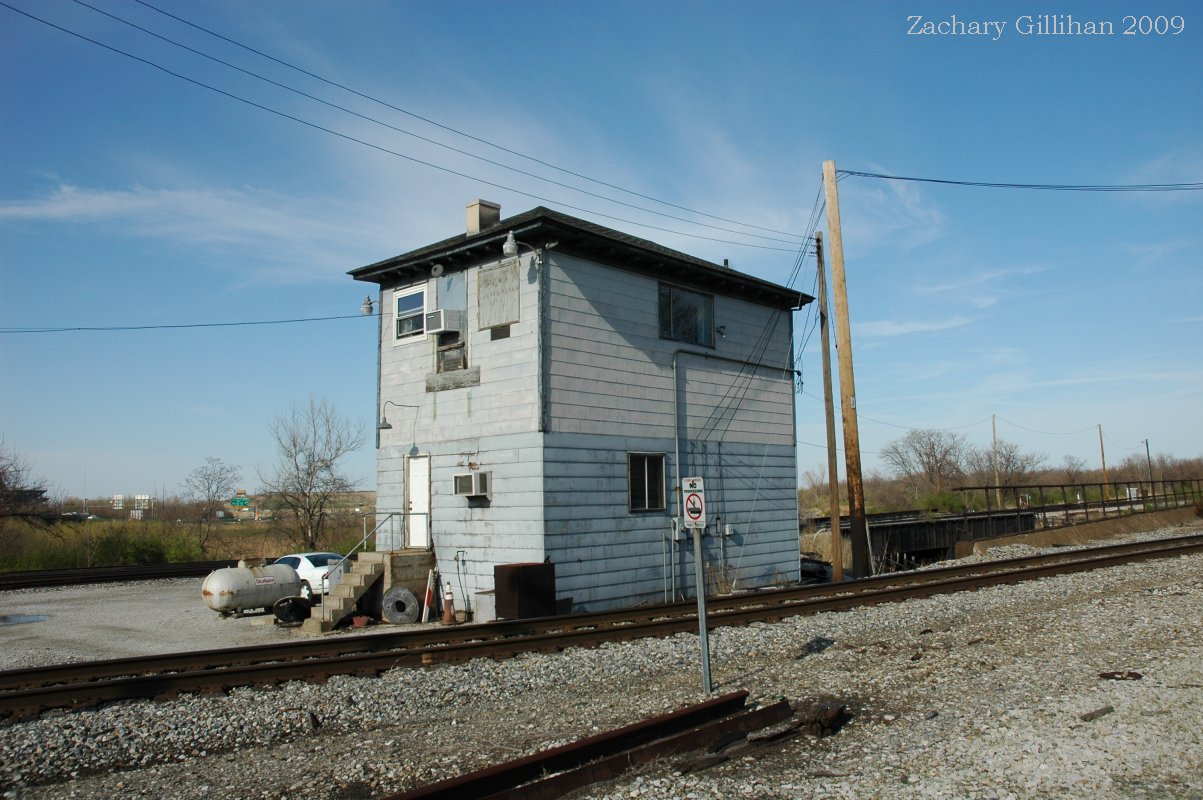
Back to the good news WILLOWS tower in East St Louis got a nice new coat of siding so you can say goodbye to the old asbestos shingles.  Inside is a super classic GRS/Taylor Model 2 interlocking machine.


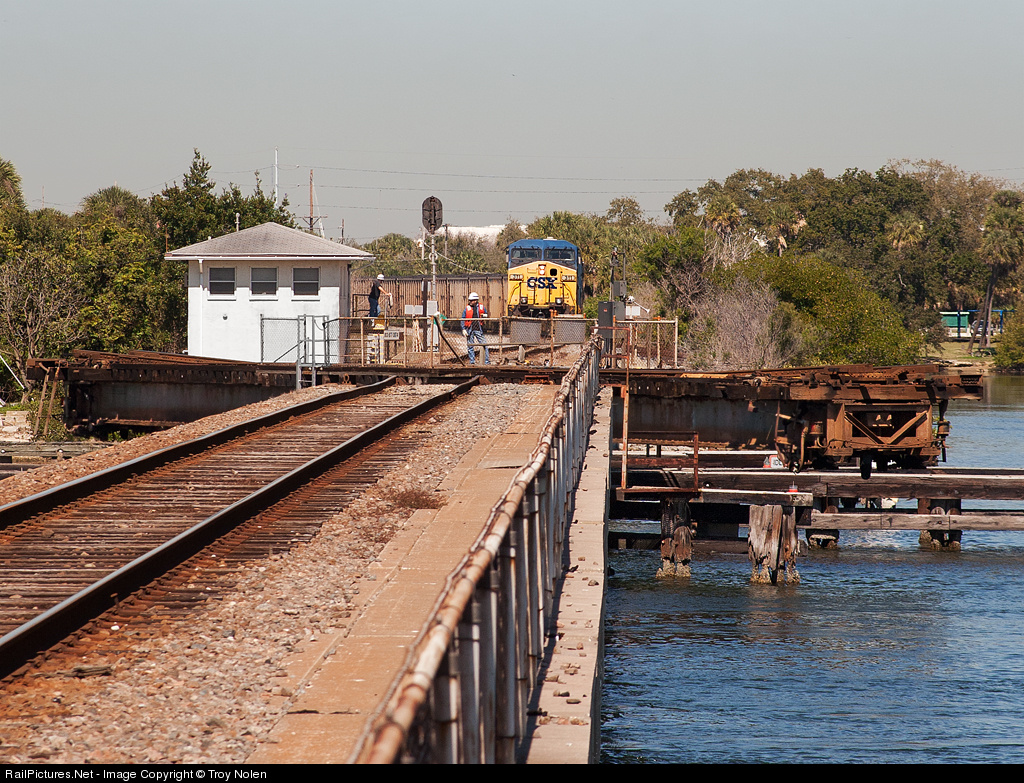
Finally I believe I have located what would count as another Active Interlocking Tower on the CSX Palmetto Subdivision Gibsonton, Florida.  Like the other recent finds this one is also a bridge cabin and this one comprises a swing span over the Alafia River.  Now a trip to the timetable did not definitively prove that this cabin maintained the requisite control over local switches and signals, but it is manned 24/7, is still equipped with classic SCL signals and is not in any sort of signaled territory so I say it is likely to still have local control and be run by an operator.


Monday, March 17, 2014

Better Know a Signaling System - Southern

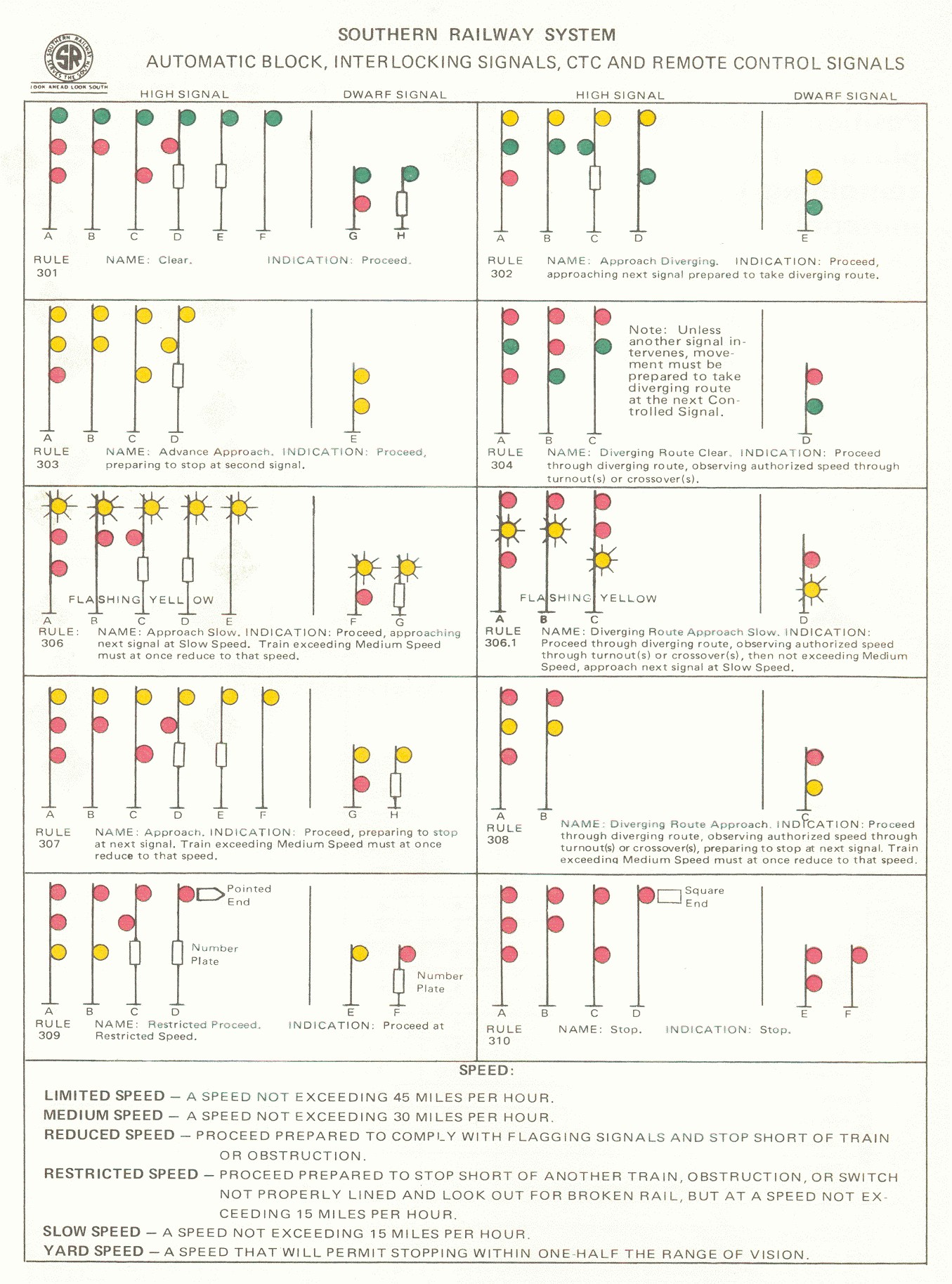
The Southern Serves the South and today it is serving my need for a blog post.The Southern is interesting as it is the most Western of the Eastern Railroads in terms of its signal indications, yet still retains a number of very Eastern elements.  Until recently the South was a fairly laid back rail environment compared to the corridor running between the Northeast and Chicago.  With large amounts of single track ABS and little need for interlockings away from major junctions and station terminals the Southern was able to get by with a total of 10 signal indications vs 21 under NORAC and similar numbers on the CSX systems.

As you can see the Southern was a route signaled system which means that all the very specific Speed based signals just get tossed right into the bin and replaced with "Prepare o Diverge", "Diverge to Clear" and "Diverge to Stop".  In what might be a new level of laziness Rule 304 "Diverging Clear" actually informs crews that if an intermediate signal does not exist between there and the next interlocking they must approach that signal prepared to diverge as well.  So at that moment the engineer must be cognizant of the current turnout speed, if there is an intermediate signal and if not then the next turnout speed as well as any additional speed restrictions which are all recalled from memory.

I might not like Y/Y Advance Approach, but its better than Approach Diverging
 What makes the Southern stand out compared to the traditional Route Signaled lined out west is their use of Y/G for Approach Diverging as opposed to Y/Y on  the UP/BNSF systems, instead using Y/Y for Advance Approach instead of *Y*.  With Y/G a major aspect the system doesn't suffer from yellow overload.

There's something about green and yellow that just goes so well together.


Another defining feature of the Southern system is the use of bottom yellow Restricting.  R/Y won't cut it as that is Diverging Approach.  You need either a third head (the preferred method now employed by NS) or a sufficiently large "gap" between the top head and the one below it. Again this requires a bit of route knowledge to prevent mixups.  The Southern tended to employ Restricting sparingly, like for movements into yards.  Today NS uses it much more frequently.

Bottom yellow restricting with a gap in action.

However NS generally prefers including the middle head.
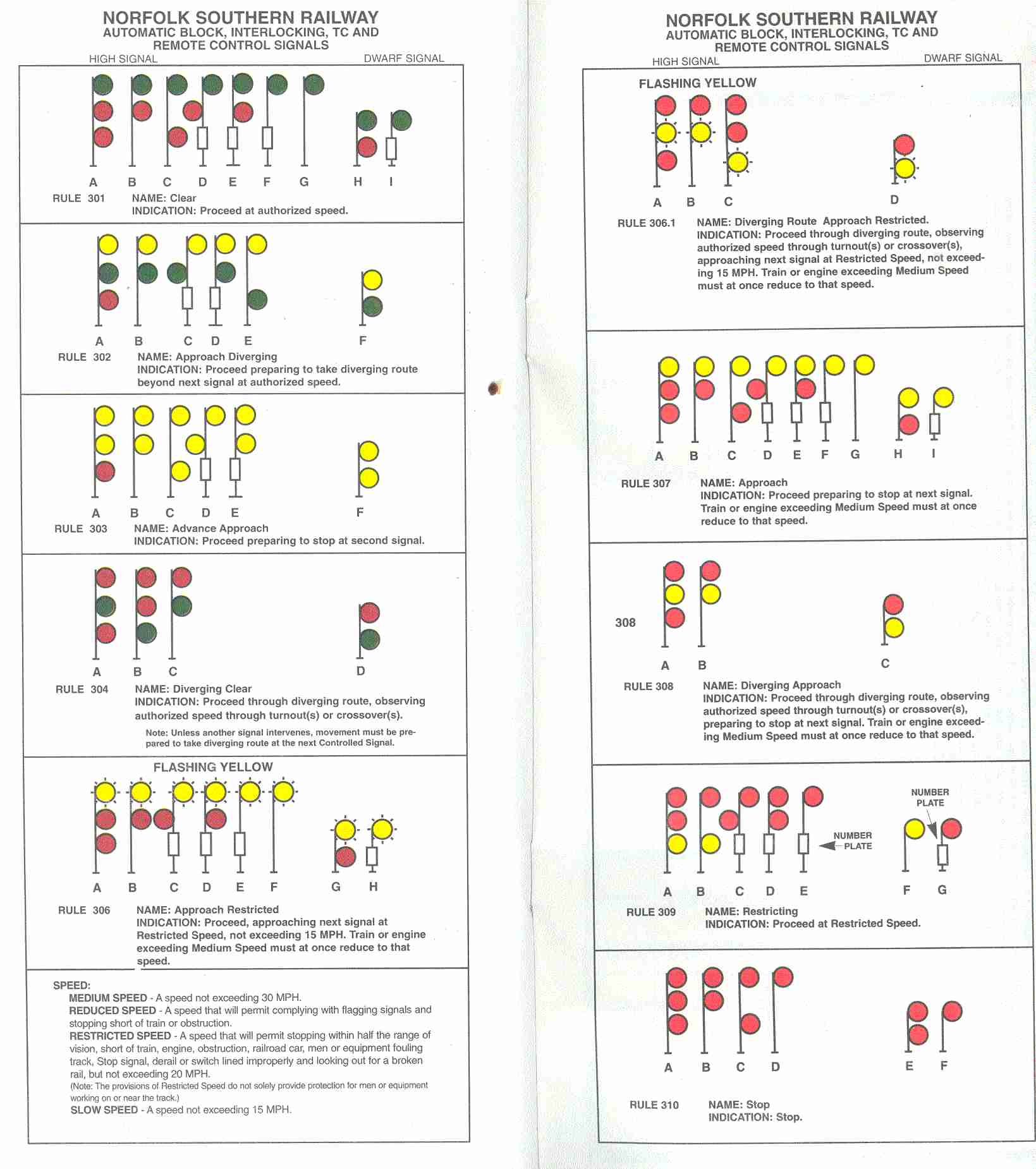
Now unlike Conrail, NS has made no attempt to either mash all of its legacy signaling signals into one unified whole or phase the older styles out.  Therefore NS maintains separate signal charts for its Southern. N&W and NORAC zones.  Before we go any further lets see how much as changed.

I'll make things easier and point out that the only change is to the *Y* indication going from Approach Slow to Approach Restricting.  This gives us the opportunity to talk about why the route signaled Southern has this big old speed signal indication in it.  Rules 306 and 306.1 were added when flashing relays became available, sort of like Medium Approach on the PRR.  They were needed for the Southern's CTC projects that looked to replace the single track bi-directional ABS lines with manual passing sidings. The new CTC sidings were not signaled and thus the need for a new indication was born.  By flashing the yellow the existing ABS signals would not need physical modification with extra heads.  At some point NS changed the indication from Approach Slow to Approach Restricting since that is the indication the train would be approaching.

Another indication that seems to have bitten the dust between 1980 and 1981 is Rule 305 or Diverging Route Clear, Approach Limited.  Again this seems like one of those CTC related rules that was trying to fix the problem of back to back interlockings I mentioned before.  In this case the Southern used the old Limited Speed Triangle to tell engineers they were diverging into a single block siding and should expect to diverge again.  It appears the experiment was a failure as like I said no mention appears in the 1981 rulebook.


Moving on to dwarf signals R/Y for Diverging Approach is carried over leaving Y as the main Restricting indication.  Fortunately the use of virtual signal heads means that a three lamp dwarf with the order R-Y-G can display R/Y Diverging Approach or Y Restricting.  Like NORAC a 4th lamp is needed to display both Clear and Diverging Clear, but instead of G/G, the Southern employs G/R like the Western Roads. All indications have their own dwarf equivalent and moreover with the exception of Restricting all indications' dwarf signals mirror at least one high signals aspect. 

Even if one of the lamps is clearly more of an afterthought.

  Well with only 10 signal rules to cover that's pretty much it. Tune in next time for whatever it is I can find photos of.

Sunday, March 9, 2014

Caught on Camera - Episode 1

I'm starting a new semi-recurring topic called "Caught on Camera" where I will highlight interesting signal indication not normally caught on camera (still or video).  I would usually stuff these into news posts, but I think they should make up their own thing.  This week I have two examples, one from the NS ex-Wabash Kansas City District and the other is from the former Conrail Detroit Line.

The NS Example is from the BIRMINGHAM (Missouri) interlocking where the the BNSF IC&E line crosses the former Wabash line to Kansas City.  Birmingham crossing also marks the start of joint operation under BNSF rules and is also under control from the BNSF KN operator at Ustick "Tower".  All signal rules and indications in this stretch of track use BNSF rules including the eastbound signals at the Birmingham crossing.  In the first photo we see an eastbound NS train wrong railing across the diamonds getting a Y indication on a dwarf signal.  However while this looks like a Rule 251 Restricting situation, because of the BNSF rules that train is either getting Approach or Approach Medium (*Y*) since BNSF does not use different dwarf indications.  Looking further down in the background we see an NS signal displaying Diverging Clear.  Just an interesting situation that is not often captured.


Same location and this time we see an eastbound light engine, right railing this time, getting an Approach indication at the diamonds under BNSF rules, but at the next interlocking we see a Restricting indication as beyond the diamonds NS rules are in effect and NS uses R/Y Restricting.


Moving over to the Detroit Line, although technically it is on the CSX (C&O) Saginaw Sub where it crosses the Detroit Line at CP-WAYNE.  This is certainly a unique situation where we have a Michigan Central style small target searchlight signal which was used to upgrade the wrong direction route on the C&O line from a dwarf as the original large target searchlight signal can be seen on the opposite track (the C&O Pierre Marquette division used large target searchlights instead of their US&S N style elephant ears).   Why would Conrail install this signal?  Because crossing at grade bring out all sorts of odd maintenance arrangements and CP-WAYNE is controlled by the Conrail/NS dispatcher.


Going by C&O signal rules this would in fact be Medium Approach Slow (assuming that the lower head isn't flashing) so I'm not sure if this this is just some poor substitute for Medium Approach Medium, if the route would take the train over one of the wye tracks and onto the Detroit Line or if the required medium route at NEWBURGH interlocking used to have a slow speed dwarf as a holdover from the 251 days and the CP-WAYNE signal was just never changed once NEWBURGH was upgraded.  Anyway, its a great catch of of what is probably a unique situation.


If you live in the area that's a public road 5 feet to the left of the signal so if you want to go and try to confirm what's going on here with the M-A-S signal go camp out and get back to me ;-)

Friday, February 28, 2014

PHOTOS: Port Road Trips - SHOCKS Interlocking

Next stop on the Enola Branch is SHOCKS interlocking, named after the nearby Shock Mill Bridge.  SHOCKS is a major junction in the former PRR low grade freight system between the Enola Branch and the Royalton Branch.  Originally built around 1905 as part of the A&S low grade improvements between Parkesburg and Enola Yard, SHOCKS is where freight trains could choose the west shore route to Enola or the East Shore route to Harrisburg on what the PRR called the Columbia Branch.  Before the Main Line as we know it was constructed, the Columbia Branch was originally part of the Philadelphia and Columbia Railroad, that in tern functioned as part of the Main Line of Public Works connecting connected Philadelphia to Pittsburgh.  In the 1995 Conrail Diagram CP-SHOCKS can be seen as one of the more interesting features and by that time served as the only remaining junction between signaled lines on the entire Port Road/Enola Branch north of PERRY.


SHOCKS as it stands today was constructed in 1938 as part of the electrification project and along with towers like THORN and PERRY, it represented the PRR's first big foray into CTC systems, although notably with the Traffic part missing.  SHOCKS was an all relay plant with a US&S 504 code line running a few miles south to COLA tower in Columbia.  Here is a 1960's era interlocking diagram showing lever numbers as part of COLA's area of control in a similar fashion to the THORN machine.

SHOCKS was built as a 2x2 flat junction and crossover so that trains entering on any track could then exit on any track.  There are two crossovers and two single turnouts for the Columbia/Royalton branch. It also featured a connection to the Marietta Industrial Track which used to serve a government defense storage facility.   On Track 2 between SHOCKS and COLA is the only segment of real Rule 261 CTC operation that was part of the COLA "CTC" project.  I don't know the rationale for employing 261 on only one of the two tracks, but the PRR had a habit of using traffic control systems as sparingly as possible.  The 1938 interlocking logic and ,layout was left virtually untouched between when it was built and 2008 when NS finally rolled out the first stage of its Port Road re-signaling project.  I don't know many microprocessor based systems that will be able to last 70 years.


As in the previous segments I will be using a few photos taken by a friend of the blog in 2004 as well as some additional photos which date from 2007, shortly before it was re-signaled.  In the above 2004 view we see the westbound main signals at CP-SHOCKS before it was re-signaled.  In the original scheme the dwarf was labeled 110R and the mast 112R and these labels were still accurate in 1995 according to the Conrail interlocking charts.

In this direction trains run in the Rule 251 ABS fashion with a Restricted speed dwarf for reverse direction movements.  Note the 11kv catenary feeders running between the 138kv transmission lines and 6kvsignal power lines.  These ran from the nearby Rowenna Substation to the various catenary sections. The high signal still features the traditional PRR layout for the lower head that only provided a backing plate for the | position since in the pre-1956 rulebook trains would approach Restricting and Slow Approach at a speed where a backing was not deemed to be necessary.  Ah the PRR, just like that old guy who unscrews the light bulbs he doesn't need. 


Here is the same 112R mast signal with its Darth Vader replacement in 2007.  The full lower head provides for Medium Speed routes onto the Royalton Branch.


The rear view shows how age was catching up with the 70-year-old signal, although it was probably nothing that a good coat of paint could fix.


The 110R dwarf signal had been replaced at some point since World War 2 with a new Safetran  equivalent.   The catenary towers on this part of the line remain standing as one is still used by Amtrak to feed the main line at Royalton. 


The dwarf was being replaced by a new Darth mast.  Although still lacking a full upper head as the re-signaling project was not going to touch the Rule 251 on the upper Enola Branch, it would allow wrong-railing trains to cross over at better than Restricted speed.


 The Marietta Industrial Track featured an original 1938 dwarf signal (112RC) on a concrete mounting, which probably is an issue if any part of the cable run develops a problem.  In this pic C&S crews can be seen working at the concrete relay house.

Sunday, February 23, 2014

Conrail's Virtual Headed Dwarfs

The concept of a signal "head" is pretty basic to the understanding of signal aspects.  Each head is capable of displaying some chunk of information and in conjunction with other heads on the same signal the entire story is told.  In the vast majority of signaling instances the signal heads are easy to identify and are distinct from one another.  From the round searchlight targets to the hooded Darth Vaders to the massive position light  assemblies, the signal head makes the "X over Y over Z" type North American signal unambiguous in its display.  The signal head concept also applies to dwarf signals and "dwarf stacks" are a well known signaling type allowing each dwarf head its own compliment of colors to display.


 Even where unit lamps are employed stacks of up to 6 units are not uncommon to create two 3 lamp heads  such as those seen here at Amtrak's COVE interlocking.


The thing is...what if you didn't feel like spending that much money on all those pesky signal heads?  A virtual signal head is where what would normally act as a single signal head instead serves as 2 or more using the relative placement of lights without the associated spacial placement.  This is generally seen as being a rather severe form of cost cutting and is rare even in North America where signaling hardware is already fairly austere.  One of the more prominent main line examples is on the former Milwaukee Road main line between  Milwaukee and St. Paul, now operated by CP and uses 4-lamp masts to display the full range of weak route signal indications like Y/Y, R/G and R/Y.


Or a 5-lamp mast at interlockings where both Y/Y and L aspects are required.

http://www.railpictures.net/viewphoto.php?id=496982&nseq=455

 However the cost effective signaling award might just belong to Conrail for its use of virtual headed 2, 3 and 4 lamp dwarf signals.  Now this might be more widespread and I'm probably being a bit unfair picking on Conrail, but on the other hand the NORAC signal aspect system was tweaked specifically for just this sort of low cost signaling so I suspect that Conrail was one of the more aggressive users of the practice.  How does NORAC cater to the use of Virtual Heads in dwarf signals you ask?  G/*R* for Medium Clear and Y/*R* for Medium Approach avoids having aspects like R/G or R/*Y* create conflicts with a virtual head system.  All NORAC dwarf indications can be displayed on a signal with Red on the bottom.

Y/*R* Medium Clear at CP-TRENT  Yes, its flashing.
Why would Conrail care so much when it didn't seem to bother other railroads?  First of all there was a lot of Rule 251 double track in the Conrail territory and chronically short on cash the road had to cut itself into profitability.  This meant that when making new interlockings for single track or even double track CTC a dwarf was a better deal than a mast.  While route signaled roads out west could get by with having a single lamp dwarf display full blown Clear off a signingor reverse signaled route, Conrail's speed signaling system really couldn't.  Single searchlight or position light dwarfs limited turnouts to slow speeds so virtual head dwarfs could eliminate the problem for the same price.


Conrail went crazy with the concept.  A 2-lamp dwarf displaying only Stop, Restricting or Slow Approach could now display Medium Approach.  Adding a green lamp gave them Medium Clear, Approach Medium and Approach Limited.  Limited Clear was given the coveted *G* dwarf slot so that doesn't really count as a gain, but the C&O was forced to use *G* for Medium Clear on their non-virtual US&S N-3 signals so the extra flexibility is still there.  The only two dwarf indications not covered were Y/Y Approach Slow and G/G Clear, with both requiring a 4th lamp (Clear AND Approach Slow would require 5 lamps).  Again, while one might assume the signal engineers would want to put a gap between the greens such as G-Y-G-R that would be an incorrect assumption, especially where a 3-lamp is getting an upgrade to 4-lamp, such as a Rule 251 route going 261.


For comparison New Jersey Transit, which prefers to use non-virtual head dwarfs, must use 6-lamp dwarfs to get the same aspects that Conrail could squeeze from 4.  Here is a 6-lamp dwarf stack at the new DIVIDE interlocking displaying Medium Clear.


On the NJT RiverLINE NJT was responsible for the initial signaling design which resulted things like this 7-lamp monster at the Trenton Station.


But from the new signaling designs it appears that Conrail SAA has had a hand in subsequent modifications like the conversion of a mast signal to a dwarf south of Burlington which uses 4-lamp virtual headed dwarf.


Which even maintains a virtual R/R as seen below.


There are other instances on the RiverLINE of huge 5 and 6 lamp signals being converted into more compact varieties such as a Y-R-Y-R unit designed to give Approach Slow.

Let's take a quick look at some other popular speed signaled railroad.  In this rather unique Canadian example we see a US&S N-2 dwarf attached to an H-2 searchlight to create a 3-lamp dwarf signal capable of displaying Restricting and all the other slow speed indications.

http://www.railpictures.net/viewphoto.php?id=507860&nseq=964


 Because of its Lunar White fetish, the use of 4-lamp dwarves on CSX is common, but unfortunately its use of R/Y and R/G for the "Medium" indications means it is harder to employ virtual heads.   Of course it does make it easier to tell if turnouts are signaled for slow or medium speed such as this example on the re-signaled former Conrail Selkirk branch at CP-SK.  Had CSX stuck with NORAC an upgrade would have not needed any hardware changes.

Typical slow speed CSX 4-banger dwarf. 
 Even thought CSX could get away with using single light indications for it's slow speed signals, they also have a preference for virtual heads.  Using L/R for Restricting would have the benefit of a limited cost free bulb out protection

Slow Approach without all the flashing.
 More often than not CSX is going to spend the money on a twin stack of Unilens searchlight signals like these displaying Clear the old fashioned way at Huntington Ave in Baltimore.


As for the former Conrail parts of NS, I am sure that the virtual head system is still in use, but I also know that NS seems to be much more committed to using signal masts, even in instances where a simple 3 indication dwarf would do such as here at CP-WORKS.


What's the takeaway?  What is implied by a signal aspect chart can always be ignored or tweaked by a clever railroad just like a clever railroad can play fast and lose with signal progression or play cab signal tricks...but more on those later.

Friday, February 14, 2014

Better Know a Signaling System - Delaware and Hudson

Here in the inaugural episode of Better Know a Signaling System I am starting with something small to just sort of see how things go.  Actually brevity that is one of the interesting features of the old D&H signal set with only 10 total signal rules in their 1948 rulebook or 9 if you go by this undated chart that appears on railroadsignals.us

http://www.railroadsignals.us/rulebooks/dh/index.htm

While 9 or 10 signal rules might sound like a lot compared to the 21 or seen in under NORAC or CSX, the D&H finds itself in good company with many other railroads not operating multi track main lines in and around busy urban terminals, especially those making use of route signaling.  The D&H is a very conventional speed signaling system designed for single main track operation with passing sidings.  If you remember back to my signaling dialects post you'll see that the D&H uses Y/Y for advance approach, R/Y/G for Medium Approach Medium, R/Y/R for Medium Approach and R/Y or R/R/Y for Restricting.  The R/Y/G Medium Approach Medium was made possible because the D&H made a point to use high signals at siding exits and R/Y/R Medium Approach was enabled by using only three headed signals at interlockings.  Here is an example of the three head policy that was still in effect up through about 2011 with brand new Unilens tri-heads installed on the former D&H Colonie Branch at CPO-5.


Unfortunately since CP went all Darth Crazy, two head signals are now being allowed to slip through as seen here at CPF-478.  Hmmm, looks like they are dumping right handed placement as well.


Contrast with the Boston and Maine's CPF-464 right across the Hudson River which has no problem making use of two headed signals and R/*Y* Medium Approach.


Another interesting practice that comes across on the 1948 signal chart is the use of offset heads for automatic signals.  A common practice back in the day, but one that is still followed in Canada to mark automatics instead of number plates.  It is not surprising that under CP ownership this practice was not challenged.  Although not a new CP install here is the MP 8.2 automatic on the Colonie Branch with the offset heads.


Staying with the 1948 chart we find a few interesting tidbits when it comes to dwarves.  Without slow speed indications the D&H could use G/R for clear and Y/R for Approach.  R/*Y* was used for Medium Approach to make room for R/Y Restricting.  The most interesting dwarf was Y/G for Medium Approach Medium, which I guess came up more than Approach Medium.  Single head dwarfs were limited to Y and R/Y Restricting and R Stop.  So kudos to the D&H for not installing Slow Speed turnouts I guess.


Aside from its dwarfs the only non-NORACy indication the D&H adopted was the Y/Y Advance Approach.  Of course with no slow speed signals it makes perfect sense.  There was also a R/Y/Y Medium Advance Approach, which was left off the Railroadsignals.us chart.  The thing is that when the Guildford Rail System (ex-B&M) purchased the D&H in the 1980's it did more than re-mile the main line from Binghamton to Maine.  In the 2007 CP Northeast US Timetable (towards the end) we can see that the signaling has gotten a lot more...conventional.  There is suddenly a R/R/G and dwarf G Slow Clear along with dwarf *Y* Slow App.  To compliment those Y/Y is now Approach Slow and *Y* picks up Advance Approach.  All the other old dwarfs are just plain gone except for Y/G, which is now Approach Medium.

So that's the story of the D&H signaling system.  It started out pretty conventional and then got even more-so after several new owners put their hand in the pie.

Monday, February 10, 2014

What's Old is Old Again

Yup, its time for another news post and this time I will be showing some examples of old things that are being discarded and old things that are being kept around.  In what is probably a first CSX is getting a pass from the news as for once i don't have any new examples of their bull headed signal desecration.  Anyway we begin with the former N&W NS Columbus District where the southern end of a Rule 251 segment at Portsmouth, Ohio is being sterilized with CTC and Darth Vaders.


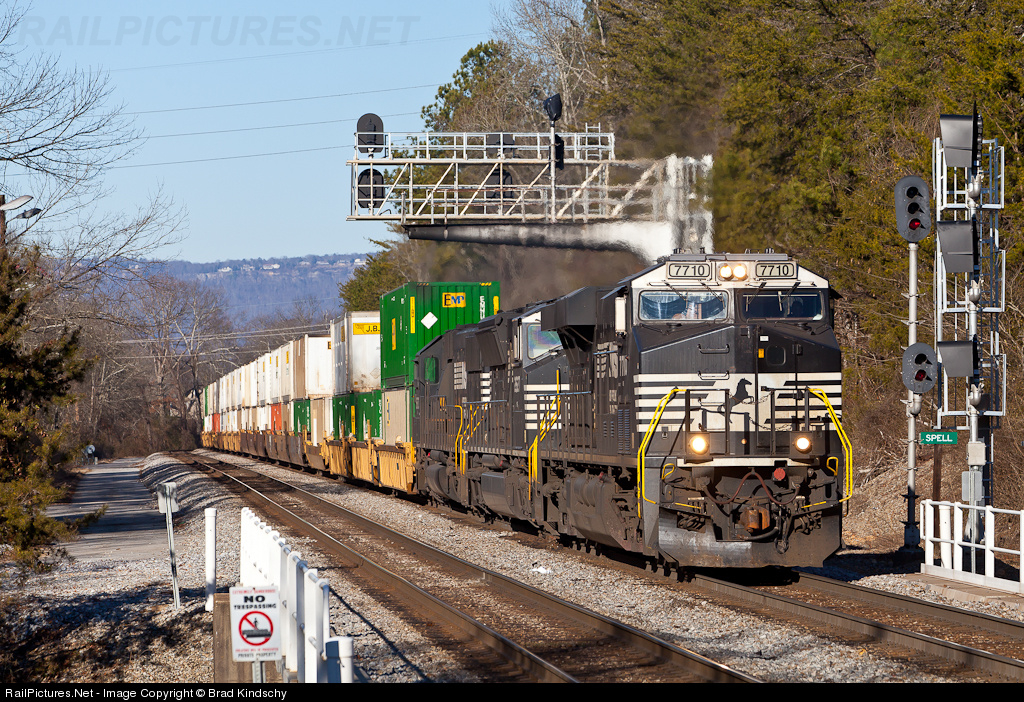
Here we see NS wasting an absolute tank of a cantilever gantry being squandered by NS at SPELL interlocking in the Chattanooga area.  Come on, that wouldn't rust away in a century of Sundays.


More updates from the slow motion re-signaling project in the Birmingham 17th St Junction area.  Looks like this one isn't just about the signals, but also involves new switches and track layouts.


Now onto the news of old signals being left in place.  A lot of people have pointed out that the famous "Vickers" Interlocking east of Toledo, OH is on track to be re-signaled.  Now that part is true with the signals on the crossing CSX line and the eastbound NS signals being replaced due to a siding capacity increasing mod, but the most important and most famous part of Vickers, the three track westbound NYC signal bridge, appears to be safe for now.  Here is the view along the CSX line.


And the classic NYC signal bridge.  The eastbound signals and replacements are visible in the background.  The replacements are going up because of new intermediate signals being installed on what used to be a one block (or no block) siding.


Here is an odd signaling arrangement at a CSX interlocking in Georgia.  Far signals are original SCL elephant ears. Close signals are a standard Darth Vadar and a non-Darth LED traffic light.  Could this be a portent of the future?


While CSX is ripping and tearing all sorts of stuff on the former Chicago Line here is a 3x3 NYC signal bridge in Syracuse with small target searchlights in one direction and large target Unilens searchlights in the other.  Not sure what caused that, but I'll take it.