It's no secret that the PRR was never a huge fan of CTC thanks to their abundance of multi-track main lines and manned interlocking towers. So far we have seen an example of the PRR's use of CTC without traffic control, ie remote control interlockings, but a predominance of Rule 251 operation. However due to its rather constrained geography that favored single track lines with passing sidings, the Susquehanna River valley also featured two genuine Rule 261 signaled CTC lines. One of these is the Buffalo Line running north of Harrisburg and, of course, the other is the Port Road Branch running from PORT to PERRY. So while the remaining segments of our Port Road Trip may seem a bit less interesting than those that came before, it actually represents an opportunity to examine a method of operation common to the rest of the rail system that the PRR tended to avoid.
So passing CRESS we finally leave the COLA CTC zone...or at least the Harrisburg Division CTC zone. Below CRESS the Port Road entered the Maryland Division and if you recall the
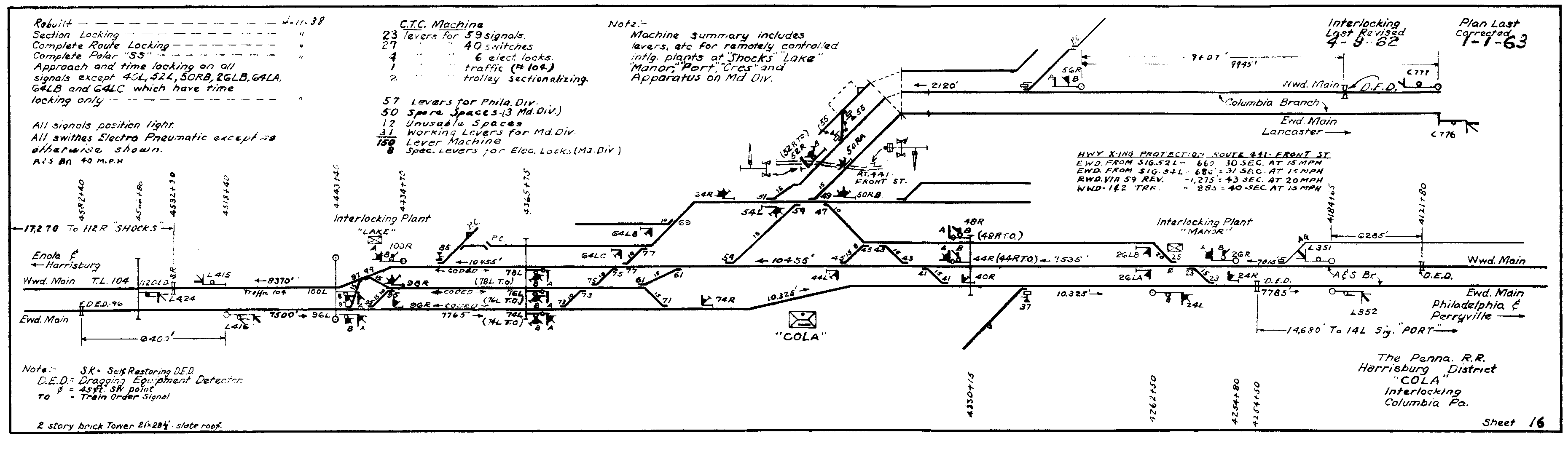
COLA interlocking sheet there are 50 levers on the 150 lever CTC machine used by the Maryland Division. These 50 levers control the 9 interlockings south of CRESS and north of QUARRY. Today we will be looking at the intermediate signal south of CRESS, the HARBOR siding and a little bit of the Safe Harbor substation complex.
Between CP-CRESS and CP-WEST HARBOR are the MP 35 automatic signals C357 and C356. Remember the mileage is now counting down towards Perryville instead of Parkesburg. Here we see the two signals looking westward with the
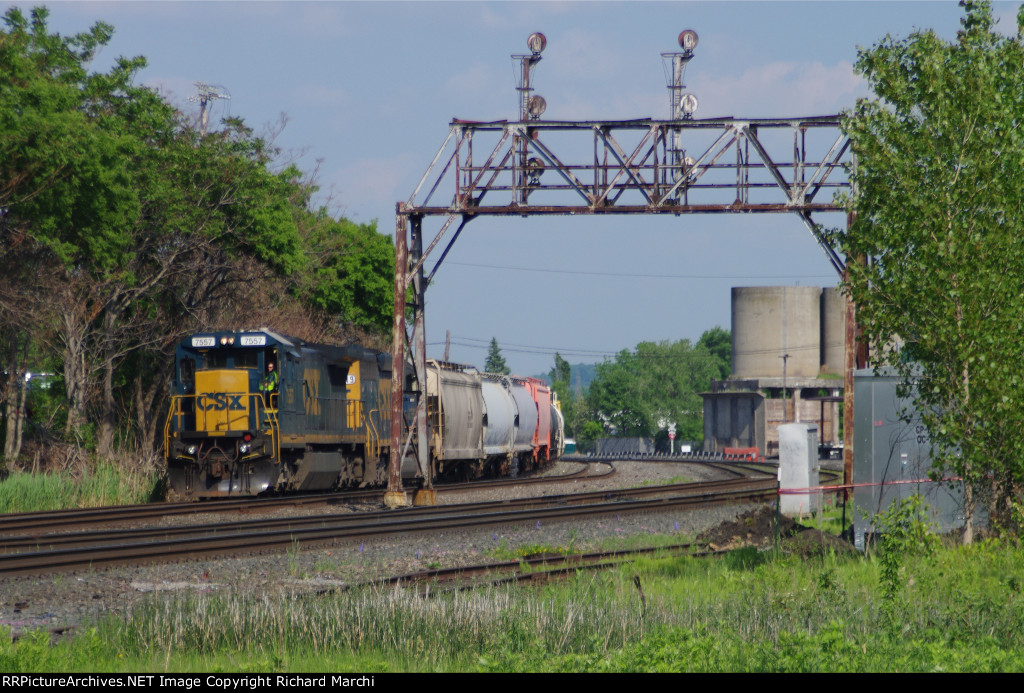
Fisherman's Run flume (aka shoefly) far in the background. At this point the A&S is running parallel to the Port Road about 20 or 30 feet up the rocky slope. The signals are arranged in the typical fashion for a single pole catenary structure with one PL being mounted on the catenary mast and the other on its own mast.
The C357 signal is displaying an Approach indication for the stop signal at CP-CRESS. Although CRESS features a medium speed turnout, because it is the entrance to double track ABS territory there is only a straight and a restricted speed route available and therefore C357 does not need to display Approach Medium.
Here in this rather backlit reverse view we see the C356 mast signal. The layout of this intermediate is a bit counter intuitive because the signal that is unable to display Approach Medium is the distant for an interlocking with only restricted speed routes while the signal that can't display Approach Medium faces an interlocking that could have a Medium speed route if not for the Rule 251. Note the lack of pole line power tap. Here the 6000 volt, 100hz power supply was running up on the A&S alignment and feeding both it and the Port Road.
The reason for the lower head | on C356 is not because the Harbor siding was ever downgraded in the Conrail era, but instead because of the short (5000 foot) distance between CP-HARBOR and CP-WEST HARBOR. Trains diverging at CP-WEST HARBOR would get an Approach. Trains stopping at CP-HARBOR (perhaps for a meet) would get an Approach Medium.
This rather long shot of C357 shows the signal displaying Approach in the time before the dispatcher lined a route at CP-CRESS for an eastbound NS freight train. Around 2010 all the catenary poles were chopped down by NS.
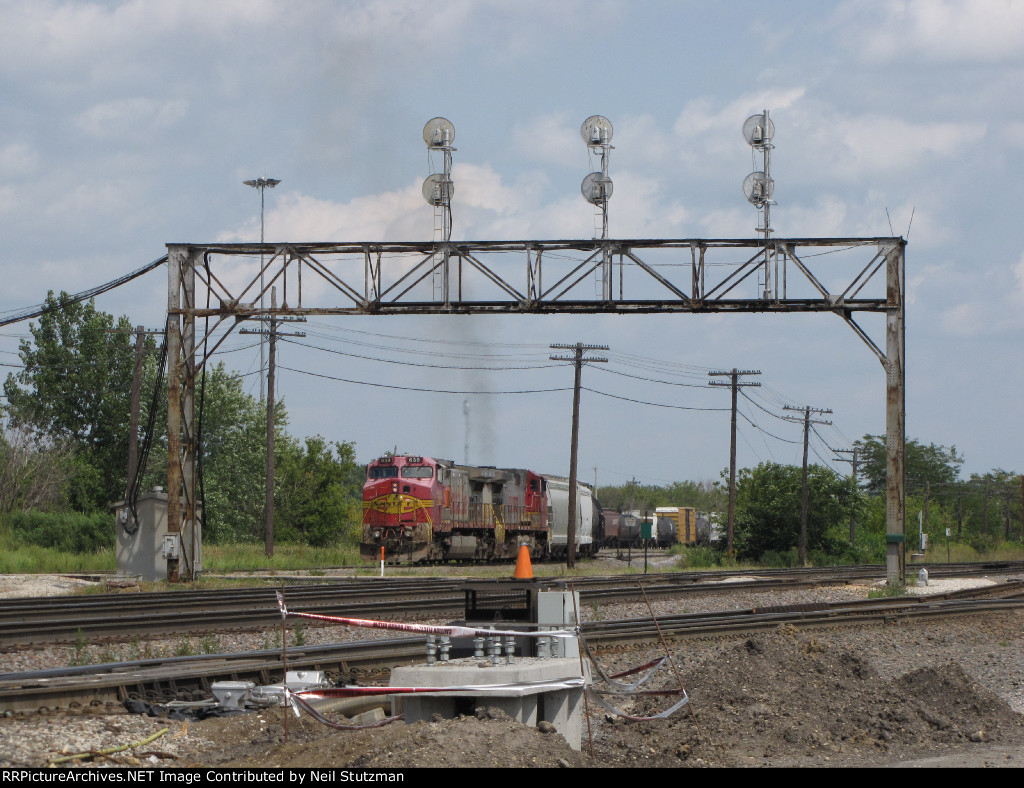
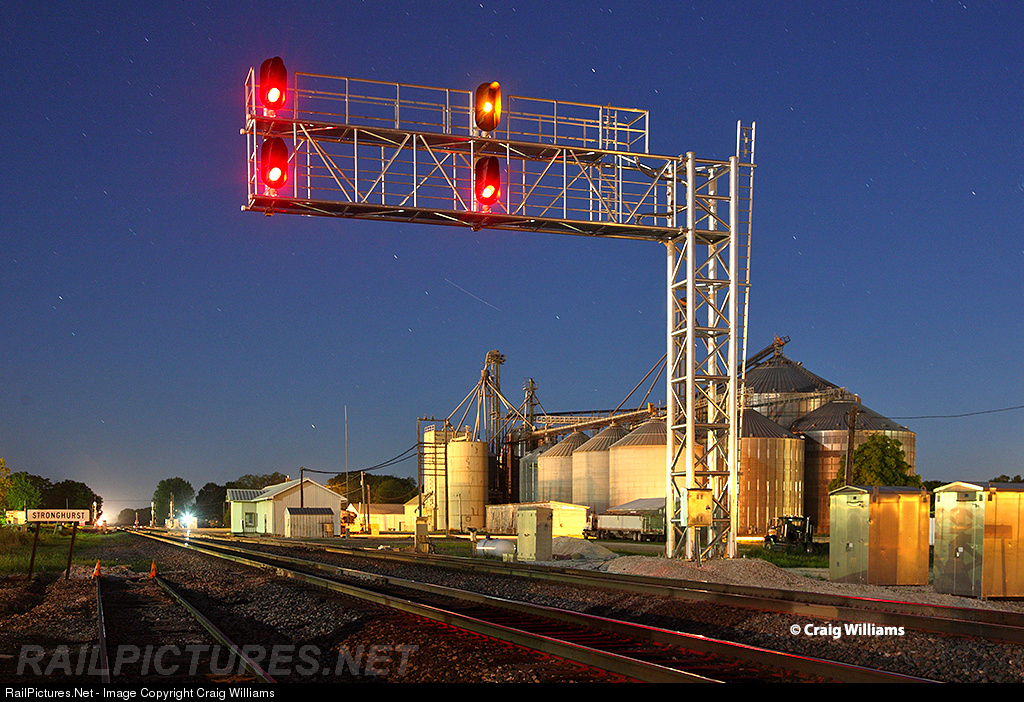
After the re-signaling project a new bi-directional mast was installed with Darth Vader signals. The odd layout has been replaced by Approach Medium signals in both directions. Not sure I agree with the placement of the signal
and the relay box on the lake side of the tracks. This part of the river is a well known flood risk.
CP-WEST HARBOR, at MP 33.2, is the west end of a 5000 foot long restricted speed ending. It was located in the shadow of the impressive
Safe Harbor viaduct and adjacent to the
Safe Harbor Dam. The single \ on the lower head is all you get in this situation. If the siding were signaled this signal would also come with a lower head \ for Slow Approach.







%20woyh%20clear%20sig%20west%20aikin%209-5-2014.jpg)


.JPG)
.JPG)
.JPG)
.JPG)
%2BPort%2BRoad%2BC357.JPG)
%2BNS%2B50K%2BMP%2B35.7%2B6.JPG)

.JPG)