So it's been a while since we last visited the PRR Main Line and this time I have something special. OVERBROOK interlocking,
straddling the border between the city of Philadelphia and Montgomery county, is not only an important part of past and present Main Line services, it is also an active interlocking tower dating from 1926 with all of the PRR trademarks on display for all to see. OVERBROOK and its interlocking is highly accessible, being located in the middle of a commuter station. However what makes this tower truly special is that in the 2003-2004 time period I was able to visit it on several occasions and spent hours inside watching the operations and even working the U&SS Model 14 machine. This will be the first of a three part look at OVERBROOK, the first covering OVERBROOK interlocking, the second OVERBROOK tower (inside and out) and the third OVERBROOK's CTC territory.

OVERBROOK is the first typical crossover interlocking on the Main Line after ZOO. It was later expanded to include the west end of the old Belmont Freight yard and CTC control over the junction with the old Schuylkill River branch at VALLEY interlocking, but the core of its operations were the 4-track crossover tracks that ran the length of the station. Here is a 1972 interlocking diagram showing OVERBROOK's territory at the peak of its responsibilities.

The original 4-track crossover part of the interlocking controlled by the US&S Model 14 interlocking machine dates from 1926. In 1941 OVERBROOK assumed control of the west end of PRR's 52nd Street Yard, situated between the main line passenger tracks stretching between OVERBROOK and ZOO by means of a direct wire relay interlocking. Not a separate interlocking in its own right, this new territory was made part of OVERBROOK interlocking itself, but referred to as the "Woodbine" section of OVERBROOK on signaling documents. OBERBROOK was also given CTC control over the aforementioned VALLEY interlocking on the Main Line and JEFF interlocking on the Schuylkill branch. Woodbine, VALLEY and JEFF were all controlled from a new US&S unit lever CTC machine installed on the operator's desk in the bay window and is the reason OVERBROOK is shown with two interlocking machines on the diagrams. Finally, in 1964, OVERBROOK was given one last CTC interlocking, MANAYUNK, when the Schuylkill branch was cut back to a single track at that passenger station. Here is how OVERBROOK appeared after 20 years with Amtrak in 1992.
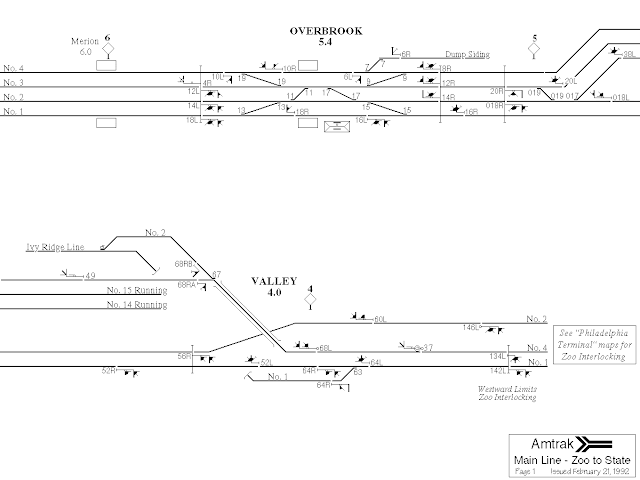
You can see that Woodbine and the old 52nd St yard complex has been greatly diminished as freight traffic left Amtrak territory in the 1980's. VALLEY has also been simplified, JEFF has been transferred to SEPTA control and MANAYUNK no longer exists after passenger service was cut back to Cynwyd. Finally here is how OVERBROOK's territory looks at the time of this writing in 2016.
The biggest change is the route that Main Line passenger track 4 takes between ZOO and OVERBROOK. Previously it had flown over the freight yard complex on a long truss bridge at VALLEY interlocking. (That is how freight traffic was able to access the yard from the middle tracks at OVERBROOK). However in the early 1990's twin crises emerged with a common solution. PCB from the former PRR electric MU shoppes at Paoli had contaminated large parts of three counties and the VALLEY flyover bridge was rapidly deteriorating and could no longer support passenger train speeds.
 |
| Realigned track 4 (far left) and the old VALLEY flyover. |
The solution was to shift track 4 over to run adjacent to tracks 1 and 2 on the site of the former freight yard and then build a new SEPTA MU maintenance facility on the newly available space. This had the side effect of requiring three new interlockings, STILES, PAXON and WOODBINE (not to be confused with OVERBROOK's Woodbine section mind you), which would then be controlled by ZOO, as it had a leverman job to support the extra workload. The effect on OVERBROOK proper was the further truncation of the Woodbine section, removing the #14 and #15 running tracks the 017 switch. This left only a triplet of signals, the 20R and 018R, and a single switch,
the 019. The reason for the leading zero was to differentiate levers on the CTC machine from levers on the Model 14 machine.
 |
| The westbound 018R signal at OVERBROOK's Woodbine section. |
As I mentioned before, OVERBROOK's Woodbine section was located directly adjacent to the
new Amtrak WOODBINE interlocking, but confusion was minimized through the use of colorized position lights on the newly hardware.
 |
| 1941 PRR PL vs 1994 Amtrak PL. Taste the difference! |
Originally intended for terminal freight moves, the 019 is a slow speed switch with Slow Approach displayed for diverging routes on high PRR signals. The best indication the 018R can give is
Approach Medium for a diverging route over the 17 switch at OVERBROOK.
 |
| OVERBROOK 018R displaying Slow Approach over the 019 switch reverse. |
Eastbound movements at OVERBROOK's Woodbine section were provided with a 4-track signal bridge hosting signals for the center tracks 2 and 3. In 1994 the bridge was re-purposed to also support WOODBINE's eastbound home signal as well. Tower, between OVERBROOK and ZOO, all 3 tracks are technically bi-directional, although reverse movements on #1 track will encounter a string of PL dwarf signals displaying slow speed indications. Prior to 1994 track 4 was only signaled for westbound movements, but this was upgraded when the three new interlockings were added. As you can see, due to its slow speed and somewhat redundant nature, the track 3 route over 019 switch isn't used much, but the famous 4-track main line does start here.
I should also mention that OVERBROOK was the site of a 1954 experiment to equip the upper head Stop position with red lenses, a measure that was later adopted by the Penn Central and Conrail. However Amtrak did not embrace this modification (at first) and OVERBROOK was converted back some time after 1976.
 |
| OVERBROOK 20R displaying Slow Approach over the 019 switch reverse. |
WOODBINE interlocking, that provides a seldom used westbound exit from SEPTA's Overbrook maintenance facility, is notable for the frequently displayed Slow Approach indication on its westbound mast signal. This is due to OVERBROOK's rather unique layout involving pocket tracks.

Only a few hundred feet separate the eastbound Woodbine signal bridge from OVERBROOK's westbound signal bridge. Despite all 4 tracks being technically bi-directional, only tracks 2, 3 and 4 (from left to right) are given high signals on the bridge as reverse movements on 1 are exceedingly rare and made at slow speed (no cab signal code). However they are still made under signal indication without a track warrant. Track 2 is Rune 251 in the eastbound direction west of OVERBROOK so its 14R signal does not provide straight route indications. The 12R and 8R signals on tracks 3 and 4 do have Clear indications (as seen on the 8R) however you might notice the absence of an Approach / on the upper head. This is due to the short distance between the westbound gantry and the pocket exit signal on track 4 or the interlocking exit signal on track 3. While most railroads would use speed control followed by a straight approach for short signal blocks, the PRR was on of the few that would follow it up with a Slow Approach. This was due to the availability of a slow speed indication on standard high signals.