In Europe, mechanical signaling is still quite common. Paired with the manual block system, all or nearly all-mechanical interlocking towers control thousands of miles of main line track. However in North America, the all-mechanical tower, that is with semaphore signals controlled directly by levers and pipeline, is virtually unheard of . Yes examples can be found at drawbridges and diamond crossings on low density track, but the difference is quite stark. Part of the reason is the general incompatibility of automatic block and mechanical signals. Manual block was much less popular in North American than in Europe. The other reason had to do with a number of ICC regulations that required signals to be interlocked with train detection (read track circuits) and that signals be electrically interlocked with point detectors.
You can imagine my surprise when I discovered Neilson Jct in Neilson, IL to have a set of fully mechanical signals controlling a manual block style junction with non-Restricted speed movements. Now RR Signal Pics does a great job providing basic details about Neilson, but I just wanted to not only call attention to that page, but also to a set of videos that have been on Youtube since 2011, but due to poor use of keywords, does not appear on most interlocking tower or signaling related searches.
For a single switch between two secondary tracks, Neilson has a surprising number of levers. First, just like in British practice, each former C&EI distant has its own lever. Second, each of the southbound signals are connected to derails which also come with a facing point lock. Finally, the 12 lever operated a mechanical timer that I assume provides approach locking in the absence of track circuits.
The northbound home signal handled the route route selection issue by having two semaphore heads, each controlled by a different lever and indicating one of the two routes. Of course the straight route semaphore was for the C&EI and the lower diverging route semaphore for the BN.
Aside from the British style of operation, what really puzzles me is how such a tower survived up through 1989. Checking Google Earth it appears the single junction switch was replaced by a hand operated type and that the line is un-signaled.
Basically just watch the 7 videos and read up on the RR
Signal Pix page. I'm just trying to call attention to an historical
oddity that is in need of some help with discoverability :-)
Wednesday, September 13, 2017

Tuesday, September 5, 2017
The Curtain Closes on IRT Signaling (Take 2)
One of my earliest posts for this blog back in 2011, covered the closing of the NYC Subway's E. 180th St interlocking tower. This was the last instance of an electro-mechanical single interlocking tower on the IRT division and also what I thought at the time was the last bastion of old IRT signaling as well. You see, in addition to it's on interlocking plant, E. 180th St tower also had CTC control of the (5) Dyre Ave line. It seemed logical that closing the tower would be followed by a re-signaling of the Dyre.

Well it turns out I was wrong and the old IRT signaling on the Dyre persisted for another 6 years! Unfortunately, I was just informed that the NYCTA would finally be concluding it's closure of the E. 180th extended enterprise by cutting in a new, bog standard IND style system on the Drye on or after Labour Day 2017.

If you want a full explanation of IRT and IND/BMT signaling, you can find it here, but the short explanation is that the IND/BMT system uses the upper head for block occupancy and the lower head for route. So a G/Y signal would be Diverging Clear and Y/G would be Approach Straight. The IRT used a more railroad style system with each head representing a different route. R/G would be diverging clear, etc. Basically something that would be familiar to almost any real world railroader. The NYC Subway marked old IRT signals with a red number plate and outside of the Dyre they were last seen on the (2) and (4) lines in the Bronx up through the turn of the Millennium.

While I guess it was a good thing that these signals survived 6 more years that I had assumed, I'll definitely regret not taking the time to go up and see them beyond my last visit in 2009.
Wednesday, August 30, 2017
Amtrak PERRY Area Changes
There are some changes afoot in the Perryville area on Amtrak's Northeast Corridor. To start, about a month ago I received this rare bit of good news about changes to GRACE interlocking, which featured Amtrak's brief operational test of Conrail style tri-light signals.

Well turns out the experiment is over and Amtrak is replacing them with colorized position lights. So thumbs up emoji!

Unfortunately, Amtrak isn't stopping there. It turns out they are also replacing the main line dwarf and pedestal signals at PERRY interlocking with CzPL masts. I have to assume this is motivated by the 562 project that was reported to be going in between PRINCE and RAGAN as the new mast have 'C' boards, however unless Amtrak is looking to expand track capacity with extra ABS blocks, the "Clear to Next Interlocking" indications are completely unnecessary as the NEC between OAK and PRINCE is comprised entirely of back-to-back interlockings! Did someone retire because you folks used to do this the right way with Rule 261 or Interlocking Rules replacing 562 in instances of back-to-back interlockings.

Maybe someone thought that a 'C' lamp couldn't be attached to a pedestal or dwarf signal, but Conrail had no problem fitting 'C' lamps to PL dwarfs at CP-MA on the Morrisville Line.

Since the new signals are being spliced in, not going up in parallel, the typical "testing in parallel to save money" does not apply. No position lights are always nice, but IMHO these full sized masts just look ungainly. In electrified territory the signals should be up on gantries or it just looks half assed. WWPRRD!

Tuesday, August 22, 2017
The Axis Invades Baltimore
Some of you may have heard that the Baltimore Metro was installing a new CBTC signaling system in conjunction with its new order of 78 Breda (now owned by Hitachi) railcars. This might be surprising as such systems tend to only be economically viable when extremely high throughput over 20tph is required. Baltimore's 6tph service is more than adequately serviced by a traditional block system, but I figured that once again some non-technical administrator was fooled by a signal vendor. However this weekend I learned that the situation is far worse. Not only has the Maryland MTA guppied up for CBTC, but they have also opted to adopt a German style axle counter system for backup train detection without any track circuits, even within interlockings.

The Baltimore metro was constructed back in 1983 with a fairly typical audio frequency cab signal system with 6 speed codes. Apparently they have not very little investment in renewing the system and 30 years later most of the impedance bonds are end of life and getting unreliable so they see an axle counter system as a way to cut costs. Breda is under the same umbrella as Ansaldo STS, the Italian signaling company that bought US&S and now both operate under Hitachi. This enabled Hitachi to offer both the cars and signal system as a $400 million package deal, and Baltimore found it hard to say no.
Unfortunately use of a German style signal system without positive train detection may result in problems when the German railway culture is not important. The Baltimore Metro will be blind to broken rails, floods and random vehicles rolling onto the main line. Track workers will no longer be able to clip in a track circuit shunt to protect themselves. In Germany the government spends freely on rail maintenance and employees tend to obey orders without question. In the lower cost United States, it is only a matter of time before this budget system proves deadly.
Tuesday, August 15, 2017
CP-ROCHESTER - Back from the Dead?
So is CP-ROCHESTER back from the dead or is it just a zombie that NS will eventually shoot in the head. For a little context, CP-ROCHESTER in Rochester, PA was a junction of three former Conrail "Lines", the Fort Wayne Line, the Cleveland Line and the Youngstown Line. A 4-track partial crossover, CP-ROCHESTER took the 4 track Fort Wayne line in from the east and spit a 2 track Fort Wayne line sandwitching a 2 track Youngstown Line, all while the Cleveland Line branched out to the side. CP-ROCHESTER had always been a bit of a pain because it was not a 4-track complete crossover with only a complete facing ladder and two disjoint facing crossovers.

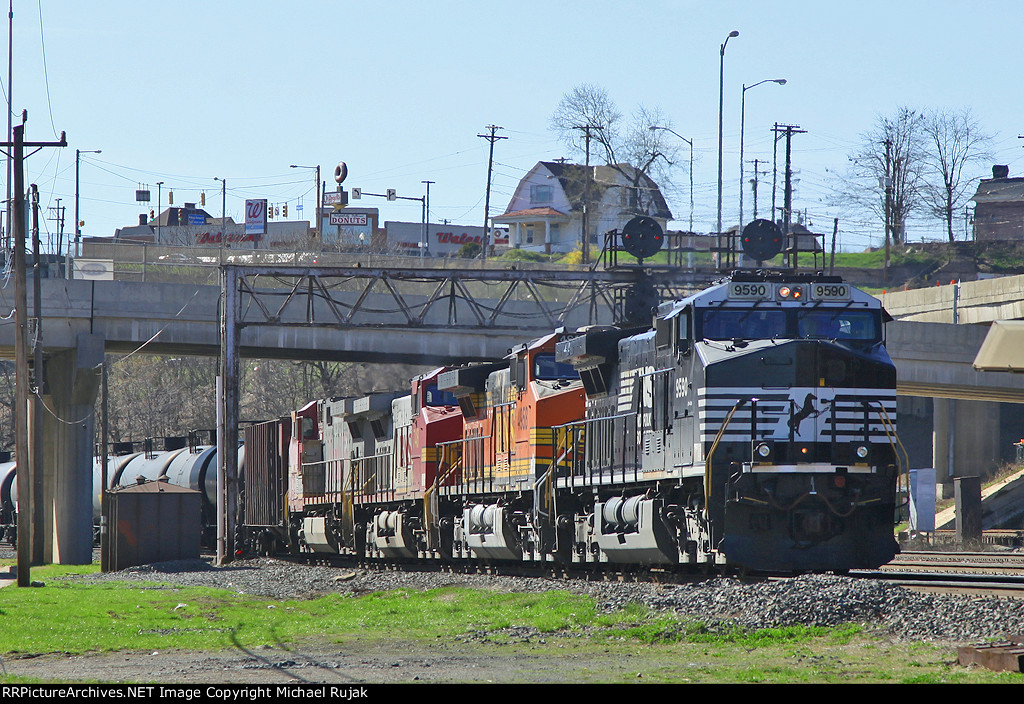
CP-ROCHESTER is as much a mix of signals as it is a mix of lines. When the old tower was closed in the 1990's, Conrail worked to re-use as much hardware as it could. The westbound PRR signal bridge with two high PL signals was retained, however 261 operation on all 4 track necessitated the old reverse direction pot signals be upgraded to Conrail special 4-lamp dwarfs (GGYR). Eastbound trains a new tubular Conrail cantilever and dwarfs and Cleveland line trains got a couple ratty looking color light masts.

Years ago NS single tracked the Youngstown Line and constructed a new CP-BRIGHT about two miles west of CP-ROCHESTER where the two main tracks could go to one. The interlocking was just a single turnout and located solely on the Youngstown Line, however this gave some people ideas and about 9 months ago CP-BRIGHT was expanded into a 4-track full crossover and the new split point between the Fort Wayne and Youngstown lines. The intention was to then remove CP-ROCHESTER except for the Cleveland Line turnouts, however this plan was postponed as dispatchers have found it exceedingly useful to store Conway Yard bound trains in the new pocket tracks created by the back-to-back interlockings. It also allows for all sorts of paralel movements.
Needless to say, CP-ROCHESTER and its Conrail/PRR heritage is still extremely endangered. I'd advise anyone in the area to get out and document it ASAP.
Fun Fact: I had always wondered why Conrail had installed GRS point machines at CP-ROCHESTER and CP-WEST CONWAY instead of their usual US&S M3 fare. However then I saw that each of the towers there had used GRS Model 2 interlocking machines, a real rarity for the Pensy.
CP-ROCHESTER is as much a mix of signals as it is a mix of lines. When the old tower was closed in the 1990's, Conrail worked to re-use as much hardware as it could. The westbound PRR signal bridge with two high PL signals was retained, however 261 operation on all 4 track necessitated the old reverse direction pot signals be upgraded to Conrail special 4-lamp dwarfs (GGYR). Eastbound trains a new tubular Conrail cantilever and dwarfs and Cleveland line trains got a couple ratty looking color light masts.

Years ago NS single tracked the Youngstown Line and constructed a new CP-BRIGHT about two miles west of CP-ROCHESTER where the two main tracks could go to one. The interlocking was just a single turnout and located solely on the Youngstown Line, however this gave some people ideas and about 9 months ago CP-BRIGHT was expanded into a 4-track full crossover and the new split point between the Fort Wayne and Youngstown lines. The intention was to then remove CP-ROCHESTER except for the Cleveland Line turnouts, however this plan was postponed as dispatchers have found it exceedingly useful to store Conway Yard bound trains in the new pocket tracks created by the back-to-back interlockings. It also allows for all sorts of paralel movements.
Needless to say, CP-ROCHESTER and its Conrail/PRR heritage is still extremely endangered. I'd advise anyone in the area to get out and document it ASAP.
Fun Fact: I had always wondered why Conrail had installed GRS point machines at CP-ROCHESTER and CP-WEST CONWAY instead of their usual US&S M3 fare. However then I saw that each of the towers there had used GRS Model 2 interlocking machines, a real rarity for the Pensy.
Tuesday, August 8, 2017
DOLTON JCT Tower Closed and Demolished (1897-2017)
Well the inevitable finally happened. The last all-big-lever interlocking tower in North America was not only taken out of service, but razed to the ground. DOLTON JCT and its 172-lever S&F machine was built by the PRR in 1897 (and possibly rebuilt in 1944). The squat wooden structure was built to accommodate an Improved Saxby and Farmer pattern frame with a giant horizontal locking bed.

A typical Chicagoland flat junction with more diamonds than turnouts, DOLTON JCT controlled the east end of the large B&OCT / IHB yard complexes. In 1942 the tower had 136 active levers, decreasing to 100 in 1944 and the number has only gotten smaller and smaller since then. when I Was able to visit in 2014, new owner IHB had started the process of chipping away the territory into new, independent sub-interlockings.


For full coverage of the last years of Dolton Junction tower and its ultimate demise, including a bevy of interior photos, check out the Industrial Scenery blog.
http://industrialscenery.
Also, as I mentioned before, John Roma has a number of additional interior photos posted at:
http://www.flickr.com/photos/jonroma/se ... 973032939/

A typical Chicagoland flat junction with more diamonds than turnouts, DOLTON JCT controlled the east end of the large B&OCT / IHB yard complexes. In 1942 the tower had 136 active levers, decreasing to 100 in 1944 and the number has only gotten smaller and smaller since then. when I Was able to visit in 2014, new owner IHB had started the process of chipping away the territory into new, independent sub-interlockings.


Apparently, the interlocking was cut over to the IHB dispatcher on February 27th, 2017 and then the tower itself was finally knocked down on Friday, August 4th in order to make way for a track realignment project. Hopefully, like the IHB CALUMET tower that was closed in early 2016, local preservation groups were given the opportunity to save artifacts and what was in all likelihood, the largest mechanical lever frame still in existence in the western hemisphere.

http://industrialscenery.
Also, as I mentioned before, John Roma has a number of additional interior photos posted at:
http://www.flickr.com/photos/jonroma/se ... 973032939/
Monday, July 31, 2017
Reading Country News
Just a brief news post. I can report that the last remaining 1950's vintage signaling on the former Conrail Reading line, including CP-WEST LAUREL and CP-LAUREL, has been deactivated as of a couple weeks ago. The section of ABS 251 between CP-BLANDON and CP-ALLEN remains intact for the time being. Fortunately I paid a visit to these vintage interlockings around Thanksgiving of last year. They had been part of the GRS provided Reading area CTC project that had been installed along with the Blandon Low Grade line. You can read about my documentary visit here.

Meanwhile, out on the New York Branch, CP-WOODBOURNE has also has its signals replaced (although possibly not resignaled outright given the old Conrail relay hut is still in use.) This was probably part of the same project that hit the Conrail signals at CP-BERRY, CP-NESH, CP-FAIRLESS JCT and even the 1990's Conrail signaled CP-RIVER and CP-BELMONT. At this point the Trenton Line can pretty much be considered an extension of the A-Line.

Interestingly, it appears that CSX is one of the last railroads clinging to Safetran Unilens signals As I previously reported, a number of design flaws has parked their neo-Searchlights for replacement on most railroad....except CSX. For example, Caltrain is the latest road to retrofit their Unilens signals with LEDs. Not sure if these specific examples at the San Jose Diridon Station are 3-color or just flash *R* Restricting, but its a major rebuke of the type.

I actually have one other major bit of positive news to report, but I'm going to save it for its own post. ;-)
Subscribe to:
Posts (Atom)