A blog devoted to explaining the ins and outs of North American railroad signaling, past, present and future. This blog seeks to preserve through photo documentation the great diversity and technical ingenuity of 20th century signaling and interlocking hardware and technology. Related topics cover interlocking towers and railroad communications infrastructure.
Note, due to a web hosting failure some of the photos and links may be unavailable.
This might be a few weeks old, but I just wanted to report that the famous CP-ROCHESTER was pretty much completely removed, replaced by a new CP-BRIGHT and CP-BRIDGEWATER. Located in Rochester, PA and not the home of Eastman Kodak, CP-ROCHESTER was the junction between the Conrail Fort Wayne Line, Cleveland Line and Youngstown Line and comprised a complete 4-track crossover with a 2 to 1 track compression on the other side of the Beaver River Bridge on the Cleveland Line.
CP-ROCHESTER was done in by being situated across multiple curves and also because it contained curved turnouts, a real maintenance headache. It was replaced by CP-BRIGHT, a three 3-to-4 track crossover located on tangent track nearer to the New Brighton Flyover, formerly exclusive to the Youngstown Line. Although CP-BRIGHT and CP-ROCHESTER operated in tandem for a time as the tracks between them could be used to hold trains entering Conway Yard, NS ultimately removed all but one crossover and one turnout from CP-ROCHESTER that were used to provide access to the Cleveland Line.
ROCHESTER tower, a rare General Railway Signal plant on the Pensy, had been demolished by Conrail in the early 90's, but the position light signals, equipped with Rule 562 'C' lamps for the Fort Wayne Line and still configured for PRR era Rule 251 operation, had remained in place until 2019.
Just got the bad news that what I believe is the last "tower" style tower in Ohio closed some time in late April. HALLETT, located north of Toledo, was owned and operated by the Ann Arbor regional railroad and also served as its dispatch center. It was the last in a plethora of Toledo area towers, including STANLEY, WALBRIDGE and IRONVILLE, that made it onto the 21st century.
Although it appeared as a strange garden shed, it actually housed a US&S Style S electro-mechanical machine, although from what I heard all of the "armstrong" levers had been removed with the entire plant controlled by the suspended miniature levers. Apparently CSX paid to re-interlock its portion of the plant while the Ann Arbor diamond crossing was turned into an automatic interlocking.
Word is that the Ann Arbor dispatchers are still on site, but will likely be moved to some centralized office belonging to it's corporate parent in another state. This also leaves DELRAY tower in Detroit as the last remaining Style S electro-mechanical machine in North America.
In other Ohio news I just learned, but was not surprised, that NS DRAWBRIDGE tower in Cleveland, Ohio had also been downgraded from a tower to a bridge cabin with a bridge tender. Located at the Junction of the Cleveland and Chicago Lines at the mouth of the Cayuga River, the tower had been re-signaled by Conrail and modified by NS, but still retained some PRR PL dwarf signals on the far side. Like HICK tower in Indiana, the plant was re-signaled again along with NS's general Chicago Line re-signaling project and NS took the opportunity to place switches and signals under dispatcher control.
All of this came to light as NS recently took away what little authority the on site bridge-tender had to open and close the span upon their own authority resulting in massive delays to local marine traffic as the clearance is only a few feet. While one may struggle to think of any towers in Ohio that ARE still open, I am pretty sure a number of bridges still include on site control of switches and signals, including RU tower in Lorain.
In this age of Darth Vader signals and shiny metal structures, it's nice to find a railroad that isn't afraid to stick with tradition, especially if tradition means thinking outside the box. It wasn't long ago that signal departments would customize their hardware based on local circumstances or what they had sitting around the shop, as opposed to whatever some subcontractor is influenced to buy.
Take the new interlocking at the west end of the new Wachusett MBTA station on the Guilford's Freight Main Line. The eastbound mast signal has been installed across the opposite main line track requiring a doll arm. If this isn't rare enough the Guilford decided to use a blue marker light instead of a blue reflector and even then they went with a GRS marker searchlight instead of something current.
If that wasn't odd enough look at the Westbound signal. Instead of a cantilever or signal bridge the Guilford went with a three track bracket mast. I'm not sure I am aware of a similar structure in North America. The rightmost signal is an automatic for the opposite main, the center the adjacent main and the leftmost, the station track.
Of course it doesn't stop with signals as one can see with the second hand standard cab GE's. :-)
For about 14 years my primary web hosting was a student computer club at a major university. Memberships and server access were off the lifetime variety and the group was very well established and all the stuff that normal web hosts typically charge for, like bandwidth and hardware, was free. Well, never make assumptions because in the age of smart phones and apps, kids these days don't know how to run servers anymore and after a literal server meltdown in October 2017, there was simply nobody with the skills to get things running again and also not much demand because...apps and AWS. My emergency mirror webhost for many years had also been forced to shut down leaving me to rely solely on Google's various free services. While this is pretty good for text, photos and videos, I was unable to host general files and my content went from appearing in most rail searches on Google to practically none of them as Google Photos aren't searchable (go figure).
Anyway, after a year of waiting in vain for the students to get their butts in gear, Eric Haas of Redoveryellow.com came to the rescue. I don't know how long his amazing generosity will last, but as long as it does you should be able to find my photo archive at https://www.redoveryellow.com/position-light/. I still plan to future proof my blog posts with Google and anyone else who wants to host a mirror, but at least in the short term I should be able to restore all the dead links to my own content. It might take a few months for me to actually restore all of the gallery indexes and probably longer to fix the links but please bare with me. Anyway, to celebrate I went to the trouble of restoring my two pages on Amtrak's THORN interlocking and Amtrak THORN tower, which not only needed the photos to be reprocessed, but also re-uploaded and most of the links fixed.
In addition, I recorded two streaming sessions as I re-edited the photos with all sorts of historical commentary and fun stories learned from the THORN operators back in 2005. I don't usually promote my attempts at live content, but there's a lot of good signaling and tower info in them.
Finally, I wanted to mention that I have uploaded Mark Beij's PRR interlocking diagram collection to a sub-directory. I did not create an index (yet), but they should show up on Google at some point so the archive should be discoverable once again. For anyone who forgot, the Keystone Crossings site folded about a year ago, taking with it a valuable trove of Web 1.0 era information on the PRR. This just emphasizes the need to backup, archive and mirror any valuable you might come across. Anyway thank you again Eric and if anyone else wants to provide mirror space please let me know.
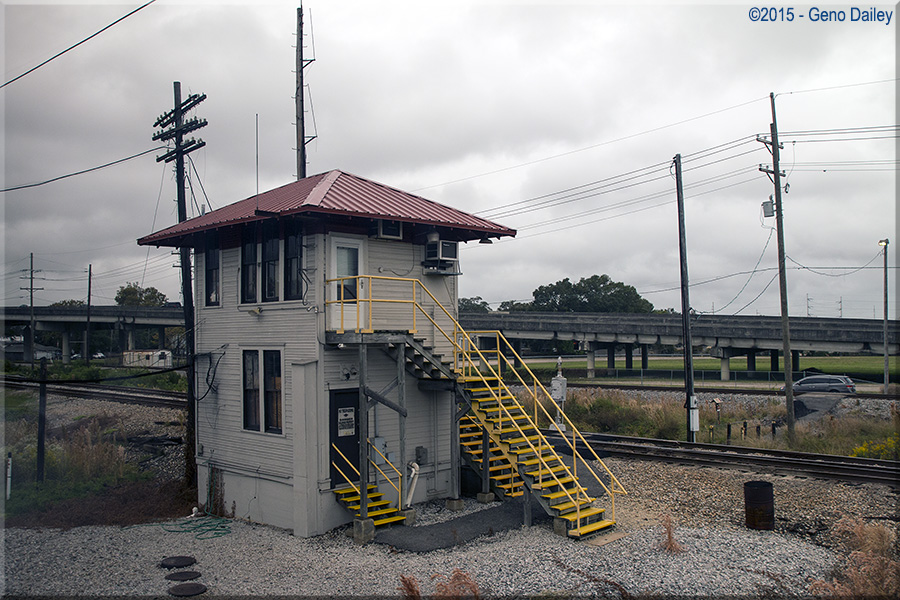
In a somewhat surprising bit of bad news, EAST BRIDGE JUNCTION interlocking tower closed a week or two ago. Operated by the New Orleans Public Belt at the east end of the Huey P. Long bridge in New Orleans, EAST BRIDGE JCT contained a GRS Model 5 pistol grip style interlocking machine and had been mirrored by WEST BRIDGE JCT up until a few years ago when that tower was also closed. The loss of these two towers, combined with the recent closure of LENOX near St. Louis is a major blow to main line electro-mechanical interlocking.
East Bridge Jct at Night in 2015
And in daylight.
Although in this day and age no classic tower closure should be a surprise, the demise of the two BRIDGE JCT towers has surprised me. Both were operated by a publicly owned railroad and not only are public railways typically strapped for capital improvements, the NOPB lacked any sort of main line or need for a dispatching center, making tower control less of a waste. The towers were also located in the American capitol of corruption and their staffing and maintenance requirements provided a good number of patronage jobs. As you can see the towers were well appointed with external stairways, roofs and lighting. If Hurricane Katrina couldn't kill them I figured that nothing could, however I Union Pacific did some wheeling and dealing to get the towers closed and placed under the control of their own dispatchers :-(
The PRR "Pedestal" signal was actually invented for the Philadelphia Suburban Station approach viaduct in 1927. Until that time the PRR only had high signals and dwarf signals for low speed operations. The underground station and its approaches needed a high signal that could fit in the restricted clearances of BROAD interlocking. Thus, the Pedestal signal was born with two PRR dwarf units stacked on top of eachother much in the same fashion as two searchlight units being stacked.
As you can see the Pedestal has the appearance of a single cast unit with access plates for each signal head and a junction box. However many of the signals in the SEPTA BROAD interlocking complex have a slightly different design that appear to be two dwarfs welded into a single assemble with no junction box. Now I don't know if these are 1927 prototypes or something SEPTA bodged together in the 1980's BROAD re-signaling project that retired the Model 14 machine (I suspect the later)
Anyway, it looks like SEPTA is at it again with an ersatz Pedestal signal for no other reason than new Pedestal signals are no longer available in their original configuration. I can't say if the job was a custom commission or something from the catalogue, but SEPTA purchased some rather boxy PRR Pedestal substitutes for some of the automatic signals on the Suburban Station ramp.
While similar the differences are quickly apparent. The entire backing has depth, instead of just acting as a mounting point for two PL dwarfs and a junction box.
Lamps are of course lunar LEDs and the manufacturer is L&W, a small time signal outfit I have encountered before with LED searchlights.
Here you can see how they compare with an "original".
And a fiew from the side showing off the depth.
As cheap as these new signals look, I have to commend SEPTA for taking the time to replace like with like, instead of starting on a color light campaign or just going to Rule 562 as they have most other places on their system. Similar choices were made with replacement amber PL high signals at ZOO and ARSENAL.
The Londonist has just produced a very interesting piece on the LUL Edgware Road signal cabin, which was built in 1926 with a Westinghouse Style K interlocking machine (license built UK version of a US&S Model 14). Unfortunately the London Underground has been bitten by the same CTBC bug as the NYC Subway, despite the old adage "If it ain't broke, don't fix it". The article comes with an attached video and numerous photos of the signal cabin and a number of other cabins also at risk for closure. Because putting one's eggs in one basket is all the rage, the LUL will also be converting to a centralized control center model.
The good news is that there are plans to preserve the cabin, although the ultimate level of interactivity or public access remains unclear. Here is another video showing a compressed view of an entire night shift at the cabin.