With the LIRR Budd M3's on the way out and all sorts of signaling changes under way, the Long Island Rail Road should probably be one of my top priorities for photos and video. Unfortunately with only 174 M3's on the active roster (vs ~800 M7s) not only is scoring one incredibly difficult, the crews are notorious surly and not only hostile towards videography, but will also tend keep the front car closed or run with the half cab door open to physically block the forward view. Getting LIRR video requires someone local who can ride day in and day out in order to be there when the stars align. Fortunately for everyone, MrMaster767 is on the job and has assembled a comprehensive library of LIRR "Cab" videos, many in 60Hz 4k.
While many of the LIRR routes have been rendered blah due to a general lack of interlockings and wayside signals, some of his grabs are quite a bit more interesting such as the Atlantic Ave Branch showing off the current disposition of position light signals and pneumatic point machines. For example DUNTON interlocking still has a smattering of pneumatics and some new-installed position lights, while down by BROOK and VAN a number of the PL dwarfs have been replaced by color lights and some electric point machines have appeared as well.
He also has a rear facing video showing off the new Ronkonkoma Branch second track and the reduced aspect signaling that went with it :-(
As much as I might try, I can't do it all. It's nice to see that others are able to pick up the slack and cover other portions of the North American rail scene.
Monday, September 9, 2019

Monday, September 2, 2019
METRA Western Ave (Tower A-2) Position Lights Removed
Seeing as how I reported on the removal of the position lights at Racine (aka CP-MORGAN) in April of 2018, I might be a little late to the party on reporting this, but it seems that METRA was indeed unwilling to support a number of oddball signals, even if it meant modifications to a US&S Model 14 plant that will eventually be replaced by some sort of flyover.
As you can see in this photo, the position light signals have been replaced by 4-lamp Metra style heads that support the mostly restricted speed crossovers. The exception is the 68R signal that saw its two headed position light replaced by a two headed color light. If it is any consolation the CNW signals and pneumatic point machines were left untouched. These were possibly the last main line PRR position light signals in the Chicago Area.

If you were wondering why there were a bunch of PRR position lights orphaned on Metra, it was because the former Pennsylvania Railroad Panhandle Route to Logansport came in Chicago via the back door, going up the west side then back east before entering Union Station from the north. You can read more about the history of this interlocking in my previous articles.
Sunday, August 25, 2019
Vanishing NEC Pneumatics (and other News)
The NEC continues to see a wide scale reduction in the number of pneumatic point machines. Within the last year BIDDLE and OAK interlockings on the southern end have been replaced by electric, BAY interlocking has been half replaced, LANDOVER interlocking is en-route to be decommissioned entirely and just recently FAIR interlocking in Trenton has started seen selective replacement of its still impressive pneumatic plant.
The HAROLD re-signaling project in support of East Side Access is not largely complete, however some track and switch work is ongoing for the physical connections to the new lines.

On the Shore Line a new interlocking, LIBERTY, has been commissioned west of the Kingston, RI station to support the new third track and island platform.

Around Boston, the ACSES PTC system is being installed on North Side MBTA lines, although it is not clear if this is in conjunction with cab signals or not. Normally ACSES is designed to work in conjunction with cab signals and ATC, but modifications to allow operation without cab signals is within the real of possibility. Also notable is thatACSES transponders have not appeared in the Guilford Rail System territory, which is generally exempt from the PTC requirement and has demonstrated hostility towards installing it for the Amtrak service if not required to.
For some updates regarding recently reported stories, the Rule 562 'C' boards are up in both directions at OAK interlocking, although not in service and all of the PRR pedestal signals on the SEPTA trunk line between Suburban Station and 30th St station have been replaced by the new ersatz variety.
 |
| BIDDLE interlocking with new M3 point machines. |

On the Shore Line a new interlocking, LIBERTY, has been commissioned west of the Kingston, RI station to support the new third track and island platform.

Around Boston, the ACSES PTC system is being installed on North Side MBTA lines, although it is not clear if this is in conjunction with cab signals or not. Normally ACSES is designed to work in conjunction with cab signals and ATC, but modifications to allow operation without cab signals is within the real of possibility. Also notable is thatACSES transponders have not appeared in the Guilford Rail System territory, which is generally exempt from the PTC requirement and has demonstrated hostility towards installing it for the Amtrak service if not required to.
For some updates regarding recently reported stories, the Rule 562 'C' boards are up in both directions at OAK interlocking, although not in service and all of the PRR pedestal signals on the SEPTA trunk line between Suburban Station and 30th St station have been replaced by the new ersatz variety.
Sunday, August 18, 2019
UK Lickey Incline Classic Signaling
I found an interesting video on the manual block setup on Lickey Incline, the steepest Main Line gradient on the UK. This 2.65% grade stretched over two miles on the line to Birmingham and due to the under powered nature of UK locomotives, most trains, passenger included, would need help getting up. Although the line was fitted with track circuits, manual block was still employed. To ease operations, an intermediate manual block signal was provided so that two trains could climb the grade at the same time. This video details how the blocks were worked and how the helpers were dealt with.
Compare with operations on the steepest main line grade in North America, Saluda.
Compare with operations on the steepest main line grade in North America, Saluda.
Sunday, August 11, 2019
Website: Hidden Trackside Treasures Of Southwestern PA
I wanted to take a moment to plug another blog I just found that takes an in depth historical look at the PRR Main Line between Altoona and Pittsburgh. Given the title, I am sure that it will eventually cover other topic, but at this point the articles have focused on the PRR Main Line, specially the transition from the Classic PRR configuration of the 1950's and 1960's. to the modern Conrail configuration of the 1980's.
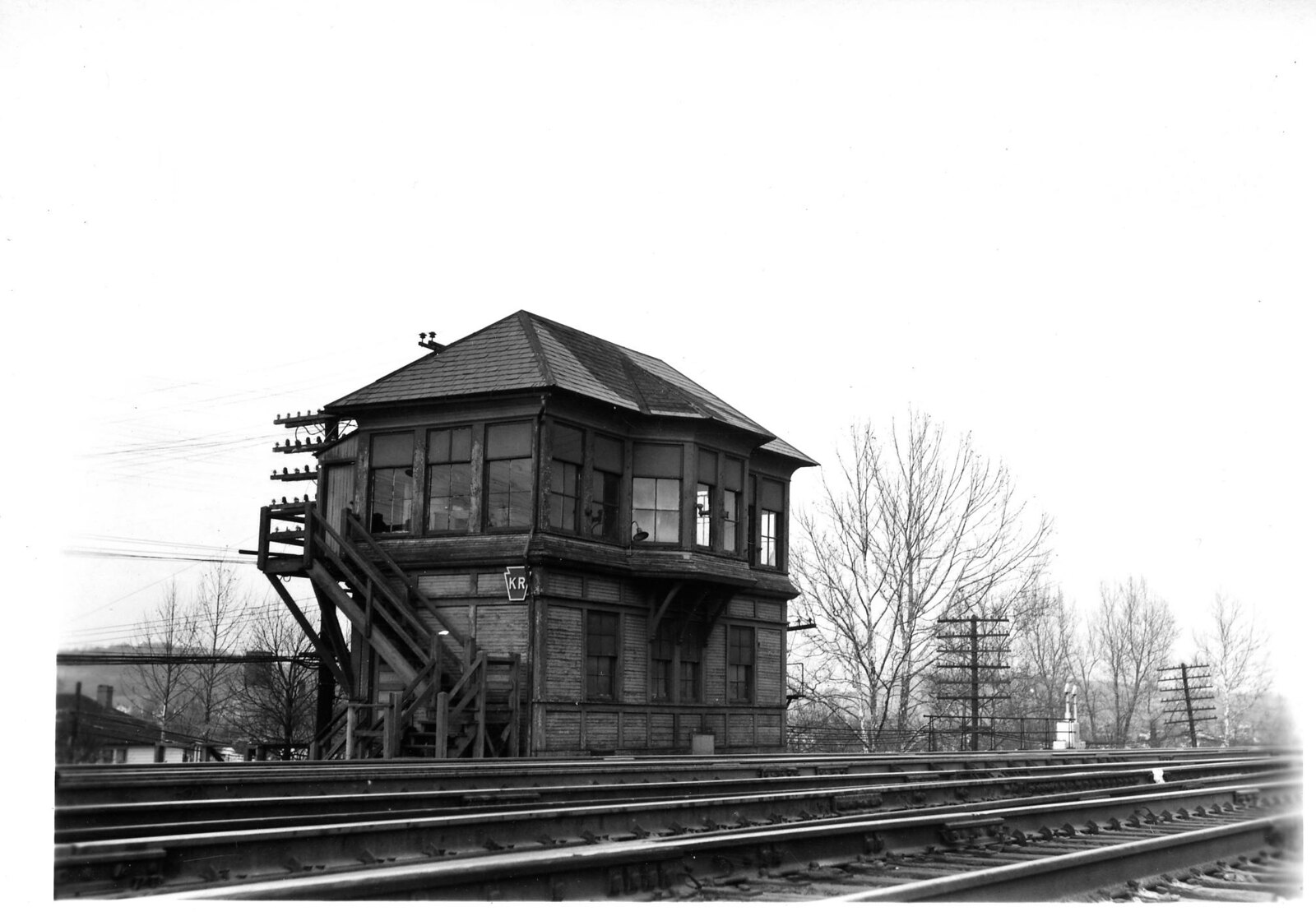 The articles are well researched with much scanned and displayed primary source material. One series covers the lost interlockings and interlocking towers of the Western PRR Main Line, like Latrobe's KR tower, seen above.
Another series covers the Penn Central's plan to convert the PRR Main Line to CTC operation a decade or two before Conrail was able to complete the task with its influx of Federal funding. It's just say things would have been a lot more interesting if the line was rebuilt with the PC's understanding of how railroading would work.
My only criticism is that over the past 3 years there have only been a handful of posts, so let's show the creator some appreciation with the hope that he'll increase his output ;-)
 |
| The future CP-WING, with and without CTC applied as the Penn Central envisioned it. |
Another series covers the Penn Central's plan to convert the PRR Main Line to CTC operation a decade or two before Conrail was able to complete the task with its influx of Federal funding. It's just say things would have been a lot more interesting if the line was rebuilt with the PC's understanding of how railroading would work.
My only criticism is that over the past 3 years there have only been a handful of posts, so let's show the creator some appreciation with the hope that he'll increase his output ;-)
Sunday, August 4, 2019
Amtrak NEC Happenings
Just wanted to provide a quick update on some operations on the Southern NEC. I previously reported on Amtrak's plans to extend Rule 562 operation southward to BUSH interlocking. Currently 562 is only in service between BACON and GRACE, but this past month work started at OAK interlocking to both remove the pneumatic point machines and install new signals with 'C' boards.

At this point OAK interlocking only has a single crossover between tracks 4 and 3, creating a combination trailing point ladder when combined with GRACE. This crossover will be replaced with a new electrically powered concrete model and some other reports hint of a second crossover creating a facing point ladder as well.

The southbound 'C' boards indicate an immediate risk for the 4 automatic signal locations between OAK and BUSH. I have been able to document those at Perryman and Aberdeen, but the others are less accessible :-(

Finally, Amtrak is adding a new trailing point ladder at PERRY interlocking to carry trains from the Pord Road, across the two through tracks and over to the track 1 siding. Apparently this is in anticipation of track work on the track 4 siding or switches at PRINCE interlocking.
Wednesday, July 31, 2019
CN Cripples Chicago 16th St / 21st St Corridor
In a move that could only make sense as part of some nefarious plan to cripple Amtrak service, Canadian National has single tracked a critical portion of its connecting line between the former Illinois Central main line and it's Chicago area distributor that runs west to Joliet on the former Chicago and Alton alignment. Specifically the mile or so long segment between the two major passenger crossings at 16th St and 21st St, the former controlled by a famous METRA interlocking tower and the second by Amtrak's Chicago terminal train directors.

As you can see in the above diagram CN has cut Main Track 1 between a new 18TH ST interlocking and the existing CERMACK interlocking. The method of the cut will create bottlenecks for Illini Service Amtrak trains on and off the St Charles Air Line from downstate and Lincoln Service trains entering and exiting the Heritage Corridor at CERMACK due to Conrail style interlockings that eliminate any sort of parallel operation. Why would they do such a thing?

The answer is diamonds, and not the kind that makes one wealthy. Elimination of Main Track #1 will also eliminate 5 diamonds between both interlockings. For those of you who don't know, main line diamonds are expensive maintenance items that also require fairly periodic replacement.

As we can see from this photo at 21st St, the small signs seem to indicate that the diamonds are the maintenance responsibility of CN. The bottleneck will be felt as freight white periods at both crossings cause CN traffic to back up along the line and this will now preclude Amtrak service from being able to sneak by. Perhaps that is the ultimate point. "Unavoidable" delays may force the State's hand in funding alternatives to the diamond crossings like an overpass at 16th St and the Grand Crossing connector on the NS Chicago Line south of the city. The real loser is the 16th St tower which will loose a substantial number of its remaining active levers :-(
Subscribe to:
Posts (Atom)