Search This Blog

Saturday, March 25, 2023

FRA Approves RFP Sub Cab Signal Removal

The FRA has granted CSX's December 2021 request to discontinue use of cab signals on the former Richmond, Fredericksburg and Potomac route between Washington, DC and Richmond, VA. Several months into a full blown rail safety panic it seems a bit tone deaf for the FRA to approve the removal of a well proven, reliable and completely failsafe signaling mechanism for good old fashioned waysides with a PTC safety overlay, but what do I know. Although we have seen similar cab signal removals by Union Pacific and BNSF, the RF&P cab signals had actually been integrated with the ETMS PTC system in a similar fashion to Norfolk Southern's Conrail territory. This makes CSX's post facto decision to ditch them an unfortunate surprise especially since the railroad choose to extend the northern limits of its RF&P CSS territory to CP-ANACOSTIA within the last decade. 

The motivation for the move is two fold. First, CSX doesn't have to worry about maintaining a large pool of CSS equipped locomotives to run over a single subdivision as well as performing a required CSS test before locomotives run over said subdivision. Likewise Virginia Railway Express no longer has to worry about CSS equipment or tests for its fleet and Amtrak can likely get away with neglecting the CSS on its Washington based diesel fleets. 

Cab Signal pickup on a VRE MP36

The second motivation is that despite the RF&P being "like" the successful PRR/Conrail system, it did have a major shortcoming wherein Medium Clear and Medium Approach signals would draw a Restricting (20mph) cab signal within interlocking limits instead of Approach Medium (45mph) or Approach (30mph) respectively.  This relay era cost saving measure that was never rectified and is likely the basis for some of the claims that the RF&P CSS does not play well with the ETMS PTC system that attempts to rely on the presence of cab signal codes for movement authority..

Like many FRA applications it may be a number of years for CSX to follow through on its plans. Unlike Union Pacific and BNSF that could literally wave away their ATS ATC and ACS systems at the stroke of midnight, CSX actually integrated the RF&P Sub CSS into its PTC solution with ETMS wayside interface units located only at interlockings to enforce the positive stop. Between interlockings the presence or absence of CSS codes would inform ETMS as to the enforcement of restricted speed situations such as an occupied block or open switch. CSX will need to install additional ETMS wayside interfaces at every automatic block signal location and every hand operated switch. Unless this work had already started it is likely to take a year or more before the CSS can be completely decommissioned.

As I have stated numerous times before, use of coded track circuits are both more reliable and provide a greater level of safety than wireless systems. Since the start of 2023 there have been at least two serious ETMS PTC outages to affect both Amtrak and MARC resulting in the cancellation of one or more days of scheduled service. CSS with ATC provides redundant speed control functionality that is completely independent of ETMS that can allow for (in a CYA sense) continued operation during a PTC outage. from an operations point of view CSS allows for mid-block signal upgrades and also provides for an easy path to 110mph service on the RF&P via the eventual extension of Rule 562+ACSES south from the NEC. Removal of the intermediate CSS code change points will significantly raise the costs of restoring CSS or just expanding the number of signal blocks to increase capacity.

For all we know CSX might still change its mind as the current rail safety panic continues to unfold and increases the political liability of removing safety systems to save a buck. Amtrak's plans to extend Rule 562 into the First Street tunnels further questions the cost savings if VRE and Amtrak diesels retain the need to be cab signal equipped for operation into Washington Union Station. In a further bit of irony CSX's purchase of Guilford Rail Service saddled it with additional Rule 562/ACSES territory that it will be unable to shake due to the MBTA. 

It will be interesting to see what happens to the remaining stub of CSS territory on the Philly Sub between CP-BELMONT and CP-PENROSE that was part of the old PRR West Philadelphia Elevated line to the South Philly freight yards. Leading locomotives do not need to be CSS equipped, but the system is still in service with all of the associated "costs".

Friday, March 17, 2023

Signal Replacement on the N&W H-Line

 One of the few remaining holdouts of classic signaling in the northeast has been the former Norfolk and Western H-Line between Roanoke and Front Royal. Although the northern end between Front Royal and Hagerstown was re-signaled nearly a decade ago for NS's north-south corridor, the southern end became a bit of a backwater and due to a fairly recent signal logic update ~2000, there was little incentive to replace the N&W color position lights at interlockings.

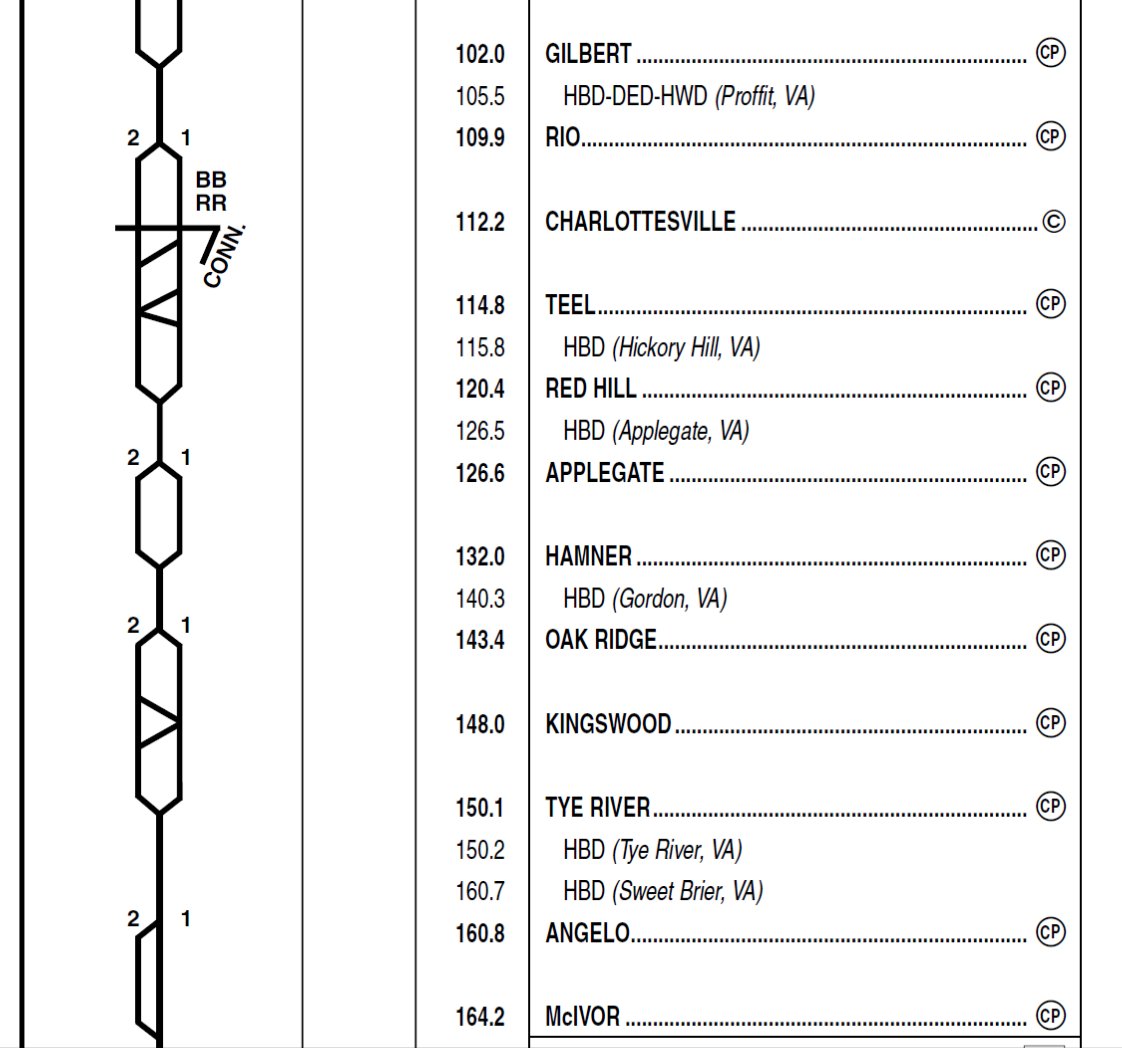
Thanks to a Position Light correspondent, I have reports of a gradual signal replacement project by NS that is hitting select locations on the H-Line, most notably centered on the city of Waynesboro. It does not appear to be a comprehensive project with Darth Vaders going up at every interlocking and a cutover date, but more individual projects going one interlocking at a time.  At the type of writing the next interlocking on the list appears to be STANLEY. The full March 2023 H-Line position light status appears below.


The new signals are the typical NS garbage, but because this is likely not replacing the fairly modern signal logic, the signal-ing is staying the same with western style route signals displaying N&W signal aspects.

As seen about at BUNEA VISTA both tracks approaching the end of a siding will see the same signal configuration with "straight" route Clear and Approach indications since there is only one route for each line. A second fixed red marker is provided since Eastern roads tend to prefer R/R for absolute signals. The single track mast signal would have G/Y/R over Y/R over Y/R to display R/Y/R Diverging Approach, R/*Y*/R Diverging Approach Diverging and R/R/Y Restricting. The one silver linking is the use of Conrail style blue station signs on the relay hits complete with the "CP" prefix.  It remains to be seen if the Southern green station signs will be retained.


Friday, March 10, 2023

Look For The Union Label

The Union Switch and Signal M3 family of electric point machines set the standard for performance and reliability, however entering into the catalogue around 1953, the M3's design and technology have long since gone off patent and are free for fly by night competitors to copy. Today we will take a quick look at the US&S trademarks as applied to their M3 family as well as the marks of imitators so you can avoid getting scammed. 


Before I begin I would like to state that the following is not an exhaustive list as I am sure there will be countless variations within the broad categories I will outline below. I have photos of hundreds of M3 family switch machines and I am just going to take the average and find the best examples.

First off is what I will call the small verbose branding.  We have a small USS trademark followed by three lines of text consisting of "US&S Co", "Made in USA" and what appears to be parent information cast into the lid of the circuit contact portion of the switch machine. I suspect this is the earliest design as it looks most similar to the few surviving M2 machines and would likely be within the 17 year patent period starting around 1950.

The next version sees the third line dropped reducing the text to just "US&S Co" "Made in USA".

This is followed by the large logo variant that keeps the 2 lines of text, but has a larger US&S logo cast into the detector box cover.

Next we have the boxed variant that features the late model boxed US&S logo followed by "US&S Co" and "Made in USA" on earlier 1990's vintage machines and then just "US&S Co" in the later ones that are being sold up to the current day.


Now that you've seen the real stuff, let's check out some of the fakes. At the top of the skeezy list is this M23 I found on the UP Moffat Tunnel sub without any branding at all! 😬

Our next imitator is made by Vossloh and sold as the VSM-24.

Some of these are branded JMI, which is a machining and casting outfit. I am not sure if JMI was making complete switch machines and had that business bought out by Vossloh or if JMI was just a subcontractor.

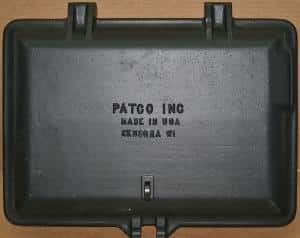
Here is one I unfortunately neglected to get a good photo of, a Patco Industries branded M23B. Patco industries is known for their rebuilding work and sells pretty much every part of an M3 for spares so I am not sure if this was built from scratch or just has a lot of Patco parts.  It's worth mentioning that the branded contact case cover is made from aluminum, not cast iron.

I have heard mention of a few other companies selling M3 family switch machines and of course there are the international variants like Westinghouse Brake and Saxby Signal Company, but these are all the photo examples I have. If you know of any others please let me know in the comments and if you have some photos you wouldn't mind sharing I can add them to the list! Just remember, if you are looking for a quality electric switch machine, just look for the Union label.

Monday, February 27, 2023

Former Conrail Indy Line Re-Signaling

 In a recent post I made a quick comment about CSX replacing former Conrail type signals on the former Big Four main line near Quincy, OH.  Well it seems that someone in the area took the initiative to grab some photos of the string of Conrail tri-light signals between Quincy and Sydney, OH that are under threat. It also confirms that CP-153 at Quincy marks the boundary between Seaboard and Conrail signaling rules.

The local fan covered the intermediates at MP 155, MP 159 and the next interlocking, CP-163. The whole Indy line is a crazy quilt of old signals, new signals, Conrail Rules and Seaboard rules. At this movement all I can say is that the line is currently at Quincy and moving westward.

Saturday, February 18, 2023

Reading and Northern Video Update

 It's been a good while since my last Reading and Northern update and although there's been nothing earth shattering I was recently tipped off to a cheat code when it comes to exploring the generally less accessible northern division between Scranton and Jim Thorpe. With the general collapse of any other interesting signaling in the region I have been been putting additional time and effort into getting photos of the R&N's newly installed CTC signaling between Reading and Jim Thorpe.  However while the R&N inherited some interesting bits of signaling from the Conrail era, most of it reachable either by boat or long hikes along 20 miles of inaccessible right of way in the Lehigh River Gorge. My Plan A was to try and grab a seat on one of the many R&N passenger excursions however the summer 2020 one was cancelled by Covid and the recently announced one in May 2023 quickly sold out. 

However one of my fantastic readers linked me to a speeder enthusiast's Youtube channel that included a 2022 speeder trip from Reading all the way to Pitson Yard north of Scranton, which is pretty much the entire R&N CTC'd main line. This basically provided all the signal status information you need for either fact of existence or for planning more involved photo trips. Part 1 covers Tamaqua through White Haven in a very respectable 90 minutes with part 2 White Haven to Pitson.


If you don't want to spend 3 hours watching the videos the TLDR is between CP-COAL and CP-WHITE HAVEN the LVRR signaling has been replaced by square Safetran CL-10 modules in a target/tri-light configuration. Between White Haven and Glenn Summit is where the LVRR searchlights appear and finally between Glenn Summit and CP-DUPONT is the land of 1980's non-modular GRS traffic lights.

Aside from closing the gap between the Hometown viaduct and Jim Thorpe, I'm not sure how much more the R&N is planning to expand its CTC, but whatever they do I'll be sure to report on it here. Meanwhile I will continue to gather R&N signal photos for additional less current events type posts.

Sunday, February 12, 2023

Amtrak's B&P Tunnel Related Signaling Work

Amtrak recently filed with the FRA to replace its Rule 261 signaling between BRIDGE interlocking in south Baltimore and GROVE interlocking near Odenton with Rule 562 cab signals without fixed wayside signals. A recent article from Trains Magazine provides some insight on why Amtrak has chosen this particular stretch to convert. Part of the prep work for the B&P Tunnel replacement involves a new high speed turnout at WINANS interlocking south of the Halethorpe MARC station. When Halethorpe gained high level platforms in 2013 it forced all northbound stopping trains to switch over to Track A at WINANS, resulting in a 2 mile long 45mph cab signal restriction for the standard speed turnout. The 80mph high speed turnout will mitigate this source of delay.

WINANS Interlocking Medium Speed turnout.

Converting to the 80mph turnout, as well as any signaling work to support the new tunnel at BRIDGE will require signal changes and Amtrak has decided to perform a general signaling conversion from Rule 261 to Rule 562. I suspect these these changes will be lumped in with the tunnel project and thus paid for with B&P tunnel money.  Artful use of adjacent state funded capitol projects to pay for state of good repair items is a common trick among the cash starved rail public transit sector. 

4x2 Signal Bridge at GWYNN

The 562 project will eliminate the 2 4-track automatic signal locations between BRIDGE and WINANS and 3 3-track automatic signal locations between BRIDGE and GROVE. Of course just because Amtrak has filed to carry out these changes doesn't mean they will happen tomorrow. In 2018 I reported on a similar NEC Rule 562 application to convert the segment between OAK and BUSH. I recently found out this application was related to a similar externally funded capitol improvement projects to install high level platforms and Metropark style crossovers for the Aberdeen, MD station. As of 2023 this project has yet to break ground.

Sunday, February 5, 2023

Don't Regulate Defect Detectors Like Signals

It looks like the derailment in East Palistine, Ohio is causing another full blown safety panic of the type that brought us Positive Train Control. Some of the more benign proposals are calling for increased regulation of equipment defect detectors such as those that scan for overheated axle bearings. Like everything the devil is in the details and treating detectors exactly like other FRA regulated safety devices such as signaling systems and grade crossing protection would be a mistake that would take an automation technology that railroads don't really have a problem with, into a high cost headache that would become an actual target for cost reductions.

Let's be absolutely clear. Hotbox detectors (HBD) and the response to their alarms have not been impacted by investor demands or Precision Scheduled Railroading (PSR). The frequency, placement and procedures associated with defect detection have not substantially changed for the past 40 years. Conrail spaced HBD's every 20 miles with supplementary dragging equipment detectors every 10. NS kept those exact same detector locations since Conrail was taken over in 1999. The Southern Railway preferred a 10 mile detector spacing and on former Southern parts of NS that detector spacing has also remained unchanged since its operations were merged with the N&W in the late 80's.  Speaking of the N&W, their detector spacing was every 15 miles and has also remained unchanged. Long story short the derailment was not caused by corporate cost cutting.


The risk of strict regulation, similar to that applied to signals, is that ay change to a detector would require costly certification processes and/or regulatory approval. For example Amtrak and other railroads must go through a full regulatory process, including public hearings to, apply a software update to their PTC system. Detectors on the other hand display a far greater range of context specific innovation with secondary features like train speed, axle counts and time/temperate enouncements. Regulating all of these features like signals would create a race to the minimum standard as regulated features would have to be rigorously maintained and certified. Don't think this is fanciful prediction either as believe it or not there do exist FRA regulated detectors in situations where they form part of the signaling system. 

Some examples like the CP-BANKS, shown above near the Rockville Bridge on the former Conrail Pittsburgh Line, have interlocked high car detection. As part of the interlocking, even changing the readout recording would have required costly re-certification and as a result the CP-BANKS detector retained its Conrail readout some 20 years after Conrail's absorption by NS. Other examples might include the propensity for all automatic signal locations on some western roads to have an breakaway style dragging equipment detector stick. If those are linked to the signal system (instead of radio readout) it would explain why this type of protection has persisted on select western lines and no others.

Regulated standards are important, but requiring a public heating to adjust alarm thresholds or change a broadcast recording (no matter how much I would love to hear KCS and Guilford over the air in 40 years) is liable to trigger loophole abuse in an area was uncontroversial.