Search This Blog

Tuesday, November 11, 2014

Better Know a Signaling System - Seaboard

Well last time around we explored the signaling system that ate the Northeast.  Now we can explore the signaling system that is eating the signaling system that ate the Northeast. The Seaboard Coast Line railroad, itself an intermodal amalgam of the Atlantic Coast Line and Seaboard Airline, is the 'S' in CSX and the Seaboard system of signals are those which CSX has chosen to standardize on, brushing away the B&O CPLs, C&O color lights and former Conrail NORAC signals.  The reasons is not really due to any inherent superiority, but has more to do with major flaws in both the C&O and B&O systems and the company headquarters being in Jacksonville, FL and NORAC signals were not invented there.  Note I am not going to call these CSX signals because there is still little that CSX has had to do with them, unlike NORAC, which may have borrowed most of the signal rules, but still put its own stamp on them.

Unlike the other dominant signaling system in the South used by the Southern Railway, Seaboard uses speed signals and today is one of the three major codes of speed signaling code along side NORAC and CROR (Canadian signals).  It shares a lot in common with those other codes including the three head (Normal, Medium, Slow) system and Y/G for Approach Medium.  However Seaboard is defined more by its differences than its similarities.


Seaboard's most defining characteristic is its use of Lunar White and only Lunar White for restricting.  There are a few smaller route signaling systems that have this feature, but ever since the availability of *R*, no other major railroad has relied on just Lunar White. 


Back when the Seaboard adopted Lunar for Restricting, Restricting was a seldom used indication, mostly seen where there were routed leading to unsignaled track like yards.  For normal interlockings the Seaboard did not provide any capability to display a "call-on" and therefore they made do with US&S N-3 and 3-color searchlight heads.  However in modern times it is CSX's policy to provide a restricting capability on all controlled signals.  This in turn leads to the frequent use of 4-lamp signal heads, which were nearly unheard of in the area of searchlights and pre-cast color light heads. 


The use of LW for Restricting of course frees up R/Y and R/R/Y for Medium Approach and Slow Approach respectively.  R/Y/R is also used for Medium Approach and is employed by CSX in areas where conversion from non-Seaboard signaling is under way (Conrail, RF&P, P&LE, Etc) or a third signal head is provided.  Lunar white is the first of many instances where CSX management has said "my way or the highway" when its comes to incorporating the signaling ideas of others.  CSX predecessors NORAC, P&LE, RF&P and the C&O all used lower yellow Restricting, which has the advantage of not needing 4-lamp heads, but I guess the south is always right.


 Now just because one had R/Y for Medium Approach doesn't mean that R/*Y* can go unused.  CSX has decided to fill this slot with Limited Approach, which appears to violate the principle of reducing trains to Medium Speed upon passing an Approach indication


Seaboard's other fateful decision was the continued use of Y/Y advance approach, even where the aforementioned alternate speed signal systems had switched over to Y/Y for Approach Slow.  The real kicker is that CSX does not currently use the *Y* aspect, even as an alternate Advance Approach for NORAC compatibility.  This requires that all "patch jobs" require an extra signal head instead of just a flasher relay.  Now if you look closely at the 1989 CSX signal rules I posted above *Y* is listed an a Y/Y alternative, but the original Seaboard set did not include this option and CSX itself later dropped it as well for reasons unknown.

Y/Y Advance Approach on the Abbeville Sub in Bogart, GA where a new interlocking created short blocks.


Without a two lamp Approach Slow indication like Y/Y, all situations involving Slow Speed must use "three headed monsters" to display the Y/R/G flavor.


Like several other pre-NORAC railroads (and the C&O) the Seaboard used R/Y/G for Medium Approach Slow for reasons involving one block sidings that I have already explained.  However CSX chose not to update R/Y/G to the now more common Medium Approach Medium when that indication was added in the 1990s, instead flashing the lower green up "upgrade" the older indication.  If you jump ahead to 6:17 in the following video you can see a CSX medium Approach Medium leading to a R/Y Medium Approach.


In the theoretically sound Caltrain speed signaling system R/Y/Y was chosen as Medium Approach Slow as it worked off the Y/Y/R approach slow and R/Y/G Medium Approach Medium.  Without Y/Y Approach Slow or R/Y/G Medium Approach Medium, Seaboard used R/Y/Y for Medium Advance Approach.  I suspect this might be the rarest signal indication of the Seaboard set as I have yet to positively identify a high signal location where it is employed.

Note: Do not mistake C&O Medium Approach for Seaboard Medium Advance Approach as both use R/Y/Y, but the former is much more common.  C&O signals will be covered later.

Dwarf signals are fairly typical of a speed signaling system with the major exception of Y being Slow Approach instead of Restricting.  The necessity of lunar has made the 4-light Safetrain Unilens dwarf units very popular with CSX.  Here is one displaying the Y/R variety of Slow Approach.


As one might expect R/Y and R/G are Medium Approach and Medium Clear respectively, the latter being perhaps the one case where Seaboard scores a point over NORAC.   One can tell  if a Seaboard dwarf stack protects a medium or slow speed turnout based on the position of the green lamp relative to the red. R/*Y* is provided for Limited Approach, however because of Y/R/G Approach Slow, there is no dwarf version of that indication available. 


 One might expect dwarf Y/Y to be used to the fairly common Advance Approach indication, but, bafflingly is used for Medium Advance Approach.  Unlike using Medium Approach as a Substitute for the missing dwarf Approach indication, a quirk Seaboard shares with NORAC, using Medium Advance Approach would require trains to slow to medium speed first leaving Approach Medium as the short block speed control alternative.

That's pretty much all there is to the Seaboard system of signaling.  It's a solid set of speed signal aspects, but unfortunately was never able to evolve past some of the depricated practices like Y/Y Advance Approach or R/Y/G Medium Approach Slow.  It's a real shame that CSX didn't use the Conrail merger to, at the very least, (re)adopt *Y* as an alternate Advance Approach.  

Thursday, October 30, 2014

PHOTOS: Port Road Trips - HARBOR to MIDWAY

It's time to close out the month of October with another installment of Port Road Trips.  This time we are leaving the A&S and Safe Harbor Dam behind and striking out on our own on the road to Perryville.  Having passed CP-HARBOR this section will cover the next intermediate signal at MP28/29, the west end of the long signaled siding at CP-McCALLS, the crossover at CP-HOLTWOOD and finally the MP23 automatics in advance of the east end of the signaled siding at CP-MIDWAY.

The Milepost 28/29 automatic is split between Milepost 28 and 29 due to the signals being arranged around a curve to improve sight lines.  The C290 eastbound automatic has a lower head | for diverging movements at CP-McCALLS.  It also features an 'SP' plate that stands for Slide Protection.  'SP' plates were a PRR thing that called extra attention to signals that protected slide fences.  Any train passing an 'SP' signal at restricted speed had to look out for falling rock.


 In 2004 the C287 automatic has already been replaced by a Conrail style color light.  This has taken place early in the NS era when the Harrisburg area signal shop was still using US&S NR style color lights instead of Darth Vader tombstone signals.  C287 is shown here displaying Approach for a stop at CP-HARBOR.  This pair of split signal masts were ultimately replaced by a single bi-directional mast after the NS resignaling project.


The lower head is not for diverging movements at CP-HARBOR, which if you recall were Restricted speed, but for the short block length between CP-HARBOR and CP-WEST HARBOR.  The new signal was still outfitted with an 'SP' plate just like its predecessor, but was not given a coat of black paint on the upper half of the mast in the Conrail style.


 CP-McCALLS is one of the few Conrail interlocking names that contains a lower case letter in the name.  Like I said it is located at the east end of a long, 4 mile, signaled siding.  This contrasts with the two short restricted speed sidings at Pilot and Harbor. Here we see the interlocking and the eastbound 246L signal.


CP-McCALLS features a medium speed diverging route and as such features a full PRR PL mast signal with a lower head containing both | and / positions for Medium Clear and Medium Approach.  Stop and Proceed is displayed using the central marker in place of a Restricting \.  This economic "style" would later be adopted by Amtrak.  Because CP-HOLTWOOD is back-to-back with CP-McCALLS the lower head | was also used for Approach Medium.


CP-McCALLS featured an old school PRR remote interlocking relay hut.  Until its resignaling in 2009 this section utilized the US&S 504 code system delivered via the high density plastic wrapped telecom cables. The relay hut is constructed from sheets of galvanized steel on a concrete base.  This hut survived the re-signaling with the new relay box placed on the river side of the tracks (that floods frequently...).  The #245 switch machine is a US&S M23 dual control electric model.


Here is the westbound catenary style position light signal gantry with the 246RB (siding) and 246RA (main) signals.


No surprises here.  Siding signal has a lower head for diverging movements and the main signal has a "hanger" type marker light for call-on movements.  The signals would not get any new paint before they were replaced by an NS cantilever mast at the same location.


CP-HOLTWOOD was located adjacent to the Holtwood Dam, which back in the day was paired with a decidedly less "green" coal fired power station that required shipments of coal via rail.  CP-HOLTWOOD featured a single "trailing" crossover that partly split the long controlled siding into two halves.  Here is the southbound catenary style signal gantry with two PRR PL signals.  The 242L signal on the main track features an old style lower head with the backing applied only to the | indication for Medium Clear.  The Medium Approach / was not provided a backing as it was originally displayed Slow Approach before the 1956 addition of Medium Approach.  Like CP-McCALLS both the 242L and 238L use a lower head central marker light for Stop and Proceed indications, instead of a Restricting \.


'SP' plates make another appearance on both the 238L and 242L signals.
 

Here is a reverse view of the eastbound signal gantry taken in the fall of 2007.  The signal bridge looks a bit like a hack, but it was in place as far back as the 1980's.


Wednesday, October 22, 2014

Thurmond Signals Fall

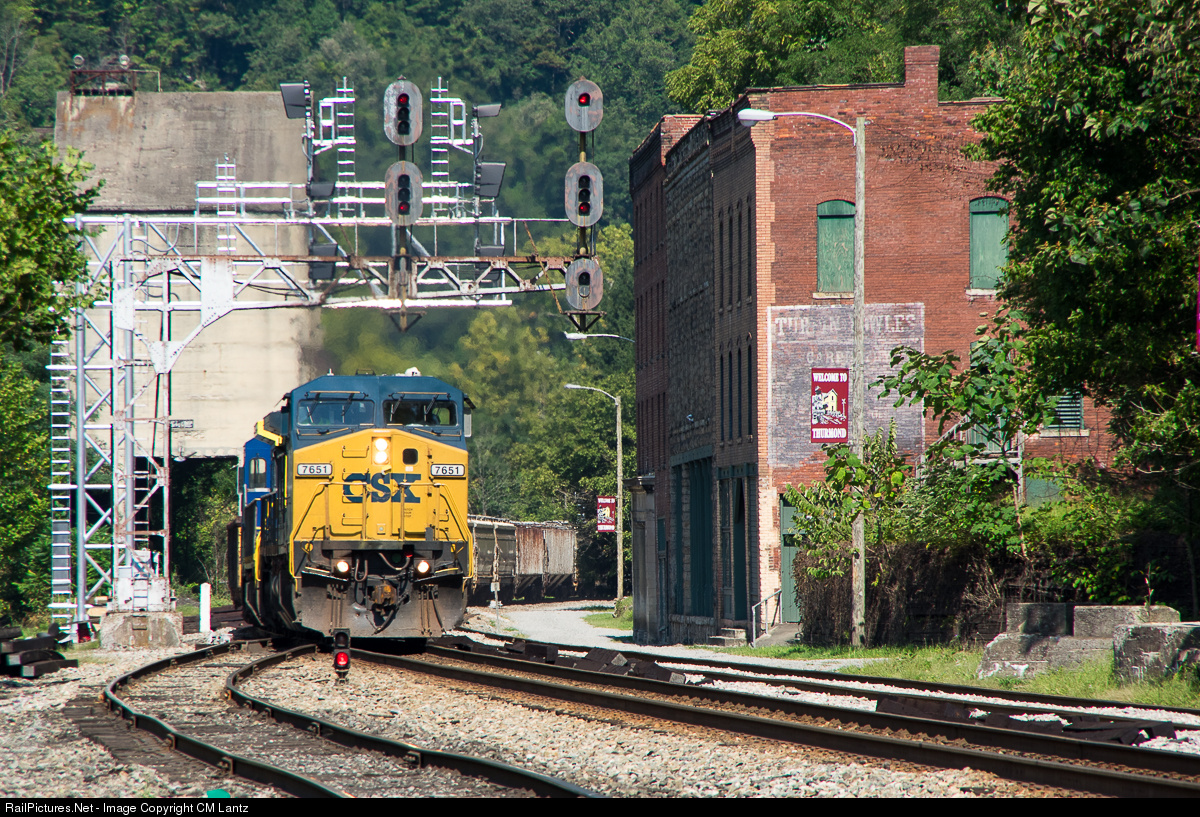
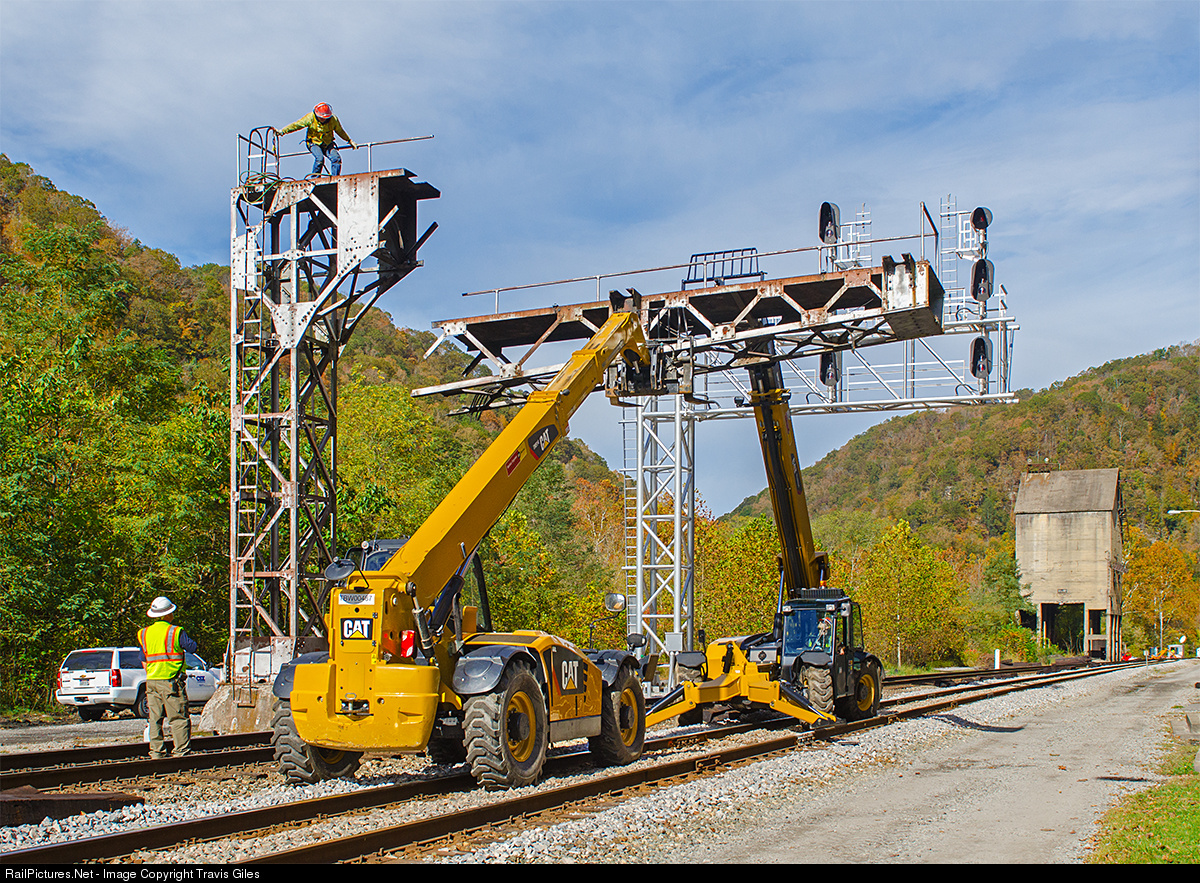
I guess it is no surprise that CSX is not above ruining a Nationally Registered Historic Place.  I've been waiting for the re-signaling project on the C&O Main Line to reach Thurmond, WV for some time now and about a month ago (right after my last new post actually) I saw that a new cookie cutter Darth Vader cantilever with Seaboard signals had gone up adjacent to the preserved "downtown" of Historic Thurmond, WV.


Seeing as it can take 6-8 months for the old signals to fall once the new signals go up, I was shocked when I saw this photo of the old cantilever getting chopped down without so much as a by your leave.


At least NS was good enough to donate one of the PRR signal bridges on the Horseshoe Curve to a museum.  That C&O Cantilever was as important to the character of that streetscape as the coaling tower.


 Anyway, while we are discussing news items it appears that the D&H re-signaling has hit CPF-485 at the Schenectady Station.


The old cantilever signal that used to stand on the main track was replaced a few years ago by a new mast type signal that will not be spared the axe.  Replacements are soulless LED Darth Vaders.


Tuesday, October 14, 2014

Know Your Current Class 1 Standard Signals

It's not really in dispute that North American railroad signaling is currently suffering from a lack of diversity.  However with all the legacy signaling still floating around I figured it would be best to illustrate the lack of diversity of a handy dandy guide.  I'm going to proceed in alphabetical order so you can see for yourselves.

Amtrak:

Former Pennsylvania Railroad Territory - LED lit Safetran Position Lights


Non-PRR NEC - LED target color lights.  Non-Safetran Modular housings.


BNSF: Safetran "Darth Vader" heads with silver painted reverse.  2 heads with three lensed lamps most common.


 Caltrain: Color light signals with square modular units.


 CN: Safetran "Darth Vader" type heads with bare LED lamps. (See Below)

CP:

Primary - Safetran "Darth Vader" type heads with bare LED lamps.


Secondary - In house "mystery" type searchlight.


 CSX: Safetran "Darth Vader" heads.  4 lensed lamp heads used for Lunar White restricting indication.


Monday, October 6, 2014

Caught on Camera - Episode 4: Relay Logic

Today I have a few photos taken in that brief period of time when the relays are still fluttering about and signals, at least the old school variety, can do some rather..."nonstandard" things.  Today we begin on the SEPTA reading trunk line between the Center City Tunnel and Wayne Junction.  This was re-signaled around 1990 and while heavy use of solid state logic was just around the corner, northeast commuter lines were still hitting things up in the traditional way.  Here we see the LED upgraded 24 automatic on track #2 displaying Clear G/G New York Central style.


Woah...now the 24 auto is totally off the reservation!  I will say that I wish I knew what about LED arrays make certain ones fade out and others exhibit more binary behavior.


Alright, time to lift the veil.  Here's a video of the signal progression. Note the relay lag actually lasts for a second or two.


Here is an example from a recent trip on the Capitol Limited on the former Conrail Chicago Line just out of Chicago.  Here the MP 508 automatic is in the process of flipping from Stop and Proceed up to Approach right after our train passed by.  This is because there was a westbound Wolverine Service train waiting for us to clear the single track at CP-506.


One of my favorite signals with wonky relays is the southbound Southern cantilever at MIDLAND interlocking in Gainesville, GA.  This signal has some serious Conrail envy because when trains pass it at Approach Diverging, it drops first to R/Y Diverging Approach before finally going R/R.  I say Conrail envy because this is somewhat typical on plants where R/Y is used for Restricting.

In this Caught on Camera special you can first see the signal upgrade from Approach to Approach Diverging, then get knocked down  in the manner I just pointed out.


I'm sure I have a few more examples of this sort of behavior captured on still or video, but I'm going to leave it at these for now.  If you have some fun examples of relay logic feel free to post them in the comments.

Sunday, September 28, 2014

No Joy in Signalville

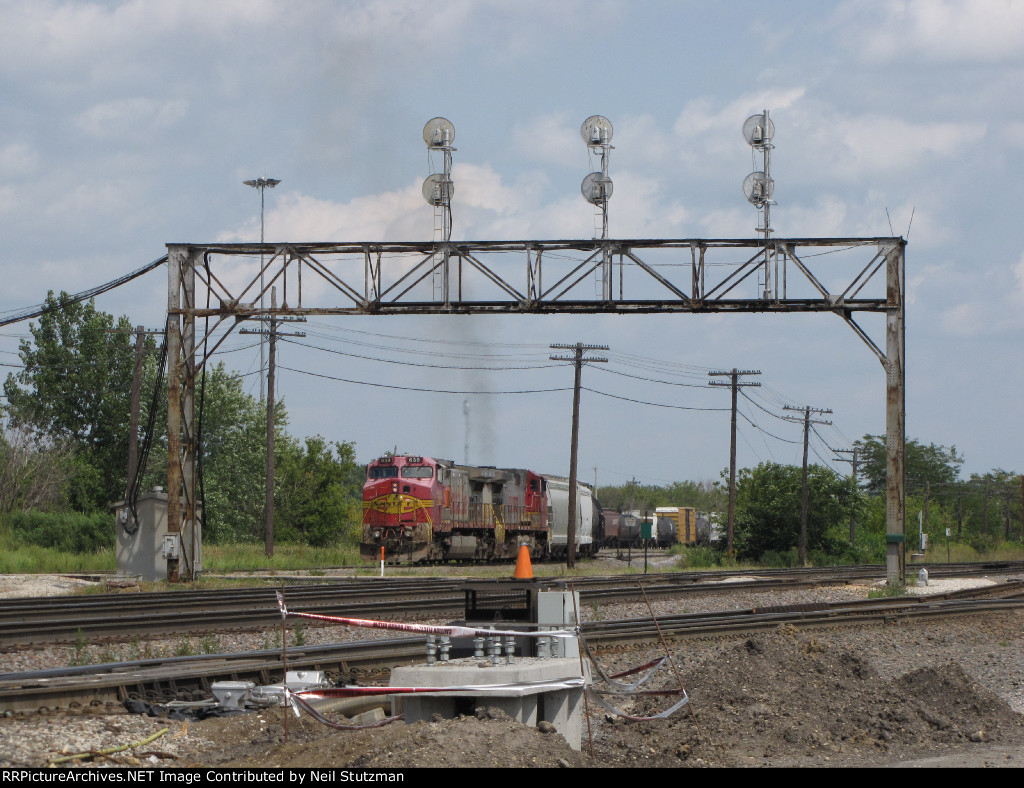
This month's news post is going to be another of the all bad variety.  It seems that the worst effect of the Midwestern oil boom is that railroads are flush with re-signaling money.  We start out at the western end of the CBQ Chicago raceway in Eola, IL where the boom is falling on the massive searchlight interlocking complex there.  Although I would hardly call this a surprising development with the concrete relay huts and above ground cable runs,  Luckily this interlocking is able to be photographed from both METRA and Amtrak trains,


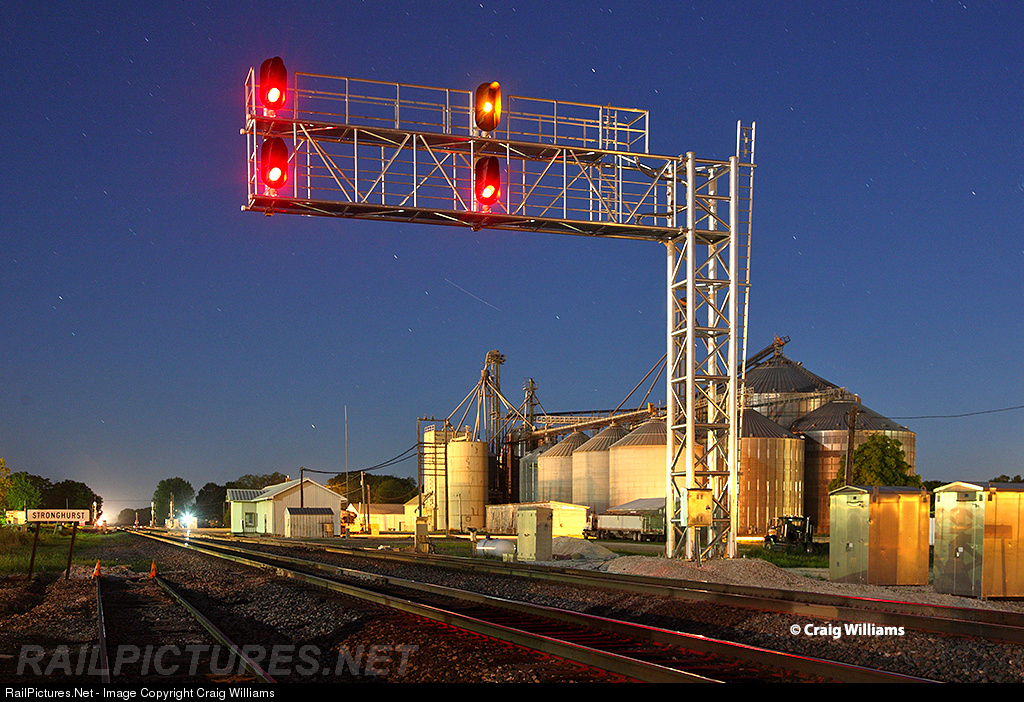
 Further west I had previously had hope for the BNSF Chillicothe sub due to what were clearly 2000's re-signaled searchlit interlocking plants.  However it appears that STRONGHURST was not among these (again note the above ground cable runs) and it was recently saw the Darths turned on.


Going about as far west as is possible, the new signals on the Donner Pass route between SWITCH 9 and SHED 10 were cut in.  Good thing I took an encore trip on the Zephyr back in June.  See my trip report for information on other parts of the line.


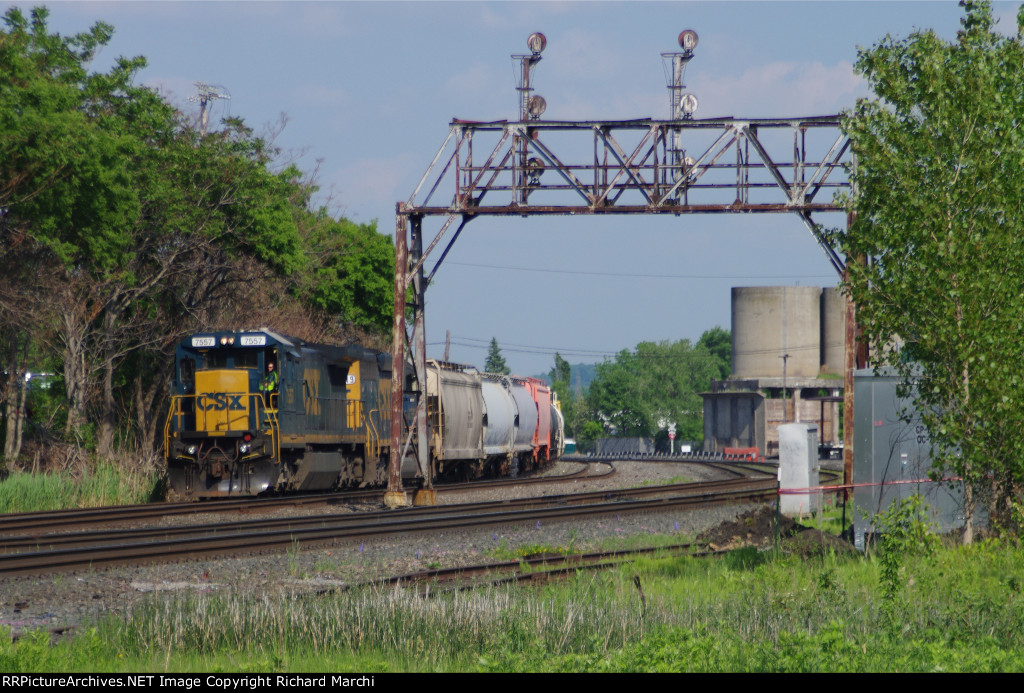
The small target searchlights are coming down at CP-287 near Syracuse on the Chicago Line.  I assume this is part of a larger re-signaling project.  The larger question will be what happens to the "new" Conrail signaled CP-290.


http://www.rrpicturearchives.net/showPicture.aspx?id=3836797

The new signals on the CSX Philly sub have been cut in through the Ankin siding.


 Moving over to Ohio the C&O signals on the Northern Sub in the Richmondale, OH area have also finally been removed.


 Saving the worst for last it appears that for some reason the Kansas City Terminal is replacing some of its searchlights in the Union Station area.  I was hoping that KCT's independence would insulate it from the resignaling mania sweeping the nation.  The real danger is replacement of SANTA FE JCT and its pneumatic point machines.


In an update to a previous news item I noticed a photo of the famous 4-track "modern" PRR PL signal bridge at CP-ROCKVILLE.  The bridge is now down to 3 PLs as one of the yard tracks was lengthened by installing a new Vader mast a few hundred feet to the west.