I recently stumbled upon a YouTube channel run by an old Amtrak conductor who posted a number of video narrations of various parts of the Pennsylvania Tunnel and Terminal Railroad (Penn Station, Sunnyside Yard, etc) including the towers and signaling. The videos were shot prior to the mid-90's when the old towers and old signaling were still in place.
Here in this discussion of the Penn Station track layout, one can see some interrior footage of A Tower starting around 4:30
This video show Sunnyside Yard has some footage around Q tower a little past 3:30.
Here is another Sunnyside video with some Q tower content right up front and some R tower inside footage after 8:00
These are the ones with the most tower content, but her has a bunch of other tour videos that are still very interesting. Check them out!!!
Saturday, March 31, 2018

Tuesday, March 27, 2018
Here Comes the Harrisburg Line CTC Project
Well NS just cut in the CTC on the former Conrail Reading Line, however the original "Reading Line" was the Reading railroad Main Line between Philadelphia and Reading. Eventually folded into the Conrail Harrisburg Line, running between Philadelphia and Harrisburg, the western end was given the CTC treatment pretty much on the NS/CR border in 1999/2000. However, the portion between Reading and Philly was largely left in it's ABS Rule 251 State barring a few bits and pieces here and there.
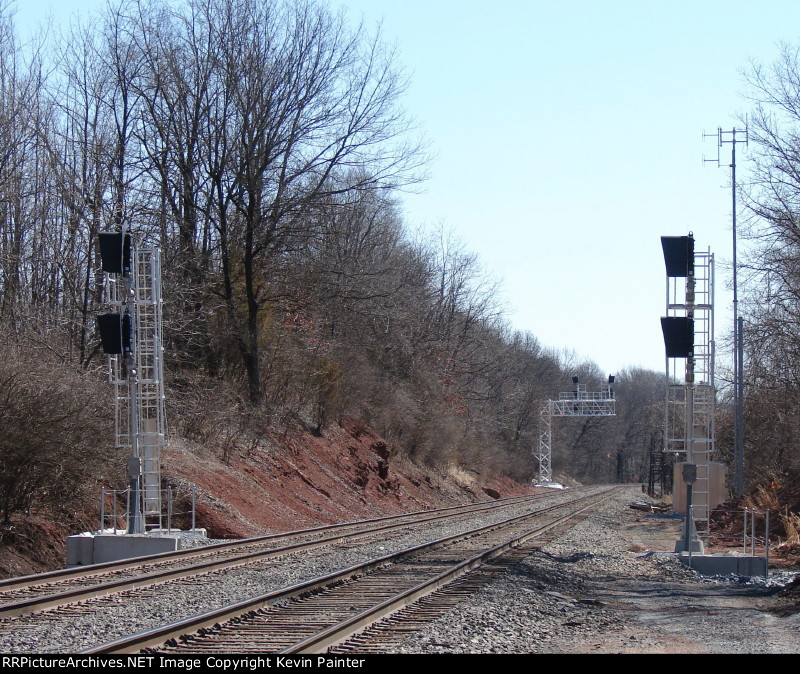
NS has already gone about replacing most of the former Conrail ABS small target searchlights with Darth masts, and then embarked on a re-signaling project that has gone from CP-FALLS to CP-PHOENIX (exclusive). However a few searchlights and Rule 251 remnants hold on. Still, a new crossover is in evidence at CP-BIRD and just a few miles north of there a new crossover is going in at the future CP-LORANE.

The biggest loss, besides the whole concept of single direction ABS, will be CP-TITUS, which is pretty much still in it's 1960's Reading System configuration, complete with a movable point diamond. Needless to say, that i currently my top target for documentary preservation. Hopefully things will move slowly, as they did with the Reading Line, however one has to be prepared for the unexpected, like with the Allentown Terminal complex. Don't pass up the opportunity to get out there while you can.
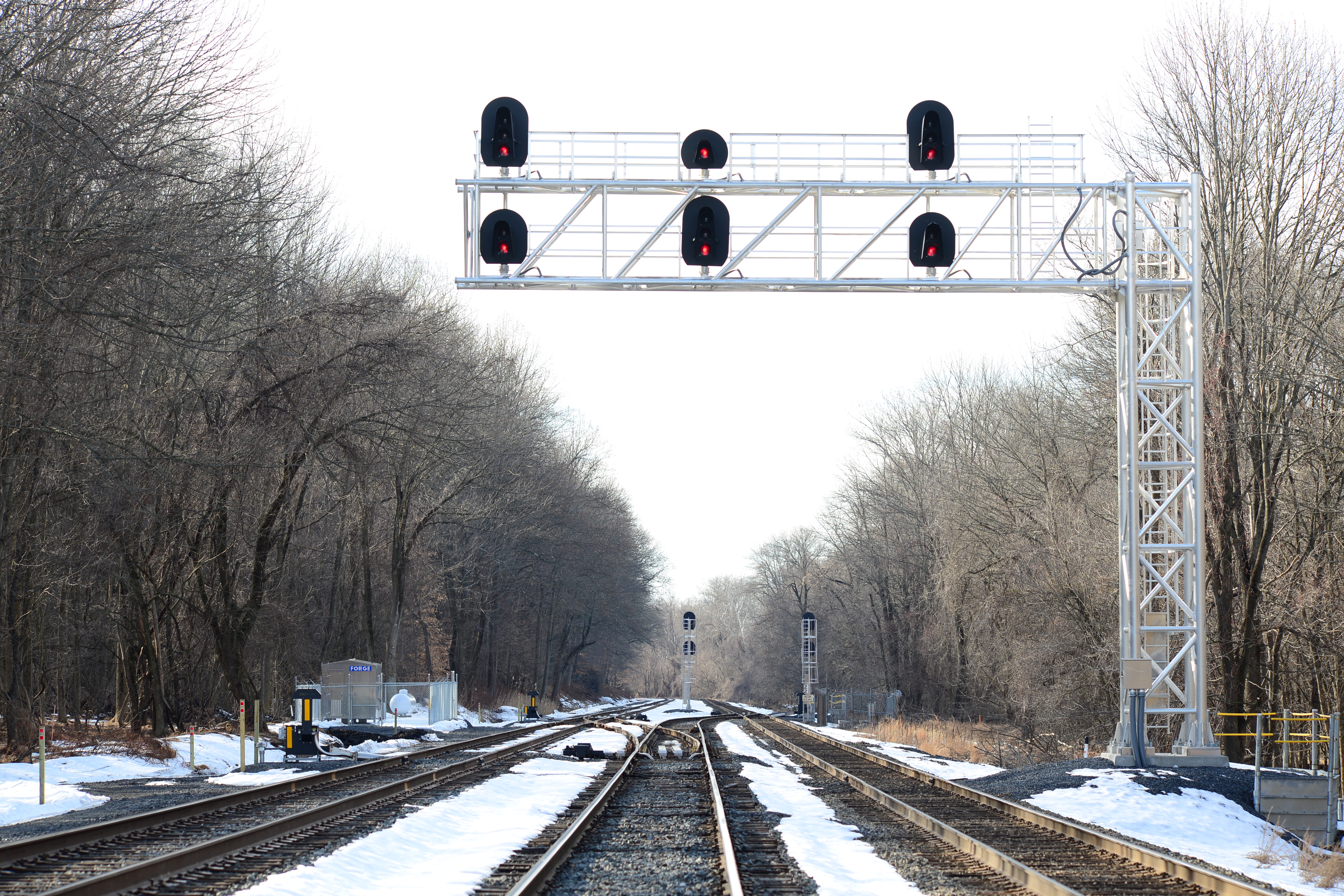 |
| The All New CP-FORGE |
The biggest loss, besides the whole concept of single direction ABS, will be CP-TITUS, which is pretty much still in it's 1960's Reading System configuration, complete with a movable point diamond. Needless to say, that i currently my top target for documentary preservation. Hopefully things will move slowly, as they did with the Reading Line, however one has to be prepared for the unexpected, like with the Allentown Terminal complex. Don't pass up the opportunity to get out there while you can.
Monday, March 19, 2018
NS Reading Line 261 Finally Cut In
Wow, so it took nearly 2 years, but the short, 30 mile long NS Reading Line has finally been "upgraded" to bi-directional Rule 261 operation, replacing the former Conrail small target searchlight signals. Fortunately, over the course of two marathon trips I was able to document most of the signals between CP-WEST LAUREL and CP-ALLEN, inclusive.

The Reading Line and I go way back, it being the site of one of my very first interlocking surveys all the way back in 2002 and later captured in this blog post on CP-ALBURTIS. I later surveyed the Reading Line from the back of an Amtrak fall foliage train in 2016, returning a few weeks later to document the west end and then about 6 months after that to cover the east end. Incidentally, the re-signaling will also come with an increase in speed from 50 to 60mph, with NS now making full use of its Class 4 track. Speed increases are rare events, even after a re-signaling effort as it requires the re-timing of every grade crossing on the route, whereas normally they can be left alone. This may have accounted for the protracted timeframe of the project.

I want to thank my friend Kevin, a Reading Line local, for being my guide and I want to direct everyone over to his own photo album of the signaling changes over the last 2 years. It's a damn shame to see another stretch of increasingly rare ABS bite the dust, but at least we did everything we could to capture what it was like.

The Reading Line and I go way back, it being the site of one of my very first interlocking surveys all the way back in 2002 and later captured in this blog post on CP-ALBURTIS. I later surveyed the Reading Line from the back of an Amtrak fall foliage train in 2016, returning a few weeks later to document the west end and then about 6 months after that to cover the east end. Incidentally, the re-signaling will also come with an increase in speed from 50 to 60mph, with NS now making full use of its Class 4 track. Speed increases are rare events, even after a re-signaling effort as it requires the re-timing of every grade crossing on the route, whereas normally they can be left alone. This may have accounted for the protracted timeframe of the project.

I want to thank my friend Kevin, a Reading Line local, for being my guide and I want to direct everyone over to his own photo album of the signaling changes over the last 2 years. It's a damn shame to see another stretch of increasingly rare ABS bite the dust, but at least we did everything we could to capture what it was like.
Sunday, March 11, 2018
Book Review: GRS - Elements of Railway Signaling
So it's come to this. I'm so desperate for filler content that I've taken a page from the Forgotten Weapons playbook and started posting book reviews 😂 General Railway Signal's (GRS) Elements of Railway Signaling (or at least this version) was published in 1979, on the 75th anniversary of the companies consolidation. It is an industrialreference book similar to Babcock and Wilcox's "Steam: It's Generation and Use" and is likely targeted at electrical engineers who are looking to enter the railway signaling field or at least manage it. No publisher information is listed and it appears to have no ISBN.

The book is exceedingly comprehensive, covering everything from basic track circuits to CTC systems and NX interlocking schemes. It also covers all sorts of obscure topics like approach lighting and hump yard retarder systems. When one reads the word "Basics" in a title, one might expect a focus on "basic" operations. Big easy to read diagrams of Automatic Block schemes and grade crossings. This book is more an inch deep and a mile wide, providing a basic explanation of pretty much every railroad signaling topic.

Ultimately this is where the book can fail a reader with no or only casual electrical engineering experience (and no, not the digital kind that everybody is learning today). For pretty much every signaling topic one can think of, the book provides a paragraph or two, a diagram and then moves on to the next topic. There has been very little effort given to actually trying to provide intuitive explanations and a lay reader will probably need to make more than a few passes.
Ultimately a reader will gain insight into why (classic) signaling works the way it does, however there are so many ways to do similar things that without further information one will not be able to tell how any specific piece of railroad is signaled. Moreover, with a date of 1979, there are a lot of things that are not covered like solid state relay replacements and data transmission that uses packets instead of simple frequencies and polarities. Still, it's a very valuable reference for anyone who is looking to understand how things worked in the pre-digital age and Railway Signaling is far more accessible than something like Color Television or Telephone Switches. After all, relays are pretty much digital devices.

Because of it's "not really published" status, the book is hard to find at typical online booksellers. Ebay is your best bet with final sales prices ranging between $20 and $30 before shipping. These books also can be found at train shows with a typical price of $40.

The book is exceedingly comprehensive, covering everything from basic track circuits to CTC systems and NX interlocking schemes. It also covers all sorts of obscure topics like approach lighting and hump yard retarder systems. When one reads the word "Basics" in a title, one might expect a focus on "basic" operations. Big easy to read diagrams of Automatic Block schemes and grade crossings. This book is more an inch deep and a mile wide, providing a basic explanation of pretty much every railroad signaling topic.

Ultimately this is where the book can fail a reader with no or only casual electrical engineering experience (and no, not the digital kind that everybody is learning today). For pretty much every signaling topic one can think of, the book provides a paragraph or two, a diagram and then moves on to the next topic. There has been very little effort given to actually trying to provide intuitive explanations and a lay reader will probably need to make more than a few passes.
Ultimately a reader will gain insight into why (classic) signaling works the way it does, however there are so many ways to do similar things that without further information one will not be able to tell how any specific piece of railroad is signaled. Moreover, with a date of 1979, there are a lot of things that are not covered like solid state relay replacements and data transmission that uses packets instead of simple frequencies and polarities. Still, it's a very valuable reference for anyone who is looking to understand how things worked in the pre-digital age and Railway Signaling is far more accessible than something like Color Television or Telephone Switches. After all, relays are pretty much digital devices.

Because of it's "not really published" status, the book is hard to find at typical online booksellers. Ebay is your best bet with final sales prices ranging between $20 and $30 before shipping. These books also can be found at train shows with a typical price of $40.
Wednesday, February 28, 2018
Northern Buffalo Line Trip Report
So after reporting that the PRR signaling on the Northern NS/Conrail/PRR Buffalo Line was in danger, I took a trip up to the Williamsport, PA area to take what photos I could before everything went away. Previously NS had re-signaled everything from the north end of Northunberland Yard through to the wye complex at Linden. I had visited the latter location back in 2006 when I was chasing a Levin sponsored PRR E8 trip to Renovo and knew that classic signals were still in place through to Lock Haven, however replacements were in the process of going up. Long story short if you'd like some spoilers, my buddy Todd has already posted his trip report, but I have a few takeaways of my own.

First of all NS did carry out a general signal refurbishment project so the old PL's will be looking their best when they are unceremoniously ripped out in the next few months. although that did mean the demise of the pneumatic point machines. Second, CP-RIVER, which used to span the entire length of the Susquehanna River Bridge at Linden, has its northbound signal moved to the south bank, probably so the LV RR shortline could take full responsibility for the bridge.

After the Linden complex I tried to stop by CP-BUD, but found it to be inaccessible thanks to a gate closing off what is nominally a private road serving some vacation cabins, however I was able to document CP-PINE and the two famous 2-track PRR signal bridges between CP-PINE and CP-LANE. Moreover, just south of the MP 197 bridge there is also an abandoned weigh-in-motion scale that has the equipment arranged in a very strange setup on a platform over a river and protected by steel plate armour.

Getting onto the bad news, CP-LANE, a crossover on the double track just before Lock Haven, PA, had been re-signaled in the same sweep that also hit CP-LOCK HAVEN. Of course the most shocking discovery was this little sign next to the new southbound at CP-LOCK HAVEN.

Yup, NS has completely scrapped the signaling north of Lock Haven, PA. They had already cut back the Rule 261 to Emporium, but for whatever reason they just decided to throw in the towel. You might notice that the northbound cantilever has signals that all support 261 territory north of Lock Haven, but between the time those signals were ordered and today it appears that their plans :-(

All of the relay cabinets have been unceremoniously dumped in the backlot of the NS Lock Haven station/crew base so if you're a relay collector...

First of all NS did carry out a general signal refurbishment project so the old PL's will be looking their best when they are unceremoniously ripped out in the next few months. although that did mean the demise of the pneumatic point machines. Second, CP-RIVER, which used to span the entire length of the Susquehanna River Bridge at Linden, has its northbound signal moved to the south bank, probably so the LV RR shortline could take full responsibility for the bridge.

After the Linden complex I tried to stop by CP-BUD, but found it to be inaccessible thanks to a gate closing off what is nominally a private road serving some vacation cabins, however I was able to document CP-PINE and the two famous 2-track PRR signal bridges between CP-PINE and CP-LANE. Moreover, just south of the MP 197 bridge there is also an abandoned weigh-in-motion scale that has the equipment arranged in a very strange setup on a platform over a river and protected by steel plate armour.

Getting onto the bad news, CP-LANE, a crossover on the double track just before Lock Haven, PA, had been re-signaled in the same sweep that also hit CP-LOCK HAVEN. Of course the most shocking discovery was this little sign next to the new southbound at CP-LOCK HAVEN.

Yup, NS has completely scrapped the signaling north of Lock Haven, PA. They had already cut back the Rule 261 to Emporium, but for whatever reason they just decided to throw in the towel. You might notice that the northbound cantilever has signals that all support 261 territory north of Lock Haven, but between the time those signals were ordered and today it appears that their plans :-(

All of the relay cabinets have been unceremoniously dumped in the backlot of the NS Lock Haven station/crew base so if you're a relay collector...
Wednesday, February 21, 2018
NYCTA Union Turnpike Tower Closes and Warwick CPL's Fall
Double shot of bad news today, although none of it was unexpected. At 5am on Monday, February 20th, 2018, the UNION TURNPIKE tower on the NYCTA Queens Boulevard Line closed. The tower had entered service on 12/1/1936 and contained a 43-lever US&S Model 14 machine. It was replaced by the new Forest Hills Master Tower that also closed Roosevelt Avenue Tower (60-lever GRS Model 5) on 7/11/2016 and Continental Avenue Tower (83-lever US&S Model 14) on 9/11/2017. As I reported earlier in the year, the Northern Boulevard tower (12-lever GRS Model 5), remains open on the local alignment, but will also be closed at some point. The Model 14 towers at Parsons and Jamaica Yard are not currently scheduled for replacement.

In other news, the replacement signals covering the CTC island at Warwick, OH (south of Akron) have been cut over. These have some significance for me as I recall that back around 2000 I was taking my first real long distance Amtrak journey via the old Three Rivers. After being delayed by over 4 hours between Pittsburgh and Akron due to freight congestion, I awoke in my coach seat to see all sorts of strange sites out the window. At Warwick, the RoW opened up with yard tracks in the middle. Emerging from the morning fog I saw B&O CPL signals in their native habitat. It wasn't the first ones I had seen in person of course, but just seeing them when so much of the trip was to be filled with darth vaders on the rebuilt Chicago main line was an amazing experience.

So long and farewell old friends.

In other news, the replacement signals covering the CTC island at Warwick, OH (south of Akron) have been cut over. These have some significance for me as I recall that back around 2000 I was taking my first real long distance Amtrak journey via the old Three Rivers. After being delayed by over 4 hours between Pittsburgh and Akron due to freight congestion, I awoke in my coach seat to see all sorts of strange sites out the window. At Warwick, the RoW opened up with yard tracks in the middle. Emerging from the morning fog I saw B&O CPL signals in their native habitat. It wasn't the first ones I had seen in person of course, but just seeing them when so much of the trip was to be filled with darth vaders on the rebuilt Chicago main line was an amazing experience.

So long and farewell old friends.
Monday, February 12, 2018
PTC Assimilates METRA Beverly and Fox Lake Branches
PTC is in the news after that CSX wreck and it came to my attention that, as one might expect, METRA's solution to some of more oddball signaling arrangements is replacement with bog standard CTC. One of these quirky signaling setups is the Rock Island District's Beverly Branch, which, amazingly, still runs under time separation. The 30 mph line with frequent stops and many level crossings basically gives all stops locals a 10 minute buffer behind them. Following trains work under timetable and line of sight. Well of course one could try and emulate this with some sort of moving block system...or just installed CTC, which is what METRA is doing.

The other casualty is the Fox Lake branch, that turns off the old MILW main line at Rondout and heads west to Fox Lake. This single track line makes use of an interurban style Automatic Permissive Block system with meets taking place at Gray's Lake. Again, there is nothing that would prevent a PTC system to just plug into the existing signals, even ones worked automatically, however once you have to test everything you might as well replace it.

I am going to laugh and laugh when someone markets a PTC solution based on computer vision with no wireless wayside components. So much fire and fury, all for nothing.
The other casualty is the Fox Lake branch, that turns off the old MILW main line at Rondout and heads west to Fox Lake. This single track line makes use of an interurban style Automatic Permissive Block system with meets taking place at Gray's Lake. Again, there is nothing that would prevent a PTC system to just plug into the existing signals, even ones worked automatically, however once you have to test everything you might as well replace it.
I am going to laugh and laugh when someone markets a PTC solution based on computer vision with no wireless wayside components. So much fire and fury, all for nothing.
Subscribe to:
Posts (Atom)