Actually its not Australia I'm talking about today, but New Zealand. Recently I had heard that a re-signaling scheme had been carried out on the Hutt Valley Line, the old signals of which actually had their own website. Well today I learned that the project only re-directed CTC control from a local US&S panel to a dispatch office in Wellington. Even better all the original relay based CTC interlockings were left untouched.
Ok, that's pretty minor, but the news gets better. While the US&S Model 14 interlocking machines in the US are marching towards extinction with the recent re-signaling projects at ALTO, UNION and WB, US&S parent company Westinghouse did sell power frames based on that same technology overseas to mostly British commonwealth countries as the style L, K, N and B miniature lever frames. They are basically US&S frames just with the levers working back and forth instead of side to side (so the poor signalmen wouldn't get confused ;-) ) Anyway these are about as rare as their breathern here in the United States with only a handful of examples still in main line operation in the UK and South Africa. Well today I learned that again, despite some minor re-signaling, not only is the large Style L frame controlling the Wellington, NZ terminal still in service, but it was actually upgraded with three flat panel displays replacing its old bulb lit model board. Talk about a clash of technologies!!
Not only does that frame survive, but so do three others on the North Island Main Trunk at Tawa, Porirua and Plimmerton with Porirua being in use daily and only Tawa being "generally known" about. Here is a page that has some more up to date information on the Style L machines in New Zealand.
Anyway its nice to know that even if power frames vanish from the United States they can still be found in some nice vacation destinations overseas. And then if those go you can always check out the pneumatically actuated Style V machines installed on London Transport up through 1999!!
A blog devoted to explaining the ins and outs of North American railroad signaling, past, present and future. This blog seeks to preserve through photo documentation the great diversity and technical ingenuity of 20th century signaling and interlocking hardware and technology. Related topics cover interlocking towers and railroad communications infrastructure.
Note, due to a web hosting failure some of the photos and links may be unavailable.
Search This Blog
Thursday, December 22, 2011
Monday, December 12, 2011
Wee Bit of Good Searchlight News
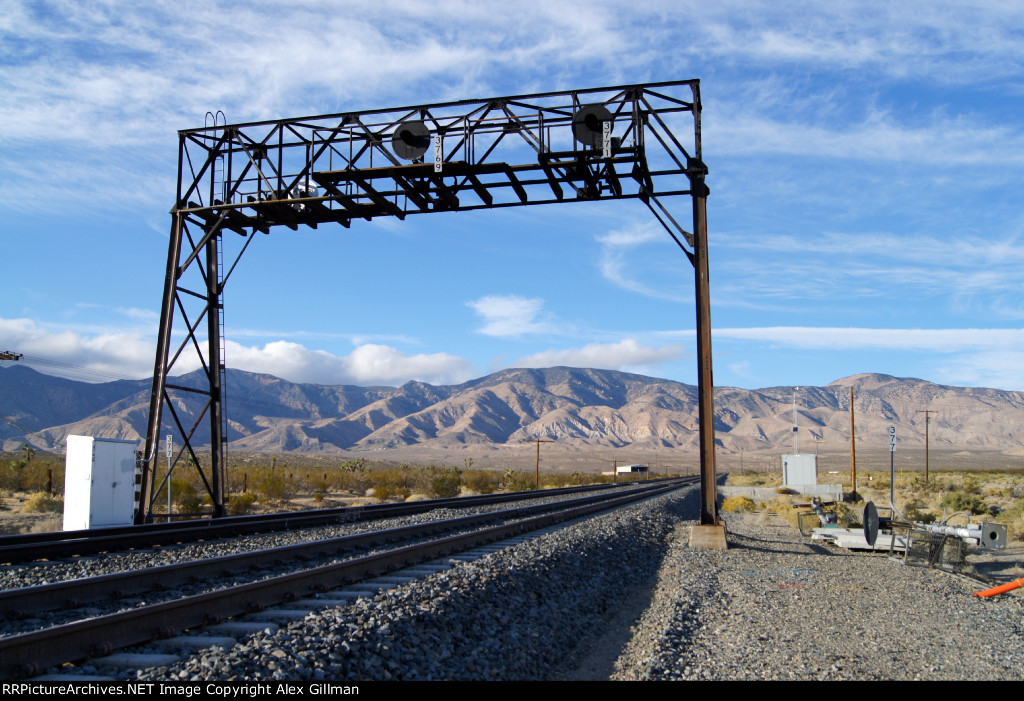
Just saw that out on the former Southern Pacific line in Mojave, CA the MP 377 signal bridge is being taken down for what are probably justified structural issues. However the two track gantry with its 4 searchlight signals is being replaced with a pair of searchlight masts. Huzzah!! Finally, a Class 1 railroad that isn't afraid to Reduce, Reuse and/or Recycle.
Before...
After...
The searchlight masts definitely appear to be used, but hey, I'll take it.
Before...
After...
The searchlight masts definitely appear to be used, but hey, I'll take it.
Sunday, December 11, 2011
C&O Main Line Re-Signaling Plan
Well the bad news is in and if you have plans to ride the Cardinal do it now because most of the remaining C&O signaling on the main line will be gone by the end of next year. Already the signaling has been moving east from Montgomery, but I just learned that already the old signals have been removed between OX Cabin and Clifton Forge on the east slope of the Allegheny slope. Next year the plan is to fully denude everything between there and Hinton including White Sulfur Springs and the summit at Tuckahoe. Hopefully there will be something left when I ride the dome car on the Cardinal next season . I'm feeling really bad that I didn't seize the opportunity this year, although I do have two surveys of the signaling on the line of marginal quality.
Saturday, December 10, 2011
PRR Main Line Survey 2009 Part 9 (CP-JW to SW)
As we enter the final zone of signaling on the PRR Main Line I thought it might be worthwhile to summarize things a little in relation to where the signaling in each section dates from and who installed it as we travel from Philadelphia to Pittsburgh to provide a bit of perspective.
Not sure what conclusions can really be drawn here, but as we pass Johnstown we enter into the earliest of the re-signaling projects that was intended to replace the original PRR signaling. The Pittsburgh Division interlocking charts indexed at Multimodal Ways list the interlocking system used in this section as D601 (details of which I was unable to locate) and the interlocking sheets are the last series of which were hand drafted. I suspect this is a late model of all-relay based CTC technology that first became popular in the 1950's and was eventually supplanted by the new SSI systems in the 1980's.
One side effect of being an early adopter was that none of the PRR signal bridges were replaced with Position Light mast signals. In 1980 railroads still had many first generation road switchers in service and they were designed to run long-hood forward so signals still had to be mounted to the right of the track (Engineer's Side). This meant either gantries or tall bracket masts were needed on double track CTC lines. The downside of this is that between MP 290 and MP 353 there has been significant attrition of position lights because by the time the gantries finally became life expired Conrail has stopped installing position light mast signals to replace gantries like they had between MP 105 and MP 231.
We begin our journey at Johnstown on a new track diagram, but still in three track territory.

Past CP-C we come to CP-JW, which used to be remote C tower with direct wire control from C's Model 14 machine. CP-JW was re-signaled when C tower was closed and had all new signals installed. Like CP-AO, CP-JW is on track 1 only and provides access to the Johnstown yard and helper base from the west. As such there is a power split point derail on the yard track. The signal on the main track is an innovative model that allows the whole signal head unit to be cranked down to ground level for servicing. While this saves on maintainers having to climb the ladder, it requires that the signal be taken out of service, a complicated process that involves the dispatcher and transmitting paperwork to trains. Simply working on a traditional signal will simply result in a dark head, which is covered by standard rules. The yard track has a simple 3-stack Safetran modular dwarf signal that can display 1 or 2 lamp combinations.
I should mention here that when Conrail re-signaled the lines it was more likely to connect the existing interlocking appliances and signals to the new vital logic controllers. Today most railroads prefer to install brand new signals and get all the testing out of the way before taking the old signals out of service and placing the new ones in service in one go. In a literal cut-over the interlocking would have extended downtime to test all of the splices were done properly. CP-C and CP-JW were both re-signaled in this new fashion.
The new relay hut was placed directly adjacent to the old one. It looks like in 2003 someone was still producing new Conrail style ID boards.
A traditional mast signal was erected at the west end of the interlocking in the new NS "tombstone" variety. The switch at CP-JW leads to unsignaled territory, but CP-JW is also the track 1 distant to CP-C and grants a lower head green lamp for Approach Medium aspects.
Just past the Johnstown Amtrak station we pass the 2752E signal mounted on a late model PRR gantry. The position light signals on this bridge apply to track 2 only and it is the eastbound distant to CP-C on track 2. This section of the line had its block signals refreshed by Conrail in the 1990's so their style of re-numbering applies. I should also point out that while this looks like a normal three track line, track 3 on the left is not like the others. It will diverge from tracks 1 and 2 and cross the Conemaugh River to run down the other side to CP-CONPIT.Logical "Main Lines" with tracks that take different paths from point A to point B are not a unique occurrence and such tracks are often called Slow Routes or Turkey Paths. In this case the time penalty for a track 3 routing is +15 minutes and every so often this train will suffer that penalty when tracks 1 or 2 are congested.
Also note where the second island platform for the Johnstown station used to sit. Today track #1 is reached with a long duckboard platform.
The MP 277 automatic is a Conrail install consisting of a Cantilever covering tracks 1 and 2 and a mast for track 3. This is the distant for CP-C on track 3 so we can confirm that track 3 has one less block in this segment than tracks 1 and 2 do. From the footings these signals replaced a PRR signal bridge at the same location that also used to be part of the SG tower plant. This interlocking which the old decision point for movements into the Sang Hollow Extension, which was what track 3 was known as at the time.
After several additional floods in the 20th Century the Army Corps of Engineers decided to pot an end to the problem by applying appropriate protections to the riverbank .
We are once again treated to position light masts installed in the 1990 refresh for the MP 280 automatic.
More PLs at MP 283. The rail line is now traversing the Conemaugh River gap through a thick mountain ridge and there are no adjacent road lines or settlements.
The MP 286 automatics are co-located with an AEI tag reader and the "New Florance" Hotbox/Dragging Equipment detector. This is the westbound distant to CP-CONPIT.
CP-CONPIT is an important junction between the Pittsburgh Line and the Conemaugh Line (hence the name). The Conemaugh Line is a low-grade route that follows the Conemaugh River to the Allegheny River and then down into Pittsburgh. The Pittsburgh Line will cut overland to Pittsburgh directly. The westbound mast signals on tracks 1 and 2 are Position Light and mount early examples of the 'C' Board you might remember from Amtrak's re-signaled Harrisburg Line. The Conemaugh Line was the PRR's experimental installation of cab-signal only operation in the late 1940's between here and CP-KISKI where the line reaches the Allegheny River. It took another 4 decades for cab signal only operation to be expanded my Conrail to some of the PRR's other former routes.
Also notice that a new EMD SD70M-2 is waiting on track 3 with a mixed freight train.
- MP 000 -> MP 067 - Pennsylvania Railroad - Relay + Electromechanical - 1940s
- MP 067 -> MP 104 - Amtrak - Solid State - 2008
- MP 105 -> MP 231 - Conrail - Solid State (GE Series 6) + Relay - 1990
- MP 231 -> MP 237 - Pennsylvania Railroad - Relay (US&S 504 CTC) + Electromechanical - 1950s
- MP 237 -> MP 265 - Conrail - Solid State (GE Series 6) + Relay - 1994
- MP 265 -> MP 274 - Norfolk Southern - Solid State - 2000
- MP 274 -> MP 290 - Conrail - Relay (no interlockings) - 1990
- MP 290 -> MP 353 - Conrail - Relay(? Listed as D601 system) - 1980
Not sure what conclusions can really be drawn here, but as we pass Johnstown we enter into the earliest of the re-signaling projects that was intended to replace the original PRR signaling. The Pittsburgh Division interlocking charts indexed at Multimodal Ways list the interlocking system used in this section as D601 (details of which I was unable to locate) and the interlocking sheets are the last series of which were hand drafted. I suspect this is a late model of all-relay based CTC technology that first became popular in the 1950's and was eventually supplanted by the new SSI systems in the 1980's.
One side effect of being an early adopter was that none of the PRR signal bridges were replaced with Position Light mast signals. In 1980 railroads still had many first generation road switchers in service and they were designed to run long-hood forward so signals still had to be mounted to the right of the track (Engineer's Side). This meant either gantries or tall bracket masts were needed on double track CTC lines. The downside of this is that between MP 290 and MP 353 there has been significant attrition of position lights because by the time the gantries finally became life expired Conrail has stopped installing position light mast signals to replace gantries like they had between MP 105 and MP 231.
We begin our journey at Johnstown on a new track diagram, but still in three track territory.
Past CP-C we come to CP-JW, which used to be remote C tower with direct wire control from C's Model 14 machine. CP-JW was re-signaled when C tower was closed and had all new signals installed. Like CP-AO, CP-JW is on track 1 only and provides access to the Johnstown yard and helper base from the west. As such there is a power split point derail on the yard track. The signal on the main track is an innovative model that allows the whole signal head unit to be cranked down to ground level for servicing. While this saves on maintainers having to climb the ladder, it requires that the signal be taken out of service, a complicated process that involves the dispatcher and transmitting paperwork to trains. Simply working on a traditional signal will simply result in a dark head, which is covered by standard rules. The yard track has a simple 3-stack Safetran modular dwarf signal that can display 1 or 2 lamp combinations.
I should mention here that when Conrail re-signaled the lines it was more likely to connect the existing interlocking appliances and signals to the new vital logic controllers. Today most railroads prefer to install brand new signals and get all the testing out of the way before taking the old signals out of service and placing the new ones in service in one go. In a literal cut-over the interlocking would have extended downtime to test all of the splices were done properly. CP-C and CP-JW were both re-signaled in this new fashion.
The new relay hut was placed directly adjacent to the old one. It looks like in 2003 someone was still producing new Conrail style ID boards.
A traditional mast signal was erected at the west end of the interlocking in the new NS "tombstone" variety. The switch at CP-JW leads to unsignaled territory, but CP-JW is also the track 1 distant to CP-C and grants a lower head green lamp for Approach Medium aspects.
Just past the Johnstown Amtrak station we pass the 2752E signal mounted on a late model PRR gantry. The position light signals on this bridge apply to track 2 only and it is the eastbound distant to CP-C on track 2. This section of the line had its block signals refreshed by Conrail in the 1990's so their style of re-numbering applies. I should also point out that while this looks like a normal three track line, track 3 on the left is not like the others. It will diverge from tracks 1 and 2 and cross the Conemaugh River to run down the other side to CP-CONPIT.Logical "Main Lines" with tracks that take different paths from point A to point B are not a unique occurrence and such tracks are often called Slow Routes or Turkey Paths. In this case the time penalty for a track 3 routing is +15 minutes and every so often this train will suffer that penalty when tracks 1 or 2 are congested.
Also note where the second island platform for the Johnstown station used to sit. Today track #1 is reached with a long duckboard platform.
The MP 277 automatic is a Conrail install consisting of a Cantilever covering tracks 1 and 2 and a mast for track 3. This is the distant for CP-C on track 3 so we can confirm that track 3 has one less block in this segment than tracks 1 and 2 do. From the footings these signals replaced a PRR signal bridge at the same location that also used to be part of the SG tower plant. This interlocking which the old decision point for movements into the Sang Hollow Extension, which was what track 3 was known as at the time.
After several additional floods in the 20th Century the Army Corps of Engineers decided to pot an end to the problem by applying appropriate protections to the riverbank .
We are once again treated to position light masts installed in the 1990 refresh for the MP 280 automatic.
More PLs at MP 283. The rail line is now traversing the Conemaugh River gap through a thick mountain ridge and there are no adjacent road lines or settlements.
The MP 286 automatics are co-located with an AEI tag reader and the "New Florance" Hotbox/Dragging Equipment detector. This is the westbound distant to CP-CONPIT.
CP-CONPIT is an important junction between the Pittsburgh Line and the Conemaugh Line (hence the name). The Conemaugh Line is a low-grade route that follows the Conemaugh River to the Allegheny River and then down into Pittsburgh. The Pittsburgh Line will cut overland to Pittsburgh directly. The westbound mast signals on tracks 1 and 2 are Position Light and mount early examples of the 'C' Board you might remember from Amtrak's re-signaled Harrisburg Line. The Conemaugh Line was the PRR's experimental installation of cab-signal only operation in the late 1940's between here and CP-KISKI where the line reaches the Allegheny River. It took another 4 decades for cab signal only operation to be expanded my Conrail to some of the PRR's other former routes.
Also notice that a new EMD SD70M-2 is waiting on track 3 with a mixed freight train.
Tuesday, December 6, 2011
Speed Signaling with Caltrain
Between 2002 and 2004 the Caltrain commuter route on the peninsula between San Francisco and San Jose underwent a near total rebuild to bring it up to the same high tech standards as many of the companies that had their headquarters adjacent to its tracks. At the turn of the 21st century the line was operating much as it would have been at the turn of the 20th with basic single-direction Automatic Block Signal operation with hand operated crossovers at temporary block stations where orders would have hooped up to trains during single line working. Much of the line still used jointed rail and there were only five interlockings on the entire route clustered at the north end near San Francisco, one of which was the 4th and King St terminal and the three of the remainder being used by freight trains accessing spur tracks.
Fortunately for history the line was documented by a West Coast signal fan and you can see his work here.
http://www.redoveryellow.com/signals/coast/_C326-359.html
http://www.redoveryellow.com/signals/coast/_C360-381.html
Two years later the line could not be more different. It was upgraded to fully bi-directional CTC operation with welded rail and large sections with concrete ties. Stations were rebuilt and two long 4-track passing sections were constructed near the Northern and Southern portions of the line to allow new express train services to pass locals without delay. A plethora of new interlockings were installed to allow 2-track express passing or just easy recovery from engineering works. Again, all of these changes were documented by the same signal fan.
http://www.redoveryellow.com/signals/coast/after_ctx/_C326_358.html
http://www.redoveryellow.com/signals/coast/after_ctx/_C359-381.html
What is perhaps more interesting is that as Caltrain owned the tracks between CP-COAST and San Francisco it was free to make the decision to abandon the old Southern Pacific inherited 'route' signal rules and adopt more modern speed signal rules comparable to those seen in the east. As Amtrak had the long term contract to run the Caltrain services this better fit its operating practices elsewhere in the country.
The old route style signaling had been popular back when interlockings were few and far between and traffic densities light, but with increased routes and higher speed differentials Caltrain dumped the whole route concept and adopted a speed signaling scheme influenced by prior art, but with its own unique flavour.
The Caltrain signal rules can be found its the following rulebook documents. Also included are the Union Pacific route signaling rules still in service on the UP owned portions of track so you can compare and contrast.
Caltrain ETT No 2
Caltrain ETT No 2 Supplement No 4
So what is interesting is that Caltrain started with the typical "Northeast" style signal set with Y/Y as Approach Slow and *Y* as Advance Approach, but dumped the use of "bottom yellow" in Restricting signals, using *R* instead. With bottom yellows now free R/Y and R/R/Y could be tasked to Medium and Slow Approach. The system retains some Western influences with the Approach Restricting aspect and Caltrain also added some innovative new aspects such as R/*Y* as Limited Advance Approach, R/R/*Y* as Slow Advance Approach and R/Y/*R* as Medium Approach Restricting. They also logically extended the Northeast style system by using R/Y/Y as Medium Approach Slow.
Because no automatic signal aspect requires 3 heads (a problem caused by using Y/R/G for Approach Slow) Caltrain was able to adopt a uniform visual aesthetic for its signals (probably to the delight of its vendor, US&S) by fitting all standard block signals with 1 head, distant signals with 2 heads and interlocking signals with 3 heads. Each head in turn was fitted with all three lamps, if they were needed or not. This gives the engineer an easy way of identifying what sort of signal they are facing, even if it means Caltrain spent a lot more outfitting signal lamps that would never need to be illuminated. On some of the 4+ track home signal gantries this can lead to quite the interesting Christmas Tree effect, especially when flashing aspects are involved.
This brings us to our main feature. Back in March I was out in the Bay Area for a conference and I was able to capture video from the north-facing railfan window of a gallery car of the entire line. Now this consists of about 40 minutes worth of video showing nothing but Clear signals and is probably something you don't really need to see, however I later filmed a second partial run at night where my express train takes the Bayshore passing route for some reason which shows off some aspects other than Clear. Also in evidence are the numerous grade crossings (including pedestrian grade crossings at stations which the trains have to whistle for) and this really cool Southern Pacific era 8-track signal gantry that was fitted with new signals and left in place. In that same area you can also see the last hand operated crossovers on the line used by local freight trains to switch between goods sidings that straddle the main line.
The first video between Millbrae and Bayshore can be seen here:
There is a gap between the way caused by my camera batteries running out.
In the second video you can see the new Lunar White marker lights that were attached to the signals in the terminal area for some reason. The terminal is the only un-resignaled portion of the line retaining its original Southern Pacific searchlights and pneumatic point machines (possibly the only pneumatic points west of Kansas City) and the Lunar Markers may be to differentiate the special case terminal signals with the new speed signaling system.
Anyway, I hope you all enjoy the video and see that converting to Speed Signaling is an achievable goal.
Fortunately for history the line was documented by a West Coast signal fan and you can see his work here.
http://www.redoveryellow.com/signals/coast/_C326-359.html
http://www.redoveryellow.com/signals/coast/_C360-381.html
Two years later the line could not be more different. It was upgraded to fully bi-directional CTC operation with welded rail and large sections with concrete ties. Stations were rebuilt and two long 4-track passing sections were constructed near the Northern and Southern portions of the line to allow new express train services to pass locals without delay. A plethora of new interlockings were installed to allow 2-track express passing or just easy recovery from engineering works. Again, all of these changes were documented by the same signal fan.
http://www.redoveryellow.com/signals/coast/after_ctx/_C326_358.html
http://www.redoveryellow.com/signals/coast/after_ctx/_C359-381.html
What is perhaps more interesting is that as Caltrain owned the tracks between CP-COAST and San Francisco it was free to make the decision to abandon the old Southern Pacific inherited 'route' signal rules and adopt more modern speed signal rules comparable to those seen in the east. As Amtrak had the long term contract to run the Caltrain services this better fit its operating practices elsewhere in the country.
The old route style signaling had been popular back when interlockings were few and far between and traffic densities light, but with increased routes and higher speed differentials Caltrain dumped the whole route concept and adopted a speed signaling scheme influenced by prior art, but with its own unique flavour.
The Caltrain signal rules can be found its the following rulebook documents. Also included are the Union Pacific route signaling rules still in service on the UP owned portions of track so you can compare and contrast.
Caltrain ETT No 2
Caltrain ETT No 2 Supplement No 4
So what is interesting is that Caltrain started with the typical "Northeast" style signal set with Y/Y as Approach Slow and *Y* as Advance Approach, but dumped the use of "bottom yellow" in Restricting signals, using *R* instead. With bottom yellows now free R/Y and R/R/Y could be tasked to Medium and Slow Approach. The system retains some Western influences with the Approach Restricting aspect and Caltrain also added some innovative new aspects such as R/*Y* as Limited Advance Approach, R/R/*Y* as Slow Advance Approach and R/Y/*R* as Medium Approach Restricting. They also logically extended the Northeast style system by using R/Y/Y as Medium Approach Slow.
Because no automatic signal aspect requires 3 heads (a problem caused by using Y/R/G for Approach Slow) Caltrain was able to adopt a uniform visual aesthetic for its signals (probably to the delight of its vendor, US&S) by fitting all standard block signals with 1 head, distant signals with 2 heads and interlocking signals with 3 heads. Each head in turn was fitted with all three lamps, if they were needed or not. This gives the engineer an easy way of identifying what sort of signal they are facing, even if it means Caltrain spent a lot more outfitting signal lamps that would never need to be illuminated. On some of the 4+ track home signal gantries this can lead to quite the interesting Christmas Tree effect, especially when flashing aspects are involved.
This brings us to our main feature. Back in March I was out in the Bay Area for a conference and I was able to capture video from the north-facing railfan window of a gallery car of the entire line. Now this consists of about 40 minutes worth of video showing nothing but Clear signals and is probably something you don't really need to see, however I later filmed a second partial run at night where my express train takes the Bayshore passing route for some reason which shows off some aspects other than Clear. Also in evidence are the numerous grade crossings (including pedestrian grade crossings at stations which the trains have to whistle for) and this really cool Southern Pacific era 8-track signal gantry that was fitted with new signals and left in place. In that same area you can also see the last hand operated crossovers on the line used by local freight trains to switch between goods sidings that straddle the main line.
The first video between Millbrae and Bayshore can be seen here:
There is a gap between the way caused by my camera batteries running out.
In the second video you can see the new Lunar White marker lights that were attached to the signals in the terminal area for some reason. The terminal is the only un-resignaled portion of the line retaining its original Southern Pacific searchlights and pneumatic point machines (possibly the only pneumatic points west of Kansas City) and the Lunar Markers may be to differentiate the special case terminal signals with the new speed signaling system.
Anyway, I hope you all enjoy the video and see that converting to Speed Signaling is an achievable goal.
Monday, December 5, 2011
Finding a Blue Lining
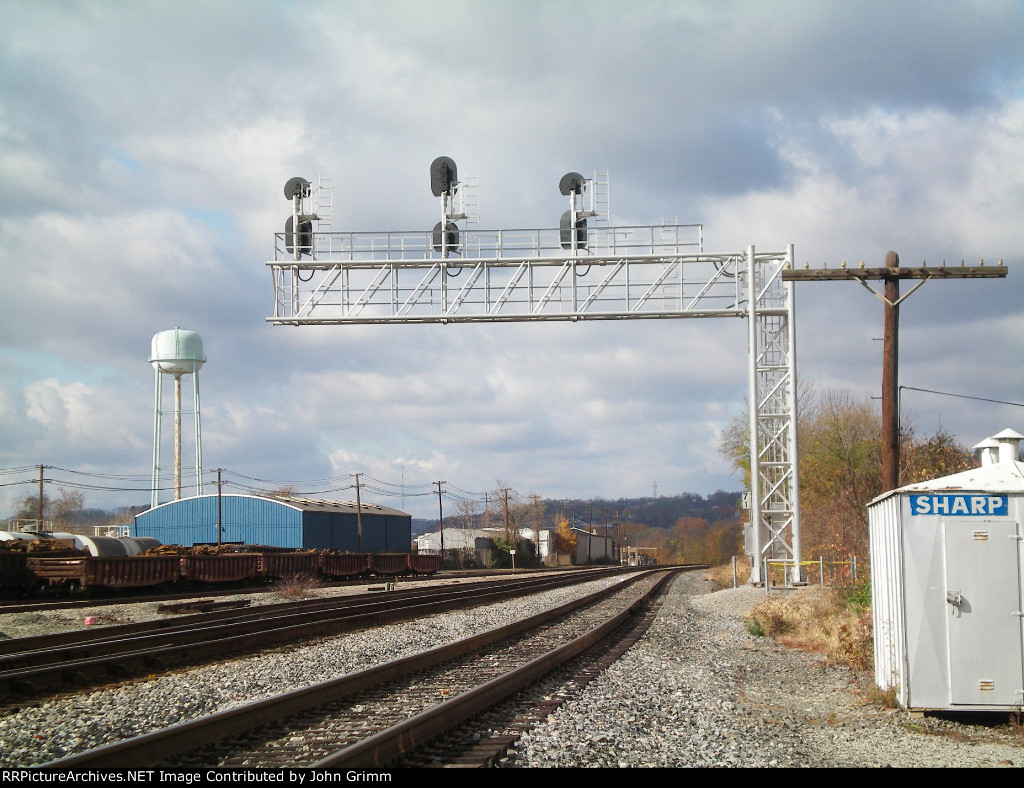
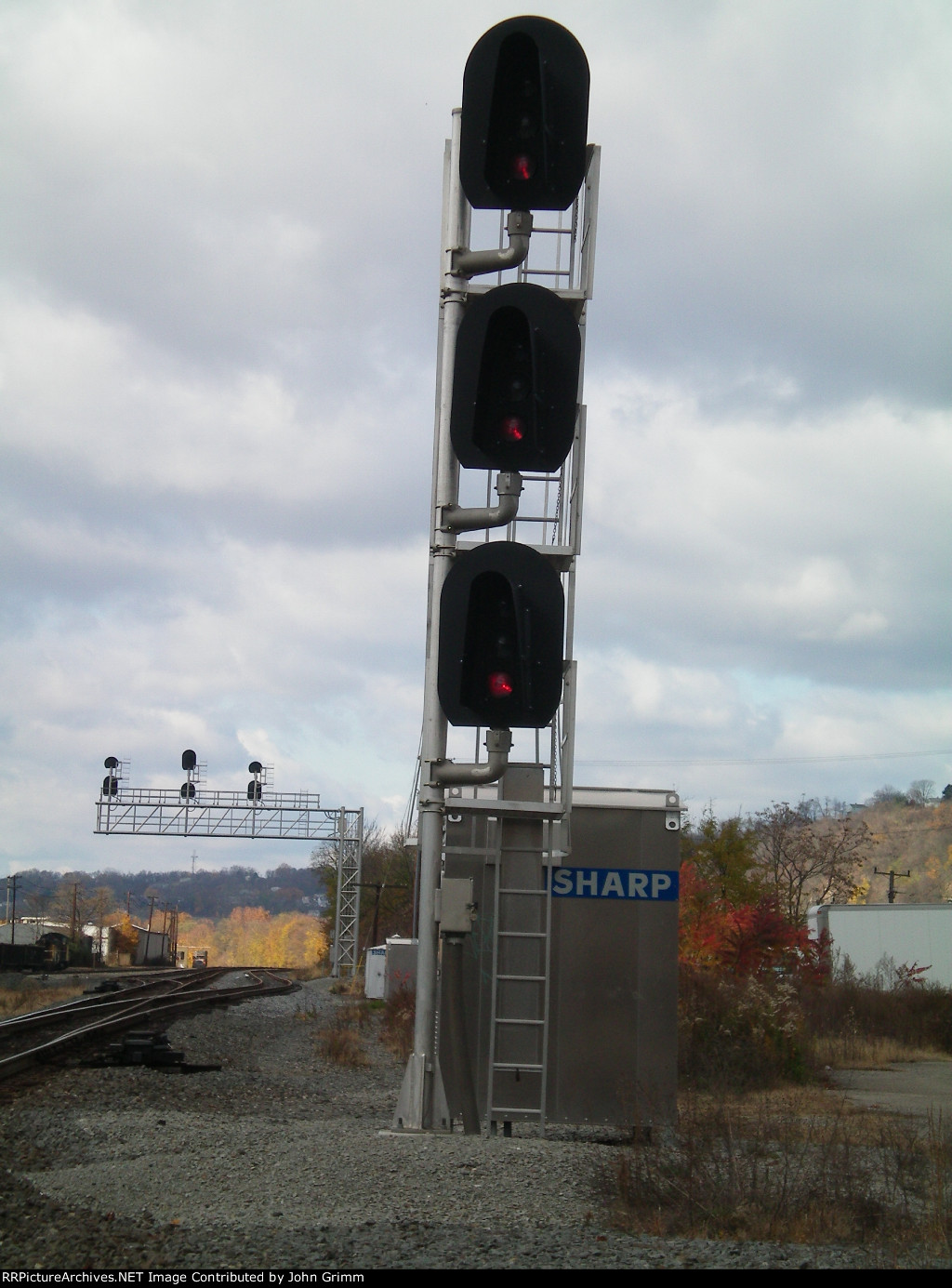
We all know the railroads have been in overdrive lately resignaling even perfectly functional interlockings on non-pole line CTC routes. Well I have managed to find one small silver, or should I say blue lining to all of this. Recently NS re-signaled three interlockings on the western end of the Conemaugh Line near Pittsburgh. CP-HERR, CP-ENTA and CP-SHARP were all Penn Central era interlockings with mostly solid steel signal gantries and cantilevers, position lights and pneumatic point machines. Well NS removed the whole lot as they reconfigured Enta Yard. However at both rebuilt interlockings NS bothered to install brand new Conrail blue location signs on the relay huts. I guess its a nice thought, but I would have preferred they leave the interlocking appliances alone to begin with.
Here we see the original relay hut with the new cantilever mast.
And the new relay hut with the new sign.
Here we see the original relay hut with the new cantilever mast.
And the new relay hut with the new sign.
Wednesday, November 30, 2011
PRR Main Line Survey 2009 Part 8 (CP-UN to CP-C)
Well we have reached the summit of the PRR at Gallitzin and it is time to coast down the West Slope. While not as dramatic as the East Slope and its Horseshoe Curve the West Slope is still a helper district, is three tracks and has a good bit of cool signaling.
The following track diagram will apply to this part.

If you forgot all of the photos can be seen here.
The summit of the Alleghenies, like most mountain railroad summits, features a complex of tracks that enables the use of helpers to be cut off and return to base and also accommodate any reductions in main tracks due to tunnels and junctions of alternate / low grade routes. The Gallitzin Summit is not different and at one point featured all of those in a giant interlocking complex known as BN-SF-AR-UN, seen here in this 1948 chart. After a signaling consolidation project during World War 2, the entire complex was controlled from a pair of US&S Model 14 interlocking machines in a new all brick tower overlooking AR interlocking overlooking tracks 1 and 2 with a logically seperate yet direct wire controlled UN interlocking on tracks 3 and 4. East of AR and UN was the previously mentioned SF interlocking where the Muleshoe Curve route diverge and before that was BF that provided a trailing point pre-processing ladder.
Today only AR and UN remain as active interlockings and the tower was closed in 1994. Today CP-AR serves as the eastern end of two sidings off track 1 that run between there and CP-MO. CP-UN acts as a crossover between tracks 2 and 3. Finally, between AR and UN runs a loop track that helper sets (or excursion trains) can use to turn back to Altoona after helping a westbound train over the grade. CP-UN used to have a 3-track PRR signal bridge for westbound movements, but around 2009 it was replaced by a color light cantilever due to structural issues. We can see it here with the 12W and 14W signals.
#15 switch crossover with pneumatic switch machines.
The slow speed loop track splits off between the two crossovers on the #11 switch.
The relay hut is located in the crook of the loop track, adjacent to the #11 crossover.
The restricting-only 14E reverse direction dwarf follows immediately on the Rule 251 West track #3.
Around a bend sits the 12E-1 signal sitting all alone on a 2-track PRR signal gantry. The lower head only offers a Restricting indication as the only routes available are straight ahead or against the flow of traffic on track #3. Back in the day this used to support two semi-automatic exit signals for westbound movements.
After leaving CP-UN we pass under the 2493 automatic, which is for westbound movements on tracks 3 and 4 only. Yes you heard me right, between CP-UN and CP-MO the tracks are renumbered 0 through 4 due to the presence of two siding tracks on the other alignment and thus track 3 becomes 4, 2 becomes 3 and we have a new tracks 2 and 0. This automatic is also distant to CP-MO, mounted on a two track late model gantry and if you look at the bottom | you can see the old mounting bracket for a Limited speed triangle.
The following track diagram will apply to this part.
If you forgot all of the photos can be seen here.
The summit of the Alleghenies, like most mountain railroad summits, features a complex of tracks that enables the use of helpers to be cut off and return to base and also accommodate any reductions in main tracks due to tunnels and junctions of alternate / low grade routes. The Gallitzin Summit is not different and at one point featured all of those in a giant interlocking complex known as BN-SF-AR-UN, seen here in this 1948 chart. After a signaling consolidation project during World War 2, the entire complex was controlled from a pair of US&S Model 14 interlocking machines in a new all brick tower overlooking AR interlocking overlooking tracks 1 and 2 with a logically seperate yet direct wire controlled UN interlocking on tracks 3 and 4. East of AR and UN was the previously mentioned SF interlocking where the Muleshoe Curve route diverge and before that was BF that provided a trailing point pre-processing ladder.
Today only AR and UN remain as active interlockings and the tower was closed in 1994. Today CP-AR serves as the eastern end of two sidings off track 1 that run between there and CP-MO. CP-UN acts as a crossover between tracks 2 and 3. Finally, between AR and UN runs a loop track that helper sets (or excursion trains) can use to turn back to Altoona after helping a westbound train over the grade. CP-UN used to have a 3-track PRR signal bridge for westbound movements, but around 2009 it was replaced by a color light cantilever due to structural issues. We can see it here with the 12W and 14W signals.
#15 switch crossover with pneumatic switch machines.
The slow speed loop track splits off between the two crossovers on the #11 switch.
The relay hut is located in the crook of the loop track, adjacent to the #11 crossover.
The restricting-only 14E reverse direction dwarf follows immediately on the Rule 251 West track #3.
Around a bend sits the 12E-1 signal sitting all alone on a 2-track PRR signal gantry. The lower head only offers a Restricting indication as the only routes available are straight ahead or against the flow of traffic on track #3. Back in the day this used to support two semi-automatic exit signals for westbound movements.
After leaving CP-UN we pass under the 2493 automatic, which is for westbound movements on tracks 3 and 4 only. Yes you heard me right, between CP-UN and CP-MO the tracks are renumbered 0 through 4 due to the presence of two siding tracks on the other alignment and thus track 3 becomes 4, 2 becomes 3 and we have a new tracks 2 and 0. This automatic is also distant to CP-MO, mounted on a two track late model gantry and if you look at the bottom | you can see the old mounting bracket for a Limited speed triangle.
Subscribe to:
Posts (Atom)