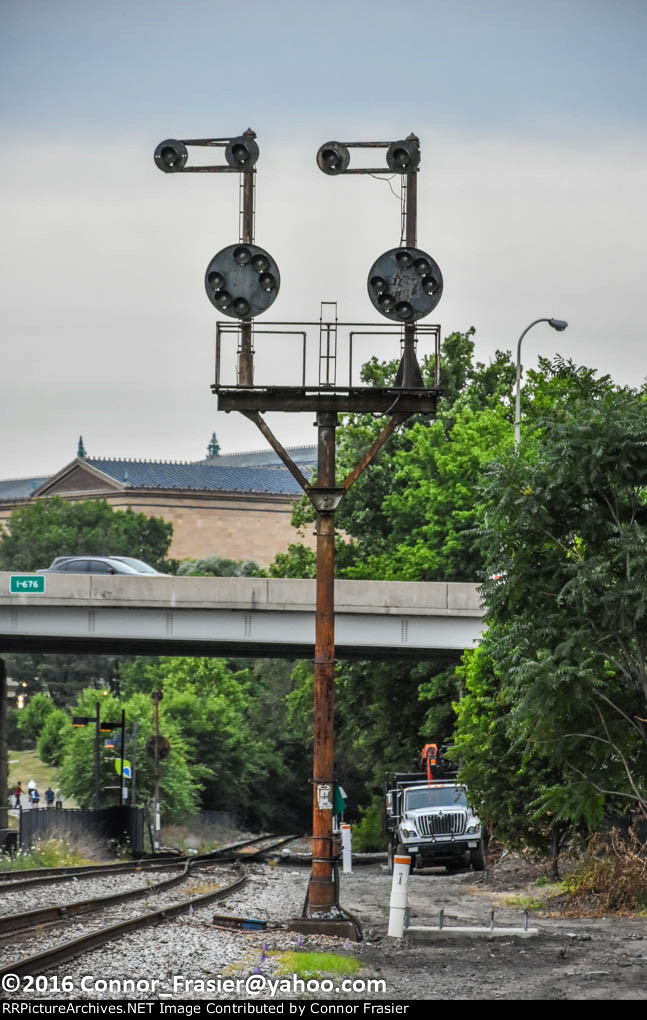
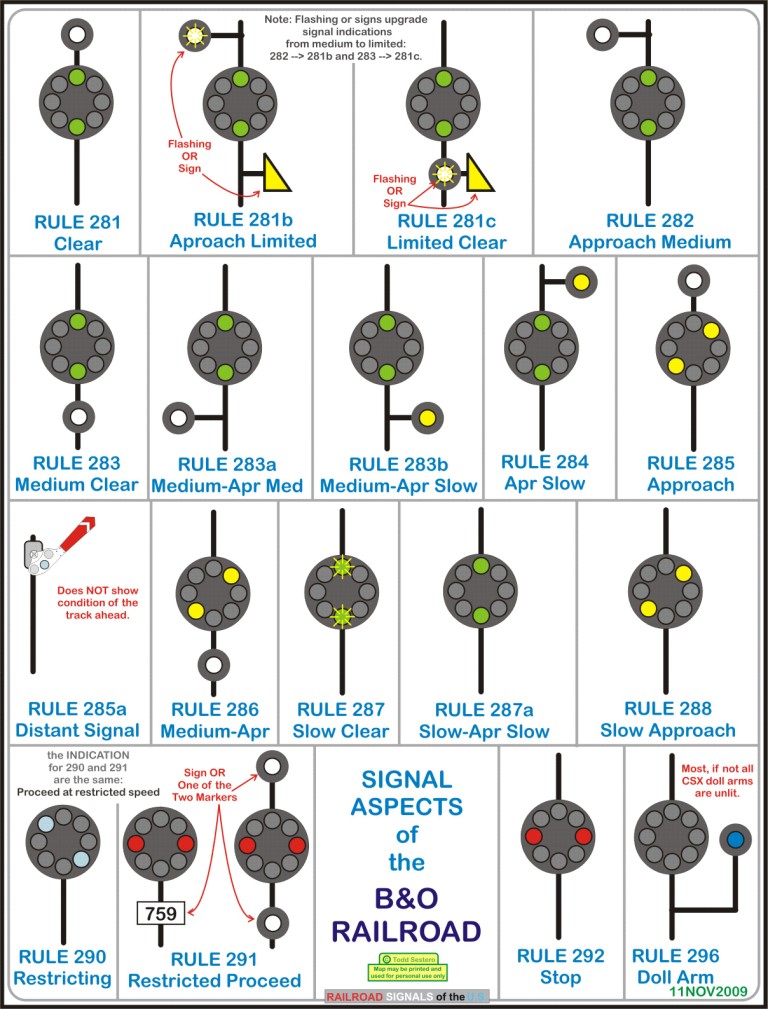
Ah, here's the one I know you've been waiting for. What is arguably the most unique and most advanced signal indication system in the united states and arguably one of the best in the world. Why is this the case? First, it was designed from scratch in the 1920's, after the advent of high intensity electric lighting and also after most other railroads had adopted some sort of color light or position light system, allowing the B&O to learn from their example. Second, it had the strongest theoretical underpinnings of any other signaling system. Another misconception is that the B&O CPL is in the same family as Amtrak's or N&W's colorized position lights. In fact the B&O is a class by itself as in those other systems position has a one to one mapping to color while the B&O uses the position of marker lights called "orbitals" to modify the central color-position target.

There are so many neat features about the B&O system that I hardly know where to begin so I might as well just list those that come to mind.
- B&O CPLs use the same signal aspects on dwarf and high signals.
- A B&O CPL will only display the color red when the block ahead is potentially obstructed.
- The B&O CPL system is fail safe in terms of bulb out conditions.
- B&O CPL high signals use larger lamps than other position light systems.
In addition to those "nice to have" features, the B&O CPL system follows an algorithm that is both elegant and simple so this time you won't be seeing me going through all sorts of deviations from the norm and musing on how they happened.
We start with the central target. This is divided into 4 possible
color-positions, Red ---, Yellow /, Green | and Lunar \. If there are
two signals to a stop, Green is displayed.
If there is one signal to a stop, Yellow is displayed
And if the block ahead is obstructed then Red is displayed.
Lunar is the same as Red, but is used for yards and non-signaled track. That's all there is to the central target, no exceptions.
Next come the marker lights, also known as orbitals, located around
the central target and displaying a plain white or amber color. The six
possible orbitals are referred to in their clockface position, 2
o'clock, 4 o'clock, 6 o'clock, 8 o'clock, 10 o'clock and 12 o'clock.
You can also use 12, 1, 5, 6, 7, and 11. These modify the central
target that provides block information with speed information. Again, I
am going to throw out another list here.
- 12 o'clock - Normal to Normal
- 2 o'clock - Normal to Slow
- 10 o'clock - Normal to Medium
- 4 o'clock - Medium to Slow
- 6 o'clock - Medium to Normal
- 8 o'clock - Medium to Medium
- None - Slow to Slow
Even here there are regular patterns with the upper orbitals indicating Normal speed at the signal and the lower ones indicating Medium speed. Slow speed at the signal lacked any lit orbital.
 |
| Approach Slow at HB Tower |
 |
| Medium Approach Slow at BAILEY |
Of course nothing starts out perfect and the B&O CPL system did have two minor tweaks. The first is that the "to slow" 2 and 4 o'clock orbitals were changed from a white lamp to an amber lamp for increased salience as a crew could easily forget which side meant which speed instruction.
 |
| Slow Approach Slow actually serving as such at BAILEY |
The other rules patch was to cover up perhaps the only flaw that was built into the system. Initially, Green | without any orbitals indicated Slow Clear, but in the 1960's this was changed to Slow Approach Slow since a bulb out on either the 10 or 2 o'clock could accidentally upgrade an Approach Medium or Approach Slow to Slow Clear. The role of Slow Clear was then replaced by a flashing Green | with no orbitals lit.
 |
| Lit orbital with the direction of traffic |
 |
| Dark orbital against the flow of traffic |
Like the PRR and Amtrak, the B&O had an on again/off again relationship with using marker lights for Stop and Proceed indications. Most times the 12 o'clock orbital would be lit, but the presence of a number plate made it technically unnecessary. The one time this distinction had a difference was on CTC territory where signals set against the flow of traffic would not illuminate the orbital, despite the fact a number plate still authorized movement. This makes me wonder if at some point the orbitals were indeed required to be lit for Stop and Proceed reducing reverse direction automatics to absolute Stop.
 |
| Just pretend its flashing |
The final change to the B&O CPL system was the addition of limited speed triangles / flashing 10 and 6 o'clock orbitals for limited speed turnouts in a manner similar to the PRR.
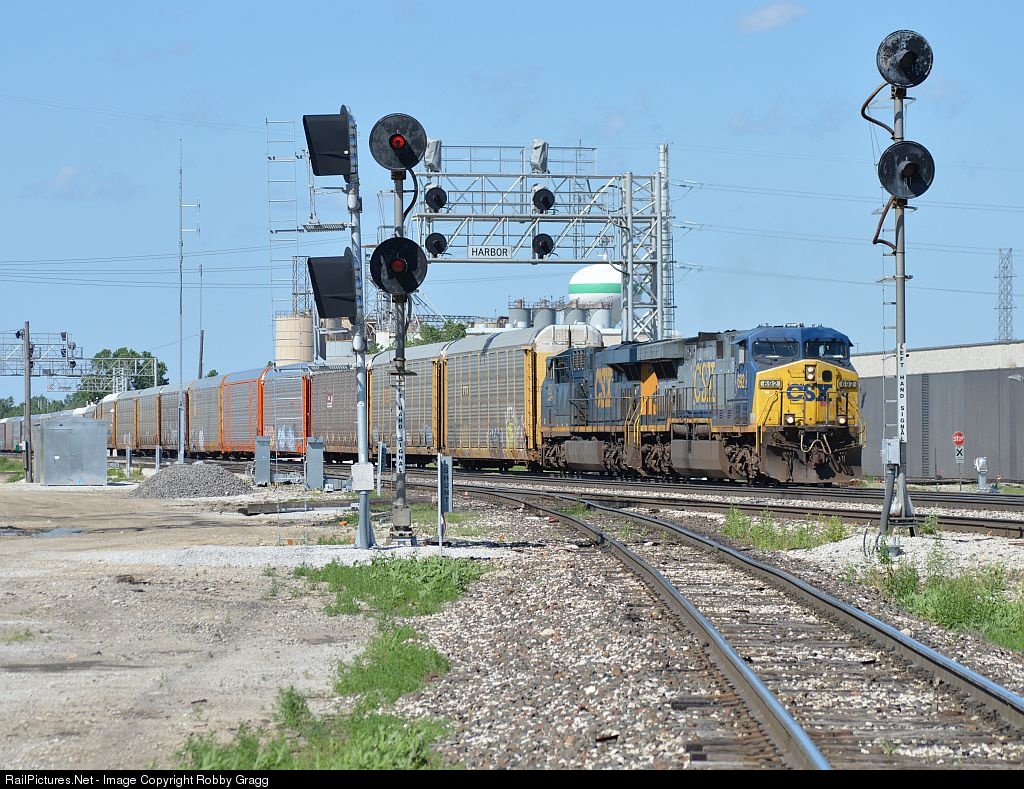
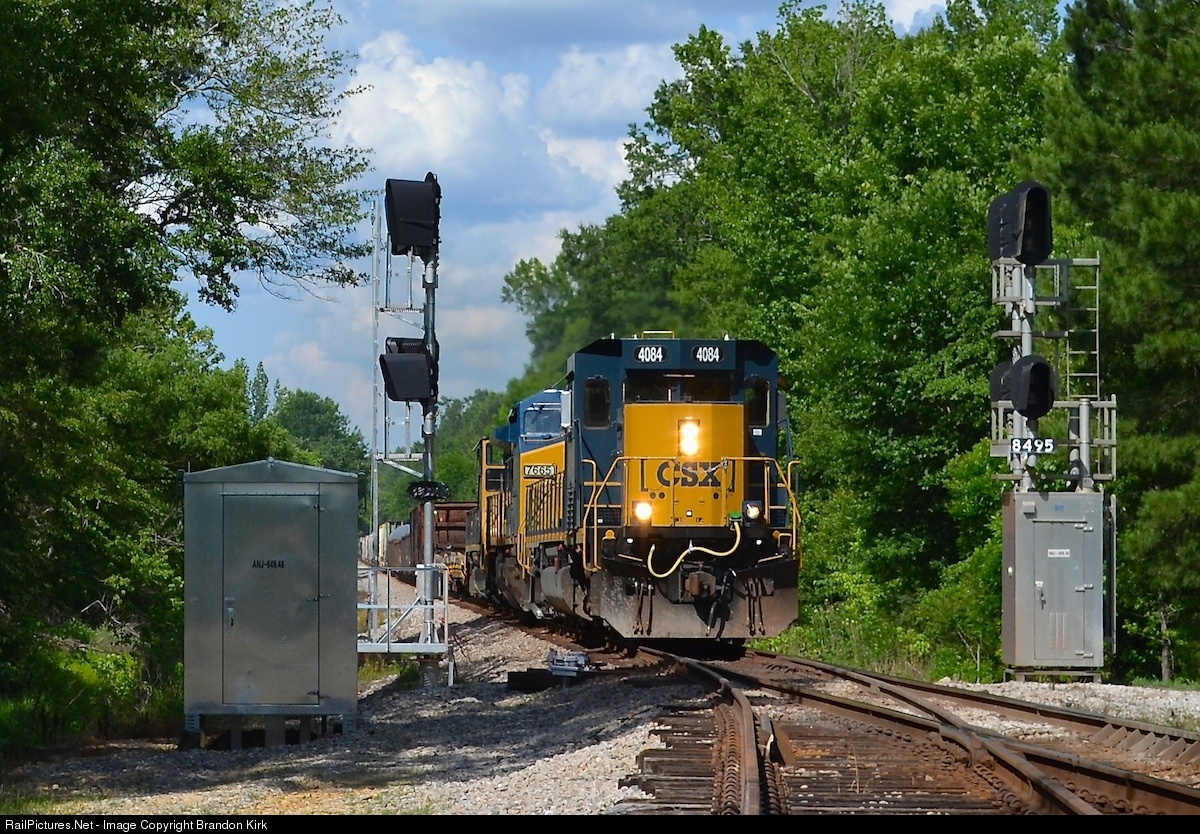
If the ICC had ever mandated railroads adopt a national signaling system I suspect it would have been this one simply because it solves some many of the "problems" pointed out with North American pattern signal rules such as using Red as a placeholder and using different signals on dwarfs and masts. The B&O CPL was installed new as a matter of policy on CSX up through the early 1990's on former B&O territory, but alas the signal bulb maintainer's union was broken and the dreaded Darth Vaders have been spreading ever since. If you happen to be in a position to catch one of these signals in action make sure you do because they are disappearing quickly.