Search This Blog

Friday, June 14, 2024

Amtrak FAIR Interlocking Loses Its Quirks

 A little while back I discussed the evolution of NORTH PHILADELPHIA interlocking from its construction in 1914 to its disestablishment in 2005. Early urban interlockings such as NORTH PHILADELPHIA were colorful characters with all sorts of extra infrastructure to handle not only the main line traffic, but also stuff like industrial switching, yard and light engine moves. FAIR tower in Trenton, NJ is not only NORTH PHILADELPHIA's sibling in appearance, but also in its arc through history. While I don't want to get too deep into the history and evolution of FAIR, I will say that it was drastically expanded in the 1930's, then entered a series of successive diets in the late PRR, Penn Central and Amtrak eras before the tower was closed around 1994.

In its second to last iteration that lasted from around 1990 to about 2020, FAIR had lost all of the double slips and freight support it had maintains up through the end of mineral traffic on the Belvidere and Delaware line. It's primary function was that of a passenger terminal for the Philly and New York area commuter services that terminated there. The two remaining quirky features were two additional tracks at the far northern and northerner limits of the right of way. Track 7 was used to store SEPTA equipment, while "North Low Track" served as an extra place to stash New York bound peak period trains overnight. Below you can see how the plant changes from its late PRR configuration to post CTEC configuration.

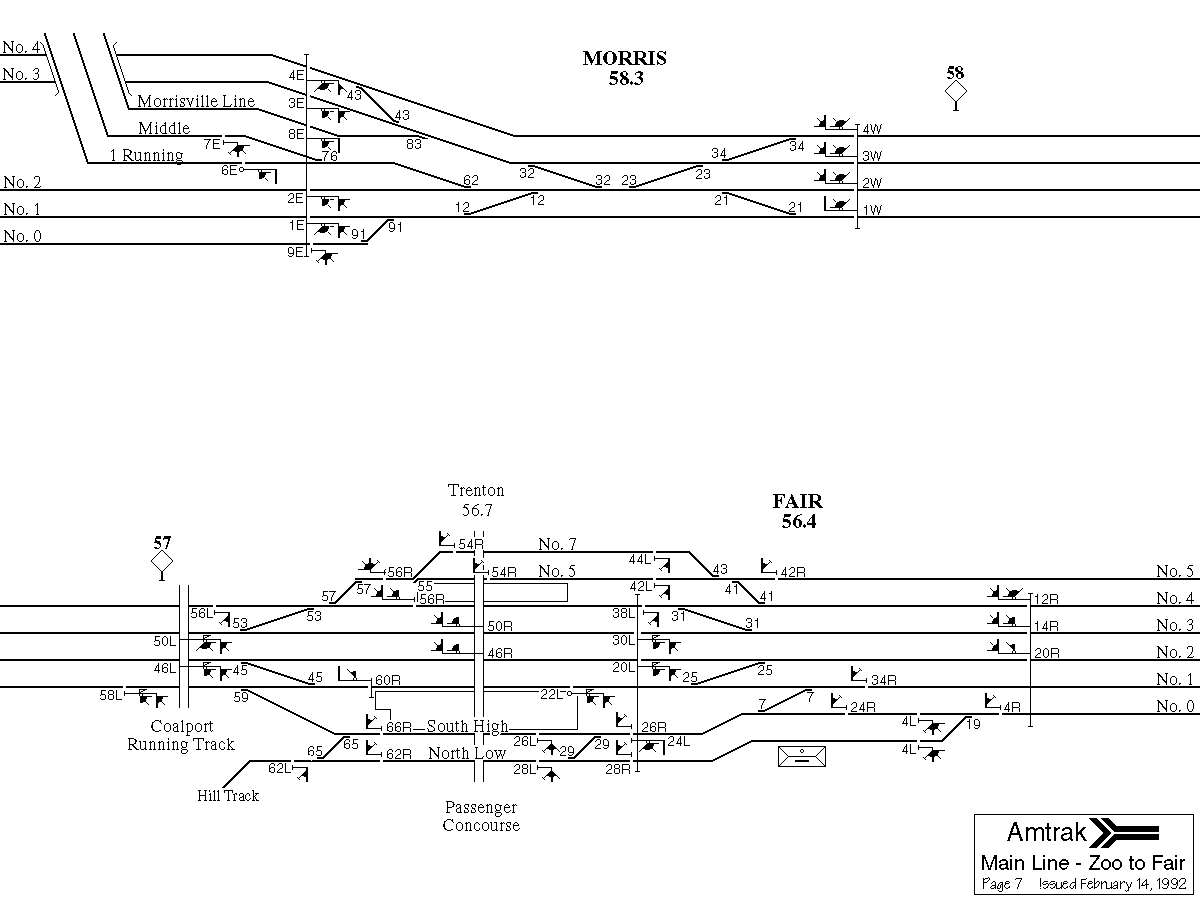
The area of interest is the North Low and Hill Tracks. The Hill Track used to connect with the Bordentown Secondary to Camden which saw limited passenger service like the famed Nelly Bly NYC to Atlantic City express train. In the commuter era that was used as precious storage space, keeping alive the old configuration that used to serve Doodlebugs that would run into Trenton from rural South Jersey.


While eastbound movements out of North Low could be made via the "Wall Track" past the tower, this involved a Restricted speed signal. The preferred option was the 86 switch protected by the 6BE and 8BE signals. This was located at the eastern end of the platform with 4 dwarf signals protecting the single low speed switch. One of the dwarfs was mounted on a striped stick for better visibility.

At the west end of the platform was another left-hand turnout, the 86W switch and associated 6BW and 8BW dwarf signals. You are seeing things right in this only allowed for North Low access from the hill track. This became an issue when around 2005 NJT opened up its Morrisville Yard west of Trenton in Pennsylvania, turning all of the terminal traffic that needed to be shuffled about into run-through traffic. Trains arriving from Morrisville could not access the North Low and as you can see from the rust, it became disused. 

Starting in 2019, Amtrak brought the rationalization hammer down on this legacy configuration. The 86W switch was reversed, the Hill Track was removed and the 16 switch from Main Track 1 was fixed up for higher speeds. Now trains from Morrisville can access the North Low, making it potentially useful again. Unfortunately the next step came with the same interlocking refresh that removed all of FAIR's pneumatic point machines. The 86 switch and its associated signals were completely removed.

Trains using North Low will now have to take the slow route past FAIR tower and them on 0 Track to HAM interlocking, but as you can see from the grass, it is unlikely there will be a need for North Low any time soon. While this all makes sense, especially in the age where efficiency is more and more important, the 86 switch and its dwarf signals are still a loss worth noting.


Saturday, June 8, 2024

Ghosts of Union Pacific Cab Signals

Until recently Union Pacific operated one of the most extensive systems of cab signaled main line in North American, if not the most extensive (by route miles). Unfortunately as previously covered, the UP Automatic Cab Signal system was not immediately applicable to informing the required PTC overlay like Norfolk Southern's has proven to be, so the decision was made to take it out of service on at least the eastern portion of the network. However because so many UP locomotives were cab signal equipped and because in most situations the cab signal codes are still active in the rails themselves, UP has taken to covering over the cab signal display unit in the cabs.


I assume the same will be seen on many of the cab signal equipped CSX locomotives now that they have managed to rid themselves of the requirement on the centrally located RF&P Sub. It will be interesting to see how long this setup hangs around before the ACS display is completely removed.

Friday, May 31, 2024

Washington Union Station CPLs go LED

It appears that the next step in Amtrak's surprising B&O CPL renaissance is the upgrade of those in the Washington Union Terminal area to use LED lamps. Since the terminal area was last re-signaled, the US&S built dwarf CPL's have suffered from low output, possibly lower than the more typical GRS counterparts (US&S was awarded the contract and had to make its own copycat B&O style CPL's as a result). Combined with the overhead catenary, it has made capturing signaling indications on camera rather challenging.

Well now things are on easy mode as you can see here with the incandescent pole pointed 315 signal compared with the gantry mounted 311 and 351 signals displaying Clear and Approach respectively.

For another point of comparison here is the incandescent 189 signal displaying Slow Clear at the end of Track #23.

In addition to the LED's we can see that the orbitals on the gantry mounted signals have received new extra wide backing plates, even if the additional orbital lamps aren't installed. Hopefully the LED conversion won't be limited to just the overhead signals, which do suffer from the extra visibility problems caused by the overhead wires..


Friday, May 24, 2024

PU Tower Restoration Update

Former Central RR of New Jersey PU (Phillipsburg Union) tower in Phillipsburg, NJ recently held an open house to shot off the state of the tower's restoration effort. It is affiliated with the NJ Transportation Heritage Museum that, amoung other artifacts, has an operable triple expansion steam pump. I had last visited the tower in 2017 where it was clear that a lot of work had already been carried out, however the Model 14 interlocking machine was a long way from being restored due to massive stripping as you can see below.


I found some photos from the event and starting on the operator's level the Model 14 has recovered a significant amount of levers. We can also see wires indicating plans to reactivate some functionality.


The operator's desk now hosts all sorts of artifacts.


The lower level features a full suite of air compressors and the power board.


 There is also some documentation discussing how the tower was closed and reopened several times by the CNJ as is desperately tried to abandon its operations in PA. I definitely need to get up there again, but I might want to pace myself and wait until more of the Model 14 is functional, just to avoid having to make extra trips. 

Saturday, May 11, 2024

SEPTA Broad St Subway Signal Project

The SEPTA Broad Street Line is notable for being one of the best examples of pneumatically powered signaling appliances in the form of point machines and trip stops. The whole line is equipped with such devices except for the Fern Rock shop and yard complex, which was subjected to a re-signaling project around 2005. Well I just caught word that due to a long term plan to rebuild the City Hall station, SEPTA will be installing bi-directional signaling between the line's WALNUT and FAIRMOUNT interlockings.

Single direction signaling at WALNUT interlocking.

Since it was constructed in the late 1928 it has operated almost entirely with single direction ABS with a few isolated segments of bi-directional signaling within interlocking limits. SEPTA's plans to rebuild City Hall will take entire platforms out of service so the usual practice of closing either the local or express track will not be an option. As a result SEPTA is looking to install some bi-directional capability so the normally 4-track railroad can operate as a two track railroad between Walnut Locust and Girard stations. 

It will be interesting to see what brand of signaling equipment SEPTA decides to go with and if they stick with pneumatic trip stops or convert to electric. After the MFL was re-signaled around 2000, SEPTA was able to bank a large amount of 1980's vintage pneumatic trips and A-10 point machines that have been slowly appearing on the BSL so there might be enough in stock to supply the project. Since the wayside signal system is likely to be replaced around when new rolling stock is purchased, this would save money on an ultimately short term change. On the other hand if someone else is paying, SEPTA could decide to rid themselves of a "troublesome" technology. There could also be a mix with the existing equipment left alone and only the new reverse direction signals getting electric. Regardless, I think I might take the time to get photos of whatever is currently in place.

Sunday, May 5, 2024

Southern Caltrain Signaling Changes

With Caltrain's new electrification set to kick off soon, I have been checking if there have been any additional signaling changes beyond the removal of the King St Terminal cantilever. While most of the action is happening north of San Jose Diridon, the wires do extend down to the Tamien Station, which has a direct VTA connection and has always seen a bit of through service. Here is what I found when I checked in on the Southern Pacific era signaling on that part of the line.

First up was CP-CAHILL and the southern end of the Diridon terminal. As expected these were replaced some time ago, getting the traffic light treatment in early 2017.

Next were the SP signals at CP-DELMAS about a mile to the south These lasted quite a bit longer, being replaced by US&S modular traffic lights around 2021-2022.


The most interesting changes occurred at CP-MACK at the Tamien Station. CP-MACK had southbound Sp masts, a northbound Sp cantilever and a northbound two "head", 6-module dwarf stack. Around 2021 the track two cantilever signal was changed from SP to Darth Vader type. Then later in 2022, both cantilever signals were replaced by two "head" LED searchlights. 

In an even more baffling turn of events the dwarf stack was replaced by a two "head" mini transit style signals. 


Your guess is as good as mine as to why, but its definitely something to see. As for the rest of the line to Gilroy and beyond, it appears to be unchanged.


Tuesday, April 30, 2024

RF&P Cab Signals Out of Serice Mid-June

When CSX first announced in plan to discontinue cab signal rules on the RF&P in 2021 I went into some detail about the possible motivations. A year later when the FRA petition was approved (despite a national spotlight on rail safety issues) I again explored some possible timelines for the process. Well it seems that we have our answer and the cab signal system will be taken out of service on June 15th, 2024. 

As a result of the process, I had to assume the worst and I embarked on a program to document the remaining RF&P intermediate signals that somehow survived the great 2010's re-signaling effort. Between 2023 and 2024 I didn't notice any changes on the physical plant so it appears that so far the discontinuation of the CSS has consisted of adding the PTC integration to all of the intermediate signal locations and hand throw switches. Because CSX does not use large visible antennas at every signal location, the process was largely invisible to outside observers. 


What this means on a technical level is that for the near term the cab signal codes will still be present in the rails to transmit block state. CSX in its filings indicated that moving to ETMS PTC for ABS speed enforcement will allow it to remove the mid-block code change points where Approach drops to Restricting. Since these are all less than 10 years old and theoretically reliable, it will be interesting to see if this is given any sort of priority. It will also be interesting to see if VRE has to retain the cab signals on its locomotives for the Washington Terminal area, which I heard is planning to actually install cab signaling in the 1st Street tunnels between CP-VIRGINIA and A interlocking. With VRE looking to purchase the Manassas Line, who knows, CSS might make a return. 


PS: Also keep an eye on the patches of former Conrail/PRR cab signaling around Philly. CSX does not have to run equipped locomotives on this territory so they might keep it active for the benefit of NS.