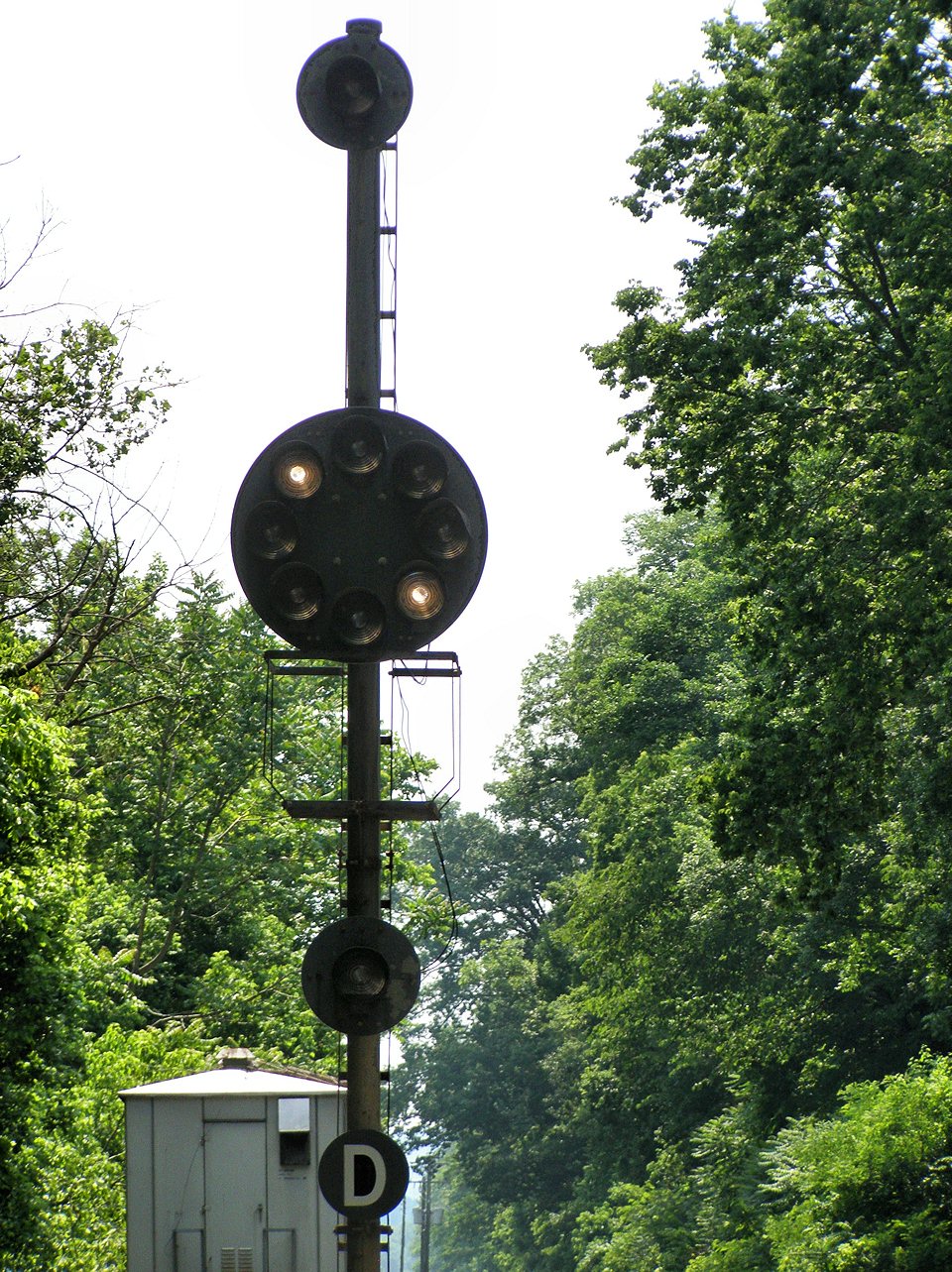
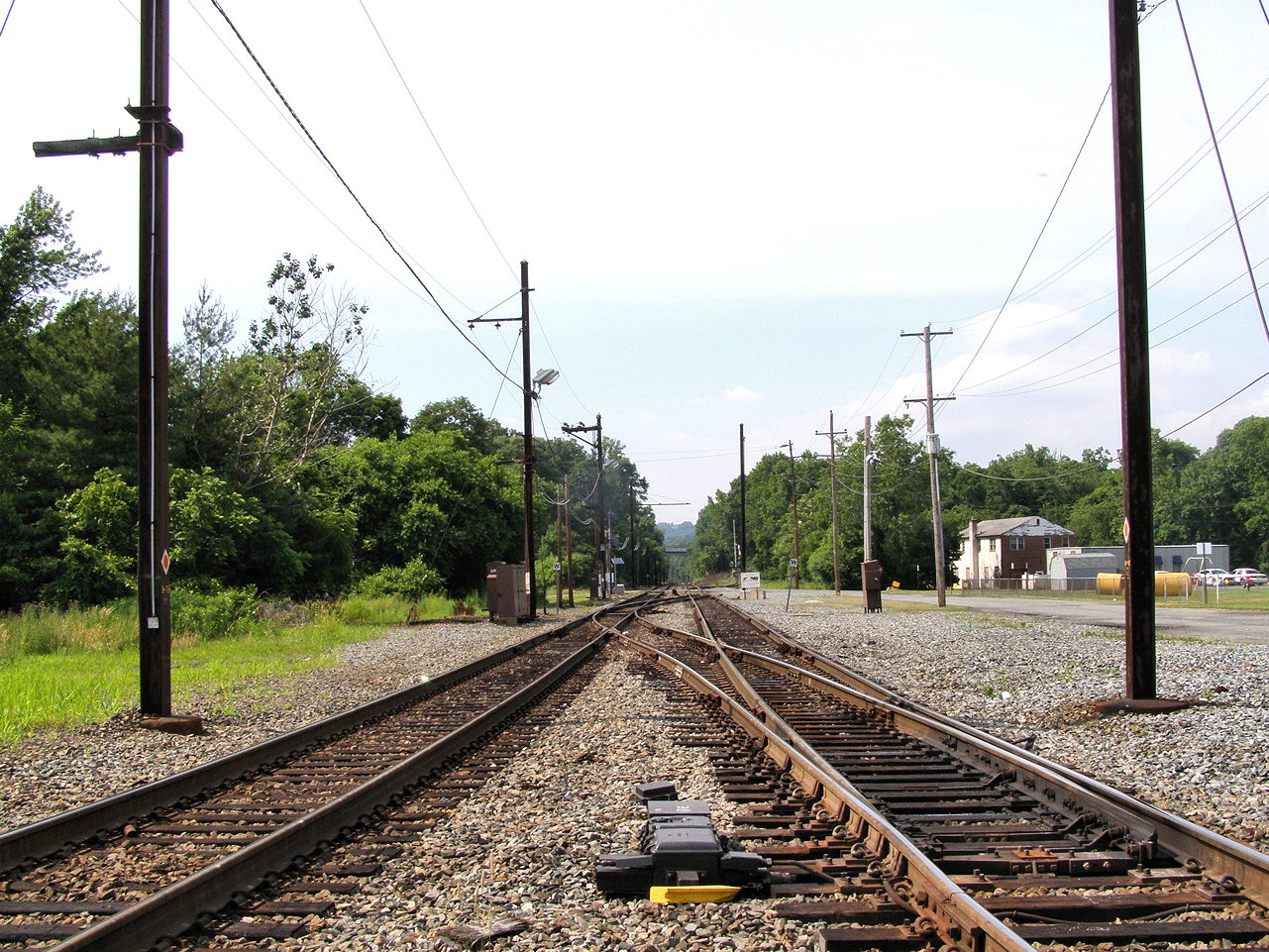
Well it's been about two years, but we have finally come to the end of our Port Road trip. Having passed through Port Deposit , the town that put the Port in Port Road, there is still a bit more to cover before the line intersects the Main Line - Philadelphia to Washington at Perryvillle, MD. Having collapsed to a single track at
CP-TOME, the Port Road will expand back to two tracks at
CP-QUARRY before passing through the retired interlocking at
MINNICK and finally terminating at PERRY. Here is the signal sheet covering today's featured territory.
Having pass CP-TOME we have left the CTC territory controlled from the console in COLA tower and entered the territory controlled from the CTC machine in PERRY tower (at least up through the Penn Central era). QUARRY interlocking is one block length east of TOME and is located on the side of a rock outcropping that constricts the right of way down to a single track. CP-QUARRY was modernized during the Conrail era with fresh vital components in a modern relay hut. It was also upgraded with a 45mph Limited Speed turnout.
Here we see the 2E eastbound PRR PL mast at CP-QUARRY as well as the narrowness of the right of way. Like CP-TOME, there is a gap between this signal and the turnout in order to place the signal before the curve. The 2E mast has full upper and lower heads, which is contrary to what is shown on the signaling diagram that shows only a lower Stop and Proceed Marker. This is because CP-QUARRY was signaled as an equilateral turnout due to the low track speed in the area. Since the Conrail refurbishment, it has been treated as a standard switch with the left hand route onto the main track tagged as the diverging route. The bridge in the background is the I-95 crossing of the Susquehanna River.
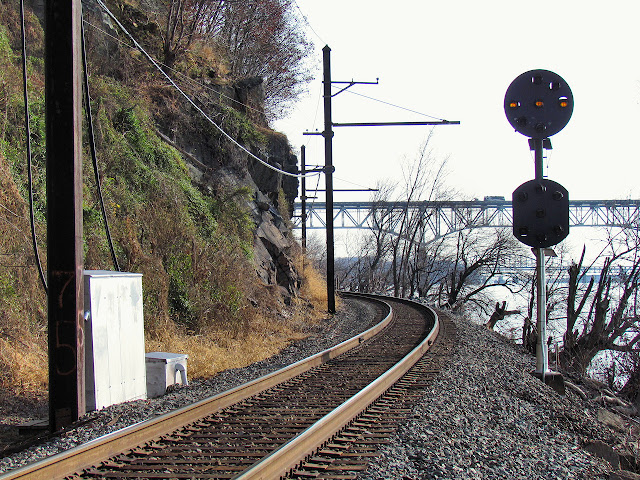
One can also see signs of NS-era refurbishment in the form of a grey plastic signal cable snaking up the side of the pole. This part of the like also retained its catenary masts, which are still employed to carry the pole line for block status communication between CP-QUARRY and CP-TOME and utility power for the interlocking.
Here we can see the pole line passing through the eastbound mast relay box. Due to the distance between the eastbound mast and the relay hut a second battery box has been provided. BTW if you are interested in what this signal sounds like, you can listen to it
here.
Around the curve the eastbound mast is out of sight when we encounter the interlocking power supply fed from a utility circuit run along the old catenary masts. This was installed after the 6kv 100Hz power supply was removed ~2009. These photos were taken in 2013.
Closeup of the new 60hz utility transformer. The commercial supply is single phase with a hot line and neutral line.
Here we see the CP-QUARRY Limited Speed turnout in the eastbound direction. The placement just avoids being that thing MoW forces hate, a turnout on a curve. The point machine has been a dual control M23 since the Conrail refurbishment.
CP-QUARRY with the original power supply located directly above it.
Like the other interlockings up and down the Port Road, the 504B code line at CP-QUARRY has been replaced by a satellite link.
The new brown painted relay hut is augmented by a pair of PRR vintage relay cabinets connected by wire pipes. Again we see the block line passing through the old cabinets on their way to the westbound signals and MINICK. These cabinets hosted all of the CP-QUARRY relay logic in a manner reminiscent of CP-JEB until the new hut was installed in the 1990's.
The two track westbound gantry is of the typical hybrid catenary mast style. There is a bit of a discrepancy between the interlocking as it exists today and how it appears on the interlocking diagram above due to my previous comments about the equilateral signaling. Today the main track is signaled for a diverging move, while the siding track gets the straight route. Of course none of this matters with track speeds of 30mph.
The 2WS signal (according to the diagram) off the signaled siding track, is equipped with a full upper head for the straight route and a lower head with a Restricting \ and an Approach Medium (Limited?) | for the back-to-back CP-TOME. Prior to the re-signaling the lower head consisted of a lone | with a Stop and Proceed indication.
The main track 2W signal was designated to run over the diverging route, hence the lack of a Clear | on the upper head. However an upper / is provided for Approach Medium (Limited?) indications for a diverging move at CP-TOME. The full lower head supports not only a Restricting \, but also a Medium Approach / and | for Medium Clear and Approach Medium (Limited?).
CP-MINNICK is another oddity, which would make it rather par for the course on a route that has seen so much alteration over the last 50 years. Today CP-MINNICK isn't a CP at all, just another intermediate signal located between two interlockings, CP-QUARRY and PERRY. However from the layout and a few other features, it is clear without even having to look at a historic timetable that this was previously an interlocking. These photos were taken in 2010, after the lineside signal power had been removed, but before the catenary poles were scrapped.
This heavily guyed two-track catenary gantry holds the eastbound PRR PL signals for the former CP-MINNICK. MINNICK was located at the west end of the old
Perryville freight yard, providing interlocked access to the C&PD with control remote to the CTC machine in PERRY tower. By the 1980's the yard was on its last legs and by the 1990's it was little more than a public delivery spur with a non-interlocked switch. When the interlocking was removed CP-MINNICK reverted to an automatic signal location with a bit of depth, distant to both PERRY and QUARRY.
The automatic conversion consisted of apply auto number plates and removing the Restricting \ position on the lower head. The numbers given were 22E/W and 21E/W with 22 applying to the main track and 21 to the siding as per Conrail practice as opposed to PRR practice which would have had a C prefix and different numbers eastbound and westboumd.
The eastbound
siding signal is a clone of the main track signal with --- and / positions on the upper head and a / position on the lower head. This is because the wye onto the NEC at PERRY is a slow speed curve so approaching trains get an Approach Slow if the signal is pulled up or an Approach if it is not. If you look at the 1997 interlocking chart above you can see the diagram was poorly updated and still reflects the old CP-MINICK configuration that has only a \ on the lower head of what became 21E. The stop and proceed indication displayed during my visit shows that traffic was westbound on the siding.
Traffic on the main track was in the eastbound direction as indicated by an Approach signal on 22E. This signals lower head / was original to the CP-MINNICK configuration. The lower head \ was removed.
Frontlit view of the signal gantry showing off some of the rust on the old MINNICK signals as well as the approach to the interlocking.
I didn't know what this was at the time, but I later yearned this rather large relay-hut looking thing was actually the southern supply point for the 6kv 100hz signal power line running from here to Enola. By 2009 the pole line power had been retired, but for almost 20 years this had lit up the position lights after whatever arrangement Conrail had with Amtrak fell apart in the late 1980's. I assume whatever did the frequency conversion was solid state, but I didn't venture close enough to listen for motor-generator sounds.
This catenary section switch was located right past the 5 switch to the Perryville Yard lead. Attached to it was the former power tap for the 6kv 100hz signal power. The downfall of the self-generated system was that every time a tree blew into the wires it was Conrail/NS that had to send out crews to fix it instead of the local utility.
Closeup of the south pole shows the power lines running from the frequency converter up to the 6kv level (small insulators).
The cinderblock relay house still sports its Conrail blue interlocking signs (like I said, it wasn't hard to tell this was an ex-interlocking). I suspect that most of the old interlocking relay logic is still in place, just modified slightly to act in an automatic setup. What looks like a TBS hut has been installed. If I had to guess its use it would be a place that crews could be sign in/out when their trains were waiting to enter the NEC.
As far back as 1986 MINNICK only consisted of a single switch on the controlled siding. Interlocking was in service on both tracks, but the main track had no interlocking appliances. It would be logical for a crossover to be installed, but in my 1986 video I see no evidence of one. One reason to include the interlocking on both tracks would be to create a holdout signal for reversing movements at the Perryville Wye.
Evidence of the old yard lead can be seen in the westbound signal gantry which is clearly three tracks wide. The 5 switch was converted to electric operation sometime between 1986 and it's ultimate removal. No evidence of the old compressor plant or pipeline caught my eye during my visit.
MINNICK also included a Dragging Equipment Detector within interlocking limits. Can't be too careful when bringing freight trains onto Amtrak's delicate NEC.
The 3-track heritage of the westbound gantry is more in evidence in the other direction with the left hand support now well off the RoW into the trees. As you can see the 21W signal on the siding is displaying Approach with traffic set in the west direction. This is a popular nighttime railfan hotspot due to a road running next to the RoW and the ability to illuminate slow moving night trains under classic PRR PLs.
The 22W on the main track was altered back when CP-QUARRY was changed from equilateral to its standard configuration. The upper head was replaced with one that lacked the Clear | position. We can see this thanks to the significant reduction in rust. I am not sure if these signals were re-painted by NS, but they would certainly be candidates for it. The lower | is for Approach Limited indications for CP-QUARRY.
The 21W signal on the siding track lost its lower head Restricting \ and now serves as a basic ABS signal.
At PERRY we finally reach the end of the C&PD at what is now Amtrak territory. The entirety of PERRY interlocking is a bit outside the purview of this trip, however I do feel that the crossover on the C&PD wye does count as part of the Port Road so we'll dive into it here.
NS trains enter Amtrak territory at the 18R and 22R signals at PERRY interlocking. PERRY has long since been re-signaled, but the oddball nature of the wye setup didn't jive with the US&S numbering scheme, so the old lever numbers were retained. A PRR pot signal governs movements on what is today the main track while a colorized PRR PL mast handles the siding.
Apart from the colorization the 22R mast has been left untouched, even retaining its finial. The non-standard round lower head goes back to at least 1986. The signal displays Approach Slow for movements onto the NEC, even though the 8S signal has a Medium Speed route. I suspect the 22R mast displays Slow Approach for any stop at either 9N or 8S. Behind the mast is the last active 6kv power feed on the C&PD. Prior to Conrail building its own power supplies, the lines would continue on to Safe Harbor and beyond.
The 18R dwarf on the main track supports the full compliment of slow speed indications. The signal is caged to prevent rock damage or vandalism. Behind it is the 17 switch in the reverse position.
When I first visited the interlocking back in 2004 I found a special bonus in the form of the 17B switch machine which was sill equipped with an old version of the US&S M3 point machine evidenced by the rounded motor housing. When I returned in 2011 it had unfortunately been
"upgraded".
Here we are looking back through the C&PD part of PERRY through the 19 turnout. With today's level of traffic on the NEC, daylight movements are few and far between, but once the white period ends around 9am this wye sees a constant stream of trains heading to and from the Baltimore area and the DelMarVa peninsula. Chief amoung these are crude oil trains heading to refineries in Delaware.
The eastern entrance to the C&PD is in the form of a pair of switch dwarfs governing movements off the Perryville Wye.
Unlike many stick-dwarfs these are equipped with ladders and baskets. This is the surprisingly grown up 18L signal.
Head on view of the 22L dwarf.
Like COLA, PERRY tower was one of the PRR's forays into CTC control, although in this case PERRY's home interlocking was handled by a US&S all electric machine (of which that 17B M3 might have been wired to). In addition to QUARRY and MINNICK, PERRY also controlled PRINCE to the north and GRACE and OAK to the south. The tower was built in the 1940's in the same style as the other brick towers constructed up and down the NEC to accommodate wartime traffic.
Northbound trains heading off the wye pass by the 9N stick dwarf and onto Track 4 to make the run to PRINCE interlocking.
The original configuration of the interlocking had a ladder to access tracks 2 and 3. Today track 4 is the only option. The 4N signal creates a pocket to allow MARC passenger trains to wait at the platform while lingering freights exit the NEC.
Southbound Port Road trains pass by the 8S pedestal signal and onto a medium speed ladder to access the NEC.
Beyond the northbound signal trains proceed onto the Susquehanna River bridge and from there points south.
And that bring our Port Road Trip to an end. I hope you found this informative and I apologize for the delays in getting the last parts out. As you can see they got rather lengthy. Anyway, if you are interested in my next big project I am planning to Survey the B&O main line between Washington, DC and Pittsburgh.