Search This Blog

Sunday, December 15, 2024

GLENWOOD Tower Demolished

It has been reported, and confirmed on street view, that the former B&O tower in the Glenwood section of Pittsburgh has been demolished. As covered in my 2022 post, the tower was built in 1908 and closed by CSX in 2003 with the adjacent yard and line leased to the Allegheny Valley Railroad. These lease arrangements can often freeze infrastructure in place as user doesn't own the tower and the owner doesn't want to invest in a potentially asbestos impacted demolition. In 2019 the AVR took full ownership of the former CSX P&W Sub and adjacent Glenwood Yard and at the time of my report I suspected that the change in ownership would unfreeze the situation.  


Turns out I was right and AVR made the expected choice of demolition, as opposed to finding some alternative use for the decayed wooden structure. Unfortunately no trace of the structure remains. 

Saturday, December 7, 2024

Mind the Gap! - The case of "3rd Head Restricting"

There's a odd feature in current North American railroad signal practice dating back to the 19th century that hints at the practices of old like a vestigial organ. Lacking a former name, one might call the aspect "lowest head Restricting" or "3rd head Restricting", but its feature is a prominent gap between the top "full speed" or "normal route" head and the bottom lamp used to display Restricting indications. What would be a R/R/Y (or R/R/L) under normal circumstances, becomes R/ /Y, with the middle head omitted. So why does this exist and why is it still in use today.

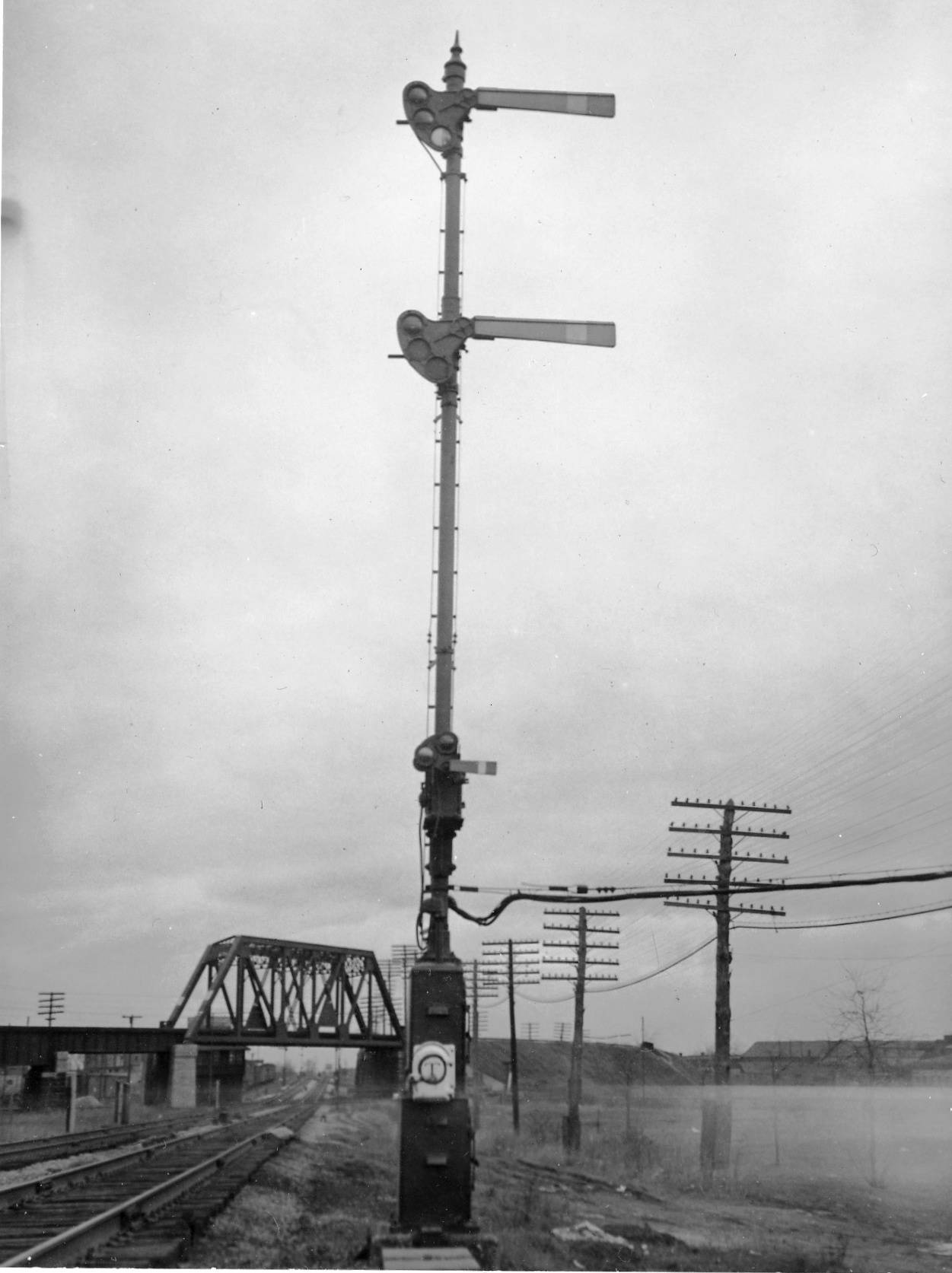
Low head restricting originates in the concept of the subsidiary signal. In the days of mechanical semaphores a subsidiary signal is a smaller semaphore arm mounted below the "main" arms to give Restricting type movement authority.


In North America, it was not uncommon for this subsidiary signal to be mounted on the ground at the base of the mast or under the signal if mounted on a gantry or cantilever. The New Haven railroad was a proponent of this ground mounting practice and continued it up until they were folded into Penn Central.

As North American signaling progressed into the electric era, signal aspect systems would have an upper head for straight routes, a lower head for diverging routes and then a "subsidiary signal", either on the mast or on the ground, for Restricting/call-on conditions. Interlocking setups like the Taylor system would even have a separate lever controlling each signal head. Although this "third head" position on signals would later see use with other slow speed and combination indications like Medium Approach Medium, the link between the third head and Restricting remained strong. Of course as an economizing measure, some railroads went the route of only using two heads with R/Y as Restricting and simply not having a Diverging Approach type indication (its not strictly necessary). However, one could also economize by eliminating the middle head if it was only serving as a marker, especially if the lower "head" was its own signal on the actual ground. The Erie, along with the Reading, were both good examples of the gap between the upper and third head were left exceptionally large to avoid confusion.


Of course as signal mounting distances became more standardized, this gap became less emphasized to the point where one could make the argument that there was a likelihood of confusion between R/Y Diverging Approach and R/ /Y Restricting. Here we see an example of two bracket mounted signals with R/ /Y restricting at Chicago's KEDZIE interlocking installed by the CNW in the 1990's.


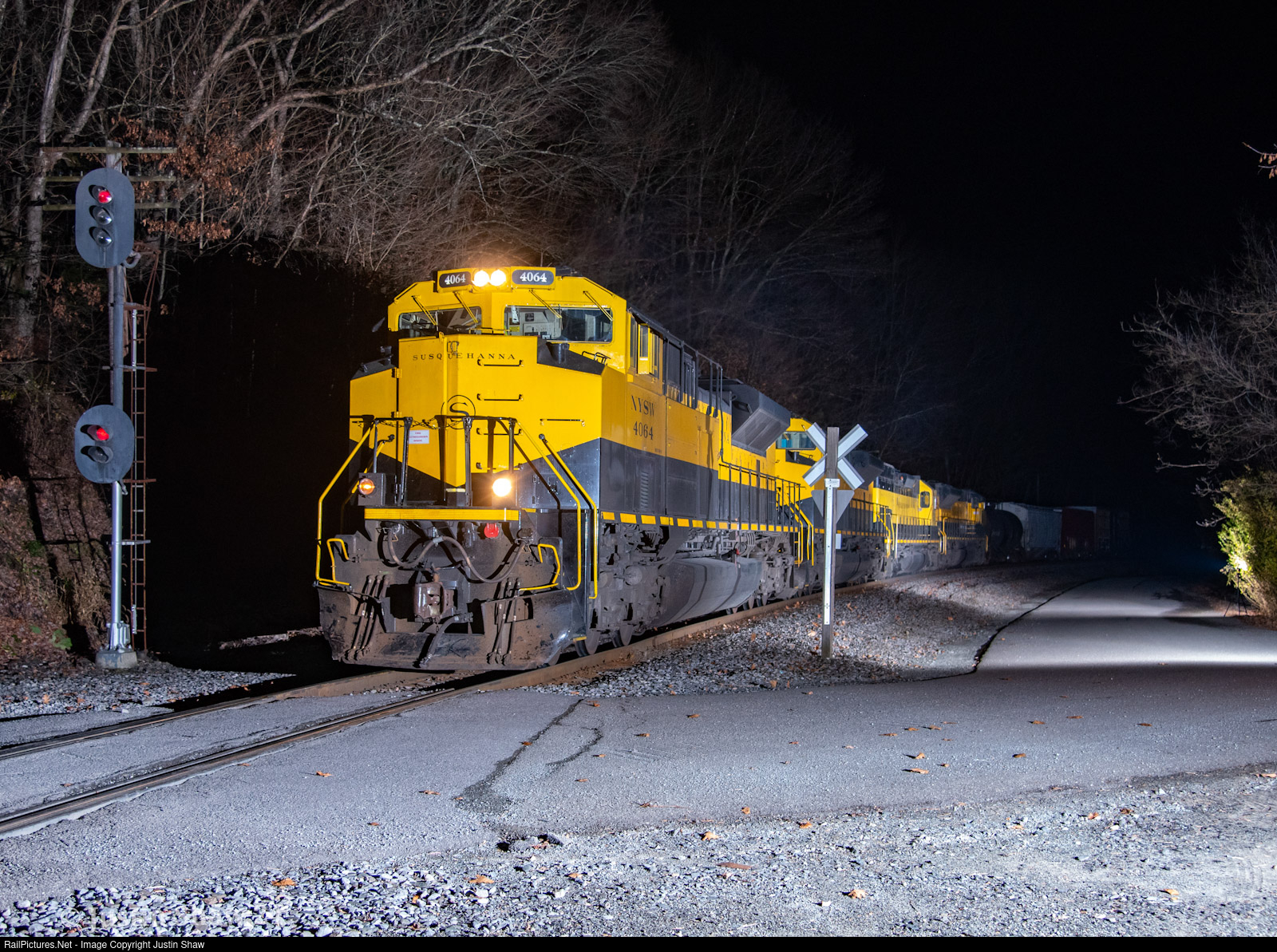
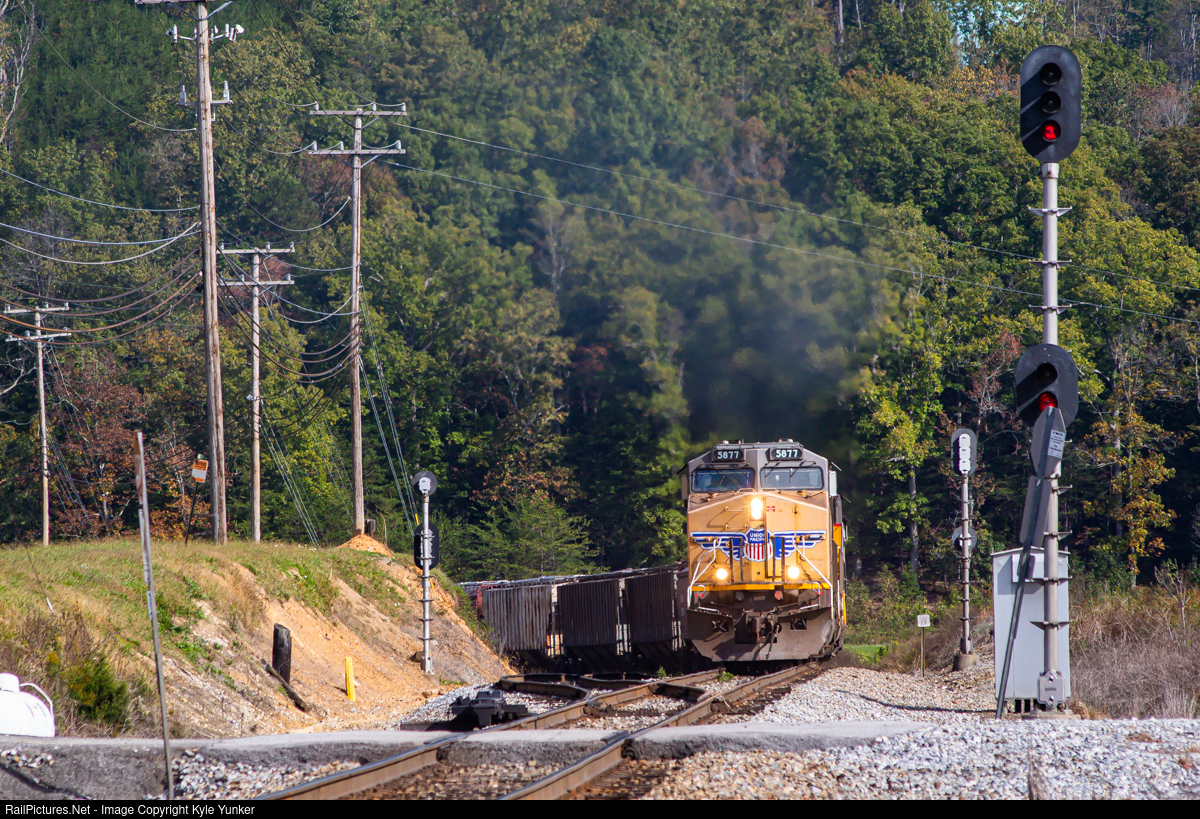
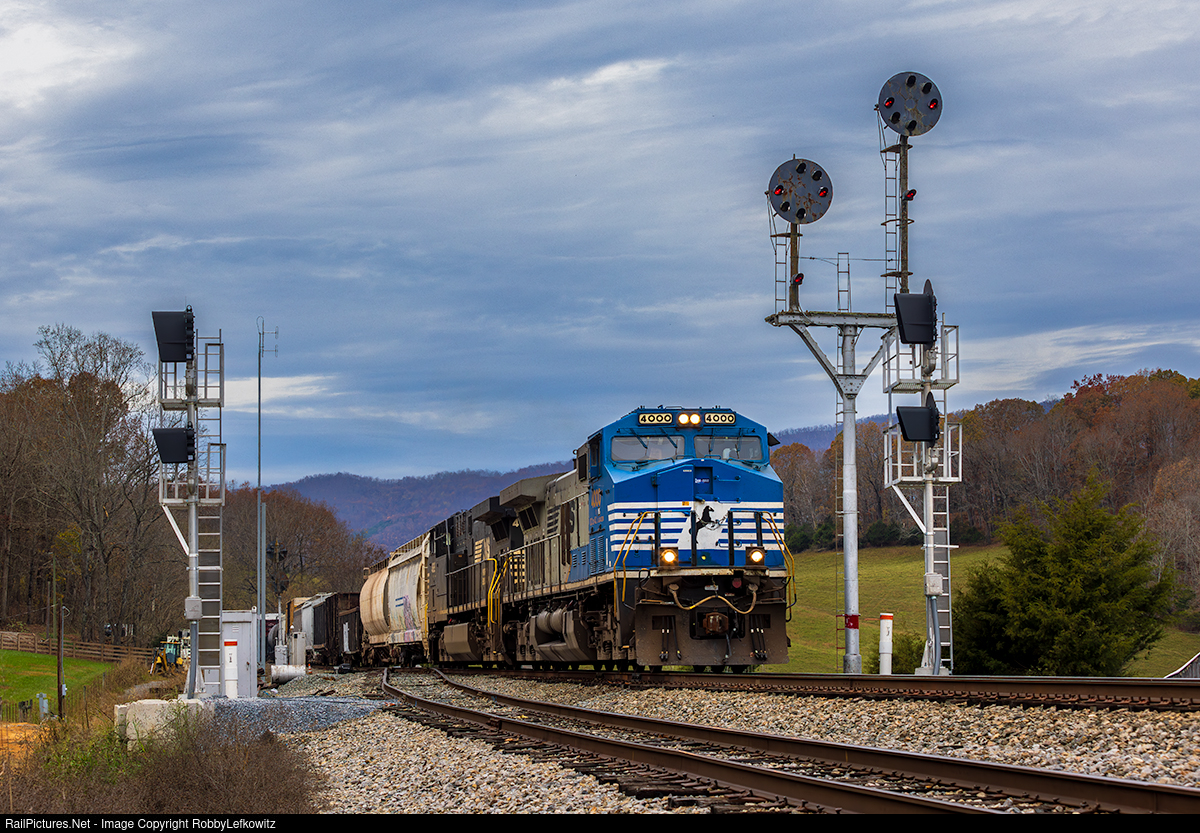
Today one can accommodate both R/Y Diverging Approach and a Restricting indication on a two headed mast through the use of lunar white or flashing red . At this time NS is the only major railroad to install new examples of R/ /Y Restricting and does so only on its former Southern RR signal territory. 


Of course quite a few railroads, including Canadian Pacific aligned Delaware and Hudson, never went with the economizing feature of the gap and instead went with a three head system with R/R/Y Restricting and R/Y/R Medium Approach. Under the Conrail associated NORAC system R/ /Y of predecessor roads like the Erie and Reading were considered to be a two head R/Y Restricting with three head R/R/Y Restricting as another option. The C&O on the other hand only had R/Y Restricting with any third head left dark because they just had to be different.

Sunday, December 1, 2024

Cleveland Line Autos Now on the Way Out

 In another example of either speaking too soon or rolling under the lowering door like Geordi, it has been reported that NS is planning on removing the remaining Cleveland Line ABS Position Lights I recently reported on

Scuttlebutt is that NS actually needs the parts to maintain the PL's on the western Fort Wayne Line, however I suspect that after the East Palestine explosion closed the Fort Wayne Line, the lack of PTC on the lower Cleveland may have become an issue. No word on the timeline, but I'll try to track the progress and if the project is a 1 for 1 signal replacement or something that will convert the line from ABS to CTC.

Saturday, November 30, 2024

CSX Accelerates Boston and Maine Resignaling

It appears that CSX has put its foot to the floor regarding resignaling the former Boston and Main Eastern Route Main Line. From the MBTA division post at CP-PLAISTOW to Exeter, new signals are already in place with prep work underway between Exeter and the Maine border. 

Blocks are being lengthened from 2 to 3 miles and even the LED target signals recently installed by Guilford are being replaced. Perhaps the most shocking turn of events is the conversion from NORAC to Seaboard signal rules, despite the presence of NORAC rules and cab signals on both MBTA and former Boston Line territory. This also closes the door on any potential Rule 562 cab signal conversion, even if all of the locomotives running on the line will have to be cab signal equipped. It is unclear when the new signaling will be cut over as CSX has been known to move quickly on new hardware before following up with the logic and testing, but I would suggest that any interested parties move with all possible speed to get their photos, and maybe some video of the flashing Green single dwarf Limited Speed signal at CP-PLAINSTOW.

Sunday, November 24, 2024

THORN Tower's Last Act

Amtrak's THORN tower has been staffed 24/7 and routing trains on the former Pennsylvania Railroad Main Line since 1938, however after having gone on a rather extensive diet in recent years, THORN tower appears to be entering its last act. However its not going without a few strange twists.

As a CTC era tower with both local and remote relay based interlockings, THORN presents a fairly easy case for remote control, as was the case with THORN's sister tower COLA back in 1987. Already Amtrak has chipped away at THORN's territory, re-signaling CALN interlocking and transfering control to the Section C dispatcher in 2020.  Now it appears that the plan is to re-signal and transfer control of the local THORN interlocking in the middle of 2025.  

While this would typically mean the closing of THORN tower itself, the news is that the tower will continue in service controlling GLEN interlocking via the 1938 CTC machine and FRAZER interlocking on the 1994 vintage unit lever panel. Much of THORN's work involves FRAZER interlocking as that is where SEPTA trains for the busy R5 Paoli/Thorndale service lay over.

Plans also include the removal of DOWNS interlocking with deadhead movements continuing on to THORN. For years track #2 between THORN and GLEN had been in terrible shape with Amtrak operators and dispatchers looking for ways to avoid using it.  However it has been recently rehabilitated and train managers are looking to make better use of the asset. 

With these changes I would expect to see "C" boards for Rule 562 operation on both sides of THORN and if DOWNS is removed it is possible that cab signal only operation will extend all the way to FRAZER (track #1) and GLEN (track #4). Whatever happens, I'll keep everyone informed.

Friday, November 15, 2024

Some Apalachian Signal News

We first head to the N&W H-Line where ARCADIA interlocking is the next to get hit by the replacement ax. See my previous report for a more detailed status of H-Line signals. This location seems to be pretty accessible for anyone traveling the I-81 corridor this holiday season.

Next comes news from the CSX Big Sandy Sub in eastern Kentucky, known for its surviving C&O signaling. Due to declines in coal traffic, CSX has been removing or shortening passing sidings in a bid to save costs (and sometimes having to restore the sidings in a bid to set money on fire). Anyway while this didn't matter much on the re-signaled main line, its now affecting the classic signaled Big Sandy so expect interlocking removal/automatic downgrade to follow track removal at locations like SK Cabin in Thelma Kentucky

Most worrisome is the fate of the milepost 55.7 two track intermediate signal gantry on the other side of town. Although the situation has persisted for the better part of a year, this absolutely constitutes a railfan emergency.

 Finally in another "whoops I missed it" moment, the often photographed "modern" style C&O bracket masts adjacent to US 23 south of Catlettsburg, KY were replaced sometime in 2023. Likely installed in the CSX era, the replacements are typical color light masts displaying the same C&O signal aspects.


Wish I had some better news, but the wins are few and far between.

Saturday, November 9, 2024

PHOTOS: Amtrak CORK Tower

 A while ago I posted the first part of my coverage of the Pennsylvania Railroad's 1929 CORK interlocking tower in Lancaster, PA which covered the tower's history and the layout of the interlocking on the PRR's Main Line. Today we cover the tower itself, heading inside to see how it functioned in both its pre and post re-signaling phases. The exterior photos date from 2005 when the interlocking complex was in the process of being resignaled. 

To recap, CORK interlocking and tower were constructed as part of the 1929 Lancaster station project which moved Lancaster's busy passenger depot away from a downtown alignment with slow speeds, lots of grade crossings and partial street running. The resulting interlocking plant spanned approximately 3.3 miles of main line track, which was an outlier for early 20th century direct wire controlled interlockings in North America. Like the contemporary Lancaster station. CORK was built of a dark brick and featured a prominent bay window sheathed in copper cladding. 


The tower had one auxiliary building that housed the primary compressed air plant and was situated on the south side of the tracks in line with the extreme west ends of the high level station platforms. The tower had an internal staircase with the shelf type relay room on the first floor. With its brick construction and slate roof, the tower was in excellent physical shape as it entered the 21st century. 


Heading inside the tower we find a typical layout with the operator's desk sitting in front of the US&S Model 14 interlocking machine. A defect detector readout and overhead catenary section breaker control panel are to the operator's right with the lockers, clock and old telecom plugboard sitting to the left. One interesting feature is that the room has retained its original 1929 vintage overhead lamp fixtures. 


The operator's space is feels like a more cramped version of HARRIS tower with less space around the interlocking machine on all four sides. The gap between the scoreboard style model board and the rear aligned internal staircase is particularly small. As with other PRR Main Line towers, lever blocking devices are stored on top of the interlocking machine and the bathroom is in the left rear corner. Also note the location of the refrigerator, notice board and train order hoops. 


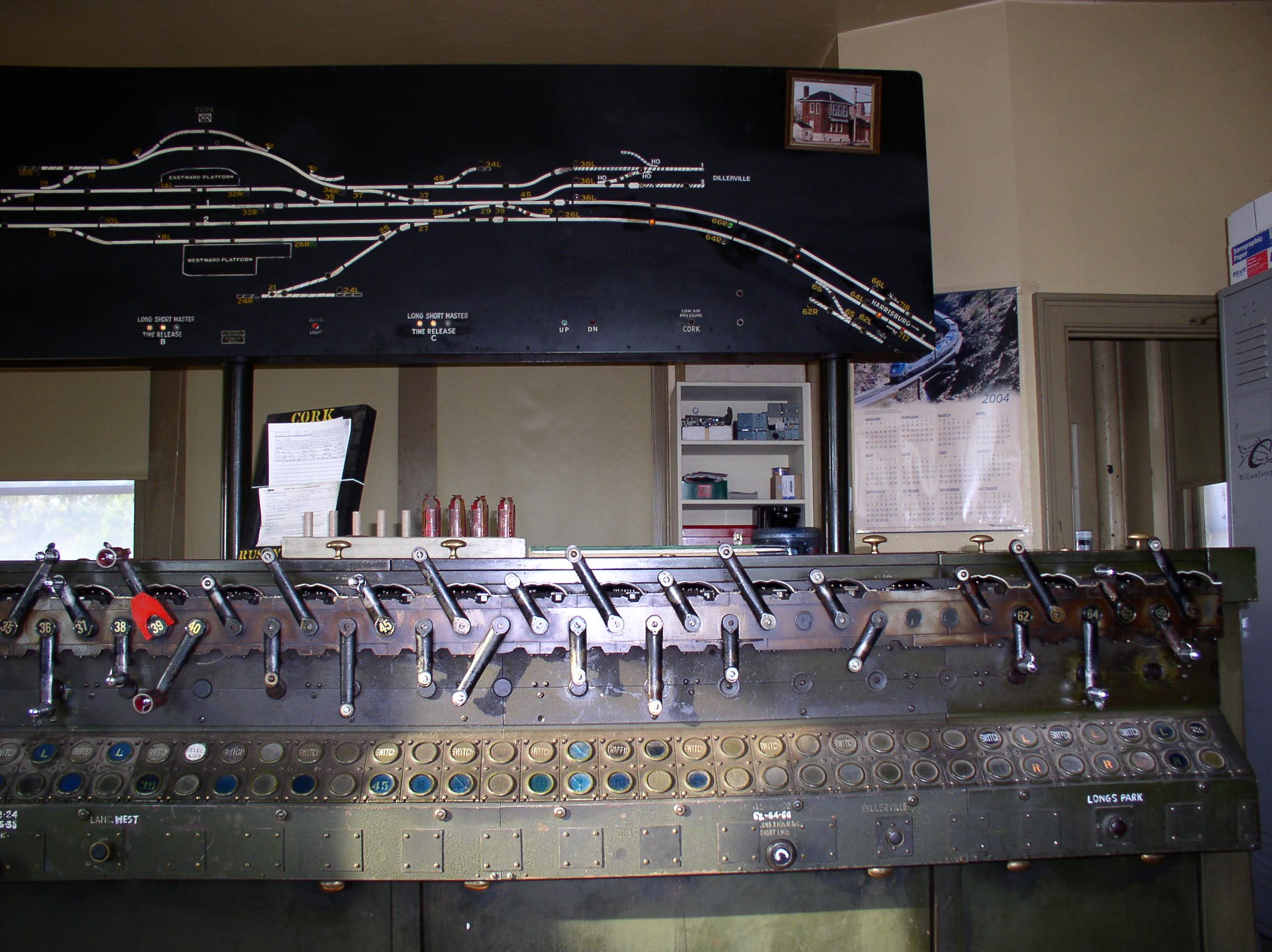
The sprawling CORK interlocking plant was controlled by a relatively modest 67 lever interlocking machine with 49 active levers in its 1960's configuration consisting of 23 levers for switches, 23 levers for signals, 2 levers for electric switch locks and 1 crossing lever for the Reading's Lancaster Branch diamond crossing. The plant was divided into three timer zones, A, B and C with the A timer handling the Conestoga section, the B timer the central Cork plant and the C timer the Reading crossing. The short run was 1 minute with the long run being about 5 minutes and 30 seconds. The tower also had 4 horns for Conestoga, the tower itself, Lancaster West, Dillersville yard and the Reading crossing (Longs Park).


One interesting feature was the presence of Rusty Rail tabs instead of the more usual placard. Besides that the levers were of the standard US&S crank type.


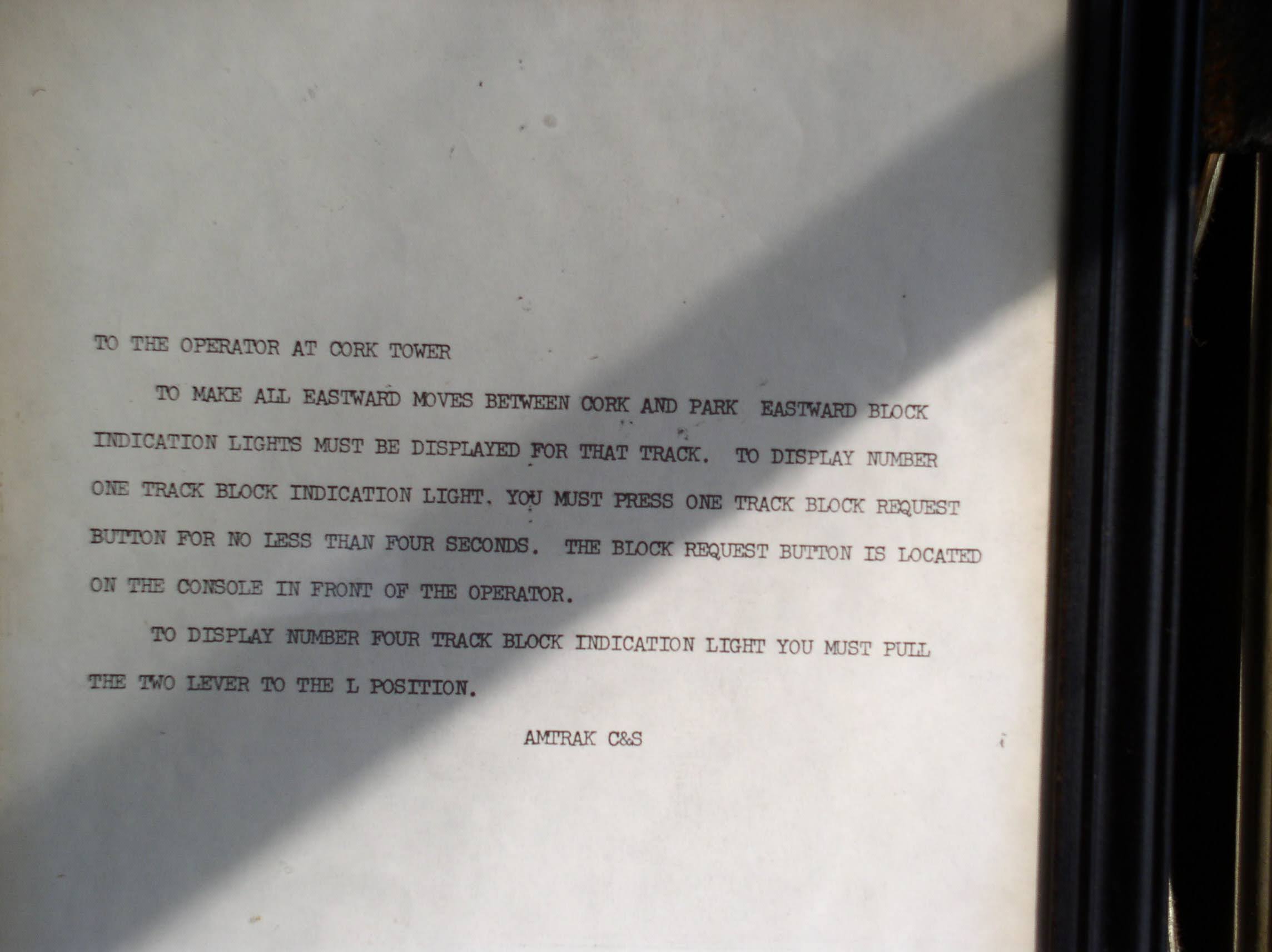
Although CORK's model board was a standard PRR illuminated type, it had several interesting features features. Grade crossing status lights were located at either end of the board to indicate the activation status of the Irishtown Road (east) or Eby Chiques (west) crossings. There were three low air alarms for East and West Conestoga in addition to the Cork main plant. In the post-1960 era two block indication lamps were added for tracks 1 and 4 eastbound. These had some interaction with PARK tower to the east as well as the intervening temporary block station at LEAMAN with track #1 being lit by the regular 2 lever and track #4 by a button on the operator's desk console. Best I can tell this was some technical method to prevent conflicting movements beyond what would be afforded by train orders and the dispatcher. Finally the most endearing model board feature was a framed photo of CORK tower itself that is also present in photos from c. 1992.